
Section 1: Equality of rights under the law shall not be denied or abridged by the United States or by any state on account of sex.
Section 2: The Congress shall have the power to enforce, by appropriate legislation, the provisions of this article.
Section 3: This Amendment shall take effect two years after the date of ratification.
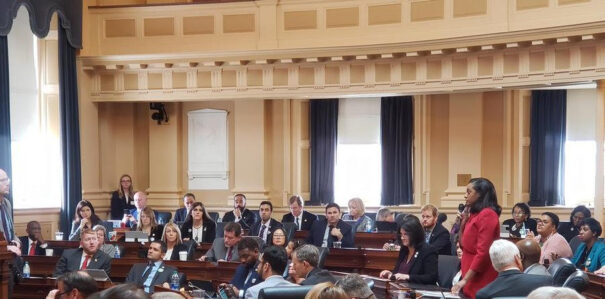
On the afternoon of January 15, 2020, the Virginia House of delegates voted to ratify the Equal Rights Amendment and make Virginia the 38th and final state needed to enshrine the ERA in the U.S. Constitution.
“Today is a major victory for women and girls throughout the country,” declared Delegate Hala Ayala (D), who cosponsored the ERA ratification bill along with the chief sponsor Del. Jennifer Carroll Foy (D), both women of color elected for the first time in 2017.
A year and a half earlier, in 2018, the Illinois state legislature became the 37th state to ratify the ERA. Illinois followed the state of Nevada that in 2017, after ERA supporters won Democratic majorities in both houses of the state legislature in the 2016 election, became the 36th state to ratify.
Current Status
The ERA has now reached the 38-state threshold needed to ratify a constitutional amendment. On March 28th, 2023, Rep. Ayanna Pressley (D-MA-7) and Rep. Cori Bush (D-MO-1) launched the first ever Congressional Caucus for the Equal Rights Amendment. Rep. Pressley introduced a joint House resolution, H.J. Res. 25, to remove the deadline on the ERA’s ratification and affirm the ERA as the 28th amendment to the U.S. Constitution. An identical resolution was introduced in the Senate, and on April 27th, 2023, the Senate debated the resolution. However, the vote to advance the resolution to the floor failed to overcome the filibuster, 51-47. Republican leadership in the House refused to schedule a vote on the resolution.
On March 24, 2025, Rep. Pressley again introduced a joint House resolution to establish the ratification of the Equal Rights Amendment, H.J.Res.80. Senators Mazie Hirono (D-HI) and Lisa Murkowski (R-AK) introduced an identical Senate resolution with the following text:
Resolved by the Senate and House of Representatives of the United States of America in Congress assembled, That notwithstanding any time limit contained in House Joint Resolution 208, 92d Congress, as agreed to in the Senate on March 22, 1972, the article of amendment proposed to the States in that joint resolution is valid to all intents and purposes as part of the United States Constitution having been ratified by the legislatures of three-fourths of the several States.
Legal precedent supports Congress’ power to set or revise ratification timelines and decide if an amendment has been properly ratified. In Coleman v. Miller (1939), the Supreme Court affirmed that only Congress can determine whether a long-pending amendment remains valid. Therefore, the passage of the joint resolution alone would be sufficient to officially recognize the ERA as a ratified constitutional amendment. Neither the President nor the courts play a role in this process.
We must demand a vote in the U.S. House of Representatives to affirm the ERA as the 28th amendment.
On February 28, 2023, a federal appeals court dismissed Illinois v. Ferriero, a case brought forth by Attorneys General from Virginia, Illinois, and Nevada demanding that former U.S. Archivist David Ferriero certifies that the ERA has been ratified by the required 38 states. The ruling was ultimately dismissed on procedural grounds, and only reaffirmed the necessity for the U.S. Congress to take action by voting to remove the deadline on the ERA. Under the direction of the Biden Administration, the current National Archivist has not certified and published the ERA. The Department of Justice’s Office of Legal Counsel (OLC) released a memo further reaffirming Congress’s Article V authority to pass a resolution to recognize the ratification of the ERA.
Lawmakers and activists continue to build movement towards passing state-level ERAs across the nation, with Nevada having passed an expansive state ERA in 2023, and New York and Minnesota headed towards election season in the next year.
Take Action
A seven-year timeline for the ratification process was imposed on the ERA by Congress. The timeline was included in the preamble of the ERA resolution, and not the text of the ERA itself. Given that states only vote on the text of the ERA, many legal experts have argued the deadline is not valid, yet courts have ruled that it is binding and Congress must vote to remove the deadline.
Sign on to the petition here, demanding your Representative to vote to remove the arbitrary deadline on the ERA, and to once and for all enshrine equality in the United States Constitution.