Today in Herstory: The “Silent Sentinels” Go Back to Court – This Time, to Seek Justice

Founding Feminists is FMF’s daily herstory column.

FoundingFeministLogo-color

November 24, 1917: Another day in court for some “Silent Sentinel” suffragists who have been imprisoned for picketing along the White House fence.

But unlike many previous occasions, they were not in a courtroom to face more charges, but to make their own accusations against Occoquan Workhouse authorities for the abuses they’ve suffered since being sent there 10 days ago.

Lucy Burns, Dora Lewis and Hattie Kruger were able to join their fellow suffragists today. The three were not in court for the first day of the hearing because prison officials claimed they were “too ill” to attend. But attorneys for the suffrage prisoners argued that this was a trick to keep the three – as well as their stories and visible injuries – hidden. U.S. District Court Judge Edmund Waddill agreed, and ordered that they be produced in court today.

Evidence that the transfer of the White House pickets to Occoquan from the Washington Asylum and Jail (commonly called the “District Jail”) had been illegal was presented yesterday, so today the testimony concerned the brutality of the “Night of Terror,” which began on the evening of November 14th, and the unusually harsh treatment and restrictions on these prisoners at the Workhouse since that time.

Attorney Matthew O’Brien was in charge of listing and detailing the illegal procedures and brutalities inflicted on the prisoners in Superintendent Whittaker’s care, but Dr. John Winters Brannan, President of the Board of Trustees of Bellevue Hospital in New York, gave testimony that seemed to have the greatest impact. His wife, Eunice Dana Brannan, is one of the imprisoned suffrage pickets, and he finally had the opportunity to speak with her at length earlier today.

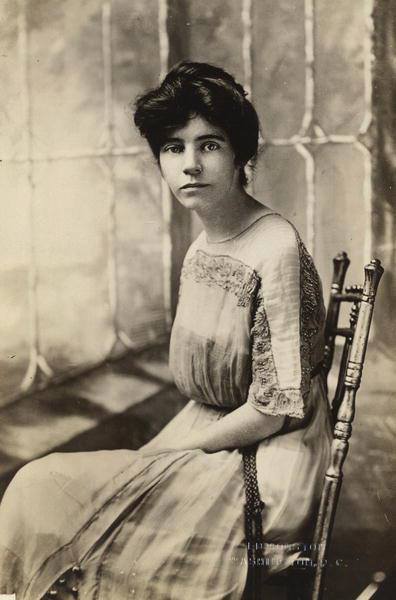
Eunice Dana Brannan
Eunice Dana Brannan

He told the court:

I find Mrs. Brannan in a state of almost complete collapse from the shocking treatment to which she has been subjected in Occoquan Workhouse … Today is the first opportunity I have had to hear my wife’s full story, though I have been in Washington three times this week, attempting to find out the actual conditions of her imprisonment. She was not allowed to communicate with me from the workhouse, and when I saw her last Sunday, Superintendent Whittaker insisted upon being present at the interview, and would not allow me to ask her any questions concerning the institution. I find that she herself was twice warned by the Superintendent with threats that she must not tell me anything of the conditions in the workhouse.

When I went through the workhouse last Sunday the wards and lavatories seemed to be clean. I find now that the white paint which impressed me has been put on in response to the protests of earlier suffrage prisoners, and that it is only a blind to deeper sinister conditions. One thing I did notice was the look of terror which came into the faces of all the women prisoners when Mr. Whittaker stepped near them.

From my wife’s account it was evident that the suffrage prisoners were deliberately terrorized when they entered Occoquan and were treated with great brutality by the men guards, who handled them and knocked them about with the fury of thugs, under the immediate direction of Mr. Whittaker himself, who called out that the men ‘would be glad to get their hands on them and handle them rough.’

There was no excuse for this treatment whatever, since the ladies did not, as reported, refuse to give their names to the Superintendent, but merely refused to give them to the matron, in order to force Mr. Whittaker to appear before them and listen to their demands to be treated as political offenders. When he arrived he gave them no opportunity to give their names, but burst into the room and called his guards in after him with orders to ‘seize’ Mrs. Lawrence Lewis, who was acting as spokesman. She was dragged from the room with curses and with Mr. Whittaker shaking his fist in her face and threatening her with a gag and a strait-jacket.

The others, my wife tells me, were all brutally and outrageously handled, and are still carrying their bruises. They were thrown into a panic of terror and finally separated from each other and literally hurled into their cells, where they were kept in darkness all night. Mrs. Brannan called from her cell across the corridor to a young girl and asked if she was all right. Mr. Whittaker at once appeared and said he would bring the gag and strait-jacket if she spoke again.

In some cells there were three women with nothing to lie on but one narrow bed and two straw mats. They were offered no food until the following noon, and Miss Cora Week of New York was denied the so-called ‘privilege’ of a glass of water. Mrs. Henry Butterworth of New York was carried off alone into the men’s section of the jail, and deliberately told there would be no other women with her, and there she was left all night without any other woman prisoner or matron near her and the sound of men’s voices on all sides.

As for the hunger strike, that has not been started because the women desire to make martyrs of themselves, but in an attempt to secure food which they could eat, and decent living conditions.

These facts represent an intolerable condition that cannot be permitted to go on. Whether we agree with these ladies or not in the methods they employ to win a share in our Government, we are compelled to recognize their sincerity and sacrifice, and the fact that they feel that they have broken no law, since the Constitution guarantees their right to petition and the Clayton Act makes picketing in the District legal. If they are guilty of an offense it is trivial in comparison with the outrageous insults and brutal treatment to which they have been subjected.

After all the testimony was completed, the judge called a recess so he could consider his decision. When he called the court back into session he gave this ruling:

The locking up of thirty human beings is an unusual sort of thing and judicial officers ought to be required to stop long enough to see whether some prisoners ought to go and some not; whether some might be killed by going, or whether they should go dead or alive. This class of prisoners and this number of prisoners should have been given special consideration. There cannot be any controversy about this question … You ought to lawfully lock them up instead of unlawfully locking them up – if they are to be locked up … The petitioners are, therefore, one and all, in the Workhouse without semblance of authority of legal process of any kind … and they will accordingly be remanded to the custody of the Superintendent of the Washington Asylum and Jail.

Though expressing strong disapproval of the picketing of President Wilson at the White House, Judge Waddill ruled that pending appeal, the prisoners could be paroled into the custody of their attorneys. Eunice Dana Brannan, Emily Du Bois Butterworth and Cora Week accepted, because their condition was so poor that they might not survive further confinement in any prison. All the others declined the offer, and are tonight in the District Jail serving as “reinforcements” for Alice Paul and Rose Winslow. Paul and Winslow are serving sentences totaling seven months, have been on a hunger strike since November 5th, and been force-fed three times a day since November 8th in the District Jail’s hospital ward.

The authorities at the District Jail must now deal with dozens of suffrage prisoners, serving months-long sentences, and twenty who will be refusing to eat. They are presently force-feeding five there: Alice Paul, Rose Winslow, Lucy Burns, Dora Lewis and Kate Heffelfinger. Warden Zinkham – and the Wilson Administration – are now faced with the dilemma of either allowing the hunger strikers to starve to death, or engaging in mass force-feedings under the spotlight of widespread publicity and sympathy for these peaceful protesters, or doing something that will end the standoff. All we can do for now is express support for the imprisoned suffrage pickets and await further developments in this test of wills.

Today in Herstory: More Suffragists Endure Force-Feeding at Occoquan Workhouse

Founding Feminists is FMF’s daily herstory column.FoundingFeministLogo-color

November 21, 1917: The number of suffragists being subjected to the ordeal of force-feeding has suddenly increased from two to five.

Lucy Burns and Dora Lewis, leaders of the hunger strike at Occoquan Workhouse, were transferred out yesterday and sent to join Alice Paul and Rose Winslow in the hospital ward of the Washington, D.C. District Jail, where Paul and Winslow are in their fourteenth day of force-feedings. Kate Heffelfinger has also joined the ranks of those singled out for this form of legalized torture.

According to a statement given out by the National Woman’s Party tonight:

Fearing their death in Occoquan, Superintendent Whittaker last night moved Mrs. Lawrence Lewis of Philadelphia and Miss Lucy Burns of Brooklyn to the Government jail in Washington. Miss Burns was force-fed at Occoquan before leaving. Her struggles were heard by other prisoners in the next cells, who describe them as terrifying. It required five guards to hold her during the feeding. Mrs. Lewis was fed after her arrival at the jail.

Kate Heffelfinger, who has been on a hunger strike at the District Jail for over a week, was taken to the hospital ward last night and is now undergoing the ordeal as well. A note she wrote today has been smuggled out and reads:

Three times a day for fourteen days Alice Paul and Rose Winslow have been going through the torture of forcible feeding. I now know what the torture is – the horrible gripping and gagging of swallowing six inches of stiff rubber tubing. Such a strain on the nervous system is not to be imagined. That over, there is the ordeal of waiting while liquids are poured through, then the withdrawal of the tube.

In other suffrage news, the New York State Woman Suffrage Party met for the second day of its convention. The first order of business was to clear up a misunderstanding in regard to one proposal that caused a great deal of controversy and generated much publicity yesterday. The “reprisal plank,” as presented to the convention – and the press – appeared to be aimed at taking revenge upon any legislator who had previously opposed suffrage, and was, as Mary Garrett Hay described it, “narrow, vindictive and vengeful.” The resolution as read, said: “At the next primaries and election we should campaign against certain candidates to State and Federal offices who have consistently opposed woman suffrage and whose records show them to have been opposed to the interests of women and children and to humanitarian legislation in general.”

At the board meeting where the resolution was discussed, the words “who have consistently opposed woman suffrage” were struck out before passage, but the W.S.P.’s Secretary had accidentally left them in when she read the proposal to the delegates. Vira Whitehouse, the organization’s president, said: “The resolution, as passed, did not contain any such clause, although as presented it did. The error was with our press department and the Party does not wish to go on record before the public as determined to carry on any such campaign.”

As to how the Woman Suffrage Party intends to accomplish its goal of helping bring about nationwide woman suffrage, a number of officers said that they will try, in a friendly, reasonable way, to convert those who are opposed or uncommitted to the Susan B. Anthony (nationwide woman suffrage) Amendment. But a companion resolution, which would make support for the amendment the only consideration upon which women voters should judge a candidate, may prove almost as controversial as the “reprisal plank.” Some delegates have noted that a candidate could favor the Anthony Amendment, but be regressive on other issues regarding women, or less than totally supportive of our nation’s war effort. So, this resolution will be discussed at length as well, and possibly be amended.

Art student and imprisoned suffragist Kate Heffelfinger of Shamokin, Pennsylvania. She is currently serving sentences totaling seven months for standing along the White House fence with a banner in support of woman suffrage and critical of President Wilson's insufficient efforts for the cause.
Art student and imprisoned suffragist Kate Heffelfinger of Shamokin, Pennsylvania. She is currently serving sentences totaling seven months for standing along the White House fence with a banner in support of woman suffrage and critical of President Wilson’s insufficient efforts for the cause.

A much less controversial resolution, expected to pass easily, would redefine the purpose of the organization now that winning the vote in New York State has been accomplished:

The objects of this organization shall be to secure equal franchise rights to the women of the United States; to collect and disseminate information upon political and social problems, and to undertake such activities as will further humanitarian legislation, benefit moral conditions, and especially protect the interests of women and children.

Though obviously not as militant as the National Woman’s Party, organizations such as the Woman Suffrage Party and the National American Woman Suffrage Association still have huge numbers of members, do massive amounts of work promoting the cause, and have great influence and prestige. The recent winning of the vote in New York, the nation’s most populous State, provides ample proof that such groups can achieve meaningful accomplishments.

But winning nationwide victory will clearly require the aggressive tactics and personal sacrifices of National Woman’s Party militants as well. Though our greatest concern and praise should be for the imprisoned “Silent Sentinel” suffrage pickets, we should also express our support for those who use traditional methods of promoting the suffrage cause. Every pro-suffrage organization helps in its own way to bring the day nearer when “Votes for Women” will be transformed from a slogan on buttons, pennants and banners into a guarantee written into our Constitution.

Today in Herstory: Suffragist Alice Paul Kept in Hospital During Hunger Strike

Founding Feminists is FMF’s daily herstory column.FoundingFeministLogo-color

November 18, 1917: Suffragist Alice Paul has finally been transferred out of the psychopathic ward of Washington, D.C.’s District Jail, and today succeeded in smuggling a note out of the hospital ward where she is now being kept during her hunger strike and force-feedings.

Her confinement to the psychopathic ward was never really about her sanity. She was singled out for extra punishment as the leader of the suffragists who have been picketing President Wilson by standing along the White House fence with large banners each day since January 10th.

These “Silent Sentinels” are highlighting the contrast between the President’s untiring advocacy of democracy around the world and his lack of any meaningful effort to help win it here for the female half of his own country. He has yet to even endorse the Susan B. Anthony (nationwide woman suffrage) Amendment, or use his considerable influence to help get it passed by Congress and then sent to the States for ratification.

Alice Paul
Alice Paul in far more pleasant times and surroundings.

Over the past few days a number of prison officials have admitted that they had no doubts about Alice Paul’s sanity, and at that point, the policy of subjecting her to the conditions of the psychopathic ward became so obviously punitive, unjustified and illegal that her confinement there could no longer be continued. In a note to Doris Stevens, who is temporarily heading the National Woman’s Party in Paul’s absence, Paul wrote:

“Miss Winslow and I are at opposite ends of the building, each locked in her room, with an iron barred door. I saw her as they brought me on a stretcher from the psychopathic ward, but I have not seen her since. We are each in a ward with three windows. Today they nailed two of my windows shut so that they cannot be opened. The third window has been nailed shut at the bottom, so that the only air I have now is from the top of one window.

“This was done by the order of Dr. Gannon. He seems determined to deprive me of air because air was one of the things we demanded in our letter asking for recognition as political offenders. We have, of course, been deprived of everything else that was included in our original demand – letters, books, visitors, decent food, except as they force it upon is through tubes. Two weeks ago they did give us letters like this one, on the back of which I am writing.”

Despite a large number of letters of support written to her from around the country, the only ones given her by her jailers have been those from her harshest critics. The letter on which she wrote her note said:

“Why not let this miserable creature starve. The country would be much better off without her and the balance of her gang of pickets. They are a rotten lot, and are crazy, and should be locked up for life. If they would starve it would save the expense of keeping them. Let them starve.”

Alice Paul’s note continues:

“I was in the psychopathic ward just a week, and was only released, I think, because of Mr. Malone’s efforts. It was apparently an attempt at intimidation. Dr. Gannon said that if I persisted in hunger-striking he would ‘write a prescription’ to have me taken to the psychopathic ward and fed forcibly. I was thereupon placed upon a stretcher and taken there. Dr. Gannon, another doctor and several nurses then proceeded to feed me forcibly.

“As he was leaving the room Dr. Gannon turned to the nurse and instructed her to ‘observe’ me. The nurse ‘observed’ me once an hour through each night, coming to the door and turning on an electric light, which flashed into my face. At first I wakened each time. After a while I grew accustomed to it.

“In addition to this little device of observing, they used other means to make one know one’s sanity was doubted. A Dr. La Conte came and examined. Dr. La Conte then told me I was not in a mental condition, as I must, of course, know, to judge things for myself. He and two other doctors and three nurses fell upon me and took samples of my blood by force.

“I was locked in my room, so I did not see the other inmates except once or twice, when they came down the corridor and looked through my bars. One could hear them, however. The last morning I was there cries began at 5:30. I turned on the light to look at the time. The cries probably awakened me.
“The morning before, they began when it was still dark. I did not ascertain the time. When one person starts shrieking the others usually join in and continue for an hour or two. Then all would be silent for several hours, when the cries would be resumed.

“One day when I had a new nurse, she introduced herself thus: ‘I know you are not insane.’ She was endeavoring to be kind, but it was staggering to have people express their friendliness to you by assuring you they did not consider you insane.”

Alice Paul has been serving sentences totaling seven months in the District Jail since October 22nd, has been refusing food since November 5th, and has been force-fed three times a day since November 8th. Rose Winslow, another suffrage picket in the District Jail, began her hunger strike at the same time, and is also undergoing the ordeal of force-feeding. Neither they, nor any of the suffragists imprisoned at Occoquan Workhouse have any intention of abandoning either their principles or militant tactics until the battle for the vote is fully successful.

Today in Herstory: Public Support for “Silent Sentinels” On the Rise

Founding Feminists is FMF’s daily herstory column.FoundingFeministLogo-color

November 17, 1917: Public support for the imprisoned “Silent Sentinel” suffragists is increasing now that newspapers have begun to print excerpts from a note written by Lucy Burns and smuggled out of Occoquan Workhouse. The lawyer for several of the women in Occoquan was also able to visit them yesterday and is still talking to the press about what he observed and was told there.

Helen Todd, representing the Committee of 1,000 Women, formed to aid the suffrage prisoners, left New York City this evening for Washington, D.C., to ask President Wilson to appoint an unbiased investigator who will look into the conditions under which those who have been arrested while picketing for woman suffrage are being held.

On November 13th, Todd and a few other suffragists had the opportunity to take a tour of the District Jail with the Commissioner in charge of District of Columbia prisons. Though she was not allowed to talk to Alice Paul or any of the other inmates there, or go to Occoquan Workhouse, in Virginia, Todd was still shocked at the conditions she observed. Commissioner Gardner appeared to be sincere about accepting her suggestions for improving the institution, and bringing its standards up to at least the minimum level of other prisons.

suffragist

Todd is particularly concerned about the hunger strikers:

“After we had seen some of the prisoners who had been on a hunger strike we actually wept. They were our personal friends, and they were emaciated and in a deplorable condition. Some of the most senseless hardships had been inflicted upon them. One had not been allowed air for fear that, if the window were opened, she would talk to people on the outside. Another was not allowed to wear her own nightdress. She would not wear the prison garment, which did not reach to her knees, and was wrapped in a sheet when we found her. When we talked of this to Commissioner Gardner, he was actually on the verge of tears himself, and promised to do everything in his power to lighten the lot of the prisoners.”

But Gardner has done nothing yet – not even answered Todd’s letters – so she has now decided to go straight to the top and try to get President Wilson to act.

Alice Paul began serving sentences totaling seven months in the District Jail on October 22nd, went on a hunger strike with Rose Winslow on November 5th, and both have been force-fed three times a day since November 8th. Paul has been confined in the psychopathic ward, presumably as additional punishment for being the leader of the White House pickets. On November 14th, thirty picketers were tried, convicted and sent to Occoquan Workhouse, where they were terrorized and brutalized upon arrival. They are now on a hunger strike, with Lucy Burns as their leader.

The protesters have been picketing along the White House fence since January 10th, and beginning on June 22nd have been subject to arrest on false charges of “blocking traffic” on the wide Pennsylvania Avenue sidewalk. They are demanding that President Wilson endorse, then lobby Congress for the passage of the Susan B. Anthony (nationwide woman suffrage) Amendment. These “Silent Sentinels” carry large banners with inscriptions highlighting the contrast between Wilson’s vigorous support for democracy worldwide and his apathy toward bringing democracy to the female half of his own country.

The total dedication of these imprisoned suffragists is generating huge amounts of publicity for the cause right now, and their ordeals will hopefully not be forgotten after the battle is won.

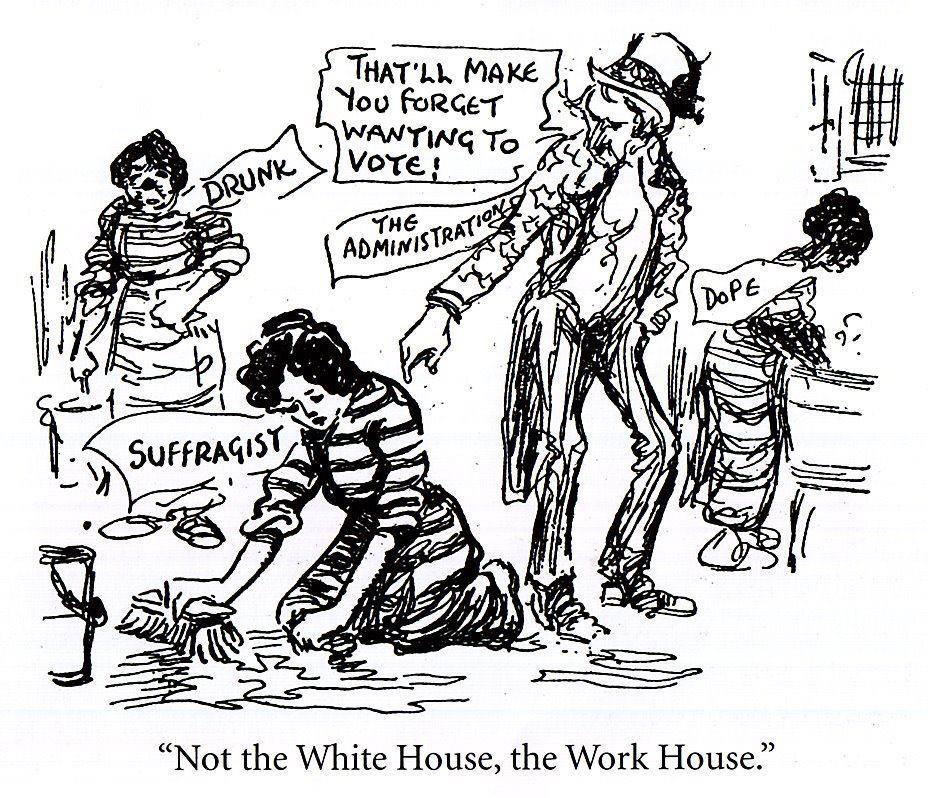
PHOTO: A cartoon from the New York Call showing a suffrage prisoner being told by the Administration: “That’ll make you forget wanting to vote!” The caption is: “Not the White House, the Work House.”

Today in Herstory: Police Arrest Silent Sentinels After a Riot in the Nation’s Capital

Founding Feminists is FMF’s daily herstory column.

FoundingFeministLogo-color

November 13, 1917: Today, “Silent Sentinels,” who are picketing President Wilson over his failure to support nationwide woman suffrage, first battled a hostile mob, and then were arrested by police – who chose not to arrest any of their attackers.

Tonight all 31 demonstrators are being held in the Washington, D.C. House of Detention after refusing to post bail.

10606540_10203527184043779_1824125933263407324_n
A mob attacking a suffrage picket near the White House gate. 

The police arrived late at the scene of the near-riot because they hadn’t expected a suffrage demonstration today. The protesters had been given suspended sentences yesterday for their picketing on the 10th, and knew that Judge Mullowney could recall them to court and jail them at any time if they engaged in further “illegal” activities.

But the pickets would not be deterred from taking up their posts along the fence near the White House gates. They marched from Cameron House, the National Woman’s Party’s headquarters, with their colorful suffrage banners held high. Things went calmly for a while, but once the government employees began leaving work, the small audience of passers-by turned into a large hostile crowd. A few boys then began stealing and tearing the banners, at which point the situation deteriorated rapidly. Police were called and eventually restored order, but only after taking the peaceful protesters into custody and off to jail in patrol wagons. They will face Judge Mullowney again tomorrow.

Meanwhile, the ordeals of Alice Paul and Rose Winslow continue in the District Jail. Paul has been there since October 22nd, serving sentences totaling seven months for her part in the picketing, which has been going on since January 10th. She began a hunger strike on November 5th, and has been force-fed three times a day since November 8th. Today she finally got a visit from the lawyer for all the pickets, Dudley Field Malone. It was necessary for him to go to the Supreme Court of the District of Columbia to compel the warden to produce Alice Paul so that he could confer with her. Malone said afterward:

Miss Paul and Miss Winslow both are very weak and are being force-fed. They are resisting food as a protest against the failure of the Government to treat as political offenders women who are arrested for demanding passage of the Federal suffrage amendment.

I was shocked to find that Miss Paul, because she is the leader of the National Woman’s Party, has been singled out from among the other suffragists and transferred to the psychopathic ward, in spite of her demand first to see her personal physician and her attorney.

Miss Paul is imprisoned in a room in the midst of insane patients, whose shrieks she can hear day and night. For fear she may not hear them the door of her room has been taken off. One of her windows has been boarded up with heavy wooden shutters, and the other one cannot be opened to let in air, so that most of the air must come from the inside halls of the building. Against her protests, alienists have repeatedly been sent to interview Miss Paul and have even brought with them a stenographer to take down what she says.

I talked with Miss Paul for an hour and a half, and she is more sane than any of the administration officials who have been responsible for this outrage. I demanded of the warden that this malicious attempt to discredit Miss Paul’s leadership and to reflect on her sanity in placing her in the psychopathic ward, surrounded by maniacs, cease at once, and that she be removed forthwith. If this is not done, I shall appeal to the court for relief from this unspeakable situation.

It is time that the sportsmanship and gallantry of American men and that the humanity and political power of the women voters of the State of New York and the Western States spoke out against this conduct of the Government.

Though only Alice Paul and Rose Winslow are being force-fed, they are not the only suffrage pickets in the District Jail, and the number of imprisoned suffragists may increase dramatically tomorrow. So while today is the one-week anniversary of a major triumph – women winning the vote in New York State – the battle nationwide is far from over, and things may get a lot tougher for the “Silent Sentinels” very soon.

Today in Herstory: DC Judge Unexpectedly Frees Arrested Suffragists

Founding Feminists is FMF’s daily herstory column.

FoundingFeministLogo-color

November 12, 1917: After all they’ve gone through, from extremes of weather to attacks by hostile crowds, arrests and lengthy jail sentences, it’s not easy to shock the suffragists who have been picketing President Wilson over his refusal to support or work for the Susan B. Anthony (nationwide woman suffrage) Amendment. But today they were truly caught by surprise.

Judge Mullowney of the D.C. Police Court did something absolutely no one expected. After all 41 of those arrested day before yesterday made their statements in his courtroom, they were given suspended sentences and permitted to go free. Whether this is a sign that the Government has decided to give up trying to persecute women for exercising their Constitutional right to peacefully protest, or is simply making it look as if leniency is being shown before extreme sentences are imposed if the protests continue is being debated tonight. But the uncertainly won’t last long, because 31 of the banner-bearing protesters went right back to the White House fence, were once again arrested, and will be back in court soon.

At their trials today, the defendants told the judge – and the many reporters present – why they protest, and that they do so in what they believe is a totally legal manner. According to Anna Kelton Wiley:

I want to state that we took this action with great consecration of spirit. We took this action with willingness to sacrifice our personal liberty, in order to focus the attention of the nation on the injustice of our disenfranchisement, that we might thereby win political liberty for all the women in this country. The Constitution says Congress shall not in any way abridge the right of citizens peacefully to assemble and petition. That is exactly what we did. We peacefully assembled, and then proceeded with our petition to the President for the redress of our grievance of disenfranchisement. The Constitution does not specify the form of petition. Ours was in the form of a banner. To say that we ‘broke traffic regulations’ when we exercised our constitutional right of petition is therefore unconstitutional.

Elizabeth Kent said:

My conscience is clear. I walked on Saturday afternoon from Cameron House to the further gate of the White House. I obstructed no traffic. I was moving. At the further gate there was no crowd. I held a banner which all might read. The Administration should commend, instead of allowing a prison sentence to be imposed upon, women who hold aloft words which show the utmost devotion to the ideals of political liberty on which the Government is founded.

Eunice Dana Brannan emphasized the need for a Federal suffrage amendment and reaffirmed the reason why the National Woman’s Party is picketing President Wilson at the White House:

As a newly enfranchised New York woman, I realize more acutely than ever the limitations of the State referendum method, the fact that we are prisoners in our own State so far as the franchise is concerned. So long as the President refuses to indorse the Federal Amendment he proves to his own country and to the whole world that he is an advocate of the unjust discrimination against American women – that he preaches democracy in words but not in democratic deeds.

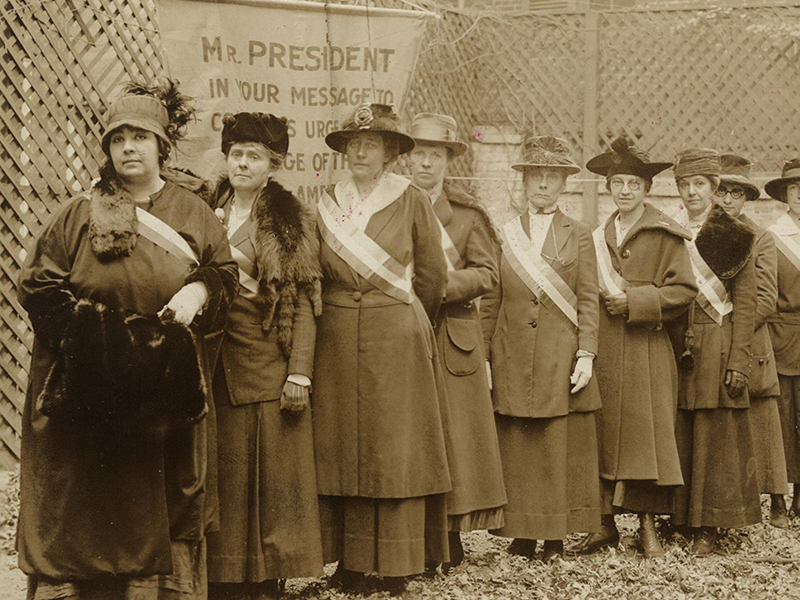
Some of those who were arrested in day before yesterday's picketing. Left to right, they are Catherine Martinette of Eagle Grove, Iowa; Elizabeth Kent of Kentfield, California; Mary Bartlett Dixon of Easton, Maryland; Mrs. C.T. Robertson of Salt Lake City, Utah; Cora Week of New York City; Amy Juengling of Buffalo, New York; Hattie Kruger, also of Buffalo, New York; Belle Sheinberg of New York City and Julia Emory of Baltimore, Maryland.
Some of those who were arrested in day before yesterday’s picketing. Left to right, they are Catherine Martinette of Eagle Grove, Iowa; Elizabeth Kent of Kentfield, California; Mary Bartlett Dixon of Easton, Maryland; Mrs. C.T. Robertson of Salt Lake City, Utah; Cora Week of New York City; Amy Juengling of Buffalo, New York; Hattie Kruger, also of Buffalo, New York; Belle Sheinberg of New York City and Julia Emory of Baltimore, Maryland.

The tactics of the pickets are controversial, provoking both strong support and vehement opposition even among fellow suffragists. A delegation of 40 women voters from New York – enfranchised just six days ago by a State referendum – went to the White House today in support of the protesters. Two were admitted and allowed to leave a petition asking for the release of the suffrage prisoners, and for President Wilson to recommend to Congress that it approve the Anthony Amendment so that it can be sent to the States for ratification.

But Carrie Chapman Catt, President of the National American Woman Suffrage Association, spoke for more conservative suffragists and said today:

The pickets make the psychological mistake of injecting into this stage of the suffrage campaign tactics which are out of accord with it. Every reform, every change of idea in the world passes through three stages – agitation, argument and surrender. We have passed through the first two stages and entered into the third. The mistake of the pickets is that they have no comprehensive idea of the movement and are trying to work this first stage in the third. We stand on the threshold of final victory, and the only contribution these women make to it is to confuse the public mind.

However, according to Dora Hazard, who heads the Syracuse, New York, branch of the National Woman’s Party, many members of the public in her area who disapprove of picketing our wartime President are far more offended by the lengthy sentences and unusually harsh prison conditions imposed on the protesters. Since the National Woman’s Party’s campaign seems to be succeeding in keeping the issue of suffrage before the public and generating sympathy for those who take part in the protests – and therefore the cause itself – the “Silent Sentinels” will continue their militant tactics.

Today in Herstory: Jailed Suffrage Protesters Show Support for Alice Paul

Founding Feminists is FMF’s daily herstory column.

FoundingFeministLogo-color

November 11, 1917: Where did the 41 suffragists arrested yesterday while trying to picket along the White House fence spend part of what may be their last day of freedom before their trials tomorrow? Inside the walls of the District of Columbia Jail.

Why? So they could express their support for the suffrage prisoners already there, especially Alice Paul, being held in the jail’s psychopathic ward, and force-fed three times a day for being the “ringleader” of the “Silent Sentinel” pickets.

The assembly was not, of course, approved by the warden, but it went forward anyway. Anna Kelton Wiley, Elizabeth Kent and Lucy Burns led their fellow visitors double-file to the warden’s office where they demanded to talk to him. The warden’s wife came to the door and said they couldn’t see him because “the poor man is prostrated,” presumably due to telephone calls from the public objecting to the extreme punishments being given to peaceful “Silent Sentinel” suffrage pickets.

The delegation decided they weren’t going to leave without accomplishing their mission, so they fanned out and began looking for Alice Paul, Rose Winslow and other suffrage prisoners. Soon, someone called out: “There’s Miss Paul … There she is!” A few surprised guards were no match for the determination of the women, so some of Paul’s most ardent supporters rushed by and clustered below her window to salute her. “West Virginia greets you!” “Oklahoma is with you!” “New York salutes you!” were among the first words that rang out.

10629783_10203516316852106_5621441396737265629_n

Despite force-feedings and sleepless nights spent listening to the shrieks of patients in the psychopathic ward, Alice Paul seemed as spirited as ever, and told supporters:

Many of you will probably be here tomorrow. I want to say to you now that you will find the conditions intolerable. You must make it clear from the first that you are political offenders and demand that you be treated as such. Your number will make it impossible for them to do anything but grant your demands.

When asked how she was doing, Paul replied:

Oh, I’m all right. I am being forcibly fed three times a day. It is worse than in England. There they feed you only twice. I am able to prevent them from giving me half of what they bring, but I have not the strength to prevent them from forcing me to take some.

She was told to “hold on,” and she assured those below: “Oh, I will.” Then she reiterated: “I want you all to demand that you be treated as political prisoners. That’s what you must do.” They assured her they would.

The guards regrouped, and began pushing the women away from Paul’s window and toward the prison gate. As they passed Rose Winslow’s window they called out to her as well. Winslow told them: “I am resisting their feeding all I can, but I am too weak to put up much resistance. My stomach is resisting, though.”

Officials at National Woman’s Party headquarters are telling of notes that Winslow has smuggled out of jail, calling prison conditions “frightful” and speaking of the torture of force-feeding, in which she and Alice Paul are held down while a rubber tube is forced into the throat and liquid poured in through a funnel. According to Winslow’s note:

Alice Paul dreads forcible feeding. I hate to think how she must be feeling. I had a nervous time of it, gasping a long time afterward and stomach rejecting during the process. Spent a bad, restless night, but otherwise all right ….. We are denied food from outside, visitors, clothes, books, many things, so please make that clear. All of the prisoners have made most of the demands we are making, as you know.

In a note to Lucy Burns, Winslow says:

The feeding gives me a severe headache. My throat aches afterward, and I always weep and sob, to my great disgust, because I try to be less feeble. It is horrible. I’m very much interested in seeing how long our splendid American men will stand for this form of discipline.

The injustice of Alice Paul’s being held in the psychopathic ward became even more outrageous yesterday, when it was reported by Lavinia Dock that even Warden Zinkham doesn’t think she belongs there. He reportedly told Dock, “I have never met a more brilliant mind” and “I shall be a subject for the psychopathic ward myself if there is not a let-up in the flood of protests I am receiving.”

If protests are having such a powerful effect, they need to be kept up and even increased. The National Woman’s Party is doing everything it can to make sure no one forgets the ordeals being undergone by the prisoners.

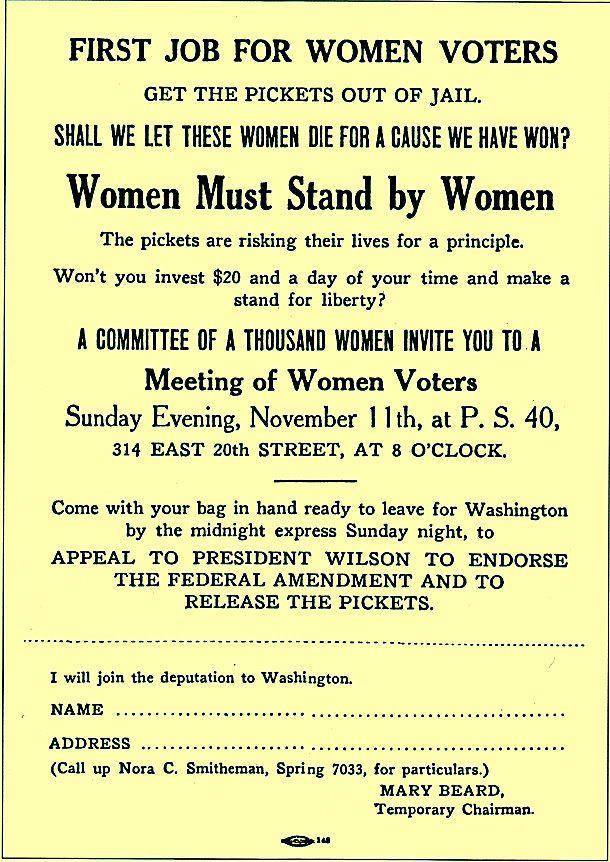
Protest meetings against the ridiculously long sentences given peaceful picketers for trivial – even false – offenses, such as allegedly “blocking traffic” on the wide Pennsylvania Avenue sidewalk, are being held all over the country by those who believe that public pressure can put an end to these outrages. A flyer for a meeting in New York City tonight – in a State where women won the vote five days ago – is shown here. Attend if you can, and then go to Washington, D.C., to call for the release of the suffrage prisoners. Demand fair treatment for all those who want to exercise their Constitutional right to peacefully protest as a way of winning the most basic right of a citizen in a democracy – the right to have an equal voice in selecting those who pass the laws that women as well as men are compelled to obey.


INFLATIONARY NOTE: $20 in 1917 = $371.92 in 2014.

Today in Herstory: It Will Take More Than Imprisonment to Deter Suffrage

Founding Feminists is FMF’s daily herstory column.

FoundingFeministLogo-color

November 10, 1917: Today, forty-one brave suffragists answered the question of whether recent mass arrests followed by increasingly lengthy prison sentences would be enough to prevent American citizens from asserting their right to peacefully voice their demand for political equality. Their answer was a unanimous and defiant “No!”

Picketers came to Washington, D.C., from as far away as Oregon, and ranged in age from very young women up to age 73. The demonstrators, each carrying a colorful five-foot banner, made such an impressive sight that they did not encounter the now-customary jeers or attacks as they marched.

After leaving the National Woman’s Party’s headquarters at Cameron House, the suffragists divided themselves into five groups, with the New York contingent making the first advance toward the sidewalk next to the East Gate of the White House.

Captain Flather, of the D.C. Police, had been busy pushing back the waiting crowds who had gathered for the spectacle so that there would be room for streetcars to pass down Pennsylvania Avenue. But when the marchers approached the gate, he abandoned that work, blocked the marchers’ path, and though they were in no way interfering with pedestrian traffic, he told the women to “move on.” Eunice Dana Brannan said she would do no such thing. There were a few moments of stares and silence, while both sides waited to see if the other would back down. No one did, so Captain Flather ordered the women arrested and taken to a “Black Maria” police van for transport to the nearest station house.

As the first group of picketers was being driven off, a second group, headed by Agnes Morey of Massachusetts, and which included women from Pennsylvania and New Jersey, moved on the West Gate. They were met by police as well, arrested, and driven off in a second van. With military precision, a third group, Californian Elizabeth Kent in the lead, and composed of troops from Oregon, Utah and Colorado, immediately moved to the East Gate.

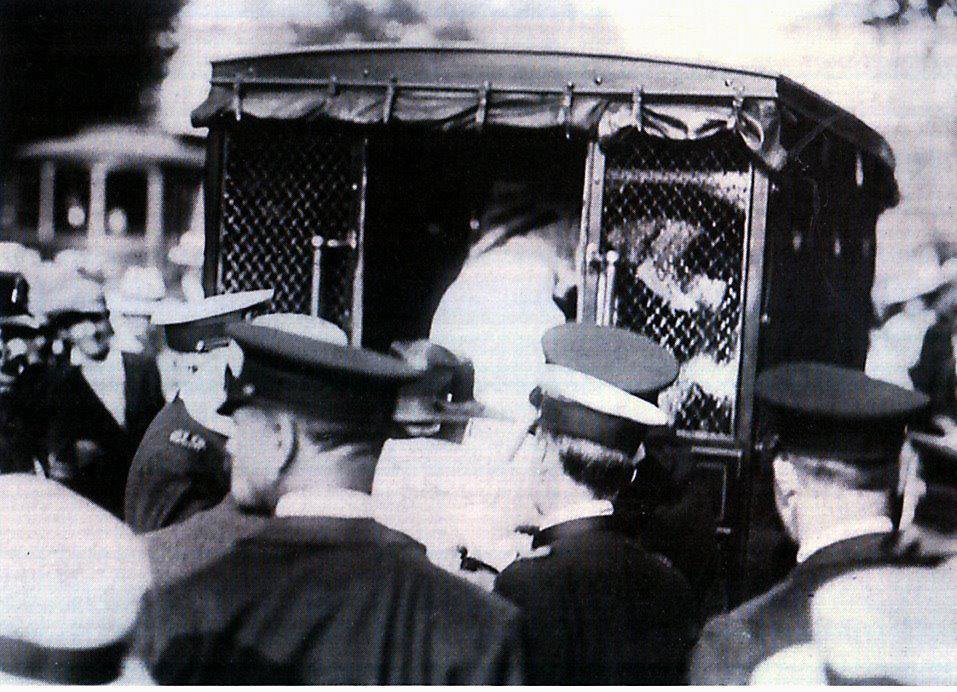
Picketers being loaded into the "Black Maria" police van earlier today.
Picketers being loaded into the “Black Maria” police van earlier today.

The crowd had now picked up on the pattern, so they knew to swivel their heads regularly to watch the action as if it were a tennis match. After the East Gate was cleared, the ritual was repeated again, with the West Gate coming under siege by picketers from Oklahoma, Minnesota and Iowa led by Mrs. Barnes of Indiana. Anna Kelton Wiley of D.C., and reinforcements from Louisiana, Maryland and Florida made the day’s final assault on the East Gate. Among those in this last group were Lucy Burns, just released after a 60-day sentence in the infamous Occoquan Workhouse, and Mary Nolan, age 73, the eldest of the “Silent Sentinels.” As she was being led away, Nolan said:

I go to jail willingly in this cause only. I have come here to picket, feeling it my conscientious duty. I am in the work for good to the end of my life. I have always done everything possible for women. The only way we can gain our freedom is by the women uniting and enduring any ill-treatment the Administration gives us, providing the steadfast purpose and the nobility of the cause.

President Wilson saw the huge crowds and final group of demonstrators being arrested as he and his wife returned from a drive around town. So today’s action clearly succeeded in reminding him of the fact that many see hypocrisy in his vigorous advocacy of democracy around the world, while doing nothing to support the Susan B. Anthony (nationwide woman suffrage) Amendment, which would bring democracy to the women of his own country.

After being transported to the police station, all the demonstrators were booked and released on $25 bail each (the full $1,025 paid by Mary Ingham) and ordered to appear in Police Court for trial day after tomorrow.

It’s going to be impossible for the Administration to shrug off these protests as being made by radicals or political enemies. Elsie Hill, daughter of the late Representative Ebenezer Hill of Connecticut noted:

Once more the Administration finds itself in the embarrassing position of arresting on technical charges the women relatives of strong Administration supporters. Mrs. William Kent of California is the wife of the National Chairman of the Wilson Independent League, ex-Representative Kent, who has recently been appointed a member of the Tariff Board. Miss Mary Bartlett Dixon is a cousin of Mitchell Palmer of Pennsylvania, Democratic Floor Leader in Mr. Wilson’s first Administration, and recently appointed receiver of enemy property. Others arrested were Mrs. Harvey Wiley, daughter of the late General Kelton, U.S. Army, and wife of the pure food expert. Dr. Wiley stumped the country for the election of Mr. Wilson in his first Presidential campaign. One of the most interesting prisoners the jail authorities will have under their control is Miss Paula Jacobi of this city, who was four months matron of a prison in Massachusetts and has studied prison reforms ever since.

Alva Belmont, a member of the Executive Committee of the National Woman’s Party wondered: “What have we come to in America when splendid women, loving liberty, are arrested for asking, ‘Mr. President, in your message to Congress, urge the passage of the Federal suffrage amendment enfranchising women.’ ”

Alice Paul and Rose Winslow remain in the District Jail, being force-fed multiple times each day, with Paul kept in the psychopathic ward. She is threatened with being declared insane and committed to St. Elizabeth’s Asylum indefinitely if she doesn’t call off the picketing of President Wilson by the National Woman’s Party. Neither Alice Paul, Rose Winslow, or any of the other suffrage prisoners in the D.C. Jail have any intention of giving in, and everyone arrested today intends to be just as defiant in court, as well as in prison should they be found guilty of the standard – and false – charges of “blocking traffic” on the wide Pennsylvania Avenue sidewalk.


INFLATIONARY NOTE : $25 in 1917 = $464.90 in 2014; $1,025 = $19,061.08

Today in Herstory: Suffrage Leaders Celebrate Victory in New York

Founding Feminists is FMF’s daily herstory column.

FoundingFeministLogo-color

November 7, 1917: The festive atmosphere that prevailed at suffrage offices last night continued this morning amid a run on “I Am A Voter” buttons by the newly enfranchised women of New York State at the headquarters of the National American Woman Suffrage Association.

The joy remained undiminished late tonight at the largest – and possibly loudest – meeting ever held in Cooper Union.

But even with all of today’s celebrations, there was still time to sift through the returns from yesterday’s suffrage referendum, as well as make serious plans for the next step in the battle. The unprecedented organizing efforts in New York City paid off well. Two years ago, the men of the city voted against suffrage by an 82,755 vote margin, which would have sunk the 1915 campaign even if up-State voters hadn’t rejected the referendum by an even greater margin of 112,229 votes. But this year, the suffrage referendum appears to have broken about even in the rest of the State, while getting a 100,000 vote boost from New York City. This landslide endorsement of “Votes for Women” leaves no doubt about the outcome, even though a few results from rural areas are not in yet.

The Empire State’s victorious suffragists lost no time in gearing up for the next step, which will be to win the vote nationwide. Both Mary Garrett Hay, head of the New York City branch of the Woman Suffrage Party, and the Executive Board of the New York State Woman Suffrage Party sent telegrams to President Wilson this morning thanking him for his support. Carrie Chapman Catt, head of the National American Woman Suffrage Association and Rev. Anna Howard Shaw, her immediate predecessor, have been invited by the President to bring a delegation of suffragists to the White House later this week for a meeting. Catt and Shaw are expected to use their audience with the President to try to convince him to support nationwide woman suffrage via the Susan B. Anthony Amendment in addition to his already expressed support for winning suffrage on a State-by-State basis.

Former President Theodore Roosevelt expressed his happiness today at the result of yesterday’s election. According to Col. Roosevelt: “The women deserved it, they were entitled to it, and I am glad the voters saw it as they should. The vote for suffrage has grown wonderfully, and the vote of yesterday is an honor to every man who marked his ballot for women.” Apparently he did some local lobbying, because the measure passed 242 to 70 at his polling place in Oyster Bay.

Every suffrage leader who took part in the campaign was at the Cooper Union victory jubilee tonight, but since the applause and cheering was virtually constant and unrestrained, it was often hard to hear the declarations of victory that everyone had been denied at the end of the first campaign in 1915 and been looking forward to for two years.

Carrie Chapman Catt got the first deafening ovation when she opened the meeting by addressing the predominantly female crowd as “My fellow citizens …” Though there were many offices as well as other referenda on yesterday’s ballot, Catt noted the historic significance of the suffrage referendum, and why November 6th will long be remembered as a red-letter day for women:

Mayors may come and Mayors may go. A hundred years from now the deeds of the present-day Mayors will have been forgotten. But the children of the centuries to come will learn that on November 6, 1917, a great step for human freedom was accomplished in the State of New York. I want to give our heartfelt thanks to the men who voted for suffrage; and to those who voted ‘No’ I want to say that we won fairly and squarely. Be good sports now and accept us into the fraternity of democracy.

Between Catt’s greeting and the singing of the “Star Spangled Banner,” which opened the rally and the “Battle Hymn of the Republic,” which closed the program, there were other words of victory, but always mixed with rededication to the hard work that still remains.

Vira Boarman Whitehouse, head of the New York State Woman Suffrage Party was one of many who said she had no intention of taking any time off: “People say to me, ‘Well now, I suppose you’re going to take a rest.’ But we shall never rest till every woman in the whole United States is enfranchised.” Reflecting on the unsuccessful campaigns in three other States in the Fall of 1915, and alluding to suffragists now turning their attention to a Federal amendment, she said: “We’re going to save Pennsylvania the trouble of another State campaign, and we’re going to save Massachusetts … and New Jersey ….” At this point a member of the audience from the Buckeye State shouted, “Save Ohio, too, while you’re at it,” causing great laughter and applause.

A resolution was adopted by those at the assembly to “renew our appeal to Congress to submit the Federal woman suffrage amendment to the legislatures of the several States in order that the suffrage campaign, stretching over a period of more than half a century, may be brought to a speedy close, thereby releasing the energies of the women of the nation from the struggle for political justice, so that with singleness of purpose we may work for worldwide democracy.”

Another resolution called for Rev. Shaw and Carrie Chapman Catt “to carry to the President of the United States expressions of our gratitude for his assistance in the New York State woman suffrage campaign, and urge him to extend further aid to our cause by recommending in his annual message that the Federal amendment be submitted to the States.” A final resolution expressed thanks to the press for its “valuable service” and hoped that it would give equally positive coverage to the campaign for nationwide suffrage.

Tonight’s final speaker was Rev. Anna Howard Shaw, who expressed the kind of unbounded optimism that is now becoming widespread in the aftermath of this landmark victory. She noted that back in 1906, when suffragists hadn’t won a victory in a decade, and only four States permitted women to vote, Susan B. Anthony, in her final days, predicted that the battle would be won by 1920. “That year will be the hundredth anniversary of Susan B. Anthony’s birth, and I hope we shall celebrate it by completing the triumph of democracy,” said Dr. Shaw.

988830_10203488367033378_5731807814278500575_n (1)
Rev. Anna Howard Shaw, president of the National American Woman Suffrage Association from 1904 until 1915, and an untiring worker in the New York State suffrage campaign this year.

With the kind of enthusiasm shown at the victory rally tonight, and the sort of political expertise demonstrated in the recent New York campaign, Susan B. Anthony’s goal of nationwide woman suffrage by 1920 now seems within reach.

Today in Herstory: New York Women Win the Vote!

Founding Feminists is the FMF’s daily herstory column.

FoundingFeministLogo-color

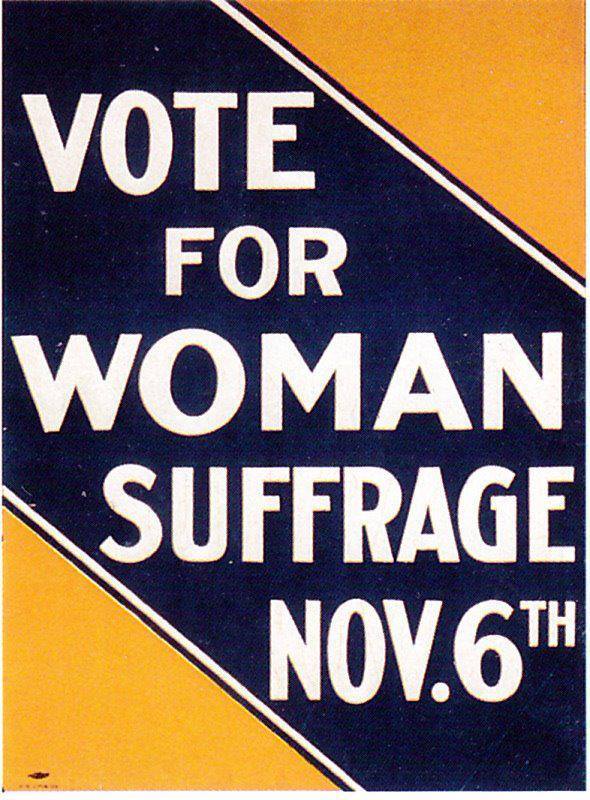
November 6, 1917: Victory!

The biggest prize of all, New York, is now an equal suffrage State, and tonight the campaign’s leaders are already enthusiastically planning how to use their new power to push for winning woman suffrage nationwide through the Susan B. Anthony Amendment.

Things began to go well right from the start, when suffrage workers took up their assigned posts as poll-watchers inside every voting location in New York City, while others stood 100 feet from the polls, giving out sample ballots and answering questions. Still more volunteers knocked on doors to be sure that all those who had said they were pro-suffrage would vote today, with rides available if needed. As the day progressed, reports came in that a number of local politicians who had been strong opponents of suffrage in the 1915 referendum were saying that they voted for it this time, or had at least dropped their opposition, so optimism grew.

The offices of the suffrage organizations were beehives of activity all day, as leaders took in every tidbit of information – and rumor – trying to get some idea of how things were going, and making sure that any problems that came up at polling places were quickly fixed. But finally the last vote was cast, and for the first time since a similar election night two years and four days ago, there was nothing for anyone to do but wait.

Fortunately, the suspense didn’t last long. Though in the old days it was necessary to wait for an election “extra” to hit the streets, citizens in these modern times get the results much faster. For instance, in many of the vaudeville houses, theaters and restaurants, stereopticons projected slides with the latest results written on them onto walls, so patrons could read them.

Ironically, it was a vehemently anti-suffrage newspaper which broke the news that delighted suffrage forces. The New York Times uses a searchlight, plus similar lights of different colors, with each color symbolizing a particular contest, to give updates to the huge crowds that gather on election nights. When the big white searchlight was pointed West then moved up and down it meant they had projected that suffrage would win. Immediately, a woman began making her way through the crowd, and when she got to suffrage headquarters, exclaimed: “The New York Times signals that suffrage has won!”

1743735_10203482306401866_6591217684579867003_n

After what were certainly the first three cheers for the “Times” ever given at any suffrage headquarters, Carrie Chapman Catt, Rev. Anna Howard Shaw, Mary Garrett Hay and other suffrage leaders got similar ovations and the party began in earnest. Things got even cheerier when word came that Associated Press had projected victory by at least 40,000 votes. At this point Rev. Shaw took out a brooch with a gold suffrage flag and some tiny diamonds, and pinned it on. It was originally given to Susan B. Anthony on her 80th birthday, and had only four diamonds in it at that time representing the four States where women could vote in 1900. Now it has eleven, and one more for New York will be added soon. Shaw then said:

Since December I have not slept nine nights in my own home, but I have said to myself, ‘If New York will only vote for suffrage I will be willing never to sleep there as long as I live.’ New York has gone ‘over the top’ today for the whole world by this great suffrage victory. The New York election will have a decided influence upon the British Parliament in granting the extension of suffrage to the women of Great Britain. It will also have an influence on the French Parliament.

Mary Garrett Hay, head of the New York City branch of the New York State Woman Suffrage Party, which hosted the gathering, was asked if this office would be closed now that suffrage was won in New York State. “No, indeed,” she said emphatically. “We have leased our headquarters for another year and we shall go on with our work. Now we have to educate women for the full rights of citizenship. We are going to start tomorrow night with a meeting at Cooper Union to work for the Federal amendment. Our work has only begun.” She later went into more detail about the new campaign:

Another battle has been won in the great war for political equality. The men of New York City and State have proved themselves to be as broad-minded, and as just, as loyal to the principles of democracy as I have always thought they were. Although we have won the battle we must keep marching along the suffrage road, keeping our organization in good working order, so that we can fight for the Federal amendment. We have always championed it, but because of our too-strenuous campaign we have not been very active in its support. Now all our forces will be allied with the National American Woman Suffrage Association to win the Federal amendment, and then to see that our New York Legislature ratifies it, and we shall use our great organization to further civic work in the City of New York.

The winning of New York, the first State East of the Mississippi where women have full suffrage, is not of just symbolic importance. It has the largest Congressional delegation of any State, and having all the delegation’s members dependent upon women’s votes for their re-election should help with getting the Anthony Amendment through Congress and sent to the States for ratification. New York’s 43 Electoral Votes can now be added to the 172 in States where women already have full suffrage – or partial suffrage and the right to vote for President – so women’s votes will now always be crucial to anyone running for the White House. And no State without woman suffrage has as many voters to convince as there were in New York, so if it can be won here, it can be won anywhere.

As American soldiers fight overseas in the Great War so that democracy will be protected and expanded, tonight a major advance for that cause was also achieved at home, using only peaceful methods, and the suffrage army’s advance now seems unstoppable.

Today in Herstory: Suffragists Make Their Final Plans for New York’s Election

Founding Feminists is FMF’s daily herstory column.

FoundingFeministLogo-color

November 5, 1917: It’s nearly all over but the voting!

Tonight, the final suffrage meetings and rallies are going on, and leaders are making sure that their armies of volunteers who have been working almost non-stop through two successive campaigns are ready to shift gears overnight and work just as hard to assure a fair election, as well as make sure that every man in New York State who wants to vote for woman suffrage gets to the polls tomorrow.

The battle in the newspapers continues unabated, with paid advertisements by both sides, and free editorials by the papers themselves. The New York State Woman Suffrage Party has an ad in many papers today entitled: “To Win The War!” It notes that the Empire State is:

 … the largest, richest State, nearest and most vulnerable and desirable a prize for an invading enemy. Yet half the force of the State has been fighting with hands bound. The men and women who ask you to vote for woman suffrage are not suggesting it as a pretty compliment to womanhood. They ask it as a vital, sound, tremendous step in putting every ounce of power that can be marshaled behind our country in its time of need.

President Wilson’s words of last week: “This is the time to vote for woman suffrage,” were also featured in the Woman Suffrage Party’s ad. It concluded by saying: “Your country needs not half but all her power! Without the vote, the women of New York cannot give their whole great fund of strength. Release the added power that has been held in check! To win the war, vote ‘Yes’ Tuesday!”

10731156_10203477218114662_1052369648502645886_n

Carrie Chapman Catt, head of the National American Woman Suffrage Association, has taken a similar stance. She recently attacked the anti-suffragists for their failure to support our wartime President in his call for equal suffrage, which he supports on a State-by-State basis: “Is this the loyalty of which the ‘antis’ prate so much? Is this to hold up the hands of the President in the hour of his greatest need of a country united under his leadership?” She reminds voters that: “To vote ‘Yes’ is to uphold the hands of the nation’s leader, who puts woman suffrage in the front rank as part of that democracy the world is fighting for.”

Though the New York Times continues its long tradition of anti-suffrage editorials, other papers are quite supportive. The Middletown Daily Press was just one of many New York State papers that had praise for the suffrage effort, as it declared today:

The suffragists have made a splendid campaign. They have lined up on their side all the leaders of thought and all the better element in politics in the State. If these forces are not sufficient to carry the day then one is moved to pity for the greatest State in the Union that, in this enlightened age, with such furor about democracy and the entire world at war for it, it can still register its stand-pat-ism and Tory-ism by turning down a proposition that will do more toward advancing real democracy than anything that has happened in years.

Suffrage leaders from Syracuse to Manhattan are expressing no fears of defeat tonight, and expect just the reverse of two years ago, when New York City gave an 87,755 vote advantage to the “antis.” This year there was an unprecedented level of house-to-house campaigning, and major unions worked zealously for suffrage. A number of women closely connected to Tammany Hall’s most powerful politicians were recruited into the New York City branch of the Woman Suffrage Party by Mary Garrett Hay, so the State’s biggest city is expected to provide a huge boost for suffrage tomorrow, instead of an insurmountable deficit.

Even at this late hour tonight, the rallies are still going on in large cities and small, with the same intensity as if suffrage were trailing badly, because no one can say with absolute certainty that it isn’t. Vira Boarman Whitehouse will be at her desk at the New York State Woman Suffrage Party’s headquarters tomorrow morning at 5:00, with leaders of all the other suffrage organizations at their posts soon afterward. They will be supervising the over 6,300 women who will either be poll-watchers inside the voting places or campaigning 100 feet outside them, plus some others transporting voters to the polls, because turnout is critical.

As the polls begin to close, there will be huge gatherings at each organization’s headquarters as the results come in. Then some time tomorrow evening, there will either be a two-years-overdue celebration of victory, or the launching of the third New York State suffrage campaign.

Today in Herstory: New York Rabbi Calls Women’s Disenfranchisement A “Great Moral Wrong”

Founding Feminists is FMF’s daily herstory column.

FoundingFeministLogo-color

November 4, 1917: The New York State suffrage campaign is coming to an enthusiastic and optimistic finish with just two more days remaining until the vote.

In a statement issued today, Carrie Chapman Catt said,

In the name of the 2,000,000 women who comprise the National American Woman Suffrage Association, and who are straining their eyes toward the great promise of victory in New York State on Tuesday, I ask you for woman suffrage.

Referring to a giant petition containing 1,035,000 names, she went on to say:

Remember that more than 1,000,000 of your mothers, wives, sisters, and sweethearts want you to vote for it, and have said so over their signatures. Remember that our country is fighting for democracy, ‘for the right of those who submit to authority to have a voice in their own government.’ Vote for woman suffrage, because it is part of the great struggle toward democracy. Vote for it as an earnest of our country’s sincerity, when it says that it fights for democracy.

A seasoned veteran of suffrage campaigns in New York and three other States in 1915, Rabbi Stephen S. Wise is still as dedicated as he is eloquent. Speaking in Carnegie Hall to the Free Synagogue today, he addressed and demolished every anti-suffrage argument one by one, and said that now is the time “to right a great moral wrong.” He also expressed no sympathy for male anti-suffragists:

If we continue to disenfranchise the women, it will be because of the meanness and want of elementary generosity of the men. The men who vote against suffrage are cowards. They are guilty of cowardice, because they know that whether the women get the vote or not, these women will continue to do their duty by their families and by their country. So far as the men are concerned, they lose nothing by depriving the women of the vote. But democracy loses, and will continue to lose, as long as men continue to perpetuate this injustice…

The argument that equal suffrage will weaken the strength of our Government is an argument against democracy, and an argument for just that kind of Prussianism which we are now fighting against. Before we can make the world safe for democracy we must de-Prussianize our own country by admitting the women to the franchise to which they are entitled.

1607123_10203472111426998_1170730790253207051_n (1)

To the argument that women in suffrage States have not yet succeeded in curing all political ills, he reminded those present that “not more than 30 per cent of the women are voting today, and yet they are expected to improve government. If woman suffrage has not purified politics already, it is because men have made politics so unclean, so filthy, that it will take 100 years of deodorizing cleanser in the hands of the women of America to make politics clean.”

The Woman Suffrage Party gave out a letter today that shows great support for woman suffrage among our soldiers, contrary to the claims of Everett Wheeler and other anti-suffragists. It began:

Company ‘K’ of the Seventy-first New York Infantry wishes to go on record to say that its every member is in favor of woman suffrage. And allow us to tell you swivel chair polishers of the Man Suffrage Association that the real red blood of this country, the men who are today in khaki, are better able to judge whether or not the women of this country shall share the privilege of the franchise. We, who have sacrificed our positions, in order to better serve our country and have offered our lives that the same country might be safe and that democracy shall be made safe for the world, have seen, realize, and appreciate what the women of this country have been willing to do for us.

Through their powerful influence, laws for our betterment have been enacted. And, by the same token, we, the men of the United States Army, look forward to that same potent influence to cause proper protection for the wives and children that we are about to leave behind. We look forward to these future female legislators to properly enact laws so that our progeny may be educated and raised in a manner that shall be a monument to the sacrifice we are today making.

Vira Boarman Whitehouse, head of the New York State Woman Suffrage Party, is expressing confidence as well: “We have made a careful canvass of the State and we find that the sentiment is strongly in favor of the proposed suffrage amendment.” Recalling the election of 1915, and equally optimistic predictions by suffrage leaders before suffrage referenda were rejected by the male voters of New York, New Jersey, Massachusetts and Pennsylvania, she said:

We realize, of course, that many of the voters may express themselves on one side of the question and vote on the other, but in several cities men of affairs have altered their opinion since the last election. Mayor Stevens of Albany is one of these, and mayors of six other cities up-State have similarly expressed themselves.

Though the outcome won’t be known for at least 48 hours, the kind of unprecedented organizing that’s gone on, and the high degree of support for suffrage that’s being expressed by prominent individuals, as well as by average voters in straw polls, has made for a good deal of justifiable optimism. But no one at any suffrage organization’s headquarters has forgotten what happened two years ago, or seems overconfident enough to ease their frantic pace of activity until the last polling place closes day after tomorrow.

Today in Herstory: All Suffrage Sights Are Set to New York

Founding Feminists is FMF’s daily herstory column.

FoundingFeministLogo-color

November 3, 1917: It’s hard to believe that it was just two years ago yesterday that the suffrage movement endured its worst setback, because its biggest victory may be just three days away!

But twenty-four months of constant campaigning, unprecedented political organizing – and U.S. entry into the war – have changed everything. But the biggest difference is that this year all efforts are focused on New York, as opposed to 1915 when suffrage forces had to simultaneously run what turned out to be unsuccessful campaigns in New Jersey, New York, Pennsylvania and Massachusetts.

In 1915 there was a major controversy over the claim that “a million New York women want the vote.” This year there could be no doubt, because petitions containing the names of 1,035,000 voting-age women who live in this State were prominently displayed in the massive suffrage parade on October 27th.

Though there was certainly some political organizing last time, this year’s campaign by the New York City branch of the Woman Suffrage Party, under the leadership of Mary Garrett Hay, put together a political machine that rivals Tammany Hall, with over 2,000 women precinct captains in New York City. Suffrage groups have distributed 18 million leaflets Statewide – house to house, dropped from the air, given out at fair booths, and on the street at open-air meetings. Speeches have been made in the largest as well as the smallest forums and posters urging a “yes” vote are tacked up on every available space.

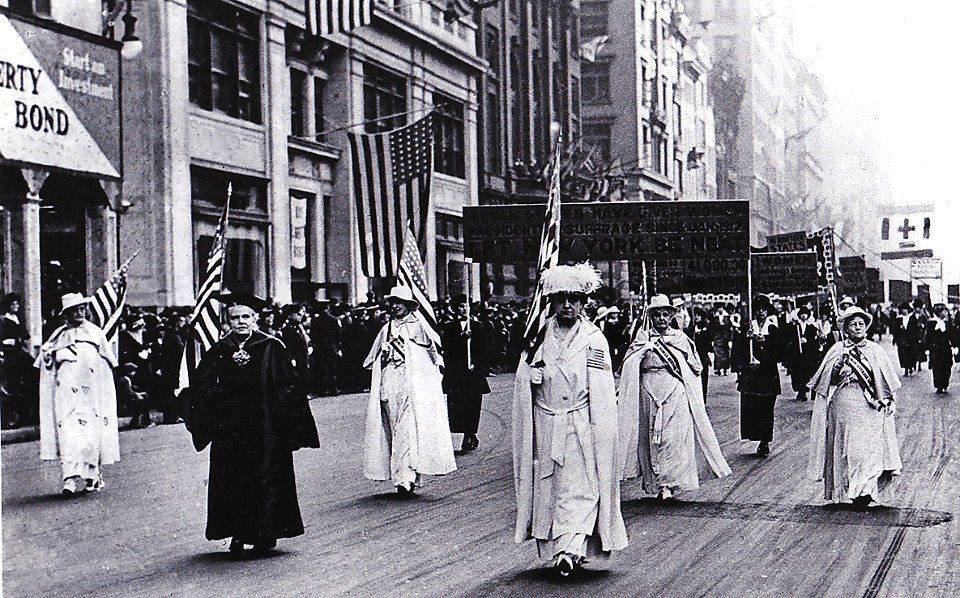
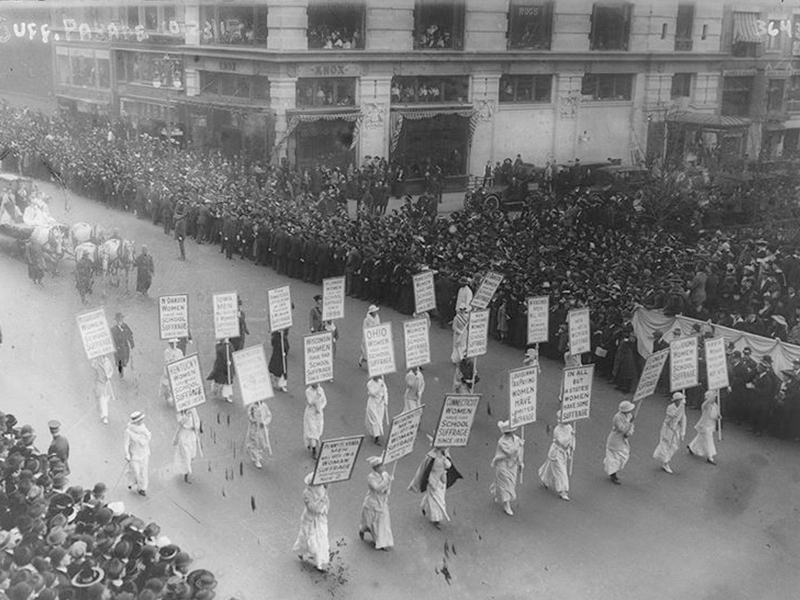
No town in the State could hold a parade this year without there being at least one suffrage float promoting the cause, and a week ago in New York City at least 20,000 marched for suffrage down Fifth Avenue. They were accompanied by 40 bands in a parade that took 3 hours to pass. Outside of the city, 80 full-time organizers have been spread out around the State, and have held about 11,000 meetings from Albany, Syracuse, Rochester and Buffalo to the smallest hamlets, with no military camp or church in the State overlooked as a potential speaking engagement.

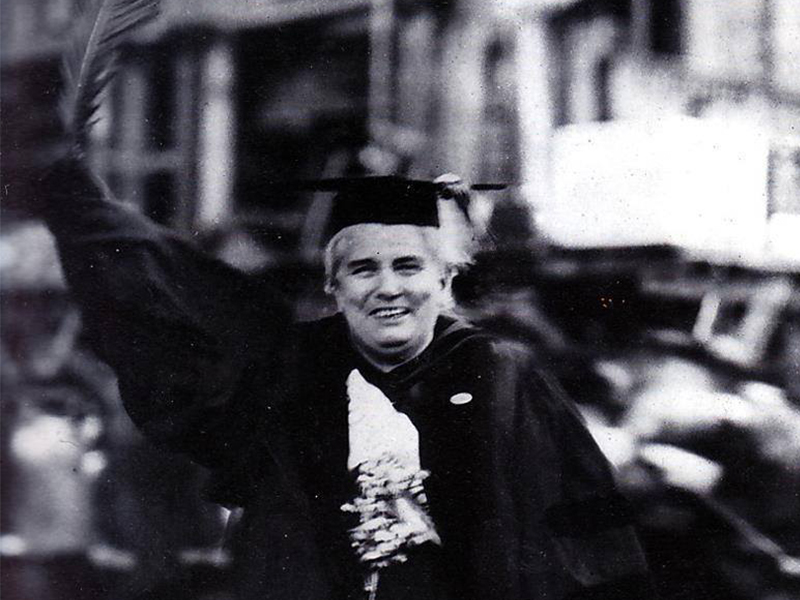
Carrie Chapman Catt, up front and near the center, and Rev. Anna Howard Shaw, in cap and gown on the left, lead at least 20,000 marchers in a suffrage parade down Fifth Avenue a week ago.

Just the fact that the suffrage amendment is back on the ballot so soon is a tribute to the persistence and political power of the suffrage movement. Resubmission required the approval of two successive State Legislatures, so Vera Boarman Whitehouse, head of the New York State Suffrage Party, deserves special praise for her skillful and tireless work in helping achieve this feat.

The great strength the suffrage movement is presently showing is even more remarkable considering how many suffragists are also engaged in war work. Once the U.S. went to war in April, members of the National American Woman Suffrage Association, under the leadership of Carrie Chapman Catt, and the Women’s Advisory Committee of the Council of National Defense, under Rev. Anna Howard Shaw, N.A.W.S.A.’s previous president, began encouraging and coordinating women’s defense work.

Though women’s war work has obviously taken time away from the suffrage struggle, it may actually help it, as more and more voting men are becoming aware of the contributions women are making to winning the world war. They are also beginning to see that withholding the franchise from women is not just unfair, but an embarrassment to our democratic ideals and gives the impression that the nation is unappreciative of women’s efforts to preserve democracy.

This evening more than 2,000 people packed a meeting at Durland’s Riding Academy on 66th Street to hear Rev. Shaw and other speakers talk of both patriotism and suffrage. After receiving a standing ovation when she took the stage, Shaw attacked an anti-suffrage leaflet entitled “Hugging a Delusion.” She noted that it was for the preservation and expansion of democracy that the Great War is being fought.

“Are the men who are fighting in the trenches hugging a delusion? Are the mothers who send their sons to the front hugging a delusion? Oh, the shame if it! Enfranchisement! The symbol of free men!” She later declared that she was so confident of victory on Tuesday that she invited everyone to come to a celebration on election night at Cooper Union.

James W. Gerard, former U.S. Ambassador to Germany, began by praising women’s war work and asking: “When have women ever failed to show the bravest spirit in the war?” He then went on to talk about the need for women to have a vote in order to win economic equality: “Women in industry do not receive the same wages as men. A girl in a box factory receives $4 a week, and if she wishes a pair of shoes she must go without meat and have only two meals a day.” The meeting was preceded by an all-afternoon rally at Columbus Circle, which followed a parade led by two women carrying large American flags.

Though elections are always unpredictable, it seems quite unlikely that New York will follow the example of Maine. Local suffragists there rejected Carrie Chapman Catt’s advice and got a suffrage referendum on the ballot on September 10th. It was defeated by (male) voters after a hurried, but intense campaign. New York’s campaign has been massive, well-organized, under way for two years, and will give the men of the nation’s most populous State a chance to show that they think their partners in the war effort deserve what the country says it’s fighting for: Democracy.

Today in Herstory: One Million New York Women Want Suffrage

Founding Feminists is FMF’s daily herstory column.

FoundingFeministLogo-color

October 31, 1915: Despite the fact that it was a Sunday, this was no day of rest for New York’s suffragists, with Election Day coming up on Tuesday.

The offices of the Woman Suffrage Party, Empire State Campaign Committee and Women’s Political Union were open early, and crowded at all times. Even the W.P.U.’s mobile “Suffrage Shop” somehow managed to host a total of about 1,000 people at various times during the day, while the final poll-watching class was going on back at its headquarters. The “antis” will not have poll-watchers, because they do not believe women are “fitted or qualified” for such work.

At the office of the Woman Suffrage Party there was clearly a good deal of activity going on, but exactly what’s being planned is a secret, with no one willing to discuss this latest project. “Be silent – the enemy listens” was the word here today, and many regular volunteers were nowhere to be seen, but are said to be busily working at some undisclosed location.

The battle of statistics continues, with Carrie Chapman Catt, head of the Empire State Campaign Committee, defending her claim that 1,000,000 of New York State’s women want suffrage, while Alice Hill Chittenden and Josephine Dodge of the New York State Association Opposed to Woman Suffrage say that only 10% of the State’s women want the vote. According to Catt: “We have made no ‘wild guess,’ we have ‘framed up’ no false statement. We canvassed. We found our million women.” Catt’s organization has gone to a great deal of trouble to gather these statistics. Many communities have been canvassed house to house, and the Committee has maintained booths at 98 county fairs, the State Fair, and numerous expositions.

Catt also noted that the “antis” have not changed their 10% estimate in ten years despite the phenomenal growth of suffrage sentiment in that time, as shown by the addition of seven States to the full-suffrage column in just the past five years. Suffrage parades didn’t even exist a decade ago, but the one on October 23rd was considered by even the most vehemently anti-suffrage newspaper in the city to have been a stunning and massive spectacle. Even that turnout was not a complete reflection of suffrage sentiment because according to Catt: “Thousands of women did not possess the physical strength to stand waiting for hours and then walk two and a half miles. Many were obliged to work Saturday afternoon, and thousands more to remain home with their children.”

Carnegie Hall continues to be a focal point of the New York campaign, as the anti-suffrage rhetoric of last night was replaced by equally strong oratory in favor of suffrage this evening. Rabbi Stephen S. Wise said: “The cause of equal suffrage is one additional symbol of the history of a great movement of the awakening, the revolt, the uprising of women against centuries of wrong and injustice, for repression and suppression are wrong and injustice.”

Rabbi Wise also spoke to the issue of the current European war, and said: “I do not say that wars will end when women have the vote, but I will essay the role of the prophet in this one instance and say that there is not going to be an end to war before the women have the vote.”

He then went on to take his most radical stand yet, supporting a kind of “pregnancy boycott” by women if men continue to deny them the ballot:

I can conceive that the time will come when women will say, ‘Either give us a share in the government or else we will no longer be mothers. We will not give life to a child and a child to life; we will not bear sons unless we can assure ourselves that they will be permitted to live’… In the face of this great calamity of war, how can men say that government could be made worse by the participation of women?

1619216_10203447287926426_8138818276177483812_n
One side of a pro-suffrage card being used to sway Massachusetts voters.

Enthusiasm for the cause has become so great that the police had to order a suffrage rally to quiet down because the singing of “America” was disturbing a church service being held by anti-suffragist Dr. Charles Parkhurst in the Madison Square Presbyterian Church. Once the service was over, the singing resumed.

Meanwhile, in Massachusetts, Margaret Foley addressed an audience of 2,000 in Worcester’s Mechanics Hall this evening. She admitted that this was an uphill struggle. She said that political bosses in her own city of Boston were “busy getting men out of jail so they will have their vote,” and U.S. Senator Henry Cabot Lodge and other powerful “Old Guard” politicians are openly working with the “antis.” She closed by saying: “We are not asking for any privileges. We are simply asking for justice. No more, no less.”

Foley said that though all wrongs would not be righted if women won the vote, “the men must trust us; with their assistance we will win by the largest majority given woman suffrage by any State in the Union.” In Springfield, Beatrice Forbes-Robertson Hale addressed an audience of 1,000 on the subject of “Women and Democracy.”

Registration figures in all three States with suffrage referenda on the ballot are unusually high, so interest in the election is great. That’s as it should be for such a momentous event, because nearly six million new voters could be added to the rolls if all the referenda pass. The number of women over the age of 21 in New York State is estimated at 2,757,521; in Pennsylvania there are 2,114,008 and in Massachusetts it’s 1,074,485, for a total of 5,946,014.

Though suffragists are expressing optimism, political leaders in each State are predicting defeat, so there are contingency plans. In Massachusetts, the 1915 campaign will immediately shift to a 1916 campaign if necessary. It may take longer to get back on the ballot in New York because of the cumbersome procedure involved, so suffrage in 1917 would be the new goal. In Pennsylvania, the State Constitution requires that a failed amendment must wait 5 years before being re-submitted to the voters, so suffragists there might try to get the State Legislature to enact “Presidential Suffrage” so that Pennsylvania women could at least vote for President, even if for no other offices. But at the moment, all efforts are concentrated on this year and the hope that no further campaigning will be needed in any of these three States.

Today in Herstory: Will New York Choose Suffrage?

Founding Feminists is FMF’s daily herstory column.

FoundingFeministLogo-color

October 30, 1915: The last Saturday before Election Day is traditionally a time of frenzied activity, and this one was no exception as New York suffragists expressed confidence about victory on Tuesday while working around the clock to attain it.

From elevated stages to down in the subways, “Votes for Women” advocates seemed to be everywhere, as did the color of “suffrage yellow.”

The 24 and 26-hour street corner speech marathons in Times Square and Columbus Circle have successfully concluded, and the enthusiasm and eloquence of the speakers were the same regardless of whether the audience was someone pausing briefly while on milk delivery rounds at dawn, or a large throng when the streets were crowded with those on their way to or from a restaurant or theater.

The suffrage orators at these marathons are usually found in threes, assigned two-hour shifts. One is an experienced veteran acting as a kind of chaperone as well as a senior speaker, accompanied by two younger suffrage speakers. It has been estimated that at the 24-hour rally almost 20,000 stayed long enough to listen to the principal arguments being made. Attendance and enthusiasm was also high at the “Yellow Rally,” a concert in Madison Square this evening with speeches made between the musical selections.

New volunteers are still coming in to the Woman Suffrage Party’s headquarters asking for work to do on Tuesday. Since there are already enough poll-watchers to staff every polling place in the city, the new recruits will be assigned electioneering duties, and stand the legally required 100 feet from the polls to answer any questions and give out sample ballots to voters. The official poll-watchers inside will be well-qualified, because the Party has been giving formal, mandatory training sessions for them since April.

The busy, but neat, shipping room of the New York Woman Suffrage Association, where vast amounts of literature have been sent out Statewide during this campaign.

One thousand women were in the Hotel Astor today at the Elizabeth Cady Stanton Centennial Luncheon, where they pledged themselves to victory. Then, as the event ended, they quickly rushed back to the various campaign offices to fulfill their pledges. Stanton was born on November 12, 1815, and it is hoped that women in her home State of New York will have the ballot by the time it would have been her 100th birthday. Harriot Stanton Blatch, head of the Women’s Political Union and daughter of Elizabeth Cady Stanton, said:

Our race is nearly run. Now, as we are approaching November 2nd and victory, we may well look back for 100 years and realize how, step by step, we have built up the organization of today. We have done this, too, of ourselves, for unlike every other disenfranchised class, we have not had one great group of men to fight our battles for us. With the exception of the aid of a few brilliant men, we have all these years been fighting our battle unaided.

There was a lively debate this morning at Carnegie Hall, with Katharine Houghton Hepburn, president of the Connecticut Woman Suffrage Association and Alice Hill Chittenden, of the New York State Association Opposed to Woman Suffrage doing most of the speaking. Among the best comebacks was one made by Hepburn, who said that if the “antis” really believed that there was great dissatisfaction with woman suffrage in the West among both men and women, they should be busy out there trying to get the women of those States to vote to disenfranchise themselves.

Carnegie Hall was filled again this evening, but by anti-suffragists, as they held their final big rally. James M. Beck, former Assistant Attorney General of the U.S., called woman suffrage “the most disastrous and absolutely irreparable experiment in the history of our Government” and said that if New York were to approve it on Tuesday, it would make State government such a farce that “Abandon hope all ye who enter here” should be written on the portals of the State Capitol.

A number of suffragists were in the audience, not to disrupt, but to see if there were any new arguments being made that needed to be refuted in the closing days of the campaign. But all the anti-suffrage speakers kept to the traditional arguments about how women don’t want to have the vote “forced on them” and that woman suffrage would destroy the family and society.

Colonel John P. Irish claimed that even though “only 20%” of women in California had registered to vote since winning the ballot in 1911, there had been a “300% increase” in juvenile delinquency. He then told the audience that this was because mothers were neglecting their family duties to become involved in politics and therefore “the human chicks are left to the hawk while the hen is up on the fence trying to crow like a rooster.” He failed to give any source for either of the percentages he used in his argument, and both figures are disputed by suffragists.

Former President Roosevelt has reaffirmed his support in writing for the suffrage amendment, and in doing so noted four Queens who were excellent rulers: Isabella of Spain, Elizabeth of England, Catherine of Russia and Maria Theresa of Austria. “If a woman is deemed fit to be the head of a mighty monarchy, surely no adequate reason can be advanced against allowing her to exercise the rights of sovereignty in a democracy,” he observed.

Making sure that everyone on the streets would get the “Votes for Women” message was not enough today. Over 100 “Lap Board” women, about half of them teachers, boarded the subway at the Seventy-second Street Station, and took the message underground. The placards, printed in black ink on a yellow background, and about half a square yard in size, were quite favorably received by the riders, and a good antidote to the anti-suffrage ads they saw. Pro-suffrage ads were barred by Ward & Gow, the company that posts subway ads.

Though the vast majority of those speaking for the established political parties in New York, Pennsylvania and Massachusetts are of the opinion that the suffrage referenda in each of their States will be defeated, suffragists are undaunted and looking forward to Tuesday night’s results. Election predictions are always uncertain, but there is no doubt being expressed by anyone at any suffrage headquarters tonight that the pro-suffrage side is running an all-out, honorable, and highly effective campaign, and that many more people support equal suffrage today than did so just a few months ago. So, victory is approaching, the only question is whether it will occur this time around or the next.

Today in Herstory: Suffragists Across NYC Hold Rallies and Meetings and Deliver Speeches for 24 Hours Straight

Founding Feminists is the FMF’s daily herstory column.

FoundingFeministLogo-color

October 29, 1915: The final few days and most strenuous phase of the New York State suffrage campaign was kicked off just after midnight this morning when the Women’s Political Union began 24 hours of continuous speeches at 47th and Broadway.

But that was only the first of 250 open-air meetings held today in various parts of New York City by suffrage groups as the November 2nd election approaches and last-minute arguments are being made to every potential male voter.

The Woman Suffrage Party has begun its own speech-making marathon at Columbus Circle, and among those expected to take the podium later this evening will be “General” Rosalie Jones. She led her hardy band of suffrage hikers from Newark, New Jersey, to Washington, D.C., in February, 1913, and on two hikes from New York City to Albany in December, 1912 and January, 1914.

The rally at Tompkins Square began a few hours ago and features a band, with Dora de Vera of the Boston Opera Company doing the singing. Another of the big rallies being held tonight is in Madison Square with music provided by the 100-piece Beethoven Symphony Orchestra.

But tonight’s rally in Carnegie Hall was certainly the biggest, as well as the best advertised. Not content to just distribute massive numbers of flyers about it around town, its sponsors had young women, led by a bugler, and wearing front and back “sandwich boards” promoting the rally, walking around town from 2 p.m. until just before the meeting began. This is a typical example of the enthusiasm of the entire campaign, because there was really no chance that the event would be less than a sellout thanks to Carrie Chapman Catt presiding, and a number of noted orators making the case for suffrage.

James Montgomery Flagg's cover illustration for this week's issue of "Leslie's," showing a "Votes for Women" advocate in a Revolutionary War uniform with a reminder that "taxation without representation" continues for women. It's captioned: "As her father fought so will she."
James Montgomery Flagg’s cover illustration for this week’s issue of “Leslie’s,” showing a “Votes for Women” advocate in a Revolutionary War uniform with a reminder that “taxation without representation” continues for women. It’s captioned: “As her father fought so will she.”

One of the Carnegie Hall speakers was Representative Edward Keating, Democrat of Colorado. He got a laugh when he addressed some of the statements made by anti-suffragists that “Votes for Women” has been a failure in the Western States: “I ride in the subways here in New York and I read the anti-suffrage signs and learn many new things about the West that I never knew before.”

Rabbi Stephen S. Wise’s speech was so well received that he was compelled to do another, and in the encore he said that he wished he could do something similar on Tuesday and vote twice for suffrage. He also talked of the European war, and said that women should have had a say about whether their nations should have become involved: “There will never be a beginning of the end of war until women have such a voice.”

Mothers who favor suffrage have been driving around all day in the “Baby Truck,” decorated with drawings of “Kewpies” by suffragist Rose O’Neill. The truck contains suffrage balloons and toys to be given to children while their mothers go to meetings or listen to speeches given by, and addressed specifically to, mothers. Even though none of the women in the audiences can vote, they can certainly influence the men who do vote by using the pro-suffrage arguments they hear.

The campaign is being run with professional political precision. Seven years ago names on suffrage petitions were gathered, then index cards made for each name. In addition to this, polling lists are used to gather more names for the index cards. Canvassers then go out and knock on doors and mark “S” on the cards of those who indicate they’re pro-suffrage, “I” if they’re indifferent, and “U” for unconverted, rather than a more pessimistic “O” for opposed. This tactic could prove to be as effective as anything used by any political machine in the city’s history.

Though no one at the Empire State Campaign Committee would give exact figures, and the outlook in Rochester and Syracuse is not favorable, there was a universal expectation of victory at its office today. Voter registration is up Statewide, and most of these new voters are thought to be pro-suffrage. Speeches have been well received, and the turnout for the parades and other events has been phenomenal. Alva Belmont, of the Political Equality Association, said today:

Not long ago it was almost impossible to get a man to consider the subject, and now I find that they come into our headquarters and buy literature because they want to understand the question. Miss Florence Harmon, who does most of the speaking for the association is often kept out, with her mother, until 1 o’clock in the morning answering questions. The men are so interested they buy literature off her on the street and give generously to the contributions for the work. As suffrage is only a question of reason and justice, as soon as people begin to consider it they will favor it.

Of course, no amount of confidence will lead to any slackening of efforts between now and November 2nd. In fact, the campaign will continue even on Election Day itself with 2,500 women officially certified in Manhattan alone as poll-watchers. They will be on duty inside the polling places to guard against fraud. There will also be volunteers stationed as closely as the law allows outside every polling place to give instructions, answer questions, and give out sample ballots showing how to vote for suffrage. The suffrage organizations are doing everything right – and in just four days we will know if the voters do their job right as well.

Today in Herstory: New York City Suffragists Begin Final Election Push Marching by Torchlight

Founding Feminists is FMF’s daily herstory column.

FoundingFeministLogo-color

October 28, 1915: Standing in the large, cheering crowd at 59th Street and 8th Avenue tonight watching the torchlight suffrage parade, it’s hard to imagine how the New York campaign could possibly get more intense that it has been up until now.

But that’s exactly what’s about to happen in the five days remaining until Election Day on November 2nd. Tomorrow is when the unprecedented push actually begins, and today all the major suffrage groups were busy making sure that everything goes just as planned when the final offensive is launched.

There is a quite impressive alliance of organizations arrayed on the pro-suffrage side in New York: The National American Woman Suffrage Association, Empire State Campaign Committee, Woman Suffrage Party, Women’s Political Union, Equal Franchise Society, and the Political Equality Association. All of them have been working hard for months, but far more ambitious plans are now being finalized for everything from huge rallies in the city’s largest halls to actions in the subways.

Improvisation brought about the subway event. Originally, suffrage groups wanted to simply post conventional subway ads by buying space and using some other space donated to them by a business that has a long-standing contract to post its own ads. But Ward & Gow, the advertising firm that places ads in subways refused to sell space to suffrage groups, or allow them to use the space donated by one of the company’s regular clients. The Public Utilities Commission has just ruled that it has no power to compel Ward & Gow to allow the ads. So instead, women will ride around all day tomorrow holding big placards in their laps for their fellow passengers to read, in order to counteract the numerous anti-suffrage ads the company has allowed to be displayed in the cars.

Not all sign-carriers will be underground, however. Tomorrow, from 2 p.m. until 7:30 p.m., women wearing “sandwich boards” front and back, advertising that night’s huge rally in Carnegie Hall, will be walking around town. And just to be certain they’ll be noticed by as many people as possible, they’ll be preceded by a bugler.

Though small in comparison to events to come or the massive pageant five days ago, tonight’s parade was still quite impressive, with large, colorful banners, band music, decorated automobiles, and at the end of the parade route even a cartoonist, Lou Rogers, turning out drawings lampooning the opposition. A “Victory” banner led the procession, with four U.S. flags following. The best float showed “Miss New York” bound to “Ignorance,” “Prejudice,” and “Vice” due to women not having the vote. At various points along the route, individual automobiles would drop out, park, then speakers would stand up in them and hold street corner rallies for the spectators.

Even the enormously popular "Kewpies" have been recruited into the suffrage campaign thanks to the strong support of their creator, Rose O'Neill.
Even the enormously popular “Kewpies” have been recruited into the suffrage campaign thanks to the strong support of their creator, Rose O’Neill.

While still confident about winning the State in general, a few places are now being conceded to the “antis.” Unfortunately, one of them is Monroe County. Its county seat is Rochester, which was the home of Susan B. Anthony. The Rochester Herald is strongly opposed to suffrage. “The odds are heavily against us here, although we have worked hard and had good audiences. I fear Monroe is gone and our only hope is that the majority against us will not be too heavy,” said Alice Cramer Clement. But in other nearby rural counties, the outlook is far more optimistic. She thinks suffrage will carry in most of them. In Ontario and Wayne Counties, she said that 90 per cent of those surveyed favored woman suffrage.

But while prospects in Monroe County may look gloomy, there was plenty of optimism at a suffrage rally in Oyster Bay, where a letter from former President Roosevelt was read to the crowd. He wrote:

The opponents of woman suffrage say that it will take women away from the home. If this were so I should certainly not favor it, just as if giving man the suffrage took him away from his business I should not favor it, for making and keeping the home must always be the chief work for both man and woman. There is, however, in my opinion, nothing whatever in this objection. Undoubtedly some foolish women may believe that getting the vote will excuse them from the performance of home duties just as in every democratic extension of the suffrage some foolish men have believed that getting the vote somehow entitles them to live without working. But it is no more possible to base action on an argument of this kind on one case than the other.

In Pennsylvania, where there is also a suffrage referendum coming up on November 2nd, Eudora Ramsey gave a fine speech at an open-air meeting tonight in front of Rhodes Drug Store in Wampum, near New Castle. She made some excellent observations about the unfairness of restricting the vote to men, beginning with the fact that every year in almost every town she visited, more girls graduated from school than boys. Why should a woman not vote is she has more education than a man? And “why should a woman who owns property and pays taxes not be able to vote when a man votes whether he owns property or not?”

Ramsey then addressed some of the anti-suffrage arguments, and like Col. Roosevelt, began with the principal one that voting would interfere with a woman’s duties at home and thereby cause great harm to the family and society. She noted that no one thinks businesses collapse or that men can’t be excellent employees if they take a little time out once a year to vote. As to the “ballots = bullets” argument: “Some men are physically unable to go to war but yet they vote. A preacher is not supposed to fight, yet he votes …. Many under 21 fight but do not vote, therefore fighting and voting do not go together.” She concluded by telling the audience:

Would a woman vote for war? No, and this is why we need women’s votes. Remember the women on Tuesday. On Amendment Number One we find yes and no. Put a cross by the sign of yes, and you’ll pay tribute to the womanhood of the State, and by doing this you will line up with God’s progressive people.

In Massachusetts, the third State that will vote on suffrage on Tuesday, there are at least 50 women typing away every day at the Boston headquarters of the Massachusetts Woman Suffrage Association, with volunteers coming in and out all day and well into the evening. One of their goals is to send out 630,000 circulars, so they’ve been busy on that for a while and will keep working until every last one is mailed. Among the things mentioned in the flyer is that all the candidates for governor favor suffrage.

The gubernatorial nominees of the Progressive and Socialist parties have gone a step further than endorsement, and given suffrage speeches. And though the two major party candidates have only given their endorsement, and not campaigned for the issue, the prestige of having Governor Walsh and his principal rival on record as favoring suffrage should be of great help on Election Day. President Wilson’s support for woman suffrage, at least on a State-by-State basis, is also prominently mentioned.

Boston suffragists are often cheered by the positive, free publicity given the movement by the local newspapers, who are “rooting for the cause” according to W.H. McMasters, a leading suffragist who can usually be found at the Boylston Street headquarters.

In addition to press support, organized labor is also on board. The State branch of the American Federation of Labor has endorsed suffrage, and many of its well-known leaders have given speeches calling woman suffrage a labor issue.

Of course, as everywhere else, saloon interests in Massachusetts are freely opening their wallets and quietly bankrolling anti-suffrage organizations. One of them, the Massachusetts Association Opposed to Woman Suffrage, has its headquarters just a block away from the pro-suffrage group. Their campaign is much more low-key than the sophisticated, aggressive, and overtly political campaign being waged by suffragists because they don’t believe in “the woman politician.”

Rev. Anna Howard Shaw, president of the National American Woman Suffrage Association, addressed a mass meeting at Associate Hall in Lowell tonight. The program opened with the band playing “America” while the audience waved small American flags provided to them. She eloquently pleaded not just for suffrage, but for every progressive reform that woman suffrage could help bring about. She also noted that the present European war might have been averted if women had been part of the political establishment:

What a different world it would be today if those few men in Europe had just consented to come together and talk the matter over. Women would have talked the matter over until it was settled. It might be wearisome, but it wouldn’t have been death.

Shaw challenged the male voters of Massachusetts to live up to the principles of a republic:

All we are asking is that men should look the truth in the face, to believe the thing they believe. Do we believe the republican form of government is desirable? If we do, then let us have it. If we do not, then let us say so, honestly, like men, and say that we believe in an aristocracy. When did the people of Massachusetts ever elect representatives? Never in the world!

The men of Massachusetts have elected representatives, and men are people, admirable people, as far as they go; but then, you see, they only go half way. There is still another half of the people who have never elected their representatives. When one-half the people elect representatives to represent the whole of the people, it is not a republic but an aristocracy.

As in New York and Pennsylvania, the Republican and Democratic parties are observing an official “hands-off” policy, so with the political machines standing on the sidelines in all three States with upcoming suffrage referenda, there’s a good chance of victory if, as suffragists believe, that’s what the average male voter wants.

Today in 1915: Suffragists Take On Candidates Violating Promises to Support the Woman’s Vote

Founding Feminists is FMF’s daily herstory column.

FoundingFeministLogo-color

October 27, 1915: One day after Tammany Hall leaders made a pledge of neutrality, and assured suffragists that no New York County Democrat would work against the upcoming suffrage referendum, a clever and very effective campaign was launched today by the Women’s Political Union to embarrass those who may consider violating that promise.

John F. Curry was unable to refrain from making anti-suffrage remarks for even the duration of the day the pledge was made, so today the Union produced a photograph of his signature, as well as those of other Tammany politicians, affixed to a document signed just last year as the State’s Democrats gathered in convention at Saratoga, where a plank favoring woman suffrage was adopted. The document read:

We the undersigned members of the Democratic Party in the State of New York, urge our Representatives in State Convention assembled, that the platform of 1914 not only renew the party’s promise of 1912 to refer woman suffrage to the voters, but pledge the party to stand in the Constitutional Convention for submitting a Constitution embodying woman suffrage, and we further urge that the platform of 1914 call upon all Democratic voters, when woman suffrage is submitted to them, to help fulfill the ideals of the greatest leader of our party and establish in this State government based upon the consent of the people.

The Union then invited any of the men who signed that statement and are now thinking about expressing opposing views to drop over at any time to refresh their memories about what they believe in regard to woman suffrage.

"Life" magazine's cover back on July 1st showed a suffragist "retouching an old masterpiece" by inserting "and women" into the line in the Declaration of Independence proclaiming that "all men are created equal."
“Life” magazine’s cover back on July 1st showed a suffragist “retouching an old masterpiece” by inserting “and women” into the line in the Declaration of Independence proclaiming that “all men are created equal.”dismo

The theater campaign went very well earlier this evening, as many of the boxes in New York’s finest theaters bore suffrage yellow bunting and posters that read: “VOTE YES ON WOMAN SUFFRAGE NOV. 2.” In some locations, orators were permitted to make suffrage speeches during intermissions or after the performance. Books of matches with a pro-suffrage message on their covers were also distributed to patrons, as well as many leaflets giving pro-suffrage statements from prestigious individuals up to and including President Wilson.

Senator William Borah, Republican of Idaho, has journeyed across the country to help the cause, and just gave a speech to the Bronx Woman Suffrage Party at Hunt’s Point Hall. He said in part:

Do not mind what the ‘antis’ say about suffrage, for I am willing to predict that they will be the first to rush to the polls when women get the vote …. According to the voting records there were 108,000 citizens who did not vote at the last election. Why not permit the 200,000 women of this greater city to vote and make up this deficiency on the part of the men who fail to perform their political duty?

Borah had an audience of more than 3,000, of which at least 1,800 were men. There would have been more listeners, but when the hall reached its capacity at 8:30, Police Captain Palmer closed the doors. Rabbi Stephen S. Wise has returned from speaking for suffrage in Massachusetts, and spoke this evening as well.

On another front, Vera Boarman Whitehouse is going to the Public Service Commission to complain about Ward & Gow, a local firm which has refused to take suffrage advertisements for subways, and will not even allow suffragists to place placards in spaces donated to them by a supporter who normally uses the space for his company’s advertising. Ward & Gow has accepted and posted ads from anti-suffragists, so it has no blanket ban on “issue” ads. If the Commission doesn’t act by Saturday, many of the women of the Empire State Campaign Committee will carry pro-suffrage placards in their laps and ride around all day so subway riders can read the pro-suffrage side of the argument, as well as see that actual suffragists look much different from the negative images of them that anti-suffragists promote.

Suffragists have been making a major effort in Buffalo for two years now, and the public is finally starting to warm up to it, according to Marjorie Shuler. She’s quite optimistic and says: “If this remarkable change means anything, it indicates that we have made headway, and that we can look hopefully for a good vote on Election Day.” The Empire State Campaign Committee oversees all the activities there and in neighboring counties, and currently averages 18 open-air meetings daily.

In Massachusetts, the battle continues in written form as well as speeches. An advertisement for the big meeting in Associate Hall in Lowell tomorrow night contains a number of reasons why Massachusetts working men should vote for suffrage. Entitled “Plain Facts for the Working Man,” it says:

You know that your vote helps you to get better working conditions. Why? Because it helps to elect to office the men who can get you what you want. If you were to die tomorrow and your wife and daughters had to work, they would need the vote for the same reasons. You love your family, but you are away all day and your wife looks after the children and the home. Think what happens when the food supply has not been properly inspected, where there is cheating in weights and measures and in the quality of goods. Your earnings are wasted. Think what happens when there are not enough schools or playgrounds. Your children go without education and play in crowded streets.

Think what happens when housing laws are bad, and streets are filthy and milk isn’t pure. Your babies sicken and die. Think what happens when dance halls and theaters are not decent, and when unlawful sale of ‘dope’ is carried on. Your boys and girls are in danger of going wrong. Remember you haven’t time to look after all these things, and your wife’s complaints to the City departments that control them do no good because she hasn’t the vote. And don’t forget there are more working people in this State than any other kind. When you let the women vote, you will double your power for getting what you need. Think it over and vote for the Woman Suffrage Amendment, November 2.

The Fitchburg branch of the Massachusetts Anti-Suffrage Association is summarizing its case to the public as well:

Mr. Voter: The suffrage fight is not a fight between men and women, but a fight between women. A small minority of women is demanding the ballot, and thus is trying to trample on the real rights of the majority of women who wish to remain free from political responsibilities. The sexes were created different, and designed to cooperate not to compete. Each is superior in its own sphere. Both are essential to life. The duty of men is to protect women from the wasteful and unnatural burden of political life. Vote no on Nov. 2.

In Pennsylvania, the suffrage amendment picked up the unanimous endorsement of the New Castle Teachers’ Federation this evening thanks to the eloquence of Eudora Ramsey, visiting the city from North Carolina to take part in the campaign. Suffragists in the Keystone State are expressing confidence, because the recent unsuccessful vote in New Jersey was in a special election, while the vote in Pennsylvania will be at a regular election, so the turnout should be much higher and be a more representative sample of the population. Pennsylvania suffragists have also encountered no meaningful opposition from any of the powerful political machines in the State, quite the opposite of what happened in its neighboring State where suffrage was defeated on the 19th.

There are just six days left to win three States. That’s no easy task, but all “Votes for Women” advocates are eager to meet the challenge!

Today in 1915: Suffragists Across the East Coast Are Ready to Fight for the Vote

Founding Feminists is FMF’s daily herstory column.

FoundingFeministLogo-color

October 24, 1915: With just nine days left until three big Eastern States vote on woman suffrage referenda, the battle for women’s equality at the polls goes on in large cities as well as small towns, and is being waged by both women and men.

From Boston, Massachusetts, to Biglerville, Pennsylvania, there has been a great deal of activity, as suffragists in all States enjoy increased respect and feel more confident after the success of yesterday’s stunning pageant on Fifth Avenue in New York.

In Boston this evening, there was a suffrage rally in Tremont Temple in which California’s most notorious anti-suffragist, Col. Irish, was the target of much humor. According to Samuel J. Elder: “A California colonel who has been making anti-suffrage speeches hereabouts says, if quoted correctly, that politics degrades women and makes them vulgar; if he means that the women of California have been degraded and vulgarized, I pity him when he goes home.” (California women won the vote four years ago.)

Elder himself was an anti-suffragist just a year ago, but has since been converted to the cause, and thinks that thousands of other Massachusetts men have also changed their minds: “The idea that a man should not know more today than he did a year ago is intolerable. That is what makes the suffrage cause a hopeful one.”

Mr. Elder said that those who think a woman’s place is in the home should consider the fact that:

About nine-tenths of the legislation relates to the home. Why should not women, who ‘belong in the home’ and have to stay in the home have an equal share in deciding the nature of that legislation? Have women got to wait until all the old duffers are dead and a new generation of men has grown up to liberate their mothers, sisters and wives?

Rabbi Harry Levy of Temple Israel got a good response to a speech in which he said that much of the opposition to woman suffrage is based on ignorance. He said that he was a suffragist because Judaism was democratic and democracy must include woman suffrage: “This is a government of, by and for the people, and not a Government in which one-half the people are taken care of by the other half.” He then noted some of the benefits woman suffrage had brought to the Western States, such as mothers’ pensions, an eight-hour day with decent wages, and an increase in the age of consent.

Anne Martin, of Nevada, also addressed some of the objections to woman suffrage, then said that if the men of the East don’t approve the upcoming suffrage referenda, the 4.5 million voting women of the West would use their influence to get suffrage for Eastern women through a Constitutional amendment. Meanwhile, in Springfield, Senator William E. Borah, Republican of Idaho, praised the work the voting women of his State had done in the 19 years since they won the franchise as he addressed a meeting of the Springfield Equal Suffrage League attended by 1,200 people.

Various local polls in Massachusetts show women are far more supportive of suffrage than men. In Holyoke, a street car poll showed 7 men for and 6 against, while 5 women favored it and only 1 was opposed. In a lunchroom, 17 men were polled, with 10 against, 4 in favor and 3 undecided. In a barbershop it was 3 against, 1 for, and 1 undecided. In Fitchburg, a much larger poll was taken, which found that of 325 women, 222 favored suffrage and 103 opposed it. Of course, only the men will be voting on November 2nd, but the local Equal Suffrage League has a membership of almost 400, and is hoping their work will change a few minds by then.

Mount Holyoke students getting ready to march for the cause in Springfield, Massachusetts.

The Boston Globe has been asking Governors of suffrage States about their views on the issue, and today received a telegram from the Governor of Oregon, where women won the vote on November 5, 1912, by a margin of 4,161 votes out of 118,369 cast:

Replying to your inquiry as to my personal opinion regarding the working of woman suffrage in Oregon, it gives me sincere pleasure to indorse its operation here emphatically. I hope the voters of Massachusetts will have the good sense to take the forward step.The women of Oregon have taken and continue to take an active interest in public affairs and use their ballots thoughtfully and well. Education, child protection, civic morality and other of the larger issues of community life inevitably are closer to women than to the men, and where women vote these big questions, upon which rest our best development, they receive an oversight and direction which do not permit of their neglect or abuse. I favored woman suffrage many years before Oregon obtained it, and after two years of votes for women here I indorse it more emphatically than ever. James Withycombe, Governor of Oregon.

In other Massachusetts actions, Rabbi Stephen S. Wise, founder of New York City’s Free Synagogue, and who recently campaigned in New Jersey for that State’s October 19th suffrage referendum, took time out from suffrage work in New York to speak for equal suffrage tonight at a Zion Association of Greater Boston meeting at Convention Hall. The Boston Typographical Union #13 met at Faneuil Hall and gave its endorsement to suffrage. Upcoming events include a speech by Rev. Anna Howard Shaw at Associate Hall in Lowell, and a meeting at City Hall by the Lowell Suffrage League.

In Pennsylvania, there was an open-air meeting last evening in Biglerville, at which John D. Keith, Esq., and Rev. J. B. Barker spoke to a large and attentive audience. Keith recounted the history of the country’s expansion of liberty, and said it was past time for women to be included. Baker emphasized that voting was consistent with women’s duties and privileges in regard to home, school, civic and reform movements.

The “Women’s Liberty Bell,” which was featured at a big rally in Philadelphia on the 22nd, will arrive in Prospect Park tomorrow, where it will be the centerpiece for a meeting outside the Post Office. It will then go on to Chester, accompanied by Helen Todd.

Interestingly enough, Florence Piersol, head of the Philadelphia branch of the Pennsylvania Woman Suffrage Association, said yesterday that she found husbands more supportive than their wives: “Again and again, when we ask women how they stand on this vital question, we get a reply something like this: ‘I am on the fence, but my husband believes in it and is going to vote for it.’ ”

The importance of individual actions is critical to victory. Both Pennsylvania Republicans and Democrats have taken a “hands off” position in regard to the suffrage referendum, and while the decision of Republican U.S. Senator Boise Penrose not to actively oppose the measure was clearly useful in getting it on the ballot in the first place, the fact that neither party is actively working for it makes it hard to reach the State’s many voters.

Fortunately, President Wilson, the nation’s highest-ranking Democrat, has given his support to suffrage – at least on a State-by-State basis. But he won’t be campaigning for any of the suffrage referenda in any of the three States where the measure will be on the ballot next month. Pennsylvania’s Republican Governor, Martin Brumbaugh, has given some personal support in the past, but has remained silent on the issue lately. However, there was an exception made when he talked to the students at Swarthmore on Founders’ Day and said he saw no reason why “girls should not play a part in government as well as in the classroom.”

There’s still hope in Philadelphia, even though the city’s mayor, Democrat Rudolph Blankenburg, has thus far been keeping out of the campaign. He’s a avid reformer, known to be a supporter of woman suffrage, and married to an active suffragist, so he may yet take part in the campaign if it looks like the voters of his city might make the difference between victory and defeat. But with or without the help of big-name politicians or party machinery, suffragists are confident that the three remaining suffrage battles of this year can be won, and no one will be letting up until the last vote is cast on November 2nd.

Today in 1915: Over 250,000 Suffragists Took Over Fifth Avenue

Founding Feminists is FMF’s daily herstory column.

FoundingFeministLogo-color

October 23, 1915: What a day for suffrage!

Though the male voters of the Empire State will decide 10 days from now whether New York will become an equal suffrage State, Fifth Avenue was certainly woman suffrage territory this afternoon. No matter what happens on Election Day, the most vivid and long-lasting memory any local suffragist will have of this campaign will be of the unprecedented turnout today and the flawless way in which every participant performed.

Making bold predictions of a record-breaking number of marchers for a parade is always a very risky move. A moderate-sized procession could be described in the newspapers as a “disappointing turnout,” and in this case, coming so soon before a vote, such headlines could have dimmed the chances for passage of the upcoming suffrage referendum.

But much to the relief of organizers – and all who favor equal suffrage – the optimistic forecasts were at the very least fulfilled today, and in the opinion of some, exceeded. New Yorkers saw a spectacle that will long be remembered by both participants and spectators, and which must have made a highly favorable impression on undecided voters, and even on some of the movement’s skeptics.

1902062_10203403496511668_633603237654655619_n

Yesterday, organizers announced that 47,230 people had signed pledges to march. But according to Police Inspector Myers, in charge of the traffic squads, there were 50,000 in the streets today. Chief Inspector Schmittberger estimated at least 35,000 marchers, and said the crowd numbered 250,000. Other estimates went as high as 60,000 marchers. But though anti-suffrage groups are claiming there were fewer marchers, there won’t be much time wasted quibbling over numbers, because absolutely no one doubts this was the largest suffrage parade in history, and a truly stunning procession.

Marchers and spectators began gathering at Washington Square early in the afternoon, with each of the participants searching out the group they’d pledged to march with, while bystanders began buying huge amounts of suffrage pennants, balloons, buttons, and anything in “suffrage yellow,” or which had the name of a suffrage organization on it. By the time the parade was to start, the 1,500 police officers assigned to crowd control were fully occupied keeping the spectators on the sidewalks, and the street clear.

The parade kicked off right on time at 3:00, with the first group of marchers passing the Fifth Avenue and 41st Street reviewing stand in front of the Public Library at 3:40. The last of the marchers did not finish passing the dignitaries until 7:10 this evening. These undeniably large numbers left no doubt that the loss of the New Jersey suffrage referendum four days ago has only spurred suffragists on to greater efforts, rather than discouraged anyone from making an all-out push to win in New York, as well as Pennsylvania and Massachusetts on November 2nd.

The procession was headed by mounted police, followed by the New York Seventh Regiment Band, and Grand Marshal Ethel Stebbins. Not far behind them was the International Woman Suffrage Alliance, displaying slogans noting that women in several other nations, such as Iceland, have won equal suffrage: “REYKJAVIC VOTES; WHY NOT NEW YORK?”

Though many of the most memorable sights were of huge, complex, horse or automobile-drawn floats, it was the well-known and highly respected Rev. Anna Howard Shaw, marching behind the National American Woman Suffrage Association banner in her cap and gown that brought the first big round of applause. The plucky New Jersey delegation, holding a banner that said: “NEW JERSEY: DELAYED BUT NOT DEFEATED” got even more applause. This expression of support was something they must have appreciated after having just suffered a major delay in attaining suffrage since they cannot re-submit their failed suffrage referendum until five years have passed. The suffragists of Rutherford had their own banner, taking pride in the fact that the men of their city had voted nearly two-to-one in favor of equal suffrage for women.

One of the largest groups was composed of teachers, with some delegations wearing dark suits and yellow suffrage sashes, while other contingents wore the traditional caps and gowns. They held such banners as: “YOU TRUST US WITH THE CHILDREN; TRUST US WITH THE VOTE.”

As might be expected, the Manhattan delegation was huge and well-received by the crowd. It featured a blindfolded woman representing “Justice,” bound by a rope held by three masked men dressed in black, labeled “Vice,” “Ignorance,” and “Prejudice.” But it was an elderly woman in the delegation, carrying a placard that said: “GETTING THERE AFTER TRYING FOR FORTY YEARS” who may have gotten the biggest cheer of the day.

Young Brooklyn suffragists carried parasols inscribed: “THE SUN WILL SHINE FOR US NOVEMBER 2ND,” while some Bay Ridge activists wore white and blue costumes as they walked alongside a wagon containing two small children. The motto on the side was: “WE WANT OUR MOTHERS TO VOTE.” But it was the Woman Suffrage Party that put the most children on a float – and even had Rose O’Neill herself decorate it with her famous “Kewpie” cartoons. A large “Kewpie” doll was swinging back and forth on the front as the float drove down the street.

There were floats illustrating everything from woman suffrage around the world to those showing women representing “Victory,” “Liberty,” “Equality,” and “Justice.” Some marchers were over 70 years of age, while others as young as 7 months were pushed in carriages or carried on a marcher’s back. At least 2,500 men marched with the women, a number of highly skilled equestrians impressed the crowd, and so many bands played that at no time or place along the route was there ever a lack of music in the chilly Autumn air.

Every imaginable occupational group was represented, generally with members in some costume denoting their profession, as well as a banner in front stating what their work was, in case there was any doubt. Each suffrage group, from the largest to the smallest, had its own delegation and unique colors, though white and “suffrage yellow” were the most common.

This was truly a great day to be a suffragist – or in some cases, to become one. If the victory sought today is achieved on November 2nd, it means this perfect parade will never have to be equaled or topped at any time in the future, and will be the way the final days of the suffrage campaign in New York State will be fondly remembered.

>