Founding Feminists: September 9, 1912

Founding Feminists is the FMF’s daily herstory column.

founding-fems

If the Progressive Party is to win the White House in November, women must register and vote in great numbers, according to former – and hopefully future – President Theodore Roosevelt. He was in Spokane today, urging women in Washington State to take full advantage of their right to cast a ballot in the upcoming General Election. He told 2,500 women gathered at the American Theater: “The suffrage having been given to you, it is not only your right but your duty to exercise it. You are false to your duty as citizens and as women if you fail to register and vote.”

His speech was most timely, because today is the final day of registration for the November 5th nationwide election. Apparently his words were quite effective, because after the conclusion of the program, women crowded the places of registration much as they did right after winning the vote here two years ago. Several hundred women were seen standing in the registration line a block away from the theater soon after the conclusion of the first of his two speeches today to female audiences.

Colonel Roosevelt’s speeches were unique in two ways. He had never addressed an all-female audience before, and neither the Democratic nor Republican Presidential candidates have yet made a speech to a similar audience. At first he was a bit hesitant, not quite sure what to say, but many years of campaigning coupled with his own excellent instincts soon took over, and before long it looked and sounded like a traditional Roosevelt rally. Following his introduction, and after shouts of “Hurrah for Teddy” subsided, he told why he and the newborn Progressive Party have earned women’s votes:

One of the things that has given me peculiar pleasure is the fact that this is the first party that ever put forth a woman suffrage plank and then tried to live up to it. We have not only declared for woman suffrage, but have tried to live up to the declaration. At Chicago we had women delegates, not only from the suffrage States, but from States that have been dragged along at the tail of the procession. We had them not only from Colorado and Washington, but from Massachusetts and New York. One of the memories of that convention that I shall always prize is the fact that one of my seconders was a woman, Miss Jane Addams.

He said he wasn’t really a “convert” to woman suffrage because he had always supported it, but that he had been changed from a passive suffragist to an active one by some of the women he’d met who were doing social reform work. He knew that suffrage would add to their power and respect. He also stated that rather than interfering with the home, suffrage will be good for it :

I believe that it will tend toward an increasing number of ideal homes, an increase in the sense of co-partnership between the man and the woman, and make each think more of the rights of the other than of his or her own rights. Just as a man can do better work for others if he is a free man, so a woman can do better work for others if she is a free woman.

via Wikimedia
via Wikimedia

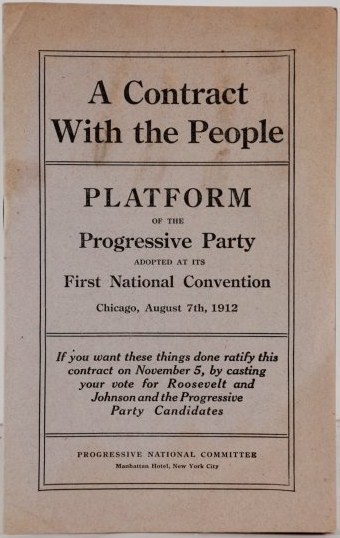
The Progressive Party Platform endorses “minimum wage standards for working women, to provide a ‘living wage’ in all industrial occupations,” so its Presidential nominee addressed that issue, and compared his views with those of one of his rivals, Democrat Woodrow Wilson:

We have studied the conditions among girls and women in industry, and know the suffering, misery, crime, and vice that are produced by an income that is insufficient to enable the girl or woman to keep body and soul together in surroundings of ordinary decency.

Mr. Wilson’s fears that the employers of these women, if obliged to pay them a proper wage, would reduce all the other employes [sic] to that same minimum wage are groundless. The employers who now pay employes a starvation wage prove by that fact that they are paying all the employes the very least they can get them to take. The objection is one of the schoolroom, and will not have weight with those who know what life is.

His loudest rounds of applause came when he told the mothers in the audience that in regard to parenting, “father has an easy time of it,” and then he repeated his invitation to women to turn out on election day: “Bring your husbands and brothers along with you if you can; but if you can’t, come anyway.”

Sarah Flannigan, a local Roosevelt campaign worker gave a clue about why getting out the women’s vote is so crucial to Progressives : “When I ask a woman how she is going to vote, she always looks a little surprised at the question, and then says in an astonished way: ‘Why, for the Progressive ticket, of course.’ I am speaking now of mothers, and the more children they have the more strongly they are for Roosevelt.”

The campaign train will now move on, but Col. Roosevelt will certainly have good memories of Spokane, and should be able to count on substantial support from the women here on November 5th, when he takes on New Jersey Governor Woodrow Wilson of the Democrats and incumbent Republican President William Howard Taft.

If the election is close, and Roosevelt’s win should be credited to the women’s vote in the six States where they have won the franchise, it could be as big a boost for the suffrage movement as for the Progressive Party. So hopefully, the women of California, Washington, Idaho, Colorado, Utah and Wyoming will recognize their special responsibility, and turn out at the polls in sufficient numbers to elect a Progressive, outspokenly pro-suffrage President this year!
Founding Feminists: September 6, 1920

Founding Feminists is the FMF’s daily herstory column.

founding-fems

Now that the fight over “Votes for Women” has moved from the State Legislatures to the courts, the process of dismantling the political machine that brought about the victory for nationwide woman suffrage has begun. In one example, Grace Wilbur Trout announced today that the Illinois Equal Suffrage Association, founded in 1869, would disband at its final convention on October 7th, having accomplished its purpose. Trout is already quite active in the League of Women Voters, the successor to the National American Woman Suffrage Association, and she was in charge of the L.W.V.’s national convention in Chicago in February.

Hopefully Trout’s confidence will be justified, because the “antis” are working just as hard now to challenge the 19th Amendment’s validity and postpone its implementation as they did to try to stop ratification. Three days ago the Tennessee House forced the pro-suffrage Governor of Tennessee to forward to the U.S. Secretary of State a copy of a resolution reversing their ratification vote on August 18th. The Governor did not sign anything that implied the House’s action was valid, and only certified that it was a true copy of the proceedings as recorded in the House Journal. That same day Tennessee Attorney General Thompson sent a telegram to Carrie Chapman Catt reassuring her that “nothing done in either branch of the General Assembly has amended the ratification and certification by the Governor to the Secretary of State of the Nineteenth Amendment upon which his proclamation was issued, nor can either branch of the Assembly, the Governor, or Secretary affect it.”

Opponents have a four-part strategy, but have already received a setback in regard to one attempt. Their primary focus is to challenge the legality of the ratification process, and get the courts to declare that the 19th Amendment is invalid because it was not properly ratified. But the Chief Justice of the D.C. Court of Appeals has refused to immediately certify their case for appeal to the U.S. Supreme Court. So now they’re waiting for the entire D.C. Court of Appeals to convene on October 4th so it can rule on the merits of their case, and then they’ll try to get it to the Supreme Court as quickly as possible for a final ruling.

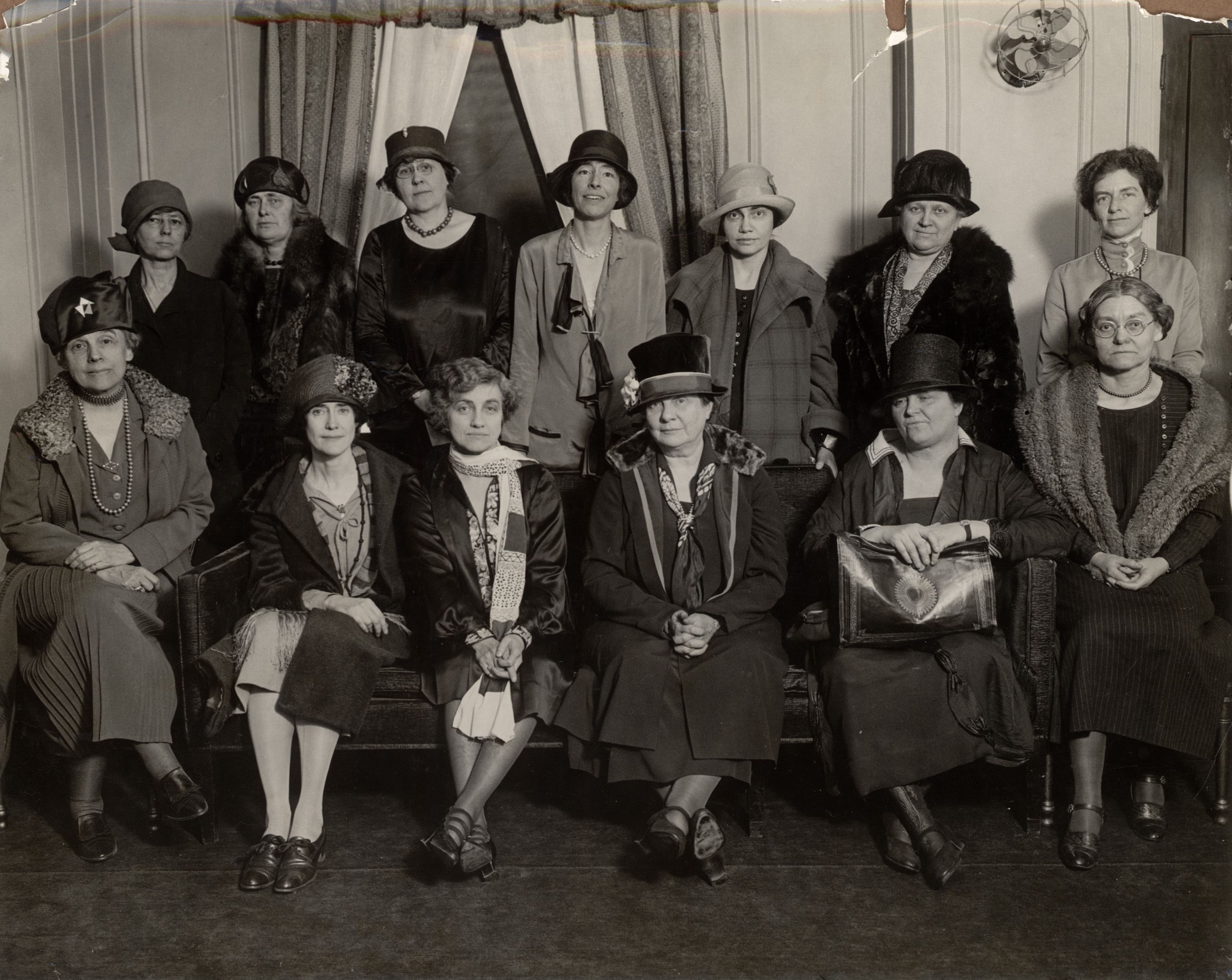
The Board of Directors of the National League of Women Voters at their convention in Chicago in February of this year. At the far right of the lower row is Carrie Chapman Catt, with Grace Wilbur Trout in the center and Maud Wood Park on the left. via The Leage of Women Voters Library

Meanwhile, suffrage opponents will also be in Nashville challenging Tennessee’s ratification of the 19th Amendment when the Tennessee Supreme Court convenes on September 20th. They will also try to use injunction and mandamus proceedings to prohibit election officials from letting women in non-suffrage States vote until after all the court cases have been decided. Finally, they will ask a State Attorney General friendly to their cause in a State where women could not vote prior to the 19th Amendment’s ratification to file a case challenging its validity. This would be the speediest way to the Supreme Court.

But Carrie Chapman Catt is not worried. Day before yesterday she said:

Women have the right to register to vote in all States under the Nineteenth Amendment to the Federal Constitution. The Federal amendment is ratified, all anti-suffragists to the contrary notwithstanding …. If any State authority denies her that privilege it is her right to demand it in the courts. It is possible for a thief to declare that a diamond ring is his because it is in his possession. It is sometimes necessary for the owner to prove his right of ownership in the court. This is parallel now with the women’s vote. No honorable State will deny it to the women.

She noted that former President Taft had something to say recently about those who may try to keep women from voting.

Election officers of the State who impede or deny her right to vote expose themselves to prosecution under statutes, whether Federal or State enacted, to protect citizens in their lawful right to vote. It may well be that the doubling of the number of voters in every State by this amendment will require, for the convenience of voters, amendments to the election laws of the States, but such inconveniences cannot be made any excuse for preventing women from exercising the franchise.

So, the suffrage battle is still being fought, both on a Federal and State level. In Mississippi, the law states that all voters must register four months before the election, and there does not appear to be any move to approve special legislation to allow women to register after that date, even though they were still prohibited from registering there on July 2nd.

In Georgia, the State Attorney General thinks women don’t even need to register, but local officials strongly disagree and are preventing women from doing so because that State’s registration deadline also ended before the 19th Amendment was ratified. But though suffrage may be delayed for a while in two States, it looks as if women will be voting for all offices and referenda, and in great numbers, in the other 46 States this year. That’s a major improvement over the 15 States when women had full suffrage just a few weeks ago.

(Photo : The Board of Directors of the National League of Women Voters at their convention in Chicago in February of this year. At the far right of the lower row is Carrie Chapman Catt, with Grace Wilbur Trout in the center and Maud Wood Park on the left.)

Founding Feminists: September 5, 1910

Founding Feminists is the FMF’s daily herstory column.

founding-fems

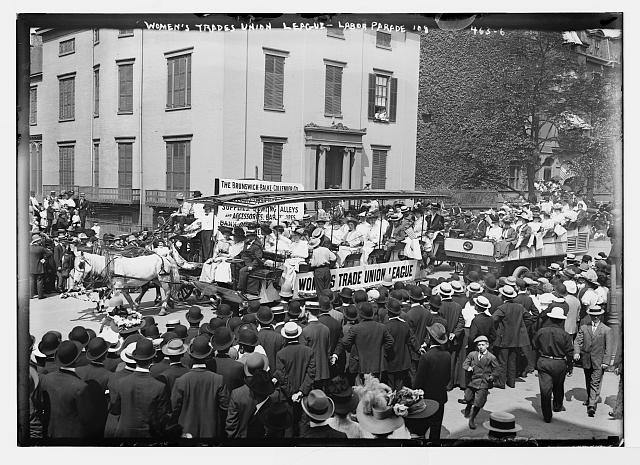
In a very encouraging sign, a majority of the over 70,000 marchers in New York City’s Labor Day Parade this afternoon were women. They used the occasion to celebrate a recent victory by shirtwaist workers, as well as show solidarity with striking cloakmakers now being prohibited from peacefully picketing by New York Supreme Court Justice John Goff.

Despite this being one of the hottest days of Summer, there were few dropouts of either sex, though the women seemed to hold up better than the men during the four-and-a-half hour parade down Fifth Avenue from 59th Street to Washington Square.

There were too many bands to count, and colorful banners were everywhere. Most of the banners were in support of the cloakmakers, who have been on strike since mid-June, and in opposition to Justice Goff’s recent ruling against their right to picket their employer. Some examples : “Goff’s injunctions can never break labor’s solidarity” ; “The bosses’ latest masterpiece – Goff” ; “We appeal from Goff’s court to the court of the people.” The most popular was “O Goff, Come Off,” written in seven different languages. One of the largest banners said : “Plutocracy steals our soap and then calls us the great unwashed.”

via Wikimedia
via Wikimedia

The record number of marchers this year is due to the efforts of the International Ladies Garment Workers Union and the Women’s Trade Union League. Helen Marot, Leonora O’ Reilly, Rose Schneiderman and Clara Lemlich all marched at the head of large delegations.

The hard-fought but successful strike against the shirtwaist companies has induced many to join the labor movement in order to win concessions from their employers similar to what shirtwaist workers got earlier this year. Among other benefits, union shirtwaist workers now have a 52-hour week instead of 65, no longer need to pay for any of the tools necessary for their work, and will get four paid holidays a year. The sympathy that these women pickets generated during the strike due to their arrests and the brutal attacks by company thugs is still present. All along Fifth Avenue marchers were applauded by spectators, and many of the mansions of their newfound wealthy women supporters, most of whom are also dedicated suffragists, were decorated for the occasion.

Following the parade, a number of women went to the office of the Women’s Trade Union League, where they were served tea and sandwiches. Though there is a lot of work yet to be done in regard to better wages, workplace safety, and recruiting more members into unions, a day to celebrate recent gains was definitely earned, and clearly enjoyed by all.

Founding Feminists: September 4, 1974

Founding Feminists is the FMF’s daily herstory column.

founding-fems

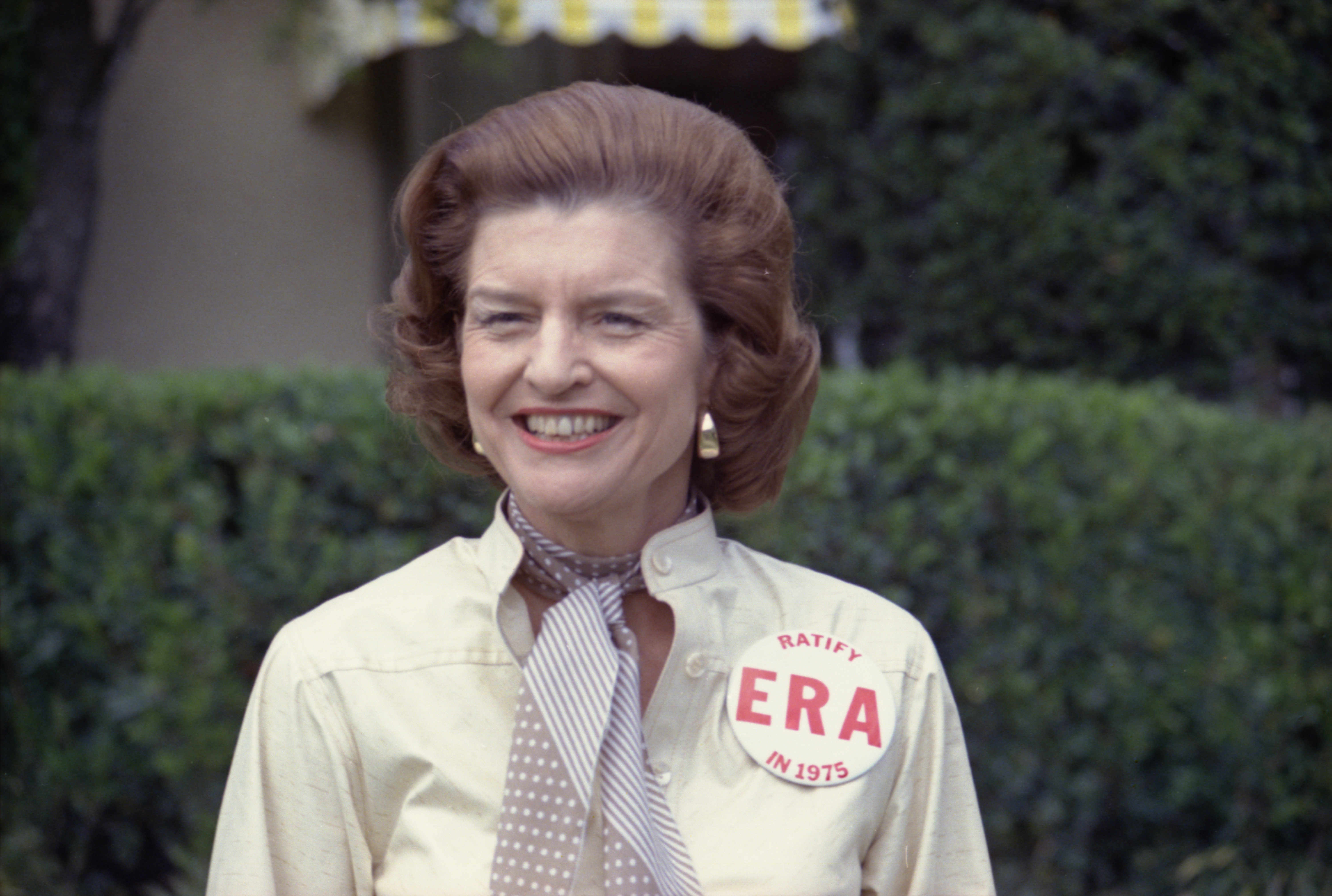
Just 26 days after becoming First Lady, Betty Ford has held her first press conference. During the 30-minute session with 142 reporters and photographers in the State Dining Room of the White House, she said that she wants to help the Equal Rights Amendment campaign, and favors abortion rights.

Today’s full-fledged news conference was an unprecedented move by a First Lady. Eleanor Roosevelt held 348 press conferences during her White House years, but they were far more informal, and open to women only, as a way of helping them get ahead in a male-dominated profession.

Though she doesn’t intend to get involved in partisan political issues, Ford does want to encourage women to play an active role in politics. There is, of course, one exception to her non-partisan role, and she left no doubt that she’ll be campaigning for President Ford’s election to a full, four-year term in 1976.

She said that in regard to the campaign for the E.R.A., a measure endorsed by Republicans since 1940 and Democrats since 1944 : “I would be happy to take part in it.” She intends to lobby for the amendment in the 17 states that have not yet ratified to help get the five more needed. Though President Ford once joked about the issue with her, and in 1971 backed off his initial strong support of it a year earlier, due to pressure from his constituents, the First Lady assured the press that the President was now an E.R.A. advocate. He re-endorsed the E.R.A. on August 22nd during a press conference.

When asked whether her views on abortion were closer to those of Vice-Presidential nominee Nelson Rockefeller, a strong advocate of abortion rights when Governor of New York, or those of Senator James Buckley (R-NY), who wants “Roe vs. Wade” overturned, and abortion re-criminalized, she said that her views were “definitely closer” to those of Rockefeller, and that she favors liberalized abortion laws.

On other issues, she said the vacation White House would be in Vail, Colorado, that she was being kept quite busy with her new duties, and that the children have adjusted well to life in the White House.

via Wikimedia
via Wikimedia

The Equal Rights Amendment was passed by Congress and sent to the States for ratification on March 22, 1972, and has until March 22, 1979 to gain the 38 state approvals needed for inclusion in the Constitution. Polls show consistent public support for the measure, and so far 33 states have ratified. Three ratifications have taken place this year : Maine, Montana and Ohio.

The Equal Rights Amendment reads :

“Section 1 : Equality of rights under the law shall not be denied or abridged by the United States or by any State on account of sex.

“Section 2 : The Congress shall have the power to enforce, by appropriate legislation, the provisions of this article.

“Section 3 : This amendment shall take effect two years after the date of ratification.”

Though the pace of ratifications has slowed (22 in 1972, 8 in 1973, 3 so far this year) that’s to be expected, as the more progressive states would have ratified quickly, with the more conservative ones doing so more slowly – and after a battle. But with only five more states needed to ratify, four and a half years to get them to do so, and the support of the First Family, things are definitely looking up for the Equal Rights Amendment as well as for feminist progress in general !

Founding Feminists: September 3, 1912

Founding Feminists is the FMF’s daily herstory column.

founding-fems

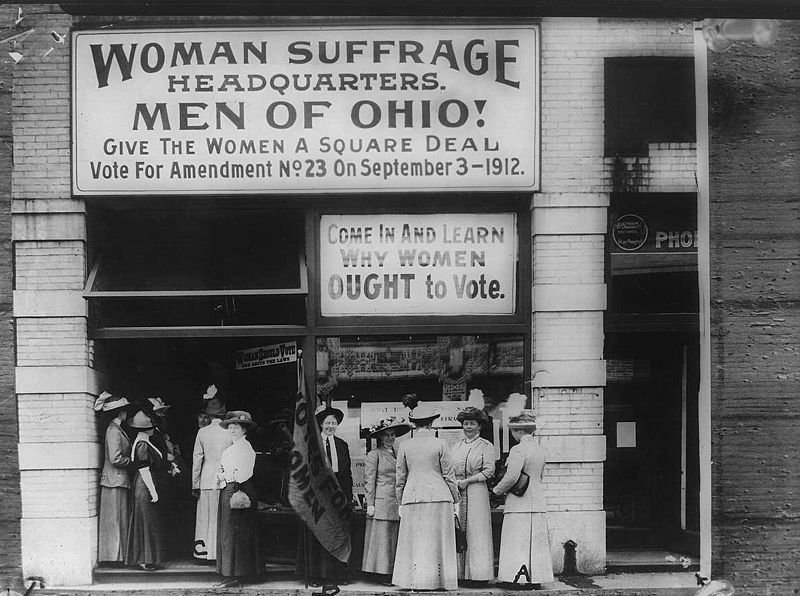
Despite a valiant try, the 1912 Ohio suffrage campaign is ending in defeat tonight. Efforts to get the issue of woman suffrage on the ballot here date back decades, and finally in late May of this year a State Constitutional Convention approved putting a proposed woman suffrage Constitutional Amendment (#23) on today’s special election ballot. This gave supporters just over three months to overcome the entrenched and well-funded opposition of the liquor industry as well as the usual anti-suffrage arguments.

The campaign was run by Harriet Taylor Upton of the Ohio Woman Suffrage Association. She is an experienced suffragist, and was Treasurer of the National American Woman Suffrage Association from 1894 to 1910. She raised an impressive war chest of $ 40,000, and was assisted by over 50 full-time workers out in the field, plus large numbers of local volunteers in each community. The highlight of the campaign was a colorful suffrage parade in the State capital of Columbus last month, in which over 5,000 took part.

National momentum seemed to be swinging in favor of suffrage, so there were great hopes for victory in the Buckeye State. Two years ago, Washington became the first new suffrage State in 14 years, then last October, California approved “Votes for Women,” and in May, there was a hugely successful suffrage parade in New York City. But Ohio seems to have brought the advance to a temporary halt.

via Wikimedia Commons

Among the major difficulties encountered here were a series of anonymous handbills that tried – apparently with success – to tie the issue of woman suffrage to Prohibition. Brewing is a major industry all over the State, especially in the Cincinnati area. Suffragists have been vigorously trying to reassure the public that the two issues are separate, and by no means do all suffragists, or all women, favor outlawing alcohol. The Ohio Woman Suffrage Association even offered a $ 100 reward for information about the authorship of these handbills, but their origin still remains a mystery.

The vote today was quite light, despite 42 amendments appearing on the special election ballot covering a wide spectrum of issues, so it’s not known whether suffrage would have carried if the turnout had been high. Amendment 23 is faring especially badly in many of the large cities. This is a common phenomenon, because the saloon operators tend to have great power there, and in this State there are major breweries to contend with as well.

Fortunately, Amendment #6, which provides for Initiative and Referendum, is passing by an overwhelming majority, so Ohio suffragists are confident of getting the issue back on the ballot again by going directly to the people, instead of having to lobby the Legislature to put it there, or wait for another Constitutional Convention.

Despite tonight’s disappointment, there’s still some room for optimism. Five other States have suffrage referenda on the ballot on November 5th, so hopefully some victories in Wisconsin, Michigan, Kansas, Arizona and Oregon will re-start the victory train !

>