Founding Feminists: October 16, 1915

Founding Feminists is FMF’s daily herstory column.

FoundingFeministLogo-color

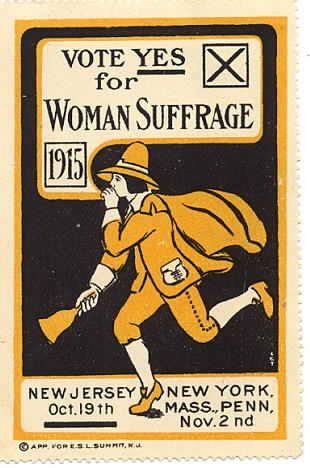
The campaign to pass the New Jersey woman suffrage referendum three days from now is finishing up in grand style.

William Jennings Bryan, Senator William Borah and Rabbi Stephen S. Wise are giving stirring speeches tonight in Paterson and Newark.

According to Bryan, “The burden of proof is on the opponents of woman suffrage. The most convincing argument in favor of it is that a mother has the right to a voice in determining the environment that should surround her children.” He also noted that the character of the opposition should be sufficient to convince anyone to vote pro-suffrage.

Senator Borah, Republican of Idaho, where women won the vote in 1896, said that though he couldn’t claim that women having the vote would eliminate all political evils or injustices, he did think that women would find and correct many wrongs that men have not.

Rabbi Wise looked forward to a more peaceful world after equal suffrage: “‘Military preparedness’ means war, and there will never be a beginning of an end to war until women vote.” He predicted that if suffrage was successful in New Jersey on the 19th, it would also win in New York, Pennsylvania and Massachusetts on November 2nd.

1380109_10201152397915610_2047620168_nIf it does win here, it will be after an uphill fight, because suffrage has very powerful opponents. But Mina Van Winkle, head of the Women’s Political Union of New Jersey has no doubts. “We have made a good fight and we think an effective one,” she said. “If we have an honest election and an honest count of the vote, and if underground influences that we are not in a position to meet do not get in their work on Tuesday, we should win.” Mrs. E.F. Feickert, President of the New Jersey Woman Suffrage Association, not only predicted that suffrage would win, but that it would do so by as much as 25,000 votes:

This forecast is based on a house-to-house canvass, which has covered the entire State and which comprises both urban and rural localities. In the cities we have found an average of seven men who are for us to one against us and three who tell us they have not decided how to vote. In the country districts we find eight men with us to one against us and three who have not made up their minds on the subject.

But Mrs. Edward Yarde Breese, President of the New Jersey Association Opposed to Woman Suffrage, is confident of carrying 13 of the State’s 21 counties. Three of the bigger ones would actually be enough to doom the measure if carried by substantial majorities, and anti-suffragists are predicting a majority of 10,000 in both Essex and Hudson Counties, and 7,500 more in Camden County.

The “antis” have taken surveys as well, and according to Breese, opposition to suffrage is especially strong in rural areas. In one community they claim that 96% of those surveyed were opposed to the suffrage referendum. Both sides concede that Essex County will reject the measure due to the influence of local political boss James R. Nugent. Hudson and Camden Counties are still hotly contested, however.

The head of the Hudson County Democratic Committee was unable to give a forecast, but according to Samuel T. French, leader of the Camden County Democratic Committee:

Woman suffrage in Camden County is gaining rapidly; The President’s declaration favoring it has given the movement new life. The Democratic Executive Committee is on record favoring it, and the vote will be a surprising one for the opponents next Tuesday. The people here are just learning that the liquor interests are fighting it harder than any other power, and had we another month it would carry in Camden County. I hardly expect it to carry in this county, but the majority will be small.

It’s definitely a gamble to try to win so many big States all at once, and to abandon the traditional strategy of making efforts to win suffrage only in States that border on a State where women already vote. But though multiple defeats would be a major setback, the payoff of multiple victories could be huge, and therefore worth the risk.

A win in all four States would mean that not only would equal suffrage have finally spread East of the Mississippi, but would have a strong presence here. Having four suffrage States with large Congressional delegations would certainly increase support for the Susan B. Anthony (nationwide woman suffrage) Amendment, since members of Congress in these States would have to face women voters in all future elections. New York is the nation’s most populous State, with Pennsylvania second. Massachusetts ranks sixth in population, and New Jersey eleventh. Each of the four States with an upcoming suffrage referendum has a larger population than California, presently the most populous suffrage State. So the stakes are extremely high, and well worth this unprecedented effort.
Founding Feminists: October 15, 1915

Founding Feminists is FMF’s daily herstory column.

FoundingFeministLogo-color

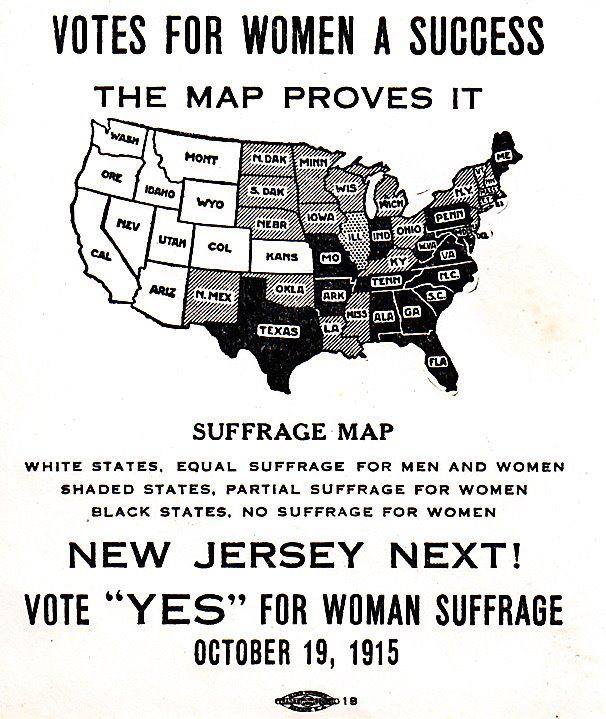
“New Jersey Next!”

That’s the motto of suffrage organizations who are undertaking a bold gamble to expand “Votes for Women” out of the West and capture four big Eastern States, with New Jersey voting first. Though women in Illinois have almost equal suffrage, and can vote for President and local offices, but not Statewide offices, at present there is no State to the east of Kansas where women can vote on the same basis as men.

But the movement has grown considerably in recent years, and confidence is now running so high that major campaigns are being waged in New Jersey, New York, Pennsylvania and Massachusetts. The vote in New Jersey is just four days from now, and a victory here would certainly give a boost to the cause just before the (male) voters in the other three States vote on November 2nd. These four States contain 24.6% of the population of the United States, and could suddenly more than double the number of women voters, so this is an all-out effort.

New Jersey is unique, in that it was the last place in the U.S. where women had the right to vote prior to Wyoming’s enfranchisement of women in 1869. Those who owned a certain amount of property, regardless of their gender or race, were allowed to vote here from 1776 until 1807, when the Legislature passed a law restricting the vote to white males, with the restrictions against women still on the books.

There have been 4,000 outdoor and 500 indoor meetings held around the State arranged by four paid and thirty volunteer organizers of the New Jersey Woman Suffrage Association. They work with three other groups in a coalition called the Cooperative Committee, the largest of the three other groups being the Woman’s Political Union of New Jersey, with the Equal Franchise Society of New Jersey and the New Jersey Men’s League for Woman Suffrage contributing to the effort as well. Thus far three million pieces of literature and four hundred thousand buttons have been distributed, so the campaign to re-enfranchise the State’s women has been a mighty effort.

Today both sides were quite active. A group of New York suffragists took time out from their campaign to travel around this State in a horse-drawn wagon converted from delivering lunches into delivering literature to voters. The group was headed by Nora Blatch DeForest, daughter of Harriot Stanton Blatch and granddaughter of Elizabeth Cady Stanton. She was accompanied by journalist Rheta Childe Dorr, Florence Kelley of the National Consumers’ League, and Alice Carpenter, Progressive (“Bull Moose”) Party activist.

1375013_10201146934099018_1029746772_n

Mina Van Vinkle, President of the Women’s Political Union of New Jersey was at her desk in Newark today, busy making sure there will be enough women poll-watchers to insure a reasonably honest election. She said: “If no underground influences get in their work on Tuesday we will win this election.”

Anti-suffrage forces are, of course, making strong last-minute efforts as well. Today a flyer by W. T. Hickey of Colorado was being distributed locally saying that suffrage in Colorado, where women won the vote in a Statewide referendum in 1893, has been a failure, and that the women legislators there have not been able to bring any benefit to women, and even opposed so-called “protective” legislation restricting women’s hours of work.

In an ominous and disappointing development, the New Jersey Federation of Labor, which in all previous years has endorsed woman suffrage, did not do so this year. The active opposition of James Nugent, Essex County Democratic Chairman, is suspected of being behind the move, due to his close and friendly relations with the liquor lobby, which fears enactment of prohibition laws if women are enfranchised. Bartenders, Waiters, Brewers, Bottlewashers and Cigarmakers all formally came out opposed to suffrage through their unions just prior to the State Federation of Labor’s convention.

The “antis” are employing their best speakers now, with the highest-ranking officers of anti-suffrage organizations in such States as New York, Pennsylvania and Massachusetts coming to New Jersey to make their case. Even the widow of the late Vice President Garrett Hobart, who served during President McKinley’s first Administration, has been drawn into the battle. She said: “Please remember that I am one of the thousands of women in our State who do not want the vote and that I speak for them when I beg you to vote against woman suffrage. We need your vote to prevent what we believe to be a great injustice to us as well as a grave menace to our State.”

But suffragists have powerful speakers as well. Three-time Democratic Presidential nominee William Jennings Bryan and Senator William E. Borah, Republican of the suffrage State of Idaho, will be addressing huge meetings in Newark and Paterson tomorrow night. These aren’t the only attempts by well-known politicians to stir up the voters for suffrage. President Wilson, though still opposed to the Susan B. Anthony (nationwide woman suffrage) Amendment, has also issued a statement of support for woman suffrage in his home State, saying:

“I intend to vote for woman suffrage in New Jersey because I believe that the time has come to extend that privilege and responsibility to the women of the State, but I shall vote, not as the leader of my party in the nation, but only upon my private conviction that as a citizen of New Jersey, called upon by the Legislature of the State to express his conviction at the polls. I think that New Jersey will be greatly benefited by the change. My position with regard to the way in which this great question should be handled is well known. I believe that it should be settled by the States and not by the National Government and that in no circumstances should it be made a party question, and my view has grown stronger at every turn of the agitation.”

Though the four referenda would only enfranchise women in four States, a successful result here on October 19th, then on November 2nd in the other three States, would increase the number of “equal suffrage” States to 15, just one State short of a third of the total, and force the men in Congress from those States to give their female constituents the same consideration and attention as the male voters get now. This would clearly be a boost for the Anthony Amendment, and bring the end of the struggle much closer. But first things first, so “New Jersey Next!”

Founding Feminists: October 14, 1918

Founding Feminists is FMF’s daily herstory column.

FoundingFeministLogo-color

The National Woman’s Party is known for its bold actions, but today’s attempt to briefly occupy the Senate as a colorful protest was its most militant tactic yet.

As announced day before yesterday:

Monday noon, upon the convening of the United States Senate, a group of women will form upon the plaza in front of the Capitol and, with no banner other than the American flag at their head and the tricolor of women’s freedom, will march up the Senate steps through the foyer and on to the floor of the Senate.

They will carry in their hands the speeches on democracy, which have been made by the thirty-four men who voted against democracy for women. In the flame of a torch carried just behind the flag these speeches will be burned. Drawing up their line in front of the presiding officer’s desk, each woman, representing a different group of women, will voice her protest against the injustice done in the cause of liberty by the men who defied Wilson’s appeal for the war measure of woman suffrage. One will be a woman voter from the West, another a working woman representing the millions of women now in industry; others will be young girls representing the women of the future.

Alice Paul noted the double standard involved in regard to men and women seeking democracy:

To remedy the wrongs that are done men it is believed right that whole nations should perish, if need be. To remedy the insult that is done woman by the men who lay the scorn and burden of disenfranchisement upon her it is considered wrong to hold a banner of protest on the steps of our Capitol. Where else are women to go for redress of their grievances, if not to the seats of power? If we cannot make our protests seen by our banners, we will make them heard by our voices in the Senate ; but we will not let it be said of women that they acquiesced in the defeat of justice and liberty.

1386004_10201140549739413_1276434291_n
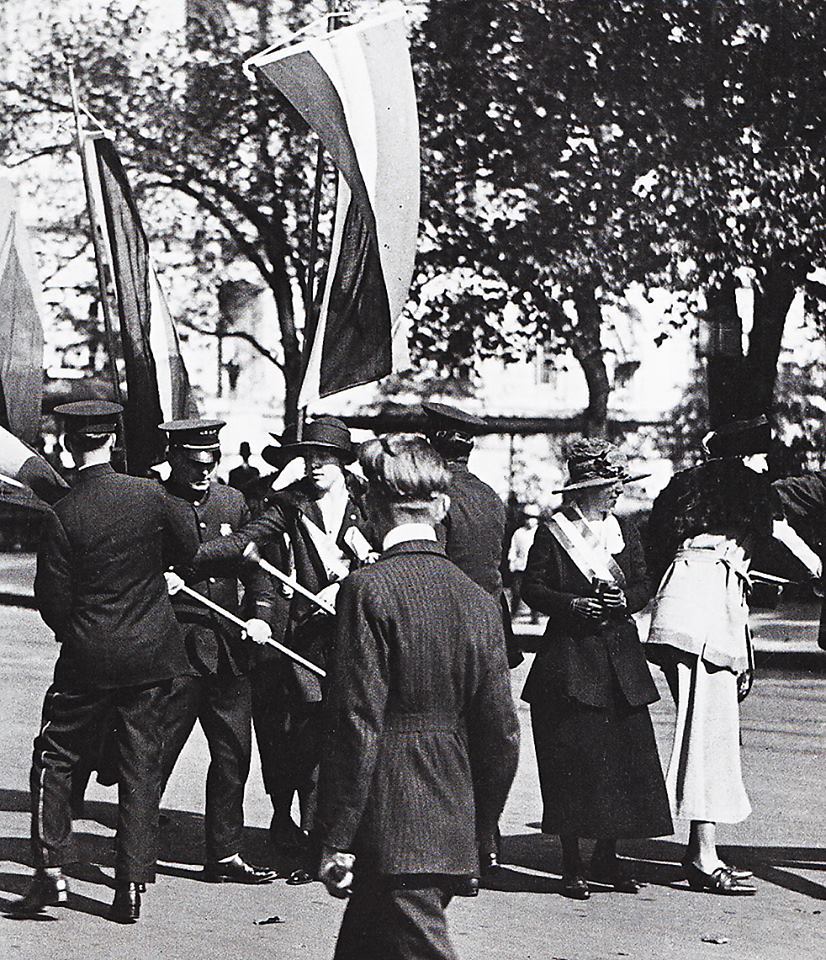
True to their word, the National Woman’s Party protesters started for the Capitol today, with the American flag and the party’s purple, white and gold banners flying. But they were stopped by a squad of Capitol police awaiting them. First, their banners were seized. Then Alice Paul and 14 other marchers were quickly arrested – in an unnecessarily rough manner – and placed in the guard room of the Capitol. None of the detainees have been allowed to communicate with anyone, not even their lawyers, or pro-suffrage Senators, and they are being held without any charges being specified.

The words that would have been burned during their occupation were those of Senators who lavishly praise bringing democracy to all other nations, while voting to withhold it from the women of their own country. “The work that we are called upon to do when we enter this war is to preserve the principles of human liberty, the principles of democracy, and the light of modern civilization,” said Senator Henry Cabot Lodge, Republican of Massachusetts. Senator William Borah, Republican of Idaho added, “This is a war that speaks for the majesty of people popularly governed.”

“When you undertake to erect a structure of democracy it must be founded upon the four pillars of justice, equality, fraternity and liberty,” said Senator John Sharp Williams, Democrat of Mississippi. Senator James A. Reed, Democrat of Missouri also spoke out in support: “This is the people’s country. The nearer you get to the people, the nearer you have a just and fair government.”

At some point the protesters will presumably be released, and will continue their daily showing of banners near the Capitol, often inscribed with the words of those who say they favor democracy but vote against it when it comes to women. Fortunately, some members of the current Senate may soon be replaced following the November elections. If two votes are gained, there will be 64 Senators for suffrage and 32 opposed, and the Susan B. Anthony (nationwide woman suffrage) Amendment will go to the States for ratification after it is re-approved by the new House, and approved for the first time by the Senate.

(Photo : National Woman’s Party protesters being arrested earlier today.)

Founding Feminists: October 4, 1911

Founding Feminists is the FMF’s daily herstory column.

FoundingFeministLogo-color

With just six days to go until the men of California vote on whether to add a woman suffrage amendment to the State Constitution, there’s been unprecedented activity by both sides, and the campaign is only going to increase in its intensity as the day of the special election nears.

The biggest suffrage rally ever held in the State took place here in Los Angeles four days ago, drawing crowds so large that even Temple Auditorium was too small to admit everyone who wanted to attend, so a second rally was begun at Choral Hall. Even this failed to provide enough room, so though 5,000 got to cheer for “Votes for Women,” 500 more were turned away. An even bigger gathering is planned for tomorrow night in San Francisco.

But the Political Equality League isn’t just preaching to the converted. It’s busy all over the State giving speeches in every possible location, regardless of the size or political leanings of the crowd. Of course, there’s still one place that suffragists haven’t yet spoken, but it’s through no fault of their own. Clifford Howard dropped by the Political Equality League office earlier today after giving a speech at the National Theater in Sawtelle. He reported that suffrage speakers are still banned from the nearby Veterans’ Home by its governor, even though the “antis” are free to give out literature and speak there.

The veterans in the audience for Howard’s speech thought their comrades at the Home would love to hear a suffrage speaker. According to Howard: “The old soldiers are wildly enthusiastic over suffrage; they prophesy that it will carry at the polls 3 to 1.” As evidence of that support, Howard said that one listener told him that he had taken a straw poll of 225 men in his regiment, and only 15 were opposed to women having the vote. The man also related an incident from last Sunday. The Chaplain was giving an anti-suffrage sermon when one of the veterans jumped up and said: “There isn’t a word of what he says that is true. Woman suffrage is all right.”

The battle continues in our numerous local newspapers. On October 2nd the Los Angeles Express said, “The women of California are as much entitled to the ballot and as well qualified to cast it with intelligence as are the men of California. Influenced, as they are, in a larger degree than men, by considerations of justice and righteousness, the addition of women to the electorate unquestionably will raise the standards of government and work enormously to the advantage of the State.”

Yesterday the Los Angeles Tribune said:

In behalf of that amendment The Tribune appeals not to the chivalry, but to the sense of justice of the men of the State. It matters not how many or how few of the women of California evidence their desire for political equality. The issue is not one of numbers, but of right and wrong. The demand for the ballot is addressed to conscience and intelligence. The right to vote on the same terms as men is sought as a matter of equal justice, not as a matter of favor …. The Tribune, from the standpoint of public policy, would regard the defeat of the amendment as a misfortune to the State and a gross injustice to its patriotic, capable and highly intelligent women. The women should have an equal voice in making the laws to which they are required to render an equal obedience. They ask equality and to refuse equality is to deny justice.

Today The Los Angeles Tribune said:

The boy or girl of today studies civics in school. The wife or mother of 1911 knows more of what is going on in the home, city and the world at large than did the father or husband in 1811. In that year there were about 100 post offices in the United States; today there are 52,000. In 1811 there were 103 newspapers ‘whose issues were enough to supply one copy a week to one out of every 50 persons, or one copy a day to one out of every 350 persons.’ Now there are 23,000 newspapers, whose issues are enough to supply every family with four copies a day. So it is absurd to say the women of 1911 don’t know enough to vote intelligently on public matters that have to do with the development and protection of themselves or their children.

via National Museum of Women's History
via National Museum of Women’s History

The “antis” have few local editors on their side other than the one at the Los Angeles Daily Times, who is as strongly opposed to “Votes for Women” as his counterpart at the New York Times. But though they rarely get their views expressed free of charge editorially, anti-suffragists seem to have plenty of liquor industry money to buy space for their propaganda in newspapers. Here’s a sample of the ads they’re placing in multiple papers:

SOME REASONS WHY WE OPPOSE VOTES FOR WOMEN:

By the Women of the Anti-Suffrage Association.

Because man is man, and woman is woman. Nature made their functions different, and no Constitutional amendment can make them the same.

Because the basis of government is force – its stability rests upon its physical power to enforce its laws; therefore it is inexpedient to give the vote to women. Immunity from service in executing the law would make most women irresponsible voters.

Because the suffrage is not a question of right or justice, but of policy and expediency; and if there is no question of right or of justice there is no case for woman suffrage.

BECAUSE IT IS THE DEMAND OF A MINORITY OF WOMEN, AND THE MAJORITY OF WOMEN PROTEST AGAINST IT.

Because it means simply doubling the vote, and especially the undesirable and corrupt vote of our large cities.

Because the great advance of women in the last century – moral, intellectual and economic – has been made without the vote; which goes to prove that it is not needed for their further advancement along the same lines.

Because women now stand outside of politics, and therefore are free to appeal to any party in matters of education, charity and reform.

Because the ballot has not proved a cure-all for existing evils with men, and we find no reason to assume that it would be more effectual with women.

Because the woman suffrage movement is a backward step in the progress of civilization, in that it seeks to efface natural differentiation of function, and to produce identity, instead of division of labor.

Because in Colorado after a test of seventeen years the results show no gain in public and political morals over male suffrage States, and the necessary increase in the cost of elections, which is already a huge burden upon the taxpayer, is unjustified.

Because our present duties fill up the whole measure of our time and ability, and are such as none but ourselves can perform. Our appreciation of their importance requires us to protest against all efforts to infringe upon our rights by imposing upon us those obligations which cannot be separated from suffrage, but which, as we think, cannot be performed by us without the sacrifice of the highest interests of our families and of society.

Because it is or fathers, brothers, husbands and sons who represent us at the ballot-box. Our fathers and our brothers love us; our husbands are our choice, and one with us; our sons are what WE MAKE THEM. We are content that they represent US in the cornfield, on the battlefield, and at the ballot-box, and we THEM in the school-room, at the fireside, and at the cradle, believing our representation even at the ballot-box to be thus more full and impartial than it would be were the views of the few who wish suffrage adopted, contrary to the judgment of the many.

We do, therefore, respectfully protest against the proposed amendment to establish ‘woman suffrage’ in our State. We believe that political equality will deprive us of special privileges hitherto accorded by law.

Though the referendum probably won’t pass by the 3-1 margin predicted by the residents of the Veterans’ Home, it should certainly pass by a comfortable margin if these are the best arguments that its opponents can come up with.

Founding Feminists: October 2, 1918

Founding Feminists is FMF’s daily herstory column.

FoundingFeministLogo-color

Undaunted by yesterday’s two-vote loss in the Senate for the Susan B. Anthony (nationwide woman suffrage) Amendment, Alice Paul and members of the National Woman’s Party are meeting today and tomorrow to plan their most effective response. One thing is certain. There will be no second vote until after the November elections, according to members of the Senate Woman Suffrage Committee. It’s the consensus of the committee’s pro-suffrage members that until the composition of the Senate is changed, the result would be another defeat.

But the 65th Congress is near the end of its term, and not only is the entire House and 1/3 of the Senate up for election on November 5th, but there have been an unusual number of Senate vacancies temporarily filled due to the death of 10 elderly Senators during this session. So a vigorous and well-run campaign could cause a major shift in favor of suffrage in the Senate. All factions of the suffrage movement will be actively working for this change.

The National American Woman Suffrage Association will be targeting four specific anti-suffragists: Senator John Weeks, Republican of Massachusetts, Senate candidate George Moses, Republican of New Hampshire, Senator David Baird, Republican of New Jersey, and Senator William Saulsbury, Democrat of Delaware.

The defeat of Senator Weeks will be the hardest task, because he is such a political powerhouse in the Bay State. But his voting record – even on issues unrelated to suffrage – leaves much to be desired, so he could be vulnerable. Among other things, he voted against the 17th Amendment, which now mandates that all U.S. Senators be popularly elected, not appointed by State legislatures, opposed creation of the Federal Trade Commission, and even voted to reduce Soldiers’ and Sailors’ insurance benefits while they fight for democracy overseas.

According to a statement released by the National Woman’s Party tonight, the electoral outlook is very favorable:

Several vacancies occur in the Senate in November, when the terms of men now serving under appointment expire. Senator Benet of South Carolina, who voted against the suffrage amendment, contradicting the President’s statement that it was a war measure, holds his seat only until the November election. He was defeated in the recent primaries when he ran to succeed himself, and will be followed by W.P. Pollock, who, suffragists hope, will support the President in this measure.

The appointment of Senator Martin of Kentucky, who voted for the amendment, lasts until March. Senator Baird of New Jersey was appointed by Governor Edge with the understanding that he would support President Wilson in all his war measures. In spite of this fact, he voted ‘No’ on the suffrage amendment last Tuesday. Senator Baird is contesting the November election for the short term with the Democratic candidate, Mr. Hennessy, who is a strong suffrage advocate. Governor Edge, who is running for the long term in New Jersey, and who appointed Baird, has made suffrage the first plank in the platform, showing the importance given the measure in New Jersey.

Senator Drew of New Hampshire, who also declined to support the President on this war measure, received only one vote in the recent State convention, and goes out in November. Vacancies occurring in suffrage States are bound to be filled by suffragists, and so will not affect the situation.

1184838_10201072793205542_1104208499_n

As might be expected, Republicans are taking great – and quite justifiable – pride in their party’s overwhelming support of suffrage. When the measure passed the House on January 10th, Democrats gave it a bare majority of 104 in favor and 102 against (50.5% support), while Republicans voted 165 in favor and 33 against (83.3% support). Three members of the Socialist Party, one from the Prohibition Party, and one Progressive Party member voted in favor as well, with one Progressive voting against, making the final tally 274-136, just over the 2/3 required, and without a single vote to spare.

In yesterday’s Senate vote, 27 Republicans and 27 Democrats favored the measure, with 10 Republicans and 20 Democrats opposed, making the final vote 54-30, two short of victory (56-28). Had two pro-suffrage Senators not died and been replaced by two anti-suffrage Senators, the Anthony Amendment would have carried. At the last minute, Senator Andrieus Jones, Democrat of New Mexico, and the chief sponsor of the measure changed his vote to “no” so that under the Senate rules he would have the right to bring it up again, thus making it officially 26 Democrats in favor and 21 opposed. But the original vote showed 57% support by Democrats and 73% support by Republicans.

“Votes for Women” may have suffered a legislative setback, but only a temporary one. Millions of women can already vote in suffrage States, and will do so in November. Yesterday’s defeat has only served to make suffragists in all States even more determined to flex their political muscles in the upcoming election and work to make sure that the two Senate votes which were lacking in the 65th Congress will be present in the 66th. Then, the Anthony Amendment can be sent to the States for ratification in 1919, and ratified in time for the 1920 election.

Founding Feminists: October 1, 1918

Founding Feminists is FMF’s daily herstory column.

FoundingFeministLogo-color

The speeches by pro-suffrage Senators today were as eloquent and impassioned as they had been during yesterday’s debate. President Wilson’s commitment to the cause was undiminished, as he followed up yesterday’s speech to the Senate with personal letters to his fellow Democrats urging them in the strongest possible terms to vote for the Susan B. Anthony (nationwide woman suffrage) Amendment today. Unfortunately, the number of Senators pledged to oppose suffrage was also unchanged from yesterday, and the amendment failed to pass by the 2/3 majority required.

Right up until the time the voting ended, Senator Andrieus Jones, Democrat of New Mexico, the amendment’s chief sponsor, had hoped for some last-minute conversions. But when the roll was called, the tally stood at 54 to 30, two short of the 56-28 (two-thirds majority) of the 84 Senators present and voting that would have meant success.

Even if all 96 Senators had been present, suffrage would still have come up two votes short due to 34 being pledged to vote “no.” The vote would have been 62-34, with 64-32 being required for passage. At the last moment Senator Jones switched his vote to the “no” column so that he would be allowed to call the amendment up for another vote if there was a more favorable outlook. This made the official vote count 53-31, technically three short of victory, but with the measure still alive.

The original count was 27 Democrats in favor and 20 opposed (57% support), and 27 Republicans in favor and 10 opposed (73% support). Not one anti-suffrage Democrat heeded the President’s call to pass the Anthony Amendment as a “War Measure.” Even Majority Leader Thomas Staples Martin of Virginia, and others who have been prominent and vigorous supporters of the President’s other policies, deserted him today.

The reason for such strong opposition by Southern Democrats is well known, and was vividly illustrated by a proposal from Senator John Sharp Williams of Mississippi. He moved that the Anthony Amendment be changed so that it would authorize only white women to vote. The motion was overwhelmingly rejected by being tabled 61-22. That 22 of the 30 votes cast against suffrage were by militant segregationists certainly tells us something about one segment of the opposition. Suffrage groups and their Senate supporters should be commended for steadfastly retaining the original 1878 race-neutral wording of the Anthony Amendment, and refusing to give in to Southern Democrats’ demands that they abandon some women to enfranchise others.

Today’s debate began with an accurate prediction by Senator Albert Baird Cummins, Republican of Iowa: “I fear that a little group of willful men are intent on bringing about the defeat of this amendment.” This was followed by a discussion of whether woman suffrage was truly a “War Measure.” President Wilson insisted yesterday that it was, because we are in a war for democracy, and there could be no better way for our nation to show its commitment to that cause than by enfranchising the female half of its own citizens.

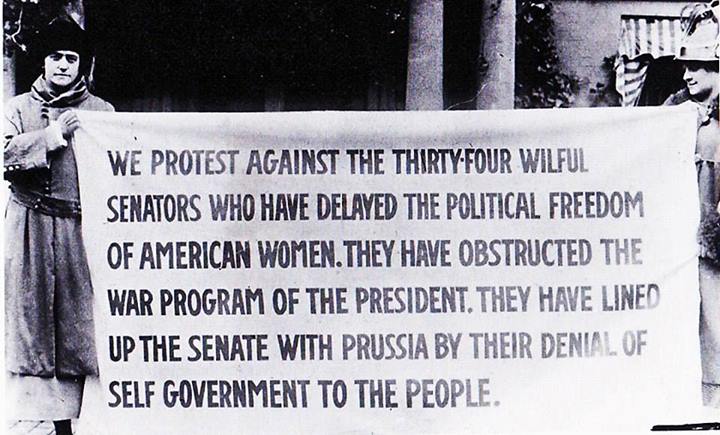
National Woman's Party pickets protesting the 34 Senators who are currently blocking equal suffrage for millions of women in non-suffrage States.
National Woman’s Party pickets protesting the 34 Senators who are currently blocking equal suffrage for millions of women in non-suffrage States.

But other than the “War Measure” issue, the debate covered nothing new, and changed no minds. Senator Knute Nelson, Republican of Minnesota, noted that “this is not the first time the voice of the prophet has not been heard in the wilderness.” Senator Cummins followed up with “No, and I want to know how Senators who vote against this amendment are going to escape the consequences of it.”

Opponents were quick to praise the 34 Senators pledged to vote against the amendment, as they celebrated today’s defeat. According to Mrs. James W. Wadsworth, President of the National Association Opposed to Woman Suffrage:

Our faith in the wisdom and integrity of the United States Senate is justified. We have held all along that if there was no desertion of fundamental principles we could not lose. There has been no desertion. In the face of a powerful lobby, false labels, political threats and pressure, thirty-four men in the United States Senate retained their sanity, stood by their convictions, upheld the principle of local self-government ‘to the last quarter of an hour.’ Millions of American women who admire courage and cherish convictions thank these Senators and are proud to be represented by such manhood. The legislative branch of the Government has retained its independence. The principle of self-determination, the Constitutional right of each State to settle the question for itself by popular vote, has triumphed over every consideration of political ‘policy.’

But many others think differently. William Jennings Bryan, three-time Democratic nominee for President, was asked if he thought the Senate had disposed of the suffrage issue. He replied:

By no means. The President presented a powerful appeal and it will continue to bring pressure to bear upon the opponents of suffrage through the responses the people will make to the President’s appeal. I expect to see the suffrage amendment submitted to the States before March 1 next … It must be remembered that the liquor interests have been the backbone of the opposition to suffrage in the North and that this influence will disappear with the ratification of the Prohibition Amendment … Taking these two influences together, I think there will be more than enough changes to give the necessary two-thirds.

The liquor industry has been the earliest, strongest, and richest foe of suffrage. Brewers and saloonkeepers fear that because women have been so prominent in the Temperance movement, women voters would quickly outlaw liquor. But even without nationwide woman suffrage, the present Congress (all male except for Rep. Jeannette Rankin, Republican of Montana) passed the Prohibition Amendment on December 18, 1917. It has been ratified by 14 States so far, and is expected to pick up the other 22 States it needs when legislatures around the country meet for their regular sessions in January. Once the liquor industry is defunded, and the prohibition issue finally disposed of, this will certainly help clear the road for suffrage.

Alice Paul and the National Woman’s Party are as confident as Bryan of eventual victory. “This defeat is only temporary,” Paul said. “The vote of the Senate, we are convinced, will be reversed before this session of Congress ends. Our efforts to secure the reversal will begin at once and will continue until our victory in the House is confirmed by the Senate.”

Senator Jones says he intends to reintroduce the suffrage resolution at the “first opportunity” and will call for a vote the moment he’s sure there are 2/3 in support. Though victory in Congress proved elusive today, there is still time left for victory in this session. Even if two votes cannot be switched in the present Senate, the midterm elections in November could produce a two-vote gain for suffrage forces, and suffragists of all factions are now going to do their best to bring about that change. So, despite today’s discouraging vote, it’s still only a question of whether the Susan B. Anthony Amendment is approved and sent to the States for ratification by this Congress or the next one.

Founding Feminists: September 30, 1918

Founding Feminists is the FMF’s daily herstory column.

FoundingFeministLogo-color

It was a truly stunning moment when President Wilson came into the Senate at 1:00 this afternoon and spoke eloquently and unequivocally for fifteen minutes on the necessity and justice of that body voting in favor of the Susan B. Anthony (nationwide woman suffrage) Amendment. It has already been approved by the House, which did so by a one-vote margin on January 10th of this year, the day after President Wilson first gave his endorsement to the amendment. But the Senate has been postponing action, and because Democrats constitute 22 of the 34 votes pledged to vote against it, only 33 of which are needed to defeat the measure, a pep-talk by a pro-suffrage, Democratic President was welcomed by all factions of the suffrage movement.

Woodrow and Edith Wilson via Wikimedia

In his address, Wilson went so far as to call the Anthony Amendment a “War Measure,” the highest priority a President can assign legislation he wishes to be passed. He said, in part:

I regard the concurrence of the Senate in the constitutional amendment proposing the extension of the suffrage to women as vitally essential to the successful prosecution of this great war of humanity in which we are engaged … It is my duty to win the war and to ask you to remove every obstacle that stands in the way of winning it. I had assumed that the Senate would concur in the amendment because no disputable principle is involved, but only a question of the method by which the suffrage is to be extended to women ….

This is a people’s war and the people’s thinking constitutes its atmosphere and morale, not the predilections of the drawing room or the political considerations of the caucus. If we be indeed democrats and wish to lead the world to democracy, we can ask other peoples to accept in proof of our sincerity and our ability to lead them whither they wish to be led nothing less persuasive and convincing than our actions. Our professions will not suffice. Verification must be forthcoming when verification is asked for …

This war could not have been fought, either by the other nations engaged or by America, if it had not been for the services of women – services rendered in every sphere – not merely in the fields of effort in which we have been accustomed to see them work, but wherever men have worked and upon the very skirts and edges of the battle itself. We shall not only be distrusted but shall deserve to be distrusted if we do not enfranchise them with the fullest possible enfranchisement, as it is now certain that the other great free nations will enfranchise them …. The executive tasks of this war rest upon me. I ask that you lighten them and place in my hands instruments, spiritual instruments, which I do not now possess, which I sorely need, and which I have daily to apologize for not being able to employ.

President Wilson’s journey from believing woman suffrage is a matter for the States to decide for themselves, and “sympathy for the cause” but no endorsement of the Anthony Amendment, to endorsement but no action, and finally to today’s vigorous lobbying for it on the eve of a crucial vote, has been a long and trying trek. Ever since his first inauguration in 1913, all suffragists have been urging him to use his considerable influence to get the Anthony Amendment through successive Democratic Congresses and sent to the States for ratification.

Alice Paul and other members of the National Woman’s Party began engaging in peaceful protests along the White House fence on January 10, 1917, and have suffered arrests, imprisonment, brutality by guards, and force-feedings by prison doctors for publicly pointing out Wilson’s previous hypocrisy of strongly promoting democracy around the world while doing nothing to bring it to the female half of his own country. This Summer they began protesting Senate inaction as well as Wilson’s insufficient support, and two weeks ago they staged a colorful protest at the Lafayette Monument. The next day, the Senate suddenly decided to schedule a vote for October 1st.

While the National Woman’s Party has not yet commented on today’s speech, Carrie Chapman Catt, president of the National American Woman Suffrage Association, and who had personally asked Wilson to address the Senate, said:

No country has paid so great a tribute to its women as was paid the women of our country today, when the President of the United States entreated the Senate to pause no longer in the passage of the Federal amendment. He perceives that the new faith in the ultimate outcome of the war, that exultation of spirit which would come to women through the recognition of their political equality, would bring into the war spiritual forces not now engaged. The President today took a stand for human liberty which no man can gainsay.

Rev. Anna Howard Shaw, N.A.W.S.A.’s previous president, also praised Wilson:

For more than forty years I have devoted my life to securing the ballot for women because I have always believed it to be a fundamental principle of right and justice, but from this day I have the authority of the Commander-in-Chief of the Army and Navy. Although the patriotism of American women will always lead them to devoted service for their country, the fact that their country recognizes the justice of their claim to political freedom will hearten and encourage them in service as nothing can.

Whether his speech will change the outcome of tomorrow’s vote remains to be seen. Southern Democrats, the principal bottleneck to Congressional
approval of the Anthony Amendment, seem as vehemently opposed as ever, judging by some of the floor speeches they made following Wilson’s remarks. As “States’ Rights” advocates, they tend to oppose Constitutional amendments in general, and are particularly opposed to this one because it is race-neutral. Section Two also gives Congress the right to pass appropriate legislation to enforce the voting rights the amendment would grant to all women, something they see as a potential “threat” to “white rule.”

Though lobbying by pro-suffrage Senators of their colleagues continues, not a single Senator of either party has yet announced a shift to the suffrage side. So, the tally at the end of the day is still what it was this morning : Sixty-one in favor, thirty-four against, and one doubtful, but leaning toward suffrage. If all Senators are present and voting, sixty-four of the ninety-six must vote in favor of a Constitutional amendment in order for it to pass by the 2/3 majority required. The party lineup tonight is as follows: 29 Democrats in favor, 22 opposed (57% support); 32 Republicans in favor, and 12 opposed (73% support) with Senator Martin, Democrat of Kentucky, leaning toward suffrage, but still uncommitted.

Knowing a vote today would be a defeat, Senator Jones, Democrat of New Mexico, the Anthony Amendment’s principal sponsor, wisely moved for a recess until tomorrow. A vote will be taken then, with everyone on the suffrage side having done their best to get a favorable result.

If Senator Martin votes as expected, and two votes can somehow be changed overnight, the Anthony Amendment will be sent to the 48 States, with 36 ratifications needed to make woman suffrage the law of the land. If the amendment is rejected tomorrow, then the National Woman’s Party’s campaign to elect Republicans and unseat Democrats in November will become even more intense, and the National American Woman Suffrage Association’s rumored “backup plan” of targeting four specific anti-suffrage Senators for defeat will likely be implemented. Either way, victory in Congress seems to be approaching, the only question is whether it will be tomorrow, or after some long-overdue changes are made in the composition of the Senate after the November elections.

Founding Feminists: September 27, 1914

Founding Feminists is the FMF’s daily herstory column.

FoundingFeministLogo-color

Alice Paul’s “Congressional Union for Woman Suffrage” is now fighting a three-front battle. In addition to its inevitable conflicts with anti-suffrage forces, and its recently declared war on Democrats, who have the power to pass the Susan B. Anthony (nationwide woman suffrage) Amendment in Congress, but have refused to do so, there is now open hostility being expressed toward the C.U. and its militant tactics by the National American Woman Suffrage Association.

Alice Paul was formerly in charge of N.A.W.S.A.’s Congressional Committee, but after coordinating their massive suffrage march in Washington, D.C., on March 3rd of last year, dissension between N.A.W.S.A.’s national leadership and those in its new, “militant” faction grew. So Paul created an independent group, the Congressional Union for Woman Suffrage, in order to pursue her goal of getting the Anthony Amendment approved by Congress and the States using whatever tactics seemed best at any particular time, and which could be implemented without asking N.A.W.S.A.’s approval.

The top priority for the C.U. at the moment is working against Democratic Congressional candidates in the nine suffrage States of the West where women can vote. On September 14th they began sending speakers with carloads of literature to the districts where Democrats will be up for election in November, hoping to get the West’s four million women voters to replace them with Republicans. Another massive shipment of literature for the Western campaign left today, according to C.U. members who spoke to the press at their headquarters tonight.

1236780_10201043472672547_796496986_nThe tactic of holding the party in power responsible for blocking suffrage is one Alice Paul learned from her time in England when she worked with the militants there. But she has certainly given the Democrats a chance to gain her favor. She has sent numerous delegations to meet with President Wilson, but has yet to get any kind of support for the Anthony Amendment, because the President considers women’s voting rights a matter for each State to decide. Meanwhile, in Congress, Democrats continue to block passage of the amendment.
The conflict is escalating because as Alice Paul has become more militant, N.A.W.S.A. has become more conservative. It originally just wanted to postpone pushing for the Anthony Amendment until more States have been won for suffrage, so the women there could pressure their members of Congress to pass it. But in March it endorsed another suffrage amendment as well.

The Shafroth-Palmer Amendment, even if enacted, would not directly grant the vote to any woman, but would mandate a suffrage referendum if 8% of a State’s registered (male) voters petitioned for one. It would satisfy Southern Democrats – the heart of the opposition – who take a “States’ Rights” position, but this is clearly not a realistic path to nationwide suffrage. Paul thinks that Federal action is the only practical strategy, the time is now, and that scarce resources can best be spent putting direct pressure on the small number of men who serve in Congress to pass the Anthony Amendment, rather than trying to convince a majority of the male voters in the 39 States where women do not have equal suffrage to vote in favor of expensive, exhausting and often unsuccessful suffrage referenda.

Needless to say, the conflicts that have become apparent in the suffrage movement have not escaped the attention of anti-suffragists. Mrs. Arthur (Josephine Jewell) Dodge, President of the National Association Opposed to Woman Suffrage said today:

On the one hand we see the Congressional Union, headed by Miss Alice Paul, declaring indiscriminate war against all Democrats because a Democratic Congress has refused to amend the legislation. On the other hand we see Dr. Anna Shaw, President of the National American Woman Suffrage Association, repudiating all connection with the Congressional Union, and even going so far as to announce that the Union is not a member of the National Association.

… From Kansas, Miss Cora G. Lewis, a member of the Kansas Board of Administration, wired Dr. Shaw last Tuesday asking whether two representatives of the Congressional Union working in Kansas had the endorsement of the National American Woman Suffrage Association. Dr. Shaw’s response was an emphatic negative. The truth of the matter seems to be that the country is confronted with the spectacle of several bands or groups of women quarreling among themselves, unable to determine whom they shall oppose or what they shall advocate, making speeches that contradict each other, and altogether creating a confusion which, in its final results, will wreck an altogether futile propaganda.

But interestingly enough, at the same time Dodge was writing another obituary for the suffrage movement, it appears on the verge of inheriting great wealth. It was learned today that Carrie Chapman Catt has been named trustee of a large fortune left by the late Miriam Leslie. The money – estimated at somewhere between one-and-a-half and two million dollars – is to be spent as Catt sees fit in the interests of woman suffrage.

Though it is expected to take a while for Leslie’s will to work its way through the courts, once the money is released for distribution, it will give a huge financial boost to suffrage advocates. At the very least it will make for a much more even match between suffragists and their opponents, who benefit from generous contributions by liquor interests fearful of prohibition laws being enacted if woman suffrage wins.

Founding Feminists: September 26, 1968

Founding Feminists is the FMF’s daily herstory column.

FoundingFeministLogo-color

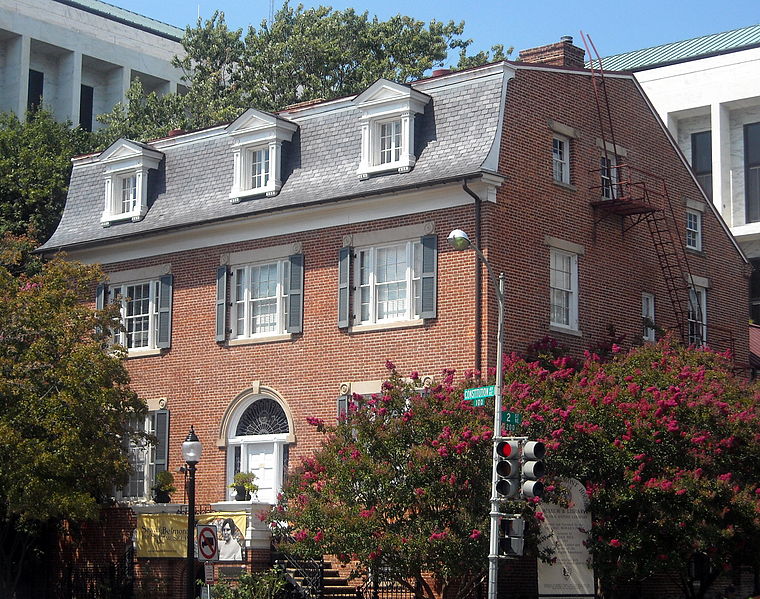
An amazing victory for the National Woman’s Party today, in a struggle which caused some of the country’s youngest feminists to unite with suffragists who had fought for the vote half a century ago. Their common purpose was to save the N.W.P.’s headquarters, and the property immediately surrounding it. A bill had been introduced in Congress to take 2/3 of the N.W.P.’s land and even some structures attached to the main house, for a proposed New Senate Office Building extension. After getting approved in the Senate, the bill was just a quick House vote and a Presidential signature away from enactment.

via Wikimedia
via Wikimedia

The National Woman’s Party’s “Silent Sentinels” picketed the White House from 1917 to 1919, enduring jail sentences, hunger strikes and force-feedings in a successful campaign to pressure President Wilson into becoming an active suffrage advocate. So the N.W.P. wasn’t about to be intimidated by any of today’s politicians. When confiscation was threatened, party members vowed that if it became necessary, they would use the same civil disobedience tactics in 1968 as were used in 1918. New feminist groups, such as the National Organization for Women and other Women’s Liberation organizations immediately offered to help. Barbara Ireton, president of the local N.O.W. chapter, promised a ring of women around the building to protect it if a condemnation bill passed.

via Wikimedia
via Wikimedia

A preliminary victory was won a week ago, when House Majority Whip Hale Boggs, Democrat of Louisiana, informed Alice Paul, the N.W.P.’s founder and honorary chair, that the vote would be postponed. At the same time, Patricia McDonald, accompanied by fifteen college students and recent graduates, arrived in town, and they began personally lobbying the House members about the historic status of the house. According to McDonald: “No hearings have ever been held, in either House or Senate, so we knew the members of Congress didn’t know anything about the house and its history.”

Today, victory was made complete when the House voted to kill the condemnation bill. “It is indeed a relief,” Alice Paul said. “It is almost unheard of for the House to vote against the Senate on a measure that affects the internal problems of the other house. A very unusual procedure.” But the house is also very unusual: one of the oldest structures on Capitol Hill, it was built between 1799 and 1800 by Robert Sewall, was damaged by the British during the War of 1812 when used by Americans defending the city, and was later bought by Alva Belmont for the purpose of donating it to the National Woman’s Party in 1929 as a national headquarters.

With this battle behind them, all of the party’s efforts can once again be concentrated on getting Congress to approve, then 38 states to ratify, the Equal Rights Amendment. Written by Alice Paul, it’s been the N.W.P.’s top priority since they formally kicked off the campaign for it on July 21, 1923.

The Equal Rights Amendment states:

Equality of rights under the law shall not be denied or abridged by the United States or by any state on account of sex.

The Congress shall have to power to enforce, by appropriate legislation, the provisions of this article.

This amendment shall take effect two years after the date of ratification.

Founding Feminists: September 25, 1932

Founding Feminists is FMF’s daily herstory column.

FoundingFeministLogo-color

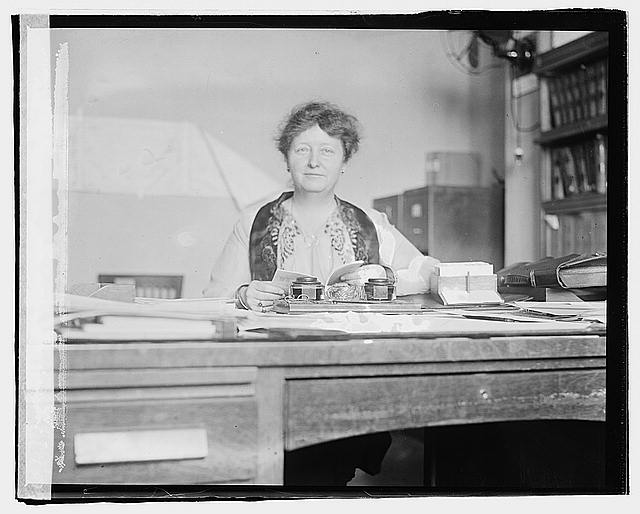
A new weapon now being used against women in the workforce was denounced tonight by Civil Service Commissioner Jessie Dell at a meeting sponsored by the National Woman’s Party at its headquarters in Washington, D.C.

Section 213 of the Economy Act of 1932 was allegedly passed to try to spread Civil Service jobs around to as many families as possible during the current economic crisis. It declares that if cutbacks are needed, those who have spouses working for the Government must be dismissed first, and if new positions become available, priority must go to those who do not have Federally employed spouses.

Dell noted that the original bill called for dismissal of wives only, but at the last minute, due to “fear, on the part of legislators, of the political effect, if discrimination against women were otherwise so clearly and forcibly shown,” the text was changed to make it neutral in regard to gender. But the change was purely cosmetic. Since men tend to get promoted faster and higher, if cutbacks require a family to live on just one salary, it is invariably the lower-paid wife who will resign to protect the higher-paid husband’s job.

Commissioner Dell also wondered about the arbitrary nature of the restrictions. If keeping a family from hoarding too many Government jobs is the aim, then why not prohibit fathers and sons, or any two family members living in the same household from being simultaneously employed? She said that the real purpose of the law was “to strike at the employment of women generally” and that “this strange freak of legislation is merely a reaction against the employment of women on the part of men who, after all the remarkable work women have done, still cannot push aside their biased opinions and honestly consider the real good of the service.”

via the Library of Congress
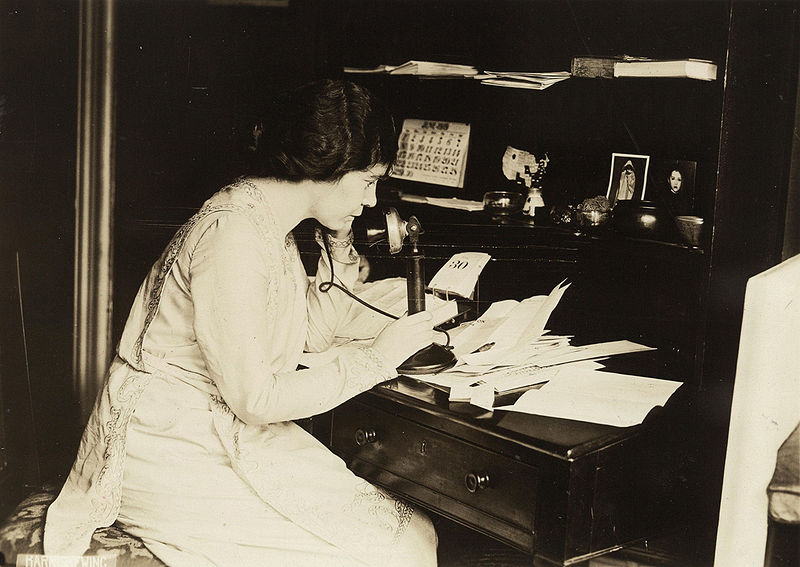
Jessie Dell at her desk, via the Library of Congress

Prejudice against married women in the workforce is nothing new, of course. The most obvious examples are strict bans on women teachers marrying, which were widespread many decades before the current business depression hit, and are by no means extinct today. But hostility toward the employment of wives in general has skyrocketed with the unemployment rate, and this form of bigotry has now has been formally enshrined in Federal law.

The new law states : “In any reduction of personnel in any branch or service of the United States Government or the District of Columbia, married persons (living with husband or wife) employed in the class to be reduced, shall be dismissed before any other persons employed in such class are dismissed, if such husband and wife is also in the service of the United States or the District of Columbia. In the appointment of persons to the classified civil service, preference shall be given to persons other than married persons living with husband or wife, such husband or wife being in the service of the United States or the District of Columbia.”

Section 213 clearly violates the principle of Civil Service employment being based solely on merit, and is anti-marriage as well. Already there are reports of working couples choosing to cohabitate rather than marry, secret marriages, and even separations and divorces among those already married, so that both partners can evade dismissal.

Civil Service Commissioner Dell urged women to “get busy and set in operation forces which will hasten the repeal movement.” She said that the law could be repealed, but only if there was “enlightened sentiment and crystallized public disapproval.” The National Woman’s Party intends to be at the forefront of the battle, and to be as successful at taking this out of Federal law as it was in helping put “Votes for Women” into Federal law via the 19th Amendment 12 years ago.

Founding Feminists: September 24, 1917

Founding Feminists is FMF’s daily herstory column.

FoundingFeministLogo-color

Though Representative Joe Walsh, Republican of Massachusetts, called it yielding to “the nagging of iron-jawed angels,” the militant tactics of the National Woman’s Party seem to be paying off. The House voted 181-107 today to finally create a separate Committee on Woman Suffrage. Up until now the Susan B. Anthony (nationwide woman suffrage) Amendment had been just one of many issues to be dealt with by the always overburdened House Judiciary Committee.

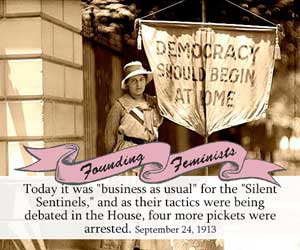
The debate today was heated, and less about whether women should vote than about the “Silent Sentinels” who have been taking up their posts along the White House fence each day since January 10th. They are there to point out the hypocrisy of President Wilson vigorously campaigning for democracy around the world while not even endorsing – much less using his considerable influence to lobby for – a Constitutional Amendment that would bring democracy to millions of voteless women in his own country. Representative William Stafford, Republican of Wisconsin, called the Sentinels’ peaceful picketing “outlawry,” and Rep. Walsh referred to the pickets as “bewildered, deluded creatures with short skirts and short hair.”

via Library of Congress

The fight for creation of the new committee was led by Rep. Edward Pou, Democrat of North Carolina, and Rep. Jeannette Rankin, Republican of Montana. After quoting some State Constitutions to show how hard it would be for women to win suffrage in some States, Rep. Rankin told her fellow House members, “Perhaps it is news to you to know that some women of the United States can never be enfranchised except by Federal amendment. Constitutions of the States are such that it is practically impossible to amend them.”

Rankin used New Mexico as an example. That State requires 3/4 of all the votes cast and a 2/3 majority in every county in order to amend its constitution through a referendum. Representative Pou, who chairs the House Rules Committee, said that President Wilson had written a letter to him in which the President said he was in favor of a Suffrage Committee in the House. A skeptical Rep. Edwin Webb, Democrat of North Carolina, who heads the House Judiciary Committee, challenged Pou to produce the letter, which he did.

Both major parties went on record in 1916 as favoring woman suffrage on a State-by-State basis, and President Wilson is personally in favor of suffrage, but unwilling to lean on his fellow Democrats – who control both House and Senate – to get the Anthony Amendment through Congress. So, pressure on President Wilson to declare passage of the amendment a “War Measure,” and on both parties to endorse nationwide suffrage, as well as on individual members of Congress to vote in favor of the Anthony Amendment will continue.

Today it was “business as usual” for the “Silent Sentinels,” and as their tactics were being debated in the House, four more pickets were arrested.

Founding Feminists: September 23, 1923

Founding Feminists is the FMF’s daily herstory column.

founding feminists

Anyone who thinks the National Woman’s Party must have lost some of its drive or militancy after finishing its campaign to put the Susan B. Anthony (nationwide woman suffrage) Amendment into the Constitution on August 26, 1920, clearly wasn’t at today’s colorful pageant in Colorado Springs. Meeting over the weekend, the party celebrated 75 years of feminist progress, while making it clear that the battle for total equality is far from over.

Alva Belmont, President of the N.W.P., let it be known at a banquet last night that the 19th Amendment was just one stepping stone on the path to equality, and that it’s time for women to assume political leadership:

For twenty centuries men have been running the world. Now it is time for women to take over affairs, and as they very nearly hold a balance of power at this time, the day may not be as far distant as old party leaders imagine when there will be set up a woman’s government by women and for women, children and humanity in general.

Plans were announced in April to set up a separate “Women’s Congress” in Washington, possibly as early as December, to debate the same issues as those of the U.S. Congress, so that women’s views could be made known. There is presently only one woman in Congress, Rep. Ella Mae Nolan, Republican of California. The National Woman’s Party may become a formal political party with its own candidates and platform.

But Belmont reassured those who fear that feminists want to simply “get even” for thousands of years of patriarchal rule and plan to disempower and restrict men, that this is not the case: “Now don’t construe my meaning as that of a woman opposed to men. I am for men, but for women and children first. Men have forgotten us during the past, but we are going to remember them and take them right up and onward with us.”

One prime example of that “equality for all” philosophy is the party’s enthusiastic endorsement of an “Equal Rights Amendment,” which they call the “Lucretia Mott Amendment” in honor of that pioneer feminist. Written by the party’s founder, Alice Paul, it would outlaw any form of discrimination against either sex by any State, the United States, or any place subject to its jurisdiction. The party made full equality for women its “paramount issue” during the 1922 midterm elections, and intends to do the same in the 1924 General Election.

Despite her many years of work and unrivaled monetary contributions to the suffrage struggle, Belmont said that she had never voted, and would refuse to do so until she could vote for a woman candidate nominated by a woman’s party. She also criticized other wealthy women for not getting involved in the struggle for dignity, opportunity and equality for all women. “For nine years,” she said, “I have been as one crying in the wilderness to women of wealth and leisure to give over their pleasure and frivolities and do something to justify their existence. I have cried in vain. No reform ever appealed to people who have all they want.”

via Library of Congress

Fortunately, there are exceptions to the rule. On July 28th, E.M. Levy announced that she had bequeathed $ 50,000 to the party in her new will. She had never taken much interest in politics until the National Woman’s Party came along, but is now an enthusiastic supporter who has already made a number of generous contributions, including a $1,000 Life Membership.

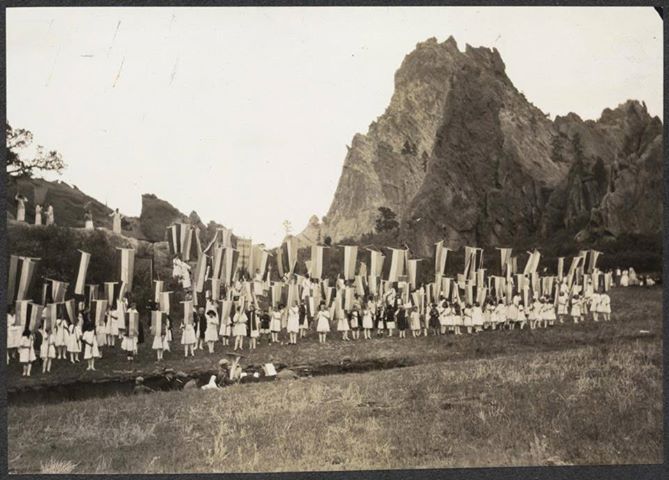
The party concluded its conference today by putting on an elaborate pageant in the Garden of the Gods. It was reminiscent of the suffrage spectacles of a decade ago. The event drew 20,000 spectators, plus reporters from many major newspapers, and film was shot by Fox, Pathe and Universal for their nationally distributed newsreels.

The program opened with Ruth Montgomery, assisted by a 200-voice chorus, singing “Angels Ever Bright and Fair,” followed by trumpets announcing the procession that followed. Led by Sally Halthausen Gough on a black horse, it was intended to salute previous efforts, and show how long the struggle has gone on since that original women’s rights convention in Seneca Falls, New York, in 1848. It included everything from a covered wagon and bright red stagecoach to more modern forms of transportation, with hundreds of participants taking part. Many portrayed feminists of earlier days, and dressed in costumes from their time.

The pageant also featured exuberant singing of confident songs, such as “The March of the Women,” an anthem from suffrage days, which begins with “Shout, Shout, Up With Your Song.” The music was accompanied by a large display of purple, white and gold banners of the National Woman’s Party held up by a delegation of schoolgirls. Other banners, bearing the words of Susan B. Anthony that “Failure is Impossible” fluttered in the breeze as well.

Colorado is a very progressive State. Women won the vote here in an 1893 Statewide ballot referendum, the first ever to succeed. But the fact that the laws are far from equal even here was stressed in numerous speeches, and cited as proof that there is still much work to be done. Among today’s speakers were many veterans of the suffrage struggle, such as Alice Paul, Sue White, and Eunice Brannan. White, who played a major role in her home State of Tennessee’s crucial ratification of the 19th Amendment on August 18, 1920, deplored the fact that even in 20th Century America, we are still living according to the ancient English Common Law assumption that in marriage, the husband and wife become one, and that the husband is the “one.”

It was noted by Alva Belmont that 30 years after winning the vote in Colorado, a wife’s earnings are still the property of her husband, and women cannot serve on juries, thus denying them even so basic a right as a trial by a jury of their peers. Of course, she also noted that things are a lot better here than in Georgia, where a father can will his children to anyone he chooses without his wife’s consent. And in Louisiana, the husband is legally recognized as “head and master” of the household.

The 14th Amendment has failed to help women in any way thus far, so there is still nothing in the Constitution to explicitly guarantee equal treatment under the law for women and men. But that oversight is something the National Woman’s Party intends to remedy, and there are plans to get the Lucretia Mott (Equal Rights) Amendment introduced into Congress before the year is out.

So, as exciting as their battle for the ballot may have been, there should be even more interesting times ahead for the National Woman’s Party on this long road to equality!

(Photo : Schoolgirls holding up the purple, white and gold banners of the National Woman’s Party at the pageant earlier today. Newsreel camera operators and photographers are in the trench in front of the banners. )

Founding Feminists: September 20, 1973

Founding Feminists is FMF’s daily herstory column.

founding feminists

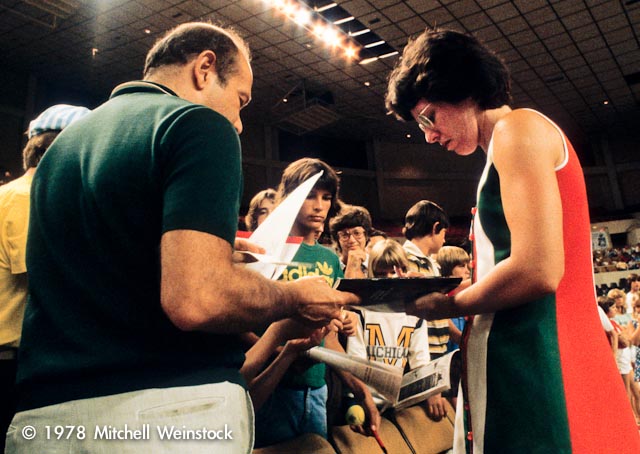
Game, set, match! Even with the carnival atmosphere, and hype more suited to professional wrestling than tennis, Billie Jean King’s 6-4, 6-3, 6-3 rout of Bobby Riggs earlier this evening was a major triumph for women in sports, and for the revitalized feminist movement itself.

Though King was intently focused on giving Riggs some lessons in how the game is played, he wasn’t her only opponent, and tonight wasn’t just about tennis. She was battling all the traditional assumptions and ancient stereotypes about men and women that the swaggering Riggs proudly embraced, and came to personify in the months since he first issued his challenge to the world’s best female tennis players.

Following months of verbal volleying, here they were at a packed Houston Astrodome, before a live television audience of about 50 million in the U.S., plus viewers in 36 other countries, with Howard Cosell and Rosemary Casals present to do an uninhibited commentary for ABC.

Male supremacists confidently awaited a repeat of Riggs’ far less publicized 6-2, 6-1 trouncing of a clearly rattled Margaret Court on Mother’s Day, ready to cheer his victory, and reassure themselves that feminism was just another passing fad, and no real challenge to the status quo.

Schoolgirls, whose opportunities to play competitive sports are now rapidly expanding thanks to Title IX, and who see King as a role model, tuned in as well. Their mothers and grandmothers, who remembered being barred from some sports when they were growing up, or whose teams never had the funding or respect they deserved, were watching too, eagerly looking forward to applauding any shot that got past Riggs. The claim that men are so athletically superior to women that even a man who hadn’t won at Wimbledon since 1939 could easily defeat a woman who won there two months ago was about to be tested, and it made for high tension and irresistible real-life television drama.

But before some no-nonsense tennis, there was another bit of flamboyance that the sport had never seen before, and is unlikely to ever witness again. King entered the stadium first, on a gold litter straight out of Cecil B. DeMille’s “Cleopatra,” carried by several well-conditioned male track and field athletes from nearby Rice University.

Riggs entered in a gold-wheeled rickshaw, pulled by six professional models in tight red and gold outfits that left no mystery as to why he dubbed them “Bobby’s Bosom Buddies.” And just to make sure that none of the 30,492 fans in the stands would mistake this for a traditional tennis match, a band blared march music while clowns and other costumed characters frolicked about in front of large banners being waved by champagne-sipping spectators who had paid up to $100 for some of the better seats.

Finally came the mutual introductions, and in keeping with the spirit of the occasion, Riggs presented King with a giant “Sugar Daddy” caramel lollypop courtesy of his principal sponsor. She responded by giving him a live (and presumably male chauvinist) pig. The piglet, named “Larimore Hustle” (Larimore is Bobby’s middle name, and hustling his real game) would be one of the few things King sent his way earlier this evening that Riggs would be able to handle. In the first set alone, Billie Jean won 26 of her 34 points with shots that Bobby’s racquet couldn’t even touch. By the end of the match it was 70 out of 109. Riggs had said that women just didn’t have the nerves to play under pressure, but he turned out to be the one making the double-faults into the net when it was his turn to serve.

This wasn’t just a win, it was a big enough drubbing that there will be no debate about whether luck played any part in the result, or if King just had an extraordinarily good night. After running him around the court to the point of exhaustion, King left Riggs with just enough strength to leap the net to congratulate her as Billie Jean tossed her racquet high into the air. Then, in one of those unforgettable TV moments, King stood in the middle of the stadium with the huge winner’s trophy raised over her head as the crowd cheered itself hoarse.

Surprisingly, Riggs made no excuses, and was among the first to say that he’d been outplayed. In the interview room afterward, he said : “Billie Jean is too good. Too quick. I got the ball past her but she not only returned it but made a better shot than I did. Too good. Too quick. She deserved to win it.”

Despite having recently won her fifth Wimbledon singles title, Billie Jean said, “I feel this is the culmination of my 19 years in tennis.” Not only did she think that her win was good for women, but for the game as well, with millions of people getting their first exposure to it. “I’ve played tennis since I was 11,” she said, “and I love it very much. When I was young I thought it was a sport just for the rich and white. There were a lot of non-tennis people who saw tennis for the first time tonight. You know I believe in spectator participation, so a lot of my dreams came true tonight.”

via Mitchell Weinstock

This evening King changed not just tennis, but the country’s attitude toward women athletes and women’s equality in general. In just two hours and four minutes, King may have given as big a boost to women’s sports as last year’s passage of Title IX, which will assure that the girls who are inspired by her feat will finally get the same access to school sports as the boys, and enjoy the same lifelong benefits from their experience. Thank you, Billie Jean, for an evening that will always be remembered in both sports and feminist history!

Founding Feminists: September 19, 1893

Founding Feminists is FMF’s daily herstory column.

founding feminists

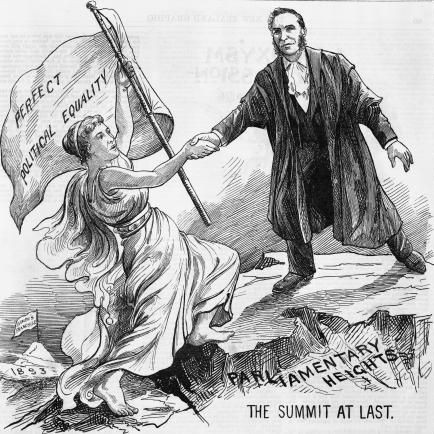
In an unprecedented victory for the worldwide suffrage movement, the women of New Zealand won full voting rights today! The struggle goes back to 1869, when Mary Ann Miller wrote “An Appeal to the Men of New Zealand,” which advocated female suffrage. Two years later, Mary Colclough gave the first public lecture on the subject. Bills to extend the suffrage were introduced into Parliament in 1878, 1879 and 1887, and only narrowly defeated. But thanks to leadership by Kate Sheppard, as well as the tireless work of Women’s Christian Temperance Union campaigners, a winning strategy was devised.

The start of the campaign was quite modest. In 1887 two petitions signed by 350 women were presented to the House of Representatives. By the next year there were 800 signatures. But after this slow start, suffrage began to pick up major support. In 1889, the enthusiasm of the newly-established Tailoresses’ Union was added to that of the W.C.T.U. In 1891, nine thousand women signed eight petitions. A year later, the Women’s Franchise League was established, and six petitions with 19,000 signatures were presented. Earlier this year thirteen petitions containing 32,000 signatures were submitted.

As in the United States, the major sources of opposition to woman suffrage have been those who believe that a woman’s “natural” role as wife and mother is incompatible with politics, plus the liquor industry, whose generosity in funding anti-suffrage organizations knows no bounds in any country. Since a good deal of the work for suffrage has been done by the W.C.T.U., it has not been difficult for liquor interests to stir up fear of prohibition and gather signatures on anti-suffrage petitions in the nation’s pubs.

This year’s final victory was by no means assured at any time. Premier John Ballance, who supported woman suffrage, died in April, and was succeeded by Richard Seddon, a strong anti-suffragist on quite friendly terms with liquor interests. But the huge number of signatures on the petitions – representing a substantial percentage of the nation’s women – were sufficient to get an Electoral Bill passed by the House. A furious campaign then ensued as it went to the Legislative Council, which had killed two previous suffrage bills.

There were rallies and heavy lobbying of Legislative Council members, both in person and by telegram. Anti-suffragists went all-out, with Seddon using every trick in the book to pressure his fellow legislators to vote “no.” Finally, the day of the vote arrived, with pro-suffrage Council members wearing white camellias in their buttonholes. But apparently Seddon’s underhanded and “strong arm” tactics had gone too far this time, and two anti-suffragists were sufficiently offended that they changed their votes to “yes,” so the measure carried 20 to 18.

Opponents, now wearing red camellias, didn’t give up, and spent the eleven days since the vote pressuring the Governor not to sign the bill. But today the “Electoral Bill” became the “Electoral Act” with Lord Glasgow’s signature, and the battle for unconditional, universal woman suffrage has now been successfully brought to a conclusion in New Zealand.


via National Library of New Zealand

Though technically a part of the British Empire, the nation has been self-governing since 1852, thanks to the British Parliament passing the New Zealand Constitution Act. A national election will take place on November 28th, and New Zealand’s Parliament will achieve a unique legitimacy by becoming the first national governing body to be freely elected by a majority of all the adult citizens of the country.

Hopefully, the U.S. will follow suit. At present, women can vote only in the State of Wyoming, where they won the ballot on December 10, 1869, when it was still a Territory. Women (and men) of all races who possessed a certain amount of property could vote in New Jersey from 1776 until 1807, at which time the franchise was unjustly restricted to “free, white male citizens of the State, of the age of 21 years, worth fifty pounds proclamation money, clear estate…” The last State to end property qualifications was North Carolina, which did so in 1856. The 15th Amendment, ratified on February 3, 1870, prohibits denial of the vote based on “race, color, or previous condition of servitude,” but is clearly not being enforced in the South, even though Congress has the power to enforce it “by appropriate legislation.”

Women in Utah Territory could vote from 1870 until 1887, when Congress passed the Edmunds-Tucker (anti-polygamy) Act and disenfranchised them. Women in Washington Territory won the vote twice, but legislation passed by the Territorial Legislature in 1883 was overturned by the Territorial courts in 1887, and a bill passed in 1888 was similarly voided. In 1889 a suffrage referendum in what is now the State of Washington was defeated by a 2-1 margin. But there is a suffrage referendum on the ballot in Colorado on November 7th, so a second suffrage State may be won soon, and as was the case in New Zealand, persistence may yet pay off!

Founding Feminists: September 18, 1968

Founding Feminists is the FMF’s daily herstory column.

founding feminists

Alice Paul is in full fighting mode today, and women are preparing to risk arrest and engage in civil disobedience if necessary. Though this sounds like a report from the suffrage battlefront 50 years ago, it’s not. One major difference between 1918 and 1968 is that back then, the National Woman’s Party wanted Congress to pass something (the Susan B. Anthony Amendment, assuring women of their right to vote) whereas today they want Congress to defeat something: a bill to confiscate 2/3 of historic Sewall-Belmont House property to build a driveway for an expanded New Senate Office Building. The party has always tried to have its headquarters as close to the center of political action as possible, but at the moment it may seem a bit too close.

The National Woman’s Party has had its offices and officers’ living quarters at Sewall-Belmont House since 1929, when it became the group’s fifth and final headquarters. The house itself is one of the oldest homes on Capitol Hill. Robert Sewall completed construction on the original house by 1800, and rented it to Secretary of the Treasury Albert Gallatin from 1801 to 1813. During the War of 1812, the house was burned by invading British troops in August, 1814, when it was used to resist their advance on Washington. Sewall rebuilt the house after the war, and it remained in his family for over a century, until purchased by Senator Porter Dale in 1922. He sold it to Alva Belmont in 1929, so that she could donate it to the National Woman’s Party as their new headquarters.

It is believed that the Joint Committee on Landmarks, in a report that will be delivered to the National Capital Planning Commission, thinks that after studying the matter for three years, the house belongs in the “landmark” category. But Rep. Kenneth Gray, Democrat of Illinois, disagrees. A member of the Public Works Committee, he has been engaging in unethical tactics to steamroll this controversial bill through the House after it was passed by the Senate.

He has presented his bill as just a “housekeeping” measure that ought to be passed by the House as a simple courtesy to the Senate, and has reportedly misinformed members of Congress that an agreement was reached with the National Woman’s Party to sell the land for $50,000. He has said that Sewall-Belmont House is “unsightly” and of “no historical significance” and that the apartments used by N.W.P. officers are in disrepair and “will fall down anyway.”

The bill was originally introduced by Senator Ralph Yarborough, Democrat of Texas, and it excludes from condemnation the central portion of the building and a small lot, but confiscates the majority of the property. “It’s all one building and one historical landmark,” says Alice Paul, N.W.P.’s founder.

When the bill first came up for discussion in the House on August 2nd, Rep. Edith Green, Democrat of Oregon, noted that the Senate had passed it by only a ratio of 4-3, hardly the kind of near-unanimous vote normally cast for uncontroversial “housekeeping” measures. Others objected to trying to push it through when so many members were away attending their parties’ national conventions in Miami and Chicago.

Alice Paul, 83, is as actively involved in this new campaign as the one half a century ago. Today she phoned N.W.P. president Emma Guffey Miller’s home in Slippery Rock, Pennsylvania, to discuss strategy, then sent telegrams to House Majority Whip Hale Boggs, Democrat of Louisiana, and Senator Everett B. Jordan, Democrat of North Carolina, asking them to delay action, citing the findings of the Joint Commission on Landmarks.

via Shutterstock
A younger Alice Paul. via Wikimedia Commons

But if conventional methods fail, the National Woman’s Party knows how to escalate. And this time they have a new ally. Barbara Ireton, president of the National Capital Area Chapter of the National Organization for Women said it was decided at meetings held today in Washington and New York that if necessary, a ring of women will surround the property to protect it if the House passes the condemnation bill and President Johnson doesn’t veto it.

So, history may repeat itself half a century after the National Woman’s Party’s “Silent Sentinels” went to jail in D.C. for peacefully protesting along the White House fence in favor of woman suffrage.

Founding Feminists: September 17, 1909

Founding Feminists is FMF’s daily herstory column.

Print

It’s a new era in the battle for the ballot, and a new headquarters for the National American Woman Suffrage Association! After six years in Warren, Ohio, first at the home of Treasurer Harriet Taylor Upton, then in the Trumbull County Courthouse, N.A.W.S.A. has moved back to New York City, and is now situated on the 17th floor of 505 Fifth Avenue, at 42nd Street.

Rent for the entire floor – $5,000 a year – will be paid by Alva Belmont. Divorced in 1895 from her first husband, William Vanderbilt, and widowed last year by the untimely passing of Oliver Hazard Perry Belmont, she has since that time become quite active in the suffrage movement. On July 15th she made an incredibly generous contribution to the cause by agreeing to lease space for this “suffrage headquarters” to be used exclusively by organizations working to win the vote for women.

via the Library of Congress.

Today reporters and photographers were give a tour of all nine rooms – as well as free “Votes for Women” pins from N.A.W.S.A. President Anna Howard Shaw, who pinned them on each guest personally. Of course, many “won’t be able to get into the newspaper office wearing them,” joked Belmont.

Things are not yet in complete order, as the largest room in the suite is filled with 24 cases of suffrage literature, and the bookshelves lack books, but have a surplus of flowered hats upon them. The offices themselves are all quite attractive. In the “President’s Room” are fine portraits of pioneer suffragists, and the “Reception Room,” near the front, is furnished in black carved oak. Next to that is Alva Belmont’s office, appointed in mahogany.

Since so many reporters were gathered together, it seemed like a good time for Ida Husted Harper to address one of her pet peeves. There has been a great deal of publicity here lately about violent actions taken by British “suffragettes” who use the term to distinguish themselves from the more moderate suffragists. So Harper said: “We would be very glad if you would not call us suffragettes. The suffragettes are all right, and we have no quarrel with them, but we represent the suffragists of long standing, and the word suffragette is the one for the suffragists who have adopted militant methods.”

Anna Howard Shaw gave some comfort to elected officials who are suffrage supporters and fair warning to those who are not: “We are now going into practical politics. We are going into the districts where our friends are in the political field and try to elect them, and we are going to try to defeat our enemies. We are told that women have more influence without the vote, and we are going to try and use that influence.”

Shaw outlined an ambitious program, and specifically mentioned major suffrage campaigns to be carried on in Washington State, Oregon and South Dakota, as well as in the Territory of Arizona. Her organization will even try to have some sort of suffrage legislation introduced in the legislatures of all 42 non-suffrage States this Winter.

Now that the nation’s largest suffrage organization is situated in such a strategic location, and rent is not a burden, the future of the cause seems very bright. Though women can only vote in four of the forty-six States (Wyoming, Colorado, Utah and Idaho), the long drought – 13 years without winning the vote in a single State – may be about to end, and a suffrage “renaissance” begin!

Founding Feminists: September 16, 1918

Founding Feminists is the FMF’s daily herstory column.

Print

The contrast between the older, traditional suffrage groups and the movement’s newer, more militant faction was never more in evidence than earlier today.

The day’s events began when National American Woman Suffrage Association members who are voters in equal-suffrage States had a friendly meeting with President Wilson at the White House. Those in the delegation lavishly praised his words of support for the cause.

Two hours later, the National Woman’s Party got a transcript of Wilson’s statement, and as a way of emphasizing that mere words will not be enough to get the President’s fellow Democrats to stop blocking passage of the Susan B. Anthony (nationwide woman suffrage) Amendment in the Senate, they set fire to copies of his latest pronouncement at the Lafayette Monument just across from the White House.

The N.A.W.S.A. delegation that had a 15-minute visit with the President was quick to praise him. According to Minnie Fisher Cunningham of Texas: “The President is a wonderful listener. He gives the closest attention to the matter presented and you have his entire interest for the period of the interview. This is real democracy – to be able to get to the head of the nation with the problems of the people.”

via Wikimedia
via Wikimedia

He told the delegation: “I am, as I think you know, heartily in sympathy with you. I have endeavored to assist you in every way in my power, and I shall continue to do so. I will do all I can to urge the passage of the amendment by an early vote.”

Though the sentiment was fine, words are not equivalent to deeds, and the National Woman’s Party was far from satisfied. After forty N.W.P. members marched from their headquarters to Lafayette’s statue, tricolor banners held high, Lucy Branham held aloft a flaming torch and said: “We want action.” Then, as she set the President’s statement alight, she proclaimed:

The torch which I hold symbolizes the burning indignation of women who for a hundred years have been given words without action. In the Spring our hopes were raised by words much like these from President Wilson, yet they were permitted to be followed by a filibuster against our amendment on the part of Democratic Senate leaders. Today the Chairman of the Rules Committee of the Senate, a spokesman of the Administration, stated that suffrage was not on the program for this session, and that the Senate was hoping to recess in a few days for the Autumn election campaigns without taking up any other measure. Today the Chairman of the Woman Suffrage Committee in the Senate, another spokesman for the Administration, announced that he would not even call the Suffrage Committee together to consider taking a vote. This session is nearing its close and the President and his party refuse to take any effective step toward the passage of the suffrage measure.

As in the ancient fights for liberty the crusaders for freedom symbolized their protest against those responsible for injustice by consigning their hollow phrases to the flames, so we, on behalf of thousands of suffragists, in the same way today protest against the action of the President and his party in delaying the liberation of American women. For five years women have appealed to this President and his party for political freedom. The President has given words, and words, and words. Today, women receive more words. We announce to the President and the whole world today, by this act of ours, our determination that words shall no longer be the only reply given to American women – our determination that this same democracy, for whose establishment abroad we are making the utmost sacrifices, shall also prevail at home.

Today’s demonstration – though the first in which they’ve used fire – is just the latest in a long series of militant protests against President Wilson begun on January 10th of last year by the National Woman’s Party. After a meeting the day before with a large delegation of suffragists, in which Wilson expressed sympathy for the cause, but unwillingness to endorse the Anthony Amendment, or use his considerable influence to help get it through Congress, the N.W.P. (then known as the Congressional Union for Woman Suffrage) began stationing “Silent Sentinels” along the White House fence near the gates each day. Their banners highlighted the hypocrisy of Wilson vigorously campaigning for democracy around the world while doing nothing to bring it to the female half of his own country.

The Sentinels first braved extreme cold and heavy snow, then Spring rains and Summer heat and humidity. They remained undeterred despite attacks by mobs angry at anyone who would criticize a President in wartime, and they have endured arrests, prison sentences, hunger strikes and force-feedings, as well as brutality by prison personnel at the infamous Occoquan Workhouse.

As recently as August 12th and 14th there were mass arrests, with injuries, and demonstrators sent to Occoquan for making peaceful protests at Lafayette’s statue over the failure of the Senate to vote on the Anthony Amendment. As Alice Paul said at the time: “We will continue to protest as long as our disenfranchisement exists. Oppression and abuse at the hands of the law merely emphasized the great need of women for political power.” On August 20th, twenty-three suffrage prisoners were released after a six-day hunger strike.

Older, more traditional suffragists have denounced the actions of the militants as allegedly “hurting the cause” by alienating male voters in States where suffrage referenda are on the ballot, as well as offending politicians who have at least come out in favor of suffrage, even if they haven’t done anything meaningful to bring it about as yet.

Militants complain that the older, more conservative suffragists are too friendly and deferential toward those who have the power to immediately pass the Anthony Amendment, and that their low-key, State-by-State campaigns will take far too long to win suffrage nationwide. But this combination of approaches actually seems to be quite effective. There has been more progress in the past five years than in the sixty-five that preceded it, so “more of the same” by both factions should produce the result that all suffragists desire: “Votes for Women” in all 48 States, and permanently assured.

Founding Feminists: September 12, 1967

Founding Feminists is the FMF’s daily herstory column.

founding-fems

Are being quite young, very attractive, and an unmarried woman “bona fide occupational qualifications” for being a flight attendant ? According to the airline industry, the answer is “yes,” but two unions and feminist Betty Friedan strongly disagree. Today a hearing was held by the Equal Employment Opportunity Commission so it could listen to both sides, then make a ruling on whether the airlines are in violation of the Civil Rights Act of 1964, or whether their biased standards are justified and should be permitted to continue.

Friedan, author of “The Feminine Mystique” and president of the almost 11-month-old National Organization for Women, noted the similarity between the job requirements of the airlines and those of a Playboy Club, and said that the airlines were “transforming stewardesses into bunnies of the air.”

“While the airlines talk about these pretty girls and the service they give,” she said, “the sexuality of the girls is a necessary factor in the job.” She called the airlines’ policies “the most flagrant kind of sex discrimination” because male airline employees are never required to resign or take other jobs upon reaching age 32 (or 35 in some cases), nor when they marry, and do not have the same ultra-strict weight requirements.

Friedan (second from the left) at an early NOW meeting. via Wikimedia.

None of the airline executives disputed the fact that they have unique and far more restrictive age standards for female flight attendants than for any of the jobs done by men, but tried to show why these rules were needed. According to Walter Rauscher, vice-president of American Airlines: “We must have a glamorous product that is wanted and needed by people,” and he resented the comparison between his company’s employees and Playboy bunnies. But he didn’t say what the difference was between being “glamorous” vs. being a “sex symbol,” or which of the many duties of a flight attendant could not be performed by a married woman, someone over 32, or a man.

Robert E. Johnson, vice-president of United Air Lines, also objected to the “airborne bunny” comparison. “I resent the implication that stewardesses are sex symbols. They are not,” he said. “They perform a quality service. I resent characterizing them as ‘bunnies.’ That is unwarranted on the basis of their conduct, breeding and behavior.” He then said that it was United’s stewardesses who kept the ” ‘friendly skies’ of United friendly,” apparently adding an ever-smiling, compliant attitude to the strict age, height, weight, beauty, grooming and marital status requirements.

The Air Transport Association, consisting of 55 airlines, sent attorney Jesse Friedin to tell the E.E.O.C. that discrimination based on age and marital status wasn’t an issue on which the Commission was even empowered to rule. But those testifying for the Transport Workers Union and the Air Line Pilots Association disagreed, and then went on to point out that not all airlines have such restrictions, so they must be arbitrary, rather than objectively necessary.

Protests against these policies date back to April 17, 1963, when eight flight attendants held a press conference to denounce the American Airlines policy of forced retirement at 32. “Do I look like an old bag ?” asked 35-year-old Barbara “Dusty” Roads. (She was able to work past the deadline because all those employed at the time the new policy went into effect in November, 1953, were given exemptions.)

The Civil Rights Act was signed into law on July 2, 1964, and the E.E.O.C. began its work a year later, charged with interpreting and implementing Title VII. However, the Act permits bias in “those certain instances where religion, sex, or national origin is a bone fide occupational qualification reasonably necessary to the normal operation of that particular business or enterprise.” Congress began taking testimony on the issue of discrimination against flight attendants on September 2, 1965, when Colleen Boland and several other women testified about the unfairness of the rules.

The present controversy began in November, 1965, when charges of sex bias by the airlines began to come to the E.E.O.C. Women have filed all but one of the complaints, the exception being from a man who wanted to be a steward, but was told that only women could apply for such positions at that particular airline. (Only about 5% of flight attendants are men.)

The E.E.O.C. held a five-hour public hearing on May 10, 1966, with representatives of both sides present. On November 9, 1966, the Commission voted on a ruling, but some of the airlines went to court and got a preliminary injunction to prevent the E.E.O.C. from publicly issuing its decision. Their main argument was that Aileen Hernandez, one of the Commissioners, was active in the newborn National Organization for Women, and therefore couldn’t have been “objective” about sex bias when the Commission vote was taken. A few months after her resignation from the Commission, the judge made his injunction permanent and said the E.E.O.C. would have to either drop the issue or hold a new hearing. They chose the latter, and that’s what took place today.

Founding Feminists: September 11, 1917

Founding Feminists is FMF’s daily herstory column.

founding-fems

Today in Washington, D.C., National Woman’s Party members celebrated the courage and commitment of their White House pickets, while more traditional “Votes for Women” advocates around the country spent the day expressing optimism about the future of the cause, despite yesterday’s overwhelming defeat of a suffrage referendum in Maine.

Six “Silent Sentinels” who had been serving time in Virginia’s infamous Occoquan Workhouse for picketing President Wilson by standing along the White House fence with large, colorful banners, were honored with a banquet earlier this evening at Cameron House, headquarters of the National Woman’s Party. The picketing has been going on since January 10th to point out President Wilson’s hypocrisy in vigorously campaigning for democracy around the world while refusing to help bring democracy to the women of America by using his influence with the Democratic majority in Congress to pass the Susan B. Anthony (nationwide woman suffrage) Amendment so it can be sent to the States for ratification.

via Wikimedia
Lucy Burns during a recent prison term in Occoquan Workhouse. via Wikimedia

Over the past eight months, pickets have endured extreme cold and heavy snow, then rain, heat and humidity, criticism from more conservative suffragists, attacks by mobs, and finally arrests and lengthy sentences in the harshest of prisons. But tonight was a time to celebrate the freedom – temporary as it probably is – of six of the many who have been willing to endure imprisonment now so that women may vote in the future.

Alva Belmont, one of the principal speakers, left no doubt about her feelings toward the Wilson Administration or the courts, as she praised the pickets just hours after their release:

We come together tonight to honor the gallant six who have so bravely endured persecution at the hands of the Government, which has used its power to oppress women instead of liberating them. The present undemocratic Administration, on technical and unproved charges, and in court trials, which have been a bitter travesty on justice, has dared to imprison American women of patriotism and distinction in a filthy workhouse, in order to attempt to suppress the insistent demand of women for their political freedom.

An Administration which could be stupid and vicious enough to meet this appeal by such medieval methods proves that it is hostile to the liberal movements of the world, and that it is trying to smother the needs of democracy at home. Such an Administration, if it does not cease its cowardly persecution should be shorn of power in the next Congressional election.

The news from Maine, where a suffrage referendum was defeated by a 2-1 margin yesterday, was not being celebrated, of course. Local suffragists fought a good campaign, distributing 1,500,000 leaflets – 10 for every eligible voter – and Deborah Knox Livingston traveled uncountable numbers of miles around the State speaking and raising money. But there was never that much hope for a victory in Maine’s first suffrage referendum due to the short time between the measure being placed on the ballot and Election Day, as well as the State’s basic conservatism. The very low turnout may also have been a factor.

But today, suffragists are still optimistic about New York State’s suffrage referendum coming up on November 6th. New York and Maine are very different, and should produce opposite results. According to Carrie Chapman Catt:

A good deal of suffrage education has been inculcated that will count toward future victory. We have learned to take what looks like failure as the forerunner of success. It was a good deal to expect Maine to go pro-suffrage in a first campaign. Even in the Western States it has taken several campaigns to win. I understand that a Maine ‘anti’ hopes the question is settled in Maine for a long time to come, but the suffrage question is never settled until it is settled affirmatively. It is true that there probably will never be another campaign in Maine except for the purpose of ratification. The Federal suffrage amendment is surely going to pass and soon. The effect of every State’s repudiation of the suffrage plank in the platforms of all political parties can serve only to focus the effort of the National American Woman Suffrage Association anew upon the Federal route to the suffrage goal. More and more our work concentrates on Washington as the immediate focal point.

Dudley Field Malone, who resigned his appointive position as Collector of Customs for the Port of New York to protest the Wilson Administration’s inaction on suffrage, and who has acted as legal counsel for the pickets, agreed that the days of making massive efforts for State referenda are probably past:

It took the liberal and progressive elements of men and women in Maine nearly twenty years before they were permitted to put a suffrage amendment to the voters of that State, and a similar suffrage amendment may not be submitted to the electorate for twenty years more because of antique political methods in Maine. In a democratic republic this is a denial of justice and democracy, without which there would be no progress. The situation in Maine proves that the most just and speedy way to enfranchise all the women of the country is by the passing of the Federal suffrage amendment through Congress.

Anti-suffragists are expressing their usual optimism that the battle is over. Alice Hill Chittenden, President of the New York State Association Opposed to Woman Suffrage said:

Woman suffrage has not carried a single State through popular election since 1914, when the two small States of Montana and Nevada extended suffrage to women, and since that date has been defeated in twelve States, namely, South Dakota, Ohio, North Dakota, Nebraska, Missouri, New Jersey, Massachusetts, Pennsylvania, New York, Iowa, and West Virginia, Maine yesterday making the twelfth.

The total majority for suffrage in Nevada and Montana amounted to about 7,000. The results in Maine point the way to defeat of woman suffrage in New York on November 6th. Most people regard the question of woman suffrage as an intrusion at this time, when the whole mind and heart of the nation is engrossed in a great war upon which we have entered. This is a time when the manpower of Government is needed ; that is the one power which can enforce law. I cannot believe the men of New York State will make the fatal mistake of adding to the electorate at this critical time some two million votes.

But despite the latest obituary for the suffrage movement by its critics, it’s healthier than ever. In the Empire State the campaign has been large, well-funded, and running on a continuous basis since the 1915 referendum’s defeat. And regardless of how the New York contest may come out, women are already a substantial voting bloc in the Western States where they have won full voting rights.

The addition of the element of militance by the National Woman’s Party may be the final ingredient to success, however. Pressure on President Wilson to do something meaningful to help suffrage is growing, as is sympathy for the women who have been jailed for simply exercising their right to peacefully protest against being excluded from the political process for no reason other than their sex.

Victory may not be at hand, but it is in sight, and now that there is a consensus among even conservative suffrage organizations that Alice Paul was right years ago about the Susan B. Anthony Amendment being the only practical route to nationwide suffrage, we know how victory will come about, so the only question is when.

Founding Feminists: September 10, 1920

Founding Feminists is FMF’s daily herstory column.

founding-fems

The National Woman’s Party will battle on! Though originally created for the purpose of putting a woman suffrage amendment into the Constitution, there was a consensus among Executive Committee members today that the victorious end of that struggle 15 days ago will not automatically cause all discrimination and barriers against women to fall, so the N.W.P. must evolve from a”suffrage” organization with a single goal of enfranchising women, to a “feminist” organization whose goal is total equality. As Alice Paul explained:

It is incredible to me that any woman should consider the fight for full equality won. It has just begun. There is hardly a field, economic or political, in which the natural and accustomed policy is not to ignore women. Men are chosen to fill high Government offices and the responsible, well-paid positions in industry. No comment was excited by the fact that no woman was a member of the Coal Commission, for instance, or the Railway Wage Board, in whose hands lay matters of vital concern to women as housekeepers and as workers. Unless women are prepared to fight politically they must be content to be ignored politically.

Though becoming an official political party with its own women candidates has been discussed, Abby Scott Baker indicated that most board members thought it would be better to continue doing what has been so successful for the party during the “Votes for Women” struggle. Therefore, the party will throw its influence and the power of women voters in favor of established party candidates who support its goals and use it against those who do not. She urged women to enter politics, but to beware of being relegated to the lowest rungs of the ladder.

You may be sure that it will be some time before they are allowed to speak up in meetings in the inner party councils. Politicians are bargain hunters, and they are not bidding very high for the women’s vote. If I have learned anything from my political experience, it is that the one thing politicians fear is a determined minority united on a program, and ready to throw its power to the group through which it can secure that program’s success. This is the policy through which the Woman’s Party won national suffrage within seven years. By following this policy, the Woman’s Party could win success for the larger problems still before women.

Alva Belmont, who hosted today’s gathering at her Long Island home, gave an example of a problem that winning suffrage did not solve, but using women’s votes as a political tool could fix. (This is not just an academic issue to her, because her daughter recently lost her American citizenship when she married the Duke of Marlborough in England.)

With such an active, fighting women’s group in the political field, it would be impossible for women to be deprived of their citizenship through marriage or to be given citizenship because of marriage. A woman should have the right of separate domicile, so that she can not be disenfranchised, as thousands of women now are because their residence is fixed by that of their husbands.

National Woman's Party members standing in front of their headquarters three months ago, with a banner that seems as relevant now as it did during the suffrage struggle. (Image marked for reuse in Google Images.)
National Woman’s Party members standing in front of their headquarters three months ago, with a banner that seems as relevant now as it did during the suffrage struggle. (Image marked for reuse in Google Images.)

The date of the upcoming National Woman’s Party convention is still uncertain, because there is still some “unfinished business” to deal with in regard to suffrage. Anti-suffragists have launched multiple legal offensives in the courts trying to invalidate ratification of the Susan B. Anthony (19th) Amendment, or at least block its implementation until after the Presidential election on November second.

The National Woman’s Party’s highest priority is making sure that women in all States can vote in the upcoming election, so they are helping fight the court suits as well as working for ratification in Connecticut. The major legal controversy involves the ratification process in Tennessee, which became the 36th and final State needed for ratification on August 18th. Eight days later, on August 26th, the Secretary of State issued his proclamation declaring that the Anthony Amendment was in the Constitution. But if Connecticut ratifies before the election, it would make Tennessee’s now-contested status irrelevant.

Fortunately, one major impediment to the National Woman’s Party’s ambitious plans has been dealt with. Dora Lewis announced at the Executive Committee meeting that the $ 12,000 debt run up during the final days of campaigning for ratification has been paid in full, thanks to vigorous efforts to collect on previous pledges, plus new contributions, the largest of which was $ 1,000 from Alva Belmont.

So, debt-free and with their initial task happily accomplished, the National Woman’s Party can now move on toward their new goal of total equality. With the votes of millions of newly-enfranchised women added to the party’s years of political experience, achievement of equal rights for women and men now seems possible in the not too distant future!

>