Appeals Court Hears Arizona Abortion Case

The 9th US Circuit Court of Appeals will hear arguments in a case that challenges Arizona’s ban of abortion at 20 weeks today. The legal issue under consideration is “whether the ban effectively prohibits abortions before viability, which would be barred by the U.S. Supreme Court’s 1973 Roe vs. Wade decision, or is merely a restriction such as others the high court has ruled that states can impose,” according to the Associated Press.

The law in question prohibits women from getting an abortion 20 weeks after a woman’s last period, which is approximately 18 weeks after fertilization. The definition of medical exception is also narrowed through the law. The law is the most restrictive in the nation. It was challenged in court by three obstetrician-gynecologists from Arizona. After the District Court in Phoenix ruled the law constitutional, the doctors appealed to the 9th Circuit Court.

Other states that have abortion bans starting at 20 weeks are Alabama, Georgia, Idaho, Indiana, Kansas, Louisiana, Nebraska, North Carolina, and Oklahoma. Thirty-one other states ban abortion after viability.

Media Resources: Feminist Daily Newswire 7/13/2012; Wall Street Journal 11/5/2012; Associated Press 11/4/2012

Malawi Suspends Criminalization of Homosexuality as Laws are Debated

In Malawi, a law against homosexuality has been suspended and the police have been ordered to stop arresting gay people pending a decision by parliament as to whether to repeal the law. Repeal of the criminalization of homosexuality will face public debate and a parliamentary vote.

In an explanation of the suspension of the law while it is debated, Attorney General Justice Minister Ralph Kasambara said: “If we continue arresting and prosecuting people based on the said laws and later such laws are found to be unconstitutional it would be an embarrassment to government. It is better to let one criminal get away with it rather than throw a lot of innocent people in jail.”

The suspension and legal debate follows the pledge to decriminalize homosexuality made by Malawi’s new President, Joyce Banda, upon taking office. Banda is seeking decriminalization in an effort to ensure a more effective fight against HIV/AIDS and also to “normalize relations with development partners including Britain.” Western development donors withdrew financial support under the previous president’s administration when the country drew international attention in 2009 for its arrest of two men who became the first gay couple to marry in Malawi.

In July, Archbishop Desmond Tutu of South Africa called for the decriminalization of homosexuality everywhere in the world as a necessary step in combating HIV/AIDS. The archbishop argued that increasing acceptance and reducing stigma of homosexuality is a crucial step in the fight against HIV/AIDS. The archbishop said, “I have no doubt that in the future, the laws that criminalize so many forms of human love and commitment will look the way the apartheid laws do to us now–so obviously wrong. Such a terrible waste of human potential.”

If homosexuality is successfully decriminalized in Malawi, it would be the first country to do so since 1994. Homosexuality is currently banned 70 countries worldwide, including 36 in Africa.

Media Resources: Reuters 11/05/2012; The Telegraph 11/05/2012; Malawi Today 11/05/2012; Feminist Daily News 07/23/2012

Protecting Abortion in FL

Next Tuesday, Floridians will cast votes on Amendment 6, a state constitutional amendment that could endanger women’s health and interfere with a woman’s decision as to whether or not to end a pregnancy. This is why women’s advocates are urging voters to VOTE NO ON 6.

Amendment 6 is dangerous because it could:
– Ban insurance from covering the medical care a woman needing to end a pregnancy, even when her health is threatened.
– Cause a woman and her family to struggle to pay for necessary medical care in the case of a severe fetal abnormality – even though they have insurance.
– Amendment 6 could even prevent a pregnant woman with cancer from getting the care she needs to protect her health.

Sixty percent voter approval is necessary for the initiative to be enacted. According to Sara Vitale, Collier County Planned Parenthood spokeswoman, if the amendment passes, it will likely be “a gateway to ‘bad legislation,’ like personhood, which defines when human life begins, and TRAP, or targeted regulation of abortion providers, which restricts abortion accessibility through limits on providers.”

Media Resources: Feminist Majority Foundation Email 10/25/12; Naples News 10/31/12

President Obama Endorses Marriage Equality on the Ballot

Yesterday, President Obama’s campaign released three statements announcing his endorsement of state ballot initiatives to legalize same-sex marriage in Maryland, Washington, and Maine. In April the President also spoke out against the measure in Minnesota, which would change the state’s constitution to ban same-sex marriage, even though Minnesota already has a law against same-sex marriage. The constitutional amendment would make the law more difficult to challenge.

The announcement in via the Seattle Post-Intelligencer in Washington reads as follows: “The President endorsed Referendum 74 in a statement by Press Secretary Paul Bell, ‘While the president does not weigh in on every single ballot measure in every state, the president believes in treating everyone fairly and equally, with dignity and respect. Washington’s same-sex marriage law would treat all Washington couples equally, and that is why the President supports a vote to approve Referendum 74.'” While the Obama campaign released three separate statements, they are all very similar, with slight state-specific variations.

Brian Ellner, co-founder of The Four 2012 campaign, said that Obama’s endorsement of marriage equality “has had a big impact on public opinion, especially among African Americans.” Ellner predicts that Obama’s support could make a big difference in such a tight election. On the same day that Obama announced his support of Referendum 74 in Washington, the Washington State NAACP also came out in support of the referendum.

Same-sex marriage is currently legal in six states and the District of Columbia. The President’s announcements on Thursday came five months after he became the first President to come out in support of marriage equality. In February the Obama Administration also announced that it would no longer defend the Defense of Marriage Act (DOMA), on the grounds that it considers the law a violation to the Equal Protection Clause of the Constitution. The Supreme Court is expected to take up a case addressing the issue of marriage equality during the year-long term that began October 1st.

Media Resources: Reuters 10/25/12; The Advocate.com 10/25/12; The Washington Blade 10/25/12

Planned Parenthood Loses Appeal, Texas Eliminates Funding

A Texas federal appeals court rejected Planned Parenthood’s challenge to a ban on government funding for the state’s women’s health clinics. A court had ruled in August to withhold all funding to Planned Parenthood and other women’s health clinics in the state that also provide abortions. Payments were provided under the state’s Women’s Health Program, which provides funding for birth control, cancer screenings, and other health services to more than 130,000 low-income women in Texas.

Governor Rick Perry, in response to the decision, announced that he would immediately stop payments to the clinics. He stated, “Today’s ruling affirms yet again that in Texas the Women’s Health Program has no obligation to fund Planned Parenthood and other organizations that perform or promote abortion. In Texas we choose life, and we will immediately begin defunding all abortion affiliates to honor and uphold that choice.”

A recent George Washington University study has found that Texas will be unable to make up for the loss of care by Planned Parenthood, which serves 40% of all low-income women who utilize the Women’s Health Program.

Media Resources: Democracy Now 10/26/12; CNN 10/26/12; Huffington Post 10/25/12

Stabbing Outside Oregon Planned Parenthood

Yesterday, a father was stabbed outside a Grant Pass, Oregon, Planned Parenthood clinic after a dispute erupted between his daughter and an anti-choice protestor.
According to the police report, the situation began after the daughter, Kailah Clair, kicked a protest sign outside the Planned Parenthood clinic. The protestor, Christopher Tolhurst, responded by pushing the girl. Clair later returned to the site with her father, Ted Clair, who punched and forced Tolhurst to the ground. Tolhurst then stabbed Mr. Clair seven times – Mr. Clair has been hospitalized and is currently in stable condition. Ms. Clair was also treated for cuts on her hands.

Police released the protester and, according to Grant Pass Police Lieutenant Dennis Ward, “there are self-defense issues to be sorted out in the case”. According to the Huffington Post, whether or not charges are filed now depends on the district attorney.

Media Resources: Associated Press 10/24/12; Huffington Post 10/24/12

Mourdock: ‘God Intends’ Pregnancy from Rape

During a debate on Tuesday night, Indiana GOP Senate candidate Richard Mourdock said that women who have been raped should be required to carry resulting pregnancies to term because the pregnancy is “a gift from God” that “God intended to happen.”

His statement in full [VIDEO]: “I believe life begins at conception. The only exception I have for to have an abortion is in the case of the life of the mother. I struggled with myself for a long time but I came to realize life is that gift from God, even when life begins in that horrible situation of rape. It is something that God intended to happen.

In response to Mourdock’s remarks, Feminist Majority President Eleanor Smeal said, “Does Mourdock mean that God intended for that rape to happen, and for it to result in a pregnancy? Is the next step not to prosecute the rapist, and to free the woman and force her to marry the rapist? This is not so far-fetched, and is happening in Afghanistan and Morocco. Such religious extremism threatens women’s lives — in fact, threatens all of our lives, and religious freedom itself.”

Media Resources: Think Progress 10/23/12; Washington Post 10/24/12

Federal Court Rules in Favor of Planned Parenthood

Yesterday, a Federal Court of Appeals ruled that Planned Parenthood could not be denied government funding under Medicaid regardless of whether or not the organization has clinics that offer abortions.

In the ruling, U.S. Circuit Judge Diane Sykes wrote, “The defunding law excludes Planned Parenthood from Medicaid for a reason unrelated to its fitness to provide medical services, violating its patients’ statutory right to obtain medical care from the qualified provider of their choice.”

According to the Huffington Post, “Planned Parenthood of Indiana receives about $3 million a year from the federal government and serves about 22,000 low-income patients.”

Last week, the Texas health and human services commissioner announced a plan to end the Texas Women’s Health Program if a federal appeals court allows Planned Parenthood to continue participating in the program. Additionally, a federal judge issued a temporary injunction that blocks an Arizona law prohibiting federal funding, through Medicaid, for health providers like Planned Parenthood who also perform abortion services.

Media Resources: Huffington Post 10/23/12; Business Week 10/23/12; Feminist Newswire 10/22/12; Feminist Newswire 10/23/12

New Rules to Ban Planned Parenthood in Texas

Last week, the Texas health and human services commissioner, Dr. Kyle Janek, announced he would end the Texas Women’s Health Program if a federal appeals court allows Planned Parenthood to participate.In March, Governor Rick Perry implemented a rule that excludes affiliates of abortion providers from the Medicaid Women’s Health Program, essentially cutting any government funding to Planned Parenthood. Then, in late August,a federal court ruled in favor of Texas, allowing the state to move forward in banning government funding for Planned Parenthood under the Texas Women’s Health Program. The case is currently being appealed at the federal level.

Kenneth Lambrecht, president and CEO of Planned Parenthood of Greater Texas responded, “It is shocking that state officials would rather end low-income women’s access to family planning and preventive health services altogether than allow Planned Parenthood to provide these vital health services.”

The Texas Women’s Health Program currently serves 100,000 low income women with Planned Parenthood as its largest provider, serving about 40% of its patients. Planned Parenthood said in a statement that the August ruling put the health of approximately 52,000 Texas women at risk.

Media Resources: Reuters 10/18/12; Feminist Newswire 04/12/12; Feminist Newswire 08/22/12; Associated Press 10/18/12; The Hill Blog 10/19/12

WI Salon Shooting Followed Domestic Violence Arrest

Yesterday morning 45-year-old Radcliffe Haughton allegedly gunned down seven women at the salon where his estranged wife worked, killing three of them, including his wife, Zina Houghton, before turning the gun on himself and taking his own life. Although the details of the case are still coming to light, it is clear that this was not the first instance of violence in their relationship, which has been clearly documented in the past weeks with court orders and police reports.

On October 4th Houghton was arrested for allegedly slashing his wife’s tires outside of the same salon, and on Thursday she successfully acquired a four-year restraining order against him. He was also ordered to turn over all of his weapons to the sheriff’s department.

As Feministing points out, The Brady Campaign to Prevent Gun Violence has collected statistics that illustrate the deadly combination of domestic violence and easy access to guns in the lives of women. In fact, “women are more than twice as likely to be shot to death by their male intimates as they are to be shot, stabbed, strangled or killed in any other way by a stranger.”

Media Resources: ABC News 10/21/12, 10/22/12; CNN 10/22/12; NY Times 10/21/12; Feministing 10/22/12


The Global War on Women

By Samantha Horsell and Michelle Hutchins

While everyone is consumed in the upcoming election and “women’s issues”, there is yet another disturbing threat at large—the global war on women.  The global war I’m thinking of goes beyond reproductive rights to the basic necessity of living free of fear.  Last week Malala Yousafzai’s shooting grabbed the world’s attention.  Her suffering on account of her desire to attend school put into perspective the violence girls and women face as they exercise their basic rights.  Sadly though, her story is only one of many involving terrorization.  Every day women are subjected to intimidation all around the world, and ironically this violence seems to be directly related to their access to basic rights.

Let’s think about Bangladesh.

Despite Bangladesh’s golden veneer of economic success, there is an underlying corrosive level of violence against women (VAW) occurring at alarming rates.  Bangladesh is considered one of the most up and coming nations and even a “model of progress”, yet their matters of gender equity and empowerment still lag behind. Official statistics reveal that gender violence in the nation “continues unabated and many complaints are dismissed without justice”.  Salma Ali, executive director for Bangladesh National Women Lawyers’ Association (BNWLA), cites a key challenge in women’s rights advocacy is “the fact that Bangladeshi society is strongly patriarchal”.

But I have to wonder, isn’t there supposed to be less violence when there is progress towards equality?

Threats against girls and women serve as an indicator of patriarchal power and control within the culture.  The more power granted to women by their governments, the more severe the social backlash is.  The legislation threatens the authority men maintain over women.  Farida Akhtar, a recognized rights activist, stated “when women are better aware of their rights though education, and want to assert them, they suffer violence.”  Women want to learn, they want to go to school. Is securing their safety too much to ask for?  Evidently, it is.

However, the empowerment of women can only go so far.  They need more than just words on paper.  Women need to be able to trust that their legal system will grant them justice when they become victims of their culture clashing with the rights granted to them.  The BNWLA reports that out of the rape cases is 2011, only 286 out of the 420 recorded were prosecuted.  “Due to better awareness female victims have learnt to raise their voices, but stop short of seeking police help.  During our 20 years of experience on VAW we have found that police often do not cooperate with victims and favor the accused,” stated Afroza Parvin.  Parvin is the executive director of Nari Unnayan Shakti, a women’s rights non-government organization founded in Bangladesh.

The situation in Bangladesh is not unique.  All across the world women are being denied justice for the crimes they endure.  As the recent documentary Half the Sky discussed, once these inequities are remedied, meaningful progress can be made.  As Gloria Steinem discussed at the Ms. Magazine 40th Anniversary Luncheon, social justice movements take time to be “absorbed into the culture and understood to be normal and natural”.  It will take time for the culture to catch up with legislation, however, women must be served on the ground within their community in the meantime.  Cooperation is a necessity if there is any hope of justice for women.

This goes far beyond women.  As the central thesis of Sex and World Peace explains, “the very best predictor of how insecure and unstable a nation is…the level of violence against women in a society.”  Women’s safety is not negotiable, and neither are their rights. 

So what do these nations have to lose? 


Photo available under creative commons license via Flickr user monjurulhoque.

VA Health Commissioner Resigns Over TRAP Laws

Virginia Health Commissioner Dr. Karen Remley resigned from her position on Thursday, citing targeted regulation of abortion providers (TRAP) laws approved in late September as the primary reason for her resignation.

These TRAP laws were designed to force existing abortion clinics to meet the same building codes as new hospitals. The Virginia Board of Health met on September 14th and voted 13-2 to reverse their June decision to grandfather in existing clinics, thus exempting them from new, hospital-like restrictions. Instead, the board is requiring existing clinics to come into compliance with regulations within two years or face closure. Virginia Attorney General Ken Cuccinelli refused to accept the June grandfather provision and asserted the board did not have the authority to amend the regulations. Cuccinelli also released a memo on September 12th threatening Board of Health members by stating that they would not be able to receive state legal counsel if they disregarded his recommendations.

In her resignation letter, Remley wrote: “Unfortunately, how specific sections of the Virginia Code pertaining to the development and enforcement of these regulations have been and continue to be interpreted has created an environment in which my ability to fulfill my duties is compromised and in good faith I can no longer serve in my role.”

Remley was appointed by former Governor and current Senate candidate Tim Kaine (D) and remained in her position under Gov. Bob McDonnell (R). During a debate last night Kaine spoke about Remley’s recently announced resignation, stating, “It’s unfortunate that a political focus on limiting women’s access to health care has prompted her resignation after many years of diligent and faithful service to the Commonwealth, but I know Karen has many years of service still ahead of her.”


Media Resources: Feminist Daily Newswire 9/27/12; Washington Post 10/18/12; Think Progress 10/18/12

BREAKING: Another Federal Court Rules DOMA Unconstitutional

Today the 2nd US Circuit Court of Appeals in New York ruled that the Defense of Marriage Act (DOMA) is unconstitutional, upholding a lower court’s decision. This is the second federal appeals court to rule the law unconstitutional because it violates the Fifth Amendment, equal protection under the law. However, this is the first ruling to go a step further. The court today found that DOMA should be subject to heightened scrutiny because the LGBT community has a history of being discriminated against and should therefore be entitled to a heightened level of protection from the courts. In the majority opinion Judge Dennis Jacobs wrote, “homosexuals are not in a position to adequately protect themselves from the discriminatory wishes of the majoritarian public.”

James Esseks, an American Civil Liberties Union attorney, said this ruling is “a watershed moment in the legal movement for lesbian and gay rights.”

DOMA defines marriage as between one man and one woman and denies federal recognition of same-sex marriages, as well as the legal benefits attached to marriage, including Social Security survivors’ benefits, family and medical leave, and immigration rights. The lawsuit in this case was filed on behalf of 83-year-old Edith Windsor by the American Civil Liberties Union. Windsor and her wife Thea Clara Spyer were engaged in 1967 and married in 2007 in Toronto, Canada. Spyer died in 2009 after a long battle with multiple sclerosis, leaving her property to Windsor. Because of DOMA, their marriage was not recognized by federal law and Windsor was asked to pay over $363,000 in federal estate taxes.

In a statement released after the ruling was announced, Windsor praised the court’s decision, saying: “This law violated the fundamental American principle of fairness that we all cherish. I know Thea would have been so proud to see how far we have come in our fight to be treated with dignity.”

DOMA was signed into law by President Bill Clinton in 1996. In February, the Obama Administration announced that it would no longer defend DOMA in court on the grounds that it considers the law a violation of the Equal Protection Clause of the Constitution. Since then, the law has been defended by a group appointed by the Republican majority in the House of Representatives. A total of seven federal courts, including two federal appeals courts and five federal courts, have now ruled DOMA unconstitutional; and several cases challenging the law are up for consideration by the Supreme Court of the United States. They are expected to make a decision about whether or not to take up a case addressing marriage equality in the term that began this month. Same-sex marriage is currently legal in six states, and will be on the ballot in four states (Maryland, Washington, Maine, and Minnesota) on November 6th.

Media Resources: AP 10/18/12; Reuters 10/18/12; Washington Blade 10/18/12; CNN 10/18/12

Study: More Women Using Longer-Acting Birth Control

A new federal study from the National Center for Health Statistics released today finds that the pill and sterilization are still the most popular birth control methods, but other hormonal methods like the patch, the ring, and the IUD are on the rise. The National Center for Health Statistics surveyed approximately 12,000 American women ages 15-44 about their use of birth control between 2006 and 2010. They compared the new data to a similar sample of about 10,000 women from 1995.

The study found that women’s use of daily birth control pills and sterilization remained almost constant, both hovering around 27% each. However, condom use as a sole form of birth control is on the decline, while the use of other hormonal methods like the patch and the ring, and other “long-acting” methods like the IUD, are on the rise. In fact, use of longer acting hormonal birth control like the patch and ring has increased 75% since 1995, and IUD use has increased by an astounding 600%.

“There is some shift toward more effective contraception. The shift is also toward methods that require less user intervention,” Lawrence Finer, director of domestic research at the New York City non-profit Guttmacher Institute, said to USA Today. Finer also published a study earlier this month, finding that the proportion of women using long-acting birth control methods “increased significantly” since 2002. This shift occurred among women in almost every demographic.

Despite the drastic jump in use of these longer-acting and more effective methods of birth control, the reality is that these methods still make up a relatively small percentage of birth control use- with only 7% of respondents using the patch or ring and only 5.6% using the IUD. The author of the report notes that the form of birth control used by women varies depending on their insurance coverage and income. Although the long-acting IUD is a more effective form of contraception than the pill, co-pays for IUDs have not typically been covered under insurance plans, which caused them to cost up to a thousand dollars up front and out of pocket.

Under the Affordable Care Act’s birth control provision, employer-based insurance plans are required to cover all forms of birth control without a co-pay. This provision of the Affordable Care Act went into effect on August 1st, 2012. The Guttmacher Institute also released a study finding that IUD use is increasing among US women, and that removing cost barriers significantly increases the number of women choosing the most effective method of contraception, rather than the most cost-effective.

Media Resources: USA Today 10/18/12; ThinkProgress 10/18/12; National Center for Health Statistics Study -Current Contraceptive Use in the United States; Testimony of Guttmacher Institute Submitted to the Committee on Preventive Services for Women

Northern Ireland Opens First Abortion Clinic

Today, Northern Ireland opened its first private abortion clinic, the Marie Stopes Family Planning Center, in Belfast. The center will operate in accordance with the laws of both Northern Ireland and the Republic of Ireland, which permits strictly restricted abortions. The center will offer surgical abortion within the first nine weeks of pregnancy and administer medical abortion, which is induced through taking a pill, only if a medical doctor determines the pregnancy would result in long-term health effects or death for the mother.

Yet, according to the vice president of Marie Stopes, Tracey McNeill, “mostly what we’ll be doing is offering advice. Many of the people we see we won’t be able to treat, because of the legal framework.” Critical awareness of women’s reproductive health issues like contraception and sexually transmitted diseases will also be made available at the clinic.

The opening was met by fierce anti-abortion protests sponsored by Catholic and conservative Protestant organizations. As a result of the protests, Northern Ireland’s Attorney General, John Larkin, has questioned the legitimacy of the clinic’s opening under law and has called for an investigation.

Media Resources: BBC 10/18/12; Washington Post 10/18/12; Guardian 10/18/12

Ohio Early Voting Permitted

Yesterday the Supreme Court refused a request to hear an appeal that asked the High Court to overturn a lower court’s ruling that allows early voting for all Ohio residents. The state’s Republican Elections Chief and Attorney General had filed the appeal to the Supreme Court. Early voting will be available to all Ohio residents in the upcoming election.

Earlier this month, Ohio’s early voting option was reinstated by a federal appeals court, which upheld a lower court’s ruling that struck down a law that limited early voting to military personnel. The law in question had allowed military personnel to participate in a three day early voting period, while barring civilians from the same access to early voting.

Grassroots organizers like Pastor Rousseau O’Neil, of Rockdale Baptist Church in Cincinnati, responded to the high court’s reaction saying, “We saw that early voting made a tremendous difference four years ago and I suspect that it will have a tremendous impact this time around as well.” O’Neil has been an active participant in voting programs such as the Souls to the Polls campaign.

In August, early voting stations in Ohio’s Democratic-leaning counties were restricted, while its Republican-leaning counties saw their early voting hours expanded. Amid controversy, Ohio’s Secretary of State Jon Husted announced that all Ohio districts will follow a uniform voting policy.

In Ohio during the 2008 presidential election, it is estimated that about 30 percent of the total vote (approximately 1.7 million ballots) was submitted before Election Day. Greg Sargent of the Washington Post remarked that “This is a big, big victory for the Obama campaign, and it could arguably make a difference to the outcome in the critical state of Ohio.” Obama carried the state in 2008.

Media Resources: Huffington Post 10/16/12; Feminist Newswire 10/08/12; Associated Press 10/16/12; ACLU; Feminist Newswire 08/13/12; Feminist Newswire 08/16/12; Think Progress 07/30/12; Washington Post 10/16/12

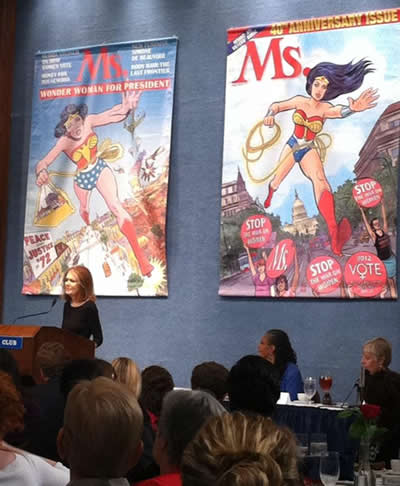
Excerpts from Gloria Steinem’s Speech as Ms. Turns 40

An inspiring keynote (view video) at the National Press Club in celebration of Ms. turning 40,focused not only on how far the feminist movement has come, but also where the feminist movement needs to go in the future. Brief excerpts of her remarks are as follows.

On current challenges facing the feminist movement:
“I was thinking of what it is that we face collectively…first it is a profound, deep backlash, which is in a sense a tribute to the frontlash, right? If we hadn’t changed the majority [of] hearts and minds in this and other countries we would not be having this kind of backlash. If you look at the public opinion polls you feel quite good because we do indeed have the majority on every single issue that we’ve raised, but nowhere is it written…that the majority will win, and there is enormous power on the other side and enormous financial interest on the other side. Just as one example of what is at stake in terms of economics, if we just had equal pay in this country, just the single thing of equal pay, which is what most everybody agrees with, right? We would have the single most important economic stimulus this country could possibly possibly ever have. It would be about $200 billion dollars more a year injected into the economy, about $150 a week more for white women on the average, for women of color something between $250 and $350. And it would be injected into the economy exactly where it’s most likely to be spent. We are not going to send it to the Cayman Islands, no! We are going to spend it and it is going to create jobs…so wherever we look I think we see what’s at stake because of course the folks that would have to pay that equal pay don’t want to pay. I mean, women are of all races and groups and in the world at large, the single greatest source of cheap labor and completely unpaid labor and that is a source of enormous resistance.”

On social movements in the context of history:
“All of the great social justice movements and the environmental movement are linked. Sometimes on campuses someone will say to me: why is it that the ultra right wing is against both lesbians and birth control? But… the patriarchal, hierarchical controlling reproduction kind of point of view is that sexuality is only ok when it is directed toward having children and takes place inside patriarchal marriage.” She continued “Our movements are LINKED not RANKED and that we in this room are linked, not ranked. That the whole paradigm of what we are looking for…is the circle, not the pyramid.”

On moving forward as a feminist movement:
“I think the backlash is problem number one, but problem number two is that the backlash takes the form of telling us that we’ve already succeeded… Young women are not feminists. Look at the public opinion polls! Young women are more supportive of feminist issues than older women are. It’s absolutely wrong, but that is the myth. You’ve already succeeded, that was yesterday… Part of what I think we need to rededicate ourselves to here today is an understanding that all great social justice movements must last something like a century if they are to be really deeply absorbed into the culture and understood to be normal and natural. We all absorb what we grew up with and it feels like ‘home’ and it familiarizes hierarchy or even violence sometimes in the home. So, it’s going to take generations to make the norm one of linking, not ranking. But we are, I would say, in this wave…we are at least 40 years into it…I don’t know how to break this to you, but we’re only half way!”

On the future:
“I hope that we will after today never again fall for the idea that it (the feminist movement) is over, or that it’s not necessary anymore or that it doesn’t have huge majority support. It does, absolutely. We have won the hearts and minds, but we have not won the power, the employers, the hierarchical religions. That’s the source of the backlash, that’s where it is. But one day, one day, we will get there.”

Media Resources: Ms. 40th Anniversary Celebration 10/11/2012

New Study: Romney/Ryan Medicare Reform Would Raise Costs for Seniors

A new study conducted by the Kaiser Family Foundation finds that nearly six in ten seniors would likely pay higher premiums for their Medicare benefits under a “premium-support” system. In a premium-support system, seniors would receive a voucher from the government to buy an insurance plan on the market. They would theoretically be able to choose between competing private plans and traditional Medicare.

The study suggests that seniors who remain in the traditional Medicare system will pay more, with an annual increase of about $720, while those who opt for a private plan will be unable to cover the cost of the benefits they currently receive under Medicare with their voucher. This could force 25 million Americans to pay more under a premium-support plan for their current benefits. Analysts warn that private insurance companies competing for the healthiest (and least costly) patients will leave the sick seniors in the traditional Medicare system, straining it and ultimately collapsing the public program.

Earlier this year, the AARP made their stance on the issue of a premium-support system clear when they released a statement saying that it “simply risks increasing costs for beneficiaries while removing Medicare’s promise of secure health coverage — a guarantee that future seniors have contributed to through a lifetime of hard work.”

The model used by the foundation was “generally based on an approach included in House Budget Chairman Paul Ryan’s fiscal year 2013 budget plan, the proposal Chairman Ryan co-sponsored with Senator Ron Wyden of Oregon.” Republican Presidential Candidate Mitt Romney “has supported a premium-support system along these lines,” and has selected House Budget Chairman Paul Ryan as his running mate in the 2012 Presidential election.

In a CNN Op-Ed posted today, House Democratic Leader Nancy Pelosi called the Romney/Ryan plan a “blueprint for the eventual destruction of Medicare as we know it.” She went on to say, “voters, be aware this year: Medicare is on the ballot, and its future is in jeopardy. Democrats created Medicare and will always fight to strengthen it for our seniors and for their families.”

Media Resources: Kaiser Family Foundation 10/15/2012; ThinkProgress 10/15/2012; CNN 10/16/2012; AARP 4/27/2012

Danger Risk Increases for Unmarried Mothers in Mali

Recent reports indicate that radical Islamists are creating lists of unmarried mothers in the northern Mali area, where they have avowed to enforce strict sharia law that forbids women from having any relationships with men outside of marriage. Unmarried women who have violated this rule have been executed, undergone forced amputations, and have been whipped and even stoned.

Married women and children are also currently endangered in northern Mali, where husbands are reportedly selling their wives, young women are increasingly being forced into marriages, and children are being sold to militants who trained them as child soldiers.

Ivan Simonovic, the Assistant Secretary-General for Human Rights of the United Nations, spoke out against these human rights violations, stating, “Civil and political rights are being severely restricted as a result of the imposition of a strict interpretation of sharia law, and systematic cruel and inhumane punishments are being implemented.”

The United Nations Security Council approved a resolution last week that allows for leaders to plan international military intervention against the radical Islamist groups in Mali, who have taken over the majority of the nation since the country’s president was overthrown in March.

Media Resources: CNN 10/13/2012; The New York Times 10/12/2012, Think Progress 10/9/2012

Catholics for Choice Poll: Majority of Catholics Not Concerned About Abortion, Gay Marriage

In a Catholics for Choice poll of 1000 self-described Catholic voters, respondents indicated that they are most concerned about jobs, public education, and healthcare-and least concerned about abortion and gay marriage. The poll found that 83 percent of Catholic voters feel no obligation to vote the way the Catholic hierarchy recommends, and 76 percent feel that Catholic politicians are not obligated to vote the way the bishops want either.

“This poll is one in a long line of polls that all tell the same two stories: first, Catholics do not listen to their bishops when making electoral decisions. In fact, they reject the bishops’ political views and make up their own minds about whom to vote for and what issues they care about. Second, Catholic voting patterns are consistent with those in the wider electorate. Watch how Catholics vote and predict the vote for president,” John Russonello, partner at Belden Russonello Strategists, the conductor of the poll, said in a press release.

The poll also found that denying communion for Catholics because they support abortion is very unpopular. In fact, not a single demographic group polled would support the practice.

Media Resources: RH Reality Check 10/11/12; Catholics for Choice Press Release 10/11/12

>