Founding Feminists: March 20, 1937

Founding Feminists is FMF’s daily herstory column.

FoundingFeministLogo-color

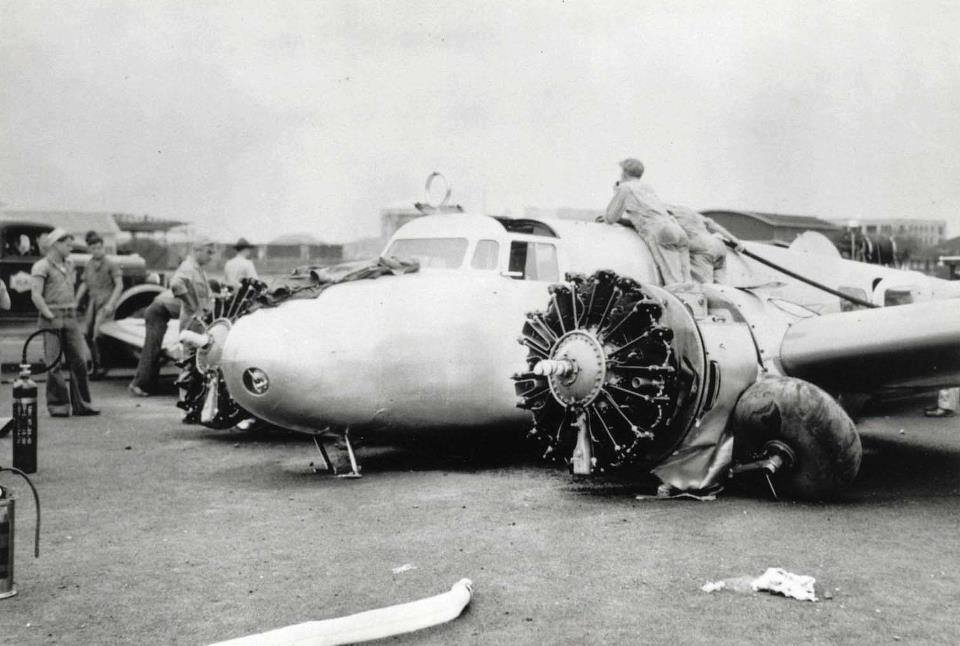
Amelia Earhart’s latest adventure nearly ended in disaster today when she attempted to fly to Howland Island, the second stop on her around-the-world flight.

But despite the setback, she immediately assured everyone that once her plane is repaired, she will be airborne again. She was barreling down the runway at Hawaii’s Luke Field at 7:30 this morning, when, as she calmly put it later: “Something went wrong.”

Though the crash took place near the end of the long runway, far from those who witnessed it, there is speculation that the plane first began to sway under the sloshing of its unusually heavy load of fuel for the long flight, then a tire blew out about the time it hit a patch of wet grass. The convergence of these events caused the plane to veer. As a wing began to dip precariously, Earhart adjusted the throttles in an attempt to level the craft. For a second it looked as if she had succeeded. But the swaying caused by the shifting of the fuel increased, became too much, and when the weight of the plane briefly rested on a single landing gear, it gave way. A wing slashed into the ground, spinning the plane as it skidded along the runway. Only Earhart’s quick cutting of the ignition switches kept a fire from breaking out that would have been fed by 900 gallons of aviation fuel easily capable of engulfing the aircraft and its passengers.

1959653_10202101083272151_1211221466_n

There was praise for her courage and skill from Army officers who witnessed the attempted takeoff. “I never saw anyone with cooler nerve,” said General Barton Yount, commander of Hickam Field.

This was actually her second near-disaster in regard to the Hawaii to Howland trip. Though she set a record for the fastest crossing from Oakland, California, to Hawaii, of 15 hours, 51 and a half minutes, it was found upon landing that the propeller bearings were almost dry. Had this not been discovered, and this morning’s takeoff been successful, she and her crew might have been suddenly forced down at sea somewhere between Hawaii and Howland, over 1,900 miles away, and possibly never found.

Her “Flying Laboratory” is presently being dismantled, and will be sent by ship back to the Lockheed factory in Burbank, California, where it will be fully and expertly repaired. Wasting no time, she and her crew, composed of Harry Manning, Paul Mantz and Fred Noonan, boarded the “Malolo” at 11:30 this morning and are already heading back to the mainland, still determined to be the first aviators to circumnavigate the world via the Equatorial route.

“This action means postponement only. It is my full intention to go ahead with the adventure as soon as possible,” Earhart said earlier today.
Founding Feminists: March 19, 1937

Founding Feminists is FMF’s daily herstory column.

FoundingFeministLogo-color

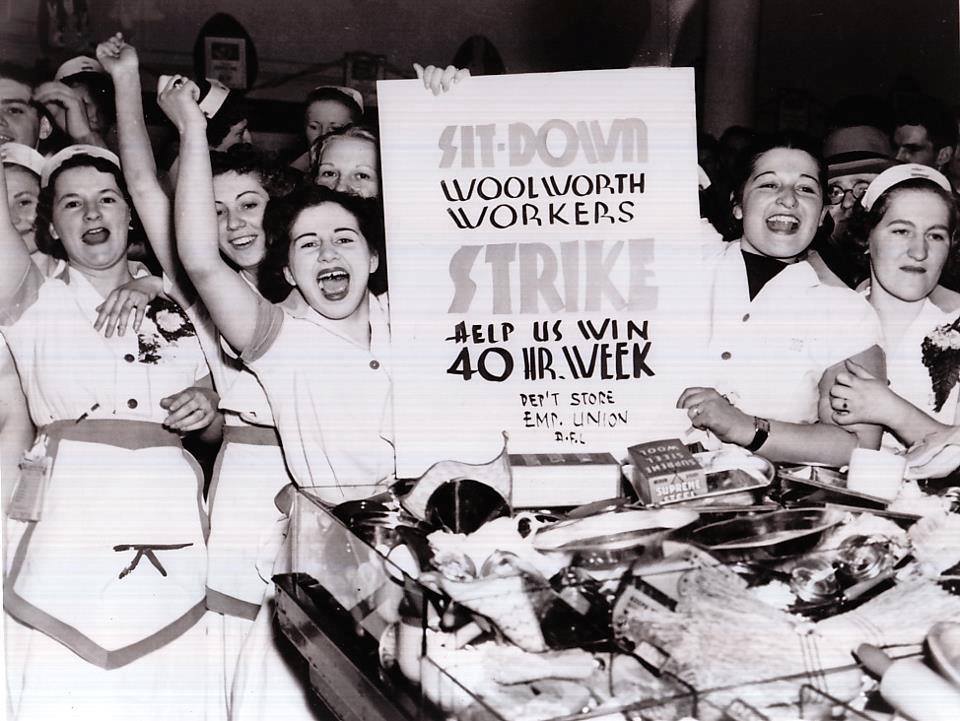
Dozens more women were arrested today both inside and outside the Woolworth Store at 34 West 14th Street in Manhattan on this third day of the strike.

The strikers, members of Local 1250 of the Department Store Employees Union, American Federation of Labor, are seeking a 40-hour week for $20 pay, and company recognition of their union.

The battle began day before yesterday at 11 a.m., when organizers blew whistles as a prearranged signal, and 50 of the 100 women at the counters stopped work and began a “sit-down strike.” This is a new and effective tactic pioneered by the United Auto Workers at the General Motors plant in Flint, Michigan, back on December 30th. Instead of walking out and being replaced, they sat at their work stations and stopped production.

1981953_10202094630510836_512461306_n

By 6 p.m., Woolworth’s management had posted private guards at all entrances to the store to keep any supplies from reaching those inside. But at 1 a.m. the next morning, 100 pickets suddenly climbed onto a ledge, opened some windows and began passing in cots, blankets, oranges, butter and some other food items to their colleagues. Management’s attempt to isolate the workers had failed, and after business had been disrupted for the day by pickets stationed at entrances, as well as by strikers in the store, the police were called in at 7 p.m. Fifty-nine strikers were arrested and dragged off to patrol wagons as the store was cleared.

Today an attempt was made to replace the strikers, when management escorted 40 women into the store at 9 a.m. But to their surprise, many of the women folded their arms and refused to wait on customers. The women were then given three choices by the store manager: work, leave or be arrested. Most ignored him, and all who stayed were arrested. At 10:00 an attempt was made by other strikers to re-take the store, with 41 arrests resulting.

The strikes at a number of Woolworth stores, and those of the H.L. Green Company as well, have become sufficiently disruptive that Mayor La Guardia sent telegrams today to both sides volunteering to mediate the dispute after a three-hour conference between union representatives and company officials produced no results. Protests outside the store will continue. Expressions of public support for the strikers are appreciated, and will help them win their demands.

Founding Feminists: March 18, 1970

Founding Feminists is FMF’s daily herstory column.

FoundingFeministLogo-color

 Just 48 hours after 46 of Newsweek’s women employees filed an E.E.O.C. complaint charging sexism, another and far more radical action took place today against a second mainstream media giant.

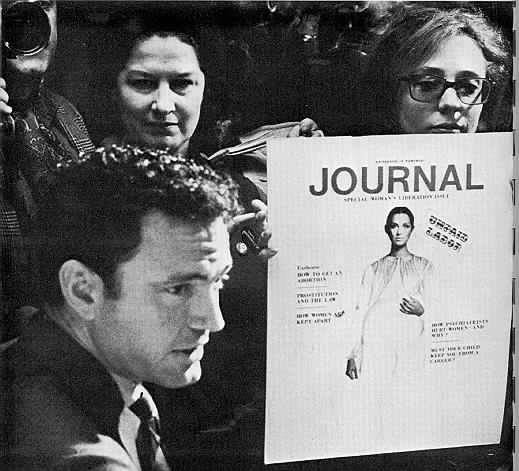
“Never underestimate the power of a woman” is the motto of the Ladies Home Journal, so when over 100 women occupied its offices today demanding a more relevant and liberated publication, there was clear confirmation of that old saying.

1897822_10202089723148155_1097811517_n (1)

Initially planned by Media Women, whose Ladies Home Journal Sit-In Committee is chaired by Signe Hammer, the siege began at 9:15 this morning when Media Women was joined by members of Redstockings, the West Village-One consciousness-raising group, New York Radical Feminists, Older Women’s Liberation, the National Organization for Women and Barnard College students. Among the more well-known feminists present today were Susan Brownmiller, Ti-Grace Atkinson and Shulamith Firestone.

The action was called to protest L.H.J. articles that are “irrelevant, unstimulating and demeaning to the women of America.” Bearing a banner that renamed the second-largest “women’s magazine” in the U.S. “The Women’s Liberated Journal,” protesters quickly packed into editor John Mack Carter’s office to present their arguments and demands. The demonstrators made concrete suggestions and even brought a mock-up for a cover, plus 20 pages of specific ideas for articles. As Carter looked on, their statement was read:

We demand that the Ladies Home Journal hire a woman editor-in-chief who is in touch with women’s real problems and needs. We demand that all editorial employees of the magazine be women. We demand that the magazine use women writers for all columns and freelance assignments because men speak to women through the bias of their male supremacist concepts. We demand that the magazine hire non-white women at all levels in proportion to the population statistics. We demand that all salaries immediately be raised to a minimum of $125 a week. We demand that editorial conferences be open to all employees so the magazine can benefit from everyone’s experience and views.

Since this magazine purports to serve the interests of mothers and housewives, we demand that the Journal provide free day care facilities on the premises for its employees’ children, and that the policies of this day care center be determined by employees.

We demand an end to the basic orientation of the Journal toward the concept of Kinder, Kuche & Kirche [children, kitchen and church] and a reorientation around the concept that both sexes are equally responsible for their own humanity.

We demand that the magazine cease to further the exploitation of women by publishing advertisements that degrade women, and by publishing ads from companies that exploit women in terms of salary and job discrimination.

We demand that the magazine cease to publish ‘Can This Marriage Be Saved?’ and all contributions by Drs. Bruno Bettelheim and Theodore Rubin. We demand an end to all celebrity articles, all articles oriented toward the preservation of youth (implying that age has no graces of its own), and an end to all articles specifically tied in to advertising: e.g., food, make-up, fashion, appliances.

We demand that service articles perform useful services: e.g., real information along the lines of Consumer Reports, telling whether consumer goods really work.

We demand that the Journal publish fiction on the basis of its merits, not specially slanted, romantic stories glorifying women’s traditional roles. The Women’s Liberation Movement represents the feelings of a large and growing mass of women throughout the country. Therefore we demand that as an act of faith toward women in this country, the Ladies Home Journal turn over to the Women’s Liberation Movement the editorial content of one issue of the magazine, to be named the Women’s Liberated Journal. We further demand a monthly column.

It was a long and trying day for all. But media coverage was good, and although there was a close call when Shulamith Firestone made a lunge at Carter, but was prevented from reaching her target by Karla Jay, it was peaceful. Finally, after 11 hours of confrontation and debate, Carter has now agreed to some demands, and the occupation is now ending. Among the things he has endorsed are day care programs for the employees, editorial training programs for women, and a special section on Women’s Liberation in the August issue.

Founding Feminists: March 14, 1916

Founding Feminists is FMF’s daily herstory column.

FoundingFeministLogo-color

The resilience of the suffrage movement was never more in evidence than today.

Just over four months after the biggest setback in its almost 68-year history, when suffrage referenda in New Jersey, Pennsylvania, New York and Massachusetts went down to defeat between October 19th and November 2nd, the campaign is back on track and well on its way to another vote on the issue in New York next year.

Today the Assembly of the nation’s most populous State agreed to put such a referendum on the ballot, and did so not by a razor-thin margin, but by an overwhelming vote of 109-30. Though the State Senate must still consent, and the Senate Judiciary Committee is blocking the referendum bill, vigorous lobbying of legislators and large public protests are expected to dislodge it, and with passage, all energies can be turned toward working for a victory in 1917.

Assembly Member Harry E. Brereton, co-author of the bill, opened the debate by saying that the Legislature owed it to the thousands of male voters who endorsed woman suffrage, and to the voteless women of New York as well, to put the question on the ballot again. He immediately ran into a storm of protest from anti-suffrage legislators. Assembly Member McCue called resubmission “an insult to the voters of this State,” and suggested that the suffragists might wait a while. Mr. Shiplacoff, a supporter of suffrage, then asked how long they should wait. “Oh, about 5,000 years,” said O’Hare, of Queens, joining the debate.

Mr. Welch of Albany viewed the resolution as “nothing more than an attempt to heckle the voters,” even though other issues that went down to defeat in November have already been approved for the 1917 ballot. Mr. Pratt then began to recite the familiar maxim, “If at first you don’t succeed …” at which point the entire body loudly intoned: “Try, try again.” The vote was finally called, and one by one the members of the Assembly went on record and gave their reasons for support or opposition.

Assembly Member Bush’s statement of conditional approval gave evidence of just how intense the lobbying had been: “I’m going to vote for this, because the majority of my constituents want it. But I want to serve notice right here that if these women keep pestering me around the Capitol, it’ll be the last time I’ll vote for the resolution.” As might be expected, there was great cheering and waving of flags and suffrage pennants in the galleries when the final vote was announced.

With this battle won, all two hundred suffrage supporters immediately went to camp out in front of the Senate Judiciary Committee’s room. After waiting several hours, it was learned that the room was now empty and that members had gone out a side door to another hearing. Everyone continued to sit for two and a half hours more until the other hearing was over and committee members returned to their regular meeting room. Finally, about 6:00, it was announced that there would be no action on the suffrage bill today.

Immediately following the announcement, Vera Boarman Whitehouse of the New York State Woman Suffrage Party climbed up on a chair to say that there would be a mass meeting at Cooper Union to protest this delay, and a demand to know who was bottling up the bill and why. A great cheer went up, followed by another example of our side’s persistent lobbying.

Vera Boarman Whitehouse speaking to a crowd.

One member of the Senate Judiciary Committee was cornered by a group of “Votes for Women” advocates while attempting to make his way down the crowded halls to his office. When his explanation for the delay proved inadequate, one member of the group asked: “What’s your name?” “Gilchrist, Madam,” he replied. “Where are you from?” she asked. “Kings,” he said. “Thanks, Mr. Gilchrist of Kings. We have got your number,” she said while solemnly writing on a pad.

Most observers expect the suffrage referendum bill to pass the Senate as well, and if so it will certainly be signed by Governor Whitman, whose wife was among those lobbying for suffrage here today. Then, building on the base of 533,348 votes won during the 1915 campaign, woman suffrage will hopefully be on its way to a major victory in the Empire State that will also provide additional momentum to get Congress to pass the Susan B. Anthony Amendment, which if then ratified by 36 of the 48 States will enfranchise women nationwide.

Founding Feminists: March 13, 1961

Founding Feminists is FMF’s daily herstory column.

FoundingFeministLogo-color

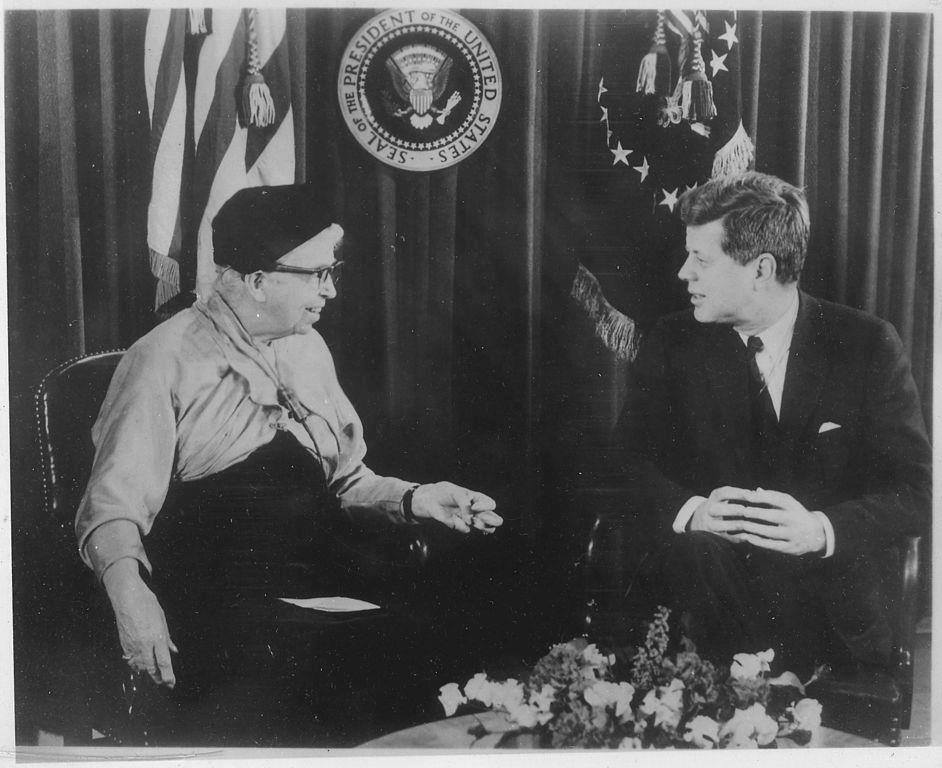
Former First Lady Eleanor Roosevelt called on President Kennedy at the White House today and gave him a three-page list of women he should consider for top jobs in his now 52-day-old Administration.

Thus far only 9 of his 240 appointments have been to women, and none of the nine have been chosen for Cabinet rank or high policy-level posts. The two had an extended discussion, lasting half an hour, but what else they may have discussed was not revealed.

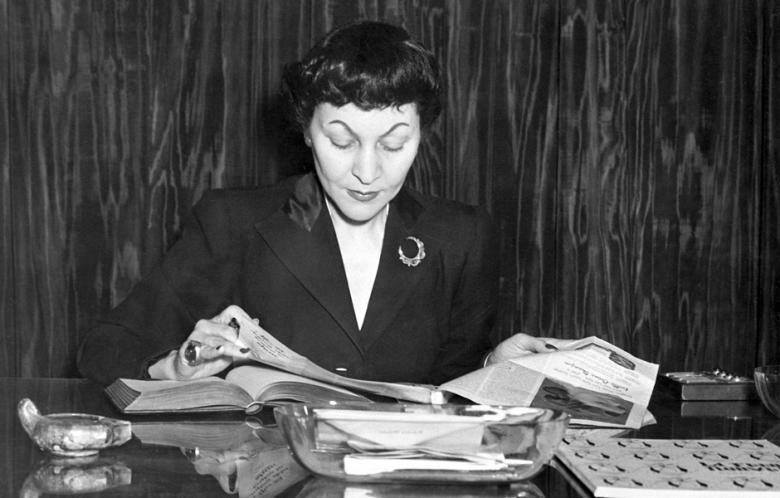
When asked by a reporter if Kennedy had failed to appoint enough women, Roosevelt diplomatically answered: “Some people feel that way.” One of those who has expressed that view is Emma Guffey Miller, a member of the Democratic National Committee since 1932. Last month she wrote to the President saying: “It is a grievous disappointment to the women leaders and ardent workers that so few women have been named to worthwhile positions.”

10003471_10202062980279600_619163717_n

Roosevelt told reporters that the reason for the low number of female appointments may simply be that the President didn’t have a list of the many qualified women who could serve, and that sometimes men need to be reminded that there are so many able women. She then noted that President Franklin D. Roosevelt had a list of women to consider for high office, supplied by an official of the National Education Association.

Eleanor Roosevelt is one of the President’s nine female appointees since he took office a little over seven weeks ago on January 20th. She has been reappointed a member of our delegation to the United Nations. Two other women have been appointed to U.N. posts as well: Marietta Tree to its Human Rights Commission and Gladys Avery Tillett to the U.N.’s Status of Women Commission.

President Kennedy’s other female appointees are: Dr. Janet Travell, the first woman to be a White House physician; Reva Bosone, a judicial officer of the Post Office Department; Elizabeth Rudel Smith, U.S. Treasurer; Esther Peterson, who heads the Labor Department’s Women’s Bureau; Frances Willis, our Ambassador to Ceylon, and Marie McGuire is the new Commissioner of Public Housing.

Founding Feminists: March 12, 1954

Founding Feminists is FMF’s daily herstory column.

FoundingFeministLogo-color

Durriya Shafik, founder and president of the Bint al-Nil (“Daughter of the Nile”) Party, announced today in Cairo that she would be undertaking a fast to protest the exclusion of women from the elections for a Constituent Assembly, which will meet on July 23rd to draft changes to the Egyptian Constitution.

She has sent telegrams to General Naguib, President and Prime Minister, as well as members of the ruling junta, and the nation’s religious and political leaders. In her message she said:

I have taken a firm resolution to go on a hunger strike until my last breath, or until Egyptian women attain their constitutional rights, without any conditions. I demand that the women of Egypt be admitted to the Constituent Assembly. I demand their admission because we are convinced that the women who form more than half the Egyptian nation must not, at any cost, be governed by a Constitution in the making of which they played no part.

In her strike headquarters at the Cairo Press Syndicate, she repeated her pledge. “I am going to fast until I get a written promise from someone in authority that under the new constitution women will have the same political rights as men,” she said. One of the proposals under consideration would bar women from holding office, and would grant suffrage to women on an individual basis, and only if their request was approved by the government.

1017123_10202058448966320_1036258878_n

This is not Shafik’s first protest. On February 19, 1951, she and nearly 1,500 women were meeting at the American University. She declared:

Our meeting today is not a congress, but a parliament. A true one! That of women! We are half the nation! We represent here the hope and despair of this most important half of the nation. Luckily we are meeting at the same hour and in the same part of town as the parliament of the other half of the nation. They are assembled a few steps away from us. I propose we go there, strong in the knowledge of our rights and tell the deputies and senators that their assemblies are illegal so long as our representatives are excluded, that the Egyptian Parliament cannot be a true reflection of the entire nation until women are admitted. Let’s go and give it to them straight. Let’s go and demand our rights. Forward to the Parliament!

After a four-hour demonstration inside the building’s gates, she was given an assurance from the President of the Senate that the demands of the women would be taken up by Parliament. These demands were for permission to participate in politics, limitations on polygamy and divorce, and equal pay for equal work. The politicians soon went back on their promise, however, and she was arrested for her rebellion. But support for her was so strong that when her trial opened, it was quickly adjourned and “postponed,” never to resume again.

Shafik has continued to fight for women’s equality despite provoking great hostility from religious leaders, with political leaders eventually following their lead. After a revolution deposed the monarchy, she formed the Bint al-Nil Party, which was recognized by the Ministry of the Interior, and held its first convention on December 11, 1952. But the new military regime has since proven to be no more sympathetic to women’s equality than the old king and parliament, and so it is time to protest again.

Durriya Shafik, born in 1908, has studied at the Sorbonne, where she wrote her doctoral dissertation on “Egyptian Women and Islam.” Upon her return to Egypt in 1945, she founded a magazine entitled “Bint al-Nil,” which eventually included a section on political issues. In 1948 she founded the “Bint al-Nil Union” which focuses on literacy and political rights for the country’s women.

Founding Feminists: March 11, 1912

Founding Feminists is FMF’s daily herstory column.

FoundingFeministLogo-color

Though suffragists have many popular themes for speeches and meetings, tonight’s choice to address 25 objections to woman suffrage has outdone them all in terms of drawing a crowd.

Less than half of those who wanted to attend were able to pack themselves into New York City’s spacious Metropolitan Temple, but the crowd out on Seventh Avenue was assured that remarks made at the meeting would be repeated at an overflow gathering. The attendance apparently surprised the police, who initially sent just one officer, assigned to enforce the fire codes limiting the number of audience members.

Mary Jenney Howe presided at the meeting, using a large gavel to maintain order. She was ably assisted by a young woman who employed a cow bell to strictly enforce the five-minute limit on speakers, a necessity caused by the large number of myths that needed to be refuted.

The evening’s principal orators were well known to the public, and equally well prepared to defend the cause. They included labor lawyer Inez Milholland; author and Broadway performer Fola La Follette, daughter of “Fighting Bob” La Follette and Belle Case La Follette; writer and editor Charlotte Perkins Gilman, and English suffragist Elizabeth Freeman. It was Freeman who generated the most controversy by defending her fellow British militants:

Militancy hurts the cause, does it? No, I don’t think it does. You have only to read the history of the United States to get the answer to this question. You read in the newspapers of the destruction of property in London. In Boston they destroyed the tea. In London we broke windows.

Freeman then reminded her listeners of the violence and brutality inflicted on the militants by the British Government through the police, and explained that the reason they don’t simply work to replace the men who run the government is because their goal is to change the system itself.

To the charge that “women don’t understand politics,” Frederic Howe asked how they could, having never been given a chance to participate in it: “Most men can’t cook, either, for the very sufficient reason that they have never had a chance to learn how to do it.”

Hutchins Hapgood addressed the charge that voting would make women less attractive by saying just the opposite was the case, as women would become even more interesting, and “will gain richer and deeper charms.”

The myth that “woman’s place is in the home” was particularly offensive to Inez Milholland. “If her place is in the home,” she said, “why is it that 9,000,000 women are now out of the home and at work in the mills, factories and workshops of the land? What are you going to do about these women if this objection is right? Are you going to pension them so they can stay home, or are you going to let them starve?”

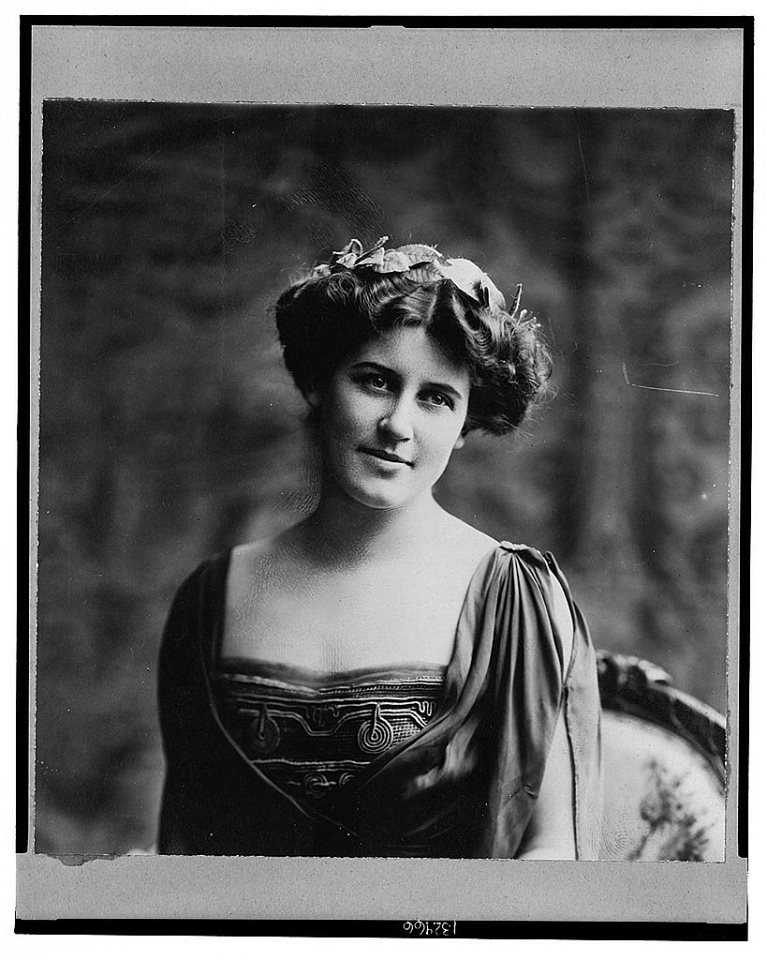
Inez Milholland, one of tonight's speakers and sister of fellow suffragist Vida Milholland.
Inez Milholland, one of tonight’s speakers and sister of fellow suffragist Vida Milholland.

Milholland was just getting into full stride when the cow bell sounded, causing her to comment: “I haven’t begun to talk on this subject yet …” as she went back to her seat.

Inez Haynes Gilmore was quite skeptical of the old argument that “the ballot means the bullet.” She noted that there is no military service requirement for male voters, and that substantial numbers of the men who fought in the Civil War were denied the vote at the time because they were under 21. She then recalled fighting women like Joan of Arc and Molly Pitcher. She pledged that: “If it is necessary for us to fight in order to vote, why, then, we will fight,” but added that “when women get the ballot, war will be as extinct as the dodo.”

Would enfranchised women take offices away from men? Only if the women candidates were more competent to hold them, according to Fola La Follette. And since “municipal government, after all, is only municipal housekeeping,” sweeping some politicians out of office would be a good thing.

Bertha Rembaugh, one of the final speakers, gave a whimsical reassurance to the males in the audience when she promised that if women got the vote they would not try to “make men good” in “too great a hurry.”

Now armed with facts and logical responses to the most common arguments against woman suffrage, the audience members can now go forth as well-trained “Votes for Women” advocates to lobby their family members, friends and neighbors, whose support will be critical when the men of New York State vote on woman suffrage.

Founding Feminists: March 10, 1919

Founding Feminists is the FMF’s daily herstory column.

FoundingFeministLogo-color

A worthy finale to a spectacularly successful 23-day nationwide rail tour by the “Prison Special” tonight, as 3,500 people greeted the formerly imprisoned suffragists at a gala in New York City’s Carnegie Hall.

An elaborate pageant of color and light opened the ceremonies in which “Justice,” played by Vida Milholland, received the women of the nations in which equal suffrage has already been achieved, and was then approached by a woman in chains and twenty black-garbed mourners. They represented America, and pled for a place in the light of true democracy. The pageant concluded with “Justice” holding aloft her torch and singing “The Women’s Marseillaise.”

Speeches from several of the ex-prisoners then followed the opening ceremonies, each speaker heartily applauded by an audience which included former Governor Whitman, William Randolph Hearst, and a number of other prominent New Yorkers.

“The militants are here, and we haven’t broken anything, not even broken down,” said Louisine Havemeyer, who then outlined the successes of the trip. There was even more applause when she announced that the National Woman’s Party, sponsors of the tour, now had enough pledges of support from members of the new, and now Republican-controlled Congress to pass the Susan B. Anthony (nationwide woman suffrage) Amendment and send it to the State Legislatures for ratification.

Vida Milholland
Vida Milholland

Mary Winsor, who served time in the infamous Occoquan Workhouse, told of her experiences with the brutality there, and then noted: “The United States fought for democracy, and who got it ? Our enemies. Women fought for democracy and received mockery. The German women have been fully enfranchised and 34 of them are seated in the German Parliament.”

Thanks to Ann Martin’s eloquence, the program was successful in raising a good deal of money for what appear to be the final battles ahead in the suffrage struggle.

An unexpected, but welcome event occurred near the end of tonight’s program. A sailor asked to take the stage, and on behalf of the Soldiers’ Sailors’ and Marines’ Protective Association and 24 other men in uniform who accompanied him to the gala, he denounced the brutal treatment given by fellow service members to the suffragists peacefully protesting outside a hall where President Wilson was giving a speech on March 4th.

Tonight’s meeting capped a final busy day of activity. In the morning the train stopped in Hartford, Connecticut, where the ex-prisoners were greeted by a large group of banner-bearing citizens and escorted to City Hall, where Mayor Kinsella welcomed them. Katharine Hepburn – suffragist, birth-control advocate and head of the Connecticut branch of the National Woman’s Party – opened a rally on the City Hall steps in honor of the visitors. Hepburn praised the courage of the women, then questioned the double standard used by many in condemning woman suffrage “militance” by contrasting Woman’s Party actions such as picketing along the White House fence, and burning the President’s speeches, with the violent revolutions of men seeking a voice in their government:

The reason you do not apply the same reasoning to the woman’s case is that you have become used to looking upon women as naturally servile and second rate. You are willing to have them beg politely for their freedom but not demand it. Well, there are some women in this country who are neither servile nor second rate and who have the spirit to protest against the present position of American women until it is changed. They are among the most worthwhile women in this country, the kind you men really like in spite of all your old fashioned notions.

Since the arrests of suffragists continue, sixteen having served time in the Charles Street Jail following a Boston demonstration just two weeks ago, the courage Hepburn spoke of is still needed. But that’s clearly in abundance as the battle for the vote finally seems about to move from winning approval of 2/3 of Congress to gaining ratification by 3/4 of the States.

Founding Feminists: March 6, 1913

Founding Feminists is FMF’s daily herstory column.

FoundingFeministLogo-color

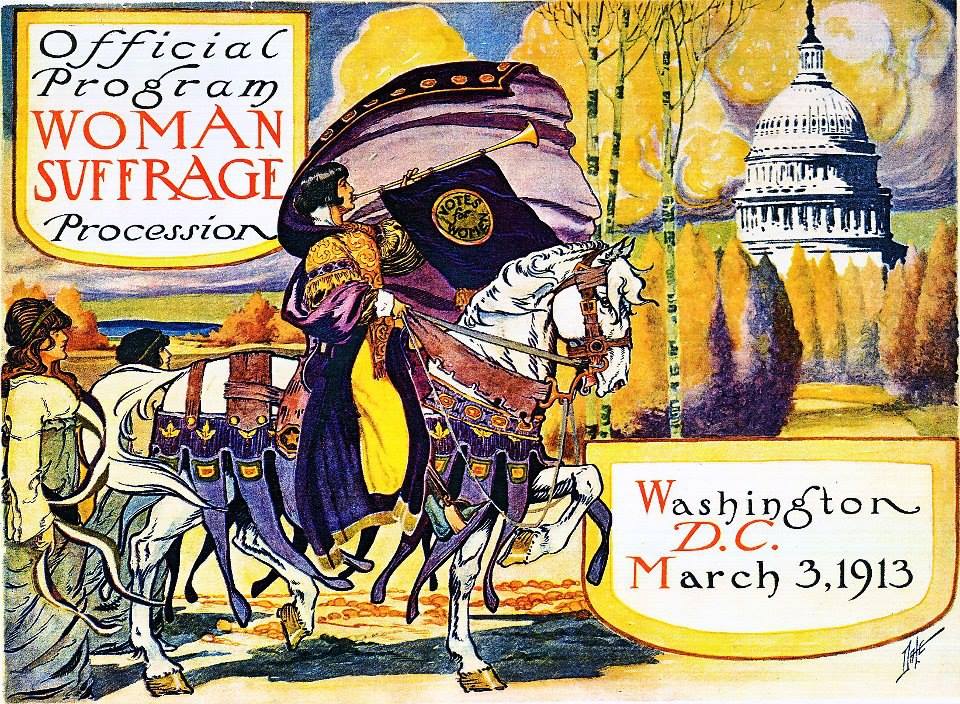
Though today’s parade of 20 witnesses before a Senate subcommittee was far fewer than the 6,000 to 8,000 suffragists who fought their way down Washington, D.C.’s Pennsylvania Avenue on March 3rd, the respect and courtesy this smaller group received was infinitely greater.

Their eyewitness accounts of the suffrage parade and pageant three days ago were such a scathing indictment of police inefficiency, indifference, hostility and even abuse that Senator Wesley Jones, Republican of Washington, who is in charge of the hearings, indicated that no more testimony on the events of the day is needed, and the job of the subcommittee will now be to fix responsibility for the disgraceful performance of the police.

Major Richard Sylvester, Chief of the District Police, spent the day in the back of the hearing room taking notes in preparation for the grilling he’s certain to receive when it’s his turn to testify. Though the parade participants had expected some heckling from the crowd, and a certain degree of pushing and shoving is inevitable when thousands of marchers and a half million spectators compete for space, what the suffrage advocates encountered went far beyond that.

Police under-deployment and outright hostility were illustrated by examples. For instance, when the crowds became so dense at Ninth Street and Pennsylvania Avenue that one of the parade floats was unable to move, one of only three nearby officers inexplicably arrested one of the float’s drivers instead of clearing a path.

1798687_10202028646981289_703002427_n

Indifference was the only alternative to hostility among police, with Julia Lathrop describing them as acting like “spectators.” Helena Hill Weed testified that though the jeers made by the crowd went well beyond the usual ribald jests and into the vilest obscenities, the police chatted in a friendly manner with those in the mob’s front ranks, and even contributed a few insults of their own, thus encouraging the remarks to escalate. Even attempts by some in the crowd to pull women off floats were ignored by the officers, with women such as 17-year-old Verna Hatfield having to fight off the attacks on their own.

Outrage over the mishandling of parade security is not confined to the halls of Congress or suffrage groups. Even the staunchly anti-suffrage New York Times denounced the behavior of both spectators and police in an editorial yesterday, calling the number of officers “pitifully inadequate” and that the few who were there were “in sympathy with the rioters rather than with the paraders.”

If the goal of the police and hecklers was to heap disrespect upon the marchers and their cause, they not only failed when the marchers showed great dignity, perseverance and restraint, but brought disgrace upon themselves and the entire anti-suffrage movement. The parade’s successful completion was therefore a double triumph, and two steps forward toward the day when nationwide woman suffrage is an accomplished fact, and “Votes for Women” marches will no longer be necessary.

Founding Feminists: March 5, 1919

Founding Feminists is FMF’s daily herstory column.

FoundingFeministLogo-color

The “Prison Special” arrived tonight in Chicago, carrying women who have served time in the Washington, D.C., District Jail, or Virginia’s Occoquan Workhouse, for picketing along the White House fence in favor of woman suffrage.

The special railroad car, chartered by the National Woman’s Party, left the nation’s capital on February 15th and has given these brave activists a chance to state their case to huge crowds and numerous reporters around the country. They have used this opportunity to detail their prison ordeals and explain why they have had to resort to ever more militant – though non-violent – tactics, such as burning President Wilson’s speeches in large ceremonial urns in front of the White House fence.

The tour has been a big hit ever since its first stop in Charleston, South Carolina, where it generated the biggest mass meeting in the city’s history. The purpose of militant actions, from picketing to “Liberty Bonfires,” is to secure action in Congress on the stalled Susan B. Anthony (nationwide woman suffrage) Amendment, center the attention of the country on the struggle for the vote, and remind people that President Wilson and his Democratic Party are responsible for the failure of the Anthony Amendment to gain approval by the required 2/3 of the House and Senate before being sent to the States for ratification.

1896823_10202024063026693_541090399_n

Upon arrival here tonight, Lucy Burns recounted her experience with force-feeding:

I had been fasting for six days and nights when they started in on me. It was a terrible experience, a horrible attempt to break my will. Five men and two women were employed in doing it. The men would pin me to the floor, several of them holding my arms by my sides. If I struggled they would sit upon me. And while the men held me the women would insert a tube in my mouth through which a fluid of egg and milk would be forced into my stomach. I was weak from the fasting, but whenever I was strong enough I would refuse to let them insert the tube into my stomach that way. Food so taken is not nourishing. It was not meant to be. It was done simply to break my will.

Their jailhouse experiences certainly didn’t rob the suffrage prisoners of their sense of humor, as can be noted from the songs they sang in prison and shared here tonight. This one is to the tune of “I’ve Been Working on the Railroad.” S.B.A. is the Susan B. Anthony Amendment, Zinkham was the D.C. Jail’s warden, and “Woodrow” refers to the President:

We’ve been starving in the Workhouse, all the live long day.

We’ve been starving in the Workhouse, just to pass the S.B.A.

Don’t you hear old Zinkham calling,

Rise up so early in the morn;

Don’t you see the Senate moving,

Woodrow, blow your horn!

The other women on the train also have compelling stories, and will tell them at a mass meeting in the Congress Hotel tomorrow night, though some will make a quick trip to Milwaukee in the afternoon. Meanwhile, the National Woman’s Party’s struggles continue.

Last night in New York City, some N.W.P. members who were attempting to peacefully demonstrate outside the Metropolitan Opera House, where President Wilson was speaking, were assaulted by police, soldiers and sailors. The women had gathered from all around the nation to express indignation that the President was leaving the country to campaign for democracy abroad while letting the Constitutional amendment that would bring democracy to America’s women languish. It failed by a single vote in the Senate on February 10th, which Wilson could surely have coaxed from a member of his own Democratic Party had he chosen to exert his full influence.

Fortunately, the 65th Congress has now ended, and as a result of the National American Woman Suffrage Association’s targeting of specific anti-suffrage Senators for defeat in the November elections, and Alice Paul’s National Woman’s Party targeting all Democrats as the “party in power” and therefore responsible for the failure of the Anthony Amendment to pass, there now appear to be enough votes in both Senate and House in the new Republican-controlled 66th Congress for passage of the Anthony Amendment.

But even though there is reason for optimism that there is now a sufficient Republican majority to overcome entrenched Southern Democratic opposition, nothing is being taken for granted, and the campaign will go on at full force until passage is achieved.

Founding Feminists: March 4, 1918

Founding Feminists is FMF’s daily herstory column.

FoundingFeministLogo-color

A major victory today for 218 suffragists arrested last year for picketing along the White House fence!

The Court of Appeals of the District of Columbia has just declared their arrests illegal, and voided all convictions of the “Silent Sentinel” pickets handed down by the local Police Court. The picketing began on January 10, 1917, the day after a delegation of 300 suffragists met with President Wilson.

A number of those at the meeting were sufficiently offended by the President’s general attitude, and his unwillingness to either officially endorse the Susan B. Anthony (nationwide woman suffrage) Amendment, or help the woman suffrage cause despite his personal support for it in principle, that they took the unprecedented step of posting pickets, dubbed “Silent Sentinels” by Harriot Stanton Blatch, outside the White House gates. Though choosing not to speak, they made their message clear through large banners emblazoned with questions such as: “Mr. President, What Will You Do For Woman Suffrage?” and “Mr. President, How Long Must Women Wait For Liberty?”

Though relations between the Sentinels, the White House, passers-by and the police were quite friendly at first, U.S. entry into the present war with Germany last April 6th sparked hostility from many on the street toward those who would criticize our President in time of war. Also, the pickets’ daily reminders of President Wilson’s hypocrisy in praising the virtues of democracy overseas while doing nothing to bring its benefits to the women of America proved quite embarrassing to the Administration, so the atmosphere grew increasingly hostile.

Arrests began on June 22nd, with Lucy Burns and Katherine Morey charged with “blocking traffic” on the sidewalk. The picketing – and arrests – continued, with 41 taken into custody on one day alone. Convictions, and sentences from a few days to as long as seven months in the District Jail or infamous Occoquan Workhouse followed. Those sent to Occoquan on November 14th were subjected to the most brutality and indignities by the guards. The “Night of Terror” when they arrived was the worst, with, among other things, Burns manacled to the bars of her cell with her arms above her head, and some women thrown into their cells so forcefully that they struck their head on the wall or metal bed frame.

1689944_10202019190104873_1012085535_n
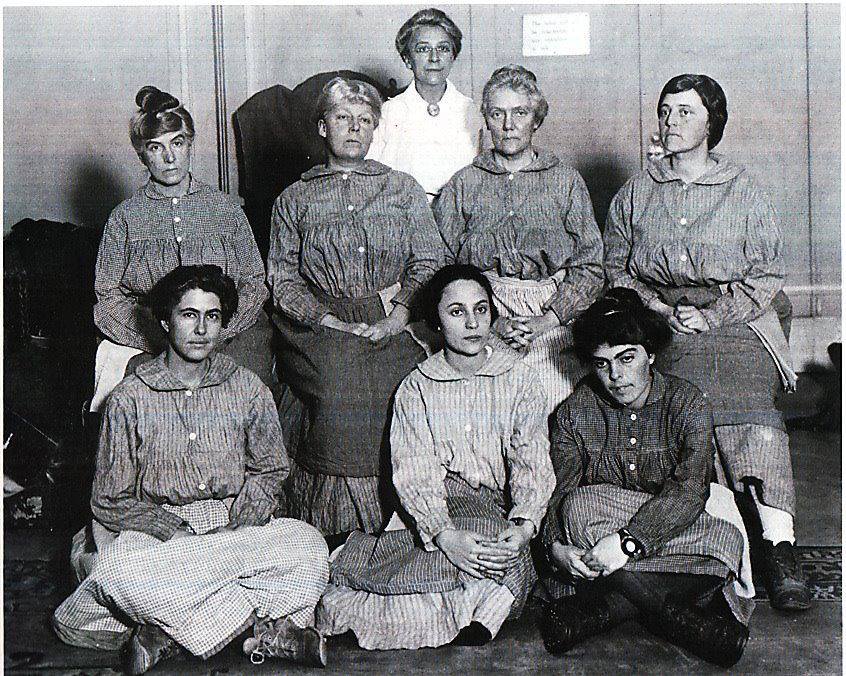
Some of the former prisoners are shown here when they held a press conference back on November 12th at National Woman’s Party headquarters wearing replicas of their prison uniforms. In the front row, left to right, are Julia Hurlbut, Nina Samarodin, and Elizabeth Stuyvesant. Standing in the second row are Eunice Dana Brannan, Elizabeth Seldin Rogers, Dora Lewis and Allison Turnbull Hopkins. In the back is Virginia Bovee, who was employed at the Workhouse and verified the claims of the suffragists about their treatment and the atrocious conditions in that institution.

The suffrage prisoners immediately began a hunger strike protesting the denial of “political prisoner” status. Lucy Burns, considered the strike’s “ringleader” was transferred to the District Jail, where she joined Alice Paul in being force-fed three times a day. Finally, in late November, the prisoners were released due to public outrage over their treatment, and on December 4th, eight lawsuits for $50,000 each were filed against the wardens of the Occoquan Workhouse and the District Jail, as well as the Commissioners of the District of Columbia, charging assault, illegal detention and false imprisonment.

Today’s court decision will allow all 218 to sue the District over their illegal arrests. It also affirms the right to peacefully assemble and protest in the future. In the words of the Court:

So far as the information enlightens us, the defendants may have assembled for a perfectly lawful purpose, and though to a degree obstructing the sidewalk, not be guilty of any offense …. Neither is peaceable assembly, under the present statute, unlawful. The statute does not condemn the mere act of assembling on a street, but prohibits assembling or congregating, coupled with doing of the forbidden acts. It would hardly be contended that if the defendants had met on one of the spacious sidewalks of Pennsylvania Avenue to conduct a peaceable conversation, though in a degree inconveniencing pedestrians, they would be guilty under the statute of crowding and obstructing the free use of the walk.

The National Woman’s Party will continue to put pressure on President Wilson to use his considerable influence on reluctant Democrats to help the Anthony Amendment. He finally endorsed it on January 9th, a year to the day after the meeting with suffrage supporters which launched the “Silent Sentinel” campaign. The next day the Anthony Amendment got the exact 2/3 majority required for passage by the House. But Wilson still needs to be prodded into helping suffragists convert enough Democratic opponents to the cause to win passage by 2/3 of the Senate. The amendment can then be sent to the States for ratification, with approval by 36 of the 48 State legislatures required to become part of the Constitution.

The Susan B. Anthony Amendment, first introduced in Congress on January 10, 1878, states :

The right of citizens of the United States to vote shall not be denied or abridged by the United States or by any State on account of sex.

Congress shall have power to enforce this article by appropriate legislation.

Founding Feminists: February 28, 1913

Founding Feminists is FMF’s daily herstory column.

FoundingFeministLogo-color

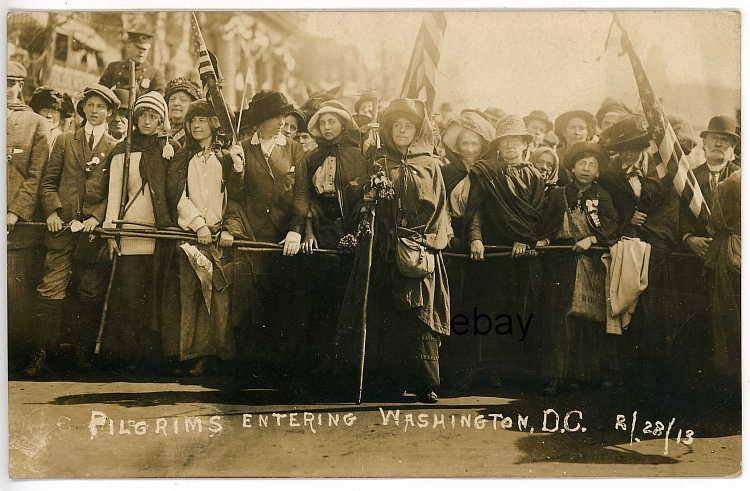
The end of the trail and a spectacular entry into Washington, D.C., today for the suffrage hikers!

After 17 days of marching over mostly muddy roads between here and Newark, New Jersey, and encountering everything from snowstorms to hostile hecklers, “General” Rosalie Jones and her suffragist “Army of the Hudson” strode triumphantly into Washington, D.C., this morning to a spontaneous and exuberant reception by thousands of cheering Washingtonians.

Not long after entering the city, enthusiastic crowds began following the hikers. Even the police were unable to prevent the throngs from leaving the sidewalks and flooding the streets when the marchers turned down Pennsylvania Avenue on their way to the recently opened headquarters of the National American Woman Suffrage Association’s Congressional Committee, at 1420 “F” Street, N.W.

Always able to overcome any obstacle in their path, the hikers changed from a line of 13 who had walked every step, followed by a line of those who had walked part way, into a column of twos with arms locked together, moving forward whenever the police could clear a small space for them to advance. Everyone wanted to salute and congratulate the pilgrims in whatever way they could, so automobile horns, whistles, and shouts mixed together in a din that must have seemed quite a change from so many days of walking the lonely roads of rural New Jersey, Pennsylvania, Delaware and Maryland.

Finally the troops reached suffrage headquarters, and General Jones addressed the cheering crowd through a megaphone before the hikers dispersed for a change of clothes, some rest, and numerous events in their honor. Among the listeners to Gen. Jones’ speech was her mother. Though a known anti-suffragist, she smiled a number of times, and seemed to take pride in her daughter’s feat, if not her objective.

To make the day still better, even the dispute over the letter from prominent suffragists to President-elect Wilson seems to have become somewhat defused. When the National Board of the National American Woman Suffrage Association told General Jones to hand over the letter she’d been carrying so that the Board members and N.A.W.S.A.’s Congressional Committee could deliver it to Wilson themselves, their edict caused understandable shock and resentment on the part of General Jones and her troops.

1901765_10201993286937310_713151230_n

But the day began with a telegram which said: “Regret misunderstanding. Board with you from beginning. Delegation to present letter to consist of national officers, Congressional Committee and pilgrims, if interview with Wilson is arranged.” It was noted that the “pilgrims” were mentioned last, despite having been the ones who had actually carried the message to D.C., but at least General Jones and her loyal band of hikers are assured of being part of an audience with the incoming Chief Executive should such an event occur.

Jones’ attendance, of course, would require her to accompany the N.A.W.S.A. officers to the meeting, something she is not presently inclined to do so soon after the totally unexpected confrontation. However, Alice Paul, head of N.A.W.S.A.’s Congressional Committee, seems to want to restore good relations, and personally praised the marchers: “We are doing all that we can to entertain the women, and I can assure you that we do appreciate the wonderful walk that they have made, and the great aid they have given the cause by their efforts and bravery.”

That the hikers have greatly advanced “the cause” was an overwhelming consensus here today. Though a massive parade and pageant featuring thousands of suffragists and coordinated by N.A.W.S.A. three days from now will be a far larger event, the impact made by General Jones’ small band has already made it clear that this is a new era in the suffrage movement.

Sixty-five years have gone by since winning the vote was adopted as a goal of those attending the first women’s rights convention at Seneca Falls, New York, in 1848. But the realization of their goal now seems only a small fraction of that time in the future thanks to bolder tactics by some of the younger suffragists and the emergence of newer organizations, plus imaginative ideas by dedicated suffragists like Rosalie Jones and her hardy band of hikers.

Founding Feminists: February 27, 1913

Founding Feminists is FMF’s daily herstory column.

FoundingFeministLogo-color

The suffrage hikers pushed on toward Washington, D.C., this morning despite rain, mud, hecklers and a growing conflict with the officers of the National American Woman Suffrage Association.

“General” Jones and her “Army of the Hudson” left Laurel about 9:00 this morning for another day of wading through Maryland’s notoriously muddy roads. They were soon joined by 25 schoolchildren who happily hiked along until someone noted the approach of a Truant Officer, at which point the students scattered and headed for their classroom.

The students of the Maryland Agricultural College at College Park were not nearly so well-behaved, and in addition to jeering the hikers, got into a fist fight with some of the “war correspondents” (reporters) accompanying the marchers. After getting the worst of it, the students retreated back to their campus.

At Beltsville, the hikers enjoyed a luncheon of crackers, fruit and apple cider, as well as the chance to briefly shed the oilskin tablecloths that were made into ponchos and added to their regular raingear this morning. Back on the road again, some of the marchers, Phoebe Hawn and Mary Baird in particular, were clearly suffering from major foot problems, but are still determined to make it all the way.

1014092_10201988228970864_1469370979_nThe next stop for the troops was Hyattsville, where they were met by former mayor Magruder, who escorted the hikers to the Armory. There they were given another luncheon, this courtesy of the Prince George’s County Business Men’s Association. After reaching the day’s goal of Bladensburg, some retired to the George Washington House, which, as its name implies, was once the headquarters of another general on the march for a cause. Others went to the Palo Alto Hotel, where the Manhattan cocktail was invented in 1846.
Genevieve Champ Clark, daughter of the Speaker of the House, journeyed out from Washington to greet the marchers and was given an ovation by those not already in bed tending to their weary feet.

Today’s stormy weather matched the relations between the hikers and officers of the New York based National American Woman Suffrage Association. At the beginning of the hike it was made clear that should she make it all the way from Newark, New Jersey, to Washington, D.C., General Jones was to deliver a letter from prominent suffragists to President-elect Wilson. But N.A.W.S.A. decreed today that the letter, which Jones has carried and carefully kept dry for 16 days over 240 miles, is to be formally presented to Wilson by a delegation of N.A.W.S.A. officers and their D.C. based Congressional Committee, though members of the pilgrim army may be “present” as well.

The letter was dutifully turned over tonight to Alice Paul, head of N.A.W.S.A.’s Congressional Committee, with General Jones saying: “If the New York suffragists feel it is better for the Congressional Committee to deliver the letter there seems little else for me to do than to bow to its wishes. As for my feelings on this matter I have little to say, other than that I am willing to make any sacrifice for the cause.”

The issue of which hikers are officially recognized by N.A.W.S.A. remains yet another source of friction. There will be a luncheon tomorrow given by N.A.W.S.A., but only women hikers who have walked the entire distance are invited. Since the men and women who walked part way, those in charge of the literature wagon, baggage car, and scout vehicle, plus the members of the press contingent are excluded, all the “eligible” marchers have decided to show solidarity with their comrades by declining the invitation.

Still, even with the bad roads, foul weather, and organizational politics, General Jones remains optimistic tonight, just one day’s march from D.C. and the end of the long trail. She summed up her feelings in verse:

Oh sisters, my sisters!
The trip is nearly done;

The hikers slowly plod along,
The towns pass one by one.

The weary miles are left behind,
The Capitol draws near;

And soon our lengthy march will end,
Amid a deafening cheer.

Oh, sisters, my sisters!
The walk was long and hard;

‘Twas up a hill and down a dale,
Across God’s dewy sward.

While women laughed and men have jeered,
At us and at our cause;

Yet every step brought near that time,
When we shall make the laws.

Founding Feminists: February 26, 1913

Founding Feminists is FMF’s daily herstory column.

FoundingFeministLogo-color

“General” Rosalie Jones and her suffragist “Army of the Hudson” are advancing again! After a series of speeches and social events in Baltimore yesterday, they hiked 22 miles today, the 15th day of their trek from Newark, New Jersey, to Washington, D.C.

Today’s march was to Laurel, Maryland, with several women from the Just Government League providing an escort out of Baltimore.

The road led mostly past farms and through tiny villages, with “Votes for Women” cheers by the hikers greeted by “Howdy” and tips of the hat from local farmers. The biggest salutes of the day came from students and faculty of the Johns Hopkins School for Nurses and the St. Mary’s Industrial School as the pilgrims passed by.

Luncheon was taken at a church in Elk Ridge, where the cracker rations Alva Belmont mistakenly sent to General Jones’ home on Long Island finally caught up with the army, and supplemented the tea and milk bought at the church.

The pilgrims were escorted into Laurel by four uniformed members of the Post Office Department and a number of women bearing yellow suffrage streamers. Upon arrival, the hikers were greeted by the Mayor, and they presented him with a letter of introduction from the Mayor of Baltimore.

But not everyone in town was hospitable, and when it was time to rest from the day’s long trip, the pilgrims were told that there were no rooms available for them at the city’s two largest hotels. Two prominent local women and the mayor’s wife quickly formed a committee to persuade the unsympathetic hotel owners to change their minds. One proprietor reluctantly relented, though only after personally meeting with the hikers. There was a small suffrage rally held outside a drug store, but as they begin the final approach to Washington, the hikers are now focused on national politics.

A yellow “Votes for Women” flag was sent to President-elect Wilson today, with a letter which read: “Suffrage Headquarters, Laurel, Maryland, Feb. 26, 1913: President-elect Woodrow Wilson: We send and beg of you to accept this ‘Votes for Women’ flag as a memento of our pilgrimage through New York and New Jersey, Delaware and Maryland. Yours very truly, Rosalie Gardiner Jones.”

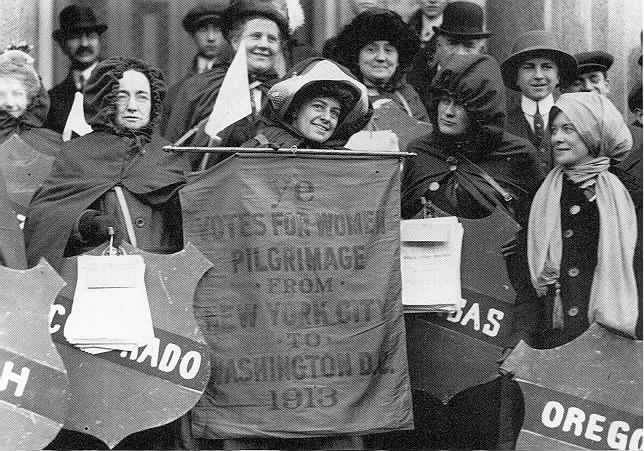
Rosalie Jones holding up the the hike's official banner (made before road conditions forced a start in Newark, rather than New York City, where the kickoff rally was held), with Ida Craft to the left holding up a shield with the name of the suffrage State of Colorado and Elizabeth Freeman on the far right, holding up the name of Oregon, another State where women have equal suffrage.
Rosalie Jones holding up the the hike’s official banner (made before road conditions forced a start in Newark, rather than New York City, where the kickoff rally was held), with Ida Craft to the left holding up a shield with the name of the suffrage State of Colorado and Elizabeth Freeman on the far right, holding up the name of Oregon, another State where women have equal suffrage.

Though atrocious roads and bad weather are things the hikers are accustomed to, organizational politics has become a new source of frustration. The National American Woman Suffrage Association (N.A.W.S.A.) has decreed that only the women hikers, and only those who have hiked the full distance from Newark, are authorized to march in Washington. But General Jones is fiercely loyal to all those who have played any part in this difficult journey, and is determined to assure that all will march together into Washington day after tomorrow as well as in the big parade and pageant five days from now. “That settles that,” she said.

“Scout Car” driver Olive Schultz motored into Washington today to attend to last-minute details. She was formally welcomed to suffrage headquarters by Alice Paul, who heads the N.A.W.S.A. committee planning the massive suffrage event on March 3rd, the day before Wilson’s inaugural.

Though she was only one person – and in an automobile, not hiking – Schultz’ arrival caused quite a stir in the city simply because she has a role in the hike. When she visited suffrage headquarters, 30 workers rushed to meet her, despite having a huge amount of work to do and less than 120 hours remaining to accomplish all of it. The intense interest that the people of Washington seem to have in the hike, and the enthusiasm shown by their fellow suffragists for the hikers bodes well for the reception that will greet the pilgrims day after tomorrow.

Founding Feminists: February 25, 1913

Founding Feminists is FMF’s daily herstory column.

FoundingFeministLogo-color

Proving that they can be as bold indoors as outdoors, the suffrage hikers descended upon two of Baltimore’s most patriarchal institutions on this, the 14th day of their journey from Newark, New Jersey, to Washington, D.C.

The first visit of the day was to Cardinal Gibbons at his residence. Though known for his personal opposition to woman suffrage, he treated his unexpected visitors with great respect, even after “General” Jones impulsively gave him a handshake as a greeting instead of kneeling and kissing his ring, as is customary for all local visitors, regardless of their religious affiliation.

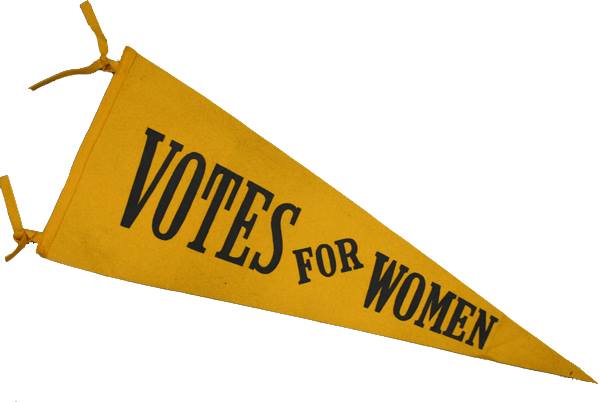
Jones then presented the Cardinal with a small “Votes for Women” pennant, which he graciously accepted, though with the friendly admonition that “in accepting this souvenir of your march, it is not necessarily a conversion to your cause.” He then diplomatically praised the hikers without actually endorsing their goal:

I hope your mission may commend itself to the judgment and conscience of the legislators. I am sure if they do not form a favorable opinion from your courage and determination their hearts must be harder than the stones that have bruised your feet on the march. I do not wish to bias their judgment, but you certainly deserve well for the efforts you have made and the courage you have shown.

The Cardinal then asked some questions about the hike, and commented: “It is wonderful that women could have done what you have done. When you have completed your pilgrimage and Washington is reached, I am sure that all will agree with me that you deserve … a good rest.” For just for a moment during the pause, the hikers dared hope he would say “the vote” instead of “a good rest,” but they were still quite pleased with his friendly tone, and deemed the meeting a successful one, all things considered.

Their next encounter was a luncheon sponsored by the “Sons of Jove.” Another breach of local etiquette here, when as cigars and cigarettes were being passed around, Chief Orator Elizabeth Freeman took one and began puffing away. The sight of a woman smoking in public shocked local suffragists, one of whom quickly told Freeman: “We don’t do that in Baltimore.” Her action jolted the Jovians as well, one of whom took the cigarette from her hand and extinguished it. But other than that, the reception went quite well.

1907557_10201977792629962_221197254_n

The hikers also called upon Acting Mayor Hubert, who accepted a “Votes for Women” flag and gave the pilgrims a letter to the Mayor of Laurel, the city they expect to reach tomorrow night after the hike resumes in the morning. Earlier this evening, the hikers went to the New Theater, where they, “Lausanne,” the horse who pulls Elizabeth Freeman’s literature wagon, and “Jerry,” the donkey who pulls a small cart for a woman tourist who’s now accompanying the hikers, went on stage to great applause.

The “Army of the Hudson” seems reunited in spirit again as the dispute between General Jones and Colonel Craft over the speed of the march and the priority given to socializing with the locals seems to have been smoothed over. But problems still remain, as the permit for the pilgrims’ march and police escort into and through Washington, D.C., has been obtained, but it’s for a day too early. Since speeding up the hike to conform to the date on the permit would revive the feud with Colonel Craft, that’s not an option, so the permit application process will have to be started over again.

But despite the inadvertent breaches of custom during the visits to the Cardinal and the Jovians, plus the misdated permit, the hikers are now optimistic, well-rested, and eager to be on the road again, with their destination now easily attainable in time to join in the National American Woman Suffrage Association’s massive parade and pageant on March 3rd.

Founding Feminists: February 24, 1913

Founding Feminists is FMF’s daily herstory column.

FoundingFeministLogo-color

“General” Rosalie Jones’ suffrage army is reunited and back to full strength again as “Colonel” Craft’s contingent marched into Baltimore on Day 13 of the hike from Newark, New Jersey, to Washington, D.C.

Ida Craft’s small detachment of troops enjoyed a big sendoff this morning from the villagers at Overlea, with four-year-old Albert Ayeman and six-year-old Julia Raspe, both wearing suffrage-yellow streamers, leading the procession out of town.

In Raspeburg, the hikers were met by members of the Just Government League, who gave them a luncheon at the home of their president. Though Col. Craft’s feet may be in notoriously poor condition after all these days of hiking, her voice is still at its best. After her luncheon speech, some of her listeners were sufficiently motivated to start a suffrage club, and will be presenting Craft with a gold medal in Washington on March 3rd for her courage and devotion to the cause.

As was the case yesterday when the main body of troops arrived, the police were again present in sufficient numbers to give the hikers a pleasant entry into Baltimore. The marchers were joined by a delegation of women from Goucher College as well.

General Jones spent today at her headquarters in the Hotel Stafford, sending hikers out to various speaking engagements, and to sell postcards bearing photos of the hike and individual hikers, while she made plans for the final days of this exceedingly successful campaign.

The "Overlea contingent" of the suffragist "Army of the Hudson" arriving this morning in Baltimore. Among those in the group are Elizabeth Freeman, in front of Lausanne, the horse pulling the literature wagon. Col. Craft is just to the left of the police officer at the right of the photo
The “Overlea contingent” of the suffragist “Army of the Hudson” arriving this morning in Baltimore. Among those in the group are Elizabeth Freeman, in front of Lausanne, the horse pulling the literature wagon. Col. Craft is just to the left of the police officer at the right of the photo.

But nearly two weeks on the road have caused some dissension in the ranks. Col. Craft, still angry about General Jones’ decision to push on to Baltimore yesterday, instead of stopping at Overlea, as planned, clearly thinks there should be more time spent socializing with the locals even if it means less hiking. A brisk pace was justifiable back in New Jersey, with a couple of hundred miles of marching ahead under unpredictable weather conditions and over unscouted, muddy roads. But there’s now a full week left until the big parade and pageant in Washington, and only a relatively short distance to go, so a change of pace and priorities seems in order. As Col. Craft put it:

I don’t believe in rushing about the country. We are now engaged in going at a ‘six-day bicycle race’ speed, and I am frank to say that I don’t like it. There must be consideration shown to both the pilgrims and to those who offer us their hospitality. I will obey the reasonable commands of General Jones, but when Gen. Jones wants to cut out all the social functions, which I think are necessary to the cause, it is going too far. We cannot slight Southern hospitality. I am going on to Washington, and if Gen. Jones cares to push on in this ‘six-day bicycle’ manner, I will not. I started to Washington, and intend to get there.

Still, even with some ruffled feelings after yesterday’s march, there is no doubt that the hike will go on, and Constance Leupp was sent ahead to Washington to help coordinate plans for the pilgrims’ arrival and activities in that city. Leupp will return to Baltimore tonight to march with the troops when they resume their trek day after tomorrow.

Founding Feminists: February 21, 1913

Founding Feminists is FMF’s daily herstory column.

FoundingFeministLogo-color

“The worst stretch of road between Boston and Atlanta,” was the way one local resident described it, and none of the suffrage hikers showed any desire to dispute that claim as they slogged their way from Elkton to Havre de Grace, Maryland, today.

The condition of the alleged “road” was so poor in places that many pilgrims found the going easier in nearby farmers’ fields.

But as unpleasant as it was for those who were walking, it was even worse for the automobiles accompanying the hikers. Three times today, the machines needed to be pulled out of the mud by horses. Bad as it was, mud was not the only problem the army’s motorized division faced. Both the baggage car and commissary wagon caught fire, though fortunately, little damage was done.

But even with all of today’s obstacles, the “Army of the Hudson” marches on toward Washington, D.C., and even picked up a new recruit. Margaret Geist, her two-wheeled cart, and a burro named “Jerry” are traveling across the country, and have decided to accompany the hikers.

Though one encounter this morning was with an apparently anti-suffrage turkey who didn’t like the pilgrims cutting across his territory, the suffragists got a much more friendly reception from Mary Peterson, who led them down a side road to her home. Already well behind schedule, the troops couldn’t stay for dinner, but they did have time to go on an egg-hunting expedition in the barn, and eagerly consumed a number of the best, freshly-laid ones.

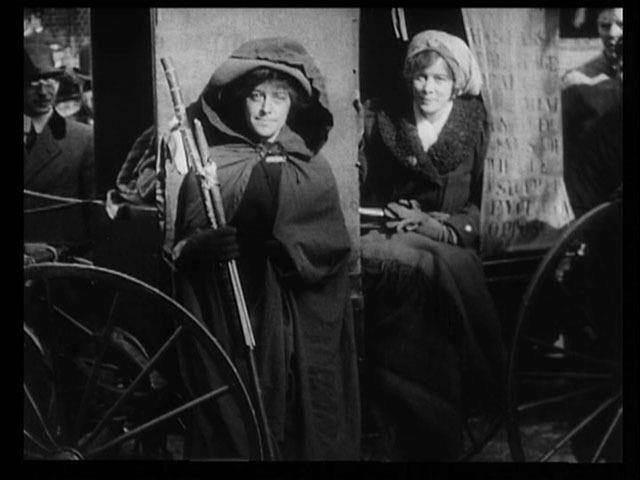
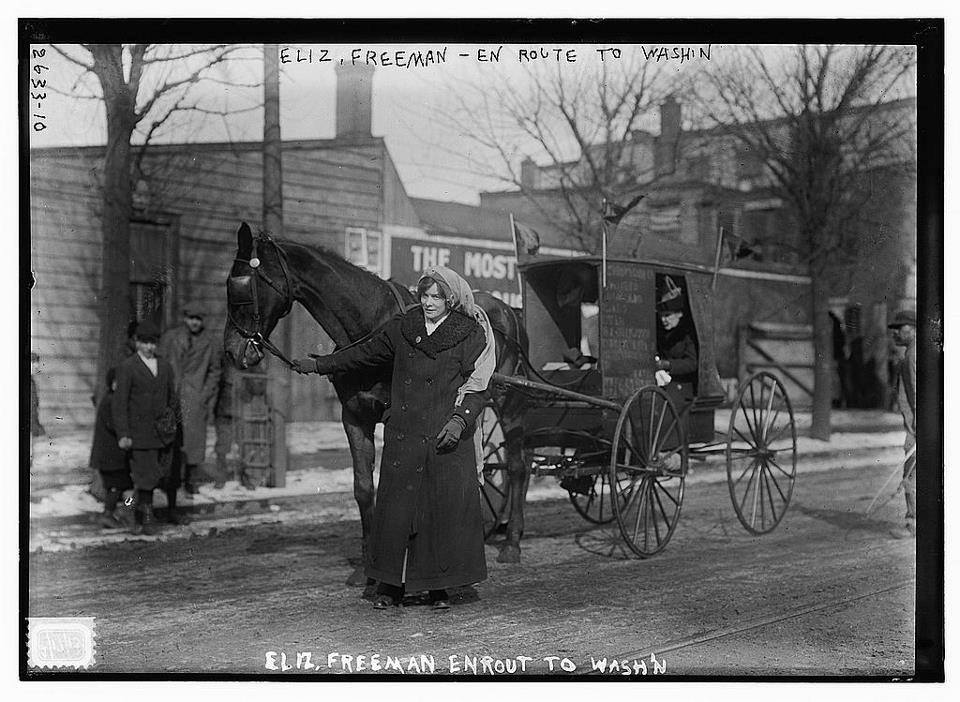
"General" Rosalie Jones standing outside Elizabeth Freeman's literature ("ammunition") wagon, as Freeman sits inside.
“General” Rosalie Jones standing outside Elizabeth Freeman’s literature (“ammunition”) wagon, as Freeman sits inside.

The next stop was at Northeast, where all five of the commissioners, plus the village “patriarch” and his suffragist niece, Emily Peach, were waiting to welcome the pilgrims, and give them a luncheon. Passing through Charleston, the marchers were given musical accompaniment when Bayard Black brought his gramophone out on the porch and played “Maryland, My Maryland” as the hikers passed by. The employees of Principio Furnace stopped work long enough to wave yellow suffrage banners, and many of the men at the big steel mills came out to applaud the hikers.

Arrival in Havre de Grace was later than expected due to road conditions, but was well worth the extra trouble. A brass band and citizens committee crossed the Susquehanna River and met the marchers at Perryville, then escorted them to the Havre de Grace City Hall, where Mayor Weber gave an address and presented them with the key to the city. Not all the troops were present for the ceremony, however. “Colonel” Craft didn’t arrive until 9 p.m. due to her swollen and blistered feet, nor did two other hikers accompanying her.

Though reluctant to admit it, all the hikers are showing clear signs of ailments similar to Craft’s, plus fatigue from the long trip. But absolutely no one doubts that they will finish what they started nine days ago in Newark, New Jersey, and that this small, but dedicated group will have given a big boost to the struggle for woman suffrage by the time they finally arrive in the nation’s capital and join in the big suffrage parade and pageant on March 3rd.

Founding Feminists: February 20, 1913

Founding Feminists is FMF’s daily herstory column.

FoundingFeministLogo-color

Another day and another State Line crossed for the suffrage hikers!

Today’s 18-mile march to Elkton, Maryland, was as eventful as it was long. It began in that most friendly city of Wilmington, Delaware, where the mayor and 20 police officers gave the “Army of the Hudson” an escort out of town. Mayor Howell also wrote a personal letter of introduction for the hikers to the Mayor of Baltimore.

The day’s first encounter was with the Green family. William Green proudly presented Ruth and Esther, age three, as future voters. Their mother shouted her support for the hikers from a window of the house, regretting that she couldn’t go to Washington, D.C., but said: “I am doing my share, for I am bringing up two new voters.”

The next stop was to visit Martha Cranston in Newport. She is one of the most active – and at over 70 years of age among the most senior – suffragists in Delaware. She gave the troops a fine speech of welcome. The City of Newport was decorated for the occasion with flags and bunting on many of the houses, and the city’s greeting even featured thirty schoolchildren, each carrying a banner. Two of the banners were inscribed “LET WOMEN VOTE” and “FOR PRESIDENT, GENERAL JONES.” Speeches were given in appreciation of the welcome, and then it was back on the road again.

The hikers taking a break, and talking to a few local residents earlier today at the Deer Park Hotel in Newark, Delaware.

As they approached Newark, the army was met by the cadet corps of Delaware College. What made this reception especially noteworthy was that the students were not given permission to miss classes and go out to meet the marchers, but they did so anyway. One hundred and seventy-five uniformed students and band members “presented arms” as a salute, then escorted the hikers into Deer Park. After bidding the hikers a fond farewell, the band played “The Girl I Left Behind Me” and marched back to their campus and an unknown disciplinary fate.

Of course, there was the standard “incident of the day,” which in this case consisted of three small boys throwing some live mice into the marchers’ ranks near Newark. Though the boys momentarily got the reaction they had hoped for from the hikers, military discipline was soon restored and the pilgrim army’s advance continued. This was at least a more humorous prank than one played in Wilmington this morning when among the packages given to the suffragists were several stamped “Handle With Care” and which contained small black sticks marked “Dynamite” and “Use Judiciously.” They turned out to be just harmless sticks of carbon.

The day’s next major event was crossing into Maryland. “General” Jones grasped some of its soil and said: “Maryland soil, we bless thee in the name of equal suffrage. My our journey be pleasant, and our cause prosper within your borders.” The ceremonial welcome continued with Dr. Ernest L. Stevens contributing a new marching song, sung to the tune of “Maryland, My Maryland.”

The suffragette is at the door,
Maryland, my Maryland;

On foot she hikes to Baltimore,
Maryland, my Maryland.

Come, join the Hudson’s hiking throng,
Stalking with Rosalie along;

And chant the dauntless suffrage song,
Maryland, my Maryland.

As they marched and sang their way, the pilgrims encountered a ten-year-old boy riding a horse with no saddle. Upon seeing the yellow suffrage banners fluttering in the breeze, the horse became frightened, but Marie Baird ran down the road, grabbed the bridle, and soon settled the horse down. “Thank you,” said the boy. “I am in favor of women voting.”

Though arriving in Elkton late in the afternoon, there was a good-sized crowd to meet the pilgrims, and despite having hiked 18 miles, many still had enough energy to make the day’s final speeches, some of which lasted well into the evening.

Aside from the fake dynamite, real mice, and the baggage automobile breaking down near Folly Woods and needing to be towed to a blacksmith’s shop by a team of horses, it was a pretty good day. Eight days after leaving Newark, New Jersey, there are now 134 miles in back of the hikers, with less than a hundred ahead, and eleven days remaining until the big suffrage parade and pageant in Washington D.C. So, the hike is going well, and on schedule!

Founding Feminists: February 19, 1913

Founding Feminists is FMF’s daily herstory column.

FoundingFeministLogo-color

After seven consecutive days of walking, and approximately 116 of the 225 miles from Newark, New Jersey, to Washington, D.C. behind them, the suffrage hikers are spending this eighth day in Wilmington, Delaware, “getting new feet” as they put it.

But while the morning may have been spent applying much of the city’s available supply of liniment to sore feet, their voices were not given any pampered treatment during the day’s stopover.

Most of the hikers, once sufficiently rubbed down, were eager to fulfill the numerous speaking requests made in this very friendly town. By noon there were speakers at the Pullman Car Works. The Hollingsworth ship and railroad car workers got a briefing as well, and in the evening the hikers went to the Garrick Theater, where five-minute suffrage speeches alternated between the vaudeville acts, and both types of performances were applauded.

“General” Rosalie Jones held a reception at her hotel this afternoon. Among those attending were the city’s mayor, and Captain Thomas Johnson, age 86, of Cape Charles, Virginia, who came to town specifically to see the hikers.

There has been much public concern and speculation about the condition of Lausanne, the $59.98 suffrage horse bought in Newark to pull Elizabeth Freeman’s literature (“ammunition”) wagon. But a veterinarian who had heard that Lausanne was “spavined, had a bowed tendon, sprung forward legs, interfered badly and was a cribber” found upon examination that “her legs were just slightly sprung, and that she has a heavy appetite,” but was otherwise all right, and fit to complete the rest of the trip so long as she continues to be well-fed.

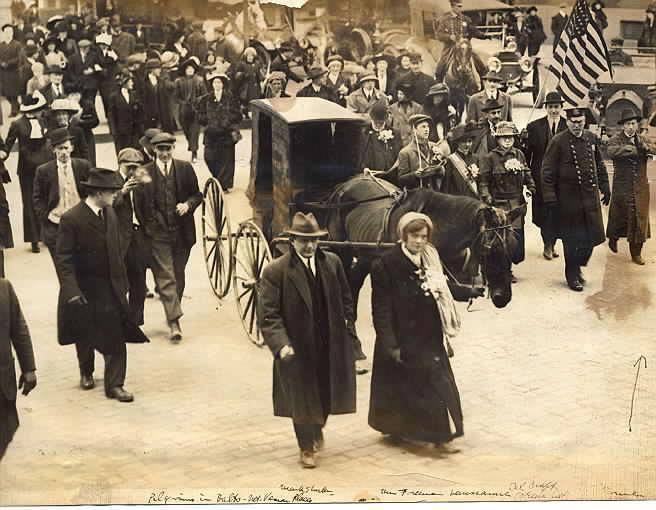
Lausanne pulling Elizabeth Freeman's literature wagon, Freeman holding the reins.
Lausanne pulling Elizabeth Freeman’s literature wagon, Freeman holding the reins.

Though General Jones’ “Army of the Hudson” is dedicated to winning the battle for the ballot by totally peaceful means, the news that the unoccupied country home of David Lloyd-George, British Chancellor of the Exchequer, had just been damaged stirred controversy in the ranks today. Freeman, who has served time in British prisons for her suffrage activities there said that she could understand the reason for such a militant action:

The situation in England is entirely different from the situation here. The women know that [Prime Minister] Asquith is their enemy. He has frankly said so. Now, Lloyd-George posed as friendly. He held out one hand to them and then had torpedoed a bill that would have helped them. Englishmen hold above all else the sacredness of property. Well, Englishwomen have attacked sacred property, and they will continue to do so. I believe in destruction of property where human life is not endangered. Lloyd-George knows now what Englishwomen really think of him.

But hiker Elizabeth Aldrich is representative of those who take the opposite view: “I would not break a pane of glass if by doing so all women were enfranchised. I am for peace and order.”

Three interesting letters arrived today. One was supposedly from “Mrs. Alfred I. Du Pont,” wife of the well-known industrialist, financier and philanthropist. When Freeman called her, she said the letter must be a hoax, because she hadn’t written it, but that she actually did support the hikers, so it was a trick that had a good result.

A second letter was more of an obvious spoof, allegedly from the “Association of Husbands,” who said they were getting tired of this cross-country hiking by suffragists.

A third letter was from someone claiming to be a librarian at the University of Pennsylvania, who said that the Dean of the Law School had alleged that $30 worth of furniture had been damaged during the suffrage rally there for the hikers. When Freeman tried to call the Dean, he was out, so the truth of this allegation remains in question tonight.

What is not in question is that both fame and support for the hikers are increasing rapidly, as more and more groups now volunteer as escorts. For instance, a brass band composed of 25 school teachers and other professional women from Marysville, Missouri, has just offered to meet the hikers at Laurel, Maryland, and escort them into Washington.

College students have been very supportive from the beginning, and Company “N” of the Pennsylvania National Guard, composed primarily of University of Pennsylvania undergraduates, has offered to march with the hikers in the big suffrage parade in Washington, D.C. on March 3rd. Not to be outdone, Princeton students have also volunteered to march along with them in D.C. next month as well.

With the last of the day’s many suffrage speeches done, the hikers have now turned in and are enjoying a peaceful night’s sleep. But tomorrow it’s back on the road again, and on to Elkton, Maryland!

Founding Feminists: February 18, 1913

Founding Feminists is FMF’s daily herstory column.

FoundingFeministLogo-color

Halfway! Day Seven of the suffrage hike was very successful in a number of ways, not the least of which was passing the midpoint in the long trek from Newark, New Jersey, to Washington, D.C.

The relatively short 14-mile day began with “General” Rosalie Jones leading her “Army of the Hudson” out of Chester, Pennsylvania, accompanied by tooting whistles, automobile horns, a police escort, at least 1,000 spectators cheering them from the sidewalk, and two local schoolgirls, ages 15 and 16, marching along for the day.

The troops carried with them a gift from Major Stundell, of Lebanon, Pennsylvania. It consisted of a large gift box containing smaller boxes of pretzels for each hiker. It was a timely gift, because a large supply of “army rations” donated by Alva Belmont had been misrouted to General Jones’ home on Long Island.

Even the traditional “incident of the day” was minor, as General Jones tripped over a rock in Pennsylvania and stumbled into Delaware. But no damage was done to the General or the State Line.

When the hikers approached the historic Robinson mansion, once frequented by numerous Revolutionary War figures, they were first met by “Jeff Davis,” a thankfully pro-suffrage bulldog who wore a blanket made of “Votes for Women” pennants. The present residents, a colony of artists, gave the hikers a warm reception.

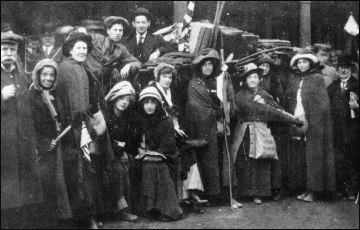
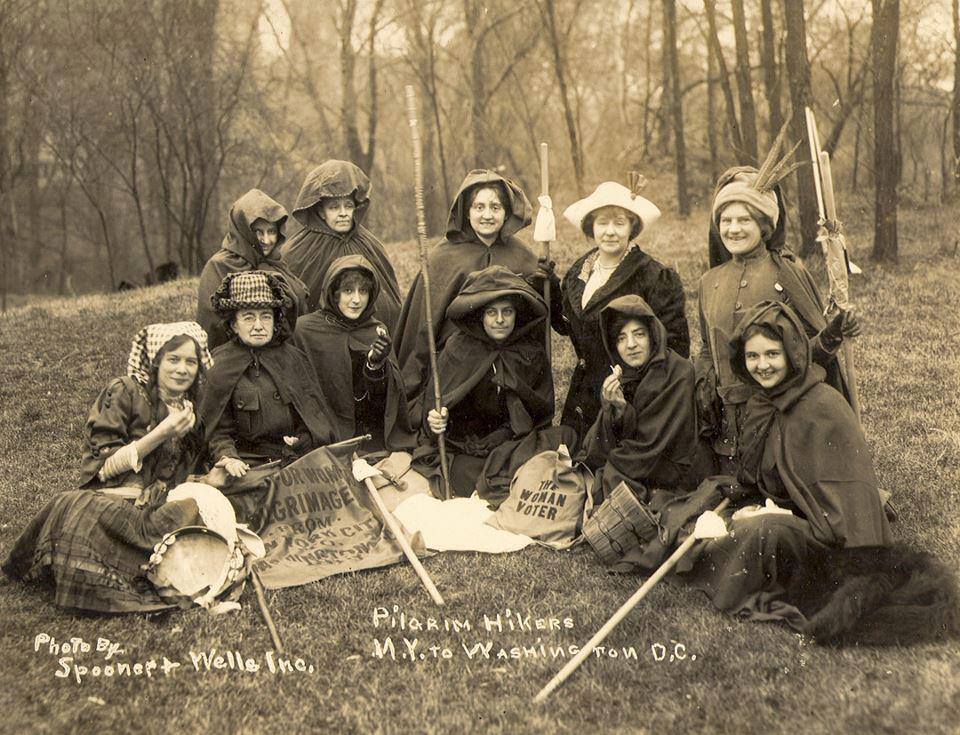
The hikers, with Elizabeth Freeman at the far left of the picture, Ida Craft second from the left, and Rosalie Jones in the middle of the front row with a hiking staff in her hand.

Next came a luncheon with single-tax advocates, known as “Ardenites.” They want to implement an idea by Henry George (1839-1897), to abolish all other taxes and replace them with a single tax based on the value of land. Female members of the Arden colony have voted on affairs of common interest for ten years. The hikers were greeted by members of the Suffragist Club of Arden. (The name “Arden” derives from the “Forest of Arden” in Shakespeare’s “As You Like It.”)

The entry into Wilmington was wonderfully triumphal, and an appropriate way to celebrate the half-way point of the march. Applauding crowds lined the streets, and three fire companies gave the pilgrims the noisiest greeting of the trip, something especially appreciated by General Jones. The parade through town was followed by a reception at City Hall, where Mayor Howell – who has mixed feelings on the issue of woman suffrage, but great admiration for the hikers – expanded the army’s growing collection of “keys to the city” by presenting them with one from Wilmington.

Later in the evening, the troops gave speeches at an open-air suffrage meeting attended by an estimated 10,000 of the city’s residents, making it the largest rally so far for General Jones and her fellow hikers.

“Colonel” Craft barely managed to make it into town today, due to an ankle injury adding to the problems she already had with sore feet. But she is expected to be able to continue on when the hike resumes. Tomorrow will be the first time since leaving Newark on the 12th that the hikers will spend an entire day in the same place. But they will still be working for the cause by doing speaking engagements in this very supportive city, and a day without hiking should give everyone a chance to give their feet some much-needed rest before starting out on the final half of the journey.

>