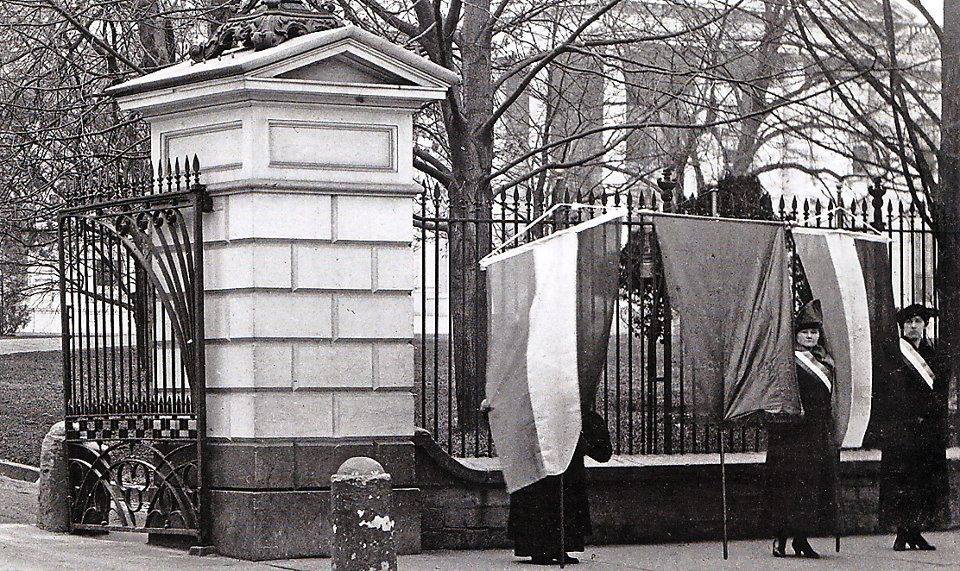
Founding Feminists: January 13, 1917

Founding Feminists is FMF’s daily herstory column.

FoundingFeministLogo-color

Four days of picketing President Wilson at the White House have brought gratifying results, and though the “Silent Sentinels” will be taking tomorrow (Sunday) off, the protests will be even larger next week, and continue until President Wilson endorses and works for the Susan B. Anthony (nationwide woman suffrage) Amendment.

Today there was a marked increase in visitors and volunteers at the headquarters of Alice Paul’s “Congressional Union for Woman Suffrage,” all as a direct result of people seeing the pickets, banners and tricolor standards next to the White House gates. Even President Wilson has been giving increased respect to the pickets, despite being the object of their protest. He went from being expressionless at first, to smiling, then tipping his hat and now bowing slightly as he passes through the gate. In response, the picketers briefly dip their banners as a way of returning the salute.

The Sentinels have also been getting a lot of friendly attention from the squirrels who populate the White House lawn. Though squirrels tend to be neutral on the issue of suffrage, they’ve been quite useful to the cause by drawing crowds who like to watch the Sentinels feed them by tossing peanuts through the fence.

One visitor to today’s protest passed along a note with especially encouraging news. He’s in a position to overhear members of Congress talking candidly among themselves, and according to this anonymous source, a couple of prominent politicians were having a conversation in which both agreed that women were becoming angry at the way the Anthony Amendment was being stalled, and the only way to avoid the wrath of women voters in the eleven “equal suffrage” States might be for Congress to simply pass the measure and send it to the State legislatures for ratification.

A meeting was held late this afternoon at Cameron House to share picketing experiences and plan strategy for the next week. A number of today’s new recruits attended, and volunteered to do sentry duty. Extra personnel will be needed, because instead of just picketing alongside the gates, an attempt will be made to line the entire White House fence along Pennsylvania Avenue with suffragists and banners late one afternoon next week. That time of day has been chosen because many of the picketers have family duties to perform in the early morning and at lunchtime.

1527127_10201732281212330_512671092_n

One example of how this protest is uniting women over the issue of suffrage was shown recently when a woman from Germany and another from England saw the banners as they were each passing by and spontaneously joined the picket line. Despite the fact that their nations have been at war with each other since August 4, 1914, they chatted amiably, and if given the opportunity, both probably would have asked Wilson the same question that appears on the banners: “MR. PRESIDENT, WHAT WILL YOU DO FOR WOMAN SUFFRAGE?”

The past four days have certainly been amazing, and this campaign is just getting started, so there’s no telling how much may be accomplished in the upcoming weeks !
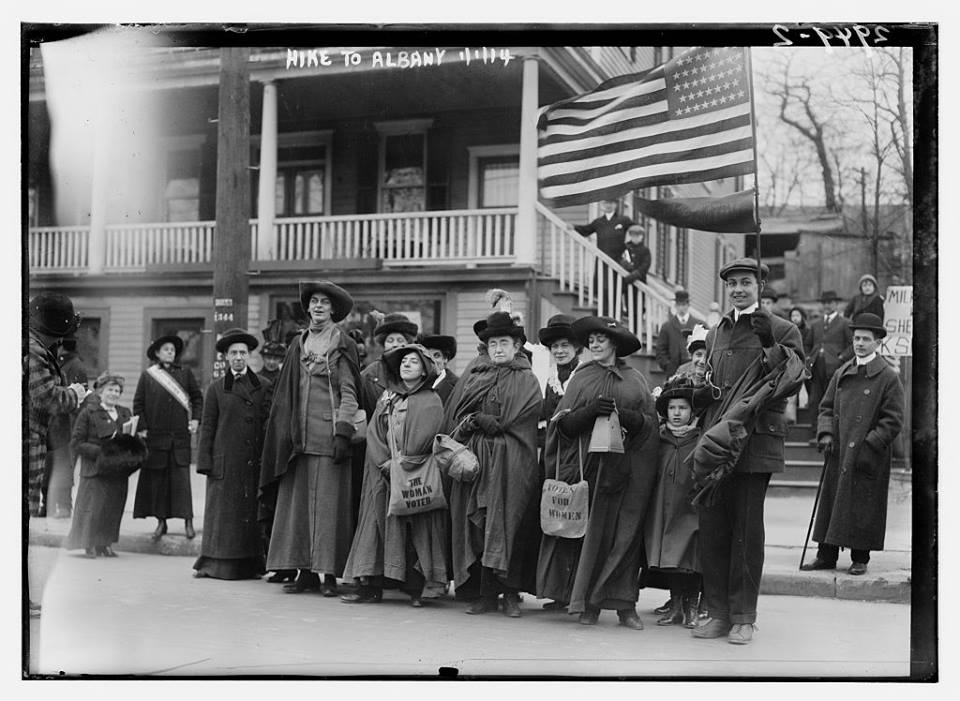
Founding Feminists: January 7, 1914

Founding Feminists is FMF’s daily herstory column.

FoundingFeministLogo-color

She’s done it again!

For the third time in 13 months, “General” Rosalie Jones has successfully led a band of suffrage pilgrims to their destination.

Her first – and totally unprecedented – “suffrage hike” left New York City on December 16, 1912, and arrived in Albany on December 28th. Its purpose was to deliver a message from prominent New York suffragists to Governor-elect William “Plain Bill” Sulzer, and then get him to officially support suffrage. They succeeded on both counts.

The massive and favorable publicity generated by their first adventure led to a far more ambitious trek from Newark, New Jersey to Washington, D.C. from February 12th to 28th of last year. That time they hiked to promote the cause, as well as to be a part of the landmark suffrage parade and pageant held in the nation’s capital on March 3rd, the day before President Wilson’s inauguration.

This third hike ended at 2:35 this afternoon, after having begun on New Year’s Day. It obviously went at a much faster pace than their first march to Albany. The goal of about 25 miles a day from the 1st through the 6th was achieved despite roads that according to General Jones were in even worse condition this year than in 1912.

Three of the eleven who arrived today hiked the entire 166 miles: “General” Rosalie Jones, “Colonel” Ida Craft and “Corporal” Martha Klatchken, all veterans of previous hikes. Though their goal was the same as 13 months ago – to deliver a message and gain the Governor’s endorsement of a Statewide suffrage referendum – there was a new chief executive to lobby. Sulzer was impeached and removed from office on October 17th, nine and a half months after being sworn in on January 1, 1913.

This year’s hike was beset with all the familiar problems, from muddy roads to high winds, bitter cold and snowstorms. General Jones often had to take breaks, as well as use a cane. But as always, the hikers just kept marching on, and today reached their destination. They were met at the edge of town by 200 cheering supporters, and were escorted on the final few miles of their journey by the Albany Political Equality Association, plus a fife and drum corps.

The hikers on January 1st, the beginning of the hike. General Jones is carrying the megaphone and a bag inscribed "Votes for Women." Just to the left of her in the front row of the photo is second-in-command Colonel Ida Craft.
The hikers on January 1st, the beginning of the hike. General Jones is carrying the megaphone and a bag inscribed “Votes for Women.” Just to the left of her in the front row of the photo is second-in-command Colonel Ida Craft.

After some speeches to the crowd on the street, the hikers went into the Assembly Chamber, where they individually urged their representatives to vote for a current bill that would allow women to act as poll-watchers. This is a wise precaution to insure an honest election when woman suffrage goes on the New York State ballot on November 2, 1915. The reception was friendly, and General Jones even got a chance for some much-needed rest in one of the chamber’s many comfortable leather chairs.

Following their meeting with the legislators, the pilgrims went to see Governor Martin G. Glynn. When she met with him, Jones was carrying a lighted lantern, and when questioned about it said that in the tradition of Diogenes, she was “looking for an honest statesman.” Governor Glynn assured her: “You will find plenty of them here.” After some initial resistance, Glynn and his secretary, Frank Tierney, accepted “Votes for Women” buttons, then praised the hikers for their zeal, but did not make any official endorsement of the referendum, or a commitment to the cause.

Though she said she didn’t want to make another hike, Jones also said: “We shall march next year, however, and every year thereafter until women are granted suffrage.” So, the struggle – and presumably the hikes, as well as the massive marches and pageants – will go on!

Founding Feminists: January 6, 1920

Founding Feminists is FMF’s daily herstory column.

FoundingFeministLogo-color

The Susan B. Anthony (nationwide woman suffrage) Amendment is now 2/3 of the way to victory in this final stage of the battle for “Votes for Women!”

Today Rhode Island and Kentucky became the 23rd and 24th States to ratify, which means that just 12 more are needed to make it the 19th Amendment to the U.S. Constitution.

At the offices of the National American Woman Suffrage Association there was unrestrained optimism, and determination to obtain the approval of a 36th State by April, so that women in every State can vote in the Presidential primaries as well as the General Election in November.

1528624_10201691990405085_1502512462_n
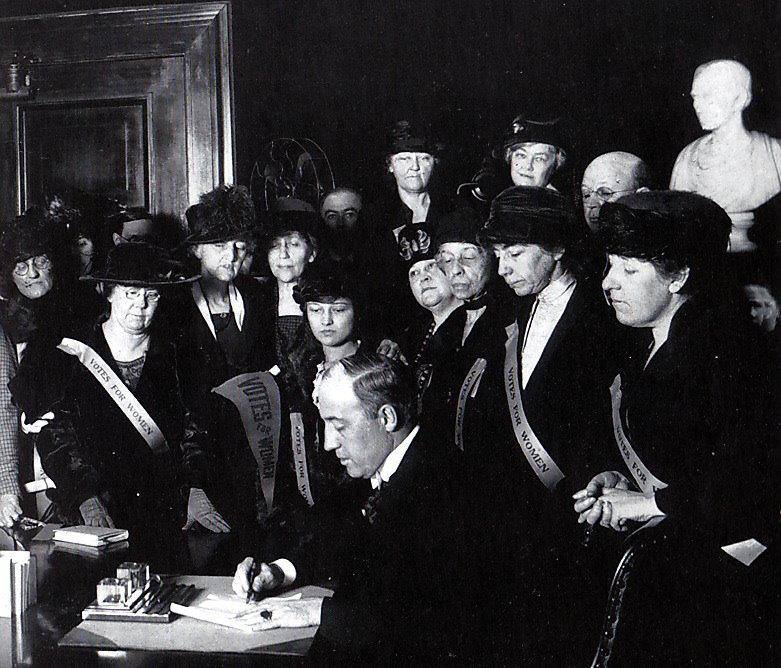
Republican Governor Edwin P. Morrow signing Kentucky’s ratification resolution earlier today. In recognition of their work, members of the Kentucky Equal Rights Association were invited to witness the ceremony.

The celebration at National Woman’s Party headquarters was delayed a bit due to a fire, but was equally enthusiastic when it finally got underway. The fire began in the furnace room just about the time word was received of the double ratification. The Party has gained a reputation for using fire as part of their demonstrations as a result of setting President Wilson’s speeches ablaze during the campaign to get the Anthony Amendment passed by Congress, so the people who were in Lafayette Park when the smoke first appeared thought it might be some sort of celebration. But the blaze wasn’t intentional or celebratory, and spread from the furnace room to the ballroom, then to the living quarters, doing about a thousand dollars damage. Fortunately, the Fire Department arrived quickly, as did the police, who helped the women carry out the most valuable items to be saved in case the fire couldn’t be extinguished. Alice Paul’s 22-star “ratification flag” was among the crucial items quickly brought outside, and this evening has two more stars.

The margins of victory for today’s ratifications show just how powerful the momentum for suffrage has become. In Rhode Island the vote was 89 to 3 in the House and unanimous in the Senate. Mary B. Anthony said on behalf of the Rhode Island Equal Suffrage Association: “It is with a feeling of profound satisfaction that I realize that Rhode Island has ratified. ‘Little Rhody’ is a fine State and here’s the proof.”

In Kentucky, the vote was 72 to 25 in the House and 30 to 8 in the Senate. The issue was of sufficient priority that it was dealt with on the first day of the legislative session. Before ratifying, the Senate rejected by 23 to 15 a proposal by the “antis” to delay ratification by submitting the Amendment to a Statewide referendum.

The Anthony Amendment was passed by Congress and sent to the States seven months and two days ago. It is nine months and twenty-seven days until the General Election, so two-thirds of the job has been done in less than half the time between those two events. But the States that remain are going to be much harder to ratify – many in the “Solid South” – so the pace may now slow considerably.

Complicating things further is the fact that the “antis” managed to postpone the Anthony Amendment’s passage by Congress for so long that some State legislatures had already adjourned their regular sessions, and are not scheduled to reconvene until next year. So, getting governors to call special sessions to vote on ratification is a high priority for all suffrage groups. There are also States in which the legislature is of a different party than the governor, so it may not want to give the governor a political victory if a special session is called. And, of course, in all States there are local, personal and partisan rivalries that complicate any vote.

There is no time limit on ratification of the Anthony Amendment, so failure to ratify this year would not doom it. But if it is not ratified in time for women in non-suffrage States to register to vote for the November 6th election it would deprive millions of women of their right to choose the next President, their House members, as well as any of the Senators who will be elected this year, inaugurated in 1921, and remain in office until March 4, 1927. The country deserves a President and a Congress elected by both male and female voters, and suffragists will be doing everything possible to assure it.

Founding Feminists: December 20, 1912

Founding Feminists is FMF’s daily herstory column.

FoundingFeministLogo-color

This fifth day of “General” Rosalie Jones and her “suffrage army’s” hike from New York City to Albany saw sore feet causing a late start, but better weather, as well as renewed commitments by the marchers. This afternoon’s sendoff in Fishkill was enthusiastic, and included the Village President, the Chief of Police and a number of local suffragists as well.

Though the day started and ended well, an experiment in recruitment along the route was somewhat less than successful. “Colonel” Ida Craft, always eager to promote the cause to all, decided it might be a good idea to make up a pro-suffrage flyer specifically addressed to some of the hobos the troops encounter in their travels. Upon seeing someone who clearly seemed to qualify for this recruitment drive resting at the side of the road, she gave him a flyer, only to discover that he was one of the county’s wealthiest landowners, and not at all flattered by the case of mistaken identity.

1459843_10201587294387750_436515767_n

The next encounter went better, however. In another of the pilgrims’ unannounced visits to roadside schoolhouses, 25 children listened attentively to General Jones and the army’s “Surgeon-General,” Lavinia Dock. One boy seemed quite supportive of women having the vote, but when Dock predicted that some day Jones might be President, this brought a worried look to his face. But at least he supports the most important step toward putting a woman in the White House, even if he’s not quite ready for a Jones Administration just yet. The teacher, Elizabeth Livingston, was undecided on the issue, but now that she has lots of literature to look over during the long Winter, that should change.

Moving farther down the road, Colonel Craft was doing her usual duty of stuffing suffrage literature into mailboxes when a farmer vigorously objected. But her enthusiasm for the cause, and logical arguments in favor of woman suffrage, were sufficient to get him to at least think about supporting the right of women to vote.

Near the day’s objective of Wappingers Falls, it was the army’s medical officer who needed attention, but after a few minutes of rest and some shoe-shaking, Dock’s malady was cured.

As their goal-of-the-day approached there was still one formidable obstacle to overcome. General Jones’ mother, having read of the exhausting pace (64 miles in just the first four days) of the hike, sent a nurse out to intercept the hikers, check on the General’s health, and implore the Commander-in-Chief to give her “Farewell Address to the Troops” and come home. But the General had no intention of deserting her army, declaring: “I am carrying a message to Garcia – beg pardon – Sulzer. I am going to walk to Albany. You may go right home and tell mother so.” This statement caused the other hikers to make renewed pledges to reach Albany as well.

The pilgrims attended a dance held this evening at the Wappingers Falls Academy of Music, though “Captain” (and Chief Orator) Jessie Hardy Stubbs did all the actual dancing for the group. She is now a full-time speaker who delivers her speeches from the baggage car, and no longer one of the three hikers. This way she can spend as much time as possible speaking and answering questions at the army’s many stops, then can quickly catch up with the hikers.

Apparently the fame of the pilgrims is now sufficient that at tomorrow’s luncheon in Poughkeepsie, an “admission fee” will be charged to the sold-out event, with the proceeds going to help “The Cause.”

This first-ever “suffrage hike” is meant to generate attention and support for the suffrage movement in general, and specifically for putting a suffrage referendum on the New York State ballot. It is hoped that the hikers will reach Albany before the end of the year, and meet with Governor-elect Sulzer to obtain his support for their “Votes for Women” referendum drive.

This has already become a spectacularly successful suffrage event. Three hikers walking around rural New York State with a contingent of “War Correspondents” sending back stories to their papers are generating far more publicity this week than a National American Woman Suffrage Association meeting in Chicago.

The last time such a small group of U.S. suffragists generated widespread publicity was on February 16, 1908, when two dozen members of the Progressive Woman Suffrage Union defied custom – and the police – by staging the first “suffrage parade” down Broadway in Manhattan. Such parades and pageants are now annual events, with between 15,000 and 20,000 marchers in New York’s suffrage parade earlier this year. This newest innovation seems to be in the same category of effectiveness, so it’s a good bet that the end of the hike in Albany will not be the end of the hikes.

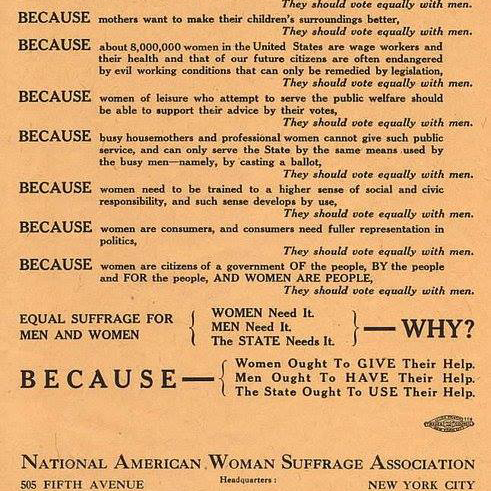
(Photo: A popular National American Woman Suffrage Association flyer explaining the major reasons why women should have the right to vote.)

Founding Feminists: December 19, 1912

Founding Feminists is FMF’s daily herstory column.

FoundingFeministLogo-color

Fatigue, rain, cold, wind and a muddy up-hill, down-hill road proved worthy adversaries, but “General” Rosalie Jones and her “suffrage army” still advanced twenty-two miles today from Peekskill to Fishkill.

Though the weather was quite unfriendly on Day Four of the hike, the people along this part of the route from New York City to Albany were just the opposite, and because yesterday’s thick fog was absent, views of the Hudson River and Storm King Mountain were spectacular. After a dispatch was sent from General Jones to a National American Woman Suffrage Association meeting in Chicago, reporting on the pilgrims’ progress, the day’s hike began with all four hikers giving a rousing cheer, echoed by a number of Peekskill’s residents.

Early on, the marchers were rewarded by an encounter with a mother and her three-year-old boy, Harold Traudt, whose attire included red, white and blue bunting. Both generations were strongly pro-suffrage. When asked, “You will vote with us when you grow up?” the boy said, “Yes, ma’am” and was given three cheers by the hikers. They then dropped in – unannounced – on a little red schoolhouse, and though the teacher, Florence Boggs, was firmly anti-suffrage, the students were having such a good time talking to the hikers that she chose not to interfere, and even promised to read some of the literature dropped off by the marchers.

Florence M. Cooley, of the Women’s Political League, appeared as promised when the troops crossed the Putnam County Line, and became just the first of their many cross-county escorts. The improving weather she brought with her was certainly welcome, and the muddy road even began to dry out a bit. The hikers took a nice break about noon to admire the view of West Point. Two more Putnam County suffragists, Lillian Jackson and Anna McKeller, also greeted the hikers and invited them to a luncheon.

1528645_10201581649406629_1070919757_n

At the entrance to an aqueduct tunnel, some workers shouted their encouragement, with “Votes for Women!” the speedy reply. That was followed immediately by a salute from the plant’s whistles. Then a boat carrying other workers across the Hudson tooted its whistle for the marchers as well, and fatigue among the hikers seemed to temporarily subside.

Darkness began to fall well before Fishkill was reached, but the locals had no trouble escorting the hikers directly to the Holland Hotel. The day’s objective was taken, though General Jones was tottering a bit at the end. She had begun limping slightly near Cold Spring, and went straight to bed at the first opportunity.

At the official welcoming ceremonies, Fishkill’s President happily surrendered the key to the town to the invading army. As usual, the indefatigable “Captain” (and Chief Orator) Jessie Hardy Stubbs managed to find another evening audience to speak to as well, and gave “Votes for Women” buttons to the men attending the anniversary dinner of the Tompkins Hose Association, a group of local firefighters.

Tomorrow it’s on to Wappingers Falls, and the question of the day will be whether the suffrage pilgrims, having already marched 64 miles in four days, will be waltzing at the local dance there tomorrow night.

Founding Feminists: December 17, 1912

Founding Feminists is FMF’s daily herstory column.

“Suffrage Army” troops are pushing on toward Albany on Day Two of their march!

Though their numbers are down to 5 from the 26 at their Van Cortlandt Park sendoff in the Bronx yesterday, the enthusiasm of those who remain is still high, thanks to many friendly receptions along the way, and a loyal group of War Correspondents giving the woman suffrage cause a boost in their papers by reporting this first-of-its-kind campaign to their many readers. Those who have walked all the way so far are “General” Rosalie Jones, “Colonel” Ida Craft, “Surgeon-General” Lavinia Dock, “Chief Orator” Jessie Hardy Stubbs, and “Private” Alice Clark.

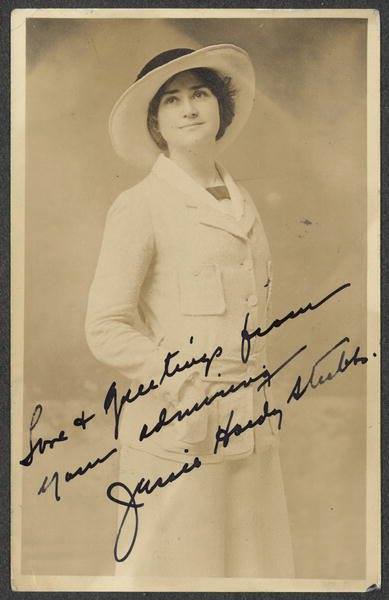
Chief Orator Jessie Hardy Stubbs

This morning the troops broke camp at Irvington, grabbed their walking staffs, buckled on their suffrage-yellow knapsacks and headed off for the day’s objective of Ossining. There was a brief debate over strategy among the high command when it was suggested that while cutting across the estate of Helen Gould an attempt be made to convert her to the cause. But “General” Rosalie Jones vetoed the idea, and resolutely ordered the hikers to keep marching toward Tarrytown, where there would be many more (though admittedly not as wealthy) citizens to convert.

Like Yonkers before it, Tarrytown was bubbling over with enthusiasm for the hikers, and before they even arrived, a delegation of residents drove out to greet them. When passing the Knox School for Young Ladies, a group of students ran out cheering, and waving the school’s banner. In return, General Jones promised: “You are all going to have a vote.” Naturally, this made them cheer even more.

Later, at a suffrage meeting in a church where the rector’s wife is a suffragist, equality prevailed as the school girls were joined by students from the Irving School for Boys. Jessie Hardy Stubbs spoke to the town’s residents, and when the youngsters began a round of applause after the speech, the adults joined in as well.

Once outside the church, the Knox girls surrounded the pilgrims, and cheered: “Rah, rah, rah, do not fret. You will get to Albany yet. Ray, ray, ray, ret, ret, ret. Cheer, cheer, cheer for the suffragette!” The Irving boys were not about to be outdone, and gave a similar expression of approval for “the marching suffragettes.”

As the pilgrims approached Ossining, a delegation from that town drove out and escorted the hikers to the Sleepy Hollow Club for lunch, where, much to the disappointment of the press corps, there were rations prepared for hikers only. Following a futile chase after a stray chicken, the War Correspondents finally found nourishment at a local diner up the road.

When the army reached the day’s objective of Ossining’s public square, a crowd of about 200 had gathered despite threatening skies, and every window overlooking the proceedings was filled with faces as well. At the rally, “General” Jones took her turn at speaking, and it closed with another enthusiastic yell from the Irving boys. The army bivouacked at the Nordica home, but not before meeting the woman reputed to have been the first suffragist in Ossining. Cornelia Arnold was quite pleased to meet these young people so committed to the cause. Following a well-deserved night’s rest, tomorrow’s objective will be Peekskill.

Founding Feminists: December 16, 1912

Founding Feminists is FMF’s daily herstory column.

FoundingFeministLogo-color

On to Albany!

The first-ever “suffrage hike” was kicked off this morning with the official cheer of “Votes for Women! Sulzer! Sulzer!” as the pilgrims began their long journey to the State Capitol from 242nd Street and Broadway in the Bronx. The pilgrims’ purpose is to drum up support for woman suffrage along the route, then meet with Governor-elect William “Plain Bill” Sulzer to enlist his help in getting the State Legislature to put a woman suffrage referendum on the ballot.

Representatives of seven suffrage organizations either fell into the line of march, cheered from the sidewalks, or followed in automobiles as 26 hikers formed a column, then headed North when “General” Rosalie Jones shouted “Forward!” through her megaphone. Olive Schultz, in the “Scout Car” had left earlier to do her duty of checking road conditions ahead and dealing with any unanticipated problems that might delay the army’s advance.

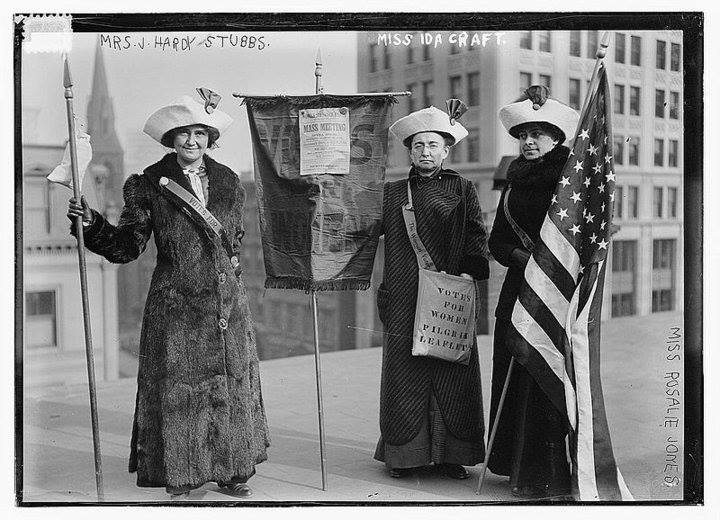
With “General” Jones at the head of the column were second-in-command “Colonel” Ida Craft, loaded down with literature to hand out, “Surgeon-General” Lavinia Dock, “Private” Kate Abbott and her drum, and “Captain” Jessie Belle Hardy Stubbs, Chief Orator and official “War Correspondent” for the groups endorsing the march. Both still and motion-picture cameras were present at the start of the hike at 9:40 and several reporters will be tagging along for the entire route in order to send back daily reports to be published in their newspapers.

From left, Jessie Belle Hardy Stubbs, Ida Craft, and Rosalie Jones.

It was an auspicious start, peppered with pleasant incidents along the way, such as an elderly woman rushing out onto her porch and waving a suffrage banner over her head until the banner caught in a tree, while she shouted “Hurrah! Good Luck! I am with you!”

The New York Police Department provided a mounted escort to the city limits, and after a cordial farewell, they were soon replaced by equally friendly officers from Yonkers, who marched along to Getty Square, where the local suffrage group had arranged the first rally. The Chief of Police, sporting a suffrage button, introduced the Mayor, who gave the cheering crowd a speech that was as supportive of “Votes for Women” as any given by the marchers.

But as enjoyable as their rally and luncheon in Yonkers were, this was also where Inez Craven decided that “Honorable Elizabeth,” the army’s only canine member, wasn’t quite up to the rest of the hike, and the dog was given an early – but honorable – discharge. The drum also gave out, and the drummer soon departed. The ranks, as expected, became considerably depleted after that initial stop, but the scenery along the winding road on this beautiful day kept up the spirits of the true pilgrims.

Darkness was falling by the time the troops reached Irvington, where they will bivouac for the night at local hotels after this long, but worthwhile and encouraging day. Tomorrow it’s off to Ossining!

(Photo: )

Founding Feminists: December 12, 1932

Founding Feminists is FMF’s daily herstory column.

FoundingFeministLogo-color
If you’ve been thinking that women seem to be losing jobs even faster than men since the current Depression began and that women who are still employed are being exploited far more than before, there is now solid evidence to back up that impression.

Mary Anderson, head of the Women’s Bureau of the Department of Labor, today brought out figures from several surveys around the country confirming these suspicions.

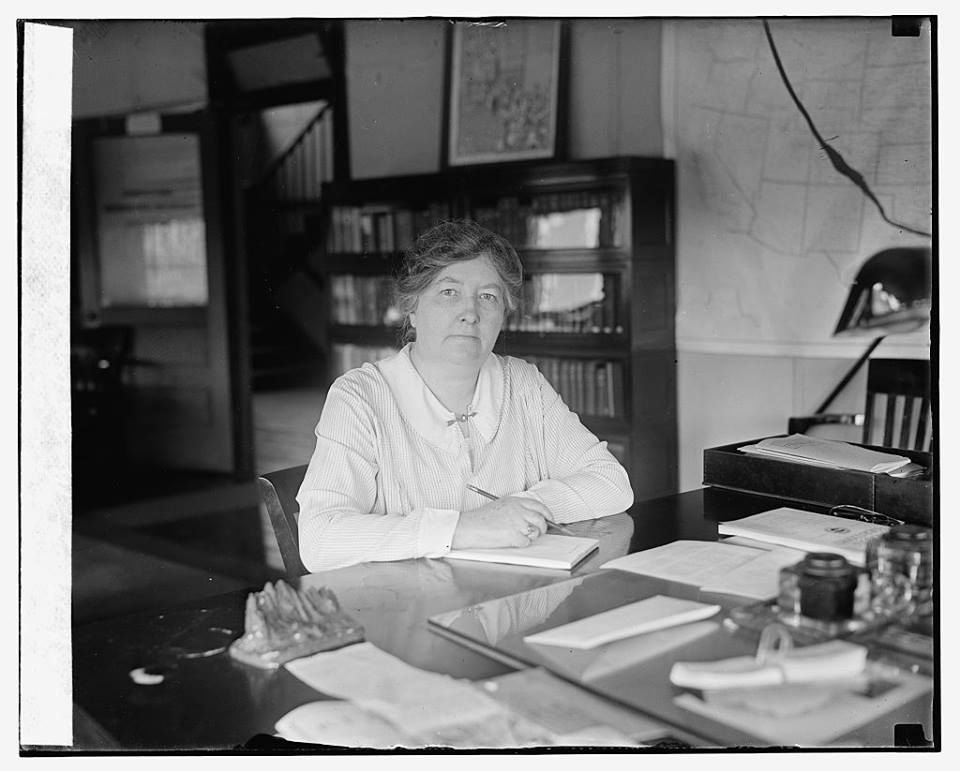
Mary Anderson, the first - and so far only - head of the Women's Bureau, appointed 12 years ago.
Mary Anderson, the first – and so far only – head of the Women’s Bureau, appointed 12 years ago.

In New York and Illinois, employment records show that the number of women who lost jobs was greater than that of men in a large number of industries that employ both men and women, and was also the case in virtually all occupations in which a majority of workers are female. Women in executive or supervisory positions are being hit the hardest.

A survey last year showed that about 20% of women in the country’s 19 largest cities were out of work, and in eight of these cities the percentage was even greater. The overall unemployment rate for the U.S. that year was 16.3%, up from 3.2% in 1929. This year it hit 24.1%. An unemployment census taken in April, 1930, just six months after the current economic downturn began, already showed 668,661 women out of work, 10% of whom were heads of families.

Wage cuts have been a widespread phenomenon during the past three years, and though a New York State survey showed the salary declines for women have actually been slightly less than those for men (21.5% vs. 22.5%), the impact has been much greater, because women were earning substantially less than men to begin with. Interestingly, figures published by the Minimum Wage Board of Ontario show women’s wages in that Canadian Province have declined by only 1.7%.

Just how low some women’s salaries have slipped in the U.S. is shown by a recent survey of 7,800 women in the garment-making industry, made at the request of Connecticut’s Democratic Governor, Wilbur Cross. Many women were paid from $4 to $6 for a 48 to 50 hour week. The wages paid to those who do piecework couldn’t be determined precisely, because no records were kept.

The practice of discriminating against women in general – and married women in particular – in the workforce clearly predates this Depression, but has become more widespread and overt since the current crisis began. The National Woman’s Party has been fighting for the rights of women in the workforce for many years, and is presently trying to repeal Section 213 of the Economy Act of 1932. It states that when reductions in personnel are needed in Federal Government departments, those who have spouses working for the Government should be terminated first.

Though apparently sex-neutral, Section 213 is really a “force-the-wives-to-resign” law. Since men tend to be promoted faster and higher, and therefore earn bigger salaries, if only one Government job is allowed per couple, it’s the wife who will quit. The alleged justification for this policy is to “spread the jobs around” among families, but if that was really the Act’s purpose, the one-job-per-family rule would also apply to fathers and sons, brothers and sisters, and any family members living in the same home, not just to spouses.

In addition to working on specific legislation, the National Woman’s Party has urged President-elect Roosevelt to be the first to appoint a woman to his Cabinet:

The women of America earnestly urge you to include women among those whom you appoint, and urge that these women be truly representative of women – women who believe in equality for men and women, women who are aware that equal and effective co-operation between men and women is a vitally essential principle of representative government.

Whether Roosevelt breaks the precedent of naming only men to Cabinet posts or not, women workers are about to get a strong voice in the White House. Just two weeks ago, soon-to-be First Lady Eleanor Roosevelt made an appeal for assistance to women hurt by the Depression at a benefit in Carnegie Hall sponsored by the Educational Department of the Women’s Trade Union League. Then, after attacking the “blindness of a few people who perhaps do not understand that, after all, the prosperity of the few is on a firmer foundation when it spreads to the many,” she noted:

I feel in the last few weeks a lifting of the spirit of the country, a new sense of hope,” and that “we are going through a time when I believe that we may have, if we will, a new social and economic order.

Hopefully, women will be an integral part of the “new social and economic order,” and the Roosevelt Administration will succeed in ending both the Depression and discrimination against women.

Founding Feminists: December 11, 1921

Founding Feminists is FMF’s daily herstory column.

FoundingFeministLogo-color
The campaign for a 20th Amendment, to assure equal rights for women, is quickly taking shape!

Though ratification of the Susan B. Anthony (nationwide woman suffrage) Amendment 16 months ago marked a major advance for women’s rights, winning the vote can only be a stepping stone on the path to total equality. Today the National Woman’s Party announced a preliminary draft of a measure to transform the ideal of equal rights for men and women into a Constitutional amendment permanently mandating it nationwide.

At the N.W.P.’s national convention in February – the first since ratification of the 19th Amendment was officially certified by the Secretary of State on August 26, 1920 – the delegates demanded “absolute equality” as the party’s new goal. A committee of legal experts was appointed to draw up a preliminary proposal for the wording of a Constitutional amendment to be approved by the organization, then submitted to Congress for passage and then to the States for ratification. The tentative text, announced today, says: “No political, civil or legal disabilities or inequalities on account of sex, or on account of marriage unless applying alike to both sexes, shall exist in the United States or any place subject to their jurisdiction.”

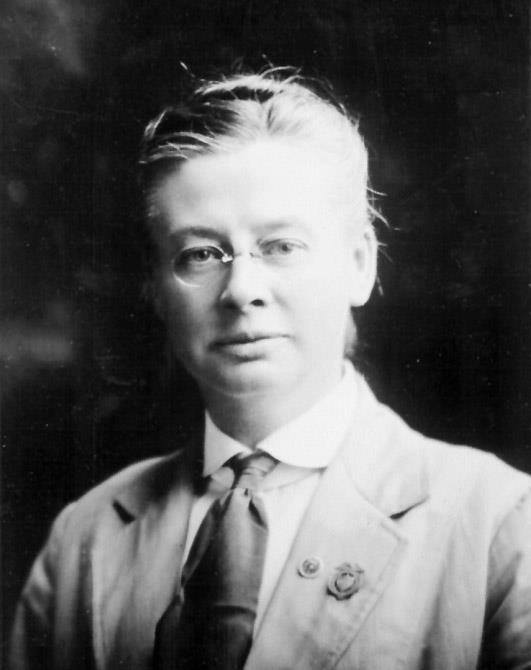
Gail Laughlin
Gail Laughlin

Among the many prestigious members of the committee who came up with the suggested wording are Gail Laughlin, who was a full-time activist with the National American Woman Suffrage Association for many years, and the first president of the National Federation of Business and Professional Women; Shippen Lewis, Secretary of the Legal Education Committee of the American Bar Association; Matthew Hale, former National Chairman of the Progressive (“Bull Moose”) Party, and George Gordon Battle, former Assistant District Attorney for New York.

According to Laughlin: “The amendment to the United States Constitution proposed by the National Woman’s Party asks nothing more for women than equal political, civil and legal rights with men, and certainly women should be satisfied with nothing less.”

George Gordon Battle thinks the time is right for this next, and final, step on the road to equality: “Undoubtedly such an amendment is required by the preponderant force of moral sentiment and by the progressive tendency of the times.”

Though the National Women’s Trade Union League expressed concern that a “blanket equal rights amendment” might endanger so-called “protective” legislation for women, Frank Walsh, former Joint Chairman of the War Labor Board and legal counsel for many labor organizations believes:

The political, civil and legal disabilities and inequalities leveled against woman, on the sole ground of sex, are so great in number, and so deeply engrafted in our legal structure by national and State statutes, as well as by court decisions, that I can see no way of approximating justice as affecting the sexes, except by passage of such as amendment as your organization has proposed. Indeed, without such an amendment, in my opinion, the late amendment guaranteeing women the right of suffrage would become a mere abstraction.

J.D. Wilkinson summed up the reason why this new amendment is the logical companion to the 19th: “The Fifteenth Amendment followed the Fourteenth Amendment, and it was generally conceded that one was the complement of the other. An amendment to the Constitution should follow the Nineteenth Amendment, giving to woman her civil rights as the Nineteenth Amendment gives to her political rights. Indeed, the latter appears the more important of the two.”

The struggle for nationwide woman suffrage, culminating with passage of the 19th Amendment, took 72 years, so the campaign for the 20th Amendment is expected to be a long one as well. The founder of the National Woman’s Party, Alice Paul, may also wish to rewrite the amendment’s somewhat cumbersome language before having it formally introduced in Congress. But the last phase of the battle for equality between men and women has finally begun, and if supporters of this “equal rights” amendment have the same dedication and persistence as those who fought for the 19th, the result should be equally successful.

Founding Feminists: December 10, 1869

Founding Feminists is FMF’s daily herstory column.

FoundingFeministLogo-color

Woman suffrage has returned to America!

For the first time since 1807, when the New Jersey Legislature revoked the right of that State’s unmarried, property-owning women to vote, there is now a part of the United States where a woman – in this case regardless of her marital or economic status – can now legally cast a ballot: The Territory of Wyoming! Established by Congress on July 25th of last year from land that was formerly part of Dakota, Utah and Idaho Territories, Wyoming has now become the first of what will certainly be many more victories in the battle for woman suffrage.

The suffrage bill was introduced into the Territorial Legislature by William H. Bright, a South Pass saloon owner, whose wife, Julia, is an enthusiastic suffragist. The measure was approved in the Council (equivalent to the Senate) 6-2. The House passed it 7-4 with one abstention. Following passage by the all-Democratic legislature, Republican Governor John A. Campbell – who had been quite favorably impressed by a women’s rights convention when growing up in Ohio – signed the bill today, while women kept vigil outside his office until he did so. This landmark legislation reads:

A BILL TO GRANT THE WOMEN OF WYOMING TERRITORY THE RIGHT OF SUFFRAGE, AND TO HOLD OFFICE.

Be it enacted by the Council and House of Representatives of the Territory of Wyoming:

SECTION 1. That every woman of the age of twenty-one years, residing in this territory, may, at every election to be holden under the laws thereof, cast her vote. And her rights to the elective franchise and to hold office shall be the same under the election laws of this territory, as those of electors.

SECTION 2. This act shall take effect and be in force from and after its passage.

Approved, December 10, 1869.

This is truly an exciting time for the suffrage movement, which on July 19th of this year reached full, vigorous maturity at age 21. It has now been fully revived following its temporary suspension during the War. National women’s rights conventions have resumed and been held annually since May 10, 1866. “The Revolution,” launched on January 8, 1868, by Elizabeth Cady Stanton, Susan B. Anthony and Parker Pillsbury, provides a lively nationwide forum for women’s rights supporters. On May 15th of this year, the National Woman Suffrage Association was formed in New York City, and on November 24th and 25th, men and women gathered in Cleveland, Ohio, to form the American Woman Suffrage Association. There has also been some discussion that the recently ratified (July 9, 1868) 14th Amendment could be used as a way of winning nationwide woman suffrage through the courts.

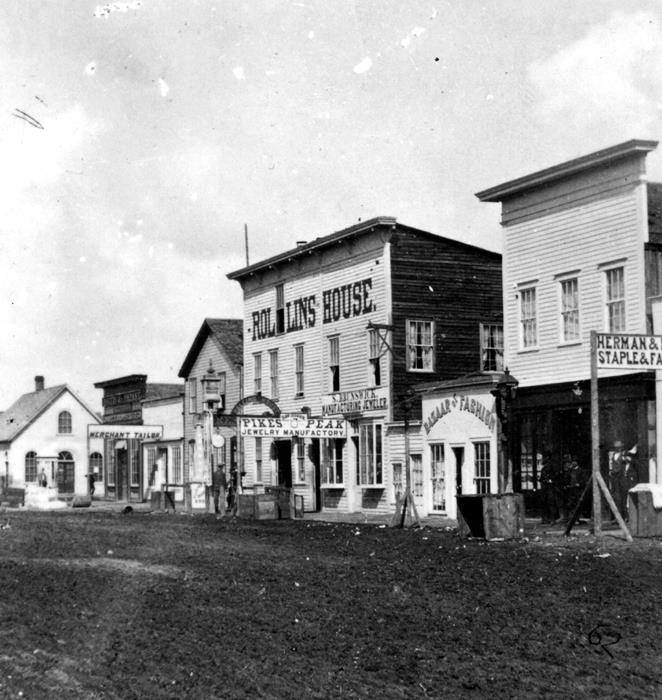
The Rollins House in Cheyenne, where the Wyoming Territorial Legislature meets. It recently approved not only woman suffrage, but equal pay for male and female teachers, and property rights for married women.

Though the first attempt to get a full-fledged State to approve woman suffrage was defeated when the men of Kansas voted against it by a two-to-one margin in a referendum two years ago, today appears to be a turning point in the battle for equal suffrage. The women of Wyoming will soon begin going to the polls to cast votes, and it will become obvious that woman suffrage is no “threat to the family” as opponents claim, but rather a clear gain for society, as well as simple justice for those who have suffered “taxation without representation” and obeyed laws enacted by politicians who have had nothing to fear from voteless women.

Once women standing in line at polling places in Wyoming becomes a commonplace sight, and the Territory’s 9,000 residents begin to reap the benefits that women will bring to politics, “equal suffrage” should spread rapidly to the rest of the Western Territories, then to all 37 States.

Founding Feminists: December 9, 1909

Founding Feminists is FMF’s daily herstory column.

FoundingFeministLogo-color

American suffragist Alice Paul has been freed from London’s Holloway Prison!

Denied “political prisoner” status, she began a hunger strike immediately after her arrival at the jail, and was force-fed twice a day after 11 November. Though quite weak from her ordeal, she said today that she had no regrets, and would engage in such tactics again if necessary.

1426708_10201525636886351_1055060785_nShe was arrested on 9 November for taking part in a suffrage protest at the Lord Mayor’s Banquet in the Guild Hall. Sneaking in hours before the event began, she and another protester, Amelia Brown, disguised themselves as scrubwomen. They spent the morning hiding, one time coming so close to being caught that a constable’s cloak brushed up against Paul in a darkened area where she was crouching to avoid detection. Whenever she ran into someone, she would ask them for directions to the kitchen. Eventually she made her way to the gallery, and when Prime Minister Asquith paused briefly during his speech, she and Brown shouted: “How about votes for women?”

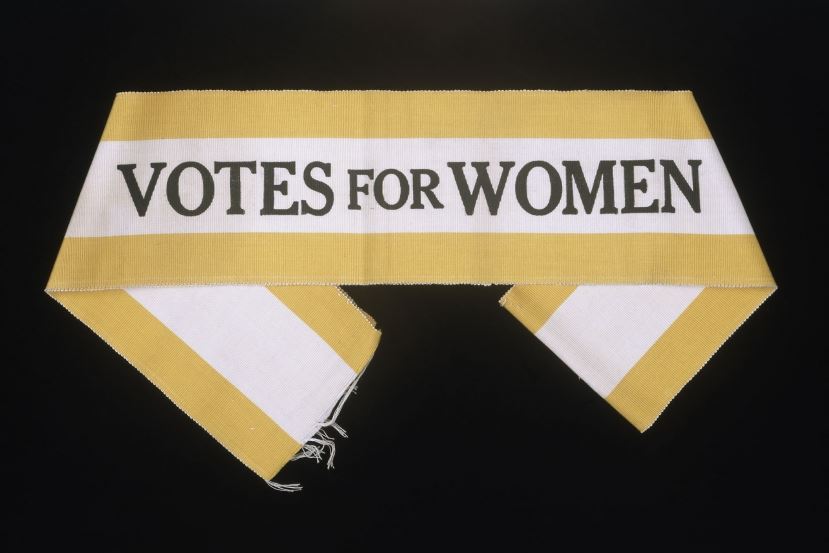
Paul and Brown were quickly arrested, tried, and sentenced to 30 days of hard labour. Both immediately went on hunger strikes. Alice Paul did no work, and resisted everything the authorities tried to do, even refusing to wear prison clothes. Though not yet recovered enough for a long interview, she did send out this statement today through a friend:

I practiced a hunger strike until November 11th. After that date they fed me twice a day by force, except on one day when I was too ill to be touched. I have no complaints against the Holloway officials. I spent the whole time in bed, because I refused to wear prison clothes. Each day I was wrapped in blankets and taken to another cell to be fed, the food being injected through my nostrils.

During this operation the largest wardress in Holloway sat astride my knees, holding my shoulders down to keep me from bending forward. Two other wardresses sat on either side and held my arms. Then a towel was placed around my throat and one doctor from behind forced my head back, while another doctor put a tube in my nostril. When it reached my throat my head was pushed forward.

Twice the tube came through my mouth and I got it between my teeth. My mouth was then pried open with an instrument. Sometimes they tied me to a chair with sheets. Once I managed to get my hands loose and snatched the tube, tearing it with my teeth. I also broke a jug, but I didn’t give in.

Alice Paul originally came to England to do further study, and to gain more experience in social work, but she became attracted to the militant wing of the suffrage movement here through her acquaintance with Emmeline and Christabel Pankhurst. She joined the Women’s Social and Political Union, and has clearly been willing to share the risks and penalties of their militant activities.

When she will return to the United States is unknown, but when she does, she could have quite an impact on the suffrage movement there, presently dominated by the National American Woman Suffrage Association, which endorses only traditional, non-militant methods for achieving the goal of “Votes for Women.”

Founding Feminists: December 6, 1913

Founding Feminists is FMF’s daily herstory column.

FoundingFeministLogo-color

Persistence pays!

After fifty-five National American Woman Suffrage Association convention delegates vowed to stay in Washington, D.C., all Winter if that was what needed to be done in order to meet with President Wilson, he has finally agreed to receive a N.A.W.S.A. deputation at 1 p.m. on the day after tomorrow, at the White House. It will consist of the entire National Board and one representative from each of the 48 States. They will try to get a definite public statement from the President regarding his views on woman suffrage, and hopefully some help in lobbying the Susan B. Anthony Amendment through Congress. It would assure women equal voting rights with men nationwide if then ratified by 36 States. Among the suffragists representing their States will be Jeannette Rankin of Montana, and Katharine Houghton Hepburn of Connecticut.

N.A.W.S.A. Field Secretary Jeannette Rankin, who will represent Montana suffragists at the meeting with President Wilson day after tomorrow.

In another major development, Alice Paul has split from N.A.W.S.A. Earlier today she was given an ultimatum from the National Board: She could either continue to lead N.A.W.S.A.’s Congressional Committee, or her Congressional Union for Woman Suffrage, but not both, as she has been doing. She refused to give up her work with the Congressional Union, and now both she and Lucy Burns will be devoting all their time to the more militant Union and working solely for passage and ratification of the Anthony Amendment.

In other suffrage news, Helen Todd attended a speech by Secretary of State William Jennings Bryan earlier this evening, and after hearing him go on for a while about the virtues of popular government, rose and called out: “And how about popular government for women, Mr. Secretary?” Bryan then replied: “Madam, in your work you doubtless have followed your judgment and conscience. In my work I have followed mine.” He then immediately left the hall.

For those who may be interested in doing suffrage work of a less militant nature, it was announced today that a two-week “suffrage school” will be opened day after tomorrow in the Friends’ Meeting House, 1811 “I” Street, N.W., Washington, D.C. Among those who will be giving expert instruction on how to conduct suffrage work will be Rev. Anna Howard Shaw, newly re-elected President of the National American Woman Suffrage Association.

Though the annual N.A.W.S.A. convention is over, today was certainly as historic as any day of that week-long gathering. The fact that N.A.W.S.A. now has the power to demand – and receive – an audience with the President proves that woman suffrage has joined the ranks of other major movements in the country. And now that Alice Paul and Lucy Burns are totally free to pursue whatever tactics they feel are needed to put the Anthony Amendment in the Constitution, there can be no doubt that the future of the suffrage movement will be different from its past, and that victory is much closer today than it was just yesterday.

Founding Feminists: December 5, 1913

Founding Feminists is FMF’s daily herstory column.

FoundingFeministLogo-color

“We are going to see President Wilson if it takes all Winter.”

That was the statement given out today by the National American Woman Suffrage Association on the final day of its convention in Washington, D.C. After Ruth Hanna McCormick and Madeline McDowell Breckenridge were unable to arrange a meeting with the President yesterday, due to his alleged “illness,” fifty-five suffragists agreed to stay behind after the convention for the purpose of meeting with Wilson and trying to get him to help push the Susan B. Anthony (nationwide woman suffrage) Amendment through a Congress controlled by his own Democratic Party.

Meanwhile, a split in N.A.W.S.A. seems to have been avoided, or at least temporarily postponed. After a meeting in which the discussion became rather heated at times, N.A.W.S.A. President Rev. Anna Howard Shaw announced that Alice Paul, who now heads the Congressional Committee, and Lucy Burns would “remain members” of the committee.

There has been discomfort among some of the more conservative N.A.W.S.A. officers over Alice Paul’s simultaneous leadership of both N.A.W.S.A.’s Congressional Committee and Paul’s own more militant Congressional Union for Woman Suffrage. One major issue is the fact that though the two groups are totally separate, this is not always clear in the public mind. But “while no committee has been appointed, it is certain that Miss Alice Paul and Miss Lucy Burns will remain on the Congressional Committee,” said Shaw today. Skepticism about whether this will actually happen when the new committee is appointed runs high, however, due to irreconcilable differences between the conservative and the more militant factions of N.A.W.S.A. over authority, strategy, tactics and funds. Conditions for their continued work on the committee may also be attached that Paul and Burns may find unacceptable.

But for today, at least, there were some cheers for Alice Paul when she gave her report about the Congressional Committee’s activities. It began work on January 2nd, with the opening of its headquarters in Washington, D.C., at 1420 “F” Street, N.W. Paul’s first task was to organize a huge suffrage parade and pageant for March 3rd, the day before President Wilson’s inauguration. She succeeded beyond anyone’s expectations. The bravery of the marchers – who despite encountering a rowdy, disruptive mob and having virtually no protection from the D.C. police still managed to finish the parade – is now legendary. The committee then went on to do even more public events, the largest of which involved twelve separate automobile “pilgrimages” by suffragists around the nation, all converging on Washington, D.C., then embarking on a procession through the city ending with the presentation of suffrage petitions containing about 200,000 signatures to the Senate on July 31st.

A salaried organizer worked in several States, and a full-time press person kept the issue of suffrage before the public with a steady barrage of press releases. One hundred and twenty thousand pieces of literature were printed up and distributed during the year, and a “Men’s League” to help the suffrage cause has also been organized.

1489259_10201498407605636_2091502758_n

The committee put on eight well-attended theater meetings in D.C. during the year, and some form of suffrage rally took place nearly every day, with between five and ten on some days. This heavy pace of activity obviously costs money, and all applauded Alice Paul’s ability to raise $25,000 for these efforts, $21,000 from the D.C. area and the rest from Philadelphia.

Though President Wilson is apparently avoiding suffragists, three of his Cabinet members were seen at a reception given today by Belle Case LaFollette, in honor of the officers of N.A.W.S.A. Three hundred of the convention’s delegates also attended. Back in the convention hall, Rev. Shaw made the organization’s opposition to “militancy” in any form clear. She especially wanted to address an out-of-context quote from her annual address that has been widely reported, and caused much controversy in the press.

In her address, Shaw quoted a statement made by Susan B. Anthony that: “There are two methods of warfare, the civilized and the barbarian. The hatchet is the weapon of barbarism, the ballot the weapon of civilization. If they continue to deny to women the weapon of civilization, they need not wonder if she resorts to that of barbarism.” Shaw then reminded everyone that she had followed that quote with: “This organization, however, is going to win with the weapon of civilization” and therefore would continue its traditional, moderate approach.

The convention, like so many other events this year, has been a huge success. Being around so many committed suffrage advocates from all around the country for a full week has certainly revitalized everyone, and though there are battles ahead both within the organization over tactics and strategy as well as against a well-funded anti-suffrage movement, everyone is looking forward to 1914 being yet another year of spectacular progress for equal suffrage.

Founding Feminists: December 4, 1913

Founding Feminists is FMF’s daily herstory column.

FoundingFeministLogo-color

Unusually strong words at the National American Woman Suffrage Association’s convention today.

In a speech to the delegates, Carrie Chapman Catt, president of N.A.W.S.A. from 1900 to 1904, declared that women demanded the vote nationwide without delay, and added that “if the Constitution stands in our way, let’s tear it up and make a new one!”

Irritation with President Wilson for neglecting to even mention woman suffrage in his message to Congress day before yesterday has increased. Today he failed to meet with convention representatives Ruth Hanna McCormick and Madeleine McDowell Breckinridge, supposedly due to “illness.” As Connecticut suffragist Katharine Houghton Hepburn noted, if he “had been brought up by an enfranchised mother, he would know more of the needs of Democracy.” Hepburn later vigorously attacked the still-widespread practice of trafficking women for prostitution:

Here in Washington at this very moment, girls are being bought and sold. The President knows it. The District Commissioners know it. The police know it. It is only the secret caucus of the House of Representatives which has prevented the Kenyon “Red Light” Bill from becoming law. I hope that the convention will adopt a resolution which will result in bringing this bill upon the floor of the House, having it debated, and passed. It will in great measure prevent the traffic in vice which is being carried on openly and with official sanction in the National Capital.

Hepburn’s resolution was immediately passed.

Carrie Chapman Catt
Carrie Chapman Catt

Rev. Anna Howard Shaw, N.A.W.S.A. president since 1904, was re-elected, with Jane Addams as First Vice President, an office she has held since 1911. They have a tough job ahead of them, but have now succeeded in revising the group’s constitution to help fund their more expansive – and expensive – efforts. After lengthy and vigorous discussions, the delegates mandated that each year all affiliated chapters must now send N.A.W.S.A.’s national headquarters the equivalent of 5% of their annual expenditures, and that representation in the national organization will be proportional to the amount of money each chapter contributes to the national office, and not to the number of members it has.

Tensions between the “militants” and the more conservative members of the nation’s largest suffrage organization are clearly growing. As one example of this conflict, Alva Belmont tried to introduce a resolution today to move the national headquarters from New York City to Washington, D.C., where “militant” Alice Paul’s N.A.W.S.A. Congressional Committee as well as her Congressional Union for Woman Suffrage are concentrating solely on getting a Constitutional amendment enfranchising women passed by Congress. The “militants” also favor the use of more aggressive tactics to accomplish this goal. But Belmont’s attempt to move N.A.W.S.A. to D.C. failed, as most of the officers and delegates still appear to favor putting the primary focus on a more conservative “State-by-State” approach and using traditional methods of lobbying.

The growing split in N.A.W.S.A. could either hinder the cause through infighting, or reinvigorate it if the “militants” leave N.A.W.S.A. and go their own way, so the next year is shaping up as critical one for the “Votes for Women” movement.

Founding Feminists: December 2, 1913

Founding Feminists is FMF’s daily herstory column.

FoundingFeministLogo-color

The treatment of women by the criminal justice system was denounced today by Louise De Koven Bowen on the fourth day of the National American Woman Suffrage Association’s week-long annual convention.

Louise De Koven Bowen

A close friend of Jane Addams, and Treasurer of Hull House, in Chicago, Bowen pointed out a lack of women police officers and women jurors, then called for reform of the courts and prisons to help women and children caught up in the system:

From the time of the arrest of a woman to the final disposition of her case she is handicapped by being in charge of and surrounded by men, who naturally cannot be expected to be as sympathetic and understanding as one of her own sex.

In the police station she is at a disadvantage, for such places of detention in most of our large cities are not fit for human habitation. When she appears for her preliminary hearing she is tousled and untidy as a result of being without proper toilet accommodations, and is therefore apt to create an unfavorable impression. In all police stations separate rooms or cells should be provided with plenty of light and air and sleeping and toilet accommodations for the women.

(Women cannot serve on juries in Illinois, and although Chicago has had a female police officer – Marie Owens – since 1891, and 10 more were sworn in earlier this year, this is hardly a sufficient presence in a force of 4,000 officers. The rest of the criminal “justice” system is similarly male-dominated.)

Hopes for a spirit of friendly cooperation between the National American Woman Suffrage Association and President Wilson have suffered a major setback. N.A.W.S.A. President Rev. Anna Howard Shaw expressed the indignation felt by all convention delegates when she denounced the President for ignoring woman suffrage in his message to Congress today:

President Wilson referred in his message to the fact that the time had come for an extension of greater social justice, and we women eagerly listened to this. We had hoped that social justice would include some measure of political justice to the women of the country. I feel fully that measure of disappointment which under the circumstances is natural, for the time had come for the President to say a word in our behalf.

No other President has ever had such an opportunity. President Wilson had the opportunity of speaking a word which might ultimately lead to the enfranchisement of a large part of the human family.

I feel that I must make this statement as broad as it is for the reason that we at Budapest last year realized that womankind throughout the world looked to the United States to blaze the way for the extension of universal suffrage in every quarter of this great globe. President Wilson has missed the one thing that might have made it possible for him never to have been forgotten. I am saying this on behalf of myself and my fellow officers.

After enthusiastic applause, the convention adopted this resolution by acclimation: “That it is the sense of this meeting that President Wilson failed to rise to the sublimest of heights of democracy when he failed in his message to Congress today to recommend the freedom of half the citizens of the civilized world.”

Though it had been hoped the new President would be sufficiently astute to jump on the suffrage bandwagon now that the campaign has become so much more of a political force than it was just a few years ago, efforts to get him to enthusiastically support the cause will go on. But with or without his support, the feeling at the convention is that the final phase of the campaign has already begun, and will end with the Susan B. Anthony (nationwide woman suffrage) Amendment in the Constitution before many more years pass.

Founding Feminists: November 26, 1917

Founding Feminists is FMF’s daily herstory column.

FoundingFeministLogo-color

There seems to be some serious negotiating going on behind the scenes, even though there were no official announcements or outward signs of activity at Washington, D.C.’s District Jail today, where the suffrage prisoners are being held.

In fact, though Alice Paul has refused food since November 5th, and been force-fed three times a day since the 8th, it appears to be the Wilson Administration that’s in a rapidly weakening condition and eager to find a compromise. President Wilson may even be ready to give in to Paul’s non-negotiable demand that he endorse and work for passage of the Susan B. Anthony (nationwide woman suffrage) Amendment.

There are reports circulating late tonight that David Lawrence, a well-known journalist with close and friendly ties to the Administration, was granted a private, nighttime jailhouse visit with the usually isolated Alice Paul, leader of the “Silent Sentinels” who picket for suffrage by standing along the White House fence holding huge banners.

Lawrence is said to have addressed the issue of “political prisoner” status first, since denial of that status was the original reason for the hunger strike that currently involves at least 19 suffragists:

The Administration could very easily hire a comfortable house in Washington and detain you all there, but don’t you see that your demand to be treated as ‘political prisoners’ is infinitely more difficult to grant than to give you a Federal suffrage amendment? If we give you these privileges we shall have to extend them to conscientious objectors and to all prisoners now confined for political opinions. This the Administration cannot do.

1456696_10201438252581798_1348574917_nThough the conversation started out like just another futile attempt to get Alice Paul to give in, the tone soon changed, due to the fact that public sympathy has recently begun turning in favor of the “Silent Sentinel” White House pickets now that their ordeals in Occoquan Workhouse and the District Jail have become widely known. Faced with the prospect of being blamed for so many women either staving themselves to death or undergoing the torture of force-feeding, the Administration seems to have offered a compromise that came close to a surrender on their part. Lawrence is said to have asked Paul: “Suppose the Administration should pass the amendment through one house of Congress next session and go to the country in the 1918 elections on that record, and if sustained in it, pass it through the other house a year from now. Would you then agree to abandon picketing?”
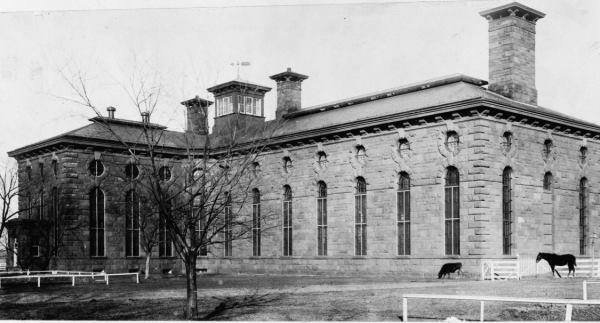
Never willing to compromise, and not about to throw away her trump card by promising that the National Woman’s Party will discontinue picketing, Alice Paul is said to have answered: “Nothing short of passage of the amendment through Congress will end our agitation.” The rest of the hunger strikers appear equally resolute, and willing to face the consequences of continued starvation – or force-feeding. That form of legalized torture has already been imposed on Rose Winslow, Lucy Burns, Dora Lewis and Kate Heffelfinger in addition to Alice Paul.

So, we may soon see whether the Wilson Administration will finally give up trying to stop the “Silent Sentinels” by imprisoning these peaceful pickets and inflicting force-feeding on those who protest their unjust treatment by refusing food. Should he switch to performing acts of good faith that will prove he is as sincere about bringing democracy to the women of his own country as he is about bringing it to the rest of the world, then – and only then – will he no longer see pickets bearing banners with quotes from his own speeches praising the fundamental right of people to elect their own leaders, or asking, “MR. PRESIDENT, HOW LONG MUST WOMEN WAIT FOR LIBERTY?” and “MR. PRESIDENT, WHAT WILL YOU DO FOR WOMAN SUFFRAGE?”

Founding Feminists: November 25, 1917

Founding Feminists is FMF’s daily herstory column.

FoundingFeministLogo-color

The struggle of the imprisoned suffragists continues today in D.C.’s Washington Asylum and Jail, commonly referred to as the “District Jail.” But now, instead of just a relatively small number of suffrage prisoners in his custody, Warden Zinkham must now deal with several dozen suffrage prisoners, nineteen of whom are hunger strikers. This is because U.S. District Court Judge Edmund Waddill ruled yesterday that all of those sent to serve their sentences in the infamous Occoquan Workhouse had been transferred there illegally.

Three of those in Occoquan, who were in such poor condition that they would not likely serve further confinement in any institution, were released on parole while their cases were appealed. The rest were sent to the District Jail, where half of them continue to refuse all food. Five of those already there have been subject to force-feedings, with Alice Paul and Rose Winslow having undergone the procedure three times a day since November 8th.

Though there is no direct communication allowed between the outside and any of the suffrage prisoners, details of their ordeals are now becoming known to the public thanks to notes smuggled out of Occoquan and the District Jail, or passed while they were brought to court for a hearing yesterday and the day before.

The reasons for the transfer of Lucy Burns and Dora Lewis from Occoquan to the District Jail several days ago have always been clear. They were “ringleaders” of the rebellion and hunger strike at the Workhouse, and in danger of death from starvation, so Superintendent Whittaker had two good reasons for wanting them transferred out. What wasn’t known publicly until now were the graphic details of the force-feedings. According to notes written on tiny scraps of paper by Lucy Burns, and made public by the National Woman’s Party:

WEDNESDAY, 12m. Yesterday afternoon at about four or five, Mrs. Lewis and I were asked to go to the operating room. Went there and found our clothes. Told we were to go to Washington. No reason as usual. When we were dressed, Dr. Gannon appeared, and said he wished to examine us. Both refused. Were dragged through halls by force, our clothing partly removed by force, and we were examined, heart tested, blood pressure and pulse taken. Of course such data was of no value after such a struggle.

Dr. Gannon told me then I must be fed. Was stretched on bed, two doctors, matron and four prisoners present, Whittaker in hall. I was held down by five people at legs, arms, and head. I refused to open mouth. Gannon pushed tube up left nostril. I turned and twisted my head all I could, but he managed to push it up. It hurts nose and throat very much and makes nose bleed freely. Tube drawn out covered with blood. Operation leaves one very sick. Food dumped directly into stomach feels like ball of lead. Left nostril, throat and muscles of neck very sore all night. After this I was brought into the hospital in an ambulance. Mrs. Lewis and I placed in same room. Slept hardly at all.

A secret diary kept by Elizabeth McShane in Occoquan has also come into the hands of the National Woman’s Party, and says in part: “Now eight days on a hunger strike. Very weak and ill. Fainted yesterday afternoon in cell. Forcibly fed some hours later. Food poured into a vomiting stomach. Left in cell all night unattended. Fainted and was found at five o’clock on the stone floor.”

The Washington Asylum And Jail, usually called the "District Jail"
The Washington Asylum And Jail, usually called the “District Jail”

Members of the National Woman’s Party are engaging in “militant” tactics such as holding up large banners near the White House gates to highlight the hypocrisy of President Wilson vigorously promoting democracy around the world while refusing to endorse or work for the Susan B. Anthony (nationwide woman suffrage) Amendment, which would bring democracy to the women of his own country. These “Silent Sentinels” are being arrested on false charges of “blocking traffic” on the wide Pennsylvania Avenue sidewalk, and given lengthy sentences more appropriate to violent crimes.

The campaign for political equality continues by conventional means as well. Carrie Chapman Catt and other high-ranking officers of the National American Woman Suffrage Association are now arriving in Washington, D.C., preparing to launch a new campaign to get Congress to pass the Anthony Amendment.

Having gone through what they already have, the iron will of the imprisoned suffragists has been proven beyond any doubt, so now the only question is how long the prison authorities – and the Wilson Administration – will allow this battle to go on, and how much suffering they are determined to inflict on those who peacefully picket for something so basic to democracy as the right to vote.

Founding Feminists: November 22, 1917

Founding Feminists is the FMF’s daily herstory column.

FoundingFeministLogo-colorTwo major developments today regarding the suffragists imprisoned in Occoquan Workhouse.

The most encouraging action was a statement from the Department of Justice: it will conduct an official investigation into the atrocious conditions and acts of brutality inflicted on the “Silent Sentinels” serving time in Occoquan for peacefully picketing President Wilson along the White House fence as a way of prodding him into supporting the Susan B. Anthony (nationwide woman suffrage) Amendment.

In another positive development, Rep. George B. Francis, Republican of New York, made an official demand to District of Columbia Commissioner William Gwynn Gardiner that Superintendent Whittaker be removed from his position at the Workhouse due to his mistreatment of the prisoners in his charge. Rep. Francis made an inspection of the prison, and says that authorities were far from cooperative in helping him determine conditions there, but that: “What guarded information I could obtain from the pickets leads me to believe that they received inexcusable rough treatment.”

Despite the fact that Lucy Burns and Dora Lewis, leaders of the week-old hunger strike at Occoquan, have been transferred to D.C.’s District Jail, the remaining strikers remain as committed as ever. With a hearing about the legality of confining the “Silent Sentinel” pickets there in the first place, as well as about the well-founded allegations of brutality toward them scheduled for tomorrow in U.S. District Court, Superintendent Whittaker has suddenly switched tactics. Instead of threatening the suffrage prisoners with force-feeding to get them to break their fast, he offered them fried chicken and other tempting treats today. All food was refused, and the hunger strike begun after the “Night of Terror” at Occoquan continues.

Lucy Burns
Lucy Burns

Though Workhouse authorities are temporarily on their best behavior a day before being grilled in court about the prison’s shortcomings, and the abuses of the women in their custody, nothing has improved at D.C.’s District Jail. Alice Paul and Rose Winslow are enduring their 15th day of three-times daily force-feeding there. Kate Heffelfinger has been getting the same treatment since she was moved to the hospital ward day before yesterday. Lucy Burns and Dora Lewis arrived from Occoquan two days ago, and all five continue to be force-fed in Warden Zinkham’s District Jail. Lucy Burns has been resisting more than any of the others, and therefore is suffering the most. Instead of her feeding tube being inserted through the mouth and then down the throat, hers is inserted through the nose, and there are reports circulating at National Woman’s Party headquarters tonight that the sounds of great struggles are heard by other prisoners every time she undergoes this ordeal.

Elsewhere, the New York State Woman Suffrage Party wound up its convention in New York City today, and managed to get through their final controversies with good feelings and enthusiasm for the cause intact. The first resolution debated today was one which said: “In view of the likelihood of the immediate submission of the Federal amendment to the State Legislatures for ratification, we should campaign against the nomination or election of any candidates for the New York State Legislature, and campaign against candidates for Congress, who will not agree to indorse the Federal amendment, providing the Federal amendment has not passed before the next Congressional election which takes place in 1918.”

But Mary Garrett Hay noticed that something was missing from the resolution, and to great applause, she said: “I move we amend that by adding: ‘but we wish it understood that we do not put loyalty to the Federal amendment before loyalty to our country.’ ” Though some felt this was dignifying the charges by opponents that suffragists are less patriotic than anti-suffragists by answering the accusations, the motion passed overwhelmingly, and candidates will be judged on both their stand on suffrage and their support for our war effort.

A resolution introduced by Harriet May Mills sought to change the name of the group to the “New York State League of Women Citizens” now that the fight for suffrage has been won in the Empire State. After a lengthy debate, the proposal was rejected. One final controversy was averted. There is a vote coming up this Spring in Rochester on a local prohibition measure, and a delegate who had been approached by a leader of the local anti-saloon league asked the convention to endorse the proposal. Regardless of what their personal feelings may have been on the issue, no one seemed eager for the Party to take a stand on the measure because the “antis” are constantly trying to hurt suffrage by linking it with this controversial issue. But Hay came to the rescue and suggested that the matter be referred to the Executive Board for a decision at some time in the future.

The convention adopted the following as a Declaration of Principles, as offered by Alice Duer Miller:

That with the increase in power that comes to us with the ballot, we render our pledges of loyalty and service to our country.

The decision of the voters on November 6, having settled the question of woman suffrage in New York State, and all women are now enfranchised citizens and must meet those new duties and obligations, and though the suffrage party is throwing the force of its organization behind the Federal amendment, its purpose otherwise is to develop a plan of education in order to assist in fitting all women for citizenship.

That to all those women who desire to serve their Government effectively, who wish to know and then act, so that the injustices and difficulties under which many of the citizens of the State live and labor may be abolished, we, the Woman Suffrage Party, extend a hearty welcome.

That we express our gratitude to the voters of New York State for having recorded their belief in complete democracy.

That we express our especial gratitude to the President of the United States for his generous and effective assistance; to the Governor of the State for his long continued support, and to all organizations and individuals who have helped us to win the privileges of full citizenship.

Tomorrow a hearing for the suffragists imprisoned in Occoquan begins in Judge Edmund Waddill’s court, and since he has ordered that they be brought to the courtroom, it means that for the first time in over a week, we will be able to see them for ourselves, objectively judge their condition, and hear their personal testimony, rather than rely on smuggled notes and hearsay. Some very compelling stories may be about to be told, and anyone who doubts the devotion to the cause of those who believe in “Votes for Women” will be unlikely to retain those doubts for much longer.

Founding Feminists: November 21, 1917

Founding Feminists is FMF’s daily herstory column.

FoundingFeministLogo-color

The number of suffragists being subjected to the ordeal of force-feeding has suddenly increased from two to five.

Lucy Burns and Dora Lewis, leaders of the hunger strikers at Occoquan Workhouse were transferred out yesterday, and sent to join Alice Paul and Rose Winslow in the hospital ward of the D.C. District Jail, where the two are in their fourteenth day of force-feedings. Kate Heffelfinger, shown in the photo, has also joined the ranks of those singled out for this form of legalized torture. According to a statement given out by the National Woman’s Party tonight:

Fearing their death in Occoquan, Superintendent Whittaker last night moved Mrs. Lawrence Lewis of Philadelphia and Miss Lucy Burns of Brooklyn to the Government jail in Washington. Miss Burns was force-fed at Occoquan before leaving. Her struggles were heard by the prisoners in the next cells, who describe them as terrifying. It required five guards to hold her during the feeding. Mrs. Lewis was fed after her arrival at the jail.

Kate Heffelfinger, who has been on a hunger strike at the District Jail for over a week, was taken to the hospital ward last night and is now undergoing the ordeal as well. A note she wrote today has been smuggled out and says:

Three times a day for fourteen days Alice Paul and Rose Winslow have been going through the torture of forcible feeding. I now know what the torture is – the horrible gripping and gagging of swallowing six inches of stiff rubber tubing. Such a strain on the nervous system is not to be imagined. That over, there is the ordeal of waiting while liquids are poured through, then the withdrawal of the tube.

Art student and imprisoned suffragist Kate Heffelfinger of Shamokin, Pennsylvania. She is currently serving sentences totaling seven months for standing along the White House fence with a banner in support of woman suffrage, and critical of President Wilson's insufficient efforts for the cause.
Art student and imprisoned suffragist Kate Heffelfinger of Shamokin, Pennsylvania. She is currently serving sentences totaling seven months for standing along the White House fence with a banner in support of woman suffrage, and critical of President Wilson’s insufficient efforts for the cause.

In other suffrage news, the New York State Woman Suffrage Party met for the second day of its convention. The first order of business was to clear up a misunderstanding in regard to one proposal that caused a great deal of controversy and generated much publicity yesterday. The “repraisal plank,” as presented to the convention – and the press – appeared to be aimed at taking revenge upon any legislator who had previously opposed suffrage, and was, as Mary Garrett Hay described it, “narrow, vindictive and vengeful.” The resolution as read, said: “At the next primaries and election we should campaign against certain candidates to State and Federal offices who have consistently opposed woman suffrage and whose records show them to have been opposed to the interests of women and children and to humanitarian legislation in general.”

At the board meeting where the resolution was discussed, the words “who have consistently opposed woman suffrage” were struck out before passage, but the W.S.P.’s Secretary had inadvertently left them in when she read the proposal to the delegates. Vera Whitehouse, the organization’s president, said: “The resolution, as passed, did not contain any such clause, although as presented it did. The error was with our press department and the Party does not wish to go on record before the public as determined to carry on any such campaign.”

As to how the W.S.P.intends to accomplish its goal of helping bring about nationwide woman suffrage, a number of officers said that they will try, in a friendly, reasonable way, to convert those who are opposed or uncommitted to the Susan B. Anthony (nationwide woman suffrage) Amendment. But a companion resolution, which would make support for the amendment the only consideration upon which women voters should judge a candidate, may prove almost as controversial as the “repraisal plank.” Some delegates have noted that a candidate could favor the Anthony Amendment but be regressive on other issues regarding women, or less than totally supportive of our nation’s war effort. So, this resolution will be discussed at length as well, and possibly amended.

A much less controversial resolution, expected to pass easily, would redefine the purpose of the organization now that winning the vote in New York State has been accomplished: “The objects of this organization shall be to secure equal franchise rights to the women of the United States; to collect and disseminate information upon political and social problems, and to undertake such activities as will further humanitarian legislation, benefit moral conditions, and especially protect the interests of women and children.”

Though obviously not as militant as the National Woman’s Party, organizations such as the W.S.P. and the National American Woman Suffrage Association still have huge numbers of members, do massive amounts of work promoting the cause, and have great influence and prestige. The recent winning of the vote in New York, the nation’s most populous State, provides ample proof that such groups can achieve meaningful accomplishments.

But winning nationwide victory will clearly require the aggressive tactics and personal sacrifices of National Woman’s Party militants as well. Though our greatest concern and praise should be for the imprisoned “Silent Sentinel” suffrage pickets, we should also express our support for those who use traditional methods of promoting the suffrage cause. Every pro-suffrage organization helps in its own way to bring the day nearer when “Votes for Women” will be transformed from a slogan on buttons, pennants and banners into a guarantee written into our Constitution.

Founding Feminists: November 20, 1917

Founding Feminists is FMF’s daily herstory column.

FoundingFeministLogo-color

No word from – or about – the suffragists being held in Virginia’s Occoquan Workhouse and D.C.’s District Jail today, but plenty of action on the suffrage front, some on their behalf.

Thirty members of the National Woman’s Party called on one of New York’s Members of Congress, Democrat John F. Carew. They lobbied him in support of the Susan B. Anthony (nationwide woman suffrage) Amendment, and also asked him to use his influence to improve prison conditions for their comrades, who have been repeatedly arrested and jailed for displaying pro-suffrage banners along the White House fence. Carew represents the Congressional District in which Eunice Dana Brannan, now serving 60 days in Occoquan, lives. The delegation was headed by former suffrage prisoner Elizabeth Selden Rogers, and included others who had gone to jail for the cause, such as Helena Hill Weed, and Maude Malone.

Rogers opened the conversation by asking Carew to pressure the President into putting a call for passage of the Anthony Amendment into his next message to Congress, and to try to better the conditions in the Workhouse where his constituent is serving her sentence. But Carew was unswayed: “I have never voted for that amendment and I am not going to change my position now,” he replied. Persistent as always, Rogers asked: “Do you want us to come and visit you every day?” Apparently he did not, and then said:

If you want me to give you a decided answer now, I will tell you I will not vote for it. I have a great deal of respect for you ladies. I have a wife and three daughters and two sons, and I love my wife and daughters best. If I thought proper I would do as you wish. I have voted against the amendment every time I have had the opportunity. The only reason that might make me change my mind is the stand New York has taken.

Though the delegation was unable to get a commitment of support for anything they came for, the fact that Rep. Carew seems to recognize the significance of New York State’s (male) voters recently enfranchising the women of the nation’s most populous State by approving a woman suffrage referendum, was reassuring. It is an indication that the victory on November 6th was just as significant as leading suffragists have said that it was, and opposition to the Anthony Amendment may be crumbling, especially among those who must now, for the first time, face women voters at every future election.

1477757_10201377437181451_1579826802_n

That win at the polls two weeks ago was celebrated tonight at the Metropolitan Opera House, where “Victory Night” ended the first day’s session of the New York State Woman Suffrage Party’s convention at the Ritz-Carlton in New York City. The list of those who officiated at the celebration offered clear proof of how much support suffrage now enjoys, with Charles Whitman, the present Governor of New York, and former President Theodore Roosevelt sharing the hosting duties with Vera Boarman Whitehouse. Rev. Anna Howard Shaw, head of the National American Woman Suffrage Association from 1904 to 1915, got numerous ovations as she recounted her 40 years of work toward winning enfranchisement, and called for a pilgrimage to Congress to finish the job.

Col. Roosevelt was also vigorously applauded when he said:

Tonight I wish in greeting you first to exchange congratulations with you, and above all with Dr. Shaw, upon the stand that New York State has now taken. Next I wish to say that we now have a right to expect that the United States as a whole will follow New York’s example, and therefore pass the Constitutional amendment at Washington. Third, and what is most important, I wish to speak through you to the women of New York about the heavy responsibilities that are now theirs. Hitherto my appeal has been that you should be given a right to which, in my judgment, you were entitled. Now you have been given this right. Now my appeal is not for you. Now I must earnestly and solemnly ask that you will well and faithfully perform the duty which the giving of the right entails…

The women and men in this country more than in any other great country of the world now stand on a near equality of right and justice, shoulder to shoulder, side by side, mother and son, husband and wife, brother and sister, lover and sweetheart. Thus standing, you and I, friends, we must face every risk and endure every hardship, until we have won the great fight for justice, wherein we have taken our place alongside all the justly acting and liberty loving nations of mankind.

The issue of the “Silent Sentinel” White House pickets was brought up at the New York Woman Suffrage Party’s convention today, but unfortunately it was in the form of a proposed resolution condemning the National Woman’s Party’s picketing of President Wilson. But another resolution introduced suggests the delegates are considering their own form of militance. They may pledge to stay out of the established political parties and reorganize the Party along Congressional District lines so they can most effectively organize women voters to defeat every member of Congress or State legislator who has opposed suffrage.

Meanwhile, in Washington, the use of seven Marines to guard the grounds around Occoquan Workhouse in order to keep supporters too far away to communicate with the suffrage prisoners by mutual shouting, or allow anyone to sneak in and have notes from the prisoners thrown to them, is being protested. A delegation of suffragists called on Navy Secretary Daniels today, and he said that if the report was true, the guards would be withdrawn. The Commandant of the Marines said he had no knowledge of any of his men being detailed to such duty, but Katherine Morey reported that they were there when she tried to visit her mother recently at the Workhouse.

Legal actions on behalf of the suffrage prisoners continue, and a hearing is scheduled for later in the week before Federal Judge Edmund Waddill in Alexandria, Virginia. The White House pickets will be brought out of Occoquan Workhouse and be able to freely testify in open court about their ordeals. Authorities will first be asked why the women whose “offense” of allegedly “blocking traffic” on the wide Pennsylvania Avenue sidewalk in the District of Columbia are being confined in Virginia, instead of at the District jail. Then, those in charge of the Workhouse will be compelled to explain why there was so much brutality inflicted upon the prisoners the evening they arrived, and justify the unusually harsh restrictions imposed on these suffragists in the days since that initial “Night of Terror.”

>