Today in 1915: NYC Suffrage Parade Expected to Include 45K+ Supporters

Founding Feminists is the FMF’s daily herstory column.

FoundingFeministLogo-color

October 22, 1915: The rapidly rising tide of support for woman suffrage will make tomorrow’s parade down New York’s Fifth Avenue even more spectacular than any before it if most of the 47,230 people who have signed pledges to march take part.

That stunning number was released today by organizers, and it means that the incredible growth of suffrage parades continues.

On February 16, 1908, it was big news when about two dozen members of the Progressive Woman Suffrage Union defied propriety – and police – by marching down Broadway in the city’s first unofficial suffrage parade. Two years later, Harriot Stanton Blatch, head of what was then called the Equality League of Self-Supporting Women, called for another march, despite the opposition of conservative suffragists who warned that such a spectacle would “set suffrage back 50 years.” This time 400 women, carrying numerous banners, were applauded by several thousand spectators.

The 1910 event generated such huge amounts of favorable publicity that it was decided to have such a march every year, and soon even those who had been the most skeptical in the beginning were now taking part. In 1911, four thousand marched, and then the number increased to somewhere between fifteen and twenty thousand in 1912. A 1913 march in Washington, D.C., was a true milestone event (even if repeatedly disrupted by rowdy crowds) and in New York, thirty thousand marched down Fifth Avenue that year.

By last year, there were coordinated marches all across the country, with the total number of participants as uncountable as the newspaper and magazine articles generated.

But while big suffrage parades have now become a tradition, there has never been anything quite like this, and there will be non-stop activity at all the suffrage groups’ headquarters until sometime tomorrow night when the last marcher finishes the route. It’s not just a matter of getting a lot of people to walk down a street. What’s hard is to get them to march in an occupational, organizational or geographic group, and in many cases in a costume symbolizing it. There are also large banners still being made, floats being decorated, bands rehearsing, and automobiles being tuned.

Of course, one dignitary who won’t be riding in an automobile will be 68-year-old Rev. Anna Howard Shaw, head of the National American Woman Suffrage Association. She insists on walking the entire length of the route, and N.A.W.S.A. will be providing a band to precede her. New Jersey suffragists will be there, too, with a banner commenting on the suffrage referendum’s loss there on Tuesday: “NEW JERSEY – DELAYED BUT NOT DEFEATED.” According to a statement issued today by Lillian Feickert, President of the New Jersey Woman Suffrage Association:

We are proud of our success. We received 140,000 votes in a fight against a corrupt political machine. To have lost by only 25,000 votes is not a bad defeat for women with a small organization and little money to carry on their campaign.

10426900_10203398236380168_6085992469525928481_n (1)
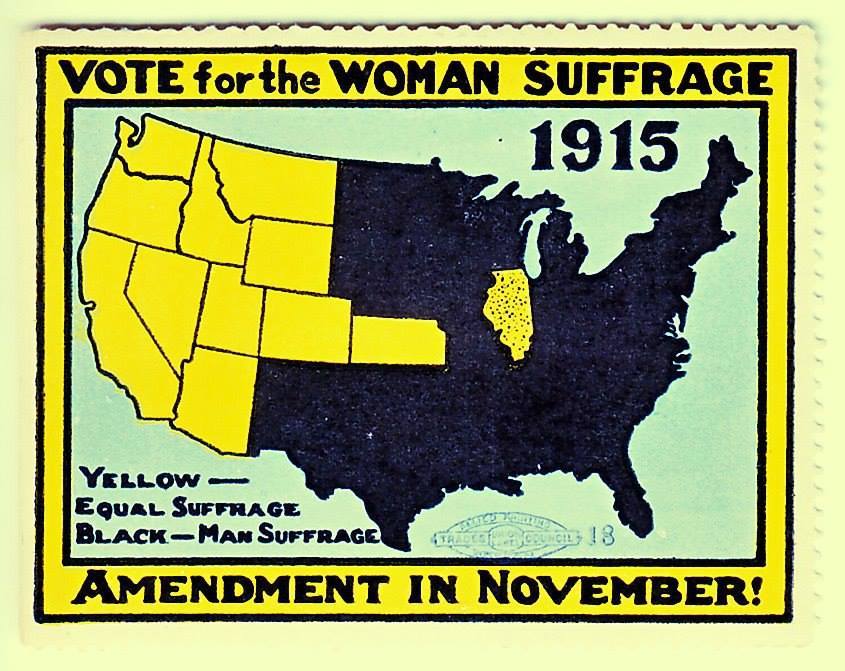
A privately printed stamp, which can be affixed to an envelope along with the regular two cents postage to promote the cause. In Illinois, women can vote for President and local offices, but not Statewide offices, so that’s why it looks different from the equal suffrage States.

Since New York is only one of three States which will have suffrage referenda on the ballot on November 2nd, there is plenty of activity elsewhere as well. The “Women’s Liberty Bell” (also known as the “Justice Bell”) arrived in Philadelphia this evening. It was welcomed to Broad Street by eight thousand torch-bearing suffragists and about a hundred thousand spectators after its 4,000-mile tour of the State in its own specially reinforced truck. There was a mass meeting in the Academy of Music after the procession, and when every seat in the hall was filled, five thousand who couldn’t be admitted became the audience for the overflow meeting.

As much enthusiasm as there is regarding the three suffrage campaigns in New York, Pennsylvania and Massachusetts, there is other work going on as well. In Washington, D.C., the Congressional Union for Woman Suffrage announced that the Susan B. Anthony (nationwide woman suffrage) Amendment would be re-introduced on December 6th. Representative Frank Mondell, Republican of Wyoming and Senator George Sutherland, Republican of Utah, will do the honors. Senator Sutherland seemed especially supportive:

I shall urge the Senate Committee on Suffrage, of which I am a member, to give a speedy hearing on the resolution which I will introduce. I shall press for action on a vote in the Senate. The matter should be disposed of as early as possible. The suffrage resolution received a majority vote in the last Congress. It will receive more the next time. It is just as absurd to debar women from the ballot box as it would be to disenfranchise all the red-headed, or all the people beyond a certain line. It is urged that giving the ballot to woman will destroy her charm and femininity; that she will develop unattractive masculine traits. These are new words set to a very old tune. The same thing was urged against the new woman a hundred years ago when she demanded an equal opportunity for education.

Though New York City’s big event is tomorrow, the mass meeting in Carnegie Hall this evening was quite impressive in and of itself. Presided over by Carrie Chapman Catt, it included such notables as the city’s youthful mayor, 35-year-old John Mitchel, Dr. Anna Howard Shaw, and Senator William Borah, Republican of Idaho. Mayor Mitchel was optimistic about the prospects on November 2nd, opening with: “I believe I can congratulate the women of this State tonight on their prospects for success.” He concluded by saying: “I shall cast my vote for the suffrage amendment. I sincerely urge upon my fellow citizens that they vote for this amendment.”

Senator Borah said: “Those who say the women won’t vote cannot have lived in a State where they do vote. I have known women to travel miles to a political meeting. Politicians know they will vote and vote intelligently.” Dr. Shaw drew many a laugh by reading some of the more extravagant claims in anti-suffrage literature. Then on a serious note, she said that though she expected victory:

If we lose in this State we will still be the victors. We have discovered our power; we know now our force and know ourselves as never before. This campaign has done more to fit us for the vote than twenty years of voting.

Now it’s on to a crucial event in the New York campaign, one which could make a victory even more likely if all goes well tomorrow.
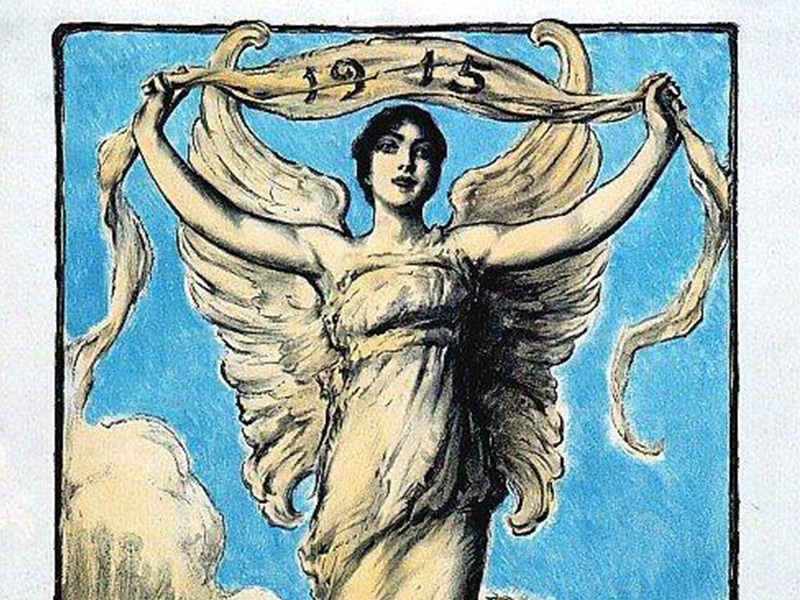
Today in 1915: Suffrage Moms Speak Up for Children’s Inclusion in Historic Parade

Founding Feminists is FMF’s daily herstory column.

FoundingFeministLogo-color

October 21, 1915: Children will definitely be marching in what’s planned to be the biggest suffrage parade in New York City’s history.

Recently, the anti-suffragists accused “Votes for Women” forces of exploiting their children by having them march in parades, so it had been previously announced that they would not be participating this time. But a backlash occurred among many of the mothers, and so today the policy was reversed. A typical reaction against the initial ban came from Elizabeth Selden Rogers, who had said:

My Betty shall march if there is not another child in the parade. Betty is 9, and she and the children of her age have learned in school about Washington and his fight for liberty, and they are old enough to understand women’s fight for freedom. There is no more reason why children should not appear in a suffrage parade than at the Piping Rock Horse Show or at other social events. They will be much safer in the parade with police protection than on the sidewalks watching with the crowds.

The cover of a booklet put out by the Empire State Campaign Committee. This group, founded in 1913 by Carrie Chapman Catt, and still headed by her, is coordinating the work of many suffrage organizations for the upcoming suffrage referendum vote in New York.

The children’s detachment will fall in line at Twenty-second Street and march to Fifty-eighth Street along the Fifth Avenue route. The girls will be wearing white dresses, white sweaters, white parade hats with small green ornaments, and will carry green pennants. Among those marching will be Harriot Stanton De Forest, age 5, great-granddaughter of Elizabeth Cady Stanton.

The parade is expected to be so large, and take so long, that the Women’s Political Union is stockpiling torches for use if the last of the marchers finish their journey after dark. One float – and there will be many – will have 10 elaborately costumed figures representing “Victory,” “Liberty,” “Equality,” “Justice,” and six continents. The W.P.U. will also have a “cavalry division” of women on horses, as well as their famous “Victory Van,” which suffrage supporters used to give out huge amounts of literature in the New Jersey campaign. Hopefully it will live up to its name here, even if it failed to do so in our neighboring State day before yesterday. The event should certainly make quite an impression on the male voters of New York, who will vote on a woman suffrage referendum on November 2nd.

Alice Stone Blackwell, president of the Massachusetts Woman Suffrage Association, was optimistic today when asked about the prospects of winning in the Bay State 12 days from now:

Ohio defeated woman suffrage in 1912, but that had no effect on Kansas, Oregon and Arizona. The failure in New Jersey does not mean that Massachusetts, New York and Pennsylvania will defeat suffrage. The question is much better understood in this State.

In Hingham, Massachusetts, the outlook appears particularly favorable. The result of a straw poll of 14 men taken yesterday by the local Equal Suffrage League was revealed today. Twelve of the men surveyed said they would vote “Yes,” and only two “No.” Both sides have a presence there, with 40 active and 50 associate members in the Equal Suffrage League, though the Anti-suffrage Association is actually larger, with a claimed membership of 150, plus 200 more on its mailing list.

In Pennsylvania, there was a large audience assembled in the Gettysburg Court House this evening to hear suffrage speeches by Beatrice Forbes-Robertson Hale and others. The listeners must have enjoyed what they were hearing, because the room was full when the evening began, and ended the same way. Hale said that the fight was “a movement of progressive persons against conservatism – not a fight of women against men.” In fact, “from the inception of the movement, it has had the support of many fine, chivalrous, far-seeing men.” She noted that the fight for equality has gone through three stages. First came the struggle for equal education, then equality in employment, and finally for equality for wives and husbands in the home, and those who opposed the first two steps are now fighting the third.

With less than two weeks left until the vote on the Pennsylvania suffrage referendum, Hale reminded her audience that suffrage has always been earned by actions and never just freely given:

Men won their freedom for themselves and that is why they value it so highly. In the same way we must work for it, we must sacrifice for it, we must give for it. We must remember that George the Third did not hand out independence with each pound of tea; neither can we sit down over our teacups and expect to get it.

Suffragists in all three States with upcoming referenda are definitely not just sitting around drinking tea and hoping for victory. They’re working very hard for it, and generating unprecedented support. Though the New Jersey vote on the 19th was a disappointment, it certainly hasn’t dampened the enthusiasm of anyone working for a triple victory on November 2nd.

Today in 1915: Alice Paul Speaks Out on a Suffrage Defeat in New Jersey

Founding Feminists is FMF’s daily herstory column.

FoundingFeministLogo-color

October 20, 1915: Though the focus of most suffragists is now on upcoming referenda in New York, Pennsylvania and Massachusetts on November 2nd, Alice Paul spoke out today about yesterday’s defeat of the suffrage referendum in her home State of New Jersey.

Since her goal and that of the Congressional Union for Woman Suffrage is adoption of the Susan B. Anthony Amendment, which would enfranchise women nationwide once passed by 2/3 of Congress and ratified by 3/4 of the State legislatures, Tuesday’s debacle only strengthens her belief that the days of campaigning for suffrage on a State-by-State basis should be over:

For more than sixty years women have been trying to win suffrage by the State referendum method, advocated by President Wilson. This has meant the expenditure of an enormous amount of energy, of time, and of money. Women are now beginning to feel that the State referendum campaigns in which the question of women’s political freedom is left in the hands of the most ignorant men voters in the State are too wasteful and indirect to be much longer continued.

They are turning to the national Government, asking enfranchisement by action of the United States Congress. We approach the next session of Congress full of hope that the leverage which the suffrage movement possesses in Congress as a result of the fact that one-fourth of the Senate, one-sixth of the House and one-fifth of the electoral vote for President now comes from suffrage States will mean the passage of the national suffrage amendment, thus doing away with costly and laborious State campaigns such as has just been unsuccessfully waged in New Jersey.

Of course, other organizations, such as the Women’s Political Union and the National American Woman Suffrage Association still support State referenda. Though N.A.W.S.A. president Rev. Anna Howard Shaw agreed that there should now be more emphasis on national suffrage, both her group and the W.P.U. are pressing ahead at full speed with their upcoming State campaigns. In fact, plans for an election night celebration at the W.P.U.’s “Suffrage Shop” on New York’s Fifth Avenue were in high gear today, as workers shrugged off yesterday’s setback and cheerfully looked 13 days ahead.

New York’s results will be different from those of New Jersey, in the opinion of Carrie Chapman Catt, among the most experienced of campaign workers: “We did not expect to win in New Jersey, for all the forces of wickedness were against the women. The whole campaign of the men was one of intimidation. I believe that the men of the political parties of New York have told the truth when they say they would not interfere with the vote in this State and I think we shall win.”

Campaign poster by Norman Jacobsen celebrating the courage and dedication of suffragists, and in support of a "Yes" vote in the upcoming referenda.
Campaign poster by Norman Jacobsen celebrating the courage and dedication of suffragists, and in support of a “Yes” vote in the upcoming referenda.

As to yesterday’s vote, one poll-watcher, Helena Hill Weed, said it was overtly corrupt. At her post in Newark from 6 a.m. until the ballot box was finally transferred to the Court House long after the polls had closed, she saw numerous violations of basic election laws, and even observed money changing hands. In regard to the influence of one political boss in particular, she said:

“We have absolutely tied up the women ‘antis’ with Jim Nugent’s party, though they have all along routinely denied it. We knew that Nugent had all through the campaign been distributing their anti-suffrage literature, but yesterday his men acted as watchers for the women.” (Some of his highest-ranking cronies were seen wearing badges of the New Jersey Association Opposed to Woman Suffrage as they monitored the balloting.) Harriot Stanton Blatch, of the Women’s Political Union, also saw money being passed, as well as “repeating” voters, and has reported these violations to the authorities.

Unfortunately, New Jersey requires that five years must pass before a referendum may again be submitted to the voters. No one here wants to just sit around until 1920, so a campaign to get the State Legislature to immediately pass legislation similar to that of Illinois, enabling the State’s women to vote for President has now begun. Though full suffrage can only be achieved through a Statewide referendum, the State Legislature can enact “Presidential Suffrage” for women on its own, at any time, so it’s still possible that New Jersey women will be able to vote for President (though no other offices) in 1916.

Once the voting trend became clear last night, and the battle had been lost everywhere except Ocean County, suffrage forces were understandably disappointed, but never dispirited. Looking forward, rather than back, it was simply time to plan for the next fight. So a kick-off rally was scheduled for the next morning in the same Military Park location in Newark where the previous campaign had ended on Election Day following a 24-hour speech-making marathon.

Mina Van Winkle, Helen Hoy Greeley, and Helena Hill Weed were among the speakers who drew a large and enthusiastic audience today. According to Greeley: “This is only one battle, nothing more than the preliminary battle in the open between the suffragists and the interests that are against them … We are in the fight to stay. It is the opening of a campaign that will go on Winter, Summer, Spring and Autumn – go on until we win, by the grace of God.”

Suffrage workers in neighboring Pennsylvania are not dismayed by the New Jersey vote, so they’re still busily planning a street parade and demonstration for the night of Friday, the 22nd, when the “Women’s Liberty Bell” arrives in Philadelphia as part of its tour of the State. There were noon meetings at various locations around that city today, and ten meetings are being held simultaneously tonight along Broad Street by the Equal Franchise Society and the Woman Suffrage Party.

In the other two States with upcoming referenda, nine organizers and five salaried speakers who have helped to found 200 local suffrage clubs are active in Massachusetts, while New York suffragists are preparing for a massive suffrage parade on Saturday, the 23rd. So, 1915 may yet be a year of victory parties, only with three instead of four, and beginning on November 2nd instead of October 19th!

Today in 1915: Women Overwhelmingly Support Suffrage in New Jersey, But Can’t Vote for It

Founding Feminists is FMF’s daily herstory column.

FoundingFeministLogo-color

October 17, 1915: Just two more days remain until the men of New Jersey vote on woman suffrage, and if women could vote, it would win in a landslide, judging by the numbers enrolled in pro-suffrage and anti-suffrage organizations in the State.

According to figures made public today, there are 75,000 members of the Women’s Political Union of New Jersey, and 25,000 in the New Jersey Woman Suffrage Association. The New Jersey Association Opposed to Woman Suffrage has a membership of only 25,000.

When asked if this four-to-one ratio was an indication that suffrage enjoyed great support from the women of New Jersey, an official of the anti-suffrage group said: “It might be an indication if the suffragists followed our rule and enrolled only women of voting age. But they will accept infants in cradles as members in order to swell their numbers.”

Promoting suffrage in New Jersey on the Asbury Park Boardwalk.

Since there are probably a little under 750,000 women of voting age in New Jersey, it means that if we presume that the vast majority of suffrage group members actually are adults, then one in eight is not only pro-suffrage, but concerned enough about it to become an active member of a suffrage organization, versus one in thirty who is actively opposed.

Since today was a Sunday, most suffrage speeches in all four States with upcoming suffrage referenda were spoken from the pulpit, rather than on street corners. Three-time Democratic Presidential nominee William Jennings Bryan spoke at Grace Methodist Church in New York City, but though campaigning for the New York State suffrage referendum on November 2nd, he mentioned the New Jersey vote coming up on Tuesday, and why it’s important that women should be able to vote on all major issues. He told the church members:

You have had a recent convert to the cause of woman suffrage. I see that the President has recently announced that he will vote for woman suffrage at the New Jersey election. I have believed that women should have the vote, but if there was only one question on which they could vote I would say that should be the question of peace or war.

Bryan condemned “propagandists,” “preparedness societies,” and “jingoes” for trying to drag us into the war in Europe, and noted that: “If the jingoes in this country are able to scare us into preparing, although they cannot name a country which might attack us, would not the jingoes in some other country be able to scare that country by pointing us out and saying that we were preparing against it?”

Though today was much closer to a traditional “day of rest” than most in this campaign, tomorrow will be the busiest so far. Three hundred and fifty-two suffrage speakers and campaign workers will be making their final pleas to voters. One meeting will be called to order at 6 a.m. by Mildred Taylor, and will continue for 24 hours, until just before the polls open on Tuesday. It will be conducted at the roving suffrage van and shop now stationed at Military Park in Newark. That location gets more pedestrian traffic than any other place in the State.

Meanwhile, in another New York church this morning, anti-suffragist Rev. Cyrus Townsend Brady was preaching that equality for women would bring
about the downfall of civilization:

What will be the ultimate result of this woman movement? We will have no more families, no more mothers, no more society, marriage will be a failure, for if it exists at all it will be a condition in which the husband will be one man and the wife another. The field for the practice of the highest virtues, the home, will be eliminated. The social purity of mankind will be undermined, prostitution will flourish, as it always does when marriage is neglected, and the result will be ruin.

Brady feels that “the perfection of the family is woman’s task,” and that “her struggle has been for a monogamous marriage” and “her triumph, while not yet complete,” will succeed if she will “continue her struggle on the legitimate lines marked out for her by successes of the past.” He thinks that voting, like decision-making in a marriage, is a male, not a female function, and “so I say deliberately that the so-called woman movement is an attempt to escape the function of woman, a revolt against the fact that woman is not a man, an attempt to enter the field of effort in which man’s powers are properly exercised. It is a rising against nature.”

But it’s Rev. Brady who is fighting against nature, because the desire to be free and equal is inherent in all people. It is now being manifested in an unprecedented way as women enter many fields from which they were previously excluded – and one State at a time, even gain entrance to the voting booth.

Hopefully there will be one more suffrage State on Tuesday, and three more after that on November 2nd. The elaborate, massive parades that have become annual events, and the fact that almost half the States in which women have full suffrage have been won in just the past three years shows a powerful trend in its favor. Though more suffrage campaigns are lost than won, the gains still mount up, as no State in the post-Seneca Falls era has revoked woman suffrage after granting it. This steady progress insures that regardless of the outcome of any specific election, nationwide woman suffrage is about “when” it’s to be achieved, and not “if.” The only question now is over which tactics will work best, and how much time and effort will be needed to win.

Today in 1915: New Jersey’s Religious and Political Leaders Speak Up for Suffrage

Founding Feminists is FMF’s daily herstory column.

FoundingFeministLogo-color

October 16, 1915: The campaign to pass the New Jersey suffrage referendum three days from now is finishing up in grand style with William Jennings Bryan, Senator William Borah and Rabbi Stephen S. Wise having given stirring speeches tonight in Paterson and Newark.

According to Bryan: “The burden of proof is on the opponents of woman suffrage. The most convincing argument in favor of it is that a mother has the right to a voice in determining the environment that should surround her children.” He also noted that the character of the opposition should be sufficient to convince anyone to vote pro-suffrage.

Senator Borah, Republican of Idaho, where women have been eligible to vote since 1896, said that though he couldn’t claim that women having the vote would eliminate all political evils or injustices, he did think that women would find and correct many wrongs that men have not.

A stamp recently printed up by suffrage supporters which can be put on an envelope along with the standard two cents postage. This way, people can promote the cause on the outside of the envelope as well as through the letter or flyer inside.

Rabbi Wise looked forward to a more peaceful world after equal suffrage, because: “‘Military preparedness’ means war, and there will never be a beginning of an end of war until women vote.” He then predicted that if suffrage was successful in New Jersey, it would also win in New York, Pennsylvania and Massachusetts on November 2nd.

If the referendum does win in New Jersey, it will be after an uphill fight, because woman suffrage has very powerful opponents. But Mina Van Winkle, head of the Women’s Political Union of New Jersey is confident: “We have made a good fight and we think an effective one. If we have an honest election and an honest count of the vote, and if underground influences that we are not in a position to meet do not get in their work on Tuesday, we should win.” Mrs. E. F. Feickert, President of the New Jersey Woman Suffrage Association, not only predicted that suffrage would win, but that it would do so by as much as 25,000 votes:

This forecast is based on a house-to-house canvass, which has covered the entire State and which comprises both urban and rural localities. In the cities we have found an average of seven men who are for us to one against us and three who tell us they have not decided how to vote. In the country districts we find eight men with us to one against us and three who have not made up their minds on the subject.

But Mrs. Edward Yarde Breese, President of the New Jersey Association Opposed to Woman Suffrage, is confident of carrying 13 of the State’s 21 counties. Three of the bigger ones would actually be enough to doom the measure if carried by substantial majorities, and anti-suffragists are predicting a majority of 10,000 in both Essex and Hudson Counties, and 7,500 in Camden County.

The “antis” have taken surveys as well, and according to Breese, opposition to suffrage is especially strong in rural areas. In one community, suffrage opponents claim that 96% of those surveyed said they were against the suffrage referendum. Both sides agree that Essex County will reject the measure due to the influence of local political boss James R. Nugent. Hudson and Camden Counties are still hotly contested, however.

The head of the Hudson County Democratic Committee was unwilling to give a forecast, but according to Samuel T. French, leader of the Camden County Democratic Committee:

Woman suffrage in Camden County is gaining rapidly; the President’s declaration favoring it has given the movement new life. The Democratic Executive Committee is on record favoring it, and the vote will be a surprising one for the opponents next Tuesday. The people here are just learning that the liquor interests are fighting it harder than any other power, and had we another month it would carry in Camden County. I hardly expect it to carry in this county, but the majority will be small.

It’s definitely a huge gamble to try to win so many States all at once, and to depart from the traditional strategy of undertaking major campaigns in States that border on a State where women already vote. But though multiple defeats would be a major setback, the payoff could be unprecedented, and is therefore worth the risk.

A victory in any of the four targeted States would mean that equal suffrage would spread East of the Mississippi for the first time since the battle for the ballot was launched in 1848. Even more importantly, having four suffrage States with large Congressional delegations (New York and Pennsylvania having the largest and second largest) would certainly increase support for the Susan B. Anthony Amendment, since members of Congress in equal suffrage States would have to face women voters in all future elections. If the Anthony Amendment is approved by 2/3 of the House and Senate, then ratified by 36 of the 48 States, women would be enfranchised nationwide. So no effort will be spared between now and the 19th to set that train of events in motion with a favorable vote on suffrage in New Jersey three days from now.

Today in 1915: Suffragists Set Their Sights on Eastern States

Founding Feminists is FMF’s daily herstory column.

FoundingFeministLogo-colorOctober 15, 1915: “New Jersey Next!”

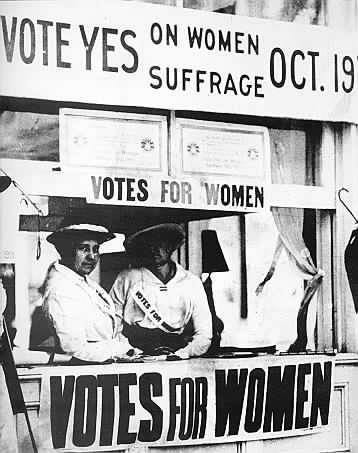
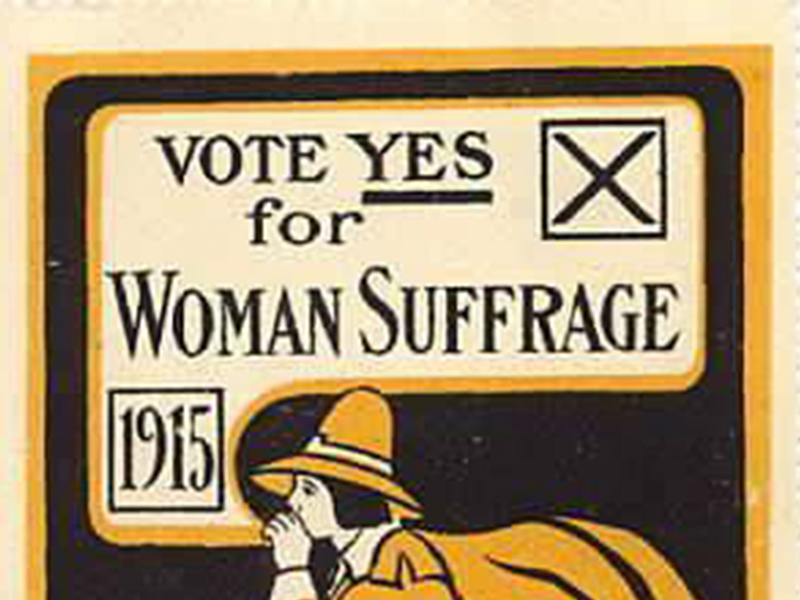
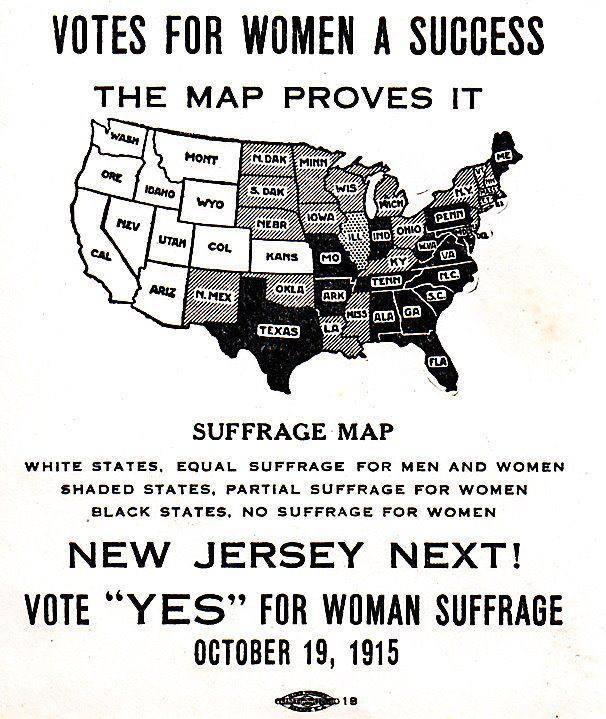
That’s the motto of suffragists who are undertaking a bold gamble to expand “Votes for Women” out of the West and capture four big eastern states between October 19th and November 2nd.

Though women in Illinois have almost equal suffrage, and can vote for President and local offices, but not statewide officials, at present there is no state east of Kansas where women vote on the same basis as men. But confidence is now running so high that major campaigns are being waged in New Jersey, New York, Pennsylvania and Massachusetts. New Jersey will vote first, just four days from now. These four states contain one-fifth of the population of the United States, and could suddenly double the number of women voters, something not accomplished since California became a suffrage state four years ago.

10685544_10203359617174712_4543627317702737651_nhis

New Jersey is unique, because women could vote here from 1776 until 1807, so long as they met the same property-owning qualifications as the male voters. There have been 4,000 outdoor and 500 indoor meetings held around the State arranged by four paid and thirty volunteer organizers of the New Jersey Woman Suffrage Association. It works with three other groups in a coalition called the Cooperative Committee. The largest of the three other groups comprising the committee is the Women’s Political Union of New Jersey, with the Equal Franchise Society of New Jersey and the New Jersey Men’s League for Woman Suffrage contributing to the effort as well. Thus far, three million pieces of literature and four hundred thousand buttons have been distributed, so the campaign to re-enfranchise the State’s women has been a mighty effort.

Today both sides were quite active. A group of New York suffrage supporters took time out from the campaign in their home State to travel around this State in a horse-drawn wagon converted from delivering lunches into delivering literature to voters. The group was headed by Nora Blatch De Forest, daughter of Harriot Stanton Blatch, and granddaughter of Elizabeth Cady Stanton. She was accompanied by journalist Rheta Childe Dorr, Florence Kelley, of the National Consumers’ League, and Alice Carpenter, Progressive Party activist.

Mina Van Winkle, President of the Women’s Political Union of New Jersey was back at her desk in Newark today, busy making sure there will be enough women poll-watchers to insure a reasonably honest election. She said: “If no underground influences get in their work on Tuesday we will win this election.”

Anti-suffrage forces are, of course, making strong last-minute efforts as well. Today a flyer by W. T. Hickey of Colorado was being distributed locally saying that suffrage in Colorado, where women won the vote in 1893, has been a failure, and that the women legislators there have not been able to bring any benefit to women, and even opposed so-called “protective” legislation restricting women’s hours of work.

The New Jersey State Federation of Labor, which in previous years has endorsed suffrage, did not do so this year. The active opposition of James Nugent, Essex County Democratic Chairman, is suspected of being behind the move, due to his close and friendly relations with the liquor lobby, which fears enactment of prohibition if women are enfranchised. Bartenders, waiters, brewers, bottle washers and cigar makers all formally came out opposed to suffrage through their unions just prior to the State Federation of Labor’s convention.

The “antis” are employing their best speakers now, as the campaign winds down to its final days, with the highest-ranking officers of anti-suffrage organizations in States such as New York, Pennsylvania and Massachusetts coming to New Jersey to make their case. Even the widow of the late Vice President Garrett Hobart (who served during McKinley’s first Administration) has been drawn into the battle, saying: “Please remember that I am one of the thousands of women in our State who do not want the vote and that I speak for them when I beg you to vote against woman suffrage. We need your vote to prevent what we believe to be a great injustice to us as well as a grave menace to our State.”

But suffragists have powerful speakers as well. William Jennings Bryan and Senator William E. Borah, Republican of Idaho, will be addressing huge meetings in Newark and Paterson tomorrow night, and these won’t be the last attempts to stir up the voters for suffrage. President Wilson has also issued a statement of support, saying on October 6th:

I intend to vote for woman suffrage in New Jersey because I believe that the time has come to extend the privilege and responsibility to the women of the State, but I shall vote, not as the leader of my party in the nation, but only upon my private conviction as a citizen of New Jersey, called upon by the Legislature of my State to express his conviction at the polls. I think that New Jersey will be greatly benefited by the change. My position with regard to the way in which this great question should be handled is well known. I believe that it should be settled by the States and not by the National Government and that in no circumstances should it be made a party question, and my view has grown stronger at every turn of the agitation.

Though the President is obviously not ready to endorse the Susan B. Anthony (nationwide woman suffrage) Amendment, and the four referenda would only enfranchise women in four of the forty-eight States, a successful result here on October 19th, then on November 2nd in the other three States, would increase the number of “equal suffrage” States to 15, and force the men in Congress from those States to give their female constituents the same attention and consideration as the male voters get now. This would clearly be a major boost for the Anthony Amendment, and bring the end of the struggle much closer. But first things first, so “New Jersey Next!”

Today in 1918: Suffragists Occupy the Senate

Founding Feminists is FMF’s daily herstory column.

FoundingFeministLogo-color

The National Woman’s Party is known for its bold actions, but today’s attempt to briefly occupy the Senate as a colorful protest of that body’s recent rejection of the Susan B. Anthony (nationwide woman suffrage) Amendment was its most militant tactic yet.

As announced day before yesterday:

Monday noon, upon the convening of the United States Senate, a group of women will form upon the plaza in front of the Capitol and, with no banner other than the American flag at their head and the tricolor of women’s freedom, will march up the Senate steps through the foyer and on to the floor of the Senate.

They will carry in their hands the speeches on democracy, which have been made by the thirty-four men who voted against democracy for women. In the flame of a torch carried just behind the flag these speeches will be burned. Drawing up their line in front of the presiding officer’s desk, each woman, representing a different group of women, will voice her protest against the injustice done in the cause of liberty by the men who defied Wilson’s appeal for the war measure of woman suffrage. One will be a woman voter from the West, another a working woman representing the millions of women now in industry; others will be young girls representing the women of the future.

Alice Paul noted the double standard involved in regard to men and women seeking democracy:

To remedy the wrongs that are done men it is believed right that whole nations should perish, if need be. To remedy the insult that is done woman by the men who lay the scorn and burden of disenfranchisement upon her it is considered wrong to hold a banner of protest on the steps of our Capitol. Where else are women to go for redress of their grievances, if not to the seats of power? If we cannot make our protests seen by our banners, we will make them heard by our voices in the Senate; but we will not let it be said of women that they acquiesced in the defeat of justice and of liberty.

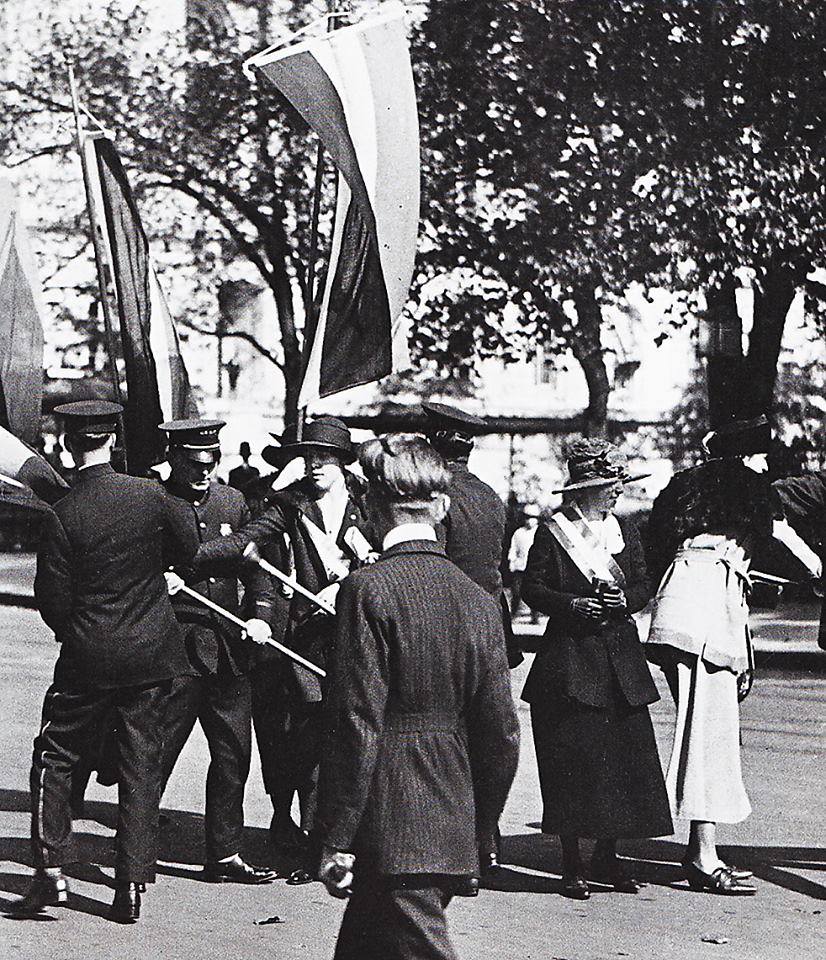
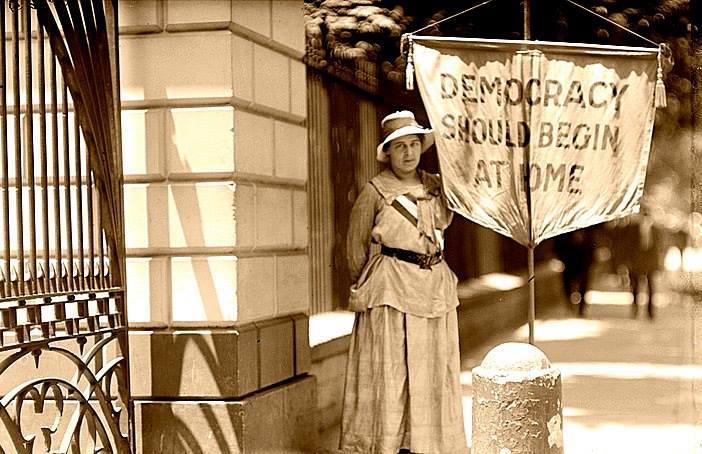
True to their word, the protesters started for the Capitol today, with the American flag and their purple, white and gold National Woman’s Party banners flying. But they were stopped by a squad of Capitol police awaiting them. Their banners were seized, then Alice Paul and 14 others were arrested – in an unnecessarily rough manner – and placed in the guard-room of the Capitol. None of the detainees have been allowed to communicate with anyone, not even their lawyers, or pro-suffrage Senators, and they are being held without any charges being specified.

National Woman's Party protesters being arrested by Capitol police earlier today.
National Woman’s Party protesters being arrested by Capitol police earlier today.

The words that would have been burned during their occupation of the Senate were those of Senators who lavishly praise promoting democracy worldwide, while voting to withhold it from the women of their own country. Some examples:

“The work that we are called upon to do when we enter this war is to preserve the principles of human liberty, the principles of democracy, and the light of modern civilization,” said Senator Henry Cabot Lodge, Republican of Massachusetts.

Senator William Borah, Republican of Idaho, echoed him, saying, “This is a war that speaks for the majesty of people popularly governed.”

“This is the people’s country,” Senator James A Reed, Democrat of Missouri, added. “The nearer you get to the people, the nearer you have a just and fair government.”

Though hypocrisy is far from rare in politics, the worst example of it in the current Senate may have been furnished by Senator John Sharp Williams, Democrat of Mississippi. The same man who just 13 days ago introduced an overwhelmingly rejected motion attempting to change the wording of the Anthony Amendment so that it would only assure the right to vote to white women has said, “When you undertake to erect a structure of democracy it must be founded upon the four pillars of justice, equality, fraternity and liberty.”

At some point the protesters will presumably be released, and will continue their daily showing of banners near the Capitol, often inscribed with the words of those who say they favor democracy but vote against it when it comes to women.

Fortunately, some members of the Senate may soon be replaced following midterm elections in November. If two votes are gained, there will be 64 Senators for suffrage and 32 opposed, (2/3 approval of both Senate and House is required) and the Anthony Amendment will go to the States for ratification after it is re-approved by the new House, then approved for the first time by the new Senate. If this is accomplished early enough, virtually all the State Legislatures will still be in regular session, ratification can occur swiftly, and women will have the vote nationwide long before even the primary elections occur in 1920.

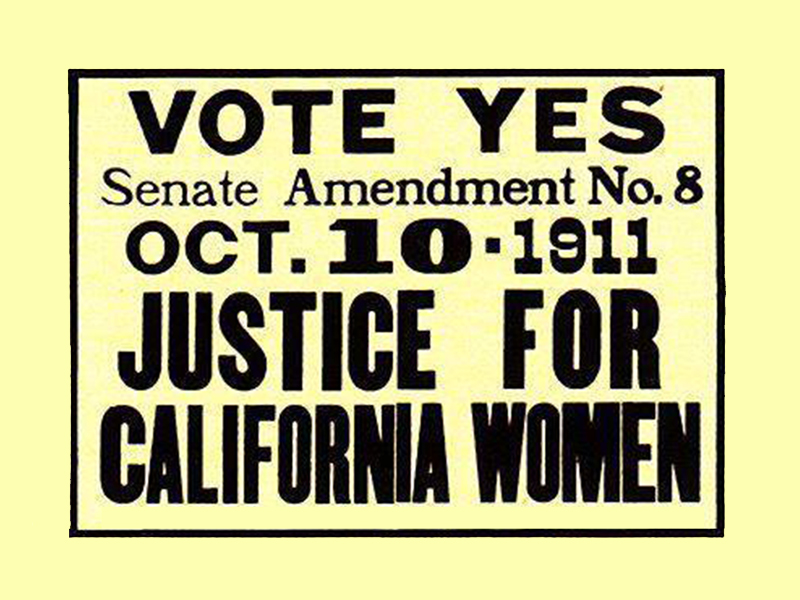
Today in 1911: Suffragists Celebrate Their Victory in California

Founding Feminists is FMF’s daily herstory column.

FoundingFeministLogo-color

It’s only the second time in 15 years that the National American Woman Suffrage Association (N.A.W.S.A.) has been able to celebrate winning “Votes for Women” in another State, so it made the most of the California victory with a mass meeting at New York’s Cooper Union tonight.

The program was quite elaborate, with special electrical effects, and salutes to individuals ranging from Abraham Lincoln to Emmeline Pankhurst. Since it was only yesterday that what looked like a crushing defeat on Tuesday night, October 10th, turned into a one-vote-per-precinct margin of victory when the last rural ballots were tallied, it’s quite amazing that such a spectacle could be put together on such short notice.

A large blue banner hung in the background of the platform with a portrait of Abraham Lincoln surrounded by six stars representing the six States in which women now have equal suffrage, and a quote attributed to him which says: “I go for all sharing the privileges of the Government who assist in bearing its burdens, by no means excluding women.” All the numerous and prominent women on the platform wore brand new six-star “Votes for Women” buttons, items that proved quite popular when offered for sale to the audience members.

Reverend Anna Howard Shaw, president of N.A.W.S.A., took the stage to open the meeting, saying: “Fellow citizens, there has never been an occasion in the world when women had so great occasion for rejoicing.” She then introduced young Portia Willis, who said: “Ladies and gentlemen, I am glad to present to you the sixth star.” At that point, an enormous star composed of electric lights lit up, the band played, the audience cheered, and then sang “The New America,” a suffrage song that dates back to a N.A.W.S.A. convention in 1891.

Ida Husted Harper found great enthusiasm when she presented a resolution calling on the New York Legislature to give the voters of the Empire State the same chance to vote on a suffrage referendum as those in the Golden State just had – and give the women here the same chance to make their case for suffrage to the men of New York.

Isaac Stevens, of Colorado, who had been working in California earlier in the campaign, was brimming with confidence, and told the audience that if the New York Legislature wouldn’t put a suffrage referendum on the ballot that suffrage supporters would just skip the whole “State-by-State” process and work on getting the Susan B. Anthony Amendment passed by Congress and ratified by the States so that suffrage would be won nationwide all at once. It was a short, but effective speech, much to the relief of some in the audience after the band played “We Won’t Go Home ‘Till Morning” as he walked on stage.

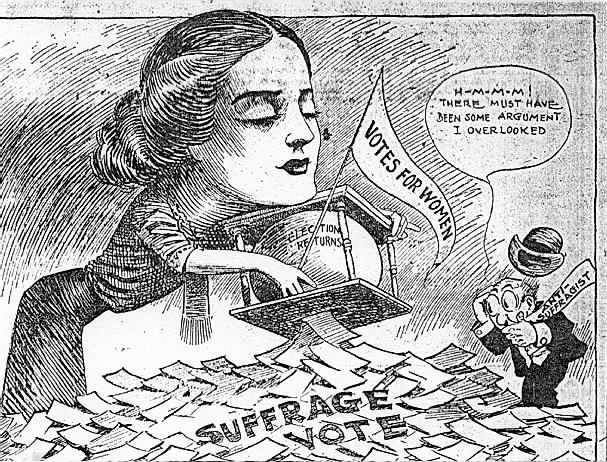
From today's Los Angeles Express, showing an anti-suffragist being overwhelmed by California's pro-suffrage vote and exclaiming "H-m-m-m. There must have been some argument I overlooked."
From today’s Los Angeles Express, showing an anti-suffragist being overwhelmed by California’s pro-suffrage vote and exclaiming “H-m-m-m. There must have been some argument I overlooked.”

Harriot Stanton Blatch, daughter of the late Elizabeth Cady Stanton, took a militantly political approach, a tactic that could prove effective now that the number of women voters is almost twice what it was just three days ago: “Where is President Taft?” she asked.

The President has said some things that are unpopular with suffragists, and though he appears to be rethinking his stance this week, Blatch had some of his statements reprinted on leaflets which she thinks ought to “fall like snowflakes” around the country next year if he and the Republican Party do not give sufficient support to the cause. The leaflets might be especially effective in the six Western States where women have the ballot, and which have 37 Electoral Votes between them that Taft will want next year if he runs for re-election.

The biggest surprise of the evening was the attendance of British militant Emmeline Pankhurst. She arrived in New York day before yesterday, and when she unexpectedly showed up at the meeting to add her congratulations, she was given a huge ovation by the crowd as the band played “Hail, the Conquering Hero.” There is a temporary lull in activities in England as Parliament is about to vote on a bill that would enfranchise married women on the same basis as their husbands. It would be a major step forward, though by no means the end of the fight for equal suffrage for all British women even if it passes. She said of the California victory: “The news is worthy of great rejoicing. English women will be particularly glad, because it will be a very great help to our campaign.”

New York suffrage groups played a role in the California campaign. The Woman Suffrage Party raised $2,000, plus a $500 contribution given to them by General Herbert Carpenter. The money enabled them to send two women, Helen Hoy Greeley and Jeannette Rankin, to California in August to travel around the State’s hot interior promoting the cause, even visiting isolated mining camps which had never heard a suffrage speech before. Since it was rural voters who were responsible for offsetting the strongly anti-suffrage vote in San Francisco, their work proved to be especially important.

Monetary contributions to the California campaign were also made by the Women’s Political Union, which also sent Elizabeth Selden Rogers there as a campaign worker as well. The College Equal Suffrage League and the Men’s League for Equal Suffrage also made donations, with N.A.W.S.A. itself contributing $3,500 through its New York office.

Meanwhile, in California, a festive atmosphere still prevailed in the offices of local suffrage groups, while statements were issued by the Secretary of State and the Los Angeles Deputy District Attorney saying that a State Constitutional amendment becomes effective immediately upon passage by the voters, so women can begin registering at any time. Of course, they must still meet the registration deadline and all other standard requirements before voting in Los Angeles, according to City Attorney John W. Shenk. But that still leaves them with several weeks to register for the city election, and women in Santa Monica and Long Beach should also have sufficient time to register for those local elections, which also take place on December 5th. County Clerk Harry Lelande said that he has already begun preparations to facilitate the registration of women. The issue of whether women must serve on juries is still uncertain according to officials.

Earlier today, Rev. Anna Howard Shaw sent a telegram to suffrage workers in Los Angeles saying: “Los Angeles men worthy their magnificent city; Los Angeles women worthy their splendid victory. Louisville shall hail you with joy.” (The next N.A.W.S.A. convention will be in Louisville, Kentucky.)

Shaw the expressed the optimism felt by all suffragists around the country as the struggle enters a new – and hopefully its final – phase:

We’re gloriously happy. This is the beginning of the end. The victory in California gives to the cause as many voters as in the five other States where we have previously won. Kansas, Oregon and other Western States are bound to follow the lead at the next elections. The politicians are also sure to realize that the women are winning their fight and will climb on the band wagon.


INFLATIONARY NOTE : $500 in 1911 = $12,794 today; $2,000 = $51,173; $2,500 = $63,971; $3,000 = $76,765; $3,500 = $89,553.

Today in 1911: A Timeline of California’s Suffrage Vote

Founding Feminists is FMF’s daily herstory column.

FoundingFeministLogo-color

4 AM: After fifteen years of trying to get a woman suffrage amendment on the ballot again, then months of hard campaigning up and down the State after the legislature agreed to put it there, the big day is finally here! All local suffragists are present and accounted for at Los Angeles suffrage headquarters, ready to make good on their pledges to work all through Election Day. The current campaign for woman suffrage in California ends when the polls close at 6 p.m. in what is hoped will be the State’s final “men-only” election.

Suffrage workers are now adjusting their sashes and buttons, and picking up literature to give out to voters when they take up their posts as near the polling places as legally permitted. Others have voter registration lists to assure that only legal votes are cast. “Votes for Women” pennants are now being attached to automobiles that will carry voters to the polls to assure a maximum turnout.

The final mass meeting of the campaign was held last night in Blanchard Hall, although it really only started there. The overflow crowd soon spilled into the streets, and finally reached City Hall, where the cheering suffragists were made welcome by Mayor George Alexander himself. The speech-making and applause went on for three hours at both locations and was just what weary suffrage workers needed as reassurance that their hard work was appreciated, and optimism justified.
6 AM: The polls have just opened, and all members of the Political Equality League’s Executive Board are now present at headquarters, and will stay for the next 12 hours to deal with whatever situations come up between now and the closing of the polls. Their legal advisers and most experienced campaign workers are also here, ready to go to any polling place at a moment’s notice. The “Votes for Women Club” will also contribute 100 workers to the 1,000 others doing similar duty. No anti-suffrage advocates will be promoting their cause near the polls today, according to an announcement they have issued.

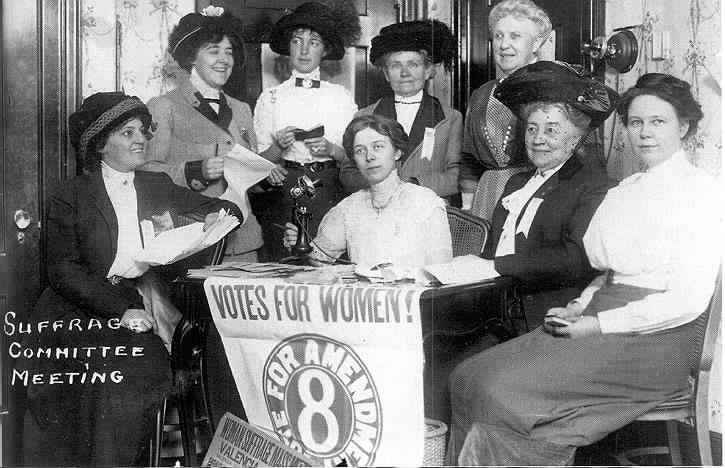
9 AM: A brief drive around Los Angeles shows an almost continuous display of “suffrage yellow” along many streets. One portion of Eighth Street has outdone them all, with yellow on every house and telephone pole, so those who have spent the past few weeks delivering banners, posters and yard signs clearly made a real contribution to the cause, and the homeowners have had no last minute change of heart.10151386_10203324417294737_7371079427794551440_n

NOON: Polls of those exiting the voting booths taken by reporters for the “Los Angeles Record” show overwhelming support for suffrage. Amendment #8 seems to be getting approved right along with #22 (Initiative, Referendum and Recall), so this is shaping up as quite a year for political reform. Estimates of the size of the suffrage victory continue to climb. Some suffrage leaders are now predicting that the measure will carry Los Angeles County by 10,000 and the State by 20,000.

J.J. Petermichel, Secretary of the Men’s Suffrage League, has returned from San Francisco, and just said that notoriously anti-suffrage city will deliver “a safe majority” for suffrage this time. Straw polls taken here yesterday were also quite favorable. One was at the F. O. Engstrum Company, and at all the buildings they have under construction. The result was 576 employees for suffrage and 193 against. Though none of its members can vote today, a poll was also taken at the Woman’s City Club, resulting in 407 in favor of Amendment #8 and 20 against. Other such surveys have given favorable results of up to six to one.

6 PM: The polls have now closed, and the verdict is in, so there’s nothing left to do but wait until enough ballots have been counted to know what the voters decided. But at least we live in a modern era, so results can be phoned in from around the State or delivered by telegram, and immediately posted on chalk boards here at headquarters. A large stereopticon, projecting the latest bulletins on a screen will be used tonight by the San Francisco Chronicle to give the latest developments to the large crowds that will be gathering outside its office.

8 PM: The “landslide” predictions and high confidence of earlier today have now faded in the face of the first reports from the North. Alameda County has been lost, and though San Francisco was always expected to vote “no,” despite a brief surge of optimism earlier today, the votes counted so far are much more heavily negative than even the most pessimistic predictions. Apparently the political bosses and saloon owners did their work well. But the early returns show suffrage carrying by a five-to-four margin in Los Angeles County, though San Diego County may erase that, leaving only the small towns, farms and ranches to offset San Francisco’s big majority against suffrage. Fortunately, all three received a great deal of attention from suffragists during the campaign.

10 PM: The atmosphere has become increasingly gloomy as even worse numbers from the North come in. Many people – exhausted from months of work and a final frenzy of activity today – have gone home, realizing that even at best, the result will not be known for certain until at least tomorrow morning. But some remain, and leave no doubt that whatever the outcome of today’s balloting, women in California will eventually vote. Frances Noel, president of the Wage Earners’ Suffrage League, said:

If we lose, then what? Well, we’ll first take a real good rest, as any soldier would after a battle royal. After that we start anew, wiser for the defeat we suffered and happier for the better understanding that has developed among womanhood in consequence of our campaign. Defeat, to us, means greater victory for womanhood in the end.

Mrs. Simons echoed those same sentiments as she departed: “We need our strength for the new work, whatever it turns out to be.”

11 PM: Not a good sign. Harry Dean, field manager of the “antis,” just made a victory statement:

Indications point to the defeat of the suffrage amendment in the State by 10,000 or over … I think the great bulk of women are happy tonight. The suffrage workers should feel happy, for they have waged a great political battle; but the ‘anti’ women have waged a better one. They waged the kind of a battle that men admire, for, after all, it is the sweet women that we all want – leave the political pool for the men to wade in. I congratulate the women of both sides, for they have both won.

Others at the headquarters of the “antis,” such as Mrs. Caswell, said:

We have worked hard to prove that it is not best for women or the State that women should have the ballot. We tried hard to show the people that a majority of women do not want it and we are satisfied with the judgment of a majority of the voters. We sent no girls or women to the polls, as this is against our principles, and we are surprised to see how few women the suffragists were able to place on the firing line. This only goes to prove our contention that a majority of women are not interested in politics.

But there are still a lot of votes to be counted, and though the outlook is far from optimistic based on what’s come in so far, suffragists are not nearly as ready to give up as certain newspapers have been this evening. Even if this does turn out to be a loss, the end of the 1911 suffrage campaign will simply be the beginning of the victorious 1912 campaign. The Initiative, Referendum and Recall measure appears to be passing by a large majority, so it certainly won’t be necessary to spend 15 more years trying to get the legislature to put woman suffrage before the voters again because the people will be able to do it themselves at any time.

According to Lillian Harris Coffin:

I shall not believe we are defeated until I see the final figures. If we are, we will start right in tomorrow with greater determination than ever, and we will have another election as soon as possible, perhaps next November. Even though the votes do not seem to be coming in as favorably as might be, still none of us are by any manner cast down. Quite the reverse. We are delighted with what we have accomplished and we have learned a great deal during the campaign. Everybody connected with our cause made a good fight, and we have only praise to bestow on all our plucky workers.

Mrs. H. F. Henshaw agrees:

I don’t consider we are beaten because the vote does not seem to tally our way. It is really only the result of our first effort. We are not going to start over again, because we have never stopped. We are just always moving toward victory. I, for one, am delighted with the fine campaign we have made. It was a splendid piece of work, and if it has not brought victory today it is the brilliant beginning of another campaign which will surely bring victory at the next election, and that election will not be so far away.

The offices of all suffrage groups will open at the usual time tomorrow morning, and the latest returns will be evaluated carefully. Whether that analysis results in conceding defeat this year then planning for the 1912 campaign or giving out a victory statement will depend on the results that come in overnight. But the battle for woman suffrage will go on under any circumstances and for as long as it takes.

October 9, 1911: Suffrage Supporters and Opponents Both Aren’t Giving Up in California

Founding Feminists is FMF’s daily herstory column.

FoundingFeministLogo-color

California suffragists and anti-suffragists normally sound radically different from each other, but today both sides are making identical and equally confident predictions of victory in tomorrow’s vote.

In North and South, from the smallest towns to the biggest cities, everyone involved in promoting or opposing the suffrage amendment is looking forward to not just the end of this exhausting battle, but celebrating a nationally significant win tomorrow evening.

Helen Todd, a factory inspector in Illinois who has been out here working for suffrage, exemplifies the frantic pace suffragists have been setting, and the enthusiasm for the cause that’s been been encountered. She said that in Bakersfield:

Our meeting was enormous, and we adjourned at 9 o’clock to the auditorium, where Francis J. Heney was speaking. ‘Will you give us a truly representative government?’ he was saying, and I, carried away by the enthusiasm of our meeting, cried out, ‘Votes for women will!’ The audience almost brought down the house and Mr. Heney, then and there, much to our delight made a splendid plea for suffrage. What a wonderful speaker and man!

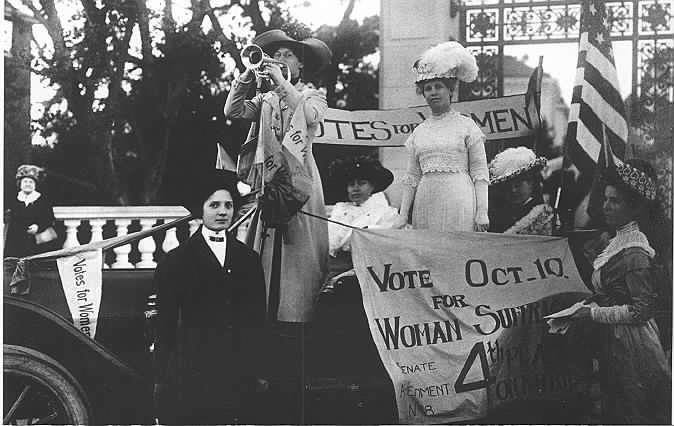
A bugler opens a recent suffrage rally as Margaret Haley, a Chicago teacher who has come to California to help the campaign, prepares to speak.

In San Francisco, Todd recently met with officers of the College Equal Suffrage League and when they asked how the campaign was going in Southern California, she recalled: \

I gave this section of the State a reputation that must not fade, and every word I said was true. The headquarters of the league fairly hums and rages with life – such loads of pretty, charming, eager women.

On the evening of my arrival I spoke to 1,200 people in a theater and afterward was rushed off in an automobile to a street meeting. Before I had finished my breakfast in the morning an automobile dashed up and I was rushed off to Berkeley to speak to a meeting of factory people at noon. From there I rushed back and flung a dress into my suitcase and was whisked off to catch a 3 o’clock train for Sacramento, where I arrived at 7 p.m. and was met by an enthusiastic committee and conducted to the Opera House as the principal speaker. I spoke for an hour here to a big audience, which was both responsive and enthusiastic.

In San Francisco, Todd spoke to two meetings in the same night, the first with an audience of 7,000 and the second 4,000: “The whole thing was most moving, the spirit, the response, the earnestness,” she said.

Of course, that same confidence is being expressed by the opposition. According to B. N. Coffman, Secretary of the Men’s League Opposed to Suffrage: “We will carry the South by a majority of more than 10,000 votes, and I am confident that the State as a whole will increase that majority from 30,000 to 40,000.

Harry E. Deane, field manager for the Men’s Anti-Suffrage League said:

We had twenty of our men in the [Los Angeles] business district today to be sure that there has been no sudden reversal of sentiment. They came back certain that we would carry this city. We have the signatures of more that 10,000 voters in Los Angeles County, but even with these pledges we have always been conservative and have estimated that the fight was not far from an even break. Today’s campaign, however, has made us realize that we have been too conservative. We now feel sure that a great many men have made the women promises without any intention of voting for them but simply because it was the line of least resistance. The easiest way out was to promise, and oftentimes they considered it more of a joke than anything else.

The anti-suffragists have been quite busy distributing their propaganda. In just the past six weeks those in the Southern part of the State have put out more than 500,000 pieces of literature. Every name on the Great Register of Voters for Los Angeles, San Diego and Ventura Counties has received something in just the past 30 days. In Los Angeles, a small army of young women wearing American flag pins is downtown today giving out anti-suffrage literature to every man they meet.

But the pro-suffrage side has not let up in the least, and is actively fighting the battle on all fronts. As one example, a double-barreled advance took place in the Los Angeles Express today beginning with an advertisement by the Political Equality League to the men of California:

Tomorrow there will be fought a battle for justice and liberty as significant as any of those great conflicts which have marked the history of human progress. If you love justice and trust women, you will give to them that priceless guarantee of all rights – the ballot.

If you listen to the enemies of democracy, who seek the control of the many by the privileged few, and to that combination of big business with protected vice which we call the machine, you will vote against suffrage. Through the vote of their organizations 100,000 women of California have said they want it. Thousands more desire it who are silent for lack of opportunity to speak. We appeal to you as fair-minded, generous, honorable gentlemen. Give us justice, and the women of California will repay you by a passionate devotion to the welfare of the child and of the State.

It was signed by Mrs. Seward A. Simons, Mrs. David C. McCan, Mrs. John R. Haynes, Mrs. Berthold Baruch, Mrs. Shelley Tolhurst, Mrs. Charles Farwell Edson, Miss Annie Bock and Miss Louise B. Carr.

This was accompanied by an editorial in the same paper:

A minister is quoted in a morning paper opposed to equal suffrage, as having said that ‘American men never have, at the ballot box or in the halls of legislation, ceased to be dominated or controlled by their love of the home.’

If this be true, then from every pulpit in this broad land wherein there has stood a man with courage enough to face the political, social and industrial evils of the time, there has gone out an enormous amount of baseless complaint. The saloon abuses, the police protected gambling hall, the red light districts of our great cities, the cruel condition under which women, girls and even children under 10 years of age are forced to work in the cities, after the attention of men in high authority has been called to these conditions, contradict this misstatement flatly, and the real facts are accessible to all. Women’s vote is needed for the reason of the more intimate connection of intelligent women with the needs and living conditions of by far the greater part of our population.

A long night’s work lies ahead, followed by early morning deployment of suffrage workers to as near the polling places as it is legal to approach to give out one final appeal to voters. Automobiles must also be tuned to top condition to give rides to the polls to voters who need them, and the last posters, banners and yard signs must be delivered this evening to those wiling to display them so they can be seen by voters on their way to the polls.

It has taken 15 years to give California’s male voters a second chance to enfranchise the women of the State, and because California is a very different place today than it was in 1896, the result should also be different. If suffrage is approved here tomorrow, and the number of women voters in the U.S. nearly doubles overnight, the movement will get a major boost nationwide, other big States should follow suit, and the entire country will be a much better place just a few years from now than it is today. So on to tomorrow, and a sixth star for the suffrage flag!

IMPORTANT NOTICE TO VOTERS: Proposed Constitutional Amendment #8 (woman suffrage) will appear in fourth place on tomorrow’s ballot, so look for it there, not in eighth place. Passage of Proposed Constitutional Amendment #22, establishing Initiative, Referendum and Recall, could also be useful to the cause. In case the woman suffrage amendment is rejected, it will need to be proposed again, this time by the people, without having to wait for the State Legislature to act. Amendment #22 will appear in seventh place on the ballot.

October 8, 1911: Suffragists Step Up Their Game in California

Founding Feminists is FMF’s daily herstory column.

FoundingFeministLogo-color

Though confident of victory in day after tomorrow’s suffrage referendum, some California suffragists are making backup plans in case of defeat.

Twenty-two other State Constitutional amendments are up for a vote. One would establish Initiative, Referendum and Recall, permitting citizens to gather signatures and place proposed legislation on the ballot themselves instead of having to convince the State Legislature to do it. Initiative and Referendum could become new tools for suffragists to use if they become law. C.R. Burger, secretary of the Citizens’ Suffrage League of Pasadena said today:

Should the referendum carry in the election Tuesday and the amendment enfranchising women fail of passage, the referendum may be invoked in an effort to prevent the taxation of property belonging to women, on the ground that as they are not represented in government, they cannot be taxed. The men who are opposed to women’s suffrage certainly should not object to paying a little additional tax to keep the privilege of the ballot exclusively for themselves.

Pasadena suffragists have certainly been doing their part in the suffrage battle, and the Citizens’ Suffrage League is confident that the city’s male voters will give the suffrage amendment a sizable majority. But no one is letting up, and there will be a final mass meeting tomorrow night at the church on the corner of Walnut and Marengo with Dr. Robert J. Burdette as the principal speaker.

As the time until the election grows short, suffragists are getting bolder, and going directly into opposition territory. Today the Political Equality League ran a paid advertisement in the notoriously anti-suffrage Los Angeles Daily Times so its readers could hear the other side:

AN APPEAL TO VOTERS.

MEN OF CALIFORNIA:

On October the tenth, you will have the opportunity of granting to women the privilege of expressing through the ballot their wishes and needs as to the conditions under which they shall live.

If you love justice, you will grant this – for it is just.

If you trust women you will grant this – they are worthy of your confidence.

If you want to put your power into the hands of the People, you will grant this – without it Democracy is impossible.

Through the vote of their organizations, 100,000 women have said they want it.

Unnumbered thousands more desire it, but are silent through the lack of opportunity to speak.

In the name of these, we beg of you, men of our State, men of our Town, give us Justice, that we may work together for the welfare of the child and the advance of Civilization.

Mrs. Seward A. Simons, Mrs. D.C. McCann, Mrs. John R. Haynes, Mrs. Berthold Baruch, Mrs. Shelley Tolhurst, Mrs. Charles Farwell Edson, Miss Annie Bock, Mrs. Louise B. Carr.

10626551_10203309179153793_5314743038052720608_n
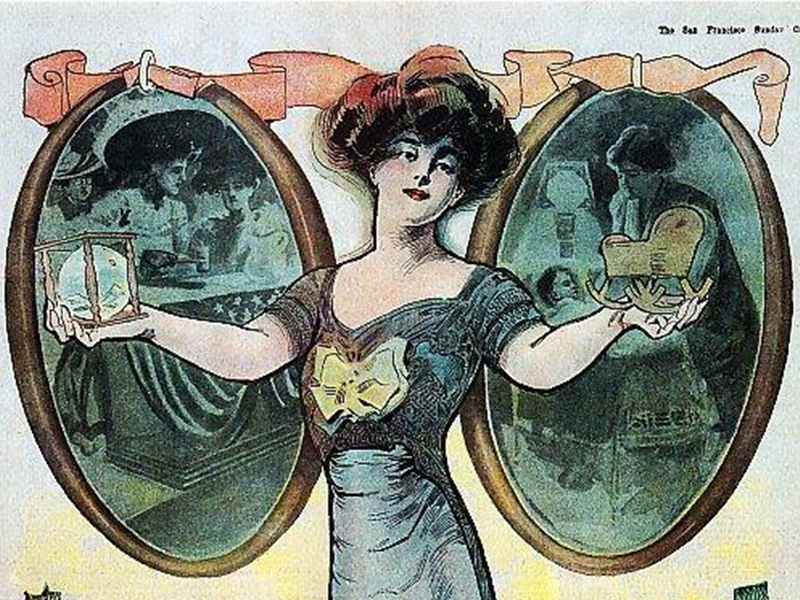
A cartoon in the San Francisco Sunday Call of July 4, 1909, in which a woman is holding up a ballot box and a cradle showing that she can handle both the responsibilities of motherhood and being a voter. The caption is: “I can handle both, says the lady.”

Though it seems somewhat superfluous for anti-suffragists to advertise in the Times, since its editorial page has already put forth every imaginable anti-suffrage argument, the always-overflowing war chest of the opposition apparently needed to be drained a bit today, so they took out a full-page advertisement in their favorite paper. The first sentence sums up their standard argument: “We, the women of the Southern California Association Opposed to Woman Suffrage, urge you not to thrust the womanhood of this State into the political maelstrom, at the request of the small minority of women who are asking for the ballot.”

The anti-suffrage ad goes on to cherry-pick the most controversial statements of suffrage leaders, harks back to a referendum held 3,000 miles away 16 years ago, takes quotes from Judge Ben Lindsey’s pro-suffrage writings out of context, accuses suffragists of being anti-religious and unpatriotic, and even criticizes the five-star suffrage flag as a “mockery” of the Stars and Stripes. The anti-suffragists conclude by returning to their original theme: “The great majority of California women do not follow the suffrage flag, they do not want the vote; they depend upon the manhood of California to protect them from the responsibility of the ballot. They rely on manhood suffrage and a safe and sane government.”

Fortunately, opposition arguments tend to wither in the face of actual experience. A Letter to the Editor appeared in the Los Angeles Tribune today illustrating this point well. It was written by a local woman who has lived in Colorado, where women won suffrage in 1893. After attending an anti-suffrage meeting, she found their arguments so bizarre that she became an ardent suffragist – who now finds herself disenfranchised because she moved to California:

I have voted eleven years – twice for President. No man ever tried to influence my vote, not even my husband. I have never received anything but courteous treatment from men gathered at the polling place. I have not been contaminated in my contact with common man at the poll. My children, husband and friends have lost none of their respect for me, although I have registered my political wishes on the ballot.

Conceding to the ‘antis’ that I have done such a disgraceful thing as to vote, I want to make another confession to them. I have also attended church where there were men present, went shopping where I met men on the street, and have stood in line at the tax window with men. I have visited the schools where there were men, and have been to the courthouse, where one sees men – and I do not feel that I have been contaminated.

Those against suffrage put forth the argument that a woman hasn’t time to go to the poll. They talk as though every day was election day. Women will wash their breakfast dishes, comb the children’s hair and wash their faces, make jam and study for higher education just the same with the ballot as the majority do without it.

The majority of women who want the ballot do not want it because it will give them a chance to hold office, any more than the majority of men are office seekers. They want it to assume their part in making the laws of this country what they should be to protect the home, the school and the individual from unscrupulous legislation.

It seems very queer that the anti-suffragists should have converted me against themselves, but it is true, and I have always been thankful that I attended that ‘anti’ meeting. It enabled me to see the contrast between a fight for a purpose and a fight [against] it – and I hope that the fight for the purpose will win as well in California as it did in Colorado.

Day after tomorrow we shall see whether Mrs. L.W. Worth will get her right to vote back, and if other California women will be able to join her at the polls in the election following this one.

October 7, 1911: California Men Debate Suffrage to a Packed Theater in San Francisco

Founding Feminists is FMF’s daily herstory column.

FoundingFeministLogo-color

With just three days to go until the vote on woman suffrage in California, the Valencia Theater in San Francisco was filled to capacity tonight by those who wanted to hear the big debate that everyone had been waiting for.

It was a spirited contest between Dr. Charles F. Aked, representing the pro-suffrage side, and Colonel John P. Irish, his equally determined opponent, and the exchange left no argument on either side of the issue unspoken.

Dr. Charles F. Aked.

The battle opened with Irish attacking the assumption that adding women to the electorate would naturally tend to improve politics. He quoted from long-time suffrage advocate Judge Ben Lindsey’s book, “The Beast, ” (a phrase which Lindsey uses to denote “corrupt influences” in his own State of Colorado, where women won the vote 18 years ago). Reading from Lindsey’s book, Irish said: “The women are as free from the Beast as the men, and no freer. They are bound by the same bonds of bread and butter.”

Aked then supplied the rest of the quote:

Do not misunderstand me – woman suffrage is right; it is expedient. In all moral issues [in Colorado] they have been loyal. The good they do is a great gain. When the women see the Beast they will be the first to attack it. The women saved us – they saved the Juvenile Court.

This response brought forth the first – and biggest – ovation Aked got during the evening, though by no means the last, from the mostly pro-suffrage, and quite boisterous crowd.

This is far from the first time anti-suffragists have tried to misuse Judge Lindsey’s words. In fact, it’s becoming so common that earlier in the week he sent a telegram to Mr. B. J. McCormick in which he said:

My Dear Sir: Unjointed sentences or statements from the contents of many addresses I have made in favor of woman’s suffrage have been used in the manner your telegram indicates. Of course it is a very disreputable kind of business and reflects no credit on those who resort to such unfair tactics.

Do the people of California insist that the women shall be ministering angels so absolutely ethereal and perfect that they are incapable of any of the wickedness of human nature? Do they demand as a condition precedent to giving them the right to vote – the same right that has been given to men – that they shall furnish conditions that were never required of men – perfection? If they do it is the height of impudence as well as the height of absurdity.

Of course, some women, like some men, are just about as crooked as they can be in politics, and of course, some of them will be just as the men have been, but our experience is that where there is one woman who stands for injustice, iniquity and fraud there are a good many men who do the same thing. If that is one point against woman’s suffrage, it is ninety times more a point against male suffrage, and the only logic of such rot in a suffrage campaign is to take the suffrage away from men and give it all to the women.

Why do the suffragists of California permit the ‘antis’ to lead them on wild goose chases by such side issues? Suppose a woman would stand for political iniquity, as some of them certainly will, what has that got to do with the question? No such arguments were used in the struggle for male suffrage. It would never have been extended, and no man outside of the privileged and property-owning classes would have a right to vote in California today. If there is anything that ought to make any honest, fair-minded man vote for suffrage, it is just such illogical arguments and unfair tactics. Very Respectfully, Ben B. Lindsey.

Having lost the first round, Irish tried another tack:

Manhood suffrage is logical. The hand that votes must be the hand that enforces the statutes created by the ballot. To divorce these two functions is to attack the very foundations of government.

But the ballot has never been restricted to men in law enforcement or even to those capable of serving on police forces, and Aked noted it was taxpaying that has been man’s principal claim to the right to vote. (“Taxation without representation is tyranny” dates back to pre-Revolutionary times.) Since women pay precisely the same taxes at exactly the same rates as men, they have just as valid a claim on the right to elect those who tax them. Aked even turned Irish’s own argument against him: “The vote of the weak is man’s answer to the aggressions of the strong. The weaker physically woman is, the more she needs the weapon of the ballot.”

An overt appeal to male supremacy launched the next volley, as Irish objected to women attacking “good laws” such as those which make the man the head of the family and give him sole control of all the couple’s property: “These laws were conceived in wisdom. Man is the head of the family because he is responsible for its support and can be sent to the rock pile if he fails to support his wife and children.”

The debate got more personal and intense as the evening went on, with cheers, hisses and boos from the crowd punctuating more and more of each speaker’s comments. The final portion of the debate was marked by demonstrations so loud that it became increasingly hard to hear the debaters. But what the end lacked in decorum it made up for in enthusiasm. Judging by tonight’s audience reactions, there will be a high turnout of voters on Tuesday, with most of them having far more intense feelings about this amendment than any of the other 22 that the Legislature has placed before the (male) electorate.

As to whether this year’s vote will turn out better than the unsuccessful suffrage fight held here in 1896, the Los Angeles Tribune has no doubts, and quotes a revered source for its prediction of victory:

It is recalled that when, fifteen years ago, Susan B. Anthony led the fight in California for equal suffrage she met with little opposition. But a few weeks before election, representatives of the State Liquor Dealers’ Association met quietly in San Francisco and passed the word along: ‘Vote No.’ In those days what the railroad and saloon said ‘went.’ They had the organization; the people had not yet learned what it meant to run their own affairs.

Does any one doubt that the interests whose welfare may not be advanced by equal suffrage have already had their meeting and passed along the same orders in the campaign of 1911?

But there are fewer people now who take such orders. An army that once followed the dictates of the machine either from fear of punishment by its orders, or in order to stand with the powers, or to be on the winning side, is broken up and scattered. Its skeleton remains, however – make no mistake about that. It is ready to take quick advantage of popular lethargy, to which it looks for a chance to rehabilitate itself, but it is powerless so long as the right-thinking people of California stay on the civic job.

One great obstacle of equal suffrage, therefore, is removed this year and only the failure of the best manhood of California to meet its full responsibility next Tuesday can again postpone the fulfillment of Miss Anthony’s prophesy after her defeat: ‘Be of good cheer; California will have suffrage.’

The polls open in less than 72 hours, and “Votes for Women” advocates will make the most of every minute until then to make sure that the late suffrage leader’s prediction is proven true.

October 6, 1911: As California Suffrage Vote Nears, Activists Remain Positive

Founding Feminists is FMF’s daily herstory column.

FoundingFeministLogo-color

Will the number of women voters in the U.S. be nearly doubled four days from now?

That delightful prospect is looking more likely each day as the October 10th vote on woman suffrage in California approaches, and signs of enthusiasm for the cause become even more apparent. The unprecedented size of the suffrage rallies certainly justifies optimism. The largest of today’s mass meetings was in San Francisco’s Valencia Theater (although it was also outside as well, with many speakers giving a second address to those who could not be admitted after every seat was filled).

The rally’s first speaker was Elizabeth Selden Rogers, who came here from New York to help with the campaign. She enthusiastically and convincingly refuted arguments made in an anti-suffrage circular by State Senator John Bunyan Sanford. In a pamphlet entitled “Against Woman Suffrage,” Sanford says:

Man can attend to all the affairs of a governmental nature. But in order that our country shall endure we must look to the home side of life. The home is the place for woman. God knows she has enough to do there in bringing up the little ones in the way they should go. If she does that duty well and trains up the modest daughter with gentle influences and makes the young boy regardful of the respect that is due his sister and his playmates’ sisters all will be well with this republic of ours.

Sanford then goes on with the usual flatteries about the purity and exalted status of women and the common argument that they should be “protected” from having to wade into the “dirty pool of politics.” But Rogers said:

He tells us that it is the duty of woman to keep the home pure. How can she keep it pure when this dirty pool comes right up to the doorstep? How can she bring up her sons and daughters to be good citizens, when the evil influences which the pool permits to exist are right there and beyond her control? Senator Sanford says that we can trust the men to protect us and our daughters from harm. Do we set wolves to guard our sheep?

And how can women keep their homes pure when thousands on thousands of them have, under modern industrial conditions, no homes to keep? He speaks of the throne upon which woman has reigned in the past. Thrones are falling all over the world before the onset of real democracy. I’d give up my place on the throne for the right to cast a ballot next Tuesday.

Senator Sanford tells us that modesty, gentleness and patience are the charms of woman. I say nothing against these great virtues. But there it is – there is where the cloven hoof shows itself in the argument. He thinks that women exist solely for the purpose of charming men, which is very nice and comfortable for men. And yet further on he tells us that woman is woman and cannot unsex herself. Then what is he worrying about?

Jackson Stitt Wilson, Socialist Mayor of Berkeley, told the audience that woman suffrage is inevitable:

Every conception by which modern democracy wrenched the crowns from the heads of kings and established the rule of the people leads straight to votes for women. The word ‘people’ in all our documents of liberty must sooner or later mean women as well as men. The logic of Americanism, the logic of the Declaration of Independence, the logic of the whole spirit and program of our democratic institutions is equal suffrage. Sex is not a determined factor in human rights. The ballot is the weapon of defense and the avenue of social expression for human personality, not for male personality. Votes for women is the logic of civilization.

Suffrage advocates at a recent meeting in San Francisco.

Frances Noel, president of the Wage Earners’ League, returned to Los Angeles from Bakersfield today, and told of great support for suffrage in the San Joaquin Valley, 110 miles north of Los Angeles. She attended a State Federation of Labor meeting, and reports only token opposition. A member of the Sailors’ Union introduced an anti-suffrage resolution, but when Noel pressed him, he admitted that it was his own idea, and not something he was proposing on behalf of his union. His resolution got only three votes.

But Noel also noted that the opposition of the liquor lobby hadn’t decreased since California’s last suffrage battle in 1896:

I had a fight with the liquor men, too. They protested against woman suffrage, of course, so I finally said, ‘Very well, you liquor men. We women have nothing to do with liquor or prohibition – we are for suffrage and suffrage only. But if you want to sit in the track, waiting to fight the steam engine, all right. Only we invite you, while there is time, to come inside the train or we will surely run over you.’

The Los Angeles Express delivered another of its fine pro-suffrage editorials today, this one simultaneously criticizing anti-suffragists and a rival paper. Entitled “Conscience and the Ballot Box” the Express said:

‘Persian men have decided against woman suffrage on the ground that women have no souls and therefore should have no vote. Men of California who oppose woman suffrage do so because women are superior to men in qualities of soul.’

The foregoing is quoted from a Los Angeles morning paper opposed to equal suffrage. If it means anything at all, other than insincere drivel, it means that men opponents of woman suffrage are absolutely indifferent to qualities of soul in political life. Webster defines ‘soul’ as ‘the principle of mental and spiritual life … the part of man’s life characterized by reason, conscience and the higher emotions.’

What kind of male citizenship is it that would rob the political life of a State of the qualities of soul most needed. If reason, conscience and the higher emotions are to be ruled from participation at the ballot box, slowly indeed will reform be carried out. Enemies of good government would, if they could, disenfranchise men also who bring qualities of soul into elections.

Here is the secret of the opposition to woman suffrage. It is fear of reason and of conscience in the voting booth. We have it from the mouths of its opponents themselves. Let every friend of honest, decent government in city, State and Nation who may see the lines quoted at the beginning of this article read them over once again and give them the thought an honest, conscientious man is willing to accord a vital proposition, and then say whether the vote of a woman is not needed as a matter of expediency as well as indisputable justice.

Readers of the Express are helping the suffrage effort as well. In a Letter to the Editor, Ira A. Cain says there are many reasons to vote for suffrage:

Because it is the right thing and the honest thing to do. A square deal demands it. Not to vote for equal suffrage is to wrong the helpless, who are not in a position to defend or help themselves in any way. Woman is asking no concessions when she asks not to longer be debarred from that which is her own. Man is simply lording over that which is not his own. Justice, manhood, dignity, common honesty, unite in demanding for woman that which has been withheld from her. Arguments to the contrary are entirely wanting. To withhold the franchise from American women is to throttle fully one-half of the intelligence of the country. Discrimination against woman by denying her equal political rights is a relic of the Dark Ages. It had its origin in savagery.

The restricted ballot is in direct violation of the essence of the Constitution of the United States, which declares, “All men are born free and equal.’ In violation of this basic principle we have proceeded to fetter one-half of the intelligence and a large per cent of the morality and virtue of this republic. It is conceded on all sides that there should be no taxation without representation. Yet we deny women the franchise and at the same time assess heavy taxes upon their property. We deny women a voice in legislation, yet compel her to obey laws made by men.

In the common schools of the United States 17,000,000 children are enrolled. As teachers in these public schools we have 400,000 women. Their work in educating the young is faithfully and conscientiously done. There is no lack of efficiency and no trusts are betrayed. They are with the millions of mothers molding the characters of our voters of tomorrow and through them shaping the destiny of the future nation. Yet out of these millions of faithful mothers and teachers not one in our State is allowed to vote. It is time that men should right the wrong men have done in denying women an equal voice in government. It can only be done by voting for the suffrage amendment.

Today marked the California suffrage campaign’s first “military victory.” By order of its governor, suffrage speakers had not been permitted to address the residents of the National Home for Disabled Volunteer Soldiers and Sailors, in Sawtelle, west of Los Angeles. Yesterday an anti-suffrage speaker gave a speech, and seemed to win over a number of residents who had previously been reported as quite supportive of suffrage. But today the governor finally relented – probably due to harsh criticism in the press – and allowed Dr. Robert J. Burdette, one of the best suffrage speakers in the State, to talk to the troops.

There was an overflow audience of 1,500 – nearly twice as many as listened to yesterday’s anti-suffrage speaker – when Burdette made his eloquent appeal to the veterans. By the end of his speech they were won back to the cause. His best argument was the injustice of the fact that if Betsy Ross were still around, even she who made the first American flag would not be allowed to vote:

And now some people say the woman who made it shall not vote under it. And we say, if there is any manhood, if there is any chivalry, if there is any grace of fairness, if there is any love or reverence for woman in the hearts of the men of California, we say – by every star that shines in glory on that azure field, we say she shall!

Betsy Ross never got to vote, but if the result on Tuesday is favorable, all California women will gain equal voting rights, and will nearly outnumber all the women who have won the vote in the five suffrage States of Wyoming, Colorado, Idaho, Utah and Washington combined. So, this isn’t just about winning a sixth State for suffrage, but gaining a massive boost for the suffrage movement. After a 14-year drought in which not a single State was won, the victory in Washington last year, plus one in California this year, could make the cause seem unstoppable, and nationwide suffrage inevitable, so this needs to be an all-out effort for the next 96 hours!

October 3, 1950: Eleanor Roosevelt Praises Women’s Rights Victories Around the World and Asks for More

Founding Feminists is FMF’s daily herstory column.

FoundingFeministLogo-color

Eleanor Roosevelt, former First Lady and present U.S. Delegate to the United Nations, today praised the progress the women of the world have made in winning the vote in the five years since the United Nations was established. According to the U.N.’s latest report, women now have the same voting rights as men in 56 countries, a gain of 21 since 1945.

10686820_10203267442750409_2798623933073446411_nThere is still work to do, however, because sixteen countries deny women any political rights: Afghanistan, Columbia, Egypt, Ethiopia, Haiti, Honduras, Iran, Iraq, Jordan, Lebanon, Lichtenstein, Nicaragua, Paraguay, Saudi Arabia, Switzerland and Yemen. In Bolivia, Greece, Mexico, Monaco and Peru, women have partial suffrage and may vote in local elections only. In Guatemala, Portugal and Syria they have full suffrage, but only if they meet educational or literacy standards not required of men.
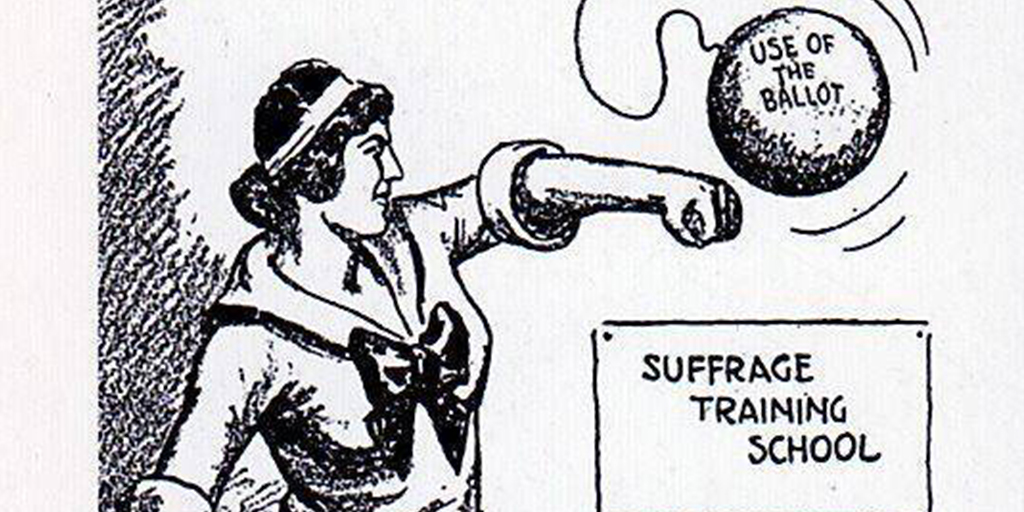
Roosevelt said today:

The right to the franchise is basic and fundamental. The fact that it has been abused, both by citizens and governments, should not blind us to its potential as the fundamental safeguard for the individual. It is axiomatic that political institutions and relations among governments must change. The important point is that when changes are needed they come about peacefully through the free choice of all the people.

She credited the U.N. Charter with helping to speed this trend toward equality for women, and told the General Assembly’s Social Committee that countries in which women do not have equal suffrage were now seen as “out of step with the times.”

Eleanor Roosevelt was first appointed as a delegate to the U.N. in 1945 by President Truman. The next year she became head of the United Nations Commission on Human Rights, and was instrumental in drafting the Universal Declaration of Human Rights in 1948. She said at the time:

We stand today at the threshold of a great event both in the life of the United Nations and in the life of mankind, that is the approval by the General Assembly of the Universal Declaration of Human Rights recommended by the Third Committee. This Declaration may well become the international Magna Carta of all men everywhere. We hope its proclamation by the General Assembly will be an event comparable to the proclamation of the Declaration of the Rights of Man by the French people in 1789, the adoption of the Bill of Rights by the people of the United States, and the adoption of comparable declarations at different times in other countries.

Her continuing commitment to women’s rights can be seen by her actions on May 1, 1946. She was an ex-officio delegate and the most active participant in a discussion of the proposed Statement of Purpose of the U.N. Subcommittee on the Status of Women. She told the members that their task was to work “until you feel women have reached the point where they are on an equal basis with men and are considered human beings.” The subcommittee then adopted as their resolution:

Whereas freedom and equality are essential to human development and whereas woman is as much a human being as man and therefore entitled to share with him; We believe that the well-being and progress of society depend on the extent to which both men and women are able to develop their full personality and are cognizant of their responsibilities to themselves and to others, and we believe that woman has thus a definite role to play in the building of a fine, healthy, prosperous and moral society and that she can fulfill this obligation only as a free and responsible member. Therefore, be it resolved that the purpose of the subcommission is to raise the status of women to equality with men in all fields of human endeavor.

Eleanor Roosevelt has already contributed much to her country, as well as the world, and hopefully will continue to do so for many more years.

October 2, 1918: Suffragists Vow to Elect Allies and Oust Enemies in Senate

Founding Feminists is FMF’s daily herstory column.

FoundingFeministLogo-color

Undaunted by yesterday’s two-vote loss in the Senate for the Susan B. Anthony (nationwide woman suffrage) Amendment, Alice Paul and other members of the National Woman’s Party are meeting today and tomorrow to plan their most effective response.

One thing is now certain: there will be no second vote until after the November elections, according to members of the Senate Woman Suffrage Committee. It’s the consensus of the committee’s pro-suffrage members that until the composition of the Senate is changed, the result would be another defeat.

But the 65th Congress is near the end of its term, and not only is the entire House and 1/3 of the Senate up for election, but there have been an unusual number of Senate vacancies temporarily filled recently, so a vigorous and well-run campaign could cause a major shift in favor of suffrage in the Senate. All factions of the suffrage movement will be actively working for this change. The National American Woman Suffrage Association will be targeting four anti-suffrage Senators, and the National Woman’s Party will intensify its already-announced campaign against Democrats, who have controlled both House and Senate since 1913, but have not delivered on suffrage, and continue to lag far behind Republicans in their support.

10304776_10203261326197499_4973390682940518536_nAccording to a statement released by the National Woman’s Party tonight, the outlook is very favorable:
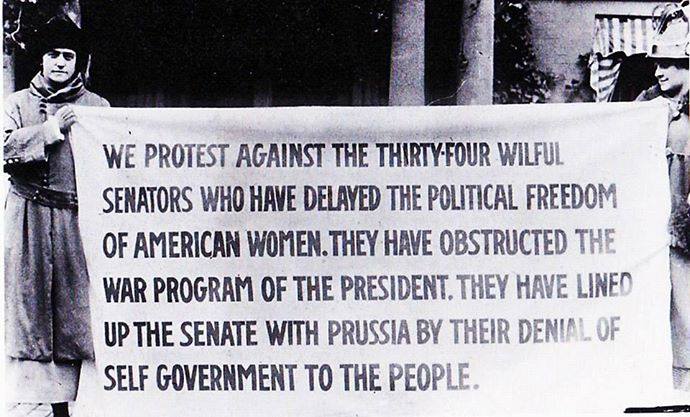
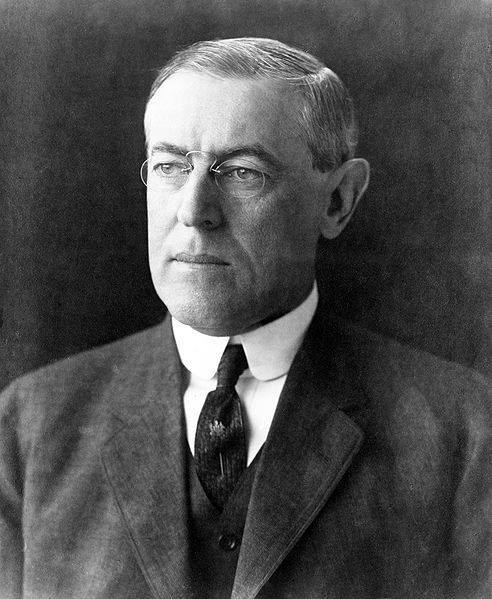
Several vacancies occur in the Senate in November, when the terms of men now serving under appointment expire. Senator Benet of South Carolina, who voted against the suffrage amendment, contradicting the President’s statement that it was a ‘war measure,’ holds his seat only until the November election. He was defeated in the recent primaries when he ran to succeed himself, and will be followed by W.P. Pollock, who, suffragists hope, will support the President in this measure.

The appointment of Senator Martin of Kentucky, who voted for the amendment, lasts until March. Senator Baird of New Jersey was appointed by Governor Edge with the understanding that he would support President Wilson in all his war measures. In spite of this fact, he voted ‘no’ on the suffrage amendment last Tuesday. Senator Baird is contesting the November election for the short term with the Democratic candidate, Mr. Hennessy, who is a strong suffrage advocate. Governor Edge, who is running for the long term in New Jersey, and who appointed Baird, has made suffrage the first plank in the platform, showing the importance given the measure in New Jersey.

Senator Drew of New Hampshire, who also declined to support the President on this war measure, received only one vote in the recent State convention, and goes out in November. The two men running for his seat are Mr. Moses, Republican, who is a strong suffragist, and Mr. Jamisson, Democrat, whose nomination has just been announced, and whose position on suffrage is being inquired into.

Vacancies occurring in suffrage States are bound to be filled by suffragists, and so will not affect the situation.

As might be expected, Republicans are taking great – and quite justifiable – pride in their party’s overwhelming support of woman suffrage. When the measure passed the House on January 10th, Democrats gave it a bare majority of 104 in favor and 102 against (50.5% support), while Republicans voted 165 in favor and 33 against (83.3% support). Three members of the Socialist Party, one from the Prohibition Party, and one Progressive Party member voted in favor as well, with one Progressive voting against, making the final tally 274-136, just enough for the 2/3 required.

In yesterday’s Senate vote, 27 Republicans and 27 Democrats favored the measure, with 10 Republicans and 20 Democrats opposed. At the last minute, Senator Andrieus Jones, Democrat of New Mexico and chief sponsor of the measure, changed his vote to “no” so that under the Senate rules he would have the right to bring it up again, thus making it officially 26 Democrats in favor and 21 opposed. Either way, Democratic support was well under the 2/3 needed (57% or 55%), and Republican support well over 2/3 (73%). Representative George Foss, Chairman of the Republican National Congressional Committee issued this statement tonight:

“Votes for women was placed on the list of necessary measures to win the war by Presidential decree in his address to the Senate. The vote taken soon after the pronouncement indicates the attitude of party support. For the measure 27 Republicans and 26 Democrats; against 10 Republicans and 21 Democrats. The defeat is charged to Democrats, who have control of the Senate by a majority of eight votes.”

“Votes for Women” may have suffered a legislative setback, but only a temporary one. Millions of women already vote in suffrage States, and will do so in November. Yesterday’s defeat has only served to make suffragists in all States even more determined to have an impact on the upcoming elections and make sure that the two Senate votes which were lacking in the 65th Congress will be present in the 66th. The Anthony Amendment can then be passed by Congress and sent to the States for ratification early in 1919, when the State Legislatures are in regular session, and ratified long before the 1920 elections.

October 1, 1918: Senators Weigh in on Woman Suffrage

Founding Feminists is FMF’s daily herstory column.

FoundingFeministLogo-color

The speeches by pro-suffrage Senators today were as eloquent and impassioned as they had been during yesterday’s debate.

President Wilson’s commitment to the cause was undiminished, as he followed up yesterday’s speech to the Senate with personal letters to his fellow Democrats urging them in the strongest personal terms to vote for the Susan B. Anthony (nationwide woman suffrage) Amendment today. Unfortunately, the number of Senators pledged to oppose suffrage was also unchanged from yesterday, and the Amendment failed to pass.

Right up until the time the voting ended, Senator Andreus Jones, Democrat of New Mexico, the amendment’s chief sponsor, had hoped for some last-minute conversions. But when the roll was called, the tally stood at 54 to 30, two short of the 56-28 (two-thirds) majority that would have meant success. (Only a 2/3 majority of those present and voting is needed, not an absolute 2/3 majority of 64 out of 96 Senators.) Had all Senators been present and voting, suffrage forces would still have been two votes short due to 34 being pledged to vote “no.” At the last moment Senator Jones switched his vote to the “no” column so that he would be allowed to call it up for another vote if there was a more favorable outlook. That made the official vote count 53-31, technically three short of victory, but with the measure still alive.

The original count was 27 Democrats in favor and 20 opposed (57% support), and 27 Republicans in favor and 10 opposed (73% support). Not one anti-suffrage Democrat heeded the President’s call to pass the Anthony Amendment as a “War Measure.” Even Majority Leader Thomas Staples Martin of Virginia, and others who have been prominent and vigorous supporters of the President’s other policies, deserted him today.

10380910_10203254430545112_8372465617311621738_n

The reason for such strong opposition by Southern Democrats is well-known, and was vividly illustrated by a proposal of Senator John Sharp Williams of Mississippi, He asked that the Anthony Amendment be re-worded so that it would authorize only white women to vote. The motion was overwhelmingly rejected by being tabled 61-22. That 22 of the original 30 votes cast against suffrage were my militant segregationists shows where much of the opposition is now coming from. Suffrage groups and their Senate supporters should be commended for retaining the race-neutral wording of the Anthony Amendment and refusing to give in to Southern Democrats’ demands that they abandon some women in order to enfranchise others.

Today’s debate began with an accurate prediction by Senator Albert Baird Cummins, Republican of Iowa: “I fear that a little group of willful men are intent on binging about the defeat of this amendment.” This was followed by a discussion of whether woman suffrage was truly a “War Measure.” President Wilson insisted yesterday that it was, because we are in a war for democracy, and there could be no better way for our nation to show its commitment to that cause than by enfranchising our women citizens. But other than the “War Measure” issue, the debate covered nothing new, and changed no minds. Senator Knute Nelson, Republican of Minnesota, noted that: “This is not the first time the voice of the prophet has not been heard in the wilderness,” and Senator Cummins followed up with, “No, and I want to know how Senators who vote against this amendment are going to escape the consequences of it.”

William Jennings Bryan was asked if he thought the Senate had disposed of the suffrage issue. He replied:

By no means. The President presented a powerful appeal and it will continue to bring pressure to bear upon opponents of suffrage through the responses the people will make to the President’s appeal. I expect to see the suffrage amendment submitted to the States before March 1 next … it must be remembered that the liquor interests have been the backbone of the opposition to suffrage in the North and that this influence will disappear with the ratification of the Prohibition Amendment … Taking these two influences together, I think there will be more than enough changes to give the necessary two-thirds.

Alice Paul is as confident as Bryan of eventual victory:

This defeat is only temporary. The vote of the Senate, we are convinced, will be reversed before this session of Congress ends. Our efforts to secure the reversal will begin at once and will continue until our victory in the House is confirmed by the Senate.

So, despite today’s discouraging vote, it’s really only a question of whether the Anthony Amendment is approved and sent to the States for ratification by this Congress or the next one.

September 30, 1918: President Wilson Speaks Out in Congress for Woman Suffrage

Founding Feminists is FMF’s daily herstory column.

FoundingFeministLogo-color

It was truly stunning and historic when President Wilson unexpectedly came into the Senate at 1:00 this afternoon to speak for fifteen minutes on the necessity and justice of that body voting in favor of the Susan B. Anthony (nationwide woman suffrage) Amendment.

It has already been approved by the House, which on January 10th, the day after President Wilson endorsed it, gave it exactly the 2/3 majority needed. But the Senate had been postponing action, and because Democrats constitute 22 of the 34 votes pledged to vote against the Anthony Amendment, a pro-suffrage pep-talk by a Democratic President was welcomed by all factions of the suffrage movement.

In his address, Wilson went so far as to call the suffrage amendment a “War Measure,” the highest priority a President can assign to legislation he wishes to be passed. He said, in part:

I regard the concurrence of the Senate in the Constitutional amendment proposing the extension of suffrage to women as vitally essential to the successful prosecution of this great war of humanity in which we are engaged … It is my duty to win the war and to ask you to remove every obstacle that stands in the way of winning it. I had assumed that the Senate would concur in the amendment because no disputable principle is involved but only a question of the method by which the suffrage is to be extended to women…

This is a people’s war and the people’s thinking constitutes its atmosphere and morale, not the predilections of the drawing room or the political considerations of the caucus. If we indeed be democrats and wish to lead the world to democracy, we can ask other peoples to accept in proof of our sincerity and our ability to lead them whither they wish to be led nothing less persuasive and convincing than our actions. Our professions will not suffice. Verification must be forthcoming when verification is asked for…

This war could not have been fought, either by the other nations engaged or by America, if it had not been for the services of women – services rendered in every sphere – not merely in the fields of effort in which we have been accustomed to see them work, but wherever men have worked and upon the very skirts and edges of the battle itself. We shall not only be distrusted but shall deserve to be distrusted if we do not enfranchise them with the fullest possible enfranchisement, as it is now certain that the other great free nations will enfranchise them … The executive tasks of this war rest upon me. I ask that you lighten them and place in my hands instruments, spiritual instruments, which I do not now possess, which I sorely need, and which I have daily to apologize for not being able to employ.

993494_10203249688026552_6428134952811555961_nPresident Wilson’s journey from a position of woman suffrage being a matter for the States to decide for themselves, to “sympathy for the cause,” but no specific endorsement of the Anthony Amendment, to endorsement but no action, and finally to today’s vigorous lobbying for the measure on the eve of a crucial vote, has been a long and trying trek. Ever since his first inauguration in 1913, all suffragists have been urging him to use his considerable influence to get the amendment through successive Democratic Congresses and sent to the States for ratification.
Alice Paul and other members of the National Woman’s Party began engaging in peaceful protests along the White House fence on January 10, 1917, and suffered arrests, imprisonment, brutality by guards, and force-feedings when they began prison hunger strikes. All of this the result of publicly pointing out Wilson’s previous hypocrisy of strongly promoting democracy around the world while doing nothing to bring it to the female half of his own country. This summer the National Woman’s Party began protesting Senate inaction as well as Wilson’s insufficient support, and on September 16th staged a colorful and well-publicized protest at the Lafayette Monument. The next day the Senate suddenly decided to schedule a vote for October 1st.

While the National Woman’s Party has not yet commented on today’s speech, Carrie Chapman Catt, president of the National American Woman Suffrage Association, and who had personally asked Wilson to address the Senate, said:

No country has paid so great a tribute to its women as was paid the women of our country today, when the President of the United States entreated the Senate to pause no longer in the passage of the Federal amendment. He perceives that the new faith in the ultimate outcome of the war, that exultation of spirit which would come to women through the recognition of their political equality, would bring into the war spiritual forces not now engaged. The President today took a stand for human liberty which no man can gainsay.

Rev. Anna Howard Shaw, N.A.W.S.A.’s previous president, also praised Wilson:

For more than forty years I have devoted my life to securing the ballot for women because I have always believed it to be a fundamental principle of right and justice, but from this day I have the authority of the Commander-in-Chief of the Army and Navy. Although the patriotism of American women will always lead them to devoted service for their country, the fact that their country recognizes the justice of their claim to political freedom will hearten and encourage them in service as nothing else can.

Whether President Wilson’s speech will change the outcome of tomorrow’s vote remains to be seen. Southern Democrats, now the principal bottleneck to nationwide woman suffrage, seem as vehemently opposed as ever, judging by some of their speeches today following Wilson’s presentation. As “States’ Rights” advocates, they tend to oppose Constitutional amendments in general, and are particularly opposed to this one because it is race-neutral and Section Two gives Congress the right to pass appropriate legislation to enforce the voting rights it would grant to all women.

Though lobbying by pro-suffrage Senators of their colleagues continues, not a single Senator of either party has yet announced a shift to the suffrage side. So, the tally at the end of the day is still what it was this morning: Sixty-one in favor, thirty-four opposed, and one doubtful, but leaning toward suffrage. Sixty-four of ninety-six Senators must vote in favor of a Constitutional amendment in order for it to pass by a two-thirds majority if all are present. The party lineup tonight is as follows: Twenty-nine Democrats in favor, twenty-two opposed (57% support); Thirty-two Republicans in favor and twelve opposed (73% support), with Senator George Martin, Democrat of Kentucky, leaning toward suffrage, but still uncommitted.

Knowing a vote today would be a defeat, Senator Andreus Jones, Democrat of New Mexico, the Anthony Amendment’s sponsor, wisely moved for a recess until tomorrow. A vote will be taken then, with everyone on the suffrage side – including the President of the United States – having done their best to get a favorable result.

If Senator Martin votes as expected, and two votes can somehow be changed overnight, the Anthony Amendment will be sent to the States, with 36 approvals needed to make woman suffrage the law of the land. If the amendment is rejected tomorrow, then the National Woman’s Party’s campaign to elect Republicans and unseat Democrats in November’s elections will become even more intense, and the National American Woman Suffrage Association’s rumored “back-up plan” of targeting four specific anti-suffrage Senators for defeat will likely be implemented. Either way, victory in Congress seems to be approaching, the only question is whether it will be tomorrow, or after some long overdue changes are made in the composition of the Senate after the November elections.

September 29, 1906: New York City’s Women Teachers Rise Up for Equal Pay

Founding Feminists is FMF’s daily herstory column.

FoundingFeministLogo-color

“Equal pay for equal work!”

That was the demand today by the 4,000 women in New York City’s Interborough Teachers’ Association. Having gotten nowhere with the Board of Education, they’re now planning to go to the New York State Legislature. At present, women’s elementary school teaching salaries start at $600 a year, and can rise to a maximum of $1,440 after 11 years if they pass extra examinations. Male teachers begin with a salary of $900 a year, and can reach $2,400 after 11 years if they pass the same extra examinations.

However, a woman teacher who teaches a boys’ class can earn a $60 a year bonus, though for many that isn’t nearly enough. District Superintendent Grace Strachan says that women teachers who switch to boys’ classes often quickly demand to be transferred back to teaching girls. According to Kate Hogan, the I.T.A.’s president, it is with the hardy group of women who continue to teach boys that the battle for equality will begin:

We are going to be true to our cry, ‘equal pay for equal work,’ in our fight. The work of equalization of salaries will be principally in making the salary of a teacher of a boys’ class equal to that of a man teacher.

10649641_10203244702061906_8526866446209056722_n

But that’s only the beginning. “When we started our campaign for ‘equal pay for equal work,’ we announced that all women in the system would profit by it, and they will,” Hogan said today, as reassurance to the women who prefer to teach girls.

One powerful ally in the teachers’ fight may be President Theodore Roosevelt. Six years ago, when he was still Governor of New York, he signed the Davis Act, an educational reform passed by the State Legislature. At the time he expressed disapproval of the provision setting a wide discrepancy between the salaries paid to male and female teachers. But since it was highly unlikely that the bill could be revised, and because the salary differences were narrower than those which existed at the time, and both sexes had their salaries raised, he gave the bill his signature, hoping the flaws could be fixed in the future.

But six years later, the problem of unequal pay for women teachers is still unresolved. Last year, a dissident faction of the Class Teachers’ Association led the campaign. They sent out a circular saying:

The time is ripe to establish the principle of equal pay for equal work. Why should a woman’s minimum annual salary be $300 less than a man’s, and why should her maximum salary be $960 less than a man’s? The women teachers do the same work, are exempt from no rules or duties, and most of them have fathers, mothers, sisters or brothers dependent upon them. Why, then, should women not receive the same salaries? Let us make a strong, united effort to bring about a consummation of what is so manifestly just.

This year it is the I.T.A. that has become militant. The Board of Education was given the power to equalize pay, but did not do so this Spring when the women made a strong, united appeal. Their proposal was rejected without a single dissenting vote. Now the teachers have decided to go directly to the highest lawmaking body in the State, and the one that passed the Davis Act in the first place. Since they do not want the Act itself repealed, only amended in regard to equal salaries, they think that they have a chance of success, and have already gotten support from some legislators.

A mass meeting will be held on Saturday, October 6th, in the old City College of New York Building, on 23rd Street, to determine how to proceed with the campaign. All those supportive of “equal pay for equal work” should attend. A victory in this fight will not just bring economic justice to New York’s women teachers, but hopefully start a national trend, resulting in equal pay for women in all fields of endeavor while this new century is still young.


INFLATIONARY NOTE / UPDATE : $ 60 in 1906 = $ 1,585.39 in 2014; $ 300 = $ 7,926.97; $ 600 = $ 15,853.94; $ 900 = $ 23,780.92; $ 960 = $ 25,366.32 ; $ 1,440 = $ 38,049.47; $ 2,400 = $ 63,415.79. Starting salaries for New York City teachers in September, 2014, range from $ 48,445 for someone with a bachelor’s degree and no experience, to $ 76,299 for someone with a master’s degree and 8 years of previous experience. The top salary for a teacher with maximum experience and coursework will be $ 119,472 in May, 2018.

September 25, 1932: Women Fight Back Against Cutback Legislation

Founding Feminists is the FMF’s daily herstory column.

FoundingFeministLogo-color

A new weapon in what’s becoming a war on women in the workforce was denounced tonight by Civil Service Commissioner Jessie Dell at a meeting sponsored by the National Woman’s Party at its Washington, D.C., headquarters.

Section 213 of the Economy Act of 1932 was allegedly passed in an effort to spread Civil Service jobs around to as many families as possible during the current economic crisis. It declares that if cutbacks are needed, those who have spouses working for the Government must be dismissed first, and if new positions become available, priority must go to those who do not have Government employed spouses.

Dell noted that the original bill called for the dismissal of wives only, but at the last minute, due to “fear, on the part of legislators, of the political effect, if discrimination against women were otherwise so clearly and forcibly shown,” the text was changed to make it neutral in regard to gender. But the change was purely cosmetic. Since men are generally promoted higher and faster than women, virtually all husbands earn more than their wives, so if cutbacks require a family to live on just one salary, it’s invariably the lower-paid wife who will resign to protect the higher-paid husband’s job, not vice versa.

Dell also noted that if keeping a family from having too many Government jobs is the aim, why not prohibit fathers and sons from being simultaneously employed, or any two family members living in the same household? She said that the real purpose of the law was “to strike at the employment of women generally” and that “this strange freak of legislation is merely a reaction against the employment of women on the part of men who, after all the remarkable work women have done, still cannot push aside their biased opinions and honestly consider the real good of the service.”

Civil Service Commissioner Jessie Dell

Prejudice against married women in the workforce is nothing new, of course, and strict bans on women teachers marrying, which were widespread decades before the current Depression hit, are not totally extinct even today. Some private companies are also implementing such policies. In a typical example, last September 28th, the Norfolk and Western Railroad announced that after October 1st it would not employ married women, and that any single woman who was presently employed there would automatically be fired if she married. Hostility toward the employment of married women has skyrocketed with the unemployment rate, and has now been formally (if covertly) enshrined in Federal law. The new law states:

In any reduction of personnel in any branch or service of the United States Government or the District of Columbia, married persons (living with husband or wife) employed in the class to be reduced, shall be dismissed before any other persons employed in such class are dismissed, if such husband and wife is also in the service of the United States or the District of Columbia. In the appointment of persons to the classified civil service, preference shall be given to persons other than married persons living with husband or wife, such husband or wife being in the service of the United States or the District of Columbia.

Section 213 violates the principle of Civil Service employment being based solely on merit, and is anti-marriage as well. Already there are reports of working couples living together instead of marrying and secret marriages, as well as separations and divorces among those already married, so that both partners can evade dismissal.

Civil Service Commissioner Dell urged women to “get busy and set in operation forces which will hasten the repeal movement.” She said that the law could be repealed, but only if there was “enlightened sentiment and crystallized public disapproval.” The National Woman’s Party intends to be at the forefront of the battle, and expects to succeed.

September 24, 1917: New House Committee Will Be Dedicated to Suffrage

Founding Feminists is FMF’s daily herstory column.

FoundingFeministLogo-color

Though Representative Joseph Walsh, Republican of Massachusetts, called it yielding to “the nagging of iron-jawed angels,” the House voted 181-107 today to finally create a separate Committee on Woman Suffrage.

Up until now the Susan B. Anthony (nationwide woman suffrage) Amendment had been just one of many issues to be dealt with by the always overburdened House Judiciary Committee.

The debate today was heated, and at times, less about whether women should be able to vote than about the “Silent Sentinels” who have been taking up their posts along the White House fence each day since January 10th. They are there to point out the hypocrisy of President Wilson vigorously campaigning for democracy around the world while not even endorsing – much less lobbying for – a Constitutional amendment that would bring democracy to millions of voteless women in his own country. Representative William Stafford, Republican of Wisconsin, called the Sentinels’ peaceful picketing “outlawry,” and Rep. Walsh referred to the pickets as “bewildered, deluded creatures with short skirts and short hair.”

Betty Gram, of Portland, Oregon, picketing along the White House fence carrying a banner reminding President Wilson that "DEMOCRACY SHOULD BEGIN AT HOME."
Betty Gram, of Portland, Oregon, picketing along the White House fence carrying a banner reminding President Wilson that “DEMOCRACY SHOULD BEGIN AT HOME.”

The fight for creation of the suffrage committee was led by Rep. Edward Pou, Democrat of North Carolina, and Rep. Jeannette Rankin, Republican of Montana. After quoting some State Constitutions to show how hard it would be for women to win suffrage in some States, Rep. Rankin told her fellow House members:

Perhaps it is news to you to know that some of the women of the United States can never be enfranchised except by Federal Amendment. Constitutions of the States are such that it is practically impossible to amend them.

Rep. Rankin used New Mexico as an example of the excessive burdens suffragists would have to overcome in some States to win the vote. That State requires 3/4 of all votes cast, and a 2/3 majority in every county to amend its constitution through a referendum.

Representative Pou, who chairs the House Rules Committee, said that President Wilson had written a letter to him in which the President said that he was in favor of a Suffrage Committee in the House. A skeptical Rep. Edwin Webb, Democrat of North Carolina, who heads the House Judiciary Committee, challenged Pou to produce the letter, which he did.

Both Republicans and Democrats went on record in 1916 as favoring woman suffrage on a State-by-State basis. President Wilson is personally in favor of women voting, but unwilling to endorse the Anthony Amendment or use his considerable influence on his fellow Democrats to push it through Congress. So, pressure on President Wilson to declare passage of the amendment to be a high-priority “War Measure,” and on both parties to endorse nationwide suffrage, as well as on individual Members of Congress to vote in favor of the Anthony Amendment will continue.

Carrie Chapman Catt and the National American Woman Suffrage Association will lobby the traditional way, while Alice Paul and the National Woman’s Party will continue their more militant tactics, and the combination of the two should produce even more favorable results. The “Silent Sentinels” were out today as usual, and as the House was voting, four more pickets were arrested.

>