September 23, 1923: National Women’s Party Celebrates Its Legacy, Vows to Move Forward at Colorado Pageant

Founding Feminists is FMF’s daily herstory column.

FoundingFeministLogo-color

Anyone who thinks the National Woman’s Party must have lost some of its drive or militance after finishing its part of the campaign to put the Susan B. Anthony (now the 19th) Amendment into the Constitution on August 26, 1920, clearly wasn’t at today’s colorful pageant in Colorado Springs, Colorado.

Meeting over the weekend, the party celebrated 75 years of feminist progress, while making it clear that the battle for total equality is far from over.

Ava Belmont, President of the National Woman’s Party, let it be known at a banquet last night that the suffrage amendment was just one stepping stone on the path to equality, and that it’s time for women to assume political leadership:

For twenty centuries men have been running the world. Now it is time for women to take over affairs, and as they very nearly hold a balance of political power at this time, the day may not be as far distant as old party leaders imagine when there will be set up a woman’s government by women for women, children and humanity in general.

Plans were announced in April to set up a separate “Women’s Congress” in Washington, D.C., possibly as early as December, to debate the same issues as those of the U.S. Congress, so that women’s views could be made known. There is presently only one woman in Congress, Rep. Mae Ella Nolan, Republican of California. The National Woman’s Party may also become a formal political party with its own candidates and platform.

But Belmont reassured those who fear that feminists simply want to “get even” for thousands of years of male rule and plan to disempower and restrict men, that this is not the case:

Now don’t construe my meaning as that of a woman opposed to men. I am for men, but for women and children first. Men have forgotten us during the past, but we are going to remember them and take them right up and onward with us.

One prime example of that “equality for all” philosophy is the party’s enthusiastic endorsement of the Lucretia Mott (Equal Rights) Amendment. Written by the party’ founder, Alice Paul, it would outlaw any form of discrimination against either sex by any State, or by the United States, in any place subject to its jurisdiction. The party made full equality for women its “paramount issue” during the 1922 midterm elections and intends to do the same in the1924 General Election.

Despite her many years of work and unrivaled monetary contributions to the suffrage struggle, Belmont said that she had never voted, and would refuse to do so until she could vote for a woman candidate nominated by a woman’s party. She also criticized other wealthy women for not getting involved in the struggle for dignity, opportunity and equality for all women:

For nine years I have been as one crying in the wilderness to women of wealth and leisure to give over their pleasure and frivolities and do something to justify their existence. No reform ever appealed to people who have all they want.

Fortunately, there are exceptions to the rule. On July 28th, E.M. Levy announced that she had bequeathed $50,000 to the party in her new will. She had never taken much interest in politics until the National Woman’s Party came along, but is now an enthusiastic supporter, who has already made a number of generous contributions, including a $1,000 Life Membership.

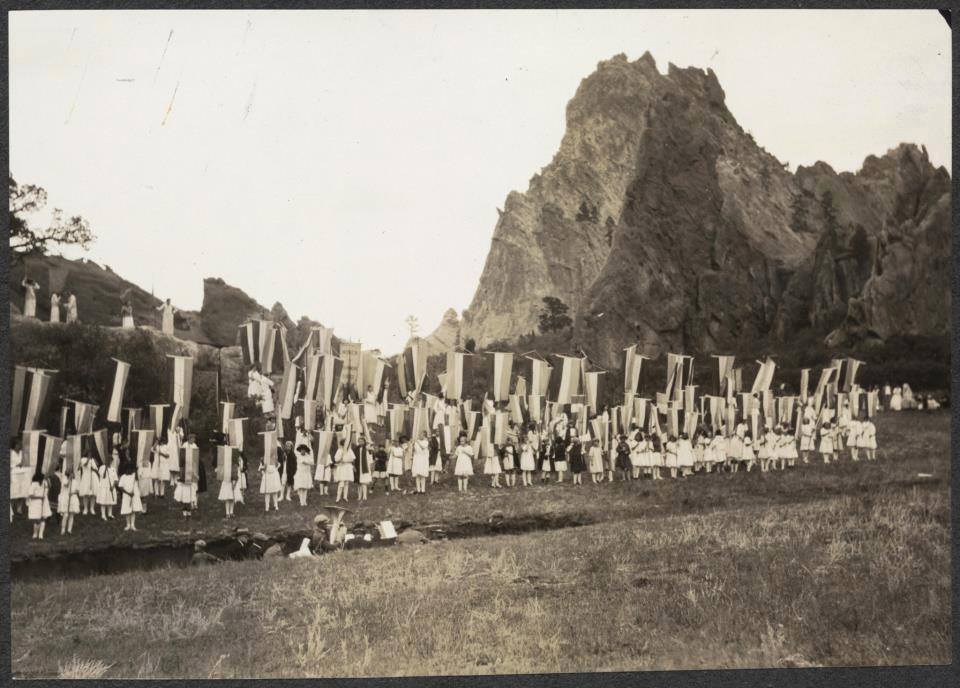
The party concluded its conference today by putting on an elaborate pageant in the Garden of the Gods. It was reminiscent of the suffrage spectacles of a decade ago, and drew 20,000 spectators, plus reporters from many major newspapers, and newsreel cameras from Fox, Pathe, and Universal.

Schoolgirls holding up the purple, white and gold banners of the National Woman's Party at the pageant earlier today. Newsreel camera operators and photographers are in the trench in front of the banners.
Schoolgirls holding up the purple, white and gold banners of the National Woman’s Party at the pageant earlier today. Newsreel camera operators and photographers are in the trench in front of the banners.

The program opened with Ruth Montgomery, assisted by a 200-voice chorus, singing “Angels Ever Bright and Fair,” followed by trumpets announcing the procession that followed. Led by Sally Halthausen Gough on a black horse, it was intended to salute previous efforts for equality, and show how long the struggle has gone on since the original women’s rights convention in Seneca Falls, New York, in 1848. It included everything from a covered wagon and bright red stagecoach to more modern forms of transportation, with hundreds of participants taking part. Many portrayed feminists of earlier days, and dressed in costumes from their time.

The pageant also featured exuberant singing of feminist songs such as “The March of the Women,” an anthem from suffrage days, which begins with “Shout, Shout, Up With Your Song,” accompanied by a large display of purple, white and gold banners of the National Woman’s Party held up by a delegation of schoolgirls. Other banners, bearing the words of Susan B. Anthony that “Failure is impossible” fluttered in the breeze as well.

Colorado is a very progressive State. Women won the ballot here in an 1893 Statewide ballot referendum, the first one ever to pass. (Women in Wyoming won the vote in 1869, but did so through the State Legislature’s action.) But the fact that the laws are far from equal even here was stressed in numerous speeches, and cited as proof that there is still much work to be done. Among today’s speakers were many veterans of the suffrage struggle, such as Alice Paul, Sue White and Eunice Brannan.

White, who played a major role in her home State of Tennessee’s crucial ratification of the 19th Amendment back in 1920, deplored the fact that even in 20th Century America, we are still in some respects living according to the English Common Law assumption that in marriage, the husband and wife become one, and the husband is the “one.”

It was noted by Alva Belmont that 30 years after winning the vote in Colorado, a wife’s earnings were still the property of her husband, and women can not serve on juries, thus denying them even so basic a right as a trial by a jury of their peers. Of course, she also noted that things are a lot better here than in Georgia, where a father can will his children to anyone he chooses without his wife’s consent. And in Louisiana, the husband is officially recognized as “head and master” of the household.

The 14th Amendment has failed to help women in any way thus far, so there’s still nothing in the Constitution to explicitly guarantee equal treatment under the law for women and men. But that oversight is something the National Woman’s Party intends to remedy, and there are plans to get the Mott Amendment formally introduced into Congress before the end of the year.

So, as exciting as their battle for the ballot may have been, there should be even more interesting times ahead for the National Woman’s Party on this long and bumpy road to equality!

INFLATIONARY NOTE: $50,000 in 1923 = $695,474 in 2014; $1,000 = $13,909.
September 22, 1932: Amelia Earhart Lobbies for the ERA at the White House

Founding Feminists is FMF’s daily herstory column.

FoundingFeministLogo-color

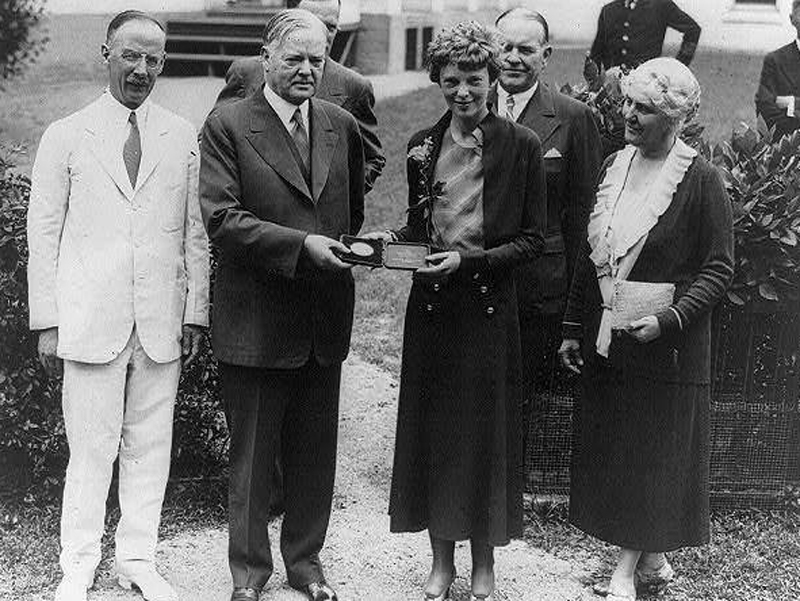
Amelia Earhart and four other members of the National Woman’s Party lobbied for the Lucretia Mott (Equal Rights) Amendment today at a meeting with President Hoover in the White House.

President Hoover, with whom she met today, presenting Amelia Earhart with the Gold Medal of the National Geographic Society on June 21st of this year for her Transatlantic solo flight.

Earhart and Anita Pollitzer did most of the talking, with the President paying close attention to what they had to say. Long-time N.W.P. members Burnita Matthews, Anna Kelton Wiley and Ruth Taunton were also present. Earhart told Hoover:

I know from practical experience of the discriminations which confront women when they enter an occupation where men have priority in opportunity, advancement and protection. In aviation the Department of Commerce recognizes no differences between men and women licensed to fly. I feel that similar equality should be carried into all fields of endeavor, so that men and women may achieve without handicap because of sex.

As far as our country is concerned, in every State of the Union today there are discriminations against women in the law. I join with the National Woman’s Party in hoping for the speedy passage of the Lucretia Mott Amendment, which would write into the highest law of our land that ‘men and women shall have equal rights throughout the United States and every place subject to its jurisdiction.’ Your own statements on equality of opportunity make me believe you understand our desire.

At a meeting with an N.W.P. delegation on January 5th of last year, the President expressed his opposition to the growing practice of firing married women workers to make jobs available to men as a means of allegedly easing the unemployment crisis.

Anita Pollitzer said: “Do you realize, Mr. President, that there is no single State in the Union today where all the laws apply equally to men and women? In almost one-half of the States women are limited in their power to contract or to carry on a business.” She then left a report with Mr. Hoover summarizing the many laws that discriminate against women.

Earhart has expressed feminist views many times before. On May 8th of last year she told 250 Barnard College students at their annual Barnard Athletic Association Dinner that the educational system was based on “sex, not aptitude,” and that it was unfair for girls to be shunted into cooking and sewing classes solely on account of their sex:

I know a great many boys who should be making pies – and a great many girls who would be better off in manual training. There is no reason why a woman can’t hold any position in aviation providing she can overcome prejudices and show ability.

On June 24th of this year she reaffirmed that she would keep her “flying name” despite her marriage to George Palmer Putnam on February 7, 1931.

Her most recent aviation feat was a solo flight from Harbor Grace, Newfoundland, to Northern Ireland on May 20th to 21st, the fifth anniversary of Lindbergh’s first solo crossing of the Atlantic in 1927. No one other than Earhart and Lindbergh have flown across the North Atlantic alone, and Earhart is the only person to have crossed the Atlantic twice by airplane. Her first time was as a passenger on June 17-18, 1928. Women’s aviation is growing rapidly here in the U.S. On January 1, 1929, there were only 34 licensed women pilots, but as of this Spring, there were 512.

The Lucretia Mott (Equal Rights) Amendment was written by Alice Paul, and has become the National Woman’s Party’s top priority since the suffrage campaign ended on August 26, 1920. At the N.W.P.’s national convention on February 16, 1921, there was a unanimous and enthusiastic call for “absolute equality,” and work was begun on drafting legislation to bring that about.

On July 21, 1923, at an N.W.P. convention celebrating the 75th anniversary of the first women’s rights convention at Seneca Falls in 1848, the exact wording was set, and the amendment officially endorsed by the party members. At Alice Paul’s suggestion, it was decided to name it for pioneer feminist Lucretia Mott.

On December 10, 1923, the Mott (Equal Rights) Amendment was introduced into the Senate by Senator Charles Curtis of Kansas. Three days later, a fellow Kansas Republican, Representative Daniel Anthony (a nephew of Susan B. Anthony) introduced it into the House, where the first hearings were held by the House Judiciary Subcommittee two months later.

The amendment continues to pick up support, and the campaign will continue until equality is guaranteed by the U.S. Constitution, no matter how long it may take.

September 19, 1893: Women in New Zealand Win Suffrage!

Founding Feminists is FMF’s daily herstory column.

FoundingFeministLogo-color

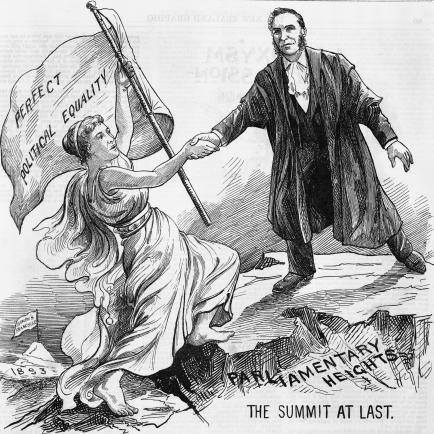
In an unprecedented victory for the suffrage movement, all women in New Zealand, regardless of economic status or race, won full voting rights today.

The struggle goes back to 1869, when Mary Ann Miller wrote “An Appeal to the Men of New Zealand,” advocating female suffrage. Two years later, Mary Colclough gave the first public lecture on the subject. Earlier bills, which would have extended the suffrage to women taxpayers only, were introduced into Parliament in 1878, 1879 and 1887, and only narrowly defeated. But thanks to the leadership of Kate Sheppard, as well as the tireless work of Women’s Christian Temperance Union (W.C.T.U.) campaigners, a winning strategy was devised and a bill granting universal and unrestricted woman suffrage was passed.

The start of the campaign was quite modest. In 1887 two petitions signed by 350 women were presented to the House of Representatives. By the next year there were 800 signatures. But after this slow start, suffrage began to pick up major support. In 1889, the enthusiasm of the newly-established Tailoresses’ Union was added to that of the W.C.T.U. In 1891, nine thousand women signed eight petitions. A year later the Women’s Franchise League was established, and six petitions with 19,000 signatures were presented. Earlier this year 13 petitions containing 32,000 signatures were submitted.

545235_10203190269141117_7545156707302245832_nAs in the United States, major opposition to woman suffrage has come from those who believe that a woman’s “natural” role as wife and mother is incompatible with politics, and from the liquor industry. Since a good deal of the work for suffrage has been done by the W.C.T.U., it was not difficult for liquor interests to generate fear of prohibition if women won the vote, and gather signatures for anti-suffrage petitions in the nation’s pubs.
This year’s final victory was by no means assured at any time. Premier John Ballance, who supported woman suffrage, died in April, and was succeeded by Richard Seddon, strongly anti-suffrage and on very friendly terms with liquor interests. But the huge number of signatures on the petitions – representing a substantial percentage of the nation’s women – were sufficient to get an Electoral Bill passed by the House. A furious campaign then ensued as it went to the Legislative Council, which had rejected two previous suffrage bills.

There were many rallies, plus heavy lobbying of Council members, both in person and by telegrams. Anti-suffragists went all out, with Seddon using every trick in the book to pressure his fellow legislators to vote “no.” Finally, the day of the vote arrived, with pro-suffrage members of the Legislative Council wearing white camellias in their buttonholes. Apparently Seddon’s underhanded and strong arm tactics must have gone too far, offending two anti-suffragists sufficiently for them to change their votes to “yes,” so the measure carried 20 to 18.

Opponents, now wearing red camellias, didn’t give up, and spent the eleven days after the vote pressuring the Governor not to sign the bill. But today the Electoral Bill became the Electoral Act with Lord Glasgow’s signature, and the battle for unconditional, universal woman suffrage in New Zealand ended successfully.

Though technically a part of the British Empire, the nation has been self-governing since 1852, thanks to the British Parliament passing the New Zealand Constitution Act. Property-owning women won the vote on the Isle of Man in 1881, but it is a Crown Dependency, not a nation, and women who do not meet the property qualifications are still voteless, so New Zealand’s action is unique.

Today’s action means another unique event will occur soon. Since all adult citizens of New Zealand may vote in the next election, the New Zealand Parliament will soon become the only national governing body in the world freely selected by all of its people, and its Premier (or “Prime Minister”) will be the only national leader who can claim to have a fully legitimate right to hold such an office and exercise the powers that go with it.

Hopefully, the United States will follow New Zealand’s example of universal adult suffrage. Though racial discrimination is explicitly outlawed by the 15th Amendment, racially discriminatory laws such as outrageously designed and administered “literacy tests” and heavy “poll taxes,” as well as terrorist acts of white supremacist groups have effectively disenfranchised millions of men in many States.

At present, U.S. women can vote only in the State of Wyoming, where they won the ballot in 1869, when it was still a Territory. Women who possessed a certain amount of property could vote in New Jersey from 1776 until 1807. In Utah Territory women could vote from 1870 until 1887, when Congress passed the Edmunds-Tucker (anti-polygamy) Act and disenfranchised them. Women in Washington Territory won the vote twice, but legislation passed by the Territorial Legislature in 1883 was overturned by the Territorial courts in 1887, and a bill passed in 1888 was similarly voided. In 1889 a suffrage referendum in what had by then become the State of Washington was defeated by a 2-1 margin. But there is a suffrage referendum on the ballot in Colorado on November 7th, so a second suffrage State could be won soon. As was the case in New Zealand, persistence may yet pay off, and this could become a year of two suffrage victories!

September 18, 1968: Suffragists Fight to Save the Historic Sewall-Belmont House

Founding Feminists is the FMF’s daily herstory column.

FoundingFeministLogo-color

Alice Paul is in full fighting mode today, and women are preparing to risk arrest and engage in civil disobedience if necessary.

Though this sounds like a report from the suffrage battlefront 50 years ago, it’s not. But there is one big difference between 1918 and 1968. Back then, the National Woman’s Party wanted Congress to pass something: the Susan B. Anthony – now the 19th – Amendment. Today, the party wants Congress to defeat a bill confiscating two-thirds of historic Sewall-Belmont House property to build a driveway for an expanded New Senate Office Building. The party has always tried to have its headquarters as close to the center of political action as possible, but at the moment it may seem a bit too close.

The National Woman’s Party has had its offices and officers’ living quarters at Sewall-Belmont House since 1929, when it became the group’s fifth and final headquarters. The house itself is one of the oldest homes on Capitol Hill. Robert Sewall completed construction on the original house by 1800, and rented it to Secretary of the Treasury Albert Gallatin from 1801 to 1813. In August, 1814, the house was burned by invading British troops because it was used by those resisting their advance on Washington. Sewall rebuilt the house after the war, and it remained in his family for over a century, until purchased by Senator Porter Dale, Republican of Vermont, in 1922. He sold it to Alva Belmont in 1929, so that she could donate it to the National Woman’s Party as their new headquarters.

It has been reported that the Joint Committee on Landmarks, in a report that will be delivered to the National Capital Planning Commission, thinks the house belongs in the “landmark” category, following a three-year study. But Rep. Kenneth Gray, Democrat of Illinois, disagrees. A member of the Public Works Committee, he has been engaging in unethical tactics to steamroll this bill through the House after it was passed by the Senate.

Representative Gray has presented his bill as just a “housekeeping” measure that ought to be passed by the House as a simple courtesy to the Senate, and has reportedly misinformed Members of Congress that an agreement was reached with the National Woman’s Party to sell the land for $50,000. He has said that Sewall-Belmont House is “unsightly,” of “no historical significance” and that the apartments used by N.W.P. officers are in disrepair and “will fall down anyway.”

The bill was originally introduced by Senator Ralph Yarborough, Democrat of Texas, and it excludes from condemnation the central portion of the building and a small lot, but confiscates the majority of the property. “It’s all one building and one historical landmark,” says Alice Paul, N.W.P.’s founder.

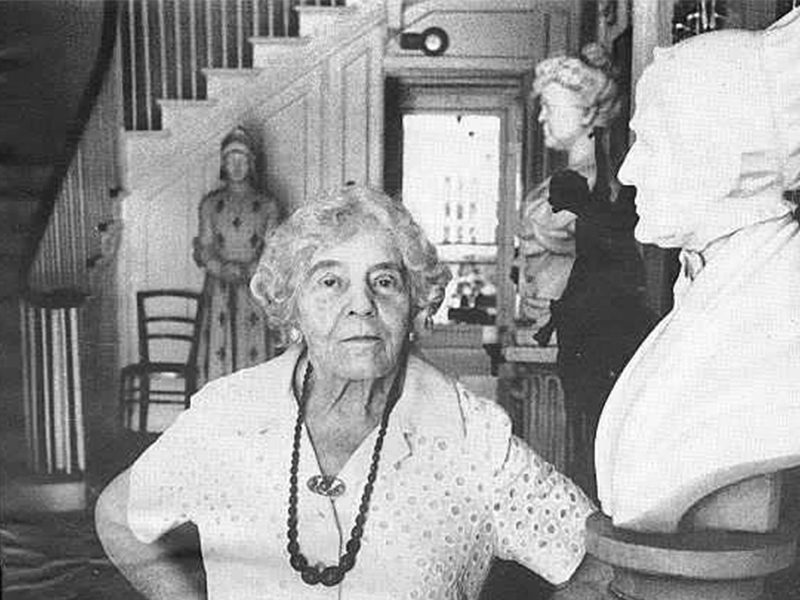
Alice Paul at the Sewall-Belmont House.

When the bill first came up for discussion in the House on August 2nd, Rep. Edith Green, Democrat of Oregon, noted that the Senate had passed it by a ratio of 4-3, hardly the kind of near-unanimous vote normally cast for uncontroversial “housekeeping” measures. Others objected to trying to push any bill through last month because so many members were away attending either the Republican or Democratic National Conventions in Miami and Chicago.

Alice Paul, 83, is as actively involved in this new campaign as the one half a century ago. Today she phoned N.W.P. President Emma Guffey Miller at Miller’s home in Slippery Rock, Pennsylvania, to discuss strategy, and has sent telegrams to House Majority Whip Hale Boggs, Democrat of Louisiana, and Senator Everett B. Jordan, Democrat of North Carolina, asking them to delay action, citing the findings of the Joint Committee on Landmarks.

But if conventional methods fail, the National Woman’s Party knows how to escalate. And this time they have a new ally. Barbara Ireton, president of the National Capital Area Chapter of the National Organization for Women said it was decided at meetings held today in Washington and New York that if necessary, a ring of women will surround the property to protect it if the House passes the condemnation bill and President Johnson doesn’t veto it. So, history may repeat itself half a century after National Woman’s Party “Silent Sentinels” went to jail in D.C. for peacefully protesting along the White House fence in favor of woman suffrage. Updates will follow when there are new developments in this confrontation.


INFLATIONARY NOTE: $50,000 in 1968 = $341,741 in 2014.

September 17, 1909: National American Woman Suffrage Association Moves Back to New York City

Founding Feminists is the FMF’s daily herstory column.

FoundingFeministLogo-color

10672421_10203176297071824_4047620239181518497_nIt’s a new era in the suffrage battle, and a new headquarters for the National American Woman Suffrage Association.
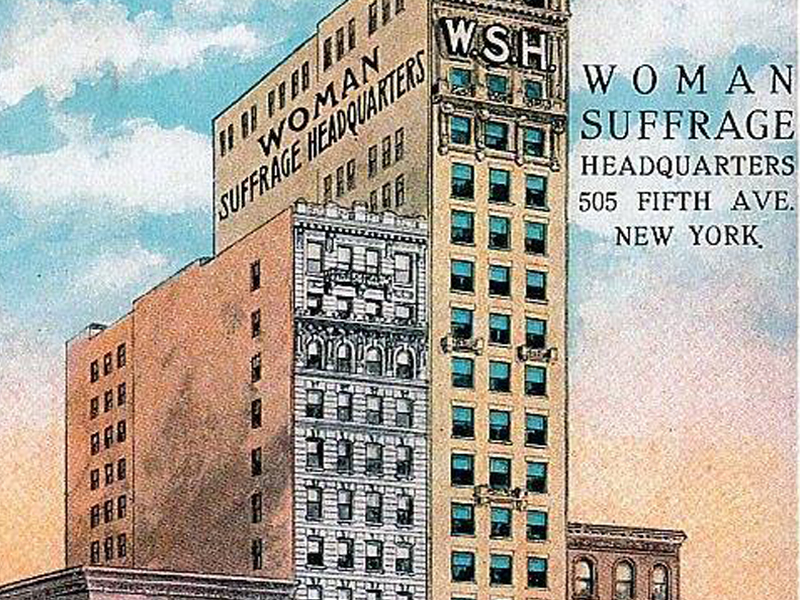
After six years in Warren, Ohio, first at the home of the group’s Treasurer, Harriet Taylor Upton, then in the Trumbull County Courthouse, N.A.W.S.A. has moved back to New York City, and is now situated on the 17th floor of 505 Fifth Avenue, at 42nd Street.

Rent for the entire floor – $5,000 a year – will be paid by Alva Belmont. Divorced in 1895 from her first husband, William Vanderbilt, and widowed last year by the untimely passing of Oliver Hazard Perry Belmont, she has since become quite active in the suffrage movement. On July 15th she made an incredibly generous contribution to the cause by agreeing to lease space for this “suffrage headquarters” to be used exclusively by organizations working to win the vote for women.

Today, reporters and photographers were given a tour of all nine rooms – plus free “Votes for Women” pins from N.A.W.S.A. President Anna Howard Shaw, who pinned them on each guest personally. Of course, many “won’t be able to get into the newspaper office wearing them,” joked Belmont.

Things are not yet in complete order, as the largest room in the suite is filled with 24 cases of suffrage literature, and the bookshelves lack books, but have a surplus of flowered hats upon them. The offices themselves are all quite attractive. In the president’s room are fine portraits of pioneer suffragists, and the reception room, near the front, is furnished with black carved oak. Next to that is Alva Belmont’s office, furnished in mahogany.

Since so many reporters were gathered together, it seemed like a good time for Ida Husted Harper to address one of her pet peeves. There has been a great deal of publicity in the U.S. lately about violent actions taken by British “suffragettes.” Militants there use that word to distinguish themselves from the more moderate suffragists, even though it was originally used in the press as a derogatory term. So Harper said: “We would be very glad if you would not call us suffragettes. The suffragettes are all right, and we have no quarrel with them, but we represent the suffragists of long standing, and the word suffragette is the one for the suffragists who have adopted militant methods.”

Anna Howard Shaw gave some comfort to elected officials who are suffrage supporters and fair warning to those who are not: “We are now going into practical politics. We are going into districts where our friends are in the political field and try to elect them, and we are going to try to defeat our enemies. We are told that women have more influence without the vote, and we are going to try and use that influence.”

Shaw outlined an ambitious program, and specifically mentioned major suffrage campaigns to be carried out in Washington State, Oregon and South Dakota, as well as the Territory of Arizona. N.A.W.S.A. will even try to have some sort of suffrage legislation introduced in the legislatures of all 42 non-suffrage States this Winter. Now that the nation’s largest suffrage group is situated in such a strategic location, and rent is not a burden, the future of the cause seems very bright. Though women can only vote in four of the forty-six States (Wyoming, Colorado, Utah and Idaho), the long drought – 13 years without winning the vote in a single State – may be about to end, and a suffrage renaissance begin.

INFLATIONARY NOTE: $5,000 in 1909 = $132,140 in 2014.

September 16, 1918: Suffragist Groups Clash Over President Wilson

Founding Feminists is FMF’s daily herstory column.

FoundingFeministLogo-color

The contrast between the older, traditional suffrage groups and the movement’s newer, more militant faction was never more in evidence than today.

The day’s events began when some National American Woman Suffrage Association members who are voters in suffrage States had a friendly meeting with President Wilson at the White House. Those in the delegation lavishly praised his words of support for the cause.

Two hours later, the National Woman’s Party got a transcript of Wilson’s statement, and as a way of emphasizing that mere words will not be enough to get the President’s fellow Democrats to stop blocking passage of the Susan B. Anthony (nationwide woman suffrage) Amendment in the Senate, the militants set fire to a copy of his statement while they held a demonstration at the Lafayette Monument just across from the White House.

Those in the N.A.W.S.A. delegation that had a 15-minute visit with the President were quick to praise him. According to Minnie Fisher Cunningham of Texas: “The President is a wonderful listener. He gives the closest attention to the matter presented and you have his entire interest for the period of the interview. This is real democracy – to be able to get to the head of the nation with the problems of the people.” Wilson told the delegation: “I am, as I think you know, heartily in sympathy with you. I have endeavored to assist you in every way in my power, and I shall continue to do so. I will do all I can to urge the passage of this amendment by an early vote.”

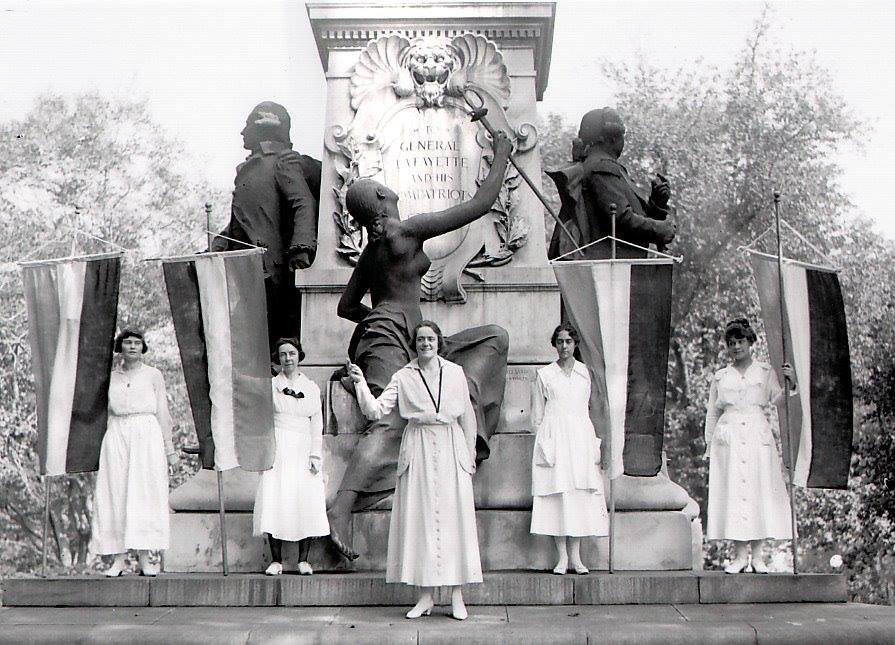
Sounds great, but words are not equivalent to deeds, and the National Woman’s Party was far from satisfied. After forty N.W.P. members marched from their headquarters to Lafayette’s statue, tricolor banners raised high, Lucy Branham held aloft a flaming torch and said: “We want action.”

National Woman's Party demonstrators gathering at the Lafayette Monument earlier today to protest President Wilson's lack of meaningful action on lobbying the Susan B. Anthony (national woman suffrage) Amendment through Congress.
National Woman’s Party demonstrators gathering at the Lafayette Monument earlier today to protest President Wilson’s lack of meaningful action on lobbying the Susan B. Anthony (national woman suffrage) Amendment through Congress.

Then, as she set a copy of the President’s statement alight, she proclaimed:

“The torch which I hold symbolizes the burning indignation of women who for a hundred years have been given words without action. In the Spring our hopes were raised by words much like these from President Wilson, yet they were permitted to be followed by a filibuster against our amendment on the part of the Democratic Senate leaders. Today the Chairman of the Rules Committee of the Senate, a spokesman for the Administration, announced that he would not even call the Suffrage Committee together to consider taking a vote. This session is nearing its close and the President and his party refuse to take any effective step toward the passage of the suffrage measure.

As in the ancient fights for liberty the crusaders for freedom symbolized their protest against those responsible for injustice by consigning their hollow phrases to the flames, so we, on behalf of thousands of suffragists, in the same way today protest against the action of the President and his party in delaying the liberation of American women. For five years women have appealed to this President and his party for political freedom. The President has given words, and words, and words. Today, women receive more words. We announce to the President and the whole world today, by this act of ours, our determination that words shall no longer be the only reply given to American women – our determination that this same democracy, for whose establishment abroad we are making the utmost sacrifices, shall also prevail at home.

Today’s demonstration – though the first in which they’re used fire – is just the latest in a long series of militant protests against President Wilson by the National Woman’s Party since January 10th of last year. After a meeting the night before with a large delegation of suffragists, in which Wilson expressed sympathy for the cause, but unwillingness to endorse the Susan B. Anthony Amendment, or use his considerable influence to get it through Congress, the N.W.P. began stationing “Silent Sentinels” along the White House fence near the gates. The words on their large, colorful banners highlighted the hypocrisy of Wilson’s campaigning for democracy around the world while doing nothing to bring democracy to the female half of his own country. The Sentinels first braved extreme cold and heavy snow, then Spring rains, mid-summer heat and humidity, attacks by mobs angry at anyone who would criticize a President in wartime, and finally arrests and prison sentences, including time at the infamous Occoquan Workhouse.

As recently as August 12th and 14th there were mass arrests, with injuries, and demonstrators sent to Occoqan for making peaceful protests at Lafayette’s statue over the failure of the Senate to vote on the Anthony Amendment. As Alice Paul said at the time: “We will continue to protest so long as our disenfranchisement exists. Oppression and abuse at the hands of the law merely emphasized the great need of women for political power.” On August 20th, twenty-three suffrage prisoners were released after a six-day hunger strike.

Older, more traditional suffragists have denounced the actions of the militants as allegedly hurting the cause by alienating undecided male voters in States where suffrage referenda are on the ballot, as well as offending politicians who favor suffrage, but oppose using militant methods to bring it about and feel uncomfortable about being linked to the protesters in the minds of some.

Militants complain that the older, more conservative suffragists are too friendly and deferential toward those who have the power to get the Anthony Amendment quickly passed by Congress but don’t use their power to do it, and that low-key, State-by-State campaigns will take far too long to win suffrage nationwide. But this combination of approaches actually seems to be quite effective. There has been more progress in the past five years than in the sixty-five that preceded them, so “more of the same” by both factions should produce the result that all suffragists desire: “Votes for Women” in every State, permanently won.

September 15, 1970: ERA Supporters Heard By Senate Judiciary Committee

Founding Feminists is FMF’s daily herstory column.

FoundingFeministLogo-color

Today, Equal Rights Amendment supporters finally got a chance to make their case to the Senate Judiciary Committee – but in a move that mirrored the kind of bias that still exists, proponents were allowed only one day of testimony, despite opponents being given three days last week.

Fortunately, the witnesses made such great impressions, and stated their case so well, that a single day may turn out to be sufficient.

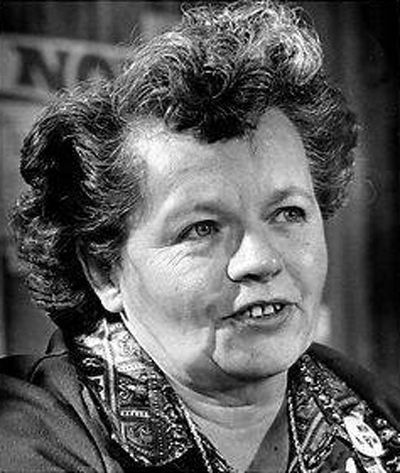
Wilma Scott Heide
Wilma Scott Heide

Wilma Scott Heide, who chairs the National Organization for Women’s National Board, and is a Human Relations Commissioner in Pennsylvania, began by addressing some stereotypes, telling the Senators:

I am not a ‘bubble head’ and I do not burn bras. I am a middle class member of mid-America.

(Here she was first alluding to a remark made on August 26th by Senator Jennings Randolph, Democrat of West Virginia, about feminists, and then the “braburning” myth that has plagued the movement since the Miss America demonstration in 1968.) She then noted that because society puts such an emphasis on arbitrary gender roles:

I know now that I shall never achieve my full potential … It is tragic that the reproductive abilities women share with all other mammals have been more highly valued and developed than the productive intelligence we do not share with any other animal. My ability to reproduce two children does not confer on me the unique ability, based on my sex, to care for and raise these children, any more than my husband’s biological ability to father these children disqualifies him from child care. Homemaking and child care are learned social roles without biological imperatives as to who performs them.

She then said that there are just three jobs which can be performed solely by members of one sex. Only women can be “human incubators” and wet-nurses, and only men can be sperm donors. All other jobs can be performed by either men or women.

Heide is also vehemently opposed to any changes in the E.R.A.’s text. Over the years proposals have been made to add “riders” to it that would allow exceptions. The original “Hayden Rider,” first proposed by Senator Carl Hayden (D-AZ) in 1950, stated that: “The provisions of this article shall not be construed to impair any rights, benefits or exemptions now or hereafter conferred by law upon members of the female sex.”

Current “riders,” proposed by Senator Sam Ervin (D-NC) would render the E.R.A. into something purely symbolic if attached. In fact, if language creating such exceptions were to be added to the text, the E.R.A. could no longer even be called an “equal rights” amendment, because it would authorize special rights and privileges for women and permanently validate forms of discrimination against men such as male-only Selective Service registration and mandatory military service.

Heide made it clear that there would be no going back to the 1950s, and that women were demanding their fair share of power and influence: “We whose hands have rocked the cradle are now using our heads to rock the boat so that in proportion to our numbers we intend to share in guiding the ship of state and of the world. We value ourselves, our children and men too much to deprive the world of our other talents.”

One example of Heide “rocking the boat” occurred on February 17th, when she led a group of about 20 N.O.W. members in a disruption of a Senate subcommittee hearing on an amendment that would lower the voting age nationwide from 21 to 18. The protesters demanded that the subcommittee take up the E.R.A. as well. The tactic worked, and that’s why the E.R.A. is the subject of hearings in the Senate now instead of languishing indefinitely in a subcommittee.

Rep. Martha Griffiths (D-MI), who was responsible for extracting the E.R.A. from the House Judiciary Committee, where it had been bottled up for two decades, and who then led the successful fight for approval by the full House, also testified at today’s hearings. She attacked anti-E.R.A. fears about abolishing “protective” legislation for women by noting: “It has always been a matter of some amusement to me that a woman who can lug around a squirming 20-pound kid all day can’t lift 12 pounds at work.”

Norman Dorson, of New York University, spoke to concerns expressed by other law professors that the E.R.A. was too vague and would lead to years of litigation. He said that these fears have been “magnified unrealistically” and that Constitutional amendments are always broad and general in their language. But even if some litigation proved necessary in the amendment’s interpretation, “It is wrong to suggest that because ending deep-set and historic discrimination will result in some uncertainly and litigation we should not act.”

With far more sponsors in the Senate than the 2/3 that are needed for approval, it appears that 47 years after its introduction into Congress, Alice Paul’s Equal Rights Amendment is about to get final approval and be sent to the States for ratification. So, unless there are unexpected developments or unforeseeable delays, when the nation celebrates its Bicentennial in 1976, the 26th Amendment to the Constitution will read:

Section 1: Equality of rights under the law shall not be denied or abridged by the United States or by any State on account of sex.

Section 2: Congress shall have the power to enforce, by appropriate legislation, the provisions of this article.

Section 3: This amendment shall take effect two years after the date of ratification.

September 12, 1967: Feminists and Labor Unions Take On Sexist Airline Industry

Founding Feminists is FMF’s daily herstory column.

FoundingFeministLogo-color

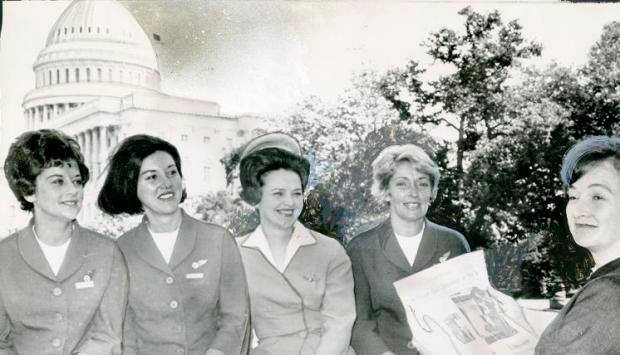
Are being quite young, very attractive, and an unmarried woman “bona fide occupational qualifications” for being a stewardess?

According to the airline industry, the answer is “yes,” but two unions and feminist Betty Friedan disagree. Today a hearing was held by the Equal Employment Opportunity Commission (E.E.O.C.), to hear from both sides so that it can make a ruling on whether the airlines are in violation of the Civil Rights Act of 1964, or whether their biased standards can be justified and permitted to continue.

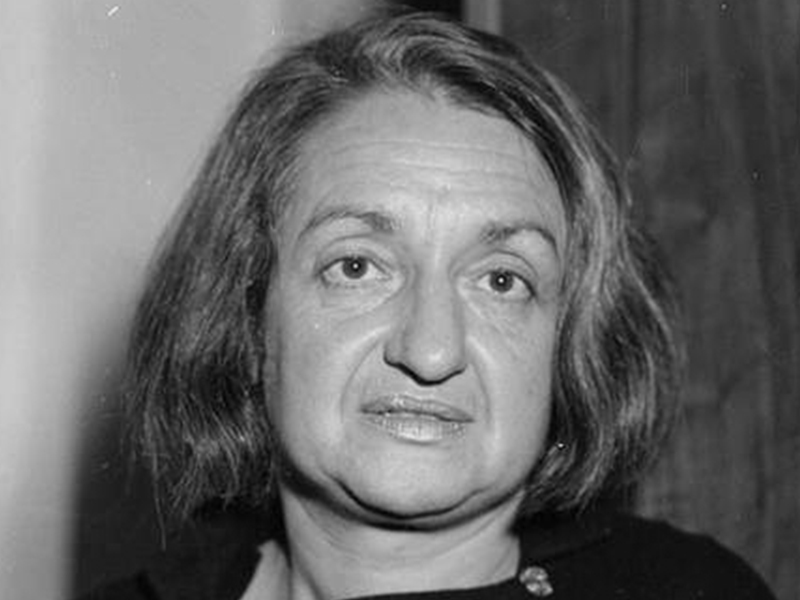
Betty Friedan, author of "The Feminine Mystique," and NOW's first, and so far only, president.
Betty Friedan, author of “The Feminine Mystique,” and NOW’s first, and so far only, president.

Friedan, president of the 11-month-old National Organization for Women, noted the similarity between the job requirements of the airlines and those of a Playboy Club, and said that the airlines were “transforming stewardesses into bunnies of the air.” She also said: “While the airlines talk about these pretty girls and the service they give, the sexuality of the girls is a necessary factor for the job.” She called their policies “the most flagrant kind of sex discrimination” because male airline employees are not required to resign, or take other jobs upon reaching age 32 (or 35 in some cases) nor when they marry, and do not have the same ultra-strict weight and grooming requirements.

None of the airline executives disputed the fact that they have unique and far more restrictive age standards for stewardesses than for any of the jobs done by men, but tried to show why they were needed. According to Walter Rauscher, vice-president of American Airlines: “We must have a glamorous product that is wanted and needed by people.” He resented any comparisons between stewardesses and Playboy bunnies. But he didn’t say what the difference was between a woman being “glamorous” vs. a “sex symbol,” or what part of the job’s duties could not be performed by a married woman, someone over 32, or a man.

Robert E. Johnson, vice-president of United Air Lines, also objected to the Playboy Club comparisons: “I resent the implication that stewardesses are sex symbols. They are not. They perform a quality service. I resent characterizing them as ‘bunnies.’ That is unwarranted on the basis of their conduct, breeding and behavior.” He then said that it was United’s stewardesses who kept the “friendly skies of United friendly,” apparently adding an ever-smiling compliant attitude to the strict age, height, weight, beauty and marital status requirements.

The Air Transport Association, consisting of 55 airlines, sent attorney Jesse Friedin to tell the E.E.O.C. that they didn’t even have the authority to rule on discrimination based on age and marital status. But those testifying for the Transport Workers Union and the Air Line Pilots Association disagreed, and then went on to point out that not all airlines have such restrictions, so they must be arbitrary, rather than truly necessary.

Protests against discriminatory practices by the airlines date back to April 17, 1963, when eight stewardesses held a press conference to denounce the American Airlines policy of forced retirement at 32. “Do I look like an old bag?” asked 35-year-old Barbara “Dusty” Roads, at the time. The Civil Rights Act was signed on July 2, 1964, and the E.E.O.C. began its work a year later, charged with interpreting and implementing Title VII. However, the Act permits bias in “those certain instances where religion, sex, or national origin is a bona fide occupational qualification reasonably necessary to the normal operation of that particular business or enterprise.” Congress began taking testimony on the issue on September 2, 1965, when Colleen Boland and several other stewardesses testified about the unfairness of the rules.

The present controversy dates back to November, 1965, when charges of sex discrimination by the airlines began to come to the E.E.O.C. The vast majority of complaints have been from women, though one was from a man who wanted to be a airline steward but was told that only women could apply for that type of work.

The E.E.O.C. held a five-hour public hearing on May 10, 1966, with representatives of both sides present. On November 9, 1966, the Commission voted on a ruling, but some of the airlines went to court and got a preliminary injunction to prevent the E.E.O.C. from publicly issuing that ruling. The airlines’ main argument was that Aileen Hernandez, one of the Commissioners, was active in the newborn National Organization for Women, and couldn’t have been “objective” about sex bias when the Commission vote was taken. A few months after Hernandez resigned from the E.E.O.C., the judge made the injunction permanent and said the Commission would have to either drop the issue or hold a new hearing, and that’s what took place today.

September 11, 1917: Banquet Honors Jailed “Silent Sentinel” Suffragists

Founding Feminists is the FMF’s daily herstory column.

FoundingFeministLogo-color

Today saw a celebration of courage and triumph in Washington, DC, as well as optimism in the wake of a defeat in Maine.

Six “Silent Sentinel” suffragists who had been serving time in Virginia’s infamous Occoquan Workhouse for picketing the White House were honored at a banquet tonight at Cameron House, headquarters of the National Woman’s Party.

The picketing has been going on since January 10th to point out the hypocrisy of President Wilson vigorously campaigning for democracy around the world while refusing to do anything to help get the Susan B. Anthony (nationwide woman suffrage) Amendment through a Congress controlled by his own Democratic Party.

Lucy Burns during a recent term in Occoquan Workhouse.

Over the past eight months, pickets have endured extreme cold, snow, and rain, then heat and humidity, attacks by mobs, and finally arrests and jail sentences in the harshest of prisons. But tonight was a time to celebrate the freedom – temporary as it probably is – of six of the many suffragists who have been willing to endure imprisonment for the sake of winning every woman her right to vote.

Alva Belmont, one of the principal speakers, left no doubt about her feelings toward the Wilson Administration or the courts, as she praised the recently-released pickets:

We come together tonight to honor the gallant six who have so bravely endured persecution at the hand of the Government, which has used its power to oppress women instead of liberating them. The present undemocratic Administration, on technical and unproved charges, and in court trials which have been a bitter travesty on justice, has dared to imprison American women of patriotism and distinction in a filthy workhouse, in order to suppress the insistent demand of women for their political freedom.

An Administration which could be stupid and vicious enough to meet this appeal by such medieval methods proves that it is hostile to the liberal movements of the world, and that it is trying to smother the needs of democracy at home. Such an Administration, if it does not cease its cowardly persecution, should be shorn of power in the next Congressional election.

The news from Maine, where a suffrage referendum was defeated by a 2-1 margin yesterday, was nothing to celebrate, of course. Local suffragists fought a good campaign, distributing 1,500,000 leaflets, or 10 for every eligible voter, and Deborah Knox Livingston traveled thousands of miles around the State speaking and raising money. But there was never that much hope for a victory in Maine’s first suffrage referendum due to the short time between the measure being placed on the ballot and Election Day, as well as the State’s basic conservatism. The very low turnout may also have been a factor.

But today suffragists are still optimistic about the New York State suffrage referendum coming up on November 6th. New York and Maine are very different States, and should produce different results. According to Carrie Chapman Catt:

A good deal of suffrage education has been inculcated that will count toward future victory. We have learned to take what looks like failure as the forerunner of success. Even in the Western States it has taken several campaigns to win. I understand that a Maine ‘anti’ hopes the question is settled in Maine for a long time to come, but the suffrage question is never settled until it is settled affirmatively. It is true that there probably never will be another campaign in Maine except for the purpose of ratification. The Federal suffrage amendment is surely going to pass and soon. The effect of every State’s repudiation of the suffrage plank in the national platforms of all political parties can only serve to focus the efforts of the National American Woman Suffrage Association anew upon the Federal route to the suffrage goal. More and more our work concentrates on Washington as the immediate focal point.

Dudley Field Malone agreed that the days of State referenda are probably past:

It took the liberal and progressive elements of the men and women in Maine nearly twenty years before they were permitted to put a suffrage amendment to the voters of that State, and a similar suffrage amendment may not be submitted to the electorate for twenty years more because of antique political methods in Maine. In a democratic republic this is a denial of justice and democracy, without which there would be no progress. The situation in Maine proves that the most just and speedy way to enfranchise all the women of the country is by the passing of the Federal suffrage amendment through Congress.

Anti-suffragists are expressing their usual optimism that the battle is over. Alice Hill Chittenden, President of the New York State Association Opposed to Woman Suffrage said:

Woman suffrage has not carried a single State through popular election since 1914, when the two small States of Montana and Nevada extended suffrage to women, and since that date has been defeated in twelve States, namely, South Dakota, Ohio, North Dakota, Nebraska, Missouri, New Jersey, Massachusetts, Pennsylvania, New York, Iowa and West Virginia, Maine yesterday making the twelfth. The total majority for suffrage in Nevada and Montana amounted to about 7,000. The results in Maine point the way to defeat of woman suffrage in New York on November 6th. Most people regard the question of woman suffrage as an intrusion at this time, when the whole mind and heart of the nation is engrossed in the great war upon which we have entered. This is a time when the man power of the Government is needed; that is the one power which can enforce law. I cannot believe the men of New York State will make the fatal mistake of adding to the electorate at this critical time some two million votes.

But despite the latest obituary for the suffrage movement by its critics, it’s healthier than ever. In the Empire State the campaign has been large, well-funded, and running on a continuous basis since the 1915 referendum’s defeat. And regardless of how that New York contest may come out, women are already a substantial voting bloc in the Western States where they have full voting rights.

The addition of the element of militance by the National Woman’s Party and its White House pickets may be the final ingredient to success, however. Pressure on President Wilson to do something meaningful to aid the suffrage movement is growing, as is sympathy for the women who have been jailed for exercising their right to protest against being excluded from the political process for no other reason than their sex.

Victory may not be at hand, but it is coming into view, and now that there is a growing consensus among all suffrage organizations that Alica Paul was right years ago about the Susan B. Anthony Amendment being the only practical route to suffrage, we now know how victory will come about, so the only question is when.

September 10, 1920: National Women’s Party Shifts Goals After Big Suffrage Victory

Founding Feminists is the FMF’s daily herstory column.

FoundingFeministLogo-color

The National Woman’s Party will battle on!

Though originally created for the purpose of putting the Susan B. Anthony (now the 19th) Amendment into the Constitution, there was a consensus among Executive Committee members today that because this recent victory for nationwide woman suffrage will not automatically cause all discriminations and barriers against women to fall, the party must now evolve from an “equal suffrage” organization to one whose goal is total equality.

As Alice Paul explained it:

It is incredible to me that any woman should consider the fight for full equality won. It has just begun. There is hardly a field, economic or political, in which the natural and accustomed policy is not to ignore women. Men are chosen to fill high Government offices and the responsible, well-paid positions in industry. No comment was excited by the fact that no woman was a member of the Coal Commission, for instance, or of the Railway Wage Board, in whose hands lay matters of vital concern to women as housekeepers and as workers. Unless women are prepared to fight politically they must be content to be ignored politically.

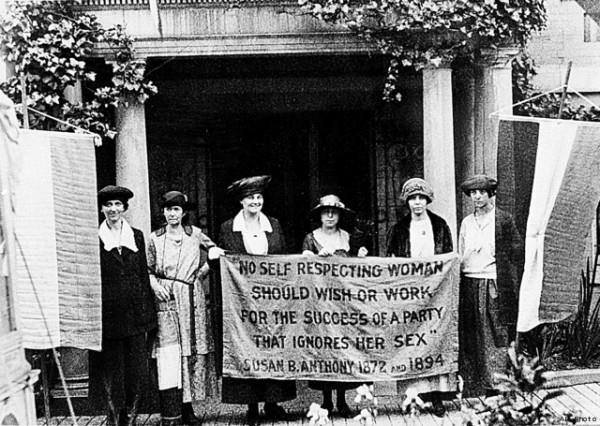
National Woman's Party members standing in front of their headquarters three months ago, with a banner that seems as relevant now as it did during the suffrage struggle: " 'No self respecting woman should wish or work for the success of a party that ignores her sex.' Susan B. Anthony 1872 and 1894."
National Woman’s Party members standing in front of their headquarters three months ago, with a banner that seems as relevant now as it did during the suffrage struggle: ” ‘No self respecting woman should wish or work for the success of a party that ignores her sex.’ Susan B. Anthony 1872 and 1894.”

Though becoming an official political party with its own women candidates had been discussed, Abby Scott Baker indicated that most board members thought it would be better to continue with the policy that had been so successful for the party during the suffrage struggle. So in this post-suffrage era, the National Woman’s Party will use its influence to help established party candidates who support its goals and to oppose those who do not. Baker urged women to enter politics, but to beware of being relegated to the lowest rungs of the ladder:

You may be sure that it will be some time before they are allowed to speak up in meetings in the inner party councils. Politicians are bargain hunters, and they are not bidding very high for the women’s vote. If I have learned anything from my political experience, it is that the one thing politicians fear is a determined minority united on a program, and ready to throw its power to the group through which it can secure that program’s success. This is the policy through which the Woman’s Party won national suffrage within seven years. By following this policy, the Woman’s Party could win success for the larger problems still before women.

Alva Belmont, who hosted today’s gathering at her Long Island home, gave an example of a problem that winning suffrage did not solve, but using women’s votes as a political tool could fix:

With such an active, fighting women’s group in the political field, it would be impossible for women to be deprived of their citizenship through marriage or to be given citizenship because of marriage. A woman should have the right of separate domicile, so that she cannot be disenfranchised, as thousands of women now are because their residence is fixed by that of their husbands.

(This is not just an theoretical issue to her, because her daughter recently lost her American citizenship when she married the Duke of Marlborough in England.)

The date of the upcoming national convention is uncertain, because there is still some “unfinished business” to deal with in regard to suffrage. Anti-suffragists have launched multiple legal offensives in the courts trying to invalidate ratification of the 19th Amendment, or at least block its implementation until after the Presidential election in November. The National Woman’s Party’s highest priority is making sure that women can vote in all States and for all offices in the next election, so they are helping fight the court suits as well as working for ratification of the 19th Amendment in Connecticut. The major legal controversy involves Tennessee, which on August 18th became the 36th and final State needed for ratification. But if Connecticut ratifies before the election it would make Tennessee’s contested status irrelevant.

Fortunately, one major impediment to the National Woman’s Party’s ambitious plans has been eliminated. Dora Lewis announced at the Executive Committee meeting that the $12,000 debt run up during the final days of the suffrage campaign has been paid in full, thanks to vigorous efforts to collect on previous pledges, plus new contributions, the largest of which was $1,000 from Alva Belmont.

So, debt-free and with an historic victory behind it, the National Woman’s Party can now move on toward the goal of total equality for women. With the votes of millions of newly-enfranchised women added to the party’s years of political experience and the high level of dedication to the cause shown by its members, achievement of that new goal now seems possible in the not-too-distant future.

September 9, 1912: Theodore Roosevelt Urges Washington Women to Vote Progressive

Founding Feminists is FMF’s daily herstory column.

FoundingFeministLogo-color

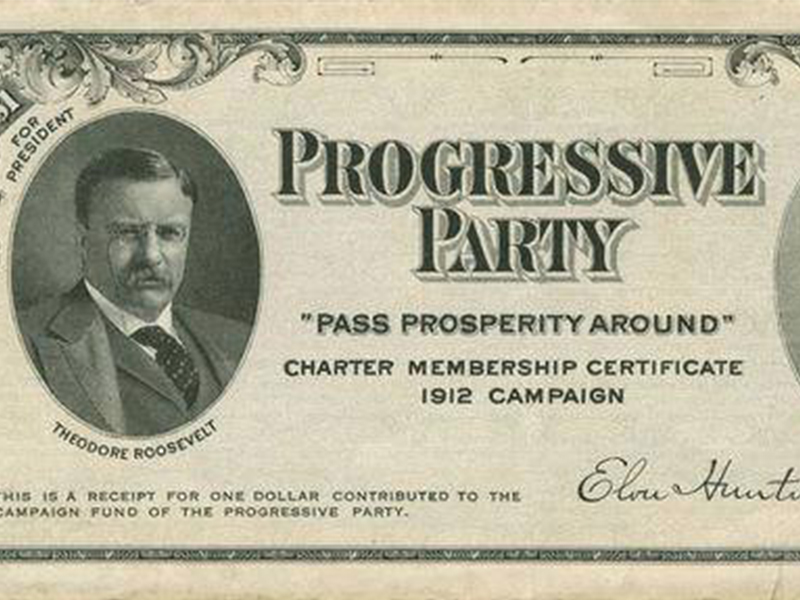
If Progressives are to win the White House in November, women must register and vote in great numbers, according to former – and hopefully future – President Theodore Roosevelt.

He was in Spokane today, urging women in Washington State to take full advantage of their right to cast a ballot in the coming Presidential Election. He told 2,500 women gathered at the American Theatre:

The suffrage having been given to you, it is not only your right but your duty to exercise it. You are false to your duty as citizens and women if you fail to register and vote.

His speech was most timely, because today is the final day of registration for the November 5th General Election. Apparently his words were quite effective, because after the conclusion of the program, women crowded the places of registration much as they did right after winning the vote here two years ago. Several hundred women were seen standing in the registration line a block away from the theater soon after he finished the first of his two speeches to female audiences.

10474199_10203129689506664_4764926336860166362_n

Col. Roosevelt’s speeches were unique in two ways. He had never addressed an all-female audience before, and neither the Democratic nor the Republican candidate has made a speech to a similar audience. At first he was a bit hesitant, not quite sure what to say, but many years of campaigning coupled with his own excellent instincts soon took over, and before long it looked and sounded like a traditional Roosevelt rally. Following his introduction, and after the shouts of “Hurrah for Teddy” subsided, he told why he and the newborn Progressive Party had earned women’s votes:

One of the things that has given me peculiar pleasure is the fact that this is the first party that ever put forth a woman suffrage plank and then tried to live up to it. We have not only declared for woman suffrage, but have tried to live up to the declaration. At Chicago we had women delegates, not only from suffrage States, but from States that have been dragged along at the tail of the procession. We had them not only from Colorado and Washington, but from Massachusetts and New York. One of the memories of that convention that I shall always prize is the fact that one of my seconders was a woman, Miss Jane Addams.

He said that he wasn’t really a “convert” to woman suffrage because he had always supported it, but that he had been changed from a passive suffragist to an active one by some of the women he’d met who were doing social reform work. He knew that suffrage would add to their power and respect. He also stated that rather than interfering with the home, suffrage will be good for it:

I believe that it will tend toward an increasing number of ideal homes, an increase in the sense of co-partnership between the man and the woman, and make each think more of the rights of the other than of his or her own rights. Just as a man can do better work for others if he is a free man, so a woman can do better work for others if she is a free woman.

The Progressive Party’s platform endorses “minimum wage standards for working women, to provide a ‘living wage’ in all industrial occupations,” so its Presidential nominee addressed that issue, and compared his views with those of one of his rivals, Democrat Woodrow Wilson:

We have studied the conditions among girls and women in industry, and know the suffering, misery, crime, and vice that are produced by an income that is insufficient to enable the girl or woman to keep body and soul together in surroundings of ordinary decency.

Mr. Wilson’s fears that the employers of these women, if obliged to pay them a proper wage, would reduce all the other employees to that same minimum wage are groundless. The employers who now pay employees a starvation wage prove by that fact that they are paying all the employees the very least they can get them to take. The objection is one of the schoolroom, and will not have weight with those who know what life is.

His loudest round of applause came when he told mothers in the audience that in regard to parenting, “father has an easy time of it.” He then repeated his invitation to women to turn out on Election Day: “Bring your husbands and brothers along with you if you can; but if you can’t, come anyway.”

Sarah Flannigan, a local Roosevelt campaign worker gave a clue about why getting out the women’s vote is so crucial to Progressives: “When I ask a woman how she is going to vote, she always looks a little surprised at the question, and then says in an astonished way: ‘Why, for the Progressive ticket, of course.’ I am speaking now of mothers, and the more children they have, the more strongly they are for Roosevelt.”

The campaign train will now move on, but Col. Roosevelt will certainly have good memories of Spokane, and should be able to count on a substantial women’s vote here on November 5th, when he takes on New Jersey Governor Woodrow Wilson of the Democrats and incumbent Republican President William Howard Taft.

If the election is close, and Roosevelt’s win should be credited to the women’s vote in the six States where they have won the franchise, it could be as big a boost for the suffrage movement as for the Progressive Party. So hopefully, the women of California, Washington, Idaho, Colorado, Utah and Wyoming will recognize their special responsibility, and turn out at the polls in sufficient numbers to elect a Progressive President this year.

September 8, 1852: National Women’s Rights Convention Sparks Excitement for Growing Movement

Founding Feminists is the FMF’s daily herstory column.

FoundingFeministLogo-color

Judging by the attendance, speeches and resolutions at today’s opening session of the third annual National Women’s Rights Convention, the movement is growing, and attracting many new and ambitious young supporters.

Best of all, advocates of equality for women here today are as dedicated to the goals espoused four years ago as were those at the original 1848 convention. In fact, more than the usual number of veterans of that gathering are here because unlike the two previous meetings held in Massachusetts last year and the year before, Syracuse, New York, is just a two-day ride, or a matter of hours on the railroad, from Seneca Falls.

Lucretia Mott presided over the lively gathering, which lost no time in immersing itself in calls for many reforms promoting equality for women, with nothing immune from attack. According to one of the early resolutions submitted today, which, like the others, will be voted on at the close of the convention:

Inasmuch as many of the Institutions, handed down to us from the past, like heirlooms, are felt to be time-honored hindrances to human progress, and opposed to that Divine truth which gives light to the world – therefore: Resolved, That it is our duty to examine these Institutions, and ascertain which of them are still worthy of honor and support, which we should seek to reform, and which to cast aside.

The demand made in 1848 that women should have the right to vote was not only reaffirmed, but militant tactics for achieving it applauded. Elizabeth Cady Stanton, though unable to attend, sent an address to be read to the convention which advocated refusing to pay taxes until the vote is won: “Should not all women, living in States where they have the right to own property, refuse to pay taxes so long as they are unrepresented in government?”

Lucy Stone made a similar plea in person, and a resolution to that effect was introduced as well: “Resolved, That it is the right of every one, holding property as a citizen of the Republic, to resist taxation till such time as she is fully represented at the ballot-box.”

Other resolutions were introduced in the afternoon: “Resolved, That the demand of Woman is not for privileges, nor favors, nor employment, nor honors but for rights,” and, “Resolved, That the right of human beings to their own persons – to their own earnings and property and to participate in the choice of the civil ruler, are rights which belong as naturally, absolutely, to Woman as to Man.”

Lucy Stone expressed her opposition to laws that give husbands a wife’s earnings and property: “It gives him her earnings, no matter with what weariness they may have been acquired, or how greatly she may need them for herself or her children.”

Rev. Antoinette Brown criticized an all-male justice system that denies women a jury of their peers by barring women from jury panels: “The law is wholly masculine; it is created and executed by man … when woman is tried for crime, her jury, her judges, her advocates are all men … common justice demands that a part of the law-makers and law-executors should be of her own sex.”

One practical and far-reaching suggestion for helping eliminate the gap between the wages of men and women was made in a letter sent by Horace Greeley and read to the convention. Noting that it is common to pay women 4 to 8 dollars a month for work equal to that for which men are paid 20 dollars a month, he said:

Friends of Women’s Rights may wisely and worthily set the example of paying juster prices, for female assistance in their households, than those now current. If they would but resolve never to pay a capable, efficient woman less than two-thirds the wages paid to a vigorous, effective man employed in some corresponding vocation, they would very essentially aid the movement now in progress for the general recognition and concession of Equal Rights to Woman.

The issue of women who are not yet in support of this movement was dealt with in another resolution: “Resolved – That as the imbruted slave who is content with his lot, and would not be free if he could (if any such there be), only gives evidence of the depth of his degradation, so the woman who is satisfied with her inferior condition, observing that she has all the rights she wants, does but exhibit the enervating effect of the wrongs to which she is subjected.”

Among those attending their first National Women’s Rights Convention is Susan B. Anthony, a 32-year-old temperance advocate and abolitionist. Acutely aware of discrimination against women due to her years of being paid less than her fellow teachers who were male, she recently had another outrageous experience. Elected as a delegate to the New York State Temperance Society’s June 17th convention by the Woman’s State Temperance Society, she found that women would not be credentialed or allowed to speak. So she and her supporters held their own meeting nearby. Her reception here was, of course, quite different, because she had been personally invited by Elizabeth Cady Stanton. Anthony was not just allowed to speak, but encouraged to do so, and was elected Secretary of the convention.

The revolutionary spirit of this convention may have been best expressed by Elizabeth Oakes Smith. She told the delegates:

10492215_10203124505257061_899839866241273297_n
Elizabeth Oakes Smith

My friends, do we realize for what purpose we are convened? Do we fully understand that we aim at nothing less than an entire subversion of the existing order of society, a dissolution of the whole existing social compact? Do we see that it is not an error of today, nor of yesterday, against which we are lifting up the voice of dissent; but it is against hoary-headed error of all times; error borne onward from the first footprints of the first pair ejected from Paradise – intermingled in every aspect of civilization, down to our own times. In view of this, it does seem to me, that we should each and all feel as if anointed, sanctified, set apart as to a great mission. It seems to me, that we who struggle to restore the divine human to the world, should feel as if under the very eye of the Eternal Searcher of all hearts, who will reject any sacrifice other than a pure offering.

We are said to be a few, disaffected, embittered women, met for the purpose of giving vent to petty personal spleen, and domestic discontent. We repel the charge – and I call upon every woman here to repel the charge. If we have personal wrongs – here is not the place for redress. If we have private griefs (and what human heart, in a large sense, is without them), we do not come here to recount them. The grave will lay its cold honors over the hearts of all here present before the good we ask for our kind will be realized to the world. We shall pass onward to other spheres of existence, but we trust the seed we shall here plant will ripen to a glorious harvest. We ‘see the end from the beginning,’ and rejoice in spirit. We care not that we shall not reach the fruits of our toil, for we know in times to come, it will be seen to be a glorious work.

The convention will continue two more days, and the struggle will go on for as long as may be necessary. But if future advocates of equality for women have the same dedication as those present today, there is no doubt that Elizabeth Oakes Smith’s prediction of victory will prove true, and those who can say they were among the first to begin the work of winning total equality for women will be especially honored.


September 5, 1910: Shirtwaist Workers Take to the Streets on Labor Day

Founding Feminists is the FMF’s daily herstory column.
FoundingFeministLogo-color

In a very encouraging sign, a majority of the over 70,000 marchers in New York City’s Labor Day Parade this afternoon were women.

The marchers used the occasion to celebrate a recent victory by shirtwaist workers, as well as show solidarity with striking cloakmakers who are now being prohibited from peacefully picketing by New York Supreme Court Justice John Goff.

Despite turning out to be one of the hottest days of the summer, there were few dropouts of either sex, though the women seemed to hold up better than the men during the four-and-a-half hour parade down Fifth Avenue from 59th Street to Washington Square.

10409552_10203108458975914_3456567188218041796_nThere were too many bands to count, and colorful banners were everywhere. Most of the banners were in support of the cloakmakers who have been on strike since mid-June, and in opposition to Justice Goff’s recent ruling against their right to picket their employer. Some examples: “Goff’s injunctions can never break labor’s solidarity” ; “The bosses’ latest masterpiece – Goff” ; “We appeal from Goff’s court to the court of the people.” The most popular was “O Goff, Come Off,” written in seven different languages. One of the largest banners read: “Plutocracy steals our soap and then calls us the great unwashed.”

The record number of marchers this year is due to the work of the International Ladies Garment Workers Union and the Women’s Trade Union League. Helen Marot, Leonora O’Reilly, Rose Schneiderman and Clara Lemlich all marched at the head of large delegations.

The hard-fought but successful strike against the shirtwaist companies has induced many to join the labor movement in order to win concessions from their employers similar to what shirtwaist workers got earlier this year. Among other benefits, union shirtwaist employees now have a 52-hour week instead of 65, no longer need to pay for any of the tools necessary for their work, and will get four paid holidays a year.

The sympathy that the shirtwaist workers gained during the strike due to public outrage over their arrests and the brutal attacks on them by company thugs is still present. All along Fifth Avenue these marchers were applauded by spectators, and many of the mansions of their newfound wealthy women supporters, most of whom are also dedicated suffragists, were decorated for the occasion.

Following the parade, a number of women went to the office of the Women’s Trade Union League, where they were served tea and sandwiches.

Though there is a lot of work yet to be done in regard to better wages, workplace safety, and recruiting more members into unions, a day to celebrate recent gains was definitely earned, and clearly enjoyed by all.

September 4, 1974: Betty Ford Speaks Up for the ERA at Her First Press Conference

Founding Feminists is FMF’s daily herstory column.
FoundingFeministLogo-color

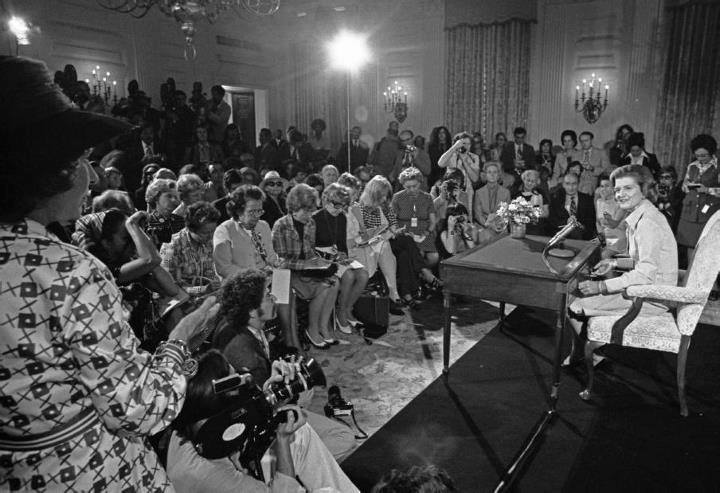
Just 26 days after becoming First Lady, Betty Ford held her first press conference today, making it clear to the 142 reporters and photographers in the State Dining Room of the White House that helping ratify the Equal Rights Amendment would be among her priorities.

Today’s full-fledged news conference was an unprecedented move by a First Lady. Eleanor Roosevelt held 348 press conferences, but they were far more informal, and open to women only, as a way of helping them get ahead in a male-dominated profession.

Though Ford doesn’t intend to get involved in partisan political issues, she does want to encourage women to play an active role in politics. There is, of course, one exception to her non-partisan role as First Lady, and she left no doubt that she’d be campaigning for President Ford in 1976.

In regard to participating in the campaign for the E.R.A., a measure endorsed by Republicans since 1940 and Democrats since 1944, Ford said: “I would be happy to take part in it.”

She intends to lobby for the amendment in the 17 states that have not yet ratified to help get the five more needed. Though her husband once joked about the issue with her when he was a Member of Congress, and in 1971 backed off his initial strong support of it a year earlier due to pressure from some of his anti-E.R.A. constituents in Michigan’s Fifth District, the First Lady assured the press that the President was now an E.R.A. advocate. He re-endorsed the E.R.A. on August 22nd at a press conference just 13 days after President Nixon resigned and Mr. Ford assumed the Presidency.

When asked whether her views on abortion were closer to those of Vice-Presidential nominee Nelson Rockefeller, a strong advocate of legalization when Governor of New York (1959-1973), or those of New York Senator James Buckley, who wants last year’s “Roe vs. Wade” Supreme Court ruling reversed and to have abortion re-criminalized, she said that her views were “definitely closer” to those of Rockefeller.

10644980_10203099874241301_4706260869085449860_n

On other issues, she said the vacation White House would be in Vail, Colorado, that she was being kept quite busy with her new duties since becoming First Lady, and that the children have adjusted to life in the White House quite well.

The Equal Rights Amendment was passed by Congress and sent to the states for ratification on March 22, 1972, and has until March 22, 1979 to gain the 38 state approvals needed for inclusion in the Constitution. Polls show consistent public support for the measure, and so far 33 states have ratified, three this year: Maine, Montana and Ohio. The Equal Rights Amendment reads:

Section 1. Equality of rights under the law shall not be denied or abridged by the United States or by any state on account of sex.

Section 2. The Congress shall have the power to enforce, by appropriate legislation, the provisions of this article.

Section 3. This amendment shall take effect two years after the date of ratification.

Though the pace of ratifications has slowed, that’s to be expected, as the more progressive states would ratify quickly, the more conservative ones more slowly – and after a battle. But with only five more states needed to ratify, and four and a half years to get them to do so, plus the strong support of the First Family, things are definitely looking up for the Equal Rights Amendment 51 years after the campaign for it was launched by the National Woman’s Party.

September 3, 1912: Suffragists Lose in Ohio

Founding Feminists is FMF’s daily herstory column.

FoundingFeministLogo-color

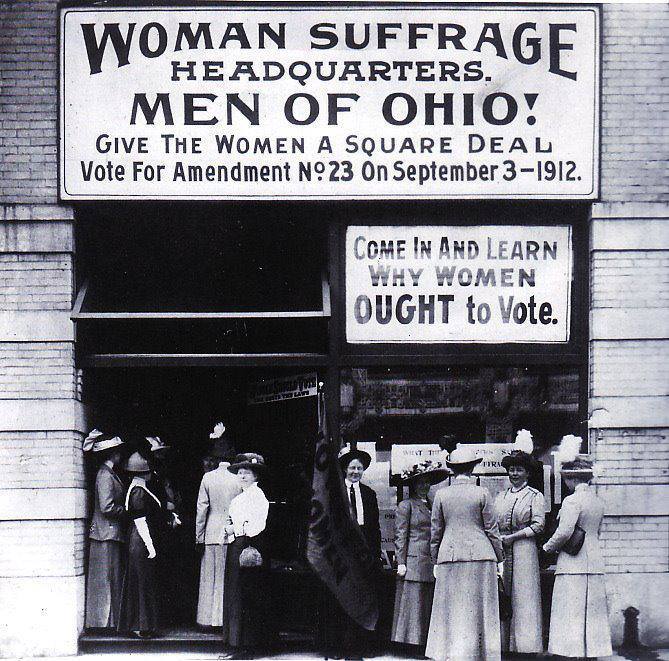
Despite a valiant effort, the 1912 Ohio suffrage campaign is ending in defeat tonight.

Attempts to get the issue of “Votes for Women” on the ballot here date back decades, and finally in late May of this year a State Constitutional Convention approved putting such a proposal (Constitutional Amendment #23) on today’s special election ballot. This gave supporters just over three months to overcome the entrenched and well-funded opposition of the liquor industry as well as refute the usual anti-suffrage arguments.

The campaign was run by Harriet Taylor Upton of the Ohio Woman Suffrage Association. She is an experienced suffragist, and was Treasurer of the National American Woman Suffrage Association from 1894 to 1910. She raised an impressive was chest of $40,000, and was assisted by over 50 full-time workers out in the field, plus large numbers of local volunteers in each community. The highlight of the campaign was a colorful suffrage parade in Columbus last month, in which over 5,000 took part.
National momentum seemed to be swinging in favor of suffrage, so there were great hopes for victory in the Buckeye State. Last October, California approved a suffrage referendum, nearly doubling the number of women voters in the U.S. overnight, and then in May, there was a hugely successful suffrage parade in New York City. But Ohio seems to have brought the advance to a temporary halt.

10686718_10203094165298581_1640787548791073764_n

Among the major difficulties encountered here were a series of anonymous handbills that apparently succeeded in tying the issue of woman suffrage to prohibition in the minds of the State’s male voters. Brewing is a major industry all over Ohio, and suffragists have been busy trying to reassure the public that the two issues are separate, and by no means do all suffragists, or all women, favor banning alcohol. The Ohio Woman Suffrage Association even offered a $100 reward for information about the authorship of the handbills, but their origin still remains a mystery.

The vote today was quite light, despite 42 amendments appearing on the special election ballot and covering a whole spectrum of issues. So it’s not known whether suffrage would have carried if the turnout had been high. Amendment 23 is faring especially poorly in many of the large cities. This is a common phenomenon, because the saloon operators tend to have great power in big cities, and in this State there are major breweries to contend with as well.

Fortunately, Amendment #6, which provides for Initiative and Referendum, is passing by an overwhelming majority, so Ohio suffragists are confident that they can get the issue back on the ballot again by going directly to the people, instead of having to lobby the Legislature to put it there, or wait for another Constitutional Convention.

Despite tonight’s disappointment, there’s still some room for optimism this year. Five other States have upcoming suffrage referenda on the ballot, so hopefully a win in Wisconsin, Michigan, Kansas, Arizona or Oregon will get the victory train back on the tracks in just a couple of months.

September 2, 1965: Stewardesses Fight Discrimination in Congressional Hearing

Founding Feminists is FMF’s daily herstory column.

FoundingFeministLogo-color

Outrageous discrimination in regard to both age and sex was the subject of a hearing today before a Labor Subcommittee of the House of Representatives.

6805_10203088548398162_5578834223513374726_n

Colleen Boland, head of the Air Line Stewards and Stewardesses Association, supported by other uniformed stewardesses in the hearing room, discussed the injustice of airlines automatically grounding or firing stewardesses who married, or reached age 32, and imposing other equally bizarre and unique rules, such as extremely exacting weight and appearance standards.

Boland noted that stewardesses were primarily judged on their sex appeal, rather than their competence at preparing and serving food, attending to sick passengers, or being ready to give critical instructions to those on board in case of an aircraft emergency. She quoted one airline executive as explaining why beauty trumped ability or experience: “If we put a dog on a plane, 20 businessmen are sore for a month.”

Though some Members of Congress were patronizing or frivolous, Representative William D. Hathaway, Democrat of Maine, was quite supportive of Boland’s testimony. He said that he would like to “eradicate from the minds of the public” the idea that airplanes were “flying bunny clubs.” This is a reference to Playboy Clubs, where young, voluptuous women dress in skimpy outfits and wear bunny ears while serving patrons.

Apparently being unmarried as well as youthful is a part of the fantasy that’s being served to the male passengers, because a substantial number of stewardesses have had to keep their marriages a secret in order to continue working.

This is not the first time that stewardesses have gone public with their justifiable complaints about discrimination. Nancy Collins and Dusty Roads have been trying to better working conditions in their profession for many years. After being ignored by executives in male-dominated unions, they got together with Representative Martha Griffiths, Democrat of Michigan, to get a bill passed that would prohibit airlines from firing or grounding stewardesses at 32 (or 35 in some cases). But the nearly all-male Congress never took the issue seriously, so what some of its members referred to as the “Old Broads Bill” was never passed.

Two years ago Collins, Roads and a number of their colleagues held a press conference at the Commodore Hotel in New York City. Because of the glamour associated with their airborne profession, the press showed up, and one photo even went nationwide. In the caption to that one, readers were asked to guess which four of the uniformed stewardesses were over 32, and therefore supposedly “too old” for the job. (Collins, Roads and two others were over that age and still working because the “out at 32” rule was only instituted in November, 1953, and the way the airlines got the unions to agree to such a ridiculous practice was to exempt any woman working at the time.)

Other avenues to justice are being pursued as well. Last year, stewardess unions filed a complaint against T.W.A. and American Airlines with the New York State Human Rights Commission. Though the Empire State has no law banning sex discrimination, New York has had a law banning age bias since July 1, 1958, though the emphasis is on those over 45, so it may not apply.

The passage of the Civil Rights Act of 1964, which outlaws sex bias, and the establishment of the Equal Employment Opportunity Commission are the most promising recent developments. Roads and Jean Montague (the latter about to be fired for turning 32), went to the E.E.O.C. office so soon after it opened this summer that they helped unpack the new office’s typewriters. The union is now trying to get the E.E.O.C. to hold hearings on the issue.

The airlines have powerful incentives to continue to discriminate. They think young, thin, attractive, unmarried women are a great marketing tool in general, and they’re seen as especially critical to United’s “Executive” flights, which are strictly limited to male passengers only. Airline companies also know that an employee who has only a brief career will never earn much more than a beginner’s salary, will be unable to gain the respect and authority that comes from seniority, and won’t be getting generous retirement benefits.

But though the suffrage movement ended 45 years ago, there are still women willing to work for full equality, and the inequality of treatment in regard to male and female employees in the airline industry is so blatant that it seems one of the more logical places to renew the struggle for equal rights.

August 29, 1942: First Class of Women’s Army Auxiliary Corps Officers Celebrate Graduation

Founding Feminists is FMF’s daily herstory column.

FoundingFeministLogo-color

Today was “graduation day” for the first class of officers of the Women’s Army Auxiliary Corps (WAAC), and all the dignitaries present to witness the ceremony were quite impressed with what the women had accomplished since beginning their training on July 20th.

Though the battle to get approval for the WAAC was long, and accompanied by a good deal of skepticism about women in uniform, there was nothing but praise today from two Major Generals, the WAAC Director, and the Congressional sponsor of the bill establishing the Corps.

10647189_10203065580943990_415657824483117154_nAfter the graduates passed in review prior to the ceremony, Major General Ulio, Adjutant General of the Army said, “I’ve never seen anything like it. When the first company came by my first reaction was to applaud rather than salute. It was outstanding. Many of our soldiers would do well to emulate them. I am very proud to be a part of this.”
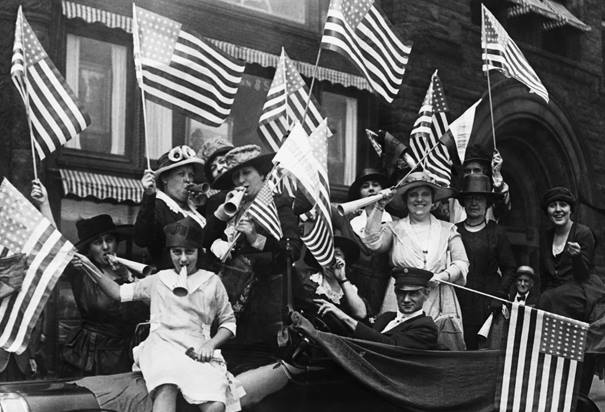
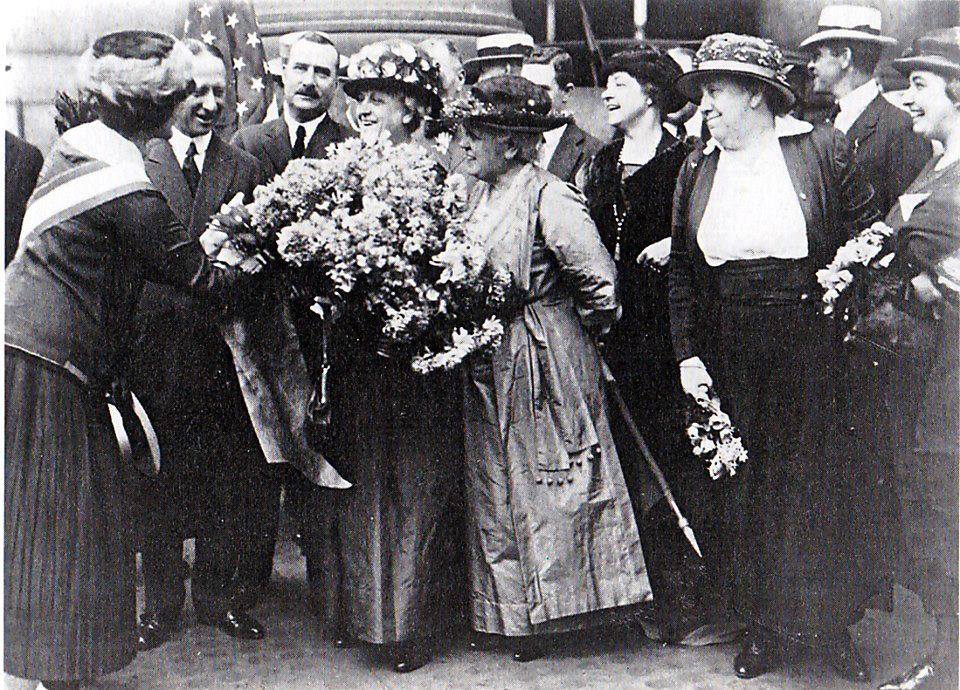
Oveta Culp Hobby, Director of the WAAC, echoed Ulio’s sentiments and said, “I was never more proud than I am today.” Hobby had also received a telegram from General George Marshall, saying, “Please act for me in welcoming them into the Army. This is only the beginning of a magnificent war service by the women of America.”

Representative Edith Nourse Rogers, Republican of Massachusetts, who never wavered in her efforts to establish the new group, told just how long her struggle had been as she delivered the commencement address. “You represent a dream which I conceived during the First World War,” she said, “when, working in England and on the battlefields of France, I saw work performed by members of the women’s army.”

During that conflict 21,480 women served as Army nurses, 10,245 of them in Europe. There were also 1,476 Navy nurses. Over 400 military nurses died in the line of duty, most from a particularly vicious and contagious form of influenza that swept through the packed military hospitals. Rogers told today’s graduates: “You are soldiers and belong to America. Every hour must be your finest hour.”

Though urged to grant direct commissions to prominent individuals or those with special skills, as some other services do, Hobby rejected the idea and has decreed that no one can become an officer in the WAAC without going through the Corps’ rigorous training. And it was quite challenging. Candidates were up early enough to be neatly dressed for inspection at 6:00 in the morning, and except for a lunch break they trained through 5:00. After supper it was time for a required study hour and washing clothes.

One objective indication of the dedication of this class was its graduation rate: 98.2% of those who began the training successfully completed it. The 436 new graduates are now Third Officers, which is the equivalent of Second Lieutenant. (They have their gold bar, but the WAAC insignia for their uniform is still in production since the WAAC was only created on May 15th.)

After leaving Fort Des Moines in about two weeks, some of the new officers will be deployed to engage in recruitment, others to train those new recruits, or to take over jobs presently being done by male soldiers so the men can be freed for combat. Some of the women may even be sent to assignments in England. But wherever they’re stationed, they will certainly be of great service to the country, and have the opportunity to show that women can serve in the military as well as in defense plants to support our war effort.

August 28, 1920: Whistles and Bells Sound at Celebrations Across the Nation for Suffrage

Founding Feminists is FMF’s daily herstory column.

FoundingFeministLogo-color

Today, people all around the country got a chance to celebrate day before yesterday’s final victory for nationwide woman suffrage, while Alice Paul took some time out to speculate about what the National Woman’s Party will do now that its original goal has been achieved.

On August 26th, when Secretary of State Colby proclaimed that the Susan B. Anthony Amendment was now the 19th Amendment to the U.S. Constitution, Carrie Chapman Catt asked that whistles and bells be sounded at noon today, and many cities eagerly endorsed the idea.

In Chicago, Mayor William “Big Bill” Thompson issued a proclamation yesterday asking people to participate in today’s “ringing of bells, blowing of whistles, sounding of horns, and such other methods as may comport with dignity and order” to celebrate “women’s wonderful and unprecedented opportunity.” Local suffragists also asked that at the sound of the first whistle or horn, the men of Chicago remove their hats in silent tribute to the nation’s millions of new women voters.

In Los Angeles, Mayor Meredith Snyder and the local Chamber of Commerce both requested that the whistles at all the city’s industrial plants be blown at noon. In Portland, Oregon, 230 women gathered for s victory luncheon, and at noon all stood at attention by their tables as they listened to the ringing of bells that paid tribute to their national triumph. In Fort Wayne, Indiana, the local League of Women Voters held a celebration as well, but they will be back to post-suffrage business tomorrow when they hire a pilot to drop leaflets over the city advising women to register early enough to be eligible to vote in the upcoming November election.

10612801_10203060579938968_8053481599750195280_n

In Boston, a wide variety of tunes were played on the Christ Church chimes at noon, including such interesting choices as “The Last Rose of Summer” and “Oh, Dear, What Can The Matter Be?” while suffragists gathered to celebrate. Two suffrage flags flew over Boston City Hall alongside the Stars and Stripes, and another huge rally was held in Faneuil Hall. In Worcester, Massachusetts, where suffrage work goes back 70 years to a national women’s rights convention in 1850, there was a mass meeting on City Hall Plaza. The mayor extended his greetings and congratulations to suffragists following the ringing of church bells, factory whistles and even fire alarms.

But the best idea for a celebration came from Columbus, Ohio. In addition to commemorating the Secretary of State’s proclamation of the ratification of the Anthony Amendment, a campaign was launched today to make August 26th an official national holiday known as “Susan B. Anthony Day.” Other women’s rights groups will soon be enlisted in the effort. Considering the importance of Anthony’s work for women’s equality, and the impact her amendment will have on the nation’s future, an annual celebration every August 26th seems totally appropriate, and sure to come about in some form.

Alice Paul certainly appreciated the nationwide salute to women’s enfranchisement, but seems more interested in bringing about future gains for women than celebrating those of the past. She is preparing to go to New York to meet with other high-ranking officers of the National Woman’s Party to decide the group’s future direction now that the Anthony Amendment is firmly embedded in the Constitution. She said today:

Certain groups in the party advocate the formation of a separate woman’s political party, with candidates and a platform. Other groups urge that we work for the elimination of discrimination against women in existing political parties. Still others groups assert that the party in securing a Federal suffrage amendment has fulfilled its purpose and is no longer needed. Decision by a majority of the executive committee will determine future actions.

Considering the success her party has had in directing the energies of dedicated feminists toward specific actions which were crucial to bringing about that initial goal of winning the vote, it seems highly unlikely that such a powerful organization, composed of extremely committed activists, will simply disband. But regardless of whether the N.W.P. decides to compete with the major parties and field its own ticket, or work with Democrats and Republicans, we already know what Alice Paul’s post-suffrage goal is. Minutes after Tennessee’s ratification on August 18th assured the Anthony Amendment’s inclusion in the Constitution, she was already outlining the next step:

“With their power to vote achieved, women still have before them the task of supplementing political equality with equality in all other fields. In State and national legislation, as well as in other fields, women are not yet on an equal basis with men. The vote will make it infinitely easier for them to end all discriminations, and they will use the vote toward that end.”

Exactly how an end to all sex discrimination will be brought about is still to be decided, but apparently the end of one battle just marks the beginning of the next, and we’ll be hearing a lot more from Alice Paul and many other veterans of the suffrage campaign until total equality is achieved.

August 27, 1920: Carrie Chapman Catt Returns to New York City for Massive Suffrage Celebration

Founding Feminists is FMF’s daily herstory column.

FoundingFeministLogo-color

Just one day after Secretary of State Colby proclaimed that the 19th Amendment was properly ratified and woman suffrage was the law of the land, Carrie Chapman Catt made her triumphant return to New York.

The “Votes for Women” celebration here began with a welcome from Governor Al Smith, then became a “victory parade” down Seventh Avenue as Catt was being driven to festivities in her honor at the Waldorf.

But these were far from the first honors for her since the 72-year battle for the ballot ended yesterday morning. The post-ratification commemorations began last night in Washington, D.C., with a mass meeting at Poli’s Theater. Then at every stop made by her train between the nation’s capital and New York City, enthusiastic local suffragists were there with flowers, tears in their eyes, and praise for her work in helping put a ban on sex discrimination at the polling place into the U.S. Constitution.

When she got off the train at Penn Station, Catt was met by 400 suffrage workers, plus a host of public officials, and members of both the Republican and Democratic National Committees. Governor Smith said: “I am very much pleased to assist in extending a welcome to the leader of the nation’s forces which have played such a large part in bringing about the political freedom of motherhood in America.” Catt then told the crowd: “This is a glorious and wonderful day. I have lived to realize the big, beautiful dream of my life – the enfranchisement of women.”

Carrie Chapman Catt holding the bouquet presented to her as she arrived in New York earlier today.

She arrived with three others who had worked closely with her in Tennessee for the 36th and final State ratification needed: Harriet Taylor Upton, of the Republican National Committee; Charl Ormond Williams, of the Democratic National Committee, and Marjorie Shuler, an organizer for the National American Woman Suffrage Association, which Catt led from 1900 to 1904 and again since 1915. Catt was then escorted to a limousine decked out in suffrage colors, accompanied by U.S. Senator William Calder and other dignitaries.

Six mounted police officers led New York’s final “suffrage parade” down Seventh Avenue as the 71st Regiment band struck up “Hail, the Conquering Hero,” while other prominent campaign workers, such as Mary Garrett Hay, marched behind Catt’s automobile while holding up suffrage banners. Catt carried with her “the biggest suffrage bouquet ever seen,” made up of suffrage-yellow chrysanthemums and blue delphiniums, tied with yellow ribbons inscribed “To Mrs. Carrie Chapman Catt from the enfranchised women of the U.S.”

Thunderous applause broke out as Catt entered the Astor Gallery of the Waldorf Astoria Hotel, and her speech proved worthy of the ovation. She told the audience: “We are no longer petitioners. We are not wards of the nation, but free and equal citizens. Let us practice the dignity of a sovereign people.” Speaking of the recent campaign, and looking to the future, she said: “We have proved in Tennessee that this is a government of the people, not an empire of corporations. Let us do our part to keep it a true and triumphant democracy.”

Knowing from their recent behavior in Tennessee – even after the State ratified – that suffrage opponents will never graciously concede defeat, Catt said: “If anyone dares oppose your right to vote we’re coming there with a legal battle and we’ll beat them. But let us remember always that we must consecrate ourselves to the realization of government by the people, and let us refuse to support, regardless of party, the man or woman who does not promise to support that principle.”

With thirty-three years of suffrage work behind her, and more work ahead with the National League of Women Voters, as well as for the cause of world peace, Catt will first be going to her home in Briarcliff Manor for a few days of well-deserved rest, then begin the second part of her life.

August 26, 1920: Victory At Last for Woman Suffrage!

Founding Feminists is the FMF’s daily herstory column.

FoundingFeministLogo-color

Absolute, final, total victory!

Twenty-six thousand, three hundred and thirty-four very long and difficult days ago, a small but brave group of suffrage pioneers declared “… that it is the duty of the women of this country to secure to themselves their sacred right to the elective franchise.” Today, the Secretary of State proclaimed that the U.S. Constitution now says:

The right of citizens of the United States to vote shall not be denied or abridged by the United States or by any State on account of sex” and that “Congress shall have the power to enforce this article by appropriate legislation.

The battle to add those two simple sentences to the Constitution took so long that of the 300 who attended the first women’s rights convention in Seneca Falls, New York, 100 of whom signed the “Declaration of Sentiments” on July 20, 1848, only Charlotte Woodward Pierce is still living. (And she’s eagerly looking forward to casting her first vote on November 2nd!)

Since woman suffrage has been postponed so long, it probably should have been expected that the day would begin with one last, frustrating delay. The train from Nashville, carrying Tennessee’s signed and sealed certificate of ratification (the 36th and final one needed for Secretary Colby to certify that the 19th Amendment had been properly approved by 2/3 of both Houses of Congress and 3/4 of the States) arrived late in Washington D.C.

Secretary Colby expected the document to be delivered by 12:30 a.m., at which time he would leave home, go to the State Department and issue his proclamation. But it wasn’t until about 3:45 a.m. that Charles Cooke called the Secretary to let him know that the certification had just arrived. Colby thought this an unseemly time to sign such an important document, and since there was no possibility of anti-suffragists getting an injunction in the next few hours to prevent him from signing the ratification proclamation, he decided to have Tennessee’s certificate delivered to him at home, and sign the document in the morning.

After double-checking to be sure that all the necessary documents from Congress and the States regarding the Susan B. Anthony Amendment were in order, he signed the proclamation at 8:00, using a single steel pen, and witnessed only by F.K. Neilsen, State Department Solicitor, and Mr. Cooke.

10615496_10203050702092028_8612696458141581499_n

The fact that none of those who had worked so hard and made such sacrifices for suffrage got to see the actual signing of the proclamation seems an injustice, but it was not an intentional one. Because there were so many who had made major contributions to the effort – and the fact that two of the principal groups were not on friendly terms with each other – Colby felt it was impossible to decide who to invite to a formal signing ceremony.

Abby Scott Baker, of the National Woman’s Party, expressed the feelings of many suffragists:

This was the final culmination of the women’s fight, and women, irrespective of factions, should have been allowed to be present when the proclamation was signed. However, the women of America have fought a big fight and nothing can take away from their triumph.

Because the news that the 19th Amendment’s ratification was now officially recognized, and would be defended by the full might of the U.S. Government arrived simultaneously with the realization that they had not been present at the signing of the proclamation, other suffrage leaders were also far more focused on this momentous victory than any personal slight.

Alice Paul, whose dedication to suffrage was proven by enduring imprisonment, hunger strikes, and force-feedings, and whose militant tactics kept the issue of suffrage in the public eye while putting irresistible pressure on political leaders such as President Wilson said:

August 26th will be remembered as one of the great days in the history of the women of the world and in the history of this republic. All women must feel a great sense of triumph and of unmeasurable relief at the successful conclusion of a long and exhausting struggle. The suffrage amendment is now safe beyond all reasonable expectation of legal attack. This opinion was secured from high legal authorities by officers of the National Woman’s Party who devoted their efforts after the signing of the ratification proclamation to discover what further steps, if any, would be necessary to protect the amendment. Pending injunction cases were automatically throw out of court by the signing of the proclamation according to the consensus of legal opinion.

Carrie Chapman Catt, head of the National American Woman Suffrage Association since 1915, met with President Wilson at the White House soon after the proclamation was signed. She presented him with a bound volume entitled “A Tribute to Woodrow Wilson.” It was a memorial of appreciation from the national officers and State chapters of N.A.W.S.A. for his efforts in favor of suffrage.

President Wilson was originally a supporter of woman suffrage only on a State-by-State basis. When he met with a delegation of suffragists on January 9, 1917, his refusal to endorse the Susan B. Anthony Amendment, and the alleged reasons for his refusal, caused Alice Paul and other members of the Congressional Union for Woman Suffrage (later the National Woman’s Party) to begin posting “Silent Sentinel” pickets along the White House fence to prod Wilson into first endorsing nationwide woman suffrage, then helping to lobby the Anthony Amendment through Congress.

Exactly one year later, on January 9, 1918, Wilson came out strongly for the Susan B. Anthony Amendment the day before a key vote in the House of Representatives, in which it got exactly the 2/3 majority it needed. Amid continual pressure on him by the National Woman’s Party as well as other suffrage groups, he became a stronger and stronger advocate of suffrage. Among his later actions were personally appearing before the Senate the night before a vote, asking the Senators to pass the Anthony Amendment as a “War Measure,” followed by numerous telegrams to State legislators asking them to vote to ratify the amendment after it passed Congress and was sent to the States on June 4, 1919.

N.A.W.S.A. officially kicked off the nationwide victory celebrations this evening at Poli’s Theater, in Washington, D.C. Secretary Colby came and brought not just his own best wishes, but those of President Wilson as well. Carrie Chapman Catt recounted the challenge of getting that final State ratification in Tennessee, and noted the powerful array of forces that had been brought together to stop approval there. But suffragists had been able to overcome the remnants of the old “whiskey ring,” still hoping for Prohibition repeal, the steel corporations, the railroad lobby, and the Manufacturers’ Association of Tennessee. But even though they used overtly racist pleas, as well as “States’ rights” arguments, opponents still came up a vote short when the final roll was called in Nashville.

Exhilarating as today’s victory may be, the task set forth at Seneca Falls has by no means been completed with the fulfillment of just one resolution. As noted in the closing paragraphs of their “Declaration of Sentiments,” those pioneers saw suffrage as merely a means to attain their goal of total equality:

Now, in view of this entire disenfranchisement of one-half the people of this country, their social and religious degradation — in view of the unjust laws above mentioned, and because women do feel themselves aggrieved, oppressed, and fraudulently deprived of their most sacred rights, we insist that they have immediate admission to all the rights and privileges which belong to them as citizens of the United States.

In entering upon this great work before us, we anticipate no small amount of misconception, misrepresentation, and ridicule; but we shall use every instrumentality within our power to effect our object. We shall employ agents, circulate tracts, petition the State and National Legislatures, and endeavor to enlist the pulpit and the press in our behalf. We hope this convention will be followed by a series of conventions, embracing every part of the country. Firmly relying upon the final triumph of the Right and True, we do this day affix our signatures to this declaration.

That struggle for absolute equality – using the same means as were outlined in 1848 – must continue with the same energy, enthusiasm and persistence that brought about today’s win.

Hard as it may be for those who have spent decades in the struggle to imagine, “Votes for Women” will inevitably be taken for granted by those who were born after this last battle was fought. But while it’s comforting to think that there will come a time when no one in this country will be able to imagine being barred from the polls solely on account of being a woman, suffragists and the work that was done to bring about that result must never be take for granted. So, it seems only appropriate to suggest that on August 26th of each year, this crucial step toward equality be celebrated, and there be rededication to the goal of those pioneers of 1848 to eliminate every vestige of sex discrimination that may still exist.

>