David became a lifelong admirer of the suffragists after briefly encountering them in a high school textbook in the early 1960s. Though missing out on that first part of the struggle for equality, he became active in "second wave" feminism through LA NOW in 1974 and has been a full-time feminist, TV news archivist, and women's history researcher at the Feminist Majority Foundation since its creation.
Founding Feminists is FMF’s daily herstory column.
As Alice Paul and other National Woman’s Party stalwarts hold one last vigil tonight, the final victory for woman suffrage appears to be at hand.
Despite the dogged determination of opponents to fight to the bitter end, the last obstacle to Secretary of State Colby proclaiming that the Susan B. Anthony Amendment was properly ratified and is now the 19th Amendment to the U.S. Constitution has been brushed aside. All that remains now is for Tennessee’s certificate of ratification to arrive here in Washington, D.C., and be delivered to Secretary Colby.
He has said that even if the certificate arrives as late as midnight or a little after, he will immediately go to the State Department and formally proclaim that the U.S. Constitution now says that: “The right of citizens of the United States to vote shall not be denied or abridged by the United States or by any State on account of sex.”
Tennessee’s certificate of ratification, now on a train from Nashville to Washington, D.C.
Today began like so many before it, battling anti-suffragists. Having failed to prevent the Anthony Amendment from getting the approval of 2/3 of both Houses of Congress and 3/4 of the State legislatures, opponents tried to use the local courts to prevent the Governor from certifying Tennessee’s ratification as the 36th and final State needed. When that desperate move also proved unsuccessful, anti-suffragists turned their attention from Nashville to the nation’s capital. Their last-ditch plan was an attempt to get the District of Columbia Supreme Court to issue an order restraining Secretary of State Colby from signing the ratification proclamation until all legal issues – no matter how groundless they were – could be fully resolved by the U.S. Supreme Court.
The plaintiff was Charles S. Fairchild, acting on behalf of the American Constitutional League. The case was argued by attorney Alfred D. Smith. Justice Frederick L. Siddons first raised the question of whether he even had the authority to issue such an order, and asked Smith to go find references and citations to show that he could do so. Smith returned to court a few hours later with the requested documentation, but the judge still refused Smith’s request to summon the Secretary of State to show cause why he should not be restrained from signing the proclamation, or to issue an order forbidding him from signing.
“I hold that the act of promulgating the ratification of the suffrage amendment is purely a ministerial act,” he said. “I am averse to issuing a rule ordering the Secretary of State to show cause why he should not be enjoined on the grounds presented here.”
The judge also seemed rather surprised to see that the “antis” were not just attacking Tennessee’s ratification, which was at one time a subject of controversy, but all 36 ratifications: “Do you attack the validity of every legislative act of the States with reference to ratification?”
Smith replied, “We do on the grounds, first that Congress had no right to propose such an amendment, and secondly, because the acts of ratification were in some instances invalid because the legislatures which voted favorably were elected before Congress proposed suffrage ratification.”
A number of Southern States – Tennessee being the only one that actually ratified – have a rule that a Statewide election must take place between the time that a Constitutional amendment is passed by Congress and the State legislature can vote on ratifying it. But in June, the U.S. Supreme Court made a ruling in regard to Ohio’s ratification of the 18th Amendment (Hawke v. Smith, 253 U.S. 221), which has been interpreted by virtually all legal authorities and scholars as invalidating all restrictions on any State legislature’s right to ratify a Constitutional amendment.
Though Justice Siddons didn’t buy any of Smith’s arguments, he did grant him one favor. Rather than putting things on hold while he took his time to consider a ruling, the judge immediately dismissed the application so Smith could take it directly to the District of Columbia Court of Appeals.
Though it’s possible the D.C. Court of Appeals might first agree that it has the authority to temporarily restrain Secretary Colby from signing the proclamation, and then choose to do so, it’s very unlikely it could act before Colby has signed the document. The opposition is indicating that if they fail to get such a ruling, or if it comes too late, their final strategy will be to continue challenging the legality of the ratification process. Their new goal would be to get the U.S. Supreme Court to rule before the November elections that at least one State’s ratification of the 19th Amendment was invalid. If that occurred, and another State hadn’t ratified by then, things would stay the same as they are now on Election Day, with women having full voting rights in 15 States plus the Territory of Alaska, the right to vote for some offices or in some elections in 26, and no voting rights at all in 7.
Suffragist leaders are quite confident that unless the train from Nashville is extremely late, they’ll win tomorrow’s race, and that Tennessee’s certification will be delivered to Secretary Colby before the D.C. Court of Appeals can even convene.
National Woman’s Party members are keeping a close watch on all developments. In a move reminiscent of their “Silent Sentinels,” who picketed outside the White House gates to put pressure on the Wilson Administration to help get the Anthony Amendment through Congress, party members are stationing themselves around the State Department tonight waiting for the final act in this drama. The building will be kept open, because some State Department employees have been ordered to stay there to receive and sign for the registered letter containing the certificate from Tennessee. The latest estimate from postal officials is that the document will arrive sometime between 12:30 and 2:30 a.m.
No matter at what hour Colby’s proclamation is made, it will be a time of triumph and celebration for all suffragists. But by no means will there be only a single commemoration. There are plans for a variety of observances from coast to coast over the next few days. Then it will be time for each individual suffragist and every suffrage organization to decide what to do now that the goal of “Votes for Women” has at long last been achieved.
Founding Feminists is FMF’s daily herstory column.
Last-ditch battles are by their very nature desperate, so it shouldn’t be any surprise that anti-suffrage forces are outdoing themselves in their attempts to put up roadblocks to certification and implementation of the 19th Amendment.
The first of two offensives began just after midnight, when 37 anti-suffrage members of the 99-member Tennessee House left for Decatur, Alabama, intent on staying there until the special session of the Tennessee Legislature is over. Their aim is to prevent a quorum from being present to defeat their motion to reconsider ratification and to preclude the authorization of any further ceremonial actions involving ratification.
There remained this morning just one “loose end” on the agenda of suffrage forces, which was to be eliminated by calling up and defeating a motion to reconsider the House’s ratification of the 19th Amendment three days ago. Most legal authorities believe that defeating or permanently tabling the motion is not necessary because the amendment has been legally ratified, and now awaits only Governor Roberts’ certification of Tennessee’s ratification, followed by the U.S. Secretary of State’s official proclamation that the 19th Amendment is part of the U.S. Constitution.
But suffragists want to take no chances on a national victory being jeopardized by some obscure parliamentary rule in one House of one State. So the plan today was to call up the reconsideration motion, then have the full House either defeat or permanently table it, presumably by the same 49 to 47 margin as the initial vote on ratification on the 18th. But instead of just the three seats that have been empty since the beginning of the session due to illnesses, there were forty vacant seats this morning. With only a handful of anti-suffragists at their desks, calling up and defeating the motion was an easy task, but whether it was legal or not is open to debate.
A Republican laughs, while a Democrat, who has bragged about a Democratic State giving the 19th Amendment the 36th and final ratification needed, frets about the fact that the vast majority of those who have now fled the State to slow down the process of certification and implementation are Democrats.
One anti-suffragist who was here today was Speaker of the House Seth Walker. After the roll was called and only 59 members of the 99-member House answered “present,” he declared that the House was 7 votes short of a quorum. In accordance with standard procedure, the Speaker then declared a one-hour recess so the Sergeant-at-Arms could go out and “arrest and bring before the bar of the House such absentees as could be found.” Of course, Walker knew that they were across the State line, and could not be found in time, nor could they be compelled to return, since the Tennessee House has no authority in Alabama.
After the recess, T.K. Riddick, who led suffragists to victory in the House on the 18th, said that since the ratification of a Constitutional amendment is a Federal, not State matter, the State law regarding what constitutes a quorum does not apply, and moved to call up the reconsideration resolution. Walker ruled the motion out of order due to lack of a quorum, but on appeal to the full House, Walker’s ruling was overruled. Ironically, at this point, Walker had to turn over the Speaker’s chair to suffrage supporter Representative Odle, because an injunction sought by anti-suffrage forces to keep all the highest-ranking State officials from taking action on the suffrage amendment had arrived, and as Speaker of the House, Walker’s name had to be on the list.
Odle immediately ordered a roll call on the motion to reconsider, and to the delight of suffrage forces, reconsideration of the vote to ratify the 19th Amendment was defeated by a vote of 50 to 9 – an absolute majority of the House, and a surprising gain of one vote for suffrage forces during the past three days. Odle then moved that the House certify and transmit the ratification resolution, and the motion passed 50 to 0, the 9 remaining “antis” refusing to vote. Walker then said nothing could force him to sign the resolution. Speaker Todd of the Senate later noted that the joint resolution didn’t need the signatures of the Speaker of the House and Senate anyway, and with or without Walker’s signature Tennessee’s ratification was equally valid.
That injunction was the other interesting development today. It was issued by Judge E.F. Langford of the Chancery Court here in Davidson County,
to restrain Governor Roberts, Tennessee Secretary of State Stevens, Senate Speaker Andrew Todd and House Speaker Seth Walker from certifying ratification or taking any action in regard to the suffrage amendment. How seriously the injunction should be taken depends upon one’s feelings about suffrage. At the headquarters of the “antis” it was considered a major victory, stopping suffrage in its tracks. According to Charlotte Rowe: “The suffragists thought they had won by a trick and they have been foiled.”
But though plans to return home by suffrage leaders have been postponed, there is no doubt being expressed that victory has been won and will soon be made official. Just before a meeting with a number of pro-suffrage groups, Carrie Chapman Catt said: “The anti-suffrage forces have made no move which was not anticipated by us” and that “when 37 men ran away from their posts, which they had sworn to safeguard, they immortalized themselves as being willing to delay for a few days the operation of woman suffrage.”
Meanwhile, in Washington, D.C., the National Woman’s Party gave an accounting today of just how expensive this ratification campaign has been for them:
From June 4, 1919, when the amendment passed the U.S. Senate, to August 18, 1920, when Tennessee’s ratification completed the long suffrage struggle, expenditures by the Woman’s Party are totaled at $149,599.36, according to the report of the Treasurer’s department issued today.
Since March 22, when Delaware, which suffragists hoped to make the 36th State, called her legislature into special session, $68,519.26 has been raised and spent by the national headquarters of the Woman’s Party. This does not include the sums raised and spent by Delaware for its own campaign or spent but not yet raised within Tennessee. The Tennessee campaign cost at least $10,000 bringing the total cost of the thirty-sixth State up to at least $80,000.
By far the greater part of this sum has come in small contributions of $1 and up. The largest contributor to the ratification fund for the Woman’s Party was Miss Mary E. Burnham of Philadelphia, Pa., who gave $14,000. Next largest was the gift of Miss Fannie T. Cochran of Pennsylvania, who gave $6,100; Mrs. Charles Boughton Wood gave $5,050 and Mrs. H.O. Havemeyer of New York City $4,850.
Money raised by the Woman’s Party has been spent in maintaining the party headquarters in Washington and the paying of its staff of officers and organizers in Washington, who have campaigned in nearly every State in the Union for ratification, in organizing demonstrations and in other phases of the year-long intensive campaign.
Naturally, the Woman’s Party would be appreciative of any donations that could be made, no matter how small, to help defray the costs of this final, and quite expensive phase of the battle for the vote.
Though there are still some legal tangles to sort through, the only thing anti-suffragists are likely to accomplish with their latest obstructionist tactics is to decrease what little respect may still remain for their movement, and they’ll probably have great success at that, judging by these recent actions.
Founding Feminists is FMF’s daily herstory column.
Another day of cheering and waving of yellow banners from the galleries of the Tennessee House as day before yesterday’s pro-suffrage majority held together, and kept ratification of the 19th Amendment intact.
When Tennessee became the 36th and final State needed to ratify, the anti-suffrage Speaker of the House changed his vote to “Aye” at the last moment so that he would have the right to introduce a motion – an any time during the next two days – to reconsider and reverse the vote to ratify.
But despite a boastful speech made at an anti-suffrage rally last night by Speaker Walker that he would have the votes to undo ratification today, he instead made a motion to adjourn until Monday, in hopes that he could change at least two votes over the weekend. Suffrage supporters defeated that motion with numbers identical to those cast for ratification on the 18th, so when it became obvious that no suffrage supporters had defected to the other side, cheering broke out.
Alice Paul’s 36-star ratification flag, on which she sewed a new star every time a State ratified the 19th Amendment.
Suffrage forces eagerly agreed to adjourn until tomorrow morning, when there will be a rare Saturday session. Though the State Attorney General and a number of experts on parliamentary procedure have said that Walker’s failure to bring up the motion to reconsider within two days should settle the issue, suffragists want no loose ends. Since a motion to reconsider is still on the House Journal as a matter of record, suffrage supporters plan to bring it up tomorrow and either defeat it outright or permanently table it. Now that two days have passed since the original vote, a motion to reconsider can be brought up by any member who voted in favor, not just the Speaker. This will be done at the time of the pro-suffrage leader’s choosing, and only if defeat of the measure is absolutely certain. Once this motion to reconsider is disposed of, there can be no further action on suffrage by the Tennessee House.
Needless to say, suffragists are continuing to keep close to their legislative allies to make sure that there are no defections, because only two switches could change a 49-47 vote to defeat the reconsideration resolution into a 49-47 vote to retract ratification and give opponents an issue to litigate in court. Although it’s believed that rescinding ratification is not legal, because two rescissions of the 14th Amendment were never recognized, such a move would give those who want to delay implementation of the new amendment an excuse to do so.
Of course, there will be court action no matter what happens. Judge Joseph Higgins, President of the Tennessee Constitutional League, said that he would ask for a writ of injunction to be issued against Governor Roberts restraining him from signing a certification that the Tennessee Legislature had properly ratified the 19th Amendment, as well as prohibiting U.S. Secretary of State Colby from issuing a proclamation that it is part of the Constitution.
The legal issue here is that the Tennessee Constitution prohibits the legislature from ratifying a Federal amendment sent to the States by Congress until after a Statewide election has taken place and the new legislature seated. The 19th Amendment was approved by Congress on June 4, 1919, and the first Statewide election after that date will not occur until November 2nd of this year. But virtually all legal scholars and authorities believe that a U.S. Supreme Court decision in June regarding Ohio’s ratification of the 18th Amendment declared that all restrictions on a State legislature’s right to ratify an amendment at any time are unconstitutional.
While desperate and dejected anti-suffragists are pinning their hopes on long-shot legal challenges and last-minute conversions, suffragists are so confident that their work is nearly done that campaign offices are being dismantled, and train reservations for tomorrow are being made so that victorious veterans of the last battle in the fight for suffrage can begin leaving for home right after the vote to reject the motion to reconsider.
Carrie Chapman Catt, never one to take anything for granted, has nevertheless begun the switch from planning campaign strategy to thinking about how to celebrate the victory. While reading through the latest batch of telegrams of congratulations, she said:
“We suffragists have worked so hard and against such odds that we have forgotten how to play.” When asked about the details of the upcoming nationwide celebration, she said: “Many proposals are coming in, but I have made no plans. The credit is not mine. It belongs to all that faithful band who have struggled for political freedom.”
Thinking back over her three decades of work, Catt also said: “What has sustained me in this thirty year contest? My unswerving belief in the righteousness of woman suffrage.”
Alice Paul has been busy with post-ratification duties as well. She has been sending telegrams on behalf of the National Woman’s Party to Attorneys General in States where women had no voting rights, and therefore have never been allowed to register, asking whether women will be able to register and vote in their States on the same basis as men once the U.S. Secretary of State issues his proclamation that the 19th Amendment has been properly ratified. No additional legislation in the States should be required to allow women to vote, because the amendment is self-executing and overrides any State laws restricting the vote to men. So her inquiry is simply to find out whether the funds and machinery necessary to register women are available.
Some States where women had partial suffrage, such as New Hampshire, Minnesota, Massachusetts and Mississippi, and well as Virginia, where they had no voting rights, have passed enabling acts specifically affirming the right of women to vote under the 19th Amendment, and similar legislation is pending in North Carolina, where women have never voted. Attorneys General in Georgia, New Mexico, Ohio, North Dakota and New Jersey, where women had partial suffrage, plus Pennsylvania, West Virginia, and Florida, where women had no voting rights, have given informal opinions that no special legislation is needed, and that women can register and vote on the same basis as men. The Governor of the partial-suffrage State of Missouri said that if there are any problems with the registration of women, he will call a special session of the State Legislature to remove the barriers. Yet to be heard from are Alabama, South Carolina and Maryland, where women had no voting rights, and Connecticut, Delaware, Louisiana and Vermont, where women had partial suffrage and could vote for some offices but not others.
Though registering millions of new women voters to vote in the November 2nd General Election, overcoming resistance by anti-suffrage State officials, and fighting off court challenges is a huge task, it pales in comparison to the challenge of achieving the victory won day before yesterday. So, the job is in competent hands, and should certainly get done in time.
Founding Feminists is FMF’s daily herstory column.
Intent on assuring that yesterday’s historic victory does not become muddled by a vote to revoke approval, suffragists spent today keeping constant company with every Tennessee legislator who voted to ratify the Susan B. Anthony Amendment.
When not being fanned on the House floor, the legislators were entertained by being taken to luncheons, on country drives, or to motion picture theaters.
Alice Paul drinking a grape-juice toast to victory yesterday in front of her 36-star ratification flag.
The anti-suffrage Speaker of the House is determined to have the ratification vote reversed, and could call for reconsideration without a moment’s notice at any time the House is in session for up to two days after the resolution’s passage. Since a single vote constituted the margin of victory that gave the 19th Amendment the 36th and final State ratification needed to become part of the Constitution, it’s essential that every House member who voted “Aye” yesterday be present and still support woman suffrage should a vote to reconsider the resolution suddenly be called. But the “Votes for Women” advocates who packed the galleries from the beginning to the end of the session today were relieved to find that nothing other than routine business was done.
Tonight, however, House Speaker Seth Walker announced that 47 members of the House had signed pledges to vote to reconsider ratification. Since that’s the same number who voted against suffrage in the initial 49-47 roll call, it means that no “anti” has converted to the pro-suffrage side, so no pro-suffrage legislator can be allowed to defect if the razor-thin majority for suffrage is to be maintained for one more day. Three legislators were absent for the original vote and may – or may not – arrive here tomorrow. If they do take their seats, it is hoped the reports that two of the three are pro-suffrage are true. But presumptions about how a legislator will vote have been proven wrong in a number of cases, so their arrival would only add to the uncertainly.
Though the legality of a State reversing its ratification is highly questionable, and has never been recognized by Congress, such a rescission vote would clearly complicate what’s now a straightforward, purely ceremonial process. The Governor must certify that Tennessee has legally ratified, then send the certification on to the U.S. Secretary of State, then Secretary Colby will officially proclaim that the 19th Amendment is a part of the United States Constitution.
Article Five of the Constitution does not require the Secretary of State to issue a proclamation of ratification, so the Susan B. Anthony Amendment fulfilled all the requirements for inclusion yesterday by having been passed by 2/3 of both the U.S. Senate and House, and 3/4 of the State legislatures. But the symbolism of the Secretary of State, representing the United States Government, proclaiming that woman suffrage is the law of the land would be quite powerful, and go a long way toward ending resistance to women registering to vote and voting in November, even if there are court challenges to Tennessee’s ratification.
It’s been quite a day for Tennessee Representative Harry Burn, whose unexpected and last-minute vote switch provided the margin of victory yesterday. While suffrage forces have been honoring and praising him, anti-suffragists have been charging that bribery was involved in his surprise vote, and both the Nashville Banner and Nashville Tennessean printed affidavits today alleging that bribes were offered Burn just before his final vote. A Grand Jury, already seated to investigate claims of “improper influences” on the State’s legislators in regard to the suffrage campaign, is now investigating these new charges, though suffragists don’t take them seriously, and even some anti-suffragists seem skeptical.
Harry Burn himself told why he voted the way he did by writing in an open letter to the Tennessee House today:
I know that a mother’s advice is always safest for her boy to follow, and my mother wanted me to vote for ratification. I desired that my party in both State and nation might say that it was a Republican from the mountains of East Tennessee who made national woman suffrage possible at this late date.
It was truly appropriate that a Republican cast the final vote needed to ratify, because suffrage and Republicans have had a close relationship for some time. When Susan B. Anthony cast her “illegal” ballot in 1872, she wrote to Elizabeth Cady Stanton that night saying she voted the Republican ticket. The Anthony Amendment itself, ratified yesterday, was first introduced into Congress by Senator Aaron Sargent, Republican of California, in 1878.
When the House passed the Anthony Amendment last year, the vote was 104 Democrats in favor and 70 opposed (59.8% support), but 200 Republicans in favor and just 19 opposed (91.3% support). In the Senate it was 20 Democrats in favor and 17 opposed (54% support), but 36 Republicans in favor and 8 against (81.8% support). In both cases it was Republicans who provided the votes necessary for the 2/3 majority required.
Of the 36 States that ratified, 26 (72.2%) had Republican legislatures, 7 were Democratic (19.4%) and in 3 (8.3%), one party dominated the House and the other the Senate. Of the 9 States which rejected ratification, 8 were Democratic. Three States never voted on ratification. And, of course, yesterday, the initial vote in the Tennessee House was 33 Democrats in favor and 36 opposed (47.8% support), while 16 Republicans voted in favor and 11 were opposed (59.2% support), Harry Burn and his party providing the votes needed for a simple 49-47 majority. (The final count was actually 50-46 because the anti-suffrage Speaker changed his vote so that he would be allowed to call up the ratification resolution again for the purpose of reversing the vote of approval.)
While some die-hard anti-suffragists fight on, some are conceding graciously. Even The New York Times, which has been second to none in its opposition to woman suffrage, today said that: ” … there is no doubt that the vote of yesterday will be almost universally taken as ending the long struggle for woman suffrage in this country.” They noted that women had already won full voting rights in many States, and were eligible to vote for President in even more. So, 68 years after their first condescending and dismissive editorial on the subject, they admitted: “A movement gathering such momentum was bound to succeed in time.”
Proponents were much more enthusiastic in their reactions, and congratulations are pouring in from around the world. Countess Maria Loschi of Rome, Italy cabled:
American women have already good will, splendid preparation, and great power. May their final enfranchisement be blessed. May all roads be open to this new wonderful army. Be united, dear friends, especially after this deserved victory, and accept greetings from an Italian woman who has known, loved and appreciated you.
Madame De Witt Schlumberger said: “Enthusiastic congratulations from the French Union for Woman Suffrage to their American sisters upon their enfranchisement so well merited.”
Ellen Key of Sweden wrote: “Sisters, use your enfranchisement in the noble spirit which made Susan B. Anthony great in the struggle.”
Governor Roberts, who called the special session so that ratification could occur, received telegrams from many prominent suffrage supporters around the country, among them President Wilson: “If you deem it proper, will you not be kind enough to convey to the Legislature of Tennessee my sincerest congratulations on their concurrence in the Nineteenth Amendment? I believe that in sending this message I am, in fact, speaking the voice of the country at large.”
But after one final night of strategy sessions, with some time out for reading congratulatory telegrams and newspaper stories with long-sought headlines proclaiming “Votes for Women!” it will be back to work early tomorrow for all suffrage organizations to assure that yesterday’s final victory is, indeed, final.
Founding Feminists is FMF’s daily herstory column.
The day of victory has arrived! After 72 years of effort, “Votes for Women” is no longer a slogan, or a distant goal, but will be a Constitutionally guaranteed right, with only purely ceremonial events remaining to be done.
The long struggle that began with a woman suffrage resolution passed in Seneca Falls, New York, on July 20, 1848, by those attending the second day of the first women’s rights convention, ended in Nashville this afternoon when the Tennessee House approved – by a single vote – ratification of the Susan B. Anthony Amendment. The “Volunteer State” has now become the 36th and final one needed to enshrine these words in the U.S. Constitution:
The right of citizens of the United States to vote shall not be denied or abridged by the United States or by any State on account of sex.” A second section says: “Congress shall have the power to enforce this article by appropriate legislation.
The final day of the battle was much like the 26,326 that led to it, with hard work done, heavy opposition encountered, and hopes rising and falling repeatedly. The anti-suffrage Speaker of the House controlled the action, and an hour into today’s debate, Rep. Seth Walker left the Speaker’s chair and took the floor to protest the implication that “special interests” were behind the opposition to suffrage and would be responsible for its imminent defeat:
The battle has been won, and the measure has been defeated. I resent the iniquitous remarks that special interests are here alone against this measure. I resent this on behalf of the womanhood that is both for and against suffrage. I move that this measure go where it belongs, to the table.
National Woman’s Party members thanking legislators outside the State Capitol today after the vote. Harry Burn is in the dark suit just right of center, in the background, shaking hands with Anita Pollitzer. On the far left is Banks Turner, shaking hands with Catherine Flanagan. In front are Thomas Simpson, Betty Gram and Sue White.
All over the chamber, “antis” gleefully shouted “Second the motion!” and Representative Overton, chosen by Walker to preside over the House so Walker could work the floor, immediately ordered the roll called. After several agonizing minutes, in which predictions of how a member would vote finally encountered reality, the result was a 48-48 tie, with 3 members absent. The “antis” demanded a second roll call, hoping to change one vote, table the measure, and end all action on suffrage until next year. Overton quickly obliged, but no votes were changed. The “motion to table” was then declared lost for want of a majority.
Since a 48-48 tie on the ratification resolution itself would be insufficient for passage, the “antis” demanded, and of course got, an immediate vote. Suffragists in the galleries awaited the inevitable result stoically, disappointed once again, but already beginning to plan the 1921 campaign for that 36th State.
Then something totally unexpected happened. Representative Harry Burn, the youngest member of the House, who had been wearing a red anti-suffrage rose, voted “Aye” on ratification even though he had just voted to table the measure twice. Did he misspeak, and might he correct himself at the end of the roll call, or were there actually 49 votes for ratification now? After a moment of stunned silence, there was an outburst of cheers from the galleries, as hopes rose once again. The roll call continued, but just as suffragists were beginning to relax, Representative Turner chose to pass. He had voted against tabling the measure, but if he was having second thoughts, and was about to change his vote from pro-suffrage to anti-suffrage, it was back to a 48-48 tie and failure to ratify.
The “antis” in the galleries and on the floor now had their turn to cheer as they appeared to be back on the road to victory after a brief detour. The roll call proceeded, then at almost the last moment Rep. Turner requested the clerk to record his vote as “Aye.” That meant Harry Burn’s vote was the only one that had changed, and the tally would be 49 to 47 in favor of ratification! (It was noticed by some observers that just before his final vote, Burn was reading and re-reading a letter, rumored to be from his mother, telling him to vote for suffrage. He has promised to discuss his vote tomorrow, so everyone is eager to hear his story.)
Pandemonium broke out even before the clerk officially announced the result. Yellow banners waved in the galleries and suffrage supporters danced and hugged, as a shower of yellow flowers they’d thrown into the air rained down on the House floor.
Barely heard amid the boisterous and lengthy demonstration, Speaker Walker made a move he may later regret. He changed his vote to “Aye” just before the tally was made official by being entered in the House Journal, because only someone who votes for a measure can ask to have it reconsidered, and the “antis” definitely want the ratification resolution reconsidered and defeated. But by making the final vote count 50 to 46, he gave the ratification resolution an absolute majority of those in the 99-member House, and prevented any challenge to it on the basis of lacking such an absolute majority for passage.
Though there will be unprecedented partying tonight at suffrage offices all across the city – and nation – no one will be going back to their home States tomorrow. The House has two days to reconsider the measure, and suffragists will be keeping close watch on all legislators to make sure there are no defections that might cause ratification to be rescinded, though the legality of rescission is highly questionable, and has never been recognized by Congress.
At least two of the three legislators who were absent today are thought to be pro-suffrage, but they’ll all be heavily lobbied in case they take their seats tomorrow. There will also be legal challenges to ratification due to a section of the Tennessee Constitution that prohibits the legislature from ratifying a Federal amendment submitted by Congress to the States until after a Statewide election of legislators has taken place. The 19th Amendment was submitted to the States on June 4, 1919, and the first Statewide election after that won’t occur until November 2nd. But a U.S. Supreme Court decision in June appears to have invalidated all restrictions on a State legislature’s right to ratify at any time, which is why the Governor felt free to call this special session to ratify the Anthony Amendment.
If the House majority for suffrage can be maintained for just two more days, all that will remain are two ceremonies. Governor Albert Roberts, who has been a tireless and fearless advocate of suffrage, will need to certify that the ratification resolution was properly passed by both the House and Senate of the Tennessee Legislature. After he signs that document it will go to Washington, D.C., where the Secretary of State will review it and similar documents from 35 other States, then issue a proclamation that the Susan B. Anthony Amendment is now officially the 19th Amendment to the Constitution. Secretary Colby said today that he would issue the proclamation as soon as the certification arrives from Tennessee. The Attorney General of the United States said that the amendment is self-enforcing and no new laws are needed to make women eligible to vote in States where they could not vote until now.
At National Woman’s Party headquarters in Washington, D.C., Alice Paul happily added a 36th star to the ratification flag, and gave out a victory statement:
The victory of women today completes the political democracy of America and enfranchises half the people of a great nation. It is a victory which has been won not by an individual or a group, but by all those women who since the time of the Revolution have suffered and protested against the humiliation of disenfranchisement and proclaimed the equality of men and women. All women of the United States are now entitled to vote in the coming elections on the same basis as men.
But our work cannot end. Ratification must be protected in the courts against attacks of its opponents. It must be safeguarded, if possible, by the winning of a thirty-seventh State. In certain States, also, provision must be made for admitting women to the polls and providing for their registration in accordance with the law. The Woman’s Party will at once get in touch with the Attorney General of each State with the object of aiding in this matter, which we anticipate will cause no difficulty or delay.
With their power to vote achieved, women still have before them the task of supplementing political equality with equality in all other fields. In State and national legislation, as well as in other fields, women are not yet on an equal basis with men. The vote will make it infinitely easier for them to end all discriminations, and they will use the vote toward that end. The National Woman’s Party, organized in 1913 to secure passage of the Federal suffrage amendment, has accomplished the purpose for which it was founded. It will meet in convention within the next two months to decide upon its future.
Paul said that she is confident today’s vote will stand:
We do not fear the results of the efforts to reconsider, but we shall, of course, do everything possible to prevent such action. We are informed by our workers in Nashville that the forces opposing suffrage, as soon as the vote was taken, began attacks on our men to induce a sufficient number of them to remain at home for the next two days in order that the reconsideration motion might be passed and the amendment defeated. They are reported to be saying to our men: ‘You have done everything you need to do now to please the suffragists; all you need to do for us is to stay home for two days.’ We are confident that none of the men who voted for us today will agree to such tactics.
The vote in the Tennesse House today showed that we had one more vote than the necessary clear majority of fifty, since two men who failed to vote were strong suffragists. One of them was unable to leave his home because of his own illness, the other was with his wife, who is critically ill. Both of these absent men were Republicans.
In addition to these two men, sixteen Republican members voted for ratification, which means that the Republicans have enlisted on the side of ratification more than a majority of their delegation in the House – a record of which they may well be proud.
The original 49 to 47 vote had 33 Democrats in favor, and 36 opposed, with 16 Republicans in favor – Harry Burn among them – and 11 against.
Paul then concluded her remarks by thanking the Presidential nominees of both parties for their help, as well as Tennessee Governor Albert Roberts who called the special session.
Alice Paul’s militant tactics and self-sacrifice certainly deserve a share of the credit for today’s victory, but so do Carrie Chapman Catt’s more than three decades of effort. Today, Catt, head of the National American Woman Suffrage Association from 1900 to 1904 and since 1915, said:
The gallant men of the Volunteer State, unafraid of the noisy threats meant to intimidate, have opened at long last the long-locked door through which millions of grateful women will pass to political freedom. Ratification of the amendment is more than a victory for woman suffrage. It is proof of the inviolable integrity of the Tennessee Legislature, a fact which should fill every Tennessee heart with pride. In this hour of victory there is but one regret, and that is every man and woman in the nation does not share our joy. Today there are those yet too blinded by prejudice to recognize the justice and inevitability of woman suffrage, but tomorrow we know that we shall work together for the common good of this great and glorious nation.
The National American Woman Suffrage Association will now begin the process of disbanding, its purpose happily fulfilled. But Catt sees plenty of work ahead for veteran suffragists:
The suffrage victory means opportunity for more work and added responsibility. The suffrage triumph is too belated for it to come with any shock of surprise. We have long been ready for it. We are ready for the work that lies ahead of us.
Since ‘votes for women’ is now an accomplished fact, what are women going to do with the vote? Are they going to draw back their skirts in disdain from all interest in politics on the ground that it is corrupt? Are they going to join the army of kid-gloved men slackers whom I have heard proudly boast that they would not touch politics with a 10-foot pole? Or are they going to be of those who will help swell America’s army of voters who put conscience and thought into the scales with party politics and party candidates?
In order to help the new woman voter find her way through the maze of these besetting questions there has been formed the National League of Women Voters. In each State, State branches are forming out of the old suffrage associations. The league is non-partisan, it is pan-partisan, all partisan.
There should also be tribute paid today to literally uncountable numbers of other suffragists going all the way back to those who gathered together in 1848 to launch this battle for the equality of men and women. Even gaining such a basic right as the vote must have seemed almost impossible not just in the beginning, but at other times, such as between the winning of Idaho in 1896 and Washington in 1910, when not a single State was won for suffrage, or 1915 when an all-out campaign in four big Eastern States produced nothing more than stunning defeats.
Though she didn’t live long enough to see today’s victory, Susan B. Anthony knew all along that it wasn’t winning the vote that was impossible, but that for those who believe in equality, “Failure is impossible.” Today she was proven right.
Founding Feminists is FMF’s daily herstory column.
Another plunge on the political roller coaster for suffrage forces today.
With the final opportunity to ratify the Susan B. Anthony (nationwide woman suffrage) Amendment before the November election drawing near, momentum seems to have shifted back toward the anti-suffrage side.
Despite an unexpectedly big victory in the Tennessee Senate day before yesterday, the outlook for ratification in the House now looks doubtful. Polls of House members were taken several times today by both sides, indicating that no one is confident of winning – or believes pledges are valid for more than an hour or two.
Anita Pollitzer, of the National Woman’s Party, checks the latest tally of vote pledges with W.J. Jameson, head of the National Finance Committee of the Democratic Party. He is one of many high-level party officials here in Nashville to lobby their fellow Democrats to vote for ratification.
The day’s good news may also be bad news. House Speaker Seth Walker announced today that there would be no attempt by him or his fellow anti-suffragists to hold the ratification resolution in committee. But he also indicated that the reason he wouldn’t try to keep it off the floor was because he’s confident that there are enough votes to defeat it.
With a majority of the members of the North Carolina House firmly pledged against suffrage, and the Governors of Vermont and Connecticut stubbornly refusing to call special sessions of their legislatures to vote on ratification, Tennessee is the only realistic hope for victory before the November election. If the ratification resolution comes up short by even a single vote here in Nashville, it means that the legislature won’t vote on it again until its regular session begins early next year. Not only will millions of women in non-suffrage States be unable to vote in November, but the 1921 suffrage campaign will have to be launched in the wake of a frustrating and devastating setback.
Though the Speaker of the House is opposed to suffrage, Governor Albert Roberts is still vigorously promoting the cause despite the political risks involved. It was learned today that two newspapers, which up until now have endorsed his bid for re-election, have told him to stop lobbying for suffrage or they will actively oppose him in November.
More opposition is on its way, as an “envoy” from the North Carolina Legislature (where 63 of 120 House members recently pledged to block ratification) is expected to arrive in Nashville shortly to give “encouraging words,” and plot mutual strategies with local suffrage opponents. The envoy, Representative W. W. Neal, is also alleged to have some sort of definitive poll showing that the Tennessee House is opposed to suffrage, and this poll will be used in an attempt to generate a bandwagon effect among uncommitted or wavering legislators that will increase the margin of rejection.
But while the result may be in doubt, the timetable of events is now starting to become clear. Tomorrow night the House Committee on Constitutional Conventions and Amendments will discuss the ratification resolution once again, and then majority and minority reports will be submitted to the full House the next day by 2:00 in the afternoon. At that point, if there are no unforeseen delays, there should be a vote on the ratification resolution itself either late that day or early the next. If all members are present and voting, 50 votes will be required in the 99-member House to win the 36th and final State ratification needed to make the proposed Anthony Amendment the 19th Amendment.
Despite the fact that this is a Sunday, it has been no day of rest for suffragists, and the upcoming week will be the busiest, and most important one yet for the cause. After today’s developments, there is certainly no danger of any slacking off due to overconfidence, and the highly uncertain outlook seems only to have spurred the forces of the National Woman’s Party and the National American Woman Suffrage Association to greater efforts. So if the same dedication that has marked the suffrage movement for the past 72 years can be kept up for less than 72 hours more, victory might still be achieved.
Founding Feminists is FMF’s daily herstory column.
The suffrage campaign stayed at high intensity today, even though it’s Saturday and the Tennessee Legislature won’t be back in session until Monday.
After the State Senate’s approval yesterday, only a roll-call vote in the House is now needed to make this State the 36th and final one needed to ratify the proposed “Susan B. Anthony Amendment” and transform it into the “19th Amendment,” so no effort will be spared until the final vote is cast.
Today Alice Paul made it clear to Presidential candidates of both major parties that she’s holding them responsible for assuring a majority for ratification in the House next week.
The unexpectedly high margin of victory in the Tennessee Senate yesterday brought hard-to-earn praise from Paul for the recent efforts of the party nominees:
There is every evidence that the national leaders of both political parties have up to this time put their shoulders to the wheel. If they continue the same determined efforts, victory in the House, when the vote comes next week is assured. The real struggle, however, has always been in the House, and the most hopeful poll today shows hardly a vote to spare, so that the result will depend entirely upon the efforts of Governor Cox and Senator Harding and the national parties. The real battleground is not in Tennessee but in Ohio. It is not too much to say that whether or not women vote next November rests with the Presidential nominees and their efforts for ratification over this weekend.
Abby Scott Baker, in charge of the Woman’s Party’s Political Committee, is in Ohio to work with the party nominees. James Cox, the Democratic Presidential nominee has his campaign headquarters in Dayton, while Harding, the Republican Presidential nominee is conducting his “Front Porch Campaign” from his home in Marion. President Wilson is also doing his part to help win ratification by sending telegrams to Tennessee Democrats. Yesterday he sent one to Seth Walker, Speaker of the House, asking him to help with the battle there. But four days ago Speaker Walker shocked everyone by announcing that he had switched to the anti-suffrage side, and so today he replied to President Wilson’s wire in this way:
I have the profound honor to acknowledge your wire of Aug. 13. I do not attempt to express the views of other members of the lower House of Tennessee, but speak for those of myself alone, which on the Anthony Amendment are contrary to yours. You were too great to ask it, and I do not believe that men of Tennessee will surrender honest convictions for political expediency or harmony.
Since almost three-quarters of House members are Democrats, strong leadership by a pro-suffrage Speaker would have assured success. But the opposition of the House’s most powerful Democrat has made things considerably more difficult. Hopefully he will continue to tell fellow Democrats in the House to vote according to their own conscience and will not use his influence to pressure legislators into voting against suffrage. But just having such a prestigious figure on their side is certainly a major advantage to anti-suffragists, and could have an effect on many House members who will want to be on friendly terms with the Speaker when they seek his support for their own bills in the future.
President Wilson isn’t the only Democratic leader trying to lobby Speaker Walker. William McAdoo, who recently served as Secretary of the Treasury, and got the most first-ballot votes at this year’s Democratic Convention, though James Cox finally won the Presidential nomination on the 44th ballot, also sent a wire to Walker:
As a former Tennessean, proud of his State and interested in her welfare, I trust I may with propriety express my earnest hope that the House of Representatives will concur with the action of the Senate and ratify the woman suffrage amendment to the Federal Constitution. It will add new glory to the historic achievements of the Volunteer State if her Legislature now consummates the great hope and long delayed act of justice to American women, which will make them full and equal participants with men in the benefits and responsibilities of truly democratic government.
Anti-suffragists are also busy, fully aware that their movement may be just one roll-call and a few days away from extinction. They are taking comfort in the fact that they need only fight in Tennessee, because a majority of North Carolina House members have pledged to fight suffrage. Today anti-suffrage forces made public a telegram from R.H. Williamson of the State Rights Defense League of North Carolina:
We are going to win in spite of pressure from the White House, from Dayton, Ohio, and from the United States Senate and the Secretary of the Navy. The will of the people of our States must be the law. If this crime is perpetrated let it not be laid at the door of either North Carolina or her daughter, Tennessee. Fight to the last ditch, and then some.
“Dayton, Ohio” refers to Democratic Presidential nominee James Cox’s headquarters, Republican Presidential nominee Warren G. Harding is a member of the United States Senate, and Cox’s running-mate is the Assistant Secretary of the Navy, Franklin D. Roosevelt. What is now Tennessee was initially part of North Carolina.
The House will be back in session on Monday the 16th, but doesn’t plan to act on the ratification resolution until a committee report on it is delivered. The House Committee on Constitutional Conventions and Amendments will meet again Monday night, and hopefully deliver a favorable report on the ratification resolution the next day, clearing the way for an immediate vote by the full House. Members of the committee are making no comments about what the report will recommend, but anti-suffragists are hinting that they may try to bury the ratification resolution in committee. If they do that, an effort will be made by pro-suffrage House members to call it to the floor even without a recommendation from the committee.
Though vote estimates are always questionable, there is no doubt that the tide is running in favor of suffrage. In yesterday’s Senate vote, 8 members of the 33-member Senate who had voted against Presidential and municipal suffrage for women in Tennessee last year voted in favor of ratifying the Susan B. Anthony Amendment this year. Support was almost unanimous among Republicans, with 7 out of 8 (87.5%) voting for ratification, and overwhelming even among Democrats, with 18 of 25 (72%) casting a “yes” vote. The fact that the vote for suffrage (25 to 4 with 4 not voting) exceeded even the moat optimistic predictions is, of course, the most encouraging sign.
But “encouraging signs” and trends aren’t what the Constitution calls for to ratify an amendment. Fifty “yes” votes in the ninety-nine-member House next week are what’s needed for final victory, so until that fiftieth vote is officially cast and recorded, there will be no let-up in the frantic pace of suffrage activity here in Nashville.
Founding Feminists is FMF’s daily herstory column.
There’s jubilation in Nashville tonight, as suffragists celebrate a victory in the Tennessee Senate that exceeded even the most optimistic predictions, and bodes well for the final vote in the House on ratification of the proposed 19th Amendment.
Ever since this special session of the legislature opened four days ago, suffrage forces have been on a political roller-coaster, with legislators going from definite pledges of support to uncertainty, or even defecting to the anti-suffrage side. Loyalties changed so rapidly that even when the numbers seemed to be in favor of ratification, they couldn’t be counted upon to stay that way for long. But when it finally came time to cast actual votes, pro-suffrage forces carried the day from the beginning.
A majority of the Senate Committee on Constitutional Amendments, which held joint hearings on the ratification resolution with a House committee last night, gave a favorable recommendation. Relying upon a recent U.S. Supreme Court decision, their report told the Senators that the legislature has a “legal and moral right to act,” and that the clause in the State Constitution which requires a Statewide election to intervene between the time a Constitutional amendment is submitted by Congress to the States and its ratification by the Tennessee Legislature is “invalidated by the U.S. Constitution.”
An anti-suffrage senator made a motion to adopt the minority report instead, which disagrees with the majority’s interpretation of the Supreme Court’s decision, but his move failed by a vote of 23 to 10. Since only 17 votes are needed for a majority in the 33-member Senate, this particular “Friday the 13th” was off to an uncharacteristically fortunate start.
Senator McFarland then tried to stop the ratification resolution by making a “point of order,” but the Chair overruled him, and was sustained by a vote of 27 to 5, one member not voting. This was followed by two hours of intense debate. At one point, when Senator Chandler began making personal attacks on Carrie Chapman Catt, then suffrage workers in general, Speaker Todd felt it necessary to chastise him, and said, to much applause from the gallery: “These slurs do not meet approval of the good women of Tennessee.”
Finally it was time for a vote on the ratification resolution itself. Most polls – uncertain as they were – had predicted 20 to 22 favorable votes in the 33-member Senate. The highest estimate was 24. When the 17th vote for ratification was cast, and a majority was assured, a great cheer went up from the galleries. It was so enthusiastic that it was necessary to suspend the roll call. Even when the “ayes” and “nays” resumed, it was hard to hear the votes being cast, but eventually the last name was called and the final tally stood at 25 to 4, with four more not voting. The announcement of the result was accompanied by another loud outburst, which required the Sergeant-at-Arms to intervene to quiet the chamber so the legislators could get on with other business.
Of course, the Senate has always been considered much easier than the House to win, but the size of the margin, and the fact that it was greater than anyone – even Carrie Chapman Catt – expected, has given all the suffragists here a tremendous boost of confidence. Attention now turns to the House, where the result is far less certain. Among other complicating factors is the fact that Speaker Seth Walker, who had been presumed to be a strong supporter of suffrage, defected to the anti-suffrage side just three days ago, and has considerable influence among his fellow House members. The House is also three times as large as the Senate, so there are far more legislators to lobby and monitor. But the heavy lobbying continues, both here in Nashville and from elsewhere.
The Tennessee Legislature is overwhelmingly Democratic, and today President Wilson sent a telegram to House Speaker Walker, saying:
May I not, in the interest of national harmony and vigor and of the establishment of the leadership of America in all liberal policies, express the earnest hope that the House over which you preside will concur in the suffrage amendment.
This follows last night’s telegram from Democratic Presidential nominee James Cox to Democratic Senators hours before the vote. Earlier tonight, Democratic Vice-Presidential nominee Franklin D. Roosevelt expressed his delight at today’s result and attacked Republican Presidential nominee Warren G. Harding’s record on suffrage.
There’s a consensus here that the House vote will be extremely close, so even rumors are now being taken into consideration when making predictions of what will happen next week. One story floating around town tonight is that the anti-suffragists are planning to ask their supporters in the House to go home so that a quorum will be lacking, and no action can be taken on the ratification resolution for the rest of this special session. If they’re even considering taking such a radical action – and one that has failed when tried by others in the past – it means that despite their public pronouncements of confidence, in private they’re desperate.
Suffragists, however, seem as confident as anti-suffragists are dispirited. “So far so good; we will now push for victory in the House,” said Florence Bayard Hilles, who heads the Delaware branch of the National Woman’s Party. Even Alice Paul, never easy to please when it comes to support for suffrage, has expressed satisfaction with recent actions of President Wilson, Democratic Presidential nominee James Cox and Republican Presidential nominee Warren G. Harding.
Interestingly enough, now that Tennessee appears to be on the verge of giving final approval to the Susan B. Anthony Amendment, the battle in North Carolina seems to be heating up again. It’s still a long shot, however, because day before yesterday 63 members of its 120-member House issued a statement saying that they would not allow North Carolina to become the 36th State to ratify. But today the Senate’s Constitutional Amendments Committee favorably reported the ratification resolution to the full Senate by a 7 to 1 margin.
North Carolina Governor Thomas Bickett is also making a major push. He said that the most anti-suffragists could do would be to delay “for six months a movement you are powerless to defeat” and that if North Carolina doesn’t ratify, “some other State will open the door and women will enter the political forum.”
Bickett reiterated the judgment of many leading Democrats that because U.S. participation in the League of Nations will be a major issue in November, enfranchising millions of women before the election would not only be just, but help the party, due to its strong support for the League, while Republicans have led the opposition:
There is another and far deeper reason for not delaying the movement we are powerless to defeat. The big question that is going to be settled in the next six months is whether this nation shall enter an alliance with twenty-nine of the most powerful nations on Earth for the purpose of forever delivering humanity from the burdens and horrors of war. On that question the women have a sacred right to be heard, for when the cannon roar the women furnish the fodder.
With the Tennessee Senate vote out of the way, only fifty men now need to cast a “yes” vote to enfranchise millions of women in all the non-suffrage States. A House committee will hold one more hearing on Monday night, the 16th, then hopefully send the ratification resolution on to the full House the next day. If nothing unexpected come up, the battle could be over in just four days.
Of course, after 72 years of experience, suffragists know to keep working as hard as they can, because even in much less momentous circumstances “something unexpected” always comes up. So this will not be a weekend to celebrate today’s victory, but to work for the one that will count for far more next week.
Founding Feminists is FMF’s daily herstory column.
The week may have begun badly for suffrage forces, but it looks as if it will end with a victory.
Tennessee House and Senate Committees on Constitutional Conventions and Amendments held a joint three-hour hearing earlier this evening on the Susan B. Anthony Amendment, which would guarantee women in all States the same voting rights as men. Afterward, it was said that there will be a favorable report by the Senate committee delivered tomorrow, and the House committee is expected to give an equally positive report on Monday, the 16th. If the ratification resolution is reported to the full Senate tomorrow it will get that body’s approval within an hour, according to Senate Speaker Andrew Todd.
Todd is not alone in his optimism, as the momentum seems to have shifted once again, now swinging back to “Votes for Women” advocates just when it counts. Governor Albert Roberts, who has been personally lobbying for suffrage among the legislators, said tonight that adoption of the ratification resolution by both houses was assured “unless something miraculous occurs.”
Suffrage leaders are now expressing views much cheerier than those of just two days ago when stunned by still-unexplained defections in the Senate and House. But with many previously uncommitted legislators now jumping on the bandwagon and pledging for suffrage, there are now predictions not just of victory, but speculations on how great a victory it will be. The most optimistic poll shows 24 votes for ratification in the Senate, 17 out of 33 being needed, and 60 in the House, where 50 out of 99 are required.
Anita Pollitzer talking to members of the Tennessee Legislature in front of the National Woman’s Party’s campaign headquarters in Nashville.
Though outwardly confident that they can still defeat ratification, anti-suffragists are apparently so desperate that they are counting on the fact that the Senate vote will be taken on Friday the 13th to be useful to their cause, and are hoping for bad luck to strike the suffragists. But it was the “antis” who had the bad luck today, as they lost one potentially powerful weapon in their arsenal. It had been feared that Speaker of the House Seth Walker, who switched to the anti-suffrage forces two days ago, might use his power to delay a vote on suffrage indefinitely if his side appeared to be losing. But today he said that if if he and his forces were in for a defeat, he “would not delay the game but would take it right away.” Senate Speaker Todd said that filibustering on this issue would not be permitted, so there appear to be no obstacles to a vote in the near future.
An encouraging sign of suffrage strength occurred earlier today in the House, when a resolution that would have prohibited any consideration of the ratification resolution during this special session, due to alleged “constitutional questions,” was rejected by a voice vote. Only three members, two less than the required number, even asked for a formal roll call. Like yesterday’s victory over a measure to postpone consideration until August 24th, this still isn’t the same as a vote on ratification itself, but it’s a very positive sign.
Today saw the Democrats apply national pressure on the State legislators in the same way the Republicans did yesterday. Governor Cox, the Democratic nominee for President, was giving a speech at Camp Perry, Ohio, when upon hearing what turned out to be an erroneous report that a vote on ratification would be taken tonight, immediately dictated the following message to be telegraphed to the Democratic legislators in Tennessee:
The platform presented to the country by a political party in not only an evidence of intent but of good faith as well. It carries specifications which will be rendered if the opportunity presents. In the modern and better day of American politics it is regarded as a promissory note. The National Democratic Convention declared for the principle of woman suffrage and pledged the party to an earnest effort toward its adoption. The Democracy of Tennessee has the chance to redeem the pledge given and I earnestly hope that it will not hesitate in the face of manifest duty.
Legislator pledges, party platforms, expressions of support for suffrage by State and national figures, and polls by even the most politically astute suffrage groups are all significant, but can’t actually ratify a Constitutional amendment. Seventeen members of the Tennessee Senate and fifty in the House can complete the process of ratification by voting in favor. If they approve, the proposed Susan B. Anthony Amendment will have its 36th ratification, be formally proclaimed as the 19th Amendment to the U.S. Constitution when the Secretary of State certifies it as properly ratified, and the 72-year battle over whether women should have exactly the same voting rights as men will be settled once and for all in the affirmative.
Though there’s renewed confidence among members of the National Woman’s Party and the National American Woman Suffrage Association tonight, there’s anxiety as well, as the week’s events have reminded everyone of just how unpredictable politics can be. But as the Senate roll call approaches and suffragists hope to take this almost-final step toward political equality in just a few hours, no one doubts that everything that could have been done to insure a victory has been done, and that there will be absolutely no slackening of efforts until the final vote is cast in the House as well.
Founding Feminists is FMF’s daily herstory column.
A key, and quite encouraging victory for suffrage forces occurred today, as a motion to postpone a vote on ratifying the Susan B. Anthony Amendment until August 24th was tabled.
Though it’s still highly questionable whether there are enough votes in both houses of the Tennessee Legislature to actually ratify the nationwide woman suffrage and give it the 36th and final State approval it needs to become part of the Constitution, at least there will be a vote soon.
Plans now are to have a joint hearing by the House and Senate Committees on Constitutional Conventions and Amendments tomorrow night, then send the ratification resolution on to the full House and Senate the next day. If approved quickly, Friday the 13th could turn out to be a very unlucky day for anti-suffragists.
Had today’s motion to postpone passed, there would have been a number of public meetings around the State on the 21st, and no vote on ratification until three days after that. But after a vigorous debate, punctuated with frequent bursts of applause by suffragists in the galleries, the House voted 50 to 37 to table the measure. Since 50 votes are enough to pass the ratification resolution itself in the 99-member House, that number is very significant. The question now is how many of those who opposed postponement favor ratification, and how many are opponents who simply want to cast a quick vote of rejection and go home.
Another attempt to block ratification was made by Representative Story. His resolution declared that since women in Tennessee had been granted Presidential and municipal suffrage last year, the Anthony Amendment would give them no new privileges, and since there is doubt about whether the State can legally ratify, due to a clause in its constitution about a Statewide election having to take place between the time an Amendment is sent to the States for ratification and a vote can be taken by the legislature, no action be taken at this time. His resolution has not yet been voted upon, but based on today’s other vote, it is unlikely to pass. (The argument about the legislature not being allowed to ratify is bogus. The Supreme Court ruled in June in a case involving the 18th Amendment that any restrictions on a State’s ability to ratify an amendment at any time are unconstitutional.)
One of the more interesting resolutions introduced today was by anti-suffragist and State Senator Mc Farland. It would ask the large number of lobbyists here from around the country “to please go away and leave us alone. We would much prefer your room to your company. The men of Tennessee, noted for their integrity and chivalry, are desirous of doing in this case for their women as they always have in the past, and we feel that we are fully capable and competent to fight our own fights without interference from any outside people whatsoever.”
Will Hays, head of the Republican National Committee
Though wrong on suffrage, Mc Farland is certainly right about Nashville being quite crowded with suffragists and anti-suffragists. But despite his displeasure, even more lobbyists are coming. Alice Paul is reported to have left National Woman’s Party headquarters in Washington, D.C., this evening to personally direct her already well-established troops here. Before leaving, she declared that responsibility for ratifying Tennessee lies exclusively with the Democratic majority.
All the leading Republicans are now urging ratification on their colleagues, and in today’s first vote regarding ratification, 23 out of 28 Republicans voted to table the postponement measure. J. Will Taylor, who represents Tennessee’s Second District in Congress assured the National Woman’s Party that Republicans would give a majority in both houses of the Tennessee Legislature for the ratification resolution, and said that he expected the present Republican majority for support to increase by the time of the vote.
Will Hays, head of the Republican National Committee, was today’s strongest advocate for suffrage among the politicians. With the apparent approval of Republican Presidential nominee Warren G. Harding, he sent a message to 3 State Senators and 11 House members that left no doubt about how the Republican Party wants them to vote:
My deep interest in the ratification of the suffrage amendment induces me to presume to communicate again to you the resolutions passed by the National Committee in February, 1918, January, 1919, and December, 1919, and by the Executive Committee in Columbus, Ohio, last month, all most earnestly urging the Republican Legislatures to ratify. Present unrest is in a large measure due to the fact that so many vital questions are clamoring for simultaneous decision. Any one of those questions, definitely settled, is a big contribution toward national stability.
The suffrage question is one that can be settled immediately by the Tennessee Legislature. It is really not a party question. Its pendency merely makes it more difficult for the public mind to focus upon the issues of the Presidential campaign. If we relieve the American woman from the necessity of claiming her constitutional rights, and her sister from the fancied necessity of opposing this claim, we will liberate a body of public opinion upon the campaign and its issues which will prove itself to be one of our greatest national assets.
Democracy in the United States is really nothing but a sham unless Election Day gives all Americans the chance to express their political opinion effectively. To hold American women bound by the result of an election, to train them in schools to think for themselves as well as a man, to accord them freedom of utterance as a constitutional right, and then attempt to deny them the opportunity to stand up and be counted on Election Day is a governmental blunder of the first magnitude.
Both parties recognize that the effects of the approaching Presidential election will influence our national life for at least fifty years. There never was an election at which it was more important for opinion and sentiment to express themselves. The action of Congress and of thirty-five Legislatures has given to millions of American women the right to hope confidently for this great opportunity. Deny them the opportunity merely because the necessary governmental machinery does not function, and you produce the unhealthy national situation which always exists when masses of citizens have burning convictions to express and no effective outlet for their expressions.
I refrain from advancing the usual argument in behalf of suffrage. I leave entirely out of consideration the partisan advantage or disadvantage which ratification might entail. I urge ratification, first, in the hope of thereby clearing the political atmosphere; second, in the belief that the suppression of effective opinion works harm to the whole body politic; and finally, in the conviction that we owe immediate action as a measure of simple justice to American women. I trust you will help in this.
As to the Democrats, recent complaints by not just Alice Paul, but other suffragists as well, that Governor Albert Roberts was not getting as personally involved as he should in the drive for suffrage diminished somewhat today. He was seen on the floor of the House this morning lobbying his fellow party members, who constitute an overwhelming majority in both the House and Senate. But yesterday’s defection of the Democratic Speaker of the House, plus a number of others, is a major setback that still needs to be overcome as the vote in Tennessee becomes even more critical due to a development elsewhere.
Tennessee is now the one and only hope of ratifying the Anthony Amendment before the nationwide election on November 2nd, because 63 members of the 120-member lower house of the North Carolina Legislature announced today that they will not allow their State to ratify:
We, the undersigned members of the General Assembly of North Carolina, constituting the majority of said body, send greetings to the General Assembly of Tennessee and assure you that we will not ratify the Susan B. Anthony Amendment interfering with the sovereignty of Tennessee and other States of the Union. We most respectfully request that this measure not be forced upon the people of North Carolina.”
There’s clearly a tough fight ahead, but today’s first victory in the Tennessee House is definitely an encouraging sign. The “no postponement” votes of the 50 House members brought some much-needed and justifiable cheer to those working at the many suffrage campaign offices around town, and as the shock of yesterday’s still-unexplained defections wears off, it is being replaced by cautious optimism.
Founding Feminists is FMF’s daily herstory column.
Although suffragists from around the country have been converging on Nashville for nearly a month, the level of excitement – as well as apprehension – escalated dramatically today.
What all “Votes for Women” supporters hope and all anti-suffragists fear may be the last battle in the 72-year struggle for the ballot has now been officially set to begin day after tomorrow.
Today, Governor Albert Roberts issued a proclamation calling the Tennessee Legislature into special session on August 9th, with a vote on ratification of the Susan B. Anthony (nationwide woman suffrage) Amendment at the top of the list of 139 issues they will be authorized to consider.
But the outcome is far from certain. Despite the ever-optimistic Carrie Chapman Catt’s assurances of imminent victory, there are not firm, public pledges of support from a majority of either Senate or House members, though there seems to be more confidence today than just a few days ago at suffrage campaign offices around Nashville.
Since there’s no doubt that the vote will be extremely close, there was a great deal of concern about a special election held day before yesterday to fill three vacant Senate seats and ten in the House. But according to the National Woman’s Party, the results are favorable to suffrage, so this should increase the momentum for ratification as well as the certainly of making predictions now that the names of all the legislators who’ll be voting are finally known.
History is also encouraging. Last year the 33-member Tennessee Senate passed a bill granting women the right to vote in municipal and Presidential elections, and did so by a margin of 17 to 14. All those who voted “yes” are still in the Senate. The same bill passed the 99-member House 54 to 32. The vacancies of five House members who voted “yes” and five who voted “no” were filled in the special election, with an apparent gain for suffrage if the National Woman’s Party’s analysis is correct. So, if everyone who voted for municipal and Presidential suffrage last year votes for the nationwide woman suffrage amendment it will pass. Unfortunately, favoring one does not necessarily mean favoring the other. Some legislators think women should vote, but only by their home States authorizing them to do so, and not by a Federal amendment passed by Congress and 36 States “forcing it” on the other 12.
Despite their desperate and precarious situation, anti-suffragists are still expressing confidence. Some of it is based on the number of people joining a new anti-suffrage group called the “Constitutional League of Tennessee.” It’s composed of those who think the State can’t legally ratify because of a clause in its constitution requiring a Statewide election to intervene between the time a Federal amendment is submitted to the States and the time the legislature votes on it. Since the Anthony Amendment was passed by Congress on June 4, 1919, that clause would appear to block a vote until after the upcoming November 2nd General Election. But a Supreme Court ruling in June regarding Ohio’s ratification of the 18th Amendment appears to most legal scholars to invalidate any restrictions on a State legislature’s ability to ratify an amendment at any time. So, invoking this clause seems to be more of an excuse to vote “no” than a reason to do so.
Now that anti-suffragists have begun wearing red roses in their lapels, they seem to be quite numerous, and are far from ready to concede defeat when asked about how the battle is going. But suffragists are conspicuous as well, with six campaign offices in Nashville alone, and many more around the State. The enthusiasm of suffrage supporters in the Tennessee Legislature also gives good reason for optimism. Joe Hanover was forced to choose between his position with the city of Memphis and sitting in this special session of the legislature, and he chose the legislature so he could vote for suffrage. W.H. Maddick, elected day before yesterday, ran on a strictly pro-suffrage platform and said he will go home immediately after casting his vote for ratification. One “no” vote on last year’s Presidential and municipal suffrage bill will definitely be reversing his position. State Senator Frank Rice of Memphis says he wants to rectify his mistake of last year by casting a “yes” vote for the Anthony Amendment this year.
Both major parties have endorsed ratification and their standard-bearers are doing what they can to help. But their enthusiasm pales before that of Parley Christensen, Presidential nominee of the new Farmer-Labor Party. He has said that the real enemies of suffrage are reactionary leaders of both major parties, and challenged both nominees to do what he has done by coming here to Nashville to lobby in person. He has also sent telegrams to Republican Presidential nominee Warren G. Harding and Democratic Presidential nominee James Cox saying:
You are well aware that unless the Tennessee Legislature, which meets on Monday, ratifies the Federal woman suffrage amendment the women of the country cannot participate in the November national elections. Your party platform pledges you and your party to immediate application of the principle of universal suffrage. If you cannot hold the members of your party faithful to the party’s pledges before election, the country will doubt your ability to carry out your pledges if you should be elected to the Presidency.
This is to notify you that out of twenty-six Democrats in the State Senate only eight are pledged to ratification, and out of seventy-three Democrats in the House only thirty-four are pledged to ratification; that out of seven Republicans in the State Senate only three are pledged to ratification, and out of twenty-six Republicans in the House only eight are pledged to ratification. And I would further notify you that many of the unpledged members have said they would stand by the decision of their party caucus.
Tennessee is the showdown of your sincerity in this matter. Anything less than immediate action resulting in ratification by Tennessee will be accepted by the thinking people of the country at its face value of 100 per cent campaign ‘bunk.’ The people have had sufficient of sympathetic words on this question from politicians of both old parties.
As exhausted as everyone is from the long campaign for suffrage, as hot and humid as the weather can be here in August, and as vicious as the opposition’s rhetoric is becoming, the approach of official roll-call votes which could provide the 36th and final State ratification needed for victory has now re-energized everyone for an all-out effort in what’s hoped will be the final round of this multi-generational struggle.
Founding Feminists is FMF’s daily herstory column.
48 members of the National Woman’s Party were arrested today when they attempted to hold a suffrage rally at the Lafayette Monument in Lafayette Park, across from the White House.
The demonstration began when Hazel Hunkins, carrying an American flag, led 100 suffragists bearing the purple, white and gold banners of the N.W.P. on a march from their headquarters at 14 Jackson Street, to the park.
The purpose of the rally was to protest the Senate’s inaction on the Susan B. Anthony (nationwide woman suffrage) Amendment, and the fact that President Wilson has not yet applied the full weight of his influence to gaining the amendment’s passage.
The House passed the Anthony Amendment on January 10th by 274-136, just over the 2/3 necessary, so only concurrence by 2/3 of the Senate (64 of 96 Senators) is now needed to send the amendment to the State legislatures for ratification by 36 out of 48. Today was chosen for the rally because it is the birthday of the late Inez Milholland Boissevain, an N.W.P. activist who collapsed on stage during a grueling speaking tour of the West in 1916, and died soon after at the age of 30.
Today’s first speaker was Dora Lewis, but moments after she began to speak, while on the steps of the statue, she was seized by police officers, arrested and dragged off. She was immediately replaced by another speaker, who was also arrested, and the pattern continued. Lavinia Dock, a veteran of “General” Rosalie Jones’ legendary suffrage hikes, tried to create a diversion by singing “America,” and was arrested.
The demonstrators then began to circle Lafayette’s statue while the police looked through a book of park regulations trying to find something to charge them with. Police then began making mass arrests of those in the park for “holding a meeting without a permit,” “congregating in the park,” and “climbing on a statue.” Though she was on the sidewalk, Alice Paul was arrested as well, when one of the officers pointed to her and said: “There’s the leader – get her !” Tonight she said:
It is intolerable that American women cannot ask for a share of the democracy for which we are fighting without having their speakers and even their listeners arrested. The world will look with amazement upon the spectacle. We are ashamed for our nation.
The reaction of the crowd to the demonstration was mixed. Some listeners applauded when the suffragists tried to speak, others applauded when the orators were arrested and taken away.
Mass arrests of suffragists have been tried before. Last year many “Silent Sentinels” were arrested for allegedly “blocking traffic” on the wide sidewalk in front of the White House, and a number of them served time in the District Jail or Virginia’s infamous Occoquan Workhouse. Some went on hunger strikes and a few, such as Alice Paul and Lucy Burns, endured force-feeding. But on March 4th of this year, the District of Columbia Court of Appeals reversed all their convictions and declared the actions of the “Silent Sentinels” were legal. They specifically said that:
So far as the information enlightens us, the defendants may have assembled for a perfectly lawful purpose, and though to a degree obstructing the sidewalk, not be guilty of any offense … It would hardly be contended that if the defendants had met on one of the spacious sidewalks of Pennsylvania Avenue to conduct a peaceable conversation, though to a degree inconveniencing pedestrians, they would be guilty under the statute of crowding and obstructing the free use of the walk …. The statute does not condemn the mere act of assembling on the street, but prohibits assembling and congregating coupled with the doing of forbidden acts.
So, it remains to be seen if today’s equally ridiculous charges stand up. But whether they do or not, National Woman’s Party members will not give up their right to peacefully protest the failure of any governmental body or official to do what they can to assure the female half of the population the right of equal suffrage.
Founding Feminists is FMF’s daily herstory column.
In a stunning – and welcome – development today, Republican Presidential nominee Warren G. Harding has reversed the position he took just yesterday of being unwilling to help in the fight to win ratification of the Susan B. Anthony (nationwide woman suffrage) Amendment in Tennessee.
He has just sent a series of telegrams and made a number of statements indicating that he is fully committed to helping win the fight for suffrage.
His first telegram went to State Senator John Houk, head of the party in Tennessee, asking Houk to find out which Republicans in the legislature could use some lobbying, and what Harding could do to help win the 36th and final State needed to ratify the proposed 19th Amendment:
With the approach of a decision by the General Assembly of Tennessee on the matter of ratifying the suffrage amendment to the Federal Constitution, I would like to be advised as to a poll of Republican members. I cling to the belief that the Tennessee Republicans are in a position to serve both party and country by effecting ratification. Will welcome advice as to whether I can aid in securing this act of justice to the women citizenship of our nation.
Harding then telegraphed Carrie Chapman Catt, head of the National American Woman Suffrage Association. She had told him of her concerns about diminishing support among Republicans, the party which has provided a substantial majority of the political support for suffrage so far. His message to her said:
Your telegram received. No discouragement is voiced from here. On the contrary, we are continuing to encourage Republicans of the Tennessee Assembly to join cordially in the effort to consummate ratification.
Harding has also talked with Abby Scott Baker of the National Woman’s Party. He told her that he would take an active part in the suffrage fight in Tennessee, and will send telegrams to two more key Republican legislators, as well as to the Republican candidate for Governor, urging them to work to secure solid Republican support for suffrage when the vote is taken.
His turnaround appears to have been due to a report given him late yesterday by the Republican National Committee. Early in the day he said in a telegram to the Harding-Coolidge Republican League of Washington, D.C., that he could not lobby fellow party members in Tennessee until he knew the reasons for their opposition, but that the R.N.C. would look into the situation there. Apparently it did, and gave him compelling reasons to end his “hands off” approach.
Though the text of the Republican National Committee’s recommendation is not known, it must certainly have referenced the fact that having achieved 35 of the 36 State ratifications needed, the suffrage amendment is virtually certain to be ratified at some point, and the only question is whether it will win in time for women in non-suffrage States to vote in the General Election in November. If it is ratified in time, both parties will want to take credit for enfranchising millions of new women voters, and if it isn’t ratified in time, neither party will want to be blamed by millions of women in States where they can already vote for failing to enfranchise the women of the other States. So, having their standard-bearers out there visibly working for woman suffrage is a good strategy for both parties no matter what happens in Tennessee.
Meanwhile, long-time suffrage supporter and this year’s Democratic Presidential nominee James Cox told Abby Scott Baker of the National Woman’s Party that he might go to Nashville to personally lobby the Democratic majority there to ratify. He said that while things did look gloomy, they were not hopeless. That’s pretty much the consensus today, although the situation is obviously looking better now than yesterday. Both major parties endorsed the Anthony Amendment at their conventions earlier this summer, and now both their Presidential candidates are committed to actively lobbying the Tennessee Legislature to ratify.
But despite confident predictions of victory made by Carrie Chapman Catt on July 25th and August 2nd, this is still an uphill fight, and the situation seems to change daily. Some legislators are believed to have defected, other seem unsure, some won’t say how they’ll vote, and it won’t be known until at least tomorrow exactly who will be voting on ratification, because 10 vacant seats in the 99-member House and 3 in the 33-member Senate are up for election today. But Senator Harding’s actions have certainly brought some much-needed cheer to the suffrage camp, and if the special election goes well, tomorrow could bring even more.
Founding Feminists is FMF’s daily herstory column.
The already uncertain chances of Tennessee ratifying the Susan B. Anthony (nationwide woman suffrage) Amendment decreased today as Republican Presidential nominee Warren G. Harding said he was not presently willing to get involved in pressuring his fellow party members there to vote “yes.”
With only five days left until the Tennessee Legislature is expected to be called into special session, and Republican support fading, it had been hoped that Harding, like Democratic Presidential nominee James Cox, would take an active part in the suffrage campaign, and as his party’s Presidential nominee would help assure solid G.O.P. support in Tennessee.
Millions of women are already eligible to vote for all offices in 15 equal-suffrage States (plus the Territory of Alaska), and can vote for President in 12 more States, so their support has become critical to any Presidential candidate. Despite Republicans having cast 65.5% of the favorable votes the Anthony Amendment received when it was passed by Congress, and being in complete control of 26 of the 35 State legislatures that have ratified it so far, Republican party officials and organizations are starting to worry. Any apparent lack of support for woman suffrage at this late date might cause all those voting women to blame Republicans for the failure of the Anthony Amendment to be approved in time to enfranchise their voteless sisters in the rest of the States for the November 2nd election.
Recently the Harding-Coolidge League of the District of Columbia sent a telegram to Senator Harding asking him to use his influence in Tennessee, and today got this response: “You can understand why I cannot consistently urge Tennessee legislators to vote for ratification without knowing their reasons for such commitment as they have made. The situation is being reported to national headquarters, where it will be given attention at once.”
But though Harding is passing the buck to the Republican National Committee, and doing nothing for suffrage, there will still be two party nominees working hard for the cause. In addition to Democratic nominee Cox, there will be Parley Christensen, Presidential nominee of the newly-created Farmer-Labor Party. He sent a wire to the National Woman’s Party today offering his services as he prepares for a Statewide speaking tour in Tennessee addressing farm and labor organizations.
In 1916 both Republicans and Democrats endorsed woman suffrage, but only if won on a State-by-State basis. This year – after the Anthony Amendment had been passed by Congress and gotten 35 of the 36 State ratifications needed – both parties finally found the courage to endorse it at their national conventions, and asked governors to call special sessions of their legislatures so that the proposed 19th Amendment could be part of the Constitution before the General Election in November.
The latest analysis of votes in the Tennessee Legislature shows that though Republicans are a minority in both houses, their support will still be critical in what everyone agrees will be an extremely close contest. Of the 7 Republicans in the 33-member Senate, 4 are pledged for suffrage, one is uncommitted, one is opposed, and the stance of the other is unknown. The 99-member Tennessee House has 28 Republican members, of whom 11 are pledged to vote “yes,” 5 are uncommitted, 2 are opposed, and 10 have not replied to inquiries. Adding to the uncertainty is a special election tomorrow to fill 3 vacant seats in the Senate and 10 in the House.
The fragility of a pledge can be illustrated by what’s been happening in regard to one given by Republican House Member Finney G. Carter, representing the 61st District. On July 9th he sent the following telegram to the National Woman’s Party: “I will vote in favor of ratifying the amendment to the United States Constitution extending the right of suffrage to women when it comes before the legislature of my State.” But on July 31st, Anita Pollitzer told Alice Paul in a telegram: “Carter says he is undecided because of constitutional questions.”
The Tennessee Constitution requires a Statewide election to occur between the time a Federal amendment is submitted to the States and its approval by the Tennessee Legislature. Since the Anthony Amendment was passed by Congress on June 4, 1919, this would seem to block a vote until after the November 2, 1920 election. But a Supreme Court decision in June regarding the 18th Amendment (Hawke v. Smith, 253 U.S. 221) appears to invalidate all restrictions on a State legislature’s ability to approve a Federal amendment at any time. Some Tennessee legislators who don’t want to come right out and say they’re opposed to woman suffrage have been using this clause as an excuse for saying they’ll vote “no.”
So, there’s a mix of excitement, uncertainty and concern in Tennessee today. But for better or worse, the time when every member of the legislature will have to take a definite stand on woman suffrage by casting a vote is coming very soon.
Founding Feminists is FMF’s daily herstory column.
An American woman has now joined the ranks of licensed aeroplane pilots!
Early this morning, Harriet Quimby earned License #37 from the Aero Club of America, an affiliate of the Federation Aeronautique Internationale. This is the first license the Aero Club has issued to a female pilot in its six-year history. Few other women in the world have been licensed to fly, Raymonde de Laroche being the first of six European women who presently hold licenses there. She ended the male monopoly on pilot’s licenses on March 8, 1910.
Getting officially licensed anywhere is not an easy task, and even Quimby had to make two attempts. Late yesterday she successfully performed the required series of figure eights around the designated course, but upon landing didn’t shut off her engine quickly enough and came to a stop 40 feet past the allotted 160 feet from her mark. Undeterred, she said that she would be back on the field at 4:30 the next morning to try again, and Aero Club officials agreed to be there.
When she and the officials arrived this morning, the field at Garden City, Long Island, was shrouded in fog, so the trials could not immediately be held. But Quimby insisted that the sun would come out and burn off the fog, and by 6:00 she was proven right. She had her Moissant monoplane wheeled out, then she climbed in, and went aloft. Flying at the standard 150 feet, she successfully circled the pylons, proving herself equally adept at right and left turns. But now came the hardest part of the test. After landing to let her motor cool, she briefly went up again, then came in for a landing, stopping within 7 feet 9 inches of the mark. This brought her close to the official world record of 5 feet 4 inches, though Tom Sopwith is alleged to have landed within a foot of his target.
She then went up again, circled the pylons once more, and landed within 160 feet of the mark a second time to show she wasn’t just lucky in the morning’s previous attempt. There remained only the altitude test, which she easily passed by going well past the 164 feet required, to 220 feet, in a series of spirals. The height was verified by a barograph carried on her plane. Upon landing for the final time she said: “Well, I guess I get that license.” An Aero Club official agreed: “I guess you do!”
In addition to being an aviator, Quimby has been a photojournalist and drama critic at Leslie’s Illustrated Weekly for the past eight years, and has written scripts that have been made into motion pictures by D.W. Griffith of Biograph.
Her interest in aviation began last October when she went to the Belmont Park International Aviation Tournament for the purpose of writing a story. Through her interest in aviation she became friends with Matilde Moissant, and they both took lessons from Matilde’s brothers at the Moissant Aviation School. Quimby’s progress at the school has been reported by the press, since she is somewhat well-known in New York. Now that she’s a licensed pilot there is no limit to what she can do in aviation, so all her fans are looking forward to this new chapter in her life.
Founding Feminists is FMF’s daily herstory column.
A huge caravan of over 60 decorated automobiles, carrying suffragists and 85,000 signatures on suffrage petitions gathered from citizens of all 48 States, assembled in Hyattsville, Maryland, today.
They then drove into D.C. to present their petitions to the U.S. Senate. These “Votes for Women” advocates had been traveling around various parts of the country in small caravans until converging on Hyattsville to begin the final procession.
The town displayed its enthusiasm for the cause with a widespread showing of “suffrage yellow” by the local residents. This was actually Hyattsville’s second encounter with a major suffrage event this year. “General” Rosalie Jones and her hardy band of suffrage hikers were met by the town’s mayor, and given a luncheon on February 27th while on their way from Newark, New Jersey, to Washington, D.C. to take part in the huge March 3rd suffrage parade and pageant.
The procession began after a rally in a Hyattsville ball park, and proceeded down roads that were thankfully much drier today than when the hikers slogged along them in February. Finally, the autos made their way down Pennsylvania Avenue in D.C. In the lead vehicle was Alice Paul, head of the National American Woman Suffrage Association’s Congressional Committee, followed by other N.A.W.S.A. officers, and sympathetic members of the Senate Woman Suffrage Committee.
The suffragists were welcomed at the Capitol by Senator George E. Chamberlain, Democrat of Oregon, the principal Senate sponsor of the Susan B. Anthony (nationwide woman suffrage) Amendment. The petitions were then formally presented to the Senate by Senator Robert Owen, Democrat of Oklahoma, with ten other Senators also making speeches urging the amendment’s passage, as 500 suffragists packed the gallery to listen.
Today’s events ended with a magnificent banquet hosted by N.A.W.S.A.’s Congressional Committee at the Brighton Apartment House. More than 20 Members of Congress were present, and Senator Charles Thomas, Democrat of Colorado, who heads the Senate Woman Suffrage Committee, encouraged the diners by saying that “Votes for Women” in the U.S. is “as inevitable as the law of gravity.” When Alice Paul asked for contributions for the suffrage campaign, $1,051 was pledged in just 10 minutes. She then announced that her committee was planning to publish a suffrage newspaper to further the fight and keep members up on the latest developments.
Lucy Burns explained that it was more efficient to concentrate on Congress than to do State-by-State campaigns, and that women now had enough voting power in suffrage States to influence legislation on a national level: “There are over 4 million women in the United States who can vote. One sixth of the Electoral Vote is cast in States where women have the vote.” Burns is not willing to accept the usual explanations for delay: “Every session of Congress, it appears, is ‘the busiest in history.’ The time for us to get action is now.”
If actions like today’s can be kept up, results can’t be far behind!
Founding Feminists is FMF’s daily herstory column.
Pickets from the National Organization for Women were out early and in force today in seven of fourteen cities that were part of a closed-circuit television conference sponsored by the National Association of Manufacturers and the National Industry Council.
The purpose of the conference was to give employers around the country a chance to talk with representatives of the Department of Labor’s Office of Federal Contract Compliance (O.F.C.C.) and the Equal Employment Opportunity Commission about how those agencies will enforce guidelines barring discrimination. The reason for the protest is the refusal of the O.F.C.C. to include bias against women in its campaign to end discrimination by companies doing business with the government.
via Judith Meuli of Los Angeles N.O.W.
The O.F.C.C. representatives made it clear that they took racial discrimination quite seriously and intended to be very strict in regard to barring companies that were racially biased from having Federal contracts. Their attitude regarding sex discrimination, however, is an open invitation to discriminate and an insult to women. Secretary of Labor Hodgson has previously said that failure to include women in affirmative action plans will not make government contracts “unawardable.”
Today, things went from bad to worse when O.F.C.C. director John Wilks illustrated the group’s attitude toward sex discrimination. After the topic of affirmative action guidelines regarding sex came up he said: “Guidelines for sex? It could be a best-seller. We’re looking forward to it.” The overwhelmingly male audience thought the remark was hilarious, but N.O.W.’s Shirley Bernard did not. She said:
That’s what we’re protesting. They haven’t really said anything pertinent about women all morning … Effectively, what has happened is that our status as a minority group in the work force has not been reaffirmed. We’ve been excluded from the benefits of Order Four [which deals with affirmative action programs] especially where it covers recruitment. Directives concerning equal employment have been watered down, wording changed from ‘must’ to ‘should.’ There seems to be a lack of interest among government agencies to alleviate the discrimination problem for women.
As noted by one N.O.W. member, the fact that 109 of 110 Federal complaint officers are men might have something to do with the problem. “Perhaps the O.F.C.C. should investigate itself,” she suggested.
The protest got lots of media attention, and even those who put on the conference had to take note of it: “You can be sure those television cameras aren’t here because our program is big news,” said Donald E. Butler, who put together the Los Angeles conference. He then noted: “As the newsmen say, where there’s a picket line, there’s a story.”
The media coverage here in Los Angeles was mixed, as is generally the case. A KFI radio reporter was quite supportive and even asked for some N.O.W. literature for his wife. But KABC-TV focused mostly on the marchers’ legs and commented on their “muscular calves.” KNBC-TV presumed the pickets were “secretaries and stenographers.”
Passersby gave both positive and negative comments ranging from “I go along with you” and the hope that “N.O.W. would change things for all women” to “Women should go back to their stoves.”
As previously arranged by N.O.W. president Aileen Hernandez and Ted Allan of N.A.M., two members of N.O.W. were permitted to register and attend the conferences in each of the 14 cities. In San Francisco one of the two was Hernandez, and in Los Angeles, Toni Carabillo, president of Los Angeles N.O.W. and Danica Henninger of N.O.W.’s Employment Task Force went in to represent the feminist view.
Apparently those who were admitted were quite effective, because during the question and answer session after a coffee break, 6 of 13 questions were about sex discrimination. The answers indicated that though eliminating sex bias had not yet been given the same priority as banning racial discrimination, certain things are clearly illegal, such as discrimination based on sex in “Help Wanted” ads, treating a woman with children differently from a man with children, and pregnancy discrimination. It was also stated that when there was a conflict between a state’s “protective” (in reality “restrictive”) law regarding women’s employment and a Federal law requiring equal treatment, the Federal law has priority.
There’s still a long way to go to attain total workplace equality, but the attention given the protests, as well as some meaningful interactions between government officials, employers, and N.O.W. members today gives hope that the government’s drive to eliminate employment discrimination will soon give gender bias the equal priority it deserves.
Founding Feminists is FMF’s daily herstory column.
A suffrage victory in New York State on November 2nd now seems assured if the results of today’s “Telephone Day” poll are an accurate representation of public sentiment.
This new campaign innovation – calling up voters to ask their views – found 75% support for the upcoming “Votes for Women” referendum and lifted the spirits of everyone at the headquarters of both the Empire State Campaign Committee and the New York State Woman Suffrage Party.
But the calls weren’t just being placed in those two offices. All New York suffrage supporters were asked to call at least five people today. Since there are 100,000 members of the New York State Woman Suffrage Party alone, the volume of calls must have been considerable.
High-ranking government officials were targeted by the more prominent suffragists. New York Mayor Mitchel assured Helen Reid that he would be voting “yes,” and Controller Prendergast told Vera Boarman Whitehouse that he hoped women would win – though like the Mayor, he wouldn’t make a prediction as to the outcome.
Physicians were quite supportive. Dr. Frederick Peterson said: “I believe in votes for women because I believe in votes for men, and because I believe in democracy. Let the men who will vote against woman suffrage next Fall remember they are lining themselves up with the saloonkeepers, the divekeepers, the gamblers, the ward heelers, and all the dark forces of evil in civic life. These forces are arrayed against woman suffrage.”
Dr. Pearce Bailey, a noted neurologist, assured his caller that he did not subscribe to the theory that women’s brains were inferior to those of men, and said that those who did believe such a myth should still vote for suffrage, because increased involvement in civic affairs would give women a chance to improve their brains.
Of the twenty newspaper editors in the city, eighteen were reached. Fourteen were in favor, two were uncertain, and two were opposed. “Every sane editor should be for woman suffrage” said Mr. McAlarney.
Ogden Mills Reid, editor of the Tribune, said: “Suffrage is bound to come throughout the country, and I hope it will be settled favorably in New York in the Fall. Social conditions will be bettered when women vote, and the conditions for the average person will be improved.”
Kenneth Lord, City Editor of the Sun, said: “I am for woman suffrage and I scarcely hear of any opposition.”
Among the clergy who said they strongly favored woman suffrage were Dean William Grosvenor of the Cathedral of St. John the Divine and Rev. Dr. Thomas C. Hall of Union Theological Seminary, with other favorable responses received from many other religious leaders.
The Police Commissioner seemed to be the only man in the city afraid to talk to the suffragists. After some hesitation, the caller was told that he was “not there,” then “on vacation.” When the caller said she’d be glad to call him up wherever he was staying, the story changed to a “walking tour” somewhere. Though the Manhattan officers seemed cool, there was quite a warm reception to the survey at a station house in the Bronx.
Lavinia Dock, a veteran of General Rosalie Jones’ suffrage hikes, was on the phone as well. She called up a real estate office where local politicians were known to gather, and asked the man who answered the phone to poll the room. “Boys, what are you going to do for suffrage?” he asked. “They say they will do everything in their power,” he then told Dock.
On top of all the positive responses from the people of New York, telegrams came in all day from numerous Mayors, former Mayors, and Governors in the West, where women vote in 11 States, and have done so for many years in some of them. All wished the suffragists here (as well as in Pennsylvania, Massachusetts and New Jersey) the best of luck in the four suffrage referenda coming up this Fall.
Politicians from Kansas, where full and equal suffrage was won by referendum in 1912, were especially supportive. W.J. Babb, Mayor of Wichita from 1913-14, said, “None of the woes predicted by some as sure to follow in the wake of woman suffrage, such as breaking up the home and other dire disasters, have befallen the people of Kansas, but our homes remain intact and happy, as before, and Kansas is still prosperous and progressive.”
C.W. Green, presently the Mayor of Kansas City, said, “For more than a quarter of a century Kansas women have voted at municipal elections. Municipal ownership, commission government, public improvements, and better schools resulted. In 1912 equal suffrage was made Statewide with resultant good. Prohibition and other good laws came directly from woman suffrage in cities.”
Governor Arthur Capper noted:
Kansas gave her women school suffrage and liked it. Afterward she gave them municipal suffrage and liked it better. Afterward she gave them full suffrage and liked it best. Suffrage in Kansas has broadened women’s views of social life. It has centered her thoughts on home and its needs, and has given a new and beneficial influence in the life of the State. It has in no way detracted from her womanliness or her character, but has strengthened both. Kansas will never go back to the rule of all the people by a part of them – men.
Empire State suffragists are now awaiting Election Day with vastly increased optimism and enthusiasm, and pronounced today’s experiment such a success that the telephone may become a regular part of their campaign.
Founding Feminists is FMF’s daily herstory column.
Alice Paul and Carrie Chapman Catt don’t agree on much – other than that women should have the right to vote – but both are now confident that nationwide woman suffrage is imminent.
Today, Alice Paul announced that a poll of the Tennessee Legislature by the National Woman’s Party shows firm pledges by 13 Senators and 35 House members to vote in favor of ratifying the Susan B. Anthony Amendment. Though 17 of 33 Senate votes and 50 of 99 House votes are needed to make Tennessee the 36th and final State needed to ratify, the number of unpledged legislators is large enough, and the number of those pledged to vote “no” is so small, that majorities in both Houses should be achieved when the roll is actually called soon after the legislature meets in special session 12 days from now.
Three days ago, the ever-optimistic Carrie Chapman Catt announced that sufficient pledges had been made to the National American Woman Suffrage Association and other pro-suffrage groups to make ratification a certainty, though she didn’t give specific numbers. Of course, adding an extra bit of suspense to the results is the fact that there will be a special election on August 5th to fill 13 vacancies, so the votes of these still-to-be-elected members of the Tennessee Legislature can’t be predicted.
Despite the fact that anti-suffragists are “on the ropes” in what looks like the last round of this 72-year bout, they aren’t ready to “throw in the towel” just yet. Today the Southern Women’s League for Rejection of the Susan B. Anthony Amendment asked Democratic Presidential nominee James Cox for a meeting. It’s highly unlikely that Governor Cox, who has been a strong supporter of suffrage for many years, and has two or three of his own paid staffers assigned to helping the ratification campaign in Tennessee, will be converted at this late date, but opponents are now desperate enough to give anything a try.
A “Suffrage Victory Map” put out in December of last year (1919) showing States where women had won full suffrage, partial suffrage and had no voting rights. States with stars had ratified the suffrage amendment by that time. The numbers seem to be how many women are eligible to register to vote in that State.
The telegram the anti-suffragists sent to Cox seems to acknowledge the positive effects the National Woman’s Party’s tactics are having on the campaign. Its actions such as picketing legislators who are opposed to suffrage, and creating a unique “Card Index” which has collected unprecedented amounts of information about legislators, and has proven quite valuable in lobbying, have clearly advanced the campaign for suffrage if opponents are complaining about these methods. The “antis” say that:
… homeloving women of the South, who do not picket, card-index or blackmail candidates, appeal to you as the leader of the Democratic Party to grant us a hearing, not on woman suffrage, which any State can adopt for itself without changing a comma of the Federal Constitution, but on two fundamental Democratic principles, State rights and party honor.
Suffrage opponents object to what they allege is a campaign by the national Democratic Party to “bring about the political conscription of our womanhood and the destruction of Southern civilization by using Federal patronage and party pressure to coerce the legislators of Tennessee into violating their solemn oaths of office and their State constitution.”
The reference to the State constitution has to do with the fact that the Tennessee Constitution contains a clause requiring a Statewide general election to intervene between the time a Federal amendment is submitted to the States and ratification by the Tennessee Legislature. But a recent U.S. Supreme Court ruling in June in regard to another amendment seems to invalidate all restrictions on a State legislature’s ability to ratify an amendment at any time. So, most legal scholars now believe that it isn’t necessary for Tennessee legislators to wait until after the November elections to vote on the suffrage amendment.
In what appears to be another reference to the National Woman’s Party, some of whose members were sent to jail for picketing President Wilson, and were awarded a small pin in the shape of a jail cell door by the party after their release, the “antis” implored Cox not to affiliate himself with a small group of pickets “whose chosen symbol is a badge representing their jail terms for persecuting a Democratic President.” Cox stated late today that he would give opponents a hearing “at some convenient time” in the future. He has already had lengthy and productive meetings with representatives of the National Woman’s Party to plan mutual strategies for ratification, so it’s clear where his priorities lie, and which side has the momentum for victory.
Founding Feminists is FMF’s daily herstory column.
The Women’s Army Corps turned out to be such a wartime success that legislation was introduced into both the House and Senate today to continue it as a permanent part of America’s military.
Bills to assure that WACs will always constitute 2% of our Army’s total strength were introduced by the Senate and House Military Affairs Committees at the request of the War Department, and with the backing of President Truman. This is certainly a welcome change from recent campaigns seeking to push women out of the same jobs they were strongly urged to take just four years ago.
The future of the Corps looked grim when recruiting ended last August, and all training schools were shut down. A year ago it had 99,388 members, but that fell to 19,592 by June first of this year. However, rather than being forcibly disbanded like the Women Air Service Pilots, the Women’s Army Corps now seems about to be reinvigorated. The Women’s Army Auxiliary Corps was originally established on May 15, 1942, and then became the Women’s Army Corps on July 1, 1943 with its members gaining full military status.
The strongest supporter of women in the military is Rep. Edith Nourse Rogers, Republican of Massachusetts. She was sponsoring legislation to permit women to serve their country in uniform even before America was attacked at Pearl Harbor. She said today, “The bill to continue the W.A.C. is a recognition of their services. I am delighted that they are going to continue. The legislation should get through easily in view of the record. They paved the way for all other women’s services except the Nurse Corps.”
Over 140,000 women have served in the Women’s Army Corps, one fifth overseas, and they freed enough men for combat duty to constitute seven entire Divisions. Though officially barred from combat assignments, sixty-two still won the Legion of Merit, three the Air Medal, ten the Soldiers’ Medal, sixteen the Purple Heart and five hundred and sixty five the Bronze Star.
General MacArthur has referred to WACs as “my best soldiers” and General Eisenhower said: “During the time I had WACs under my command they have met every test and task assigned to them … their contributions in efficiency, skill, spirit and determination are immeasurable.” Now it appears that WACs will continue to serve their country as it meets whatever challenges the postwar era may bring.

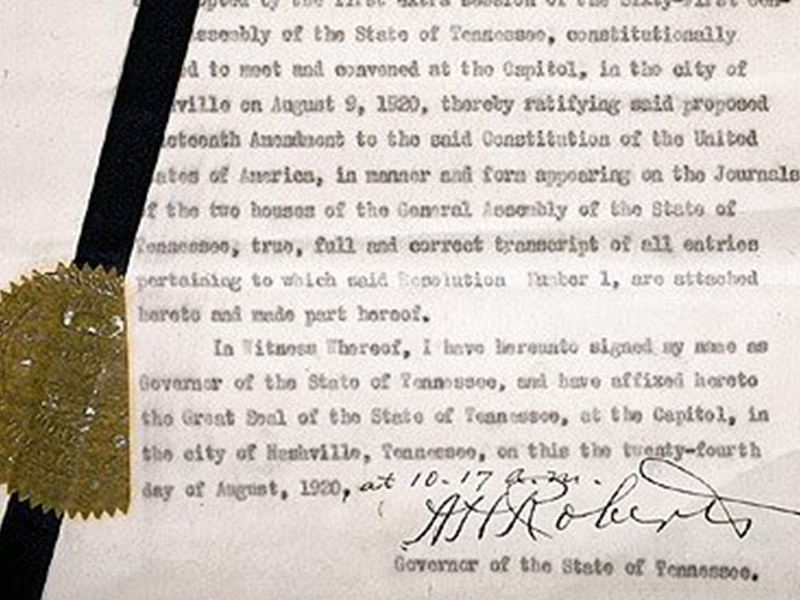


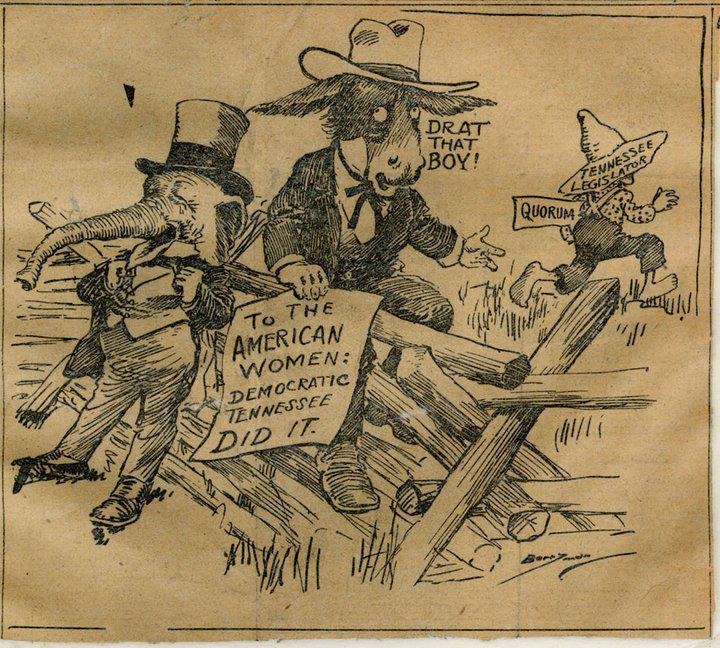


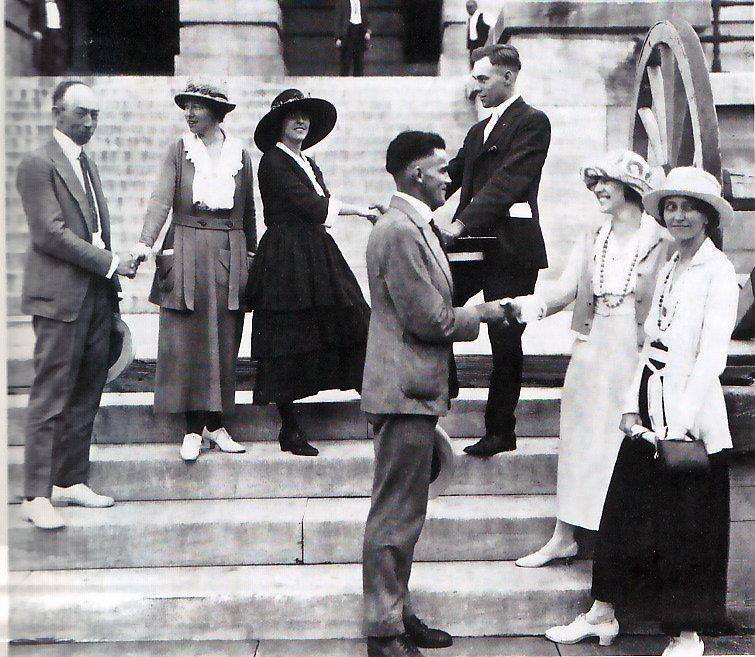


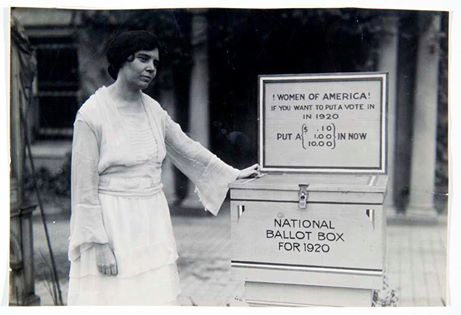

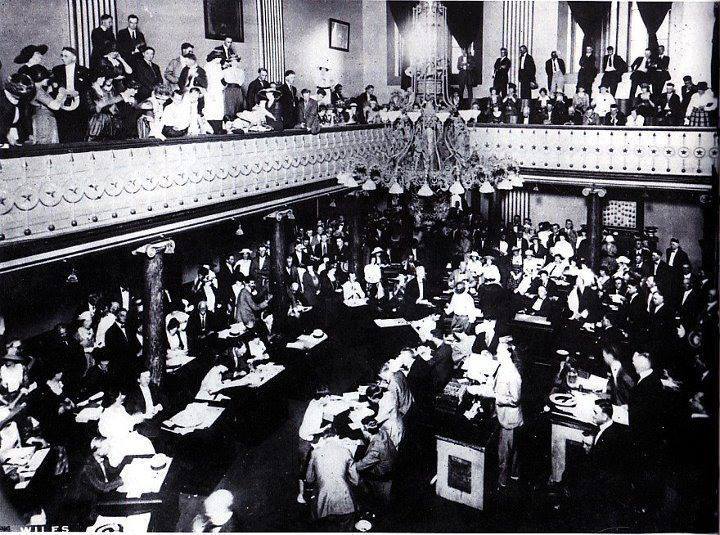

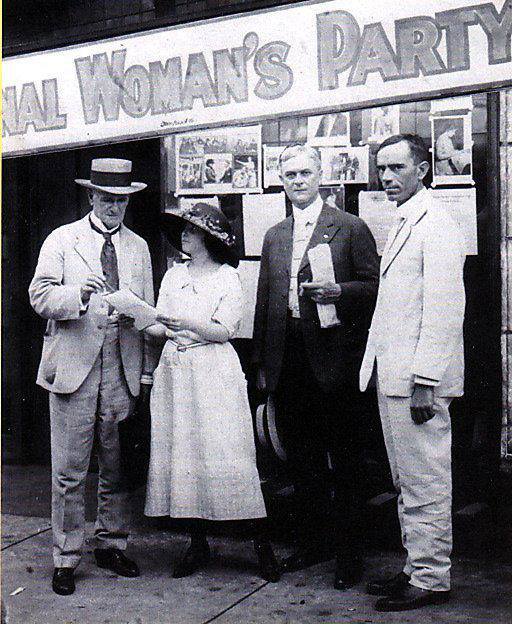

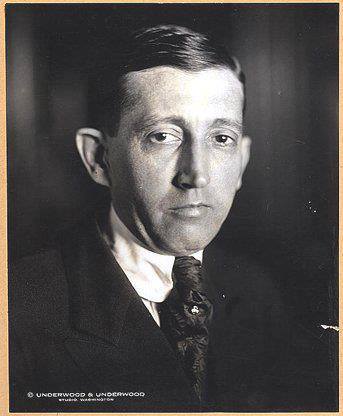

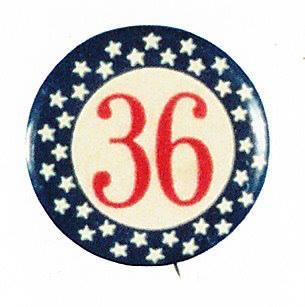

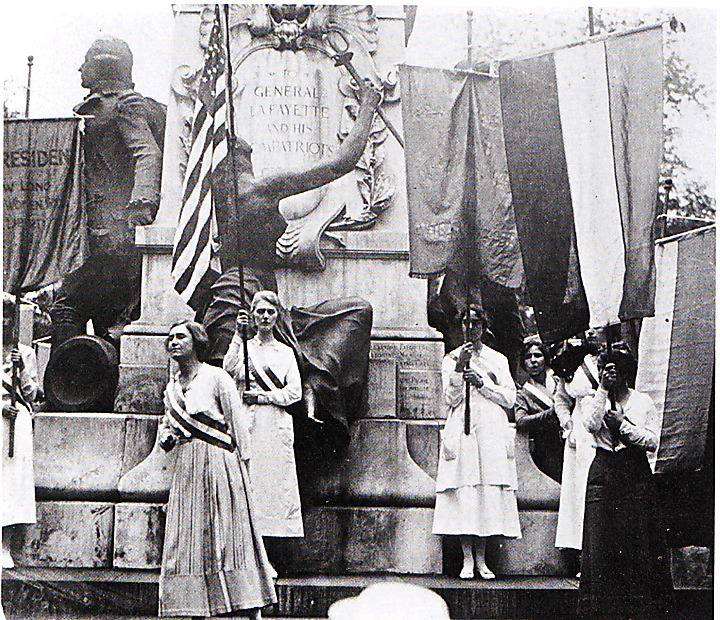

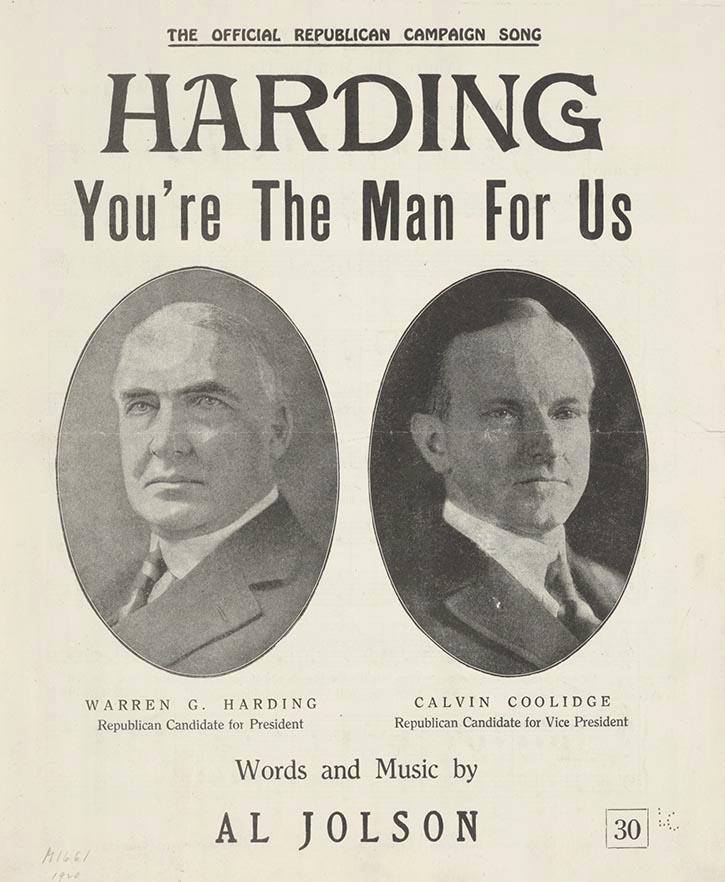

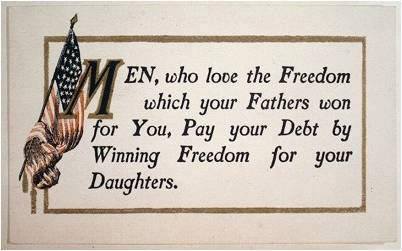
 Millions of women are already eligible to vote for all offices in 15 equal-suffrage States (plus the Territory of Alaska), and can vote for President in 12 more States, so their support has become critical to any Presidential candidate. Despite Republicans having cast 65.5% of the favorable votes the Anthony Amendment received when it was passed by Congress, and being in complete control of 26 of the 35 State legislatures that have ratified it so far, Republican party officials and organizations are starting to worry. Any apparent lack of support for woman suffrage at this late date might cause all those voting women to blame Republicans for the failure of the Anthony Amendment to be approved in time to enfranchise their voteless sisters in the rest of the States for the November 2nd election.

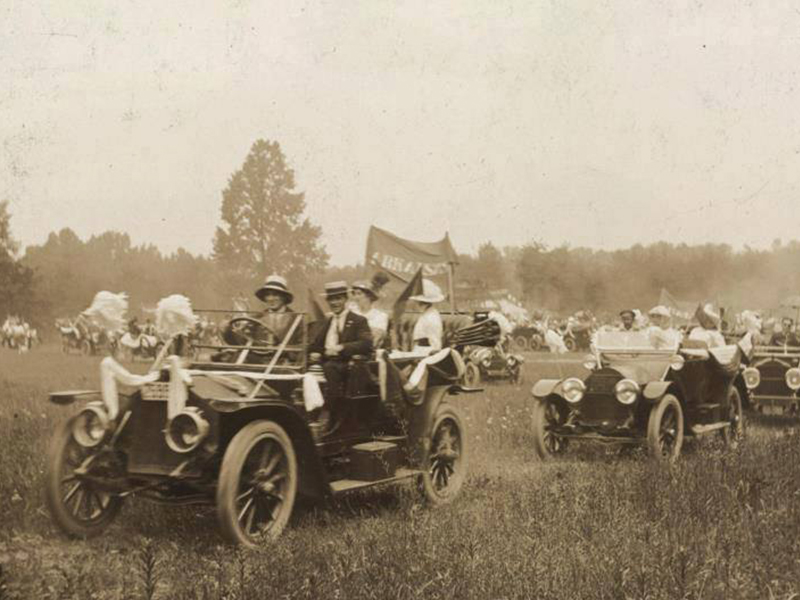



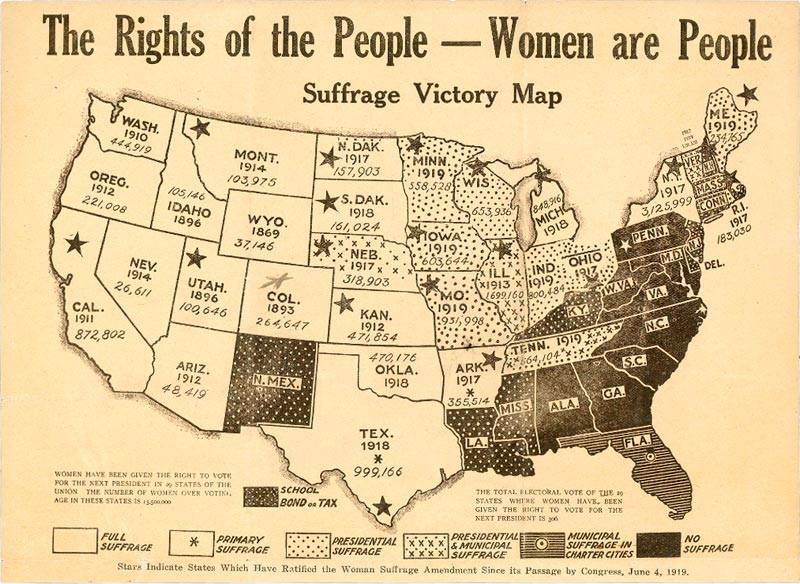

 The future of the Corps looked grim when recruiting ended last August, and all training schools were shut down. A year ago it had 99,388 members, but that fell to 19,592 by June first of this year. However, rather than being forcibly disbanded like the Women Air Service Pilots, the Women’s Army Corps now seems about to be reinvigorated. The Women’s Army Auxiliary Corps was originally established on May 15, 1942, and then became the Women’s Army Corps on July 1, 1943 with its members gaining full military status.