April 25, 1910: Los Angeles Makes History with First Female Deputy District Attorney

Founding Feminists is FMF’s daily herstory column.

FoundingFeministLogo-color

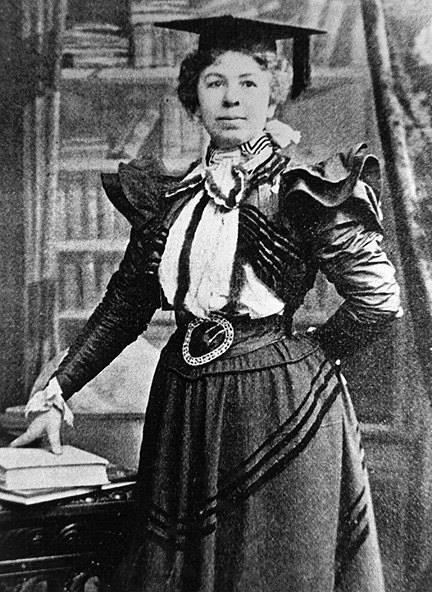
Clara Shortridge Foltz was sworn in today in Los Angeles, California, as the first female Deputy District Attorney in U.S. history.

Her road to the prosecutor’s office has been a long one. When left to raise her five children alone in San Jose, she also wanted to study law with one of the local attorneys. Initially, she met with a series of rejections, such as one that said:

My dear young friend: Excuse my delay in answering your letter asking permission to enter my law office as a student. My high regard for your parents, and for you, who seem to have no right understanding of what you say you want to undertake, forbid encouraging you in so foolish a pursuit, wherein you would invite nothing but ridicule if not contempt. A woman’s place is at home, unless it be as a teacher. If you would like a position in our public schools, I will be glad to recommend you, for I think you are well qualified. Very respectfully, Francis Spencer.

Eventually she did succeed in being allowed to study law in a local attorney’s office, and after a while felt prepared to take the bar exam. But the California Bar admitted only qualified “white male citizens” at the time, so she drew up a bill that would change that to admit any qualified “citizen or person,” and found a sympathetic State Senator to introduce it. The removal of the racial restriction caused little controversy, but allowing women to practice law was seen as an extremely radical step.

1513794_10202325940213434_400351369986319085_nThanks to her lobbying, Senate Bill 66 survived a vigorous debate in both houses of the legislature, as well as the Governor’s reluctance to sign it. On September 5, 1878, she became the first woman admitted to the California Bar.

But Foltz knew that informal study of the law was not equal to a formal college education, so she applied to the Hastings College of Law, which had no specific ban on women’s admissions. This seems to have been because the school’s founders had never considered the possibility that a woman might apply. The school “conditionally” admitted her, but this was just the beginning of the battle. She encountered hostility from the start.

She had a bad cold on her first day at school, and every time she coughed, the entire class broke out in a fit of coughing. Whenever she turned a page in her notebook, all the boys did as well. And if she moved her chair, every chair in the room suddenly and quite noisily shifted.

The next day the school’s Board of Directors voted unanimously against having women students, formally rejecting her application and that of Laura de Force Gordon as well. They sued, Foltz argued the case herself, and won.

In a speech at the Chicago World’s Fair in 1893, Foltz launched her fight for “Public Defenders,” whose full-time job will be to defend the rights of those who are accused of a crime and cannot afford a lawyer. Indigent defendants presently get court-appointed private counsel – usually the youngest and most inexperienced – who see this duty as an inconvenience, and have few resources to conduct a thorough investigation even if they want to do so. Though not yet adopted anywhere, many States and counties have expressed an interest in her excellent idea. Foltz also came up with another novel innovation, this one accepted and implemented in California almost two decades ago: a parole system.

Clara Shortridge Foltz has been an active suffragist for over thirty years. She was an early president of the California Woman Suffrage Association, and shortly after moving to this city in 1906 was elected president of one of the most active and vocal suffrage groups, the Los Angeles Votes for Women Club.

She has long criticized District Attorneys’ offices in general for overzealous prosecutions due to a system that rewards prosecutors for convictions, regardless of how they are obtained. But her goal will be justice, not public acclaim. Though it is assumed she will be assigned cases dealing with women and children, she says that she is perfectly willing to take up cases involving men if the District Attorney assigns them to her, and that she can successfully make the transition from defense attorney to prosecutor:

“I believe that it is true that a woman can better find out the truth when unfortunate women or girls get into trouble. There are times where there is a real good excuse for them being in trouble and if they do not deserve punishment it will be my duty to look into such cases as these and find if they are worthy of sympathy and lenience. I say spare the innocent, but prosecute the guilty. I do not believe that because a woman is a woman she should not be amenable to the laws …. If I find a woman who should pay the penalty for her acts, you will find that I will be a vigorous prosecutor.”

Today marks an advance for the rights of women and an improvement in the local criminal justice system as well. District Attorney Fredericks should be applauded for his appointment of a highly qualified, dedicated, and uniquely experienced attorney as a Deputy D.A., and her example should pave the way for many more women with similar legal ambitions.

April 23, 1963: Major National Endorsement Shifts Dialogue on Birth Control and Contraception

Founding Feminists is FMF’s daily herstory column. 

FoundingFeministLogo-color

A major advance today in the fight for birth control, as the American College of Obstetricians and Gynecologists officially endorsed giving contraceptive information to those who request it.

The national battle over birth control has been raging for half a century now, and it was said today that the long delay in the twelve year old group’s taking a stand was caused by the fact that so many ACOG members who are Catholic (presently about a quarter) opposed making birth control information available, and the other members didn’t feel strongly enough about the issue to push the resolution through until now.

Dr. Mary Calderone
Dr. Mary Calderone

Today, however, an endorsement not only passed, but apparently did so without dissent in the closed-door meeting. The group’s president, Dr. George E. Judd, of Los Angeles, said the “emotionalism” surrounding the issue in the past seems to have died down. So, times have clearly changed. Some ACOG members said after the vote that this resolution had been ridiculously delayed.

Long-time sex educator Dr. Mary Calderone expressed her delight at the resolution and said: “We have reached a turning point.” She referred not only to the ACOG resolution, but the National Academy of Sciences report on population published this week, and the fact that the Federal Government has just reversed its previous stand and will now give birth control information on request to those participating in foreign aid programs.

For many decades, both Federal law (the 1873 “Comstock Act”) and many state laws modeled on it which were passed soon afterward, classified birth control devices, as well as information about contraception as “obscene” materials with harsh criminal penalties for those who defied these bans. But hard work in the form of taking the case for birth control to the public in various forums, plus legislative lobbying and legal challenges have brought great changes.

In 1918, Judge Frederick Crane ruled that in New York State, an exception must be made to Section 1142 of the State Penal Code so that physicians could legally prescribe birth control to their married patients, though only if it was medically justified as necessary for the “cure and prevention of disease.” In 1936, Federal Judge Augustus Hand exempted physicians from the Comstock Act’s ban on contraceptive devices and birth control information.

Today, restrictions vary among the states, but only two – Massachusetts and Connecticut – still have absolute bans on birth control. Connecticut’s law is under challenge. Estelle Griswold and Dr. C. Lee Buxton opened a birth control clinic in New Haven in November, 1961, and were soon arrested and convicted of violating that state’s 1879 law. Their case is now on appeal, and a favorable ruling by the Supreme Court could end the battle over birth control by fully legalizing it nationwide.

The ACOG resolution reads:

The American College of Obstetricians and Gynecologists believes scientific research should be greatly expanded on (a) all aspects of human fertility and (b) the interplay of psychologic, and socioeconomic factors influencing population changes; and that full freedom should be extended to all population groups for the selection and such use of methods for the regulation of family size as are consistent with the creed and mores of the individuals concerned.

April 22, 1919: Suffrage Victories Won Across the Nation

Founding Feminists is FMF’s daily herstory column.

FoundingFeministLogo-color

Pennsylvania suffragists have never lacked determination, and today their persistence paid off, as the House passed a bill – by an almost two to one margin – to put a suffrage referendum on the State ballot in 1921.

“Votes for Women” advocates in the Keystone State never gave up after the 1915 suffrage referendum went down to defeat along with referenda in three other big Eastern States that Fall. They have been hard at work ever since, and have greatly increased the public’s support for equal suffrage in Pennsylvania, so once the Senate has passed the bill and the Governor has signed it, the referendum is expected to easily pass.

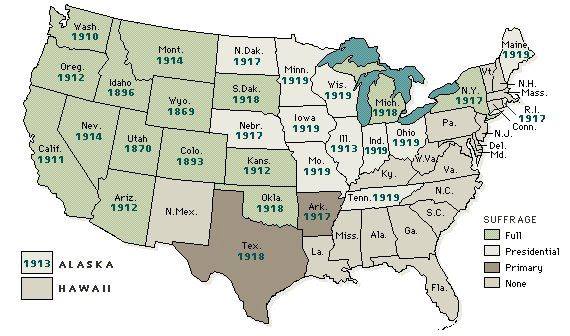
But the proposed Pennsylvania Suffrage Referendum of 1921 is just one small part of the reason why optimism abounds among suffragists. Just yesterday, Iowa became the eighth State in three months whose legislatures have passed bills enabling women to vote for President. Though only partial victories, in that women do not yet have full voting rights in these newly-won States, the fact that women can now vote for President in 27 of the 48 States, which have a combined total of 302 Electoral Votes out of the 531 which will be cast, means that regardless of whether the Susan B. Anthony (nationwide woman suffrage) Amendment is passed and ratified in time to assure full voting rights for women in all States in the 1920 election, women’s votes will be critical to Presidential candidates in the next – and all future – elections.

10292157_10202306413285273_1679178747194109990_n

Leaders of the National American Woman Suffrage Association are confident that the addition of Iowa, Indiana, Maine, Minnesota, Missouri, Wisconsin, Tennessee and Vermont (if the Governor’s veto is not sustained by the courts) as Presidential suffrage States will be enough to pressure Congress into passing the Anthony Amendment. The members of the new Congress will represent 15 States in which women vote on the same basis as men, 12 in which they have Presidential suffrage, and 29 States in which women have some form of local suffrage (some of which are the same States in which they have Presidential suffrage) and two States in which women can vote in party primaries.

There are now about 15,500,000 women eligible to vote for the next President – a number just 2,000,000 less that the total number of votes actually cast for the two major party candidates in the 1916 Presidential election. The West has only one State – New Mexico – where women cannot vote for President, and even the “Solid South” has cracked a bit, as Tennessee women will be able to help elect the nation’s next Chief Executive.

The 66th Congress will be back in session on May 19th, and it is expected that the House will once again pass the Anthony Amendment, doing so by a comfortable margin and almost immediately. Polls from various suffrage groups show uncertainly over whether there are precisely enough votes in the Senate, or whether one vote is still lacking for the required 2/3 majority. But the sudden rush of support for Presidential suffrage by the legislatures of so many States can only add to the pressure on Senators to vote for the Anthony Amendment. Then it’s on to the States, where 36 of 48 are required to ratify. Though there will be no deadline for ratification, every effort will be made to achieve it in time for women to register for the 1920 election.

April 21, 1913: Suffrage Debates Continue As Legislators, Religious Figures Speak Out

Founding Feminists is FMF’s daily herstory column.

FoundingFeministLogo-color

This certainly has been a newsworthy day for woman suffrage!

The main event was in Washington, DC, where many Senators and Representatives from States in which women already vote argued in favor of the Susan B. Anthony (nationwide woman suffrage) Amendment at hearings before the Senate Committee on Woman Suffrage.

George Chamberlain, Governor of Oregon from 1903 to 1909, and a Democratic Senator from that State since 1909

Senator George Chamberlain, Democrat of Oregon, where women won the vote in a suffrage referendum on November 5th, said: “I expect to see conditions in my State bettered, if they can be bettered, now that women have a vote. I expect Oregon to teach a lesson to the ‘effete East’ in legislation for the good of her citizens. The women are instinctively on the side of moral right.”

Harry Lane, Oregon’s other Democratic Senator, declared: “Woman is the full partner of man through life. I am a physician, and I give my testimony to this fact. If I had it my way I would give the women of this country the ballot on a silver salver [tray] with apologies for giving it so late.” He noted that in his battles against the liquor interests women had always given him great support. Republican Representative Burton French said that in his State of Idaho, where women have had the vote since 1896, women vote in the same numbers as men, thus showing that women do want the vote.

Meanwhile, Alva Belmont is preparing to go to the upcoming International Woman Suffrage Conference in Budapest, which opens June 15th. She said today that on her journey she will stop in Britain to see the Pankhursts, and learn something of their militant methods. Though she hopes New York State will pass a suffrage referendum in 1915, Tammany Hall Democrats are unfriendly, and liquor interests are very strong, so if the effort is unsuccessful, she believes it will then be time to use English-style tactics. “It is not pleasant to go out and smash windows,” she said. “You wouldn’t like it and I would not like to, but it is the only thing to be done.”

On a more peaceful note, she said that she is collecting the statements of anti-suffragists, will put them in a book some day, “and they will not be proud of them” when equal suffrage is taken for granted as simple, basic justice.

Cardinal Gibbons of Baltimore may have given Belmont an entry for her book today. Though he emphasized that the Catholic Church itself is strictly neutral on the issue of woman suffrage, Gibbons said that in his own personal view, a woman is:

 … the queen of the domestic kingdom, and her proper sphere is the home. If she were to embark on the ocean of political life, it is very much to be feared that her dignity would be impaired, if not jeopardized … As soon as women seek to enter the arena of politics they may expect to be soiled by its dust. And the grace and charm inherent in woman would be very seriously impaired by her rude contact with men in political life.

The wife who absents herself from her home invariably neglects her children and causes her husband to suffer by her absence … Although women may not now exercise suffrage, the finest among them are voting by proxy. Their power is incalculable. We cannot exaggerate the influence of a good woman on the men of her circle. What would be the value to our national life of votes obtained by the raging tactics that disgrace the name of womanhood?

Unfortunately, the male voters of Michigan seem to feel the same way as the Maryland Cardinal. The results of the April 7th suffrage referendum have now been fully tallied, and it has gone down to defeat. It had been hoped that the rural counties which had adopted alcohol prohibition would also be supportive enough of woman suffrage to offset the votes in big cities where saloons still operate freely and the liquor industry has great power. But unlike California in 1911, where farm, ranch and small-town votes saved the day, this time there was no difference between the country and city vote, and the measure went down by a margin of about 100,000.

So, “equal suffrage” still remains a phenomenon exclusive to the West. But with November’s victory in Oregon, all West Coast women now have the vote, and the newly-enfranchised women of Kansas have brought equality to within 240 miles of the Mississippi River. Once that barrier is breached, many new States in the East can be won, because the way suffrage has spread throughout nine Western states is by winning campaigns in States next to those where women already vote, and residents can see that it benefits, not harms, their neighbors.

April 18, 1910: NAWSA Finalizes Re-Election of Reverend Anna Howard Shaw, Stages a Procession to Capitol Hill

Founding Feminists is FMF’s daily herstory column.

FoundingFeministLogo-color

Today was a busy one for the National American Woman Suffrage Association.

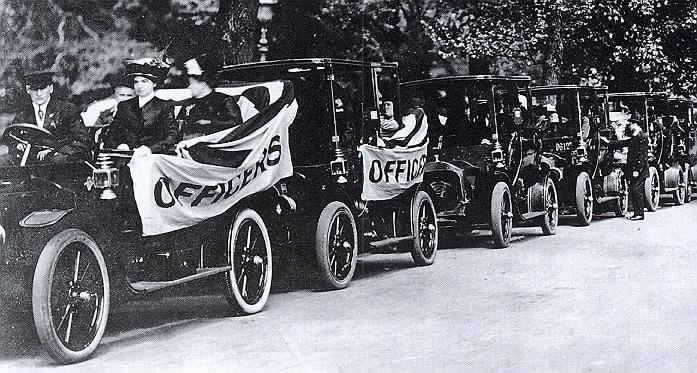
Before the morning was over, convention delegates re-elected Rev. Anna Howard Shaw as their leader, and had begun a procession of almost 50 automobiles to Capitol Hill.

The motorized parade carried petitions signed by over 404,000 citizens who want the Susan B. Anthony (nationwide woman suffrage) Amendment passed by Congress then sent to the 46 States for ratification. Approval by 3/4 (35) would make the Anthony Amendment the 16th Amendment to the U.S. Constitution (unless the Income Tax Amendment, already submitted to the States on July 12th of last year is ratified first, in which case the Anthony Amendment would become the 17th Amendment.)

The caravan got off to a bit of a late start due to a change of plans. Originally, the petitions were all together in one huge and quite impressive roll in a large express wagon. But at the last minute it was decided to unroll them and divide them up so that each State leader could arrive with the petitions from her State. It took about a half hour to do this, but once that was accomplished, a wonderfully colorful procession of automobiles and taxicabs began to roll down Pennsylvania Avenue, each carrying a banner from one of the States, with other cars for NAWSA officers.

10253757_10202274468726679_7140027105275979931_n

After being given a warm reception at the Capitol steps, the petitioners then descended on Congress, making sure each member was given a petition from his District or State, and was then urged to officially present that petition to Congress. Everyone went into the galleries to see who would follow through on this request. A number of members of both House and Senate did as they had been asked, but the enthusiastic reaction to the speeches presenting the petitions almost got the NAWSA members booted out of the Senate.

The most popular presentation was made by Senator Robert “Fighting Bob” LaFollette, Republican of Wisconsin, who said he hoped Congress would bring the ballot “into the hands of an intelligent part of our citizenship that should have received it long ago.” This caused an understandable burst of cheers from the gallery, so Senator John Kean, Republican of New Jersey, who was presiding, called for order.

Decorum lasted until Senator Moses Clapp, Republican of Minnesota, made his presentation. His speech sparked a well-deserved round of applause, to which Senator Kean responded: “No applause allowed in the United States Senate.” Three applauders laughed, and then Senator Kean said: “If there is a repetition, the Sergeant-At-Arms will be ordered to clear the galleries.” Not wanting to miss any of the kind words of supportive Senators, everyone in the galleries then quietly enjoyed hearing the cause promoted on the Senate floor.

In the House, no speeches were permitted during the presentation of petitions, but visitors were allowed to applaud as each pro-suffrage member went up to the Speaker’s desk to deposit his petition. The largest number of signatures, 72,000, came from New York, with Utah, an equal-suffrage State, contributing the next-highest total of 40,000.

Today was the culmination of a year-long effort to gather signatures by NAWSA’s State chapters. Some of the more prosperous ones would rent out booth space at county fairs and other events, while in other States, NAWSA members would simply walk around soliciting signatures from crowds at various public events.

It is hoped that this presentation will be enough to get the Anthony Amendment out of Congressional Committees, where it has been bottled up for the past 14 years. Tomorrow, “Votes for Women” advocates will appear before the Senate Committee on Woman Suffrage and the House Committee on the Judiciary to make the case for nationwide woman suffrage.

Though no State has been won for suffrage since Idaho in 1896, the fact that President Taft personally greeted the NAWSA convention delegates this year, the launching of massive, nationwide petition drives, the emergence of new and energetic organizations such as Harriot Stanton Blatch’s “Equality League of Self-Supporting Women,” and the use of public spectacles, such as the League’s suffrage parade in New York City planned for May 21st are clear proof that the movement has been revitalized, and that new victories to match this new enthusiasm should soon follow.

April 17, 1894: Empire State Suffragists Build Momentum for Federal Action

Founding Feminists is FMF’s daily herstory column.

FoundingFeministLogo-color

Victory for the woman suffrage movement – and equal pay for equal work – must rapidly be approaching if today is any example of the momentum that’s now being generated in their favor.

Illustration: Lillie Devereux Blake

There were three suffrage meetings held in the New York City area, with enthusiasm running high at all three. The largest meeting was held at the home of Dr. Egbert Guernsey, 528 Fifth Avenue, with Lillie Devereux Blake as the principal speaker. She sees a direct connection between unequal pay and political inequality, and believes that women must become more militant on both fronts: “Woman is the great unpaid laborer … men would be running over each other to see that women had equal pay if they had the privilege of voting.”

Blake then noted that “women should be companions for men,” and couples should discuss the important legislation of the day together. Especially critical are those bills that pertain to household issues: “Give us reason to be interested in these things and you will see that we understand them.”

John D. Townsend gave personal testimony that the suffrage campaign is being waged with all the vigor that its supporters could hope for:

There is no doubt that woman will succeed in obtaining the amendment to the State Constitution which she seeks. You cannot go anywhere now but someone meets you with a woman suffrage petition and asks you to sign it – and every one does sign.

However, Townsend called for tact in regard to lobbying the men who can put a suffrage referendum on the November 6th ballot as part of a package of Constitutional reforms to be put before the State’s voters:

I would suggest to the women that they deal very gently with the men who are going to the Constitutional Convention. Treat them well and feed them well. They will do everything in the way of right laws; if they do not, then will be the time to speak.

Theodore Sutro received a warm round of applause when he said:

That women do not have the privilege of the ballot seems to me contrary to all ideas of justice in this free country. It is only in accordance with principles of logic – and I might say grammar – that the word ‘male’ should be stricken from the Constitution.

The New York State Constitution currently grants the right to vote to “every male citizen of the age of 21 years.”

The Brooklyn Woman Suffrage Association also held a well-attended meeting, and there was a pro-suffrage gathering at the home of the Torries, at 64 West 55th Street.

After nearly 46 years of continuous struggle since the first Women’s Rights Convention at Seneca Falls, woman suffrage – at least in New York State – could be only 7 months away if a suffrage referendum is put on the ballot and a majority of the State’s male voters approve it. With such a victory in the nation’s most populous State, the largest State delegation in Congress would then be accountable to women voters, and could clearly be a major force in pushing the Susan B. Anthony (nationwide woman suffrage) Amendment through Congress. The proposed 16th Amendment would then be sent to the 44 States for ratification, with approval by 2/3 (30) needed.

But even without a Federal amendment, this could be a landmark year for woman suffrage if the Empire State joins the States of Wyoming and Colorado in guaranteeing equal suffrage for women. Just over five months ago, on November 7th, Colorado became the first State whose voters approved a woman suffrage referendum, so male voters can clearly be persuaded to support “Votes for Women.”

With the ballot guaranteeing women’s political equality, equal opportunity and equal pay in all professions should logically follow. So though long overdue, the end of political, legal and economic inequality for women appears to be within sight, but certainly not attainable without a good deal more work, and the same level of dedication to equality that has brought the movement so far in less than half a century.

April 16, 1927: NYC Legal Sorority Seeks to Create A List of Female-Friendly Law Firms

Founding Feminists is FMF’s daily herstory column.

FoundingFeministLogo-color

It was announced today that a list of New York City law firms which hire women is being prepared by Kappa Beta Pi, a legal sorority, so female graduates of law schools will not have to waste their time applying to local firms that will automatically reject their applications.

1536570_10202260708022670_493977860419090253_nEmily Marx, Secretary of the sorority’s New York Chapter said: “We are cataloging the city’s law firms where embryo Portias are welcome on the same terms as their fellows. It is hoped that graduates with good scholastic records will thus be saved weeks of weary job hunting.”
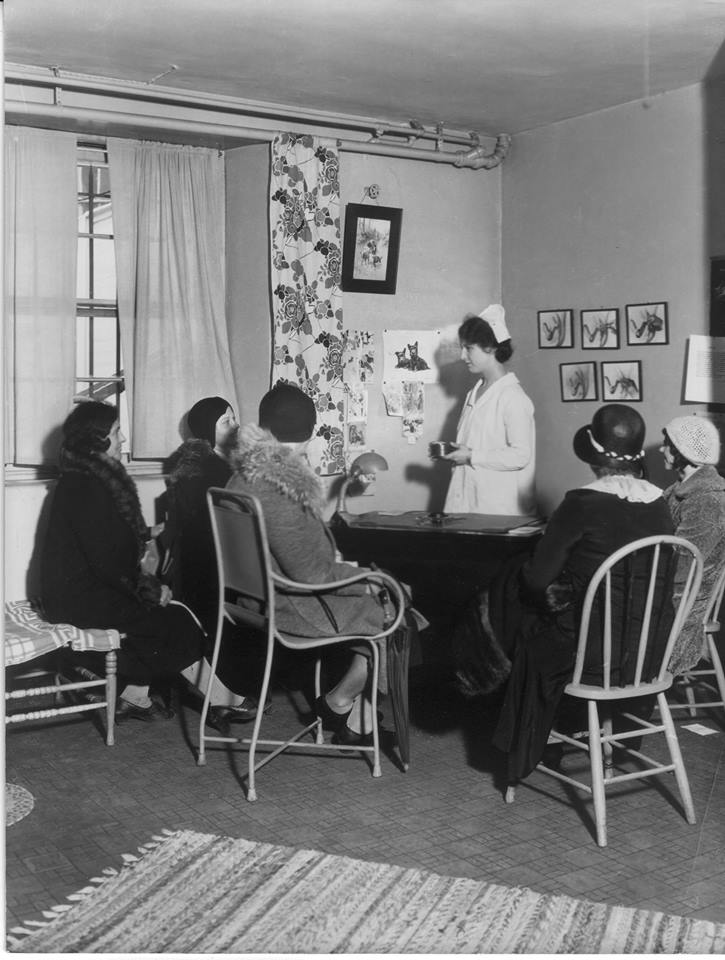
Marx’s project will be extremely valuable to the new graduates, who won’t have to repeat her experience. When she canvassed 175 law firms while looking for a job after graduation, all but 25 said they didn’t want a woman lawyer in the office, and though the rest held out some hope, they had no vacancies.

Marx’s first interview was with the somewhat bemused senior partner of a well-known law firm who was quite astonished to see a woman applying for a job. But she was encouraged when he said that he would never want to be accused of turning down a Yale graduate who was a member of the Law Review just because she was a woman. After consulting with the other senior partner, however, he came back and told her: “No girls.”

After weeks of similar rejections, Marx did finally get hired, and says that there are more such open-minded law offices in New York, but women need to know which ones they are.

There are about 35 chapters of Kappa Beta Pi, mostly in the West, because many Eastern law schools do not admit women. About 250 members now hold positions in New York City law firms, but the problem is to find work for the 100 new graduates who come to the city looking for jobs each year. Kappa Beta Pi was the first legal sorority, founded in 1908 at the Chicago-Kent College of Law to promote high standards among women law students and practicing attorneys.

The number of women lawyers has been increasing rapidly, though they still constitute a small percentage of the profession. According to the 1870 Census, only five women were actively practicing law at that time. By 1900 that number had increased to 1,010, and stood at 1,738 as of the latest Census in 1920. Hopefully, projects similar to the one outlined today will be tried in other cities as well, and will help that number continue to increase in the future.

April 15, 1929: NYC Police Raid Birth Control Clinical Research Bureau

Founding Feminists is FMF’s daily herstory column.

FoundingFeministLogo-color

The Birth Control Clinical Research Bureau’s clinic was raided this morning by New York City police, who arrested two doctors and three nurses, then seized massive amounts of “evidence,” including confidential patient records.

Dr. Hannah Mayer Stone, medical director, Dr. Elizabeth Pissoort, assistant director, and nurses Antoinette Field, Sigrid H. Brestwell, and Marcella Sideri were charged with violation of Section 1142 of the New York State Penal Code, which bans birth control devices and contraceptive information as obscene materials.

The raid was as surprising as it was outrageous, because it has been 11 years since State Appeals Court Judge Frederick Crane ruled that though New York State’s ban on birth control and the dispensing of birth control information was valid, an exception must be made for doctors prescribing contraception to their married, adult patients, if they do so “for the cure or prevention of disease.”

The Birth Control Clinical Research Bureau's clinic on a much calmer day.
The Birth Control Clinical Research Bureau’s clinic on a much calmer day.

The clinic has operated since January 2, 1923, and was the first to legally provide birth control services in the United States. The nation’s first birth control clinic was opened by two nurses on October 16, 1916, was raided 10 days later, then shut down permanently when it tried to re-open. The clinic raided today has been operated in such a way as to carefully conform to the law, as interpreted in 1918 by Judge Crane, in that only licensed physicians dispensed birth control and only to married women whose health would be endangered by a pregnancy.

In an ironic note, just moments before the raid occurred, a visiting out-of-State physician was talking to one of the members of the staff and asked if they had any trouble with the authorities. He was told: “No, those days have passed.”

But almost immediately after that conversation, eight police officers came in, pushed the clinic’s many women patients and their children out into the street, took the women’s names, then began arresting the doctors and nurses. They confiscated practically everything in sight, from forceps used to handle instruments being sterilized to confidential patient files that are the personal property of the doctors.

All those arrested were taken to the police station, where they were booked, then released on bail pending trial.

April 14, 1910: President Taft Receives Mixed Greetings at NAWSA Convention

Founding Feminists is FMF’s daily herstory column.

FoundingFeministLogo-color

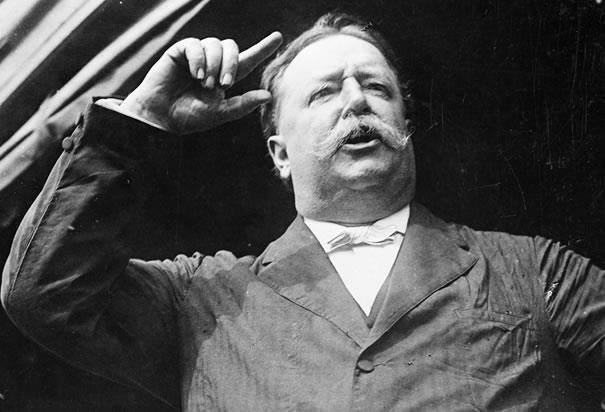
President Taft discovered today that suffragists can sometimes be a tough audience.

He came to greet the delegates to the National American Woman Suffrage Association convention, and though he was given a standing ovation as he entered the room, as well as at the end of his speech, the President was hissed at at one point by some listeners.

Taft said that he had been a bit unsure whether to come to the convention, since his views are not entirely in harmony with N.A.W.S.A., “but I consider that the movement represents a sufficient part of the intelligence of the community to justify my coming here and welcoming you to Washington.” He said that he was “always more impatient with those who go only half way with me than those who oppose me,” so he must have known that there might be a rough spot ahead.

He said that he was a strong and “orthodox” advocate of woman suffrage when he was in high school, and that his father favored it as well. Needless to say, this caused great cheers from the audience, accompanied by the waving of white handkerchiefs. But next he did something odd for a politician by telling his audience something different from what he knew they would want to hear. He said that actual experience had modified his enthusiasm. Though woman suffrage seemed to work reasonably well in sparsely populated Western States, that might not be the case if it was won in densely-populated Eastern States:

“If I could be sure that women as a class would exercise the franchise, I would be in favor of it. At present time there exists in my mind considerable doubt.”

10015657_10202247544053579_9073586841146103915_n

He said his hesitation about endorsing universal woman suffrage had to do with the possibility that the vote would not be exercised by the vast majority of women, but used only by “that part of the class least desirable as political constituents and may be neglected by many of those who are intelligent and patriotic and would be most desirable as members of the electorate.”

That brought out the hisses, and a retort by the President: “Now, my dear ladies, you must show yourselves equal to self-government by exercising in listening to opposing arguments that degree of restraint without which successful self-government is impossible.”

The rest of the speech went smoothly, and after being given a hearty round of applause as he finished speaking, he assured a somewhat embarrassed Rev. Anna Howard Shaw, President of N.A.W.S.A., that his feelings had not been injured in the least by the brief incident of hissing.

Senator Robert Owen, Democrat of Oklahoma, America’s newest and 46th State, followed the President. His remarks were enthusiastically received by the audience. He endorsed the suffrage movement “without apology,” and told the cheering crowd: “I face the prejudice of men of ten thousand years in advocating suffrage for women. Even if the entire race of men contradicts me, I still assert that woman is entitled to life, liberty, and the pursuit of happiness.”

Following the speeches, Dr. Shaw announced that there would be an open-air suffrage demonstration tomorrow, with Harriot Stanton Blatch in charge. Considering the large number of delegates who are here at the convention from all around the country, it should certainly impress upon Congress the growing power and new militance of this almost 62-year-old movement.

April 11, 1915: New York Suffragists Open “Suffrage Shop” On Fifth Avenue

Founding Feminists is the FMF’s daily herstory column.

FoundingFeministLogo-color

Though New York State’s suffrage referendum is almost seven months in the future, anyone visiting the Suffrage Shop today would think it was this coming Tuesday.

Run by the Women’s Political Union, it’s at 663 Fifth Avenue, and there is always some sort of activity going on while suffrage items are being sold. Even those basic items are now more numerous and imaginative.

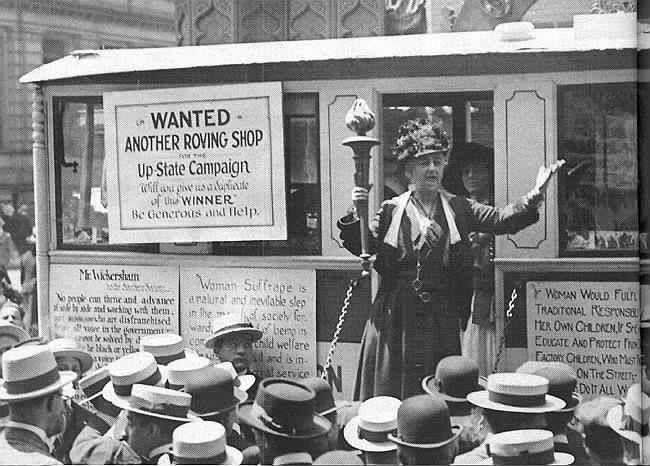
Louisine Havemeyer speaking to a crowd from a small, roving version of the Suffrage Shop.

One of the shop’s newest offerings is “Suffrage Soap.” In addition to its practical use, it promotes the cause by including a small suffrage tract with each bar which says in the W.P.U.’s colors of green, purple and white: “Votes for Women. Equal Suffrage Means Clean Politics. Use This Soap and Do Justice to Women. Women’s Political Union, 25 West Forty-fifth Street, New York City.”

Getting people to go into the shop is still a necessary first step to purchasing items, so each day there is a theme. Today’s theme was “Roman Catholic Day” and its purpose was to show “that the Roman Catholic Church, as a church is not against woman suffrage.”

Joseph T. Ryan, Secretary of the Catholic Club, presided, and City Controller William Prendergast, who is Catholic, also attended to show his support. Father John L. Belford got a good reaction from the mostly female audience when he said:

I have looked for some good reason why women should not vote and I have been unable to find one. One of the best arguments against woman suffrage that has ever been presented to me was the long editorial that appeared in the New York Times on February 7th. I read the editorial carefully and became convinced that the writer had given much time and thought to its composition, but he said nothing convincing. I was talking with Controller Prendergast about the editorial just now and Mr. Prendergast said that it seemed to him that the writer had written the editorial fifty years ago, and then gone to sleep and waked up on February 6th. I think Mr. Prendergast was kind to the writer. It seems to me that he never waked up. I’m not sure he didn’t write the editorial in his sleep.

The whole trend of the editorial was that if women were let loose in politics they would be a danger to our government. But would they? Let us look at this government man has made and he is afraid women will injure. If we are honest we must admit that in the City and State of New York the political situation is pitiful. We have a legislature in Albany that seems to be the most grossly incompetent body the Lord ever let assemble …. Would women do any harm to this government men have established? I am in a position to know that women would take into politics a certain amount of uprightness, a certain amount of public conscience, that would inevitably be beneficial. Honest men certainly have nothing to fear from them.

He then noted that there was nothing in Catholic doctrine or any decree of the Pope that would restrict the right of woman to better herself and society, and that woman suffrage would better both women and society. There are other guest speakers scheduled for each day of the week, and “Artists’ Day” is day after tomorrow.

Close attention is also being paid to the Constitutional Convention meeting in Albany, and every day that it is in session each member will be presented with a different argument for suffrage.

Rev. Anna Howard Shaw has just sent word that she will be giving 30 speeches for the suffrage campaign in the four States where the issue will be voted on this Fall: New York, Pennsylvania, New Jersey and Massachusetts. Two experienced women speakers from California, where women won the vote in 1911, will be arriving soon to work full-time in the four-State campaign.

The anti-suffragists are busy as well, however. At a meeting attended by representatives from ten of the State’s largest cities, they met at the headquarters of the New York State Association Opposed to Woman Suffrage to plan their work against “the proposed suffrage amendment to the State Constitution that would force the franchise on all women of the State.” Their plan for victory is to convince the male voters that “Socialism” of the kind which “the American Republic repudiates and is trying to hold in check” is behind the campaign for woman suffrage. Time will tell which group’s philosophy and campaign methods will eventually win out.

April 10, 1882: New York Supreme Court Rules That Wives May Sue Abusive Husbands

Founding Feminists is FMF’s daily herstory column.

FoundingFeministLogo-color

An abused wife has a right to sue her husband, according to an opinion issued today by Justice John R. Brady of the New York State Supreme Court, writing for the majority.

This bold departure from common law tradition is based on his interpretation of New York’s “Married Women’s Property Act,” passed in 1860 and revised in 1862. Though on the books for two decades, it has never before been cited as giving married women such independent – even equal – standing in a court of law.

1474385_10202220222170549_3016341396235803836_n

The case was initiated by Theresa Schultz against her husband, Theodore. She obtained an order of arrest against him for assault and battery, and also wished to sue him for her injuries. He tried to have the arrest order vacated on the grounds that a wife cannot initiate legal actions against her husband. But his attempt failed in a lower court, and today the General Term of the State Supreme Court sustained the arrest order, and in the process made it clear that the rest of the suit can proceed.

According to Justice Brady, the Legislature did intend to change the common law rule prohibiting wives from suing husbands when in 1860 and 1862 it revised the laws that pertain to married women. Though there have been previous decisions by other judges rejecting this view, and who have claimed that to give wives a right to sue husbands would disturb the domestic tranquility of marriage, Brady notes:

To allow the right [to sue] in an action of this character, in accordance with the language of the statute, would be to promote greater harmony, by enlarging the rights of the married woman and increasing the obligations of husbands, by affording greater protection to the former, and by enforcing greater restraint upon the latter in the indulgence of their evil passions.

The declaration of such a rule is not against the policy of the law. It is in harmony with it, and calculated to preserve peace and, in a great measure, prevent barbarous acts, acts of cruelty, regarded by mankind as inexcusable, contemptible, detestable.

It is neither too early nor too late to promulgate the doctrine that if a husband commits an assault and battery upon his wife he may be held responsible civilly and criminally for the act, which is not only committed in violation of the laws of God and man, but in direct antagonism to the contract of marriage, its obligations, duties, responsibilities, and the very basis on which it rests.

The rules of common law on this subject have been dispelled, routed and justly so by the acts of 1860 and 1862. They are things of the past which have succumbed to more liberal and just views, like many other doctrines of common law which could not stand the scrutiny and analysis of modern civilization.

Justice Daniels concurred in the opinion, but Justice Noah Davis dissented, writing:

I heartily concur in the unbounded detestation of wife-beaters which my brother Brady has so forcibly expressed; and I think the Legislature might well provide a carefully prepared statute giving direct personal remedies by suit in such cases; but the courts have decided that that has not yet been done, and the doctrine ‘stare decisis’ requires us to leave to the Court of Appeals or to the Legislature the gallant duty of setting the law free to redress by civil actions all the domestic disputes of husband and wife, whether committed by unbridled tongues or angry blows.

Despite its name, the New York “Supreme Court” is not truly supreme, and the Court of Appeals, which has the final say in New York State, may rule differently. But simply the fact that such a prestigious jurist has written this strong and eloquent ruling means that the day when a married woman is considered a legally invisible appendage of her husband is either at an end, or at least drawing to a close.

April 9, 1975: Men and Women Agree – It’s Time for the Equal Rights Amendment

Founding Feminists is FMF’s daily herstory column.

FoundingFeministLogo-color

Public support for the Equal Rights Amendment remains overwhelming, according to a Gallup Poll released today.

Fifty-eight per cent of the 1,542 respondents polled between March 7th and 10th said they favored the Constitutional amendment which would permanently and explicitly ban all forms of sex discrimination, while just 24% were opposed, and 18% had no opinion.

Support for the E.R.A. was strongest among those under 30 and those in the East (both 67%). Men were actually more supportive of it (63%) than women (54%) though clear majorities of both groups favored it. Opposition was greatest among women over 50, only 46% of whom supported it, and in the South, though even there, 52% were in favor.

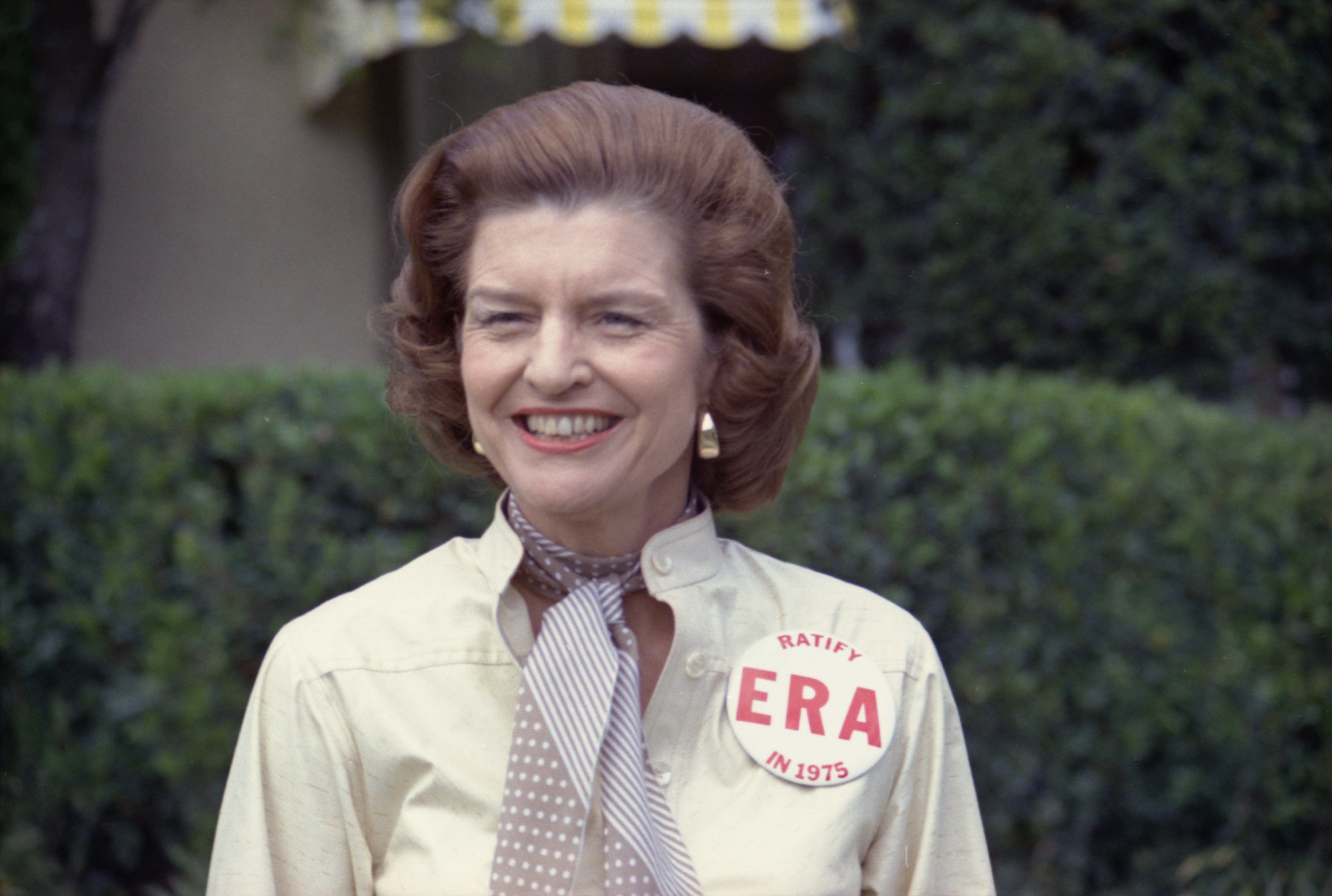
The E.R.A., written by Alice Paul, was first endorsed by the National Woman’s Party on July 21, 1923, introduced into the Senate on December 10, 1923, by Senator Charles Curtis, and into the House on December 13, 1923, by Representative Daniel Anthony (a nephew of Susan B.). Both men were Kansas Republicans. It has had the support of the Republican Party since 1940, the Democrats since 1944, and every President since Harry Truman took office in 1945. First Lady Betty Ford is an especially active supporter.

First Lady Betty Ford wearing a large "Ratify E.R.A. in 1975" button on February 26th as an honored guest of the Jackie Gleason Inverrary Classic Celebrities Golf Tournament in Hollywood, Florida
First Lady Betty Ford wearing a large “Ratify E.R.A. in 1975” button on February 26th as an honored guest of the Jackie Gleason Inverrary Classic Celebrities Golf Tournament in Hollywood, Florida

The E.R.A. was passed by the House on October 12, 1971, by a vote of 354-23, then by the Senate on March 22, 1972, by 84-8. A separate resolution, not in the text of the amendment itself, has given it until March 22, 1979 to gain the approval of 3/4 (38) of the 50 state legislatures. None of the first 17 Amendments had a deadline, nor did the 19th.

Twenty-two states approved the E.R.A. in 1972. Eight more joined them in 1973, and three more in 1974. North Dakota approved it on February 3rd of this year, bringing the total to thirty-four. Three are expected to consider it this year: Florida, North Carolina and Missouri.

The Equal Rights Amendment is needed because with the exception of the 19th Amendment, which applies only to the right to vote, no amendment in the Constitution was passed for the purpose of banning ANY form of sex discrimination. Therefore, the Supreme Court has never felt compelled to rule that laws which discriminate on the basis of sex should be subject to the same “strict scrutiny” test that is used to judge laws which discriminate on the basis of race, religion or national origin.

Almost 187 years after the Constitution took effect on June 21, 1788, it’s long past time for gender bias to be explicitly and permanently prohibited. Laws that discriminate against women – or men – should not be upheld or overturned according to some uncertain standard that changes with every new Supreme Court appointment.

The E.R.A has three sections:

Section One: Equality of rights under the law shall not be denied or abridged by the United States or by any state on account of sex.

Section Two: The Congress shall have the power to enforce, by appropriate legislation, the provisions of this article.

Section Three: This amendment shall take effect two years after the date of ratification.

The pollsters also asked women: “All things considered, who has a better life in this nation, men or women?” Three years ago, 34% of women thought they had life better. This year only 26% thought so. If this growing dissatisfaction can be translated into action on the E.R.A., those four more states can be won, hopefully in time for the nation’s Bicentennial next year!

April 8, 1931: Amelia Earhart Sets New Records – And Breaks Her Own

Founding Feminists is FMF’s daily herstory column.

FoundingFeministLogo-color

Even for Amelia Earhart, this has been quite an adventurous day.

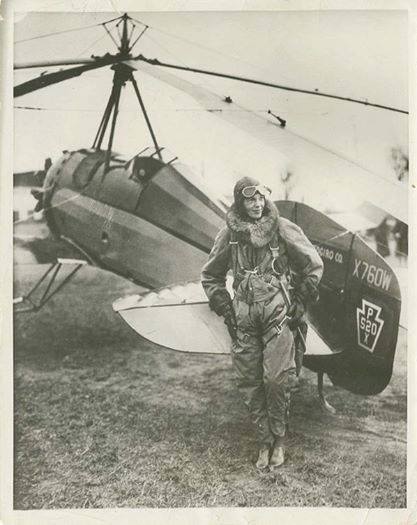
Not only did she set an altitude record that was until now held by a man, she broke her own record a few hours later, and did it all in an unusual type of aircraft. No one had ever taken an autogyro to 18,000 feet, but today she did so twice, the second time soaring to 18,415 feet.

Though fixed-wing aircraft have been around for almost 30 years, this new type was only invented in 1923. It uses a standard engine and propeller on the front for forward thrust, but instead of just two wings on the side, it also has four unpowered wings above, which rotate to provide lift as the craft moves forward through the air.

10014620_10202209057851448_6078214185637395912_nEarhart arrived at Pitcairn Aviation Field, near Willow Grove, Pennsylvania, this morning with George Palmer Putnam, her husband of just under eight weeks, and Major Luke Christopher, representing the National Aeronautical Association, who would be an official witness to any record she might set.
She first went aloft at 12:03, slowly gaining altitude for an hour and a half. When she knew she could go no higher, she cut the engine, then descended using only the power of the rotating blades overhead to slow her fall. She described the quiet descent as a “novel sensation.”

Though one record-setting flight would have been enough to make most pilots call it a day, Earhart seemed unsatisfied with the aircraft’s performance, due to a problem with the gas feed line. She told the crowd of 500: “I think I can do better than that in this plane and I’m going to try some time in the near future.”

The future turned out to be quite near, and she went up again at 4:20, this time going almost 500 feet higher, according to the barograph she carried. This instrument measures atmospheric pressure, and can therefore give an accurate reading of altitude since air pressure decreases with height.

The previous autogyro record was set by Jim Faulkner, a test pilot for Pitcairn Aviation, Incorporated. The altitude record for women in conventional aircraft is 28,773 feet, set by Ruth Nichols last month. The highest any airplane has flown is 43,168 feet, that record set by Lt. Apollo Soucek on June 4, 1930, though Captain Hawthorne C. Gray achieved 43,380 feet in a helium balloon on November 4, 1927.

Earhart set her first women’s altitude record in 1922, just a year after learning to fly, and was the first woman to cross the Atlantic, which she did as a passenger in 1928. She became the first woman to fly a plane across the country later that year, and set a woman’s speed record of 181 miles per hour last July.

Since she’s always eager to try new things, and is never satisfied until she gets the maximum performance out of any aircraft she flies, there should be many more records and adventures in her future.

April 7, 1913: 531 Suffragists Attend a Parade and Pageant in DC

Founding Feminists is FMF’s daily herstory column.

FoundingFeministLogo-color

Just five weeks after overcoming the riotous conditions which beset their parade and pageant on March 3rd, suffragists from all around the nation were back in Washington, DC, today, for another impressive event demanding a Constitutional amendment enfranchising women nationwide.

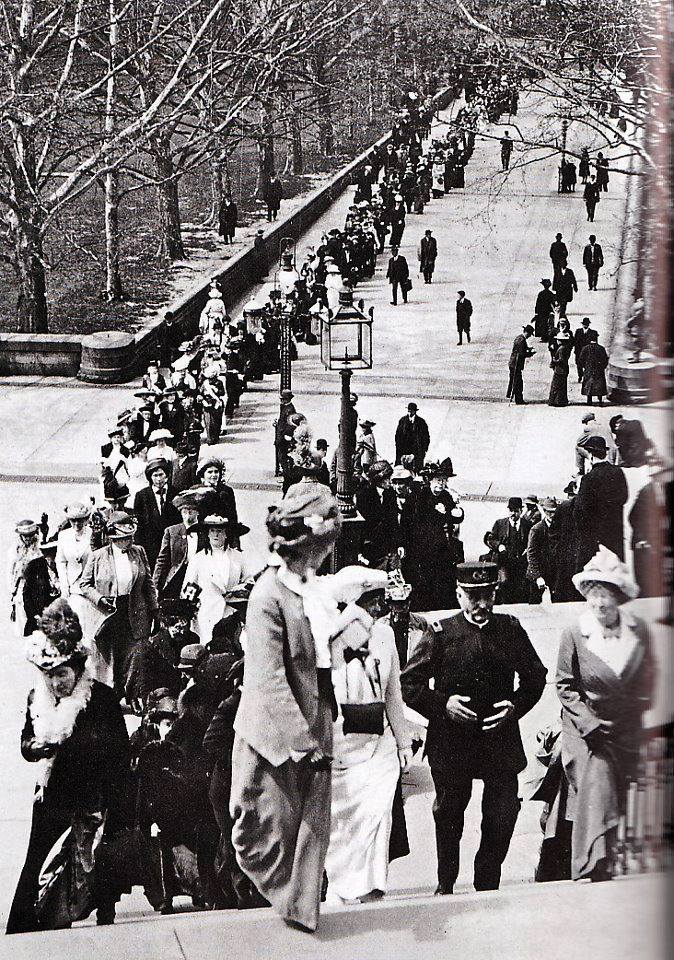
10246832_10202203754598870_8783188453653672658_nThough this event was only about one-tenth the size of the previous one, and consisted of only 531 “Votes for Women” advocates, that number was appropriate to the event’s purpose. Since each State has two Senators, there were two marchers from each of the 48 States, plus one from each of the nation’s 435 Congressional Districts. It was the largest delegation of suffragists ever to call on Congress.

After being given a welcoming speech on the Capitol steps by a U.S. Senator, they entered the Capitol, where they were greeted by Representative James W. Bryan (Progressive Party, Washington State). Bryan said that “there were enough men in the Senate and House to make certain that the flag of woman suffrage never would be pulled down in the United States.”

The delegation then filed into the Rotunda, where nine Senators and an equal number of Representatives from the nine States where women already vote received them. Those Members of Congress shook hands with each of the women as they dropped their petitions into a box specially prepared for the occasion, putting one petition in the box for each Member of the House and Senate. The women then went to the galleries, where they could see the suffrage amendment resolutions introduced on the floor by Senator George Chamberlain, Democrat of Oregon, and Representative Frank Mondell, Republican of Wyoming.

The day began with a large meeting in the Columbia Theater, in which rousing speeches were made by well-known suffragists such as Alice Paul, Harriet Burton Laidlaw, Beatrice Forbes-Robertson Hale, and Janet Richards. Those present for the event, which was organized by Alice Paul and her National American Woman Suffrage Association Congressional Committee, then took to the streets. Led by two marching bands, there was no trouble this time as they made their way from the theater to the Capitol accompanied by adequate police protection, something totally lacking 35 days ago.

April 4, 1907: The Equality League of Self-Supporting Women Votes on War, Equal Pay, and Suffrage

Founding Feminists is FMF’s daily herstory column.

FoundingFeministLogo-color

There was a packed house on hand this evening for a meeting of Harriot Stanton Blatch’s “Equality League of Self-Supporting Women” at New York City’s Cooper Union.

The meeting was every bit as enthusiastic and ambitious as it was crowded. There were three main issues on the agenda, and the audience overwhelmingly endorsed taking strong action on all three.

Winning the vote is, of course, the organization’s top priority, so a number of speakers called for woman suffrage. One of them, Rabbi Stephen S. Wise, may have been the only one in the room who had been able to vote for equal suffrage in a State referendum. He did so while rabbi of Temple Beth Israel in Portland, Oregon, before recently returning to New York to found the Free Synagogue. He said that we would never have democracy in America until women in all States vote.

Rose Schneiderman, though primarily here to speak of the plight of women workers, offered an observation about anti-suffragists:

I found out while I was in Albany something that I had not known before, that you have such things as anti-suffragists. These fine ladies stand up and say: ‘Gentlemen, save us from ourselves. We don’t want to vote. We have more womanly work to do. We have charity.’ Charity! I hate that word. They are the ones who live on charity – they never work. We who provide everything that they have are too nice about it.

Harriot Stanton Blatch, daughter of Elizabeth Cady Stanton.

Though it had been hoped to add Anne Cobden-Sanderson to the list of speakers who roused the crowd to its endorsement of woman suffrage, she was unable to attend due to still being imprisoned for her activities in England. But the gathering approved a cablegram of support to be sent to those jailed there for their militant actions on behalf of suffrage.

The next issue to be addressed was unionization and equal pay for teachers. Speakers demanded that women no longer be paid 30 or 40 percent less than men for the same work. After Linda Gano noted that despite the pay discrepancy, women are not given cheaper theater tickets or discount fares on public transit, Joseph Barondess spoke of the need for more assertiveness and unionization by teachers:

It is not fair to expect women teachers to live on $22.50 per week, but at the same time we should not forget that there are 25,000 girls in this city who are ready to work long hours at anything that will pay them $5 a week.

Women have the habit of asking too little. An employer said to me once that they were satisfied to take home a couple of dollars to buy a feather for their hats. The women teachers should do as they have done in Chicago, form an organization and get a charter from the Central Federated Union. Yet each time we have tried to organize the teachers they were too proud to go in with the common men. The men said they were gentlemen. The women said nothing and did nothing. Organized labor would, I believe, rise to demand equal pay for women teachers.

With only one dissenting male voice, the equal pay resolution for New York teachers was adopted.

The third issue was that of war and peace. Anna Garlin-Spencer noted:

The one great product that women have to nourish and protect is the human being. It costs something to produce human life, and all over the land at all times women are at the same old job at the same old stand. But the time has come when women are tired of producing cheap cannon food. No man has the right to speak for himself and a woman on the question of peace. He can speak for himself, but he must let the woman speak for herself.

The resolution giving the League’s respects to the upcoming Peace Congress, and expressing the hope that women would have a voice in questions of peace and war was quickly adopted.

Harriot Stanton Blatch, the League’s president, has good reason to be pleased with tonight’s turnout and enthusiasm, and so more such meetings should be expected in the future.

Founding Feminists: April 3, 1920

Founding Feminists is FMF’s daily herstory column.

FoundingFeministLogo-color

Over 88% of New York State’s women earn less than the $16.13 a week the Federal Government considers the minimum income needed to cover basic living costs.

Seventy-one percent receive less than $14 a week, while only 11.6% get $16 a week or more. Less than 5% earn $20 a week or more.

These facts were contained in a report made public today by the Consumers’ League of New York entitled “Women’s Wages Today.” They surveyed 500 women in various locations around the State, and came up with a number of findings.

Though they were distributed across a variety of industries, the largest group of women workers, 23%, were saleswomen or cashiers in department stores, with the clothing industry coming in next at 17%. They found that most of the women worked 48 to 54 hours a week, though 5% worked more than 54 hours, while 6% worked less than 44 hours, most of those clerical workers.

1897013_10202180354093872_1610002946_n

There is a popular notion that women work for ‘pin money’ and therefore should be paid less than men, but this was not supported by the data. Of the 500 women surveyed, 377 contributed their entire wages or a large part of them to the family income. Fifteen percent did not live at home and were entirely dependent upon their own incomes. Of this group, ten received $8 a week, twenty-one got $10, eleven received $11 a week, seventeen got $12, seven earned $13, and ten got $15 a week.

Though it might be supposed that low wages are a reflection of youth and inexperience, this was not the case. Only 26.8% of those surveyed were under the age of 18, and 40% were twenty-one years of age or older. Even among those over 30, a majority earned less than $14 a week. Wages have not even been keeping up with inflation. In 1919, 39% of women reported no increase in their pay, and there were few cases where wages kept up with the 14.5% increase in prices last year.

The gap between what women are paid and what they need results in undernourishment, unpaid bills, clothes bought on the installment plan, extra work at night or the acceptance of charity, according to the Consumers’ League. It is because of facts like those presented today that it is calling for the establishment of a State Minimum Wage Commission.

Founding Feminists: April 2, 1931

Founding Feminists is FMF’s daily herstory column.

FoundingFeministLogo-color

Babe Ruth and Lou Gehrig struck out today, felled by a teenager who needed only seven pitches to earn herself a place in baseball lore.

Jackie Mitchell, signed for the season on March 28th by Tennessee’s “Chattanooga Lookouts,” a Class AA minor league team, pitched her legendary “sinker” in an annual exhibition game with the New York Yankees, on their way home from Spring Training in Florida. The contest always attracts a good deal of attention from the local press, and comments made yesterday by the “Sultan of Swat” only increased the public’s interest.

According to Ruth: “I don’t know what’s going to happen if they let women play in baseball. Of course, they never will make good. Why? Because they are too delicate. It would kill them to play ball every day.” Despite his confidence, he did seem concerned enough to ask a reporter: “By the way, how big is she?” When told she was five feet eight inches tall, he simply said: “Well, I don’t know what things are coming to.” He found out today.

From left: Gehrig, Ruth and Mitchell, earlier today as she was warming up.

After the starting pitcher gave up a double and a run-scoring single, Mitchell was sent in just as it became Ruth’s turn at bat. Her first pitch was a ball, but the next two were right on target. Though the Bambino gave them his best swings, it was to no avail. He then demanded that the umpire inspect the ball. It was found to be in perfectly legal condition, so whatever tricks it was playing on the Babe were due solely to the pitcher’s skill.

Mitchell then shot another pitch, which Ruth apparently thought wasn’t quite in the strike zone, and he ignored. But the umpire saw it as a third strike, and the Home Run King, who hit 49 round-trippers last year and had a .359 batting average, vigorously disputed the call, then flung away his bat, and trudged to the bench.

Next up was Lou Gehrig, who hit 41 home runs and batted .379 last year against the American League’s best pitchers. But he proved no match for Mitchell. The “Iron Horse” went down swinging at all three pitches.

Taught to play ten years ago by neighbor Dazzy Vance, who now plays for the Brooklyn Dodgers, this wasn’t Mitchell’s first time pitching against males. Last year, when she played for the Engelettes, a girls’ team from Chattanooga, she threw nine strike-outs in seven innings against a boys’ team. Though she only pitched 2/3 of an inning today, relieved after letting Tony Lazzari walk, it was a great day for baseball fans – and for women in sports.

Founding Feminists: April 1, 1909

Founding Feminists is FMF’s daily herstory column.

FoundingFeministLogo-color

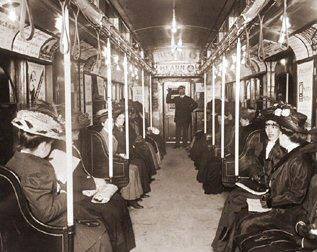
Women-only cars on the Hudson & Manhattan Railroad’s “Hudson Tube” route through the McAdoo Tunnel from 23rd Street in Manhattan to Hoboken, New Jersey, are proving popular.

Today’s ridership is up by 50% (3,000 vs. 2,000) over yesterday’s test run. Already being referred to by passengers as “Suffragette Cars” (a derisive term local suffragists dislike) or “Merry Widow Cars,” they are the last in each train during rush hours, from 7 to 9 in the morning and 4:30 to 7:00 in the evening.

1513848_10202169437260958_2131490629_nWhether the special cars will be adopted by the five-year-old Interborough Rapid Transit Company’s subway system and be established on New York City routes is still unknown, though it seems doubtful. Hearings were held two weeks ago and with the exception of the Womens’ Municipal League, which hosted the discussion, there was strong opposition.
Ida Husted Harper, author of “The Life and Work of Susan B. Anthony,” acknowledged that there were substantial problems for commuters: “It is an outrage for people to be subjected to what they have to endure in the way of transportation in New York.” But she also said:

I am opposed to the plan principally because by setting apart one car for women, men would consider that all the rest of the train belonged to them. Then, when the overflow from this segregated car tried to get into the others, the men would put up the cry that women were encroaching on their domain. We are hearing entirely too much nowadays about ‘women’s invasion.’

Harper said that she was “constantly surprised at the number of men who do give up their seats and try to help women both in the subway and surface cars,” and that the only hope is to rely on the “kindness and consideration” of the majority of men in the cars.

Lillie Devereaux Blake, veteran suffragist and president of the Legislative League, said of the proposal:

I am opposed to it. I don’t think our New York men are such beasts that we can’t sit in the same car with them. I like men. Of course, they don’t give us all we want them to. They don’t let us vote, for instance, but they will in good time, and even now they’re pretty good to us. I think it would be most unpleasant if we had a car to ourselves.

Florence Kelley, Secretary of the National Consumers’ League, testified: “The last thing in the world women want is to be segregated.”

The experiment will continue to see if its popularity lasts.

Founding Feminists: March 31, 1915

Founding Feminists is FMF’s daily herstory column.

FoundingFeministLogo-color

Today, Alice Paul’s “Congressional Union for Woman Suffrage” became a national organization, adopted a constitution, and launched a suffrage campaign that puts it into direct competition with another effort by the more conservative National American Woman Suffrage Association (N.A.W.S.A.).

The result of this all-day meeting of the Congressional Union’s Advisory Council makes it clear that there are two very different philosophies among national suffrage groups in regard to attaining their common goal of nationwide woman suffrage. But the willingness to work for that goal is reassuringly high in both groups.

The Congressional Union was formed two years ago by Alice Paul as a local Washington, D.C. organization to help support N.A.W.S.A.’s Congressional Committee, which she led at the time. Congressional Union activists have always taken a more aggressive and flamboyant approach to the battle for the ballot than N.A.W.S.A. officers felt advisable. The C.U. has engaged in activities ranging from colorful parades, pageants, motorcades and other spectacles to public confrontations with Democratic Party candidates over their party’s failure to use its majority status in Congress to pass a nationwide suffrage amendment.

Though both N.A.W.S.A. and the C.U. have the same goal of enfranchising women nationwide, N.A.W.S.A. still favors a State-by-State approach, while the C.U. sees a Federal amendment as the only realistic solution. The primary goal of the new organization is to pass the Susan B. Anthony (nationwide woman suffrage) Amendment, sometimes called the Bristow-Mondell Amendment after its current sponsors in Congress. If approved by 2/3 of both Houses of Congress and ratified by 3/4 of the states, it would immediately enfranchise women in every State on the same basis as men.

N.A.W.S.A. favors State campaigns, and currently endorses the Shafroth-Palmer Amendment, which if it became part of the Constitution would mandate a State referendum on woman suffrage if 8% of the registered voters of a State signed petitions requesting it. It would obviously be less controversial, and therefore easier to get Congress to pass, and the States to ratify, but it would directly enfranchise no one. N.A.W.S.A. sees nationwide suffrage coming about only after women have won the vote in a large number of States, and have enough power to directly influence members of Congress.

As might be expected, relations between the two rival suffrage groups have not been cordial since Alice Paul was ousted from leading N.A.W.S.A.’s Congressional Committee after refusing its demand that she resign from the Congressional Union. An attempt at reconciliation in early 1914 failed, and the two organizations have been engaging in a kind of “family feud” ever since.

N.A.W.S.A. has referred to the C.U. as an “unruly child” for its work against Democrats during last year’s midterm elections. Democrats have the Presidency, and majorities in both House and Senate, but have failed to advance the Anthony Amendment. Like the British militants, Alice Paul believes that the party in power should be held responsible for keeping women disenfranchised.

10155240_10202164108767749_359145734_n
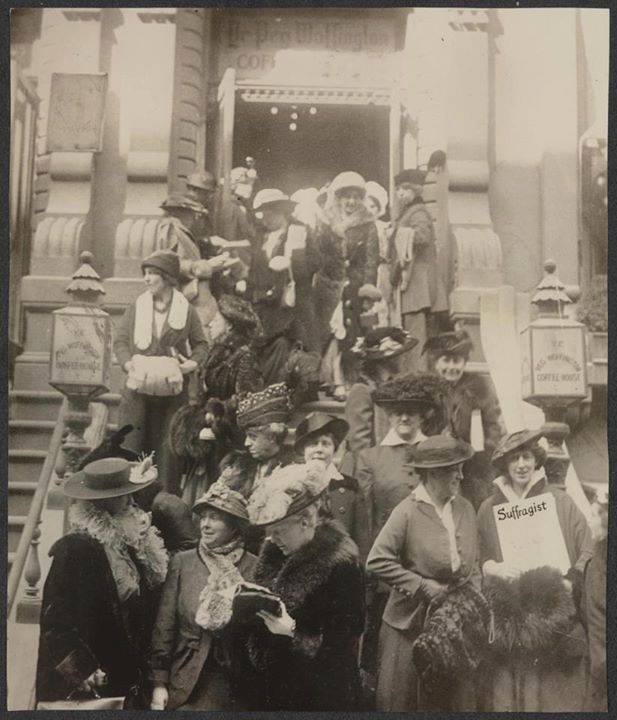
Members of the Congressional Union leaving New York’s Peg Woffington Coffee House, where the early session of their meeting today was held. The “Suffragist,” seen in the lower right corner, is the C.U.’s official publication. (Front row, from left: Elizabeth Colt, Elizabeth Kent, Elizabeth Selden Rogers, Olive Halladay Hasbrouck, with Hazel MacKaye holding the magazine; Second row: Marie Theodosia Armes, Lucy Burns and Jessie Davisson.)

Today, N.A.W.S.A., gearing up for a campaign to pass a suffrage referendum in New York State in November, issued a scathing letter signed by Katherine Dexter McCormick, its VIce President, denouncing the C.U.’s actions:

The officers of the National American Woman Suffrage Association agree with Mrs. Carrie Chapman Catt and Mrs. Harriot Stanton Blatch that this is not the time nor is New York a place for reopening of the discussion as to the best way to bring about a Federal amendment for suffrage.

It would have shown more imagination, more consideration from the women in New York, had the conference, with its appeal for funds and help, been held in some other State, but perhaps that is asking too much of an organization which is interested only in Federal suffrage. We see, usually, only what we are interested in.

But I do want to say, in all generosity, that the Congressional Union is to be heartily congratulated on giving up its policy of attacking the Democratic Party as the sole obstacle to suffrage. This was a short-sighted policy which we all deplored. It was based upon a romantic desire to imitate English tactics rather than upon a realization of the political situation in this country. We are glad to learn that the union has abandoned it, and we only wish that step had been taken before the union’s policy had misled and antagonized thousands of Democratic voters last Fall in Nebraska, Ohio, Missouri, and the two Dakotas.

In response, Lucy Burns advised fellow C.U. members who might still be in N.A.W.S.A. to resign and stop supporting it in any was as long as it favors the Shafroth-Palmer Amendment.

After a vigorous discussion, it was decided that the new group’s membership will be composed of women only, though men are welcome at the meetings, and the work of Marsden J. Perry, in attendance today, was praised.

The main work of the day was planning how to expand the group’s presence into every State, though no Congressional Union meeting would be complete without a discussion of plans for some massive public event. The one presently being planned is the Susan B. Anthony Pageant, scheduled just before the opening of the next Congress, and it is hoped it will be the biggest suffrage event ever staged.

Despite the obvious friction between the two suffrage groups, the movement is now more powerful than it has ever been, and all suffragists are united and committed to the goal of “Votes for Women” everywhere. Though the “how” and “when” of victory cannot be predicted, a major step in that direction was taken today.

Founding Feminists: March 24, 1972

Founding Feminists is FMF’s daily herstory column.

FoundingFeministLogo-color

According to a poll released today, American women are becoming much more supportive of the feminist movement and its goals, though many still remain skeptical.

Just a year ago, women who were surveyed for the Virginia Slims Women’s Opinion Poll by Louis Harris and Associates opposed efforts “to strengthen and change women’s status in society today” by 42% to 40%. But in this year’s survey, Harris found support had increased dramatically, with 48% in favor and just 36% opposed.

Though the women’s rights groups responsible for this changing of consciousness are not yet supported by a majority of women, opposition has decreased significantly. Last year 51% thought “few or none of these organizations” were helpful, while 34% thought they were. This year, 43% found them useful and 44% did not, with the 1% gap well within the poll’s margin of error.

Of course, there are still attitudes that need to be changed, especially in regard to women in political life. Sixty-three per cent of the women surveyed thought men were more emotionally suited to politics, though seventy-four percent believed women in public office can be as logical and rational as men. If given a choice between a male and a female candidate with identical qualifications and views, about 40% of women would be more likely to vote for the male candidate, while only 17% would prefer the female, and 37% said that a candidate’s gender would make no difference.

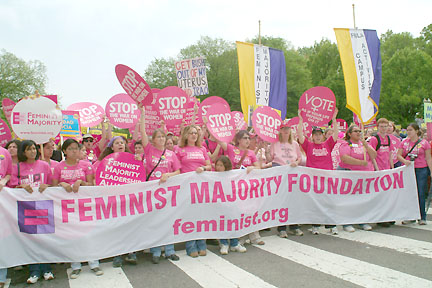
from the March for Women's Lives, 2004.
from the March for Women’s Lives, 2004.

But political inequality is now being noticed, and hopefully will be challenged. By 40% to 34%, those surveyed thought there were too few women delegates at the Presidential nominating conventions, and 32% thought half the delegates should be women. As for attaining the Presidency itself, 27% said the country will never be ready to elect a female President, but 37% believed it will happen in the next ten years.

According to Harris, women’s political views will become increasingly decisive, especially if they vote differently from men. Women voters almost tipped the 1968 election to Hubert Humphrey, and would have done so if they had cast a majority of the votes. In that election, 46% of women voted for Democrat Hubert Humphrey, 43% for Republican Richard Nixon and 11% for American Independent Party candidate George Wallace. Forty-four percent of men voted for Nixon, forty percent for Humphrey, and sixteen percent for Wallace. At a press conference yesterday, Harris said: “It is entirely likely that women will continue to be a majority of the voting constituency for the rest of the century.”

In the words of the pollsters:

A feminist ‘pro-change’ constituency is solidifying among specific groups of women. The most conspicuous increases in support for efforts to change women’s status have occurred among women who are single (from 53% last year to the present 67%), in the 18-29 age group (from 46% to 56%), college graduates (from 44% to 57%), and suburban residents (from 41% to 51%). Strong support for status-changing efforts persists among Blacks (62%), the divorced and separated (57%) and city residents (52%). Strongest opposition to change is found among women who are widows, over 40 and residents of rural areas. But even among these groups, opposition to feminist ideas is diminishing.

Among the more encouraging signs the survey found were that 48% of women now agree that: “It’s time they protested the real injustices they’ve faced for years,” with 43% disagreeing. Last year 52% rejected this view, and only 38% supported it. But actual protesting still seems to be unpopular. Any question that involved the word “liberation,” “picket,” or “protest” drew unsympathetic responses, with only about a third favoring protests and picketing as a way to win equality, though this would still represent tens of millions of women who could potentially be recruited for actions.

The pollsters concluded their survey results with an optimistic prediction validating the impression that feminists have made a good deal of progress, and that there will be more to come if we continue our efforts: “It is highly probable that women of the future will have vastly different pictures of themselves from women of today. According to the Virginia Slims study, younger women are rejecting many cherished stereotypes of their sex and frequently express opinions and life-style preferences quite different from older women.”

>