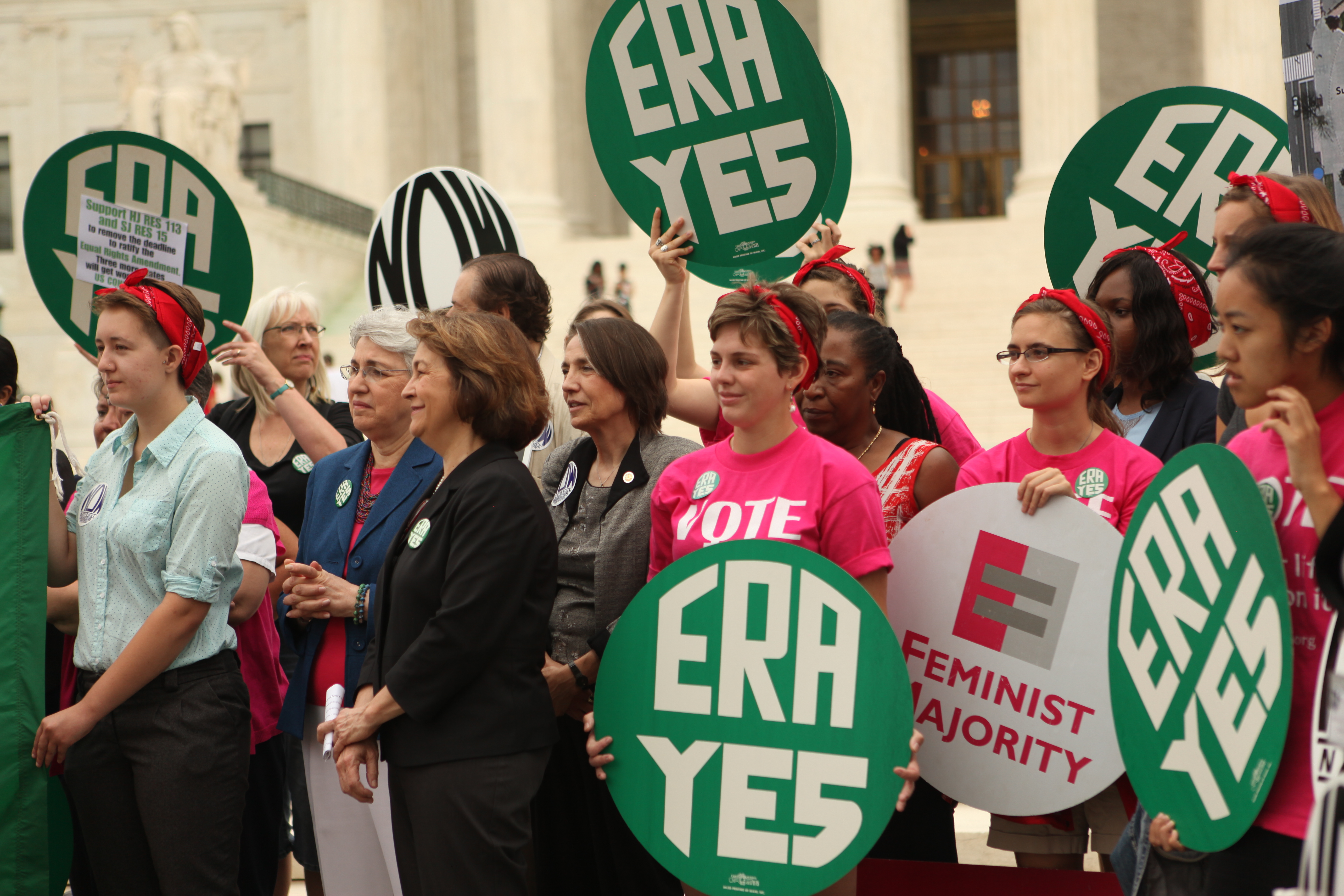
A Majority of Oregon’s Electorate Voted for Women’s Equality in the Midterm Election

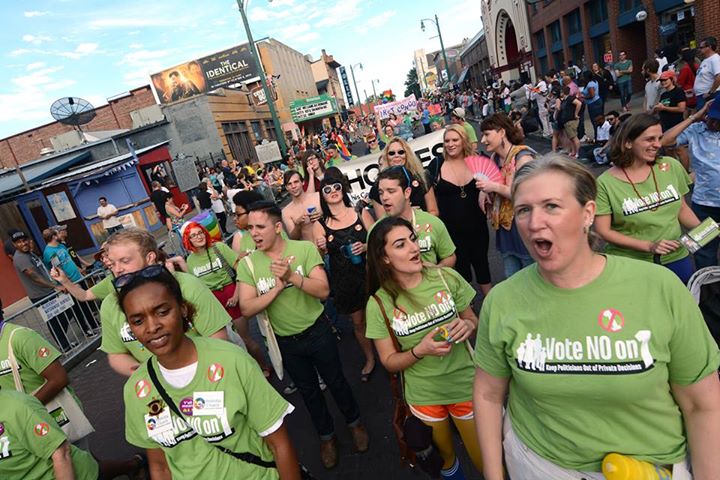
Measure 89, a state constitutional Equal Rights Amendment which was placed on the ballot in Oregon by a citizen’s petition, passed overwhelmingly by a nearly 2-1 margin, with 64 percent of voters turning out in support of constitutional equality for women.

via Jessica Johnson
via Jessica Johnson

Over 116,000 signatures from registered voters in Oregon put Measure 89 on the ballot. Voting in Oregon is done by mail, and around 69.5 percent of voters submitted ballots for the 2014 general election yesterday, making up the highest voting percentage by any state in the nation.

Measure 89 was a project of Leanne Littrell DiLorenzo, president of VoteERA.org, who ran the petition drive and subsequent campaign with the support of the Feminist Majority Foundation. DiLorenzo argued for explicit protections for women in the state constitution. “The language of Article I, Section 20 of the Oregon Constitution, written in 1857, has not changed,” she wrote. “Under it women could not vote, could not serve on juries, most could not own property, and women still do not have equal pay for equal work.”

“I am proud that the FMF campus campaign in Oregon worked on 9 campuses throughout the state to educate and mobilize students for passage of Measure 89,” Katherine Spillar, Executive Director of the FMF, told Feminist Newswire. “The students were shocked to find out that there was no provision against sex discrimination in the Oregon constitution and they worked hard for passage of this state Equal Rights Amendment.”

Four former Oregon Supreme Court justices wrote an open letter supporting Measure 89. “We believe that passage of the Oregon ERA will acknowledge the contributions and importance of more than 50 percent of our citizens by finally providing women express recognition in our state’s most important document, its constitution,” the justices wrote. In addition, Measure 89 was endorsed by many state officials including the Governor John Kitzhaber both U.S. Senators from Oregon, Ron Wyden and Jeff Merkley, who was re-elected on Tuesday. Many organizations, including the YWCA, NAACP, American Association of University Women, Feminist Majority Foundation, Oregon labor groups, business groups, the Oregon Nurses Association, and the Oregon Education Association endorsed Measure 89.

Twenty-three states now have an equal rights provision in their state constitutions. The wording of the Oregon ERA is based on the federal ERA, which has been ratified by 35 states and needs just three more states to approve it for final ratification. Measure 89 reads, “Equality of rights under the law shall not be denied or abridged by the State of Oregon or by any political subdivision in this state on account of sex.” It continues, “The Legislative Assembly shall have the power to enforce, by appropriate legislation, the provisions of this section. The final provision reads, “ Nothing in this section shall diminish a right otherwise available to persons under section 20 of this Article or any other provision of this Constitution.”

Media Resources: Feminist Majority Foundation, Ballotpedia, VoteERA.org, Oregon Secretary of State, Oregon Public Broadcasting 11/4/2014; The Oregonian 11/4/2014, 10/20/2014, 10/18/2014; Ms. Blog 10/15/2014; Feminist Newswire 9/15/2014; equalrightsamendment.org
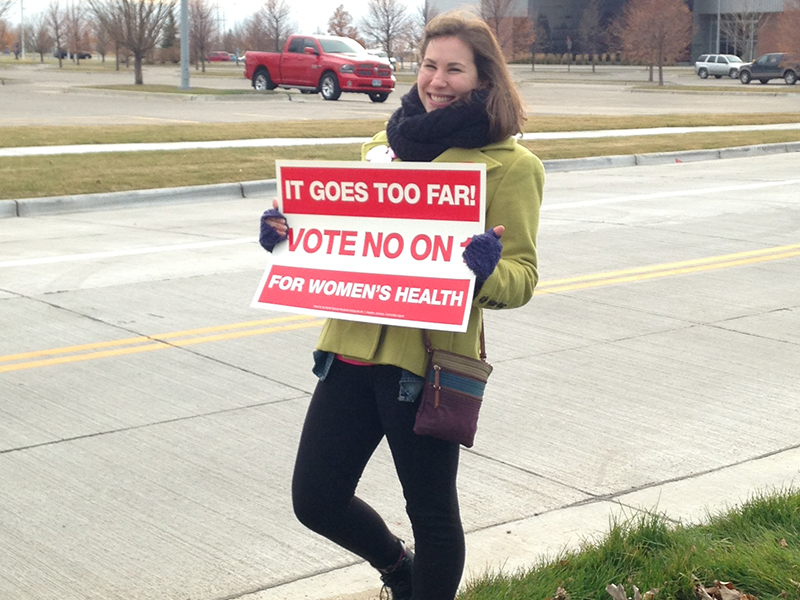
This Election Day, Students Are Mobilizing Against Anti-Abortion Ballot Measures

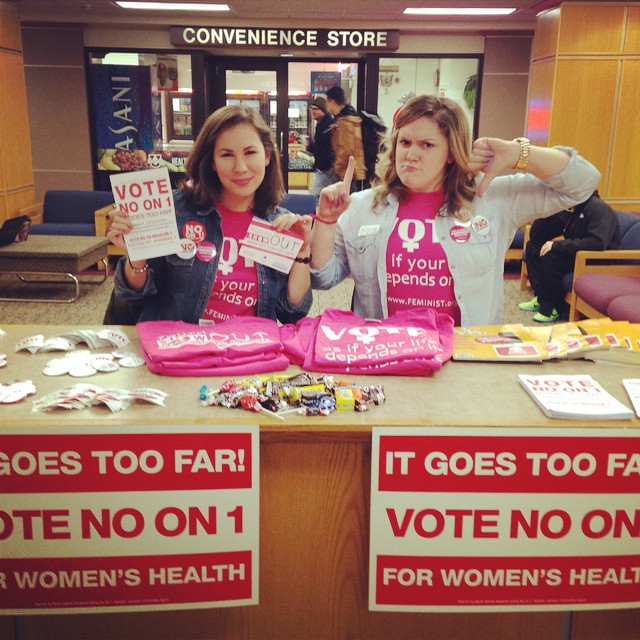
Students in North Dakota and Tennessee are getting out the vote against anti-abortion and anti-birth control ballot measures being decided today at the polls. In both states, students and young people have been leading campaigns on the ground with the assistance of Feminist Majority Foundation National Campus Organizers.

FMF National Campus Organizer Alyssa outside a polling place in North Dakota.

In Tennessee, voters will be deciding on Amendment 1 – a proposed change to the Tennessee state constitution that would take away the right to abortion and give politicians the green light to enact abortion bans, even in cases of rape, incest, or life endangerment. Students throughout the state have been educating voters on the dangerous consequences of Amendment 1, which could allow politicians to restrict access to birth control and pass laws denying life-saving treatments to pregnant women with critical illnesses like cancer.

Determined to make sure the student voice against Amendment 1 is heard, students at Vanderbilt University and Belmont University in Nashville are organizing ride shares and transporting people to the polls. Students working with the Feminist Majority Foundation at Middle Tennessee State University (MTSU) in Murfreesboro are collaborating with the MTSU NAACP to hand out flyers urging students to vote no on Amendment 1, and students at Austin Peay State Univeristy in Clarksville, near the Tennessee border with Kentucky, are engaging in visibility actions to get out the no vote.

National Campus Organizer Edwith and Planned Parenthood organizers in Tennessee.

But getting out the vote hasn’t been easy. Students at the University of Tennessee in Knoxville have reported that their Vote NO posters were torn down all over campus. And at the University of Memphis on Sunday, an anti-abortion group harassed students organizing against Amendment 1, calling female supporters “whores.” According to student reports, the harassment escalated, resulting in an altercation that left one student with a dislocated shoulder.

Feminist Majority Foundation field organizers in North Dakota, where students have been mobilizing the vote against Measure 1, a proposed personhood amendment, have reported a stream of voters at the Fargodome, where about a quarter of voters this morning were young people. Organizers braved the cold to hold up Vote NO posters visible to those driving by the Fargodome. They were greeted by voters honking their horns in support and giving the thumbs up. Over in Grand Forks, North Dakota, the mood is also upbeat, with students increasing visibility for Election Day.

If passed by North Dakota voters, Measure 1 would change the North Dakota state constitution to create an “inalienable right to life” for humans “at any stage of development” – including the moment of fertilization and conception. It would ban abortion, even in cases of rape, incest, or life endangerment, as well as some forms of birth control, and all in vitro fertilization in the state.

Election Day is TODAY. Click here for information on where to vote to your state.

Media Resources: Feminist Majority Foundation; Feminist Newswire 11/3/14, 10/22/14, 10/17/14

There’s A Lot at Stake for Women on Election Day Tomorrow

Election Day is tomorrow, November 4 – and this year, there is much at stake for women, people of color, and young people.

via Shutterstock
via Shutterstock


In many states, voters will directly decide several critical issues in their states – from raising the minimum wage to paid sick days, from abortion access and women’s civil rights to decriminalization of marijuana – through ballot measures.

In Alaska, Arkansas, Illinois, Nebraska, and South Dakota voters will have the opportunity to increase their state’s minimum wage at the polls tomorrow. The current federal minimum is $7.25 per hour, placing some families well below the poverty line. Women and minorities disproportionately make up minimum wage jobs, and would hugely benefit from an increase in wages. Massachusetts voters may also decide to pass statewide, paid sick days for both part-time and full-time workers. If passed by the voters, Measure 4 would allow the almost 1 million workers in Massachusetts who can’t earn a single hour of paid sick time, to earn up to 5 days of paid sick leave per calendar year.

Colorado, North Dakota, and Tennessee each have anti-choice measures on the ballot that would effectively outlaw abortion in all circumstances, even in cases of rape, incest, or to save the life or health of the mother. Tennessee’s Amendment 1 would take the right of privacy for reproductive rights out of the state constitution and give local legislators the power to restrict access to abortion, and outlaw many forms of birth control, such as the IUD or the pill. North Dakota’s Measure 1, a “personhood amendment” would create an “inalienable right to life” starting “at any stage of development” – including the moment of fertilization and conception. Similarly, Colorado’s Amendment 67 would include “unborn human beings” in the definition of “person” and “child” in the state’s criminal code and Wrongful Death Act, and would also ban all abortions – even in the case of rape, incest, or danger to the mother’s life or health – if the Supreme Court decision Roe v. Wade is ever overturned.

The language of both Measure 1 and Amendment 67 is dangerously vague, and both proposed changes could eliminate or restrict access to some common forms of birth control (such as the pill and IUD), deny pregnant women with life-threatening illnesses access to treatment, ban in-vitro fertilization, and subject all women who have miscarriages – and their medical providers – to criminal investigations.

Oregon is the only state in this election voting on a civil rights bill for women’s equality. While we are still waiting to ratify the federal Equal Rights Amendment (ERA), giving women equality under the United States constitution, Oregon voters will decide directly whether to adopt a state constitutional ERA. If passed, Measure 89 would guarantee all Oregonians equal rights under the state constitution, regardless of sex. This measure would be a boon to women fighting employment, wage, benefit, or educational discrimination, or women seeking protection against violence, as they would be protected by the full weight of the state constitution.

Marijuana use is on the ballot for three states this election. In Alaska, Measure 2 is on the ballot for the decriminalization of marijuana. Oregon is proposing a similar ballot in Measure 91, which would legalize recreational marijuana use. Young people and people of color are more likely to be arrested for marijuana use. Decriminalizing marijuana may help prevent unnecessary criminalization of these communities. it will prevent these communities. In addition, Florida will be voting on Amendment 2 which would allow for the use of marijuana when recommended by a physician. Marijuana has many medical benefits and should be included as a part of comprehensive healthcare. 

When going to the polls to vote tomorrow, remember that many voter ID laws have changed since the 2012 election. To find out what you’ll need to vote, visit our state-by-state voter information guide. For more about state ballot measures, click here.

Media Resources: Feminist Campus Ballot Measures to Watch; Feminist Campus State-by-State Voter Guide; Ballotpedia; Feminist Newswire 10/17/14; Yes on 4 Massachusetts; No on One Tennessee; North Dakotans Against Measure 1; Vote No 67 Campaign

Major Local and National Newspapers Want Colorado to Vote No on Amendment 67

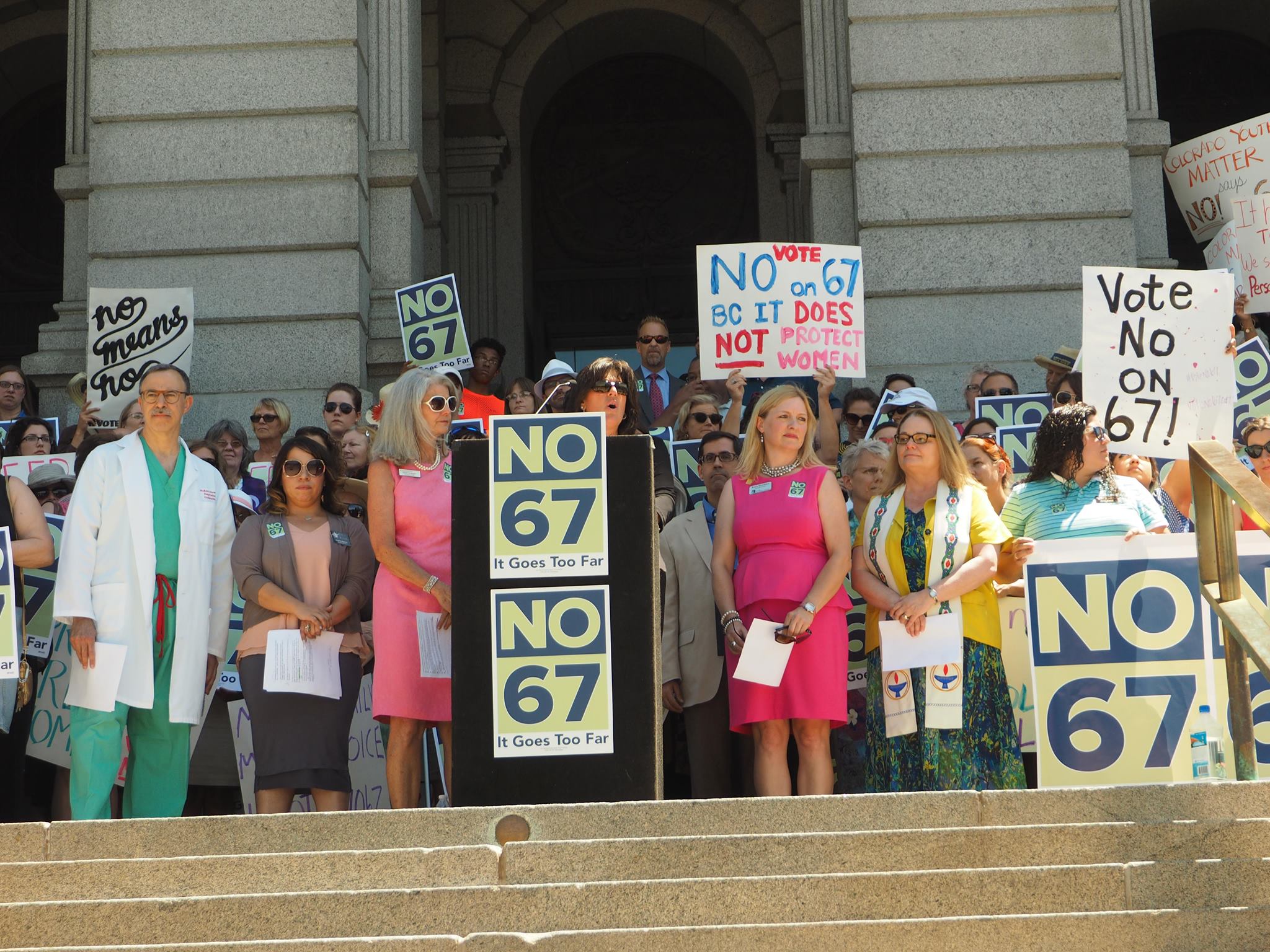
18 newspapers in Colorado have spoken out against Amendment 67, a personhood amendment being decided by voters tomorrow which would ban all abortions in the state – including in cases of rape, incest, or to save a woman’s life – as well as end in-vitro fertilization and restrict access to common forms of birth control like the pill and IUDs.

via Vote No 67
via Vote No 67


The 18 newspapers include the Denver Post, the state’s most popular paper garnering more than 10 million digital page views per month and read regularly by more than 610,000 readers. The Denver Post Editorial Board called Amendment 67 “a radical measure that would undermine constitutionally guaranteed reproductive rights.”

Many of the local editorials opposed to Amendment 67 touch on how dangerous it would be for women and doctors in the state. The state’s media giants – who have watched as voters rejected similar measures twice before – also aren’t holding back.  “Amendment 67 is wrong for women and wrong for the state of Colorado,” the Steamboat Pilot said. “Amendment 67 deserves to go down in flames,” Sky Hi Daily News wrote.

National papers have also weighed in. The New York Times Editorial Board wrote, “Amendment 67 in Colorado is a modified but no less unconstitutional version of the preposterous ‘personhood’ proposals Colorado voters overwhelmingly rejected in 2008 and 2010… The wording advertises the initiative as protecting women, when, in fact, it would do the opposite.”

Colorado’s voters feel just as strongly. Students across the state are working to ensure that Amendment 67 doesn’t pass, and many are doing so in conjunction with the Feminist Majority Foundation’s Feminist Campus program. Last month, FMF Board Member Dolores Huerta championed the Vote No on 67 campaign at a rally in Denver. More than 80 faith leaders in Colorado have also strongly opposed Amendment 67.

Amendment 67 would amend the Colorado constitution to define “person” and “child” in the state criminal code and Wrongful Death Act to include “unborn human beings.” As Gaylynn Burroughs, Feminist Majority Foundation Director of Policy & Research, explains in the Fall 2014 issue of Ms. Magazine:

If passed, Amendment 67 would threaten abortion rights, birth control, fertility treatments and some medical treatments for critically ill pregnant women – and open up the possibility of criminal investigations into miscarriages. All pregnant women’s bodies would become potential crime scenes.

Colorado voters can vote by mail, as long as the ballot is received by 7 PM on November 4, or in-person at polling centers through Election Day tomorrow. Find more information on how and where to vote here.

Media Resources: Vote NO 67 Campaign 10/31/2014; The New York Times 10/13/2014; Steamboat Today 10/11/2014; Feminist Newswire 10/6/2014; The Denver Post 10/2/2014; The Tennessean 10/2/2014; Ms. magazine Fall 2014; Feminist Campus Voting Guide

Celebrities and Survivor Advocates Encourage Tennessee and North Dakota Voters to Reject Anti-Abortion Measures

Advocates for survivors of sexual violence in North Dakota and Tennessee urged voters to turn down two dangerous anti-abortion measures when they go to the polls on this Tuesday, stressing the damage these measures would cause.

via Ashleigh Moses
via Ashleigh Moses

Saturday, in South Nashville, Vote No On 1 supporters were joined by actor-activists Ashley Judd and Connie Britton, who shared their own reasons for opposing Amendment 1 in Tennessee. Speaking to a crowd of around 100 advocates, Judd talked about how her life would have been devastated by the anti-abortion measure. She bravely shared with fellow supporters that she was raped twice before the age of 18 – a reality Amendment 1 makes no exception for.

“What if I were that vulnerable young woman at the age of 15 who was put in that horrific position?” Judd asked. “I don’t want any child, teenager, or woman in Tennessee to have to bear the double burden of sexual violence and unintended pregnancy. That is not something that is appropriate or sustainable for her life.” She added that being a person of faith does not have to preclude opposition to Amendment 1. “I’m Ashley Judd. I am a southerner, I’m a Christian, and I’m pro-choice.”

Connie Britton, Ashley Judd among speakers at Vote No On 1 Rally in South Nashville, Tennessee. (Taken by Ashleigh Moses & Edwith Theogene)
via Ashleigh Moses

If passed by Tennessee voters on Tuesday, Amendment 1 would take away state constitutional privacy rights and give politicians far-reaching power to pass laws banning abortion, even in cases of rape, incest, or life endangerment. The Amendment could also threaten access to some forms of birth control.

Edwith Theogene, a National Field Organizer for the Feminist Majority Foundation, has been in Tennessee mobilizing students against Amendment 1. “Politicians have no concept of or idea what I am doing with my private life,” Theogene told WZTV in Nashville. “I don’t think they should impede on my privacy rights and make these decisions for me. This is a private decision left for a woman, her faith, and her family.”

Amendment 1 has been opposed by local clergy, medical doctors, women of color activists, and every major Tennessee newspaper.

Advocates for survivors of sexual assault in North Dakota also came out against another dangerous measure being proposed in their state this weekend. Measure 1, a proposed personhood amendment, would amend the state constitution to create an “inalienable right to life” starting at “any stage of development” – including the moment of fertilization or conception. If passed by North Dakota voters, Measure 1 would ban abortion with no exception for rape, incest, or the life of the mother. Measure 1 would also restrict access to common forms of birth control like the pill, IUDs, and emergency contraception; ban in vitro fertilization; and could make women who suffer a miscarriage subject to criminal investigation.

Linda Isakson, the Assistant Director of the North Dakota Council on Abused Women Services, emphasized how Measure 1 would undermine a woman’s agency with no regard for the circumstances she faces. “So many victims want that decision-making power after a sexual assault,” Isakson said. “By denying them that right, we further traumatize somebody who’s already been traumatized.”

Renee Stromme, the executive director of the North Dakota Women’s Network, added that there is nothing pro-life about Measure 1. “When a woman and her unborn child have equal rights in the eyes of the law, this presents a conflict,” Stromme said. “If only one life could survive, the state would have to decide whether the mother or the child would die.”

Measure 1 has been widely opposed by students, the North Dakota Medical Association, which represents North Dakota’s doctors, medical students, the American Congress of Obstetricians and Gynecologists. The AARP of North Dakota has expressed concern that the Measure goes too far because it threatens end-of-life care, and other organizations opposing Measure 1 have highlighted its potential negative impact on organ donation.

Election Day is tomorrow, November 4.

Media Resources: WZTV Nashville 11/2/14; Grand Forks Herald 11/1/14; Feminist Newswire 10/31/14, 10/30/14, 10/27/14, 10/23/14, 10/22/14, 10/17/14, 10/6/14; North Dakotans against Measure 1; AARP North Dakota; Northern Plains Conference United Church of Christ; Vote No on One Tennessee

Federal Judge Exempts Another Catholic University from Birth Control Coverage

A federal judge ruled Tuesday that Ave Maria University, a Catholic university in Florida, does not have to comply with federal rules meant to ensure that covered employees can exercise their right to obtain birth control at no cost.

via Gabi Lamberti
via Gabi Lamberti

The Affordable Care Act requires all new health insurance plans to cover all FDA-approved contraceptives – such as the pill, emergency contraceptives, and IUDs – without charging co-pays, deductibles or co-insurance. Religious employers, such as churches, are exempted entirely from the requirement and do not have to provide employees with health insurance that covers contraceptives. Certain religiously affiliated non-profits, like Ave Maria University, who object to contraception on religious grounds, can obtain an accommodation that would allow these groups not to provide contraceptive coverage directly to their employees.

Under rules issued in 2013, a religiously affiliated non-profit seeking accommodation would simply self-certify its religious objection to providing contraceptives and submit that self-certification to its insurance issuer or to a third-party administrator who would then pay for and process claims for contraceptive services.

This summer, however, in the wake of its Hobby Lobby decision, the US Supreme Court blocked enforcement of the 2013 rules against Wheaton College, a Christian College in Illinois, who claimed that it violated the organization’s religious beliefs to submit a self-certification to its health insurance issuer, on the theory that this action made the organization somehow complicit in the provision of birth control. In that case, the Court noted that nothing in its ruling prevented women from obtaining contraceptives without cost-sharing as intended by the ACA because Wheaton College had otherwise notified the government of its objection, and the government itself could facilitate the contraceptive coverage.

Relying on the decision in Wheaton College, the Obama Administration issued interim rules in August 2014 to provide an alternate process for religiously affiliated non-profits to claim an accommodation from the ACA mandate. Under that process, the organization would notify the Department of Health and Human Services (HHS) of the objection and provide the agency with its insurance carrier’s information in order to allow HHS to set up contraceptive coverage for affected employees.

Ave Maria University contends, however, that even these new rules were too onerous, and US District Court Judge James S. Moody, Jr. agreed, granting the school a temporary injunction until a complete trial can be held.

Ave Maria University, founded by anti-abortion and anti-birth control Domino’s Pizza founder Tom Monaghan, is located in the the town of Ave Maria, Florida, a town developed by Monaghan in 2005 to be “based on traditional family values,” according to Monaghan’s development partner. According to a report on the Daily Kos, there is only one OB/GYN in the town and the doctor will not prescribe contraceptives to any woman, for any reason.

In 2004, describing the plans for the town of Ave Maria, Monaghan said that he and the developers intended to “own all commercial real estate” in the town.

“That means we will be able to control what goes on there,” he said. “You won’t be able to buy a Playboy or Hustler magazine in Ave Maria Town. We’re going to control the cable television that comes in the area. There is not going to be any pornographic television in Ave Maria Town. If you go to the drug store and you want to buy the pill or the condoms or contraception, you won’t be able to get that in Ave Maria Town.”

So far, according to the Daily Kos, there is no pharmacy in Ave Maria Town, and for now, there is no birth control coverage for employees of Ave Maria University.

The government may choose to appeal the district court judge’s ruling to the US Court of Appeals for the Eleventh Circuit.

Media Resources: SCOTUS Blog 10/28/14; The Hill 10/28/2014; Daily Kos 9/30/2014; Feminist Newswire 8/27/14, 7/7/14; Wall Street Journal 11/11/05; Centers for Medicare & Medicaid Services

Women of Color in Tennessee Are United in Opposition to Amendment 1

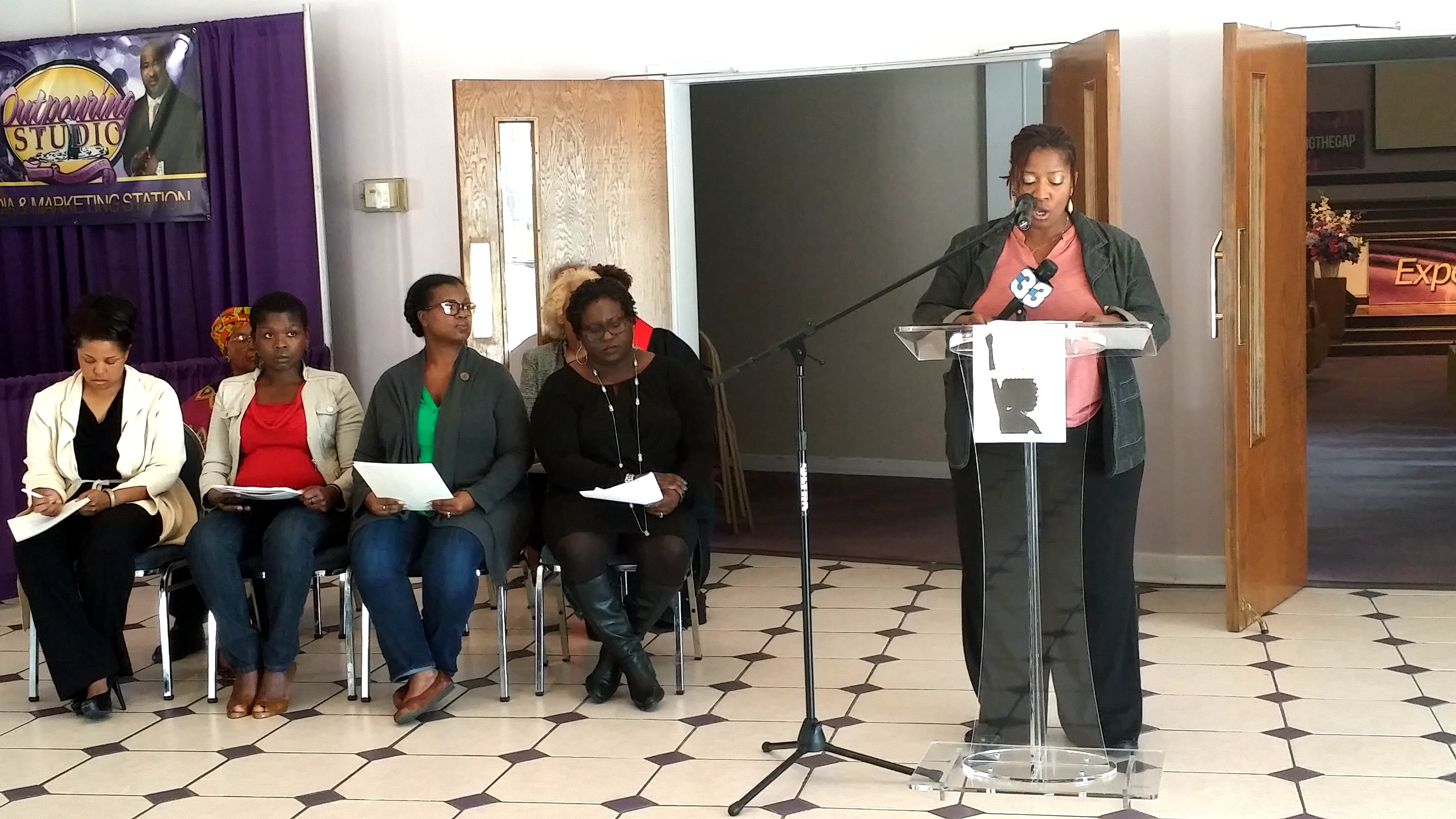
Just days before the general election in Tennessee, a coalition of community leaders, clergy, and advocates led a press conference encouraging women of color to vote no on Amendment 1, a dangerous and far-reaching measure on the state’s ballot.

via SisterReach
via SisterReach

SisterReach, a grassroots organization focused on “empowering, organizing, and mobilizing women and girls in the community around their reproductive and sexual health to make informed decisions about themselves,” organized the press conference “to call attention to the unique concerns Black and poor communities throughout Shelby County and across the state of Tennessee face on a daily basis” and to emphasize how the upcoming election “could further limit [black women’s] reproductive, economic, political, and social autonomy.”

“We assemble today to impress upon black women and women of color, many of whom are heads of households, to get out and vote,” said SisterReacher Founder and CEO Cherisse Scott at the event.

SisterReach has been educating voters about the particularly dangerous impact of Amendment 1 on women of color. Amendment 1, a proposed state constitutional amendment, would take away the right to an abortion within the state – even in cases of rape, incest or to save the life of the mother. If passed by Tennessee voters on November 4, Amendment 1 would give politicians far-reaching power to restrict access to many forms of birth control and abortion, even for those in the most tragic circumstances. In addition, if Roe v. Wade were ever overturned, Amendment 1 would lay the groundwork to outlaw all abortion in Tennessee.

Reverend A. Faye London, the Inter-Faith Outreach Coordinator for SisterReach, told the Feminist Newswire that black women’s images are being used to bait support for Amendment 1. “People are using the idea of this irresponsible ‘welfare queen’ with the wanton sexual desire, who’s using abortion for birth control, even though that’s not the reality,” London said. “We often have to say we do love our children and want our children, and it’s sad that we have to say that out loud, but we do.”

London also highlighted how the impact of Amendment 1 could be particularly devastating for low-income women and women of color who are steadily losing access to comprehensive reproductive healthcare options. Rev. London pointed to the national reduction in food assistance for low-income families, the state’s slow crawl to Medicaid expansion, and limited sex education opportunities, despite the desires of women of color in the state. The University of Memphis Center for Research on Women – a SisterReach Policy partner – found that of all groups surveyed in 2012, black women from Shelby County were most likely to want sex education for their children that included information about birth control and contraceptives. Despite this demand, the state has restricted comprehensive sex education, giving preferential treatment to abstinence-only programs, and criminalizing teachers or outside programs that condone so-called “gateway sexual activity” like genital touching.

“There are young women who have no idea how their bodies work,” London said. “There are women who have the very basic health care, but it doesn’t offer them birth control,” she continued. “This is the state of poor women, women of color, and women who just don’t have access to resources they need – and that is the thing that SisterReach is trying to lift up.”

Part of SisterReach’s outreach has also involved challenging damaging stereotypes about black women that have traditionally worked as a tool of political gain and empowering women to vote in this election.

“(It’s important) to call to people’s attention to the historical attempt to vilify the black woman for everything that goes wrong in the African American community,” London said, pointing to the framework erected by the work of Daniel Patrick Moynihan that contributes to the political practice of discrediting black women’s decision-making. “Set in the minds of some people is this process of removing the black woman from the picture. So, she’s not a person. She’s a dangerous place for black babies. She’s the murderer that’s killing black babies. She’s not a person, she’s the woman that’s killing the man’s seed. She’s not a person, she’s being duped into stopping nation-building. In all of these things – the black woman is not a person, and therefore has no agency.”

Thursday, during a Twitter chat led by African Americans for Planned Parenthood, SisterReach was one of several organizations using the #BlackVotes hashtag to highlight the issues facing black voters and the reproductive challenges that are at stake in the 2014 election.

SisterReach isn’t the only organization opposed to Amendment 1. The Feminist Majority Foundation is organizing on the ground in opposition to this dangerous amendment, and a broad coalition of national and Tennessee-based women’s rights and civil rights groups, medical doctors, religious leaders, students across the state, and every major Tennessee newspaper have come out swinging against the measure.

Election Day is Tuesday, November 4. Click here for more information on voting in Tennessee.

Media Resources: SisterReach; Feminist Newswire 10/27/14, 10/23/14, 10/6/14, 5/14/12; Feminist Campus Blog 9/24/14; The Tennesseean 8/28/14; University of Memphis Center for Research on Women; Vote No on One Tennessee; Tennessee Secretary of State

North Dakota Medical Students Speak Out Against Measure 1

Medical students at the University of North Dakota School of Medicine and Health Sciences are asking North Dakotans to vote no on Measure 1, a personhood measure on the state ballot this fall.

Alyssa and Taylor, two FMF National Campus Organizers, in the UND Memorial Union.

The students issued published a letter in the Grand Forks Herald stating that they opposed Measure 1 in part because they are against “the government’s taking control of the personal health care decisions of its citizens.” Nearly 60 UND School of Medicine students signed the letter, citing concerns over the “very broad and ambiguous language” used in the proposed amendment, which has no regard for serious and life-threatening medical situations such as ectopic pregnancies.

Measure 1 would change the North Dakota state constitution to create an “inalienable right to life” for humans “at any stage of development” – including the moment of fertilization and conception. If passed by North Dakota voters in this election, it will be the first personhood amendment to take hold in the United States, and would ban all abortions in the state, without exception, as well as outlaw many forms of birth control including the IUD, stem-cell research, and in vitro fertilization.

In their letter, the students also pointed out that Measure 1, if passed, could also dissuade doctors from practicing in the state. “[Measure 1] would make it less likely for many of us to choose to return home to practice medicine in North Dakota,” the letter read, “over some other state that does not carry the risk of criminal charges every time a woman who is of childbearing age and potentially pregnant steps into your emergency room, operating room or even clinic.” Many North Dakota’s communities are already experiencing a shortage of physicians, and the fear of fueling that shortage is serious.

Students in North Dakota have been leading the charge against Measure 1 by mobilizing and educating voters on campuses across the state with the help of the Feminist Majority Foundation’s National Campus Organizers.

“My peers and I are against Measure 1 because we trust women to make their own choices,” Emily Ramstad, a senior at North Dakota State University, wrote for the FMF CHOICES Feminist Campus Leadership Program blog. “We want to have the right to make choices for our own bodies and we want to feel safe in the state we live and go to school in. Voting no on Measure 1 ensures that, for the time being, we can.”

But students are not the only ones urging North Dakotans to vote no on Measure 1. The North Dakota Medical Association, which represents North Dakota doctors, opposes the measure, as do the American Congress of Obstetricians and Gynecologists. Several doctors providing in vitro fertilization in the state have also spoken out against Measure 1, saying that it would force the only clinic in North Dakota providing IVF to close. In addition, the AARP of North Dakota has also expressed concern that the Measure goes too far because it threatens end-of-life care, and other organizations have highlighted the Measure’s potential negative impact on organ donation

Early voting in North Dakota takes place from October 27 to October 31. Election Day is November 4. There is no voter registration in North Dakota, but an ID is required.

Media Resources: Grand Forks Herald 10/29/14; Feminist Newswire 10/22/14, 10/17/14; North Dakotans Against Measure 1, 10/20/14, 10/9/14; AARP North Dakota; Northern Plains Conference United Church of Christ; North Dakota Secretary of State; Feminist Campus 10/17/14

UPS Switches Pregnant Worker Policy Ahead of Supreme Court Case

The United Parcel Service (UPS) is changing its policy on light duty assignments for pregnant workers, even though the company will stand by its refusal to extend accommodations to a former employee in an upcoming Supreme Court case.

via Tito Perez
via Tito Perez

UPS announced on Monday in a memo to employees, and in a brief filed with the US Supreme Court, that the company will begin offering temporary, light-duty positions to pregnant workers on January 1, 2015. “UPS takes pride in attaining and maintaining best practices in the area of equal opportunity and employment, and has elected to change our approach to pregnancy accommodations,” the memo read. In the brief sent to the Supreme Court this week, the company said it “has voluntarily decided to provide additional accommodations for pregnancy-related physical limitations as a matter of corporate discretion.”

This change in policy does not mean UPS is admitting that it violated the Pregnancy Discrimination Act of 1978 (PDA) when it denied former employee, Peggy Young, a light-duty work assignment when she became pregnant in 2006. That case, Young v. UPS, will be argued at the Supreme Court this December.

In fact, the company maintains that it committed no wrongdoing when it denied Young’s request for a light-duty assignment after her doctor recommended that Young not lift boxes more than 20 pounds – even though UPS had a policy of modifying job assignments for other employees temporarily unable to fulfill their job duties.

Advocates say that the UPS policy change only highlights that its treatment of Peggy Young unjustly denied her equal opportunity. “It undermines every argument they’ve been making,” said Emily Martin, Vice President and General Counsel of the National Women’s Law Center. “They said they couldn’t give pregnant workers like Peggy Young accommodations because of collective bargaining agreements, and because it would be unduly burdensome. Well, apparently that’s not true anymore.”

In a brief filed with the Supreme Court this week, attorneys for UPS wrote, that their policy change “is not required by the PDA,” but that “UPS’s revised policy is permitted under that statute and will aid operational consistency given that a number of States in which UPS operates have relatively recently mandated pregnancy accommodations.” That trend is the direct influence of the Equal Employment Opportunity Commission’s new guidelines on accommodations for pregnant workers.

Peggy Young was a UPS driver in Landover, Maryland. After UPS denied Young’s request for a workplace accommodation, she was forced to take unpaid leave and lost her employer-provided medical coverage for the remainder of her pregnancy as well as her right to disability insurance benefits. Young sued the company, but lost in the lower courts which found that UPS’s policy of accommodating workers with disabilities or those injured on the job were “pregnancy-blind” and did not amount to impermissible sex discrimination under the PDA.

The US Supreme Court will now weigh in on whether the Pregnancy Discrimination Act actually does what it says, which is protect pregnant workers from discrimination on the job. The case will be heard on December 3.

Media Resources: Washington Post 10/29/14; Supreme Court of the United States Brief 10/2014; National Partnership for Women and Families 7/2014; Feminist Newswire 7/16/14

Medication Abortion Access Threatened by Oklahoma Court Ruling

An Oklahoma state district court judge has refused to block a state law restricting medication abortion, clearing the way for the law to go into affect on November 1.

via Shutterstock
via Shutterstock

The Oklahoma Coalition for Reproductive Justice, together with a local abortion clinic in Tulsa, challenged HB 2684 in September, arguing that the law was an unconstitutional restriction on non-surgical abortion in the earliest weeks of pregnancy. The court’s decision denied their request to temporarily block the legislation pending a final ruling on its constitutionality, rubber stamping the efforts of Oklahoma politicians to force doctors to use an outdated protocol for administering a medication abortion using the drug mifepristone – one that the medical community and the American College of Obstetricians and Gynecologists have rejected  in favor of a new standard of care that calls for a significantly lower dosage. The law bans medication abortion after seven weeks, even though the new standard can be administered safely beyond that time.

In short, the Oklahoma law forces some women seeking to exercise their constitutional rights to undergo a medically unnecessary surgical procedure.

Nancy Northup, President and CEO of the Center for Reproductive Rights, one of the organizations representing the plaintiffs in the case, said that the state court’s ruling “endorses sham restrictions passed under false pretenses to deny doctors the ability to prescribe certain kinds of care and women a safe option when they have decided to end a pregnancy.” The Center has already announced its intention to immediately appeal the ruling to the Oklahoma Supreme Court.

“Politicians have no more business playing doctor than they do intruding on our personal, private medical decisions,” said Northup. “We now look to the Oklahoma Supreme Court to maintain women’s ability to get high-quality, compassionate care based on the expertise of the reproductive health care providers they trust, not the agendas of politicians who presume to know better.”

The Center for Reproductive Rights is also fighting an Oklahoma TRAP law (Targeted Regulation of Abortion Providers)set to take effect Saturday that would require abortion providers to obtain hospital admitting privileges or face shutdown. Dr. Larry Burns, who performs 44 percent of all abortions in Oklahoma, filed an emergency motion Monday in the Oklahoma Supreme Court to block the law. Burns attempted to obtain admitting privileges with at least 12 area hospitals, but was denied by each one. If the law is permitted to take effect on November 1, Burns will be forced to shut his practice down, leaving hundreds of thousands of Oklahoma women at risk.

Politicians claim that TRAP laws like Oklahoma’s increase patient safety, but that is deceptive. Complications from legal abortion are rare, and both the American College of Obstetricians and Gynecologists (ACOG) and American Medical Association (AMA) have repeatedly stated that these measures are medically unnecessary. Because admitting privileges can also be extremely difficult to obtain, these laws result in closing women’s reproductive health clinics – thus further jeopardizing the health of women seeking access to safe and legal abortion care.

HB 2684 was passed after the Oklahoma Supreme Court struck down previous medication abortion restrictions the state had passed in 2011. Oklahoma had attempted to appeal that ruling to the US Supreme Court, but the Court dismissed the case from its docket after receiving clarification on the law from the state supreme court. Earlier this week, the North Dakota Supreme Court upheld similar restrictions on medication abortion. The US Court of Appeals for the Ninth Circuit, however, ruled earlier this year that medication abortion restrictions in Arizona were unconstitutional.

Media Resources: Center for Reproductive Rights 10/29/14, 10/24/14; Feminist Newswire 10/29/14, 10/15/14; 11/4/13; Guttmacher Institute 7/14; American College of Obstetrics and Gynecologists 12/20/13

The Japanese Government is Being Sued for Institutional Sexism

For the first time, the Japanese government is being sued by a civil servant for “institutional sexism.”

via Shutterstock
via Shutterstock

The plaintiff, who asked not to be identified, is alleging that the Health, Labor, and Welfare Ministry, where she has worked in her current position since 1989, has unlawfully withheld promotions and pay increases – because she is a woman. She is suing for more than 6 million yen in damages, an amount equivalent to what she would have earned if she had been promoted and compensated at the same rate as her male counterparts.

The civil servant said she is launching the lawsuit now “in the hopes that my action will help eradicate discrimination against women and rectify the under-valuing of what women do.” She continued, “No matter how much we contribute or how well we perform, we stand virtually no chance of advancing in our careers.” 

Of the arguments made, the complaint alleges that the human resources department is predominantly male, ensuring jobs are more frequently filled by male employees. The Health, Labor, and Welfare Ministry is tasked with enforcing Japan’s Equal Employment Opportunity Act for Men and Women.
Media Resources: Japan Times 10/21/14; The Telegraph Newspaper 10/22/14

Georgia Court Refuses to Recognize 40K Voter Registrations From Primarily People of Color and Young People

A state court judge on Tuesday refused to order the Georgia Secretary of State to add some 40,000 voters to the voter rolls, potentially disenfranchising thousands of African Americans and other people of color in the state.

via Michael Fleshman

Judge Christopher Brasher of the Fulton County Superior Court denied a petition from the Lawyers’ Committee for Civil Rights Under Law (LCCR), the New Georgia Project and the Georgia branch of the NAACP asking the court to force Secretary of State Brian Kemp (R) to process an estimated 40,000 “missing” voter registrations.

More than 100,000 voters were registered by the three groups, but about a third of those registered never made the rolls. The civil rights groups had focused on registering young people and people of color to vote. Some saw the Secretary of State’s failure to ensure that the “missing” voter registrations were processed, and the court’s support of that failure, as a ploy to suppress the vote of those groups.

“All in all – a Republican appointed judge has backed the Republican Secretary of State to deny the right to vote to a largely African American and Latino population,” said Dr. Francys Johnson, President of the Georgia NAACP.

The Secretary of State had previously launched an investigation into the new voter registrations, citing “numerous complaints about voter applications submitted by the New Georgia Project.” A completed investigation, however, recovered only 50 fraudulent applications and another 49 regarded as “suspicious” – less than 1 percent of the voter registrations submitted by the groups.

In a 14-page ruling issued Tuesday, Judge Brasher said the suit amounted only to “suspicions and fears” on the part of the groups representing the newly registered voters. Brasher suggested that the petitioners’ complaint was premature – even though early voting has already begun in the state – because the Secretary of State’s office is still in the process of registering voters.

The day before the decision, Georgia Moral Monday led a #LetUsVote rally outside of the state capitol building. According to the New Georgia Project, about 10 people were threatened with arrest for occupying Secretary of State Brian Kemp’s office.

One demonstrator, Atlanta resident Atuarra McCaslin, told Think Progress, that the Secretary of State’s failure to process the voter registrations was “an unjust thing.” He continued, “Those 40,000 now can’t participate in the voting process, even though it’s their right as citizens. The Secretary of State doesn’t really care about those 40,000 people, who are primarily people of color and youth. Those kids have been waking up politically, and now their voices are going unheard. It’s just not right.”

Voters who do not appear on the rolls can still vote using a provisional ballot. Early voting runs until October 31. Election Day in Tuesday, November 4.

Media Resources: Superior Court of Fulton County, Georgia 10/28/14;Think Progress 10/28/14; The Hill 10/28/14; Moral Monday GA Facebook 10/27/14; Washington Post 10/15/14; WSB-TV 9/9/14; Twitter; Georgia Secretary of State

North Dakota Supreme Court Upholds Abortion Restrictions

The North Dakota Supreme Court yesterday upheld a set of misguided restrictions on medication abortion, allowing what is effectively a ban on early, non-surgical abortions in the state to go into effect immediately.

via Shutterstock
via Shutterstock

The decision overturned a lower court order finding the law, known as HB 1297, unconstitutional and permanently blocking its enforcement.  North Dakota’s only abortion clinic, the Red River Women’s Clinic, challenged HB 1297 – which, among other things, required doctors to follow an outdated protocol for abortion medication approved by the Food and Drug Administration in 2000. That protocol on the use, dosage and administration of mifepristone no longer represents the predominate medical standard of care. Instead, doctors have developed a new standard endorsed by the American College of Obstetricians and Gynecologists that calls for a significantly lower dosage of mifepristone, one that can be safely administered beyond seven weeks.

A majority of the justices on the North Dakota Supreme Court – three of five – found that the medication restrictions at issue were unconstitutional under federal law. But the North Dakota state constitution requires that four of the justices must decide that a law is unconstitutional before it can be struck down. Only two justices found that the restrictions violated the North Dakota state constitution; one justice – who did find that the law violated the federal constitution – did not decide the state constitutional question.

Nancy Northup, President and CEO of the Center for Reproductive Rights, which represented the clinic in the case, said that the court’s decision “directly conflicts with courts across the U.S. that have rejected the idea that politicians have any place in the practice of medicine or in women’s deeply personal decisions about their pregnancies, their health, their families, and their future.” The clinic may decide to appeal the decision to the US Supreme Court.

The US Court of Appeals for the Ninth Circuit ruled earlier this year that similar medication abortion restrictions in Arizona were unconstitutional, and last fall, the US Supreme Court dismissed an appeal of an Oklahoma Supreme Court decision permanently blocking medication abortion restrictions in that state. Oklahoma has since passed new restrictions that are now being challenged in court. Ohio and Texas have also passed restrictions on medication abortion in their states.

North Dakota has seen a rash of anti-choice legislation in the past few years. In 2013, the Governor signed into law what amounted to a 6-week abortion ban. The ban was later declared “invalid and unconstitutional“. The state also passed a TRAP law (Targeted Regulation of Abortion Provider) that required doctors who provide abortions to have admitting privileges at a local hospital. This requirement was also challenged in court, and that case settled earlier this year.

Now, North Dakota voters are deciding on whether to approve a “personhood” amendment that would outlaw all abortion, some forms of birth control, and all in vitro fertilization in the state. Known as Measure 1, this ballot measure, would change the North Dakota state constitution to create an “inalienable right to life” for humans “at any stage of development” – including the moment of fertilization and conception. If passed by North Dakota voters in this election, it will be the first personhood amendment to take hold in the United States.

“Giving constitutional rights to a nonviable fertilized egg, embryo, or fetus – which Measure 1 would do – is dangerous to women,” wrote Kate Black, a student at North Dakota State University who is working through the Feminist Majority Foundation to help defeat the amendment. “Measure 1 would not only eliminate a woman’s right to choose abortion; it would destroy her control over her own reproductive health.”

The North Dakota Medical Association, which represents North Dakota doctors, has opposed Measure 1, as well as the American Congress of Obstetricians and Gynecologists.

Early voting in North Dakota began on October 27 and runs until Friday, October 31. Election Day is November 4. There is no voter registration in North Dakota, but an ID is required.

Media Resources: Bismark Tribune 10/29/14; Center for Reproductive Rights 10/28/14; North Dakota Supreme Court 10/28/14; RH Reality Check 10/28/14, 3/14/14; Feminist Newswire 10/22/14, 4/17/14; Feminist Campus Blog 10/16/14; Guttmacher Institute 10/1/14; North Dakota Secretary of State; Vote No on Measure 1


Ohio Officials Threaten to Close Cincinnati’s Last Remaining Abortion Clinic

Ohio’s TRAP law may soon force the last remaining abortion clinic in the greater Cincinnati metropolitan area to close, leaving an estimated 2.1 million people without access to a comprehensive reproductive healthcare site.

via Shutterstock
via Shutterstock

Planned Parenthood’s Elizabeth Campbell Surgical Center received a notice earlier this week from state health officials threatening to shut down the facility for failure to obtain a transfer agreement with a local private hospital.

Last year, Ohio Governor John Kasich (R) signed into law a requirement that abortion clinics obtain a written agreement with a local hospital willing to take patients from the clinic in an emergency, despite the fact that emergencies are extremely rare and hospital emergency rooms must already accept patients. The Governor also signed new rules that prohibit publicly-funded hospitals from having so-called transfer agreements with abortion clinics, leaving clinics at the mercy of private hospitals, many of whom are religiously-affiliated and oppose abortion.

Existing clinics, however, could apply for a variance that would exempt the facility from the requirement. The Elizabeth Campbell Surgical Center applied for a variance over a year ago, but according to a Planned Parenthood spokesperson, the state failed to respond to that request. A second clinic, Women’s Med in Dayton, has also applied for a variance and is also still awaiting a response.

This summer, the Lebanon Road Surgery Center, also in the greater Cincinnati area, faced closure when it could not find a hospital willing to sign a transfer agreement. The state department of health also denied the clinic a variance, though the facility had received it in past years. After losing an appeal, the clinic decided to stop performing abortions in late August.

Kellie Copeland, Executive Director of NARAL Pro-Choice Ohio, criticized the state’s failure to respond to these requests. “This is the sort of behavior we expect from political hacks, not public health professionals,” she said. “This is politicians playing games with women’s health, and it is shameful.”

Since 2013, Ohio has gone from 14 abortion providers to 8 because of the Ohio TRAP (Targeted Regulation of Abortion Providers) law, and Cincinnati is now slated to become the largest metropolitan area in the country without a provider.

TRAP laws like the one in Ohio are political ploys meant to close abortion clinics. “‘Protecting women’s health’ is a phrase that gets used often in the abortion debate,” Nancy Pitts, the Director of Development and Communications at Preterm, one of the last remaining abortion clinics in Ohio, told Feminist Newswire. “But it’s important to understand that these regulations have nothing to do with the health and safety of women.”

Politicians claim these laws promote patient safety, but in fact, they compromise women’s health by forcing out legitimate reproductive healthcare providers through a patchwork of medically unnecessary, burdensome, bureaucratic rules. “The women truly at the mercy of these legislative onslaughts are the low-income women without the means to overcome these barriers that politicians are placing in front of them,” says Pitts.

Media Resources: RH Reality Check 10/27/14, 4/3/14; Columbus Dispatch 10/25/14; Cincinnati.com 10/24/14, 8/29/14; Feminist Newswire 8/22/14, 7/1/13; Guttmacher Institute Spring 2013; Preterm.org

Campus Sexual Assault Survey Finds One in Six MIT Women Are Survivors

One in six women at the Massachusetts Institute of Technology (MIT) have experienced some form of sexual assault, but only 5 percent have reported it, according to the results of a survey released Monday.

via Mizz D
via Mizz D

The Massachusetts Institute of Technology emailed its nearly 11,000 graduate and undergraduate students a survey on campus sexual assault in April, only days before the White House Task Force to Protect Students from Sexual Assault released its first report. 35 percent of MIT students responded to the survey, which asked questions about several different types of unwanted sexual contact.

“We are interested in learning about the problem, measuring it and solving it,” MIT Chancellor Cynthia Barnhart told reporters during a teleconference. She emphasized that the school plans to expand prevention and education efforts and add resources to help survivors. The college also plans to conduct a follow-up survey.

Conducting and publishing such a survey is a rare move for colleges and universities nationwide. “Very few schools have publicly released any data,” John D. Foubert, a professor of higher education at Oklahoma State University who studies campus sexual assault, told the New York Times.

MIT University President L. Rafael Reif hopes that the survey will help his administration and the MIT campus community fight what the White House has called an epidemic of rape on college campuses. “Sexual assault violates our core MIT values,” Reif wrote in an email to students. “I am confident that, with this shared understanding and armed with this new data, the MIT community will find a path to significant positive change.”

In September, the White House launched the “It’s On Us” campaign, a social media-driven campaign aimed at encouraging bystander intervention to help prevent rape and sexual assault on campus.

Media Resources: The New York Times 10/27/14; Reuters 10/27/14; Feminist Newswire 4/29/14;  ItsOnUs.org;

Mullah Sentenced to 20 Years in Prison for Rape Under Afghanistan’s EVAW Law

Judge Mohammad Suliman Rasuli sentenced Mullah Mohammad Amin – a religious leader from Afghanistan – to 20 years in prison Saturday for the rape of a 10-year-old girl in Kunduz province.

via MA
via MA

Mullah Amin admitted to having sex with the girl, whose name has not been released, but claimed that the child had seduced him. The judge rejected that reasoning, which would have made both parties subject to punishment for adultery under Sharia law. “She cannot commit adultery; she is a child,” he said. “This is rape.”

During the trial, the young girl confronted Mullah Amin, saying, “You shamed me, liar, you destroyed my life.”

According to reports, the rape occurred in May at a local mosque in Kunduz where the young girl had been receiving religious instruction from Amin. After a lesson, Amin asked the girl to remain at the mosque. He then tied her hands, taped her mouth and raped her. After the rape, the girl went to a shelter run by the advocacy group Women for Afghan Women (WAW). The group transported the girl to Kabul for medical treatment of a fistula, a tear between the vagina and the rectum caused by the rape, which had to be surgically repaired.

WAW social workers have been working closely with the girl’s family to ensure the child’s safety and continued education. Allegedly, the girl’s family had threatened to kill her for bringing dishonor to the family. Honor killings are not uncommon in Afghanistan, especially for rape survivors. The family has denied planning to harm the girl, and the girl’s father traveled with her to Kabul to attend the trial.

Women’s rights advocates celebrated the judge’s decision on Saturday. “It makes us believe and trust more in the justice system in the country,” WAW Program Director Naheed Samadi Bahram told CNN. “A little young girl frolm a far province gets justice for herself, this is amazing. This is a success for human rights in the country.”

Judge Mohammad Suliman Rasuli sentenced Amin under the Elimination of Violence Against Women Law (EVAW Law), which was issued by the executive decree of President Hamid Karzai. The EVAW Law criminalizes 22 acts of violence against women – including rape, child and forced marriage, domestic violence, trafficking, and forced self-immolation – and specifies punishment for perpetrators. The Law has been in effect since 2009 but has still not been passed by Parliament.

Media Resources: CNN 10/27/14; New York Times 10/25/14; Feminist Newswire 5/20/13; Women for Afghan Women

Disparities Persist for Women of Color in States with the Smallest Wage Gaps

Newly released US Census data shows the wage gap for African American and Latina women is worse in some areas where the overall gender wage gap is small.

via Shutterstock
via Shutterstock

The gender wage gap in Washington, DC is overall the smallest in the country – but, according to analysis by the National Women’s Law Center, it turns out the wage gap for African American women in the District is the second worst in the entire country. And California’s gender wage gape is the fifth smallest in the county, but its wage gap for Latina women is the absolute worst in the US. Maryland and North Carolina shows this discrepancy, too: the overall gender wage gap is in the top ten smallest, but in the top ten largest for Latinas.

To make the comparison even clearer, the largest gender wage gap is in Louisiana, where women make 34.1 percent less than men (comparing those who work full-time, all year) – but the wage gap for African American women is even worse than 34.1 percent in 36 states and DC. And Latina women don’t make even half of what white, non-Hispanic men make in 17 states and DC.

In an attempt to lessen the gender wage gap, activists have pushed for the Paycheck Fairness Act (PFA) which would require employers to provide the Equal Employment Opportunity Commission pay data by sex, race and national origin of employees. The PFA would also prohibit employers from retaliating against their employees for discussing wages with coworkers and strengthen remedies for pay discrimination. However, the Act was blocked twice this year by Senate Republicans and four times since 2012 by legislators who voted along party lines.

The gender wage gap costs women, on average, about $434,000 in salary over the course of their careers. Women are the sole or primary breadwinners in 40 percent of families with children under 18, but they still earn 78 cents on average for every dollar earned by men – and that figure hasn’t changed much in a decade.

Media Resources: National Women’s Law Center 10/23/14; US Census Bureau 10/23/14; AAUW 9/18/14; Feminist Newswire 9/16/2014

Tennessee OB/GYNs Urge Voters to Reject Amendment 1

A coalition of local doctors is urging Tennesseeans to vote no on Amendment 1, an anti-abortion ballot measure that one doctor called “a setback for women’s rights.”

via Healthy and Free Tennessee

During a press conference at a Planned Parenthood facility in Nashville last week, one obstetrician-gynecologist warned that Amendment 1 would give politicians the right to make medical decisions they aren’t qualified to make.

“Supporting Amendment 1 will erode a woman’s fundamental right to autonomous decision-making and privacy regarding her own health care,” Dr. Deborah Webster-Clair, a retired OB/GYN, said. “Politicians should not be interfering in personal medical decisions when they do not understand the medical basis of those decisions or the physical, emotional or economic impact of each individual pregnancy,” she added.

Amendment 1 would change the Tennessee state constitution to declare that there is no right to abortion in Tennessee – even in cases of rape, incest or to save the life of the mother. If passed, the Amendment would give the state legislature even more room to create far-reaching restrictions on abortion access, even for women in the most tragic circumstances. In addition, Amendment 1 could restrict access to certain forms of birth control, like emergency contraception and IUDs, that some state politicians, contrary to respected medical information, claim are abortifacients.

“As a physician, I can tell you that there is no one-size-fits-all kind of answer to medical care,” Dr. Roger Young said. “Care has to be customized, individualized to each individual person, each individual circumstance.”Amendment 1, however, opens the door to legislation that could endanger women’s health by preventing doctors from providing appropriate medical care.

This is not the first time the medical community has voiced opposition to a ballot measure that would allow politicians to determine women’s reproductive healthcare. The North Dakota Medical Association, which represents North Dakota doctors, has urged voters in that state to vote no on Measure 1, a proposed personhood amendment that would change the state constitution to provide an “inalienable right to life” at “any stage of development” – including the moment of fertilization and conception. If passed by North Dakota voters this November, it will be the first personhood amendment to take hold in the United States, giving fertilized eggs more rights than women in the state, banning abortion and birth control, and outlawing in vitro fertilization.

Early voting in Tennessee began on October 15 and runs to October 30. Early voting in North Dakota takes place from October 27 to October 31. Election Day is November 4. There is no voter registration in North Dakota, but an ID is required.

Media Resources: The Tennesseean 10/22/14; Tennessee Secretary of State; Feminist Newswire 10/17/14; Vote No on Measure 1; Feminist Newswire 10/21/14; North Dakota Secretary of State

Thousands of Women in Iran Protest Acid Attacks in Wake of Religious Law

On Wednesday, thousands of Iranians in the historic city of Isfahan gathered to protest recent acid attacks on women. The attacks have come just as a new law protecting anyone who “corrects” others for acting “un-Islamic” was passed.

via Shutterstock
via Shutterstock

As many as 14 women in Isfahan have recently been attacked by men who have thrown acid at them. Acid attacks cause extreme burns that lead to disfigurement, blindness or sometimes death. One woman in Isfahan reportedly died on Sunday from an acid attack.

The protest in Isfahan drew at least 2,000 people and likely developed from social media action. Protests of this kind are not common in Iran where citizens fear government retaliation for demonstrating.

Yet, the acid attacks on women have sparked outrage toward extremists and a stronger resistance to the new law passed in Parliament on Sunday. Details of the law are not yet completed, but it would give government and private citizens official authority to give statements on those who behave in an “un-Islamic” way. The law does not state that attacking people is an acceptable way to react to breaking social rules.

Since the installment of an Islamic Republic in Iran after the 1979 Revolution, citizens have been made to follow Islamic law, which includes women being required to wear a hijab whenever she is in the public eye. Post-revolution policies have greatly reduced the legal status of women in the country.

While women in the country have now had to follow these strict laws for decades now, women are fighting back. A social media movement called “My Stealthy Freedom,” which has nearly 700,000 “likes,” features Iranian women who post photos of themselves without a hijab. Posting these photos was already dangerous for these women, but with the passage of this new law it becomes an even more dangerous act.


The sign reads, “You can take away my face with acid but you can NEVER take away my thoughts.”

One recent post on the Facebook page reads, “Mr. President [Rouhani], women make up half of the Iranian population, the half which have always been oppressed, the half of those who voted for you in hopes of attaining equality with men, the very women you said you would give them a proper status. Mr. President, the proper status of an Iranian woman is not staying at home out of fear for her life. The most basic rights of every human being are peace and safety, the very things of which Iranian women are deprived, not only these days, but always.”

Many women are now afraid to leave their homes for fear of being attacked, especially as the acid attacks have reportedly not necessarily targeted women who are breaking social rules.

One woman who works in Isfahan writes, “I am thinking of taking some days off, or even [to] quit my job. I hold a notebook in front of my face, whenever I walk in the streets. … I am so worried and scared that sometimes I feel my face is burning.”

Acid attacks, which are not the norm in Iran, have long been used to keep women and girls afraid, as a method of controlling them. The prevalence of acid attacks are unknown, as this violence often goes unreported. According to experts, however, women and girls are victims in up to 80 percent of all cases, and of these cases, about a third of victims of under 18.

Media Resources: The New York Times 10/22/14; National Council of Resistance of Iran 10/20/14; BBC News 8/9/13; Acid Survivors Trust International

Potential Ballot Measure in DC Would Raise Minimum Wage to $15

Low-wage workers in Washington, DC might see a significant increase in their pay, thanks to national labor rights group Restaurant Opportunities Center United (ROC).

via Steve Rhodes
via Steve Rhodes

This month, the DC Board of Elections approved language submitted by a local chapter of ROC to raise the minimum wage in the District to $15/hour by 2019. The measure, which will be called Initiative 74, also proposes to eliminate the “tipped minimum wage,” and extend the minimum wage increase to tipped workers by 2024. This means that tipped workers, who are often left out of state or federal increases to the minimum wage, would be paid the same as all other hourly wage workers.

The proposed $15 an hour is a major step forward from the wage increase currently in progress. In July, legislation passed by Mayor Vince Gray went into effect, raising the minimum wage from $8.25 to $9.50 an hour. Mayor Gray’s legislation will continue to increase minimum wage for the next two years until it reaches $11.50.

Meg Fosque, the policy director of ROC, says that the legislation has one major gap: it does not include tipped workers, who make $2.77 per hour under the present law. “[Restaurants are] one of the biggest, if not the biggest private sector employer in terms of an industry in the U.S. and have some of the absolutely lowest-paying jobs,” says Fosque.

Currently, in DC employers must ensure that tipped workers’ pay, including tips, adds up to $9.50 an hour, or pay the difference. But ROC and other labor rights groups say that this rarely happens in reality. Seven states recognize this as a problem, and have already made laws to ensure that tipped workers are paid minimum wage. Saru Jayaraman, co-founder of ROC, says that it is especially important for lessening a server’s burden to please. “There is no other industry where we let employers allow other people to pay their workers,” she said.

In pushing for action to increase the minimum wage, Fosque also pointed out the need to ensure that the minimum wage represented a fair wage. “We absolutely want to be part of and help move forward efforts to also increase the regular minimum wage and bring it closer to something that’s going to be a living wage, not only for restaurant workers, but all workers.”

The fight for $15 has been spearheaded by fast food workers, organized all around the country. Michelle Chen, reporting on this movement in the Fall 2013 issue of Ms. magazine, noted that the fast food workers had “broadened the horizons for low-wage labor organizing.” She continued, “Its media splash has put the face of today’s low-wage worker – one that’s less white, more female and struggling harder than ever – into the foreground of public consciousness.”

Nearly two-thirds of all minimum wage workers are women. Many are people of color. Tipped workers are also largely women: more than 70 percent of all servers are female, according to ROC.

“Workers trying to make ends meet deserve a fair wage,” said Feminist Majority Foundation Director of Policy & Research. “Raising the minimum wage for all workers, including tipped workers, will not only help close the gender wage gap, it will give women more opportunity for economic security.”

For Initiative 74 to make it onto the DC ballot, ROC will now have to collect signatures from five percent of the city’s voters. If the group collects the required signatures, the measure may make it to the ballot in 2016.

With federal legislation stalled in Congress, workers have looked to state and local governments to act on raising the minimum wage. Hawaii, Maryland, and Seattle, Washington recently raised their minimum wage, and this fall, several state – including Alaska, Arkansas, Nebraska, and South Dakota – will be voting on ballot measures to decide whether to raise their minimum wage.

Election Day is November 4.

Media Resources: ROCUnited.org; WAMU News 10/22/14; Washington City Paper 6/30/14; Washington Post 5/25/14; Feminist Newswire 5/8/14; The White House 3/14; Ms. Magazine Fall 2013; FeministCampus.org

>