The Justice Department’s Board of Immigration Appeals ruled for the first time on Tuesday that a victim of domestic violence fit a specific criterion for asylum: persecution for membership in a particular social group. In this case, the group is married Guatemalan women who cannot leave their relationships. The woman who brought the case fled her abusive husband in Guatemala. She frequently sought help from police in Guatemala, but they told her they would not interfere with her marriage. She argued that her experiences with abuse and the negligent police response should make her eligible for asylum. Guatemala is ranked third in the world for the murder of women.
Those seeking asylum must demonstrate that they will be persecuted in their home country because of their race, religion, nationality, political opinion or membership in a particular social group. The decision to include the woman’s experience as a criterion only affects Guatemalan women at the moment, but it opens the door for cases for people from other countries.
“The decision for this Guatemalan woman has clear implications for other Central American women, that’s for sure,” Benjamin Casper, the director of Center for New Americans at the University of Minnesota Law School, told the Associated Press. “This is the first binding decision . . . to recognize this social group of women.”
The woman has not won asylum yet, but it is expected that she ultimately will. The Homeland Security Department did not contest the case, and an immigration judge must now give a final ruling.
Media Resources: Associated Press 8/27/14; Voice of America 8/27/14
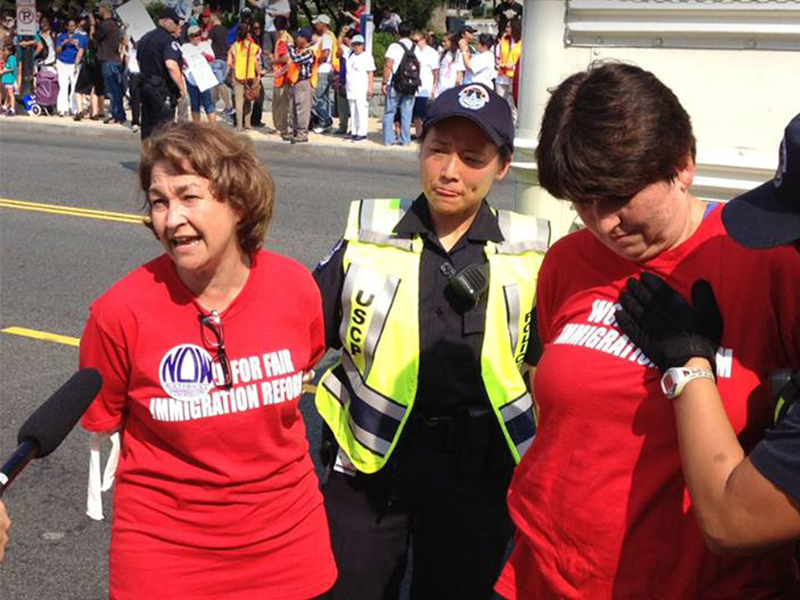
Thursday, nearly 300 people were arrested in front of the White House during a rally calling on President Barack Obama to halt mass deportations. Among them was Terry O’Neill, President of the National Organization for Women (NOW).
O’Neill was arrested during El Dia Decisivo, a civil disobedience action led by Casa de Maryland and the newly formed Casa de Virginia. She spoke to the Feminist Newswire just hours after being released from custody.
“NOW, for a very long time, has been engaged with allies in the fight for immigrant women’s rights,” O’Neill said. “NOW has long taken the position that unless you simultaneously end sexism, racism, homophobia and all the -isms that are out there, we can’t achieve true equality,” she said. As part of the We Belong Together Coalition: Women for Common Sense Immigration Reform, the group supported the Senate’s action to reform US immigration laws last year, but O’Neill said there are still “huge problems.”
“Most women who come [into the United States] come as family members of men who have visas,” she said. O’Neill called attention to the particular nest of bureaucracy facing immigrant women. “She may be a brilliant scientist, but she can’t even look for work,” O’Neill said. The employment-based visa holder can claim certain family members as dependents, but depending on the terms of the employment or family-based visa, those family members cannot seek employment in the United States. The Immigration Policy Center says family visas can “facilitate” women’s labor force participation, but they certainly do not guarantee such participation. “In the meantime, her (skills) are atrophying. She’s losing her ability to use her skills and talents while she’s waiting around for her paperwork to be processed,” O’Neill said. “We need to divert those resources from deportation to providing services.”
Advocates for comprehensive immigration reform have criticized the present Congress for its failure to prevent families from being torn apart by deportation, but O’Neill also called attention to the impact of laws that put single immigrant women at a disadvantage. “Look, not every married couple that comes into this country is going to stay married,” she told the Newswire, adding that individuals who depend on their spouse’s visa face the greatest vulnerability if and when the relationship changes. “Where’s she going to get her economic security? If the relationship is or becomes violent, the woman is extremely vulnerable.”
Advocates fought to expand the number of “U Visas” available to victims of crimes like trafficking or domestic violence, but O’Neill said there still aren’t enough. The aggressive coordination of local law enforcement with US Immigration and Customs Enforcement (ICE) officers also discourages immigrant women from coming forward if they are subjected to violence.
“If (victims of a crime) live in a community that’s largely undocumented, women will be hesitant to bring it to the authorities,” O’Neill said. “Because of the way ICE behaves, because of their insistence on scooping up large numbers of people because their only crime is that their papers aren’t in order – as long as ICE is behaving that way, that makes it harder for immigrant women to come forward.” O’Neill said this is true with or without legal status.
According to Wednesday’s Washington Post, the White House announced plans to take executive action on immigration in the coming weeks. “We want President Obama to go big,” O’Neill said. “He said he’s going to do something. We want him to do a lot. Stop all of the mass deportation. Stop separating those families.”
Media Resources: Feminist Newswire 6/10/13; American Immigration Council; Washington Post 8/27/14
Last Thursday, California Governor Jerry Brown (D) signed into law a bill that would take military sexual assault cases out of military purview and instead assign them to civilian prosecutors in the state. The law also now requires the California Military Department to report annually to the state government on sexual assault incidences and prevention plans.
Prior to the passage of SB 1422, all investigation and prosecution of military sexual assault cases was done within the military chain of command and by military lawyers. Under the new legislation, only cases in which a civilian prosecutor refuses to see a case would involve military personnel.
Last year, the Pentagon released a report that revealed epidemic levels of sexual assault in the military, as well as a culture of silence in which victims rarely came forward to report the crimes. Although 26,000 men and women were sexually assaulted in the military in 2012 alone, the report found that just 3,374 cases were reported. This year, the Pentagon identified a 50 percent increase in reported cases, but only 10 percent went to trial. Advocates have urged military sexual assault cases be prosecuted outside of the chain-of-command to reduce retaliation against victims and increase reporting.
“Sexual assault is a serious problem throughout our military,” California State Senator Alex Padilla (D-Pacoima) said in a statement. “While Washington debates how to address this crisis, California can lead by example. Victims of sexual assault deserve our support and a respectful and effective justice system.”
The Illinois Family Planning Action Plan would increase the amount of money set aside for health care organizations providing reproductive health care. It would double Medicaid reimbursement rates for vasectomies and IUDs (intrauterine devices). The plan also includes an accommodation for religiously-affiliated providers who may object to providing contraceptives. Under the proposal, patients not covered by their employer and receiving Medicaid will be referred to providers that offer contraceptive care.
Julie Hamos, the director of the state Department of Healthcare and Family Services, said the Supreme Court’s Hobby Lobby decision had a direct impact on the new proposal. Hamos said the Supreme Court ruling was of “extreme concern” to Governor Pat Quinn. Of the 3 million Illinois residents enrolled in Medicaid, a third are women of childbearing age. Unplanned pregnancies are a major expense for that population, which, Hamos said, is expected to grow under the Affordable Care Act.
A recent report concluded that the US military has the resources it needs to allow transgender personnel to serve openly. Unfortunately, military policies don’t allow them to do so.
The study, conducted by Palm Center, found that 15,000 transgender personnel currently serve in US armed forces, although standards dictate that they don’t do so openly. Researchers found that it is feasible for the US military to form and implement a more inclusive policy for transgender personnel, therefore joining 18 countries around the world that allow transgender individuals to openly serve. The report also recommended that transition-related surgery “be regarded no differently from any other surgery.”
“The decision to allow transgender personnel to serve in the military reflects the core values and principles that all military personnel should serve with honor and integrity,” the survey concluded, “and the military should not needlessly separate personnel who are willing and able to serve.”
US military policy currently classifies identifying as transgender as a psychological disorder, and standards require that anyone who has had transition-related surgery be rejected for service. The language the military currently has in its Standards of Medical Fitness excluding trans-identified folks was possibly based on an old version of the Diagnostic and Statistical Manual of Mental Disorders (DSM) that said transgender people experience a “gender identity disorder.” However, the most recent DSM classifies this as “gender dysphoria” and suggests that the condition is not be pathological.
“This is a little different than ‘Don’t Ask, Don’t Tell,” Aaron Belkin, founder and director of the Palm Center, said. “With ‘Don’t Ask, Don’t Tell’ [a former US policy that banned openly LGBT personnel that also prohibited discrimination against closeted LGBT personnel], you could really just get rid of the ban, and it was fine. With transgender inclusion, you don’t want to just get rid of the ban and do nothing. There are a few steps, but those steps aren’t difficult.”
Media Resources: Al-Jazeera America 8/26/2014; Palm Center 8/2014; The Huffington Post 6/4/2013; DSM-5; US Army Regulation
Senator Barbara Boxer (D-CA) urged California universities to create independent sexual assault victim’s advocates on their campuses in a letter sent out on Tuesday.
“As our students return to campus, they are counting on their universities to not only educate them, but also to protect them,” Senator Boxer wrote in the letter to university presidents and leaders. “Yet, as you know too well, campus sexual assault has reached epidemic levels in our country, and I am writing to ask you to create an independent victim’s advocate on your campuses.”
Boxer is urging the schools to voluntarily implement the provisions of the Survivor Outreach and Support Campus Act (SOS Campus Act), which she introduced with Congresswoman Susan Davis (D-San Diego) last month. If passed, the act will require federally-funded institutions of higher education to create an independent campus advocate who will work on prevention and response of campus sexual assault. Specifically, the advocate would conduct public information campaigns about sexual assault on campus as well as ensure survivors have access to medical care and forensic exams, crisis intervention and counseling, guidance on reporting assaults and information on their legal rights.
Media Resources: Press Release of US Senator Barbara Boxer 7/30/14, 8/26/14; The Hill 8/27/14; Feminist Newswire 4/29/14, 8/4/14; Feminist Majority Foundation
SB1135 bans the practice of sterilization with a few exceptions, including if the person’s life is in danger or sterilization is medically necessary to treat a diagnosed condition. Jails and prisons will also be required to publish data about the procedures online, with the information broken down by race, age, and justification for the procedure.
The bill was introduced after an investigation by the Center for Investigative Reporting (CIR) found around 150 women may have been illegally sterilized without state approval between 2006 and 2010. Many women had been intensely pressured by prison doctors, and some were sterilized without the proper approval and documentation from the state. California has a history of forced sterilizations, with tens of thousands of sterilizations taking place in the 20th century of people deemed “unfit” to have children, and legislators have made several attempts to restrict the practice. The current bill aims to fill some of the gaps left by previous legislation restricting it.
“It’s clear that we need to do more to make sure that forced or coerced sterilizations never again occur in our jails and prisons,” Sen. Hannah-Beth Jackson (D-Santa Barbara), the author of the bill, said in a statement. “Pressuring a vulnerable population into making permanent reproductive choices without informed consent violates our most basic rights.”
The bill now awaits Governor Jerry Brown’s signature. If he does not sign it within 12 days, it will go into effect by default.
Media Resources: The Center for Investigative Reporting 8/19/14; RH Reality Check 8/22/14; California Legislative Information 2/20/14; Feminist Majority Foundation Blog 7/1/14
A recent report by the Girl Scouts Research Institute shows that the Midwest, Northeast, and Mid-Atlantic are the best regions of the United States to raise girls, while the South – specifically Mississippi, Arkansas, and Georgia – is the worst.
The findings were based on 23 indicators of education, extracurricular activities, emotional health, physical health, safety and economic well-being. States that offer preschool education and have low high school dropout rates are consistently ranked higher in terms of best places to raise young girls, with New Hampshire at the top. The Girl Scout Research Institute conducted the survey in response to changing demographics within the Girl Scouts of the USA.
“Our aim is to inspire a national dialogue about the challenges girls are facing in communities throughout America,” said Anna Maria Chavez, the CEO of the Girl Scouts. “Only once we know where girls are succeeding and where our society needs to do more to support them can we help girls reach their maximum potential.”
The higher rate of low-income children in the southern and western US play a large part in their lower ratings. A 2013 report by the Southern Education Foundation found that a majority of public school students throughout the Southern and Western United States are low-income. Mark Mather, lead researcher of the report and a demographer at the Population Reference Bureau, told Al Jazeera America that the difference between region rankings can also largely be attributed to the intersections between poverty and education. “[The report] tells the story of the importance of education for girls,” Maher said.
“Girls are thriving in some areas, but there are portions of our population really left behind,” Kamla Modi, senior researcher with the Girl Scout Research Institute and a co-author of the report, told AlJazeera. “It’s the first we’ve really seen how different the data is geographically. There are real issues girls are facing in the South.”
Media Resources: Al Jazeera America, 8/26/14; Population Reference Bureau; Girl Scouts of the United States of America; Feminist Newswire 10/17/13
Tthe White House released new health insurance rules Friday for nonprofit organizations and for-profit businesses to comply with the Supreme Court’s ruling in Burwell v. Hobby Lobby earlier this summer.
According to Lyle Denniston at SCOTUSBlog, the new rules seem to achieve two purposes: “to keep the mandate under the Affordable Care Act (ACA) within the new limits required by the Court’s decision, and “to make sure that women who work for employers who object to the mandate for religious reasons would continue to have access to that coverage.”
A fact sheet summarizing the new rules reiterated the health benefits of expanded preventive care, including contraceptive access. “The [Independent Institute of Medicine] recommended covering all FDA-approved contraceptive services for women with child-bearing capacity, as prescribed by a provider, because there are tremendous health benefits for women that come from using contraception.”
The Supreme Court’s decision in Hobby Lobby held that closely-held corporations, like Hobby Lobby Stores, Inc., could claim a religious exemption from the ACA mandate under the Religious Freedom Restoration Act and skip paying the cost of some forms of birth control believed to be in violation of the company’s religious beliefs. The decision meant such businesses were eligible for the accommodation put in place by the White House for religious institutions, but immediately following Hobby Lobby, the accommodation form itself was challenged by Wheaton College.
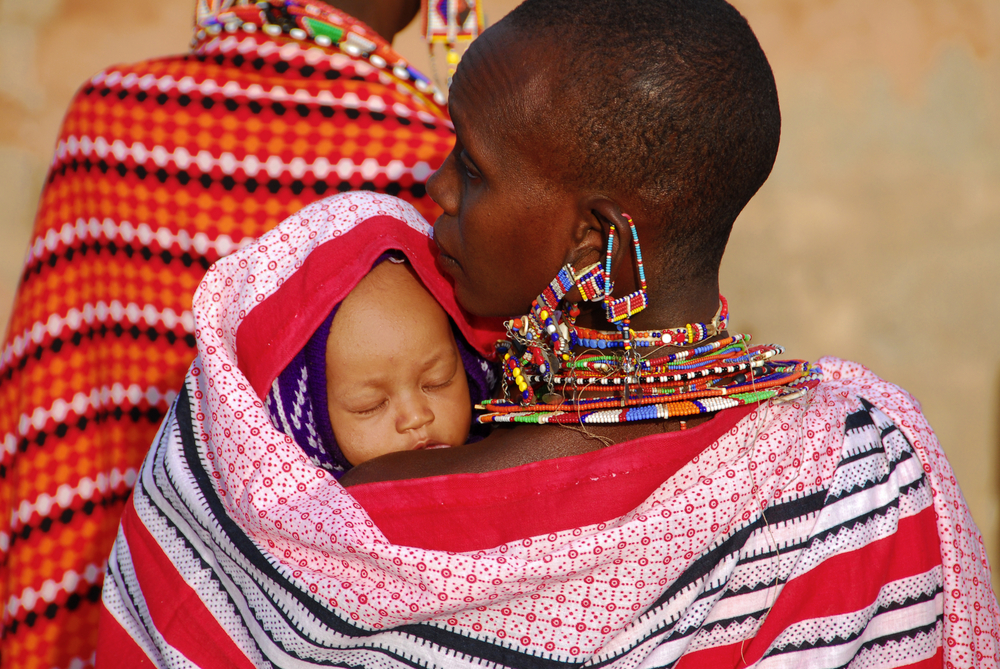
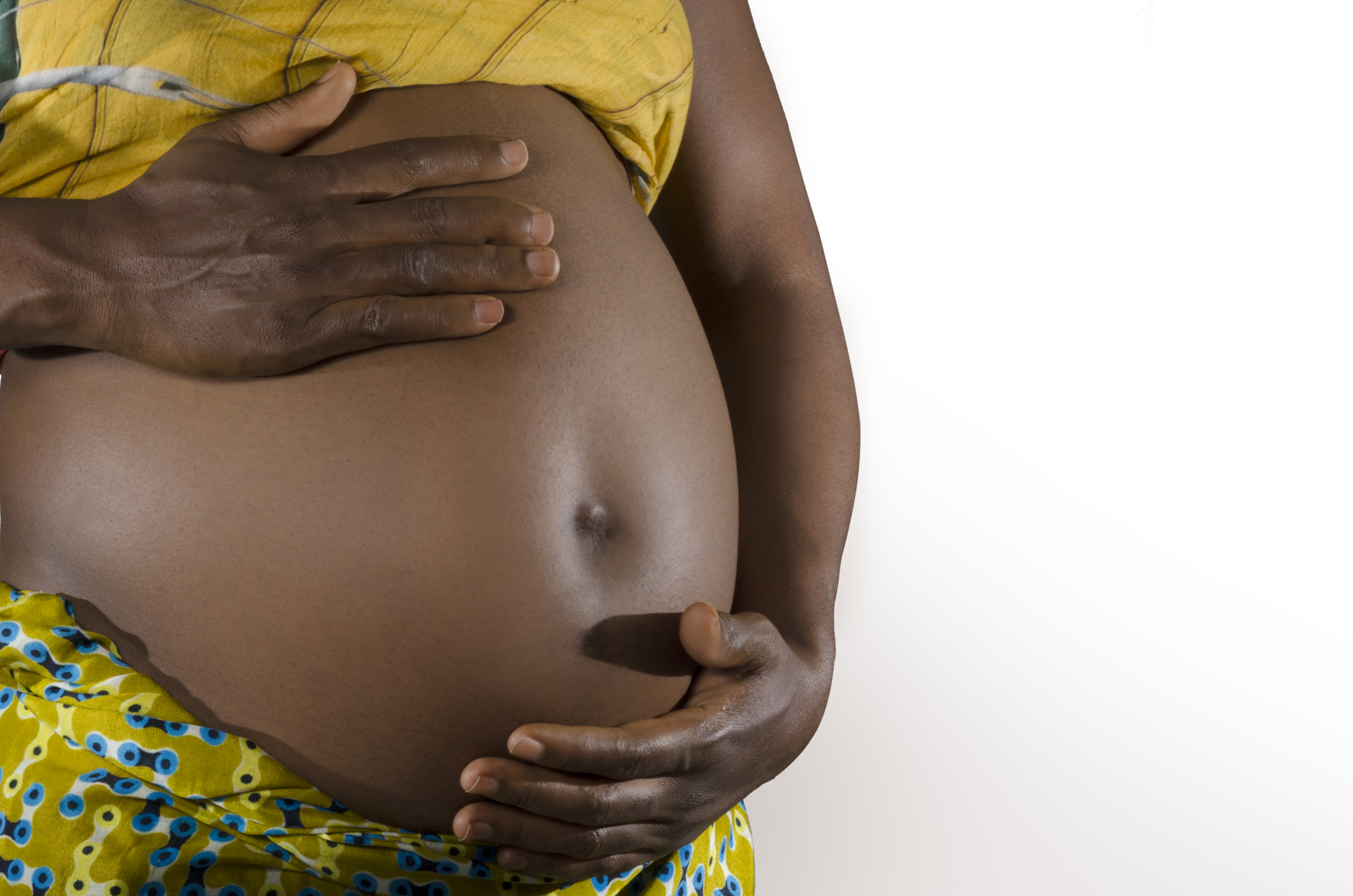
Africa’s population will reach four billion by 2100, according to a report released by UNICEF early this week. As the population grows, more investment in maternal health and family planning resources will be needed to ensure women’s reproductive health.
The authors of the report, titled Generation 2030 Africa, predict 1.8 billion births will occur in Africa over the next 35 years. By 2050, children born in Africa will make up 40 percent of children under 18 worldwide, and the number of women of reproductive age will double in the next 35 years.
Although fertility rates have fallen in Africa, an average of 5.2 children are still born to each African woman, far outpacing the rates for other regions. This high rate may be partially attributed to lack of access to family planning resources. In Cameroon, close to two-thirds of women have an unmet need for contraception. They cite several reasons for not using contraception, including the lack of adequately trained health care providers, frequent unavailability of contraceptive supplies, and limited choice of methods. In Nigeria, the Nigerian Democratic Health Survey found that only 9.8 percent of Nigerian women use family planning, while 16.1 percent have an unmet need for family planning services. Additionally, Africa has a high child mortality rate, with one out of every 11 African child dying by age five.
“We want to see African leaders… make the correct and right investments in children that are needed to build a skilled, dynamic African labor force that’s productive and can grow, and can add value to the economy,” said lead author David Anthony in an interview with NPR.
At the recent 2014 US-Africa White House Leaders Summit, President Obama and other speakers also emphasized the need to address the status of women and girls across the African continent. In addition to public and private commitments of up to $33 billion for trade and investment, the United States called on leaders of the African continent to make a considerable investment in advancing the status of women and girls, which would potentially help reduce the maternal mortality and population growth rate.
Media Resources: NPR 8/13/14; UNICEF 8/11/14; Daily Times Nigeria 7/31/14; Feminist Newswire 10/31/11, 8/7/14, 8/8/14; Feminist Majority Foundation
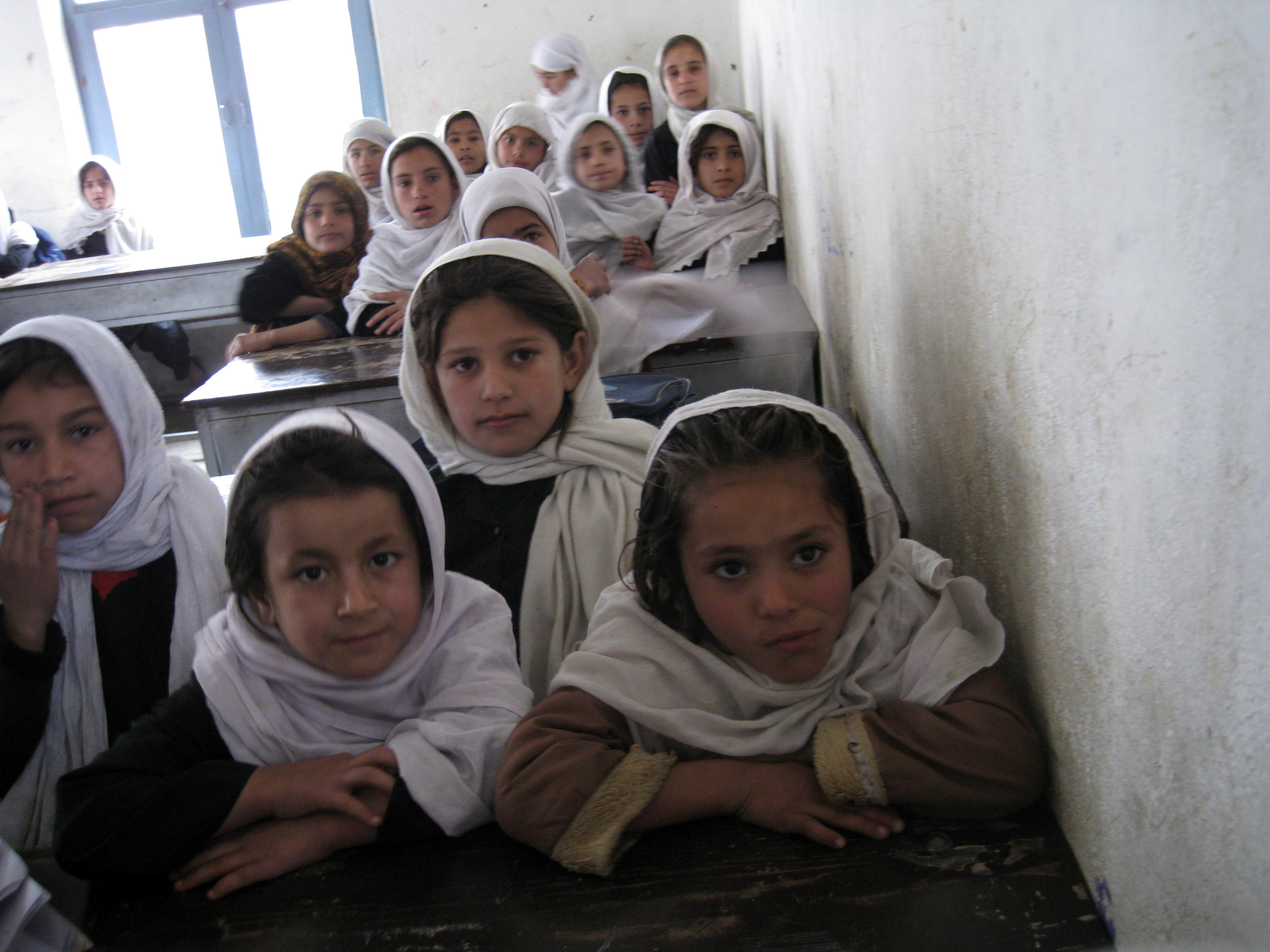
Since the fall of the Taliban, women and girls in Afghanistan have seen unprecedented access to educational opportunities thanks to the work of activists in Afghanistan and abroad and the support of the US government. “Thirteen years back – during the dark era of the Taliban – it was merely a dream for Shora Qadiri and other girls to go to school,” Feminist Majority Foundation Global Issues Associate Fatema Syed wrote on the FMF blog in May. “But now, after the collapse of the Taliban regime and with the help of the international community, Afghan girls are once again attending school, at the primary secondary, and university levels, and they are proving that if given opportunities, they can thrive.”
USAID has already contributed $1.1 billion to the improvement of Afghanistan’s education. In July, the agency announced “Promote,” a five-year program seeking to educate, promote, and train women between 18 and 30 in the region. Previously, the agency launched a program aimed at increasing literacy for Afghan women and girls called Afghanistan Reads that established community libraries and opened up literacy classes for 840 women.
Two Catholic universities in California will no longer be allowed to exclude abortion coverage from their health insurance plans, according to a decision from the state;s Department of Managed Health Care.
The state of California had previously decided to allow the insurance companies for Loyola Marymount and Santa Clara universities to deny abortion coverage, except in cases where it was needed to save a woman’s life or health. On Friday, Governor Jerry Brown’s Department of Managed Health Care reversed the decision, citing a 1975 state law requiring group health plans to cover all basic services, and sent letters to the insurance companies to inform them of the change.
“Abortion is a basic health care service,” said the department’s director, Michelle Rouillard, in the letter. “The California Constitution prohibits health plans from discriminating against women who choose to terminate a pregnancy. Thus, all health plans must treat maternity services and legal abortion neutrally.”
The universities employ around 1,000 people each. Faculty groups at both universities protested the exclusion of abortion coverage.
Other religious colleges have tried to cut abortion and contraceptive coverage as well by challenging the contraceptive coverage mandate of the Affordable Care Act (ACA), which requires health insurance providers to cover preventive health services – including all FDA-approved contraceptives, such as the pill, emergency contraceptives, and IUDs – without charging co-pays, deductibles, or co-insurance. In July, a majority of the US Supreme Court granted a temporary emergency injunction to Wheaton College, a Christian college in Illinois, ruling that the school does not have to comply with the ACA contraceptive coverage benefit.
Media Resources: SF Gate 8/22/14; Inside Higher Ed 8/25/14; Department of Managed Health Care 8/22/14; ACLU of Northern California 8/22/14; Feminist Newswire 7/7/14
Friday, the Center for Reproductive Rights joined a federal lawsuit challenging a Louisiana TRAP (Targeted Regulation of Abortion Providers) law set to take effect September 1.
“Although all of Clinic Plaintiff’s physicians who do not have admitting privileges have applied for such privileges at a local hospital, there is not enough time for the hospitals to consider and decide the submitted applications before the Act takes effect,” the complaint reads. “The process of applying for privileges and receiving a decision from a hospital on such an application can and generally does take months.”
HB 388 will effectively close any clinics located in rural areas or other neighborhoods without a hospital located within 30 mile, and also instated a 24-hour waiting period on surgical abortions. The law was modeled after a similar law in Texas which has decimated clinic access across the state.
Nancy Northrup, president and CEO of the Center for Reproductive Rights, reiterated widely shared frustration about the function of the law in a statement released Friday. “Leading national medical associations oppose admitting privileges requirements and federal courts nationwide have blocked them, recognizing them as the underhanded attempts to ban abortion that they really are,” Northrup said. “Louisiana is the latest state to advance the unconstitutional objective of denying women safe, legal abortion care under the phony pretext of protecting their health.”
Attorneys for Hope Medical Group for Women, Causeway Medical Clinic, and Bossier City Medical Suite are named as plaintiffs in the suit. If the law goes forward, the Center for Reproductive Rights said three of the five clinics in the state would be forced to stop providing abortion services or close altogether.
Media Resources: Times Picayune Newspaper 6/12/14; US District Court for the Middle District of Louisiana 8/22/14/; Center for Reproductive Rights 8/22/14; RH Reality Check 8/22/14; Feminist Newswire 5/22/14, 11/1/13
The Moral Mondays movement, which consists of weekly protests in North Carolina against the state legislature’s far-right policies, has announced a Moral Week of Action from August 22 to 28 that will take place in 11 additional states. Now, faith, labor, and social justice activists in Alabama, Arkansas, Florida, Georgia, Indiana, Mississippi, New York, Ohio, Pennsylvania, Tennessee, and Wisconsin will be holding protests of their own.
During the Moral Week of Action, protests will take place every day outside the North Carolina state capitol in Raleigh. Each day, those protest center on a different issue. Today was “Youth Moral Monday,” and on August 26, the activists will focus on women’s rights to commemorate Women’s Equality Day. On Thursday, August 28, voting rights will take the stage to coincide with the 51st anniversary of the March on Washington. Other participating states are holding daily rallies, and some are also hosting larger one-day events throughout the week.
The US Supreme Court granted a request Wednesday to stay a decision by the US Court of Appeals for the Fourth Circuit overturning Virginia’s marriage equality ban. The appeals court decision – finding the ban unconstitutional – would have allowed same-sex couples to start getting married this week in Virginia.
The Supreme Court’s decision means that Virginia is also not required to recognize same-sex marriages performed out-of-state.
Lambda Legal, which filed one of the lawsuits that led to the Fourth Circuit decision, vowed to “do everything in our power to make sure this issue is decided as quickly as possible” by the US Supreme Court. The Supreme Court issued a similar stay on same-sex marriages in Utah last January.
Same-sex couples currently have the right to marry in 19 states and in Washington, D.C., and there are lawsuits on the matter pending in all remaining states. Virginia’s attorney general, Mark R. Herring, refuses to defend the state’s same-sex marriage ban and is pushing to have the Supreme Court review the case.
In a news conference in Richmond, Virginia, when the Fourth Circuit decision was announced, Herring said, “Sometimes battles have been fought in the legislature, sometimes in the courtroom, sometimes even in the streets, but inevitably no effort to restrict the rights or limit the opportunities of our fellow Americans has ever succeeded in the long term.”
The Fourth Circuit includes North Carolina, South Carolina and West Virginia.
Media Resources: The New York Times 8/20/2014; Equality Virginia Press Release 8/20/14; Lambda Legal Press Release 8/20/14; Feminist Newswire 7/30/2014;
The Greater Cincinnati, Ohio area will lose one of its abortion providers today when the Lebanon Road Surgery Center closes its doors. The clinic closure is another loss for Ohio women whose access to comprehensive reproductive care has been limited by a 2013 TRAP law.
The Lebanon Road Surgery Center in Sharonville, Ohio once provided 2,000 abortions a year. When it is forced to shut down today, it will leave just two clinics in southwest Ohio and a total of nine clinics in the entire state.
The two remaining clinics in southwest Ohio are also in jeopardy. Both clinics applied to the Ohio Department of Health more than a year ago for the same variance that was denied Lebanon Road. The clinics are still awaiting a decision.
Under Kasich’s Administration, there have been four clinic closures, more than any other governor in the last 14 years, according to the Dayton Daily News. Kasich has also cut $2 million in family planning funds from Planned Parenthood and redirected those funds to misleading crisis pregnancy centers (CPCs).
“Gov. (John) Kasich ran and won by promising jobs,” Feminist Majority President Eleanor Smeal said. “Once he got elected, he didn’t talk about jobs. He talked about controlling a woman’s uterus.”
Media Resources: Dayton Daily News 8/21/14;New York Times 8/20/14; Feminist Newswire 7/1/13; Feminist Majority Foundation Press Release 10/2/13;
In the study by Dr. Christin Munsch, an assistant professor of sociology at Furman University in South Carolina, a sample of 646 people between the ages of 18 and 65 living in the United States were asked to read a transcript of a fabricated conversation between an employee and human resources person. During the conversation, the employee either requested flexible work hours or to work from home a few days per week or did not make a request. Participants were then asked how likely they would be to grant the request and to evaluate the employees on their likeability, commitment, dependability, and dedication.
About 70 percent of the participants who read a transcript with a male employee said they would be “likely” or “very likely” to approve his request when it was for child care reasons, compared to only 56.7 percent of those who read the same transcript with a female employee. About 24 percent found the man to be “extremely likeable” compared to only three percent who found the woman “extremely likeable.” Interestingly, only 2.7 percent found the man to be “not at all” or “not very committed,” while 15.5 percent found the woman to be “not at all” or “not very committed.”
“These results demonstrate how cultural notions of parenting influence perceptions of people who request flexible work,” explained Dr. Munsch. “Today, we think of women’s responsibilities as including paid labor and domestic obligations, but we still regard breadwinning as men’s primary responsibility and we feel grateful if men contribute in the realm of childcare or to other household tasks.”
Whereas men are rewarded at work for trying to help out at home, women continue to be penalized. The reason? Entrenched gender stereotypes. People continue to believe that men will meet their obligations at work – because they are men. In other words, according to Dr. Munsch, “We think, ‘What a great guy.’”
“For a mother, we think there’s no way she can work at home effectively. This goes back to our expectation that motherhood is intensive and that being a mother should be a woman’s number one priority,” Munsch told the Washington Post. “So if she’s working flexibly at home, we expect that she’ll be putting puzzles together with her kids or taking them to the park. We think, ‘How could she possibly get her work done?’ But with a man, we think he’ll just plop his kids in front of the TV and get the job done.”
Dr. Munsch’s study suggests that flexible work schedules – on their own – are not enough to counter gender inequality in the workplace. Without oversight into how these policies are implemented, they may serve to promote gender inequity.
Media Resources: American Sociological Association Press Release 8/18/14; Washington Post 8/18/14; Mashable 8/19/14
A joint study by three major women’s health advocacy groups calls attention to the overwhelming disparity in health outcomes for women of color in the United States. The results of the study are now under the consideration of the United Nations.
The Center for Reproductive Rights, SisterSong Women of Color Reproductive Justice Collective, and the National Institute for Reproductive Health (NLIRH) released the report last week during the UN Committee on the Elimination of Racial Discrimination’s (CERD Committee) review of the United States in Geneva, Switzerland. The study found that African-American women are four times as likely to die in childbirth as their white counterparts. The data reflect that the problem is particularly astute in the US south. Citing the World Health Organization, the groups said the maternal mortality in the United States actually increased in the period between 1990 and 2013, doubling the mortality rate in Saudi Arabia, and tripling the United Kingdom.
Women without US citizenship were also three times less likely to have private or public health insurance, resulting in minimal to no access to comprehensive reproductive health care. The Affordable Care Act (ACA) preserved a 1996 restriction requiring non-citizens to wait five years before enrolling in Medicaid, with many still barred after obtaining lawful status. The study reported that even private exchanges are off-limits to undocumented persons under the ACA. The organizations detailed how racial discrimination at the level of policy and implementation undermine women of color and migrant women’s fundamental human right to health.
The groups applauded the passage of the ACA and the domestic movement to expand Medicaid as steps in the right direction, but noted the strong political resistance even to these policy efforts.
“For too long, these women, their families, and their communities have been shut out of this country’s health care system,” said Angela Hooton, the state policy and advocacy director at the Center for Reproductive Rights. “A woman’s race or immigration status should never determine whether she will survive childbirth or access critical cancer treatments,” Hooton continued. “The United Nations must hold the US government accountable for these grave injustices.”
The UN CERD Committee is an independent body of experts that monitors participating countries’ implementation of the Convention on the Elimination of All Forms of Racial Discrimination. In 2008, the committee “expressed concern about persistent disparities in sexual and reproductive health” and called on the US to “increase efforts to expand health insurance coverage, facilitate access to maternal health care and family planning, and improve sexuality education and information.”
Media Resources: Center for Reproductive Rights 8/13/14; Office of the United Nations High Commissioner for Human Rights 2014
Provisions of the law include possible imprisonment of HIV-positive individuals, a ten-year prison sentence and fine for the “intentional transmission of HIV,” a five-year prison sentence for “attempted transmission of HIV,” and compulsory testing in some situations. The law also allows courts to order the release a person’s HIV status without that person’s consent. The signing comes not long after the Ugandan Constitutional Court struck down the country’s Anti-Homosexuality Act, a law that many believed would steer LGBT people away from getting necessary health services.
The new law was denounced earlier this year by the United States – the biggest funder of Ugandan HIV/AIDS programs. After the Ugandan Parliament voted in favor of the legislation, but before Museveni signed the bill into law, US Global AIDS coordinator Dr. Deborah Birx called on Uganda to reject criminalization of HIV transmission.
“Over the past 30 years, we have witnessed time and again how stigma, discrimination, and fear – and the misguided policies that stem from them – further fuel the epidemic by deterring those most in need from accessing lifesaving HIV prevention, treatment, and care services,” said Dr. Birx. “I join with the many health practitioners, HIV/AIDS and human rights activists, multilateral institutions, and individuals everywhere – in Uganda and around the world – in calling for the people and the Government of Uganda to reject this regressive bill.”
The stigma against those with HIV/AIDS is not limited to Uganda. HIV transmission is criminalized in many US states, too, where there have been 200 prosecutions against people on charges related to HIV transmission. And too often, HIV transmission is not fully understood. This ignorance was apparent in Texas, for example, where a man with HIV was sentenced to 35 years for spitting at a police officer – even though the Centers for Disease Control and Prevention maintain that “contact with saliva, tears or sweat has never been shown to result in transmission of HIV.”
The Center for HIV Law and Policy says, “Many people with HIV internalize and accept this judgment and the perception of those with HIV as toxic, highly infectious, or dangerous to be around. This has serious adverse ramifications for those individuals, as well as on the broader effort to combat HIV.”
Media Resources: Buzzfeed 8/19/2014, 8/1/2014; Feminist Newswire 8/1/14; PEPFAR 4/14/2014; The Center for HIV Law and Policy 4/20/2014; The New York Times 4/16/2008
The current outbreak of Ebola has killed more than 1200 people in West Africa, with Liberia having the largest increase in deaths according to the latest reportable data. Although the death toll from the virus itself is astounding, many people – including pregnant mothers – are also dying as hospitals and clinics shut their doors.
Liberia was already a country with one of the highest rates of maternal death worldwide, but the Ebola outbreak has intensified the maternal health crisis. According to reports, some health care practitioners are turning away patients for fear of spreading the virus or contracting it themselves. The interruption of health care delivery can be especially dangerous for pregnant women. One clinic in the capital of Monrovia used to see 10 to 15 births per week; now, it only sees one or two per week – and some pregnant women leave the clinic before they even give birth because of fear of contracting Ebola from others.
“The World Health Organization, the international community in general, and nongovernmental organisations must rapidly scale-up their response and send in more teams,” Joanne Liu, international president of Doctors Without Borders, said in a statement. “It is urgent that management and coordination are improved, but also that strategies are implemented to reach all affected areas and to help improve general access to healthcare in areas where the system has collapsed.”
Media Resources: Buzzfeed 8/18/2014; Médecins Sans Frontières (Doctors Without Borders) 8/15/14; New York Times 8/19/14