Ninth Circuit Blocks Arizona Restrictions on Medication Abortion

In a victory for Arizona women, the US Court of Appeals for the Ninth Circuit has blocked the state’s restrictions on medication abortion.

via Shutterstock
via Shutterstock

The Ninth Circuit issued a temporary injunction late Tuesday preventing Arizona from enforcing new regulations which would have prevented access to medication abortion after seven weeks and forced doctors to use an outdated protocol for administering the medication.

“The appeals court has recognized that Arizona women should not be denied access to critical reproductive care while yet another clearly unconstitutional attack on their health and rights makes it way through the courts,” said David Brown, a staff attorney at the Center for Reproductive Rights, which is challenging the law with Planned Parenthood Federation of America on behalf of Planned Parenthood of Arizona and the Tucson Women’s Center.

The two clinics filed their legal challenge after the Arizona Department of Health Services issued regulations implementing the medication abortion restrictions that Arizona Governor Jan Brewer signed into law in 2012. A federal district court, however, refused to block enforcement of the regulations pending the final outcome of the case, meaning that the restrictions would have taken effect on April 1. The clinics filed an emergency appeal of that decision to the Ninth Circuit. The appeals court ruling will remain in effect until the final outcome of the case.

Media Resources: Center for Reproductive Rights Press Release 4/9/14; RH Reality Check 4/9/14, 3/5/14; Feminist Newswire 4/1/14

Senate Republicans Filibuster Paycheck Fairness Act

The Senate blocked efforts to advance the Paycheck Fairness Act (PFA) by a 54-43 vote today along strict party lines, with Republicans and moderates – including Senator Susan Collins (R-ME) and Lisa Murkowski (R-AK) – voting no. Senator Reid, the Democratic Majority Leader, switched his vote to no so he could bring the bill to the floor in the future for an additional attempt to pass.

via Shutterstock
via Shutterstock

Immediately after the procedural vote failed, Senator Barbara Mikulski (D-MD), chief sponsor of the PFA, went to the floor and vowed to continue the fight. Mikulski had delivered a passionate speech earlier imploring the Senate to “lift the veil of secrecy” on wages. She said it brings “tears to her eyes” knowing of the struggles that working women and their families experience when they try to make ends meet. Senator Patty Murray summed up the feelings of many feminists when she tweeted, “This isn’t over. We aren’t going to let GOP of the hook on #PaycheckFairness. Time for them to give women a #fairshot at #equal pay.”

“The Feminist Majority and the women’s movement will not rest until the gender wage gap is closed and women are no longer cheated on pay day,” said Eleanor Smeal, President of the Feminist Majority. “The Republicans are simply standing in the doorway blocking progress for employed women,” said Smeal.

The PFA would strengthen the Equal Pay Act of 1963 by prohibiting retaliation against employees who reveal and discuss wages with co-workers, requiring employers to provide the Equal Employment Opportunity Commission pay data by sex, race and national origin of employees, facilitating the ability to file class actions in equal pay cases, and permitting prevailing plaintiffs – women or men- to receive not only compensatory or back pay but also punitive damages. Currently, plaintiffs in race or ethnicity wage discrimination cases can win punitive damages, but this is not so for plaintiffs taking gender equal pay cases to court.

The PFA filibuster came one day after President Obama signed an executive order lifting the veil of secrecy in wages for employees of federal contractors. Under this executive order, federal contractors are prohibited from retaliating against employees “who choose to discuss their compensation.” President Obama also signed a Presidential Memorandum “instructing the Secretary of Labor to establish new regulations requiring federal contractors to submit to the Department of Labor summary data on compensation paid to their employees, including data by sex and race.” Such data will be an effective tool in ending wage discrimination against women, African Americans and Latino/as.

“Women’s rights and civil rights advocates have been fighting for these advances for over four decades. Finally, thanks to President Obama, we have a breakthrough. But we will not stop fighting until it is the law of the land for the vast majority of employers – not just federal contractors. Women deserve equal pay, and we will not stop until it is a reality and the loopholes that permit cheating women employees are closed,” continued Smeal.

Media Resources: The White House 4/8/14; Huffington Post 4/9/14; Feminist Newswire 4/4/14, 4/8/14

Protestors Fight For #Not1More Deportation Across the US

On Saturday, thousands of immigration activists gathered in over 60 cities across the United States to protest the deportation of undocumented immigrants.

via NDLON
via NDLON

The main organizer of the nationwide protests, the Not One More campaign, has expressed three concrete demands for the Obama administration: the end of deportation for undocumented workers who are not serious offenders or national security threats; the end of Secure Communities (a program which allows law enforcement to hold suspected undocumented immigrants before turning them over to the federal government); and an expansion of the Deferred Action for Childhood Arrivers program.

Not One More was joined in support by labor organizations, including the AFL-CIO, which strongly condemned the deportation of immigrants without due process and urged the administration to act on behalf of undocumented workers in the United States.

“The time is now to stop deportations,” said Cesar Vargas, co-director of the Dream Action Coalition. “Immigration reform has been stalled, and we need action now. Not in three months, not review. We need it now.”

Media Resources: Think Progress 4/5/14; Not One More Deportation; AFL-CIO 4/4/14; Huffington Post 4/4/14

Senators and President Obama Mark Equal Pay Day With Actions To Close Wage Gap

Today marks Equal Pay Day – the day women must work until to earn as much as their male counterparts had by December 31 of last year. Senators and President Obama are also marking today with actions to close the wage gap.

via Shutterstock
via Shutterstock

President Obama proclaimed that today would be recognized as National Equal Pay Day –  the day up to which a woman must work in the current year to earn what men made during the previous year – and he plans to sign two executive actions that will work to close the wage gap. An executive order would prohibit federal contractors from retaliating against employees who discuss their compensation, and a memorandum would direct the Department of Labor to establish new regulations requiring federal contractors to report summary data on compensation paid to employees by race and sex to the Department.

“Women make up nearly half of our Nation’s workforce and are primary breadwinners in 4 in 10 American households with children under age 18,” Obama said in his proclamation. “Yet from boardrooms to classrooms to factory floors, their talent and hard work are not reflected on the payroll.”

On average, women still earn only 77 cents for every dollar earned by men, and women of color make even less. Black women earn just 64 cents for every dollar earned by white men, and Latina earn only 54 cents. The pay gap costs women about $434,000 over the course of their careers – impacting the ability of women to provide for their families and care for their loved ones. The pay gap also cuts into women’s Social Security, pensions, and retirement.

“The time has passed for us to recognize that what determines success should not be our gender, but rather our talent, our drive, and the strength of our contributions,” Obama added.

In addition, the Senate is expected to bring the Paycheck Fairness Act to a vote tomorrow. The Act would close loopholes in the Equal Pay Act of 1963 to require all employers to demonstrate that any pay differences between men and women doing the same work are based on legitimate business reasons, and not based on sex. It would also end pay secrecy by prohibiting all employers – not just federal contractors – from retaliating against employees who share salary information. Senator Barbara Mikulski (D-MD) will lead several other Democratic Senate women in giving floor speeches calling for its passage.

TAKE ACTION: Tell Your Senators to Support the Paycheck Fairness Act! You can also join the Twitter storm today at 2PM EST in support of Equal Pay with @FemMajority!

Media Resources: The White House 4/7/14, 4/8/14; Senator Barbara Mikulski 4/7/14; Feminist Newswire 4/4/14, 4/7/14; Feminist Majority 4/3/14

Senate Votes to Extend Unemployment Benefits

The Senate voted 50-38 yesterday to approve a bill that would restore jobless benefits for 2.4 million Americans who have been out of work for at least six months.

via Shutterstock
via Shutterstock

The bill would fund unemployment benefits through the end of May, and retroactively provides for individuals who were eligible for aid, but ceased to receive payment when the program’s funding lapsed in December.

The bill’s fate in the House is still somewhat uncertain.  Speaker John Boehner has already expressed concern about the bill and has previously stated that the Republicans would be willing to extend unemployment benefits only if the bill included job creation provisions.  At the same time, several Senate Republicans have already signed onto the bill, and several of Boehner’s House colleagues are asking for a vote on it or a similar measure.  The Republican sponsor of the bill, Dean Heller (R-NV), has also publicly stated his intention to meet with the Speaker in order to move the bill forward.

“At long last we’re within sight of one chamber working across party lines to provide this critical relief; there’s already been too much delay, with too many families suffering unneeded hardship,” said Christine Owens, executive director of the National Employment Law Project in a statement.

Media Resources: Reuters 4/7/14; Fox News 4/8/14; CNN 4/7/14; Speaker Boehner’s Office 3/19/14

Obama Poised To Sign Two Executive Actions On Equal Pay

President Obama will sign two executive actions tomorrow to promote equal pay for women.

via Shutterstock
via Shutterstock

The President will sign an Executive Order prohibiting federal contractors from retaliating against employees who discuss their compensation.  Nearly half of all workers in the US are either expressly forbidden or strongly discouraged from discussing their pay with colleagues, according to the Institute for Women’s Policy Research. Lack of transparency about what people are paid is a major challenge to enforcing equal pay laws.

“Pay discrimination is all too prevalent across the country and millions of women and their families are paying a steep price for it,” said Fatima Goss Graves of the National Women’s Law Center. “Gag rules that require employees to keep their pay secret perpetuate this inequity. These new rules will make it harder for employers to hide pay discrimination.”

The President will also sign a Presidential Memorandum directing the Department of Labor to establish new regulations requiring federal contractors to report summary data on compensation paid to employees by race and sex to the Department. The data is expected to encourage voluntary compliance with equal pay laws while also allowing for more targeted enforcement.

These actions – to be taken on Equal Pay Day, the day up to which a woman must work in the current year to earn what men made during the previous year – come just as the US Senate is expected to vote on the Paycheck Fairness Act (S. 84), which would close loopholes in the Equal Pay Act of 1963 to require all employers to demonstrate that any pay differences between men and women doing the same work are based on legitimate business reasons, and not based on sex. In addition, the Paycheck Fairness Act would end pay secrecy by prohibiting all employers – not just federal contractors – from retaliating against employees who share salary information.

Women are the sole or primary breadwinners in 40 percent of families with children under the age of 18. But, on average, women still earn only 77 cents for every dollar earned by men, and women of color make even less. Black women earn just 64 cents for every dollar earned by white men, and Latina earn only 54 cents. The pay gap costs women about $434,000 over the course of their careers – impacting the ability of women to provide for their families and care for their loved ones. The pay gap also cuts into women’s Social Security, pensions, and retirement.

TAKE ACTION: Tell Your Senators to Support the Paycheck Fairness Act!

Media Resources: AP 4/6/14; NPR 4/6/14; National Women’s Law Center 4/6/14; Feminist Newswire 4/4/14; Feminist Majority 4/3/14


Alabama Passes Bill Further Restricting Abortion Access for Minors

Minors will soon find it harder to obtain an abortion in Alabama, after the state legislature passed a bill last week creating more rules around parental consent.

via Shutterstock
via Shutterstock

A minor’s parent is already required to sign a consent form, but HB 494 will now require parents to do so in front of the physician performing the procedure. The parent giving consent must also prove their parentage by presenting a certified copy of a child’s birth certificate. Many people do not have a certified birth certificate easily available, and they can be difficult to obtain.

In addition, a young woman under 19 years of age seeking a judicial bypass of the consent law will have to provide the court with a “substantive” reason for why she does not wish to tell her parents about her decision, demonstrate her maturity and “understanding of life,” and prove that she has received counseling about alternatives to abortion. The court must inform the Attorney General that a young woman has applied for a judicial bypass and may appoint a guardian ad litem for the fetus.

“We are disappointed with passage of the bill,” said Susan Watson, executive director of the ACLU of Alabama. “It creates a lot of unnecessary red tape and, if a young woman seeks a judicial bypass, she will still find herself being put on trial as if she is a criminal.”

Alabama’s legislature also recently passed a bill extending the waiting period for having an abortion from 24 to 48 hours on Wednesday. Governor Robert Bentley is expected to sign both bills.

Two other restrictive bills that had passed Alabama’s House of Representatives are not being taken up by the Senate. They sought to ban abortion after a fetal heartbeat is detected and require women carrying fetuses with lethal disorders to learn about perinatal hospice services – services that do not exist in the state of Alabama.

Media Resources: RH Reality Check 4/3/14, 4/4/14; Reuters 4/3/14; Alabama State Legislature 2/13/14

Senate To Vote on Equal Pay Legislation

Senate Majority Leader Harry Reid (D-NV) announced that the Senate will vote on equal pay legislation as soon as next week. The vote on the Paycheck Fairness Act (S. 84) is expected to be on Equal Pay Day – the day up to which a woman must work in the current year to earn the what men made during the previous year. This year, Equal Pay Day is Tuesday, April 8.

via Shutterstock
via Shutterstock

Kerri Sleeman, an AAUW member from Hancock, Michigan, testified in support of the law at a Senate Committee on Health, Education, Labor and Pensions (HELP) hearing on Tuesday. Sleeman worked as a design supervisor for an engineering company in Michigan for 5 years. “After being told by my employer that I couldn’t negotiate my starting salary, I learned after my company went bankrupt that men I had supervised were making much more than I was,” Sleeman said. “When I asked my former supervisor why I had been paid less, he said it was likely because those men were the sole earners for their wives and children. I was considered less worthy just because I was a woman.”

Women are the sole or primary breadwinners in 40 percent of families with children under the age of 18. But, on average, women still earn only 77 cents for every dollar earned by men, and women of color make even less. Black women earn just 64 cents for every dollar earned by white men, and Latina earn only 54 cents. The pay gap costs women about $434,000 over the course of their careers – impacting the ability of women to provide for their families and care for their loved ones. The pay gap also cuts into women’s Social Security, pensions, and retirement.

“Women earn 23 cents less for every dollar a man earns,” said Senator Barbara Mikulski (D-MD), who introduced the Paycheck Fairness Act in the Senate. “Yet, women don’t get a 23 percent discount on their student loans. They don’t get 23 percent off their first mortgage or a discount on their utility bill, just because they earn less than men. In fact, women often pay more for many of the same goods and services. Women pay more in medical costs than men: an estimated $10,000 over a lifetime. Women are often responsible for child care – an average working mom pays more for child care than tuition.”

The Paycheck Fairness Act would close loopholes in the Equal Pay Act of 1963 to require employers to demonstrate that any pay differences between men and women doing the same work are based on legitimate business reasons, and not based on sex. The Act would also end pay secrecy by prohibiting retaliation against employees who share salary information.

TAKE ACTION: Tell Your Senators to Support the Paycheck Fairness Act!

Media Resources: Politico, 4/1/14; Senator Barbara Mikulski, 4/1/14; US Senate Committee on Health, Education, Labor and Pensions

Mississippi Governor Poised To Sign 20-Week Abortion Ban

The Mississippi legislature passed a bill Tuesday that will ban abortion at 20 weeks. Governor Phil Bryant announced that he looks forward to signing it quickly.

via Shutterstock
via Shutterstock

HB 1400 bans abortion at 20 weeks after a woman’s last menstrual period, so it is effectively an 18-week abortion ban. It allows exceptions in the case of severe fetal anomaly or a serious threat to a woman’s health or life, but no exception for victims of rape or incest. The state house passed the bill 91 to 20, and the state senate passed it 41 to 10.

“Mississippi women and families don’t need more over-regulation, more restrictions, and more potential lawsuits around abortion simply because politicians are hoping to score political points at the expense of the women of our state,” Felicia Brown-Williams, Director of Public Policy for Planned Parenthood Southeast, said in a statement released after the House passed the bill in February. Mississippi currently has only one abortion clinic in the entire state, the Jackson Women’s Health Organization.

A similar ban was passed in Arizona but has been permanently blocked in courts for unconstitutionally banning abortion before a fetus is viable. Other 20-week bans are currently enforced in 9 other states, and dozens of anti-choice bills are making their way through state legislatures. Most recently, West Virginia’s governor vetoed a 20-week abortion ban.

Media Resources: RH Reality Check 4/2/14; Open States; The Times-Picayune 4/2/14; Planned Parenthood Southeast 2/13/14; Feminist Newswire 3/10/14, 4/2/14

Supreme Court Strikes Down Aggregate Campaign Contribution Caps

In a divided decision, the Supreme Court yesterday struck down campaign contribution caps, paving the way for big-money donors to contribute unlimited amounts, in the aggregate, to federal candidates and political committees.

via Shutterstock
via Shutterstock

The decision in McCutcheon v. Federal Election Commission involved only how much money an individual could contribute in the aggregate during a two-year election cycle. It did not address so-called “base limits,” or the maximum amount an individual can contribute to any one candidate or committee. Those limits remain, but now the “aggregate limits” – the amount an individual donor can give in total during the election cycle – are gone. Those limits had been $48,600 for all candidates, combined, during the two-year period, and $74,600 to political parties and committees, combined. A majority of the Court found that those limits violated the First Amendment.

Justice Breyer wrote in the dissent, joined by Justice Ginsburg, Sotomayor, and Kagan, that the Court’s decision, “eviscerates our Nation’s campaign finance laws, leaving a remnant incapable of dealing with the grave problems of democratic legitimacy that those laws were intended to resolve.”

In striking down the aggregate contribution caps, the Court, relying on Citizens United v. Federal Election Commission, found that seeking to use money – through campaign contributions – in order to gain influence and access to candidates and elected officials, is not “corruption” but is a part of free speech that is “central to our democracy.”

The dissent, however, found that Chief Justice Roberts, writing for the plurality of the Court, defined “corruption” too narrowly. “In reality,” Justice Breyer noted, “as the history of campaign finance reform shows and as our earlier cases on the subject have recognized, the anticorruption interest that drives Congress to regulate campaign contributions is a far broader, more important interest than the plurality acknowledges. It is an interest in maintaining the integrity of our public governmental institutions. And it is an interest rooted in the Constitution and in the First Amendment itself.”

In short, as Justice Breyer pointed out: “Where enough money calls the tune, the general public will not be heard.”

Media Resources: US Supreme Court 4/2/14; New York Times, 4/2/14; SCOTUS Blog, 4/2/14


today’s decision

West Virginia Governor Vetoes 20-Week Abortion Ban

In a victory for women’s health, West Virginia Governor Earl Ray Tomblin vetoed a bill last week that would have banned abortions after 20 weeks of pregnancy, calling the measure unconstitutional and a undue restriction on the physician-patient relationship.

via Shutterstock
via Shutterstock

“I have vetoed HB 4588 because I am advised, by not only attorneys from the legislature, but through my own legal team that this bill is unconstitutional,” Tomblin wrote in a statement.

“The bill is also problematic because it unduly restricts the physician-patient relationship,” he added. “All patients, particularly expectant mothers, require the best, most unfettered medical judgment and advice from their physicians regarding treatment options. The medical community has made it clear to me that the criminal penalties this bill imposes will impede that advice, and those options, to the detriment of the health and safety of expectant mothers.”

The American Congress of Obstetricians and Gynecologists (ACOG), the West Virginia State Medical Association, and the chair of obstetrics and gynecology at West Virginia University lobbied and testified against the proposed ban.

If the bill had become law, anyone who performed an abortion after 20 weeks could be fined up to $5,000 and spend 1 to 5 years in jail. It had previously passed the West Virginia Senate 25-9 and the House 85-15.

Dozens of similar restrictive bills are moving through state legislatures across the United States.

Media Resources: Office of the Governor Earl Ray Tomblin’s Press Releases 3/28/14; RH Reality Check 3/31/14; WSAZ 2/26/14; The Washington Post 3/10/14; Feminist Newswire 3/10/14

Adjunct Faculty Demand Fair Pay and Benefits

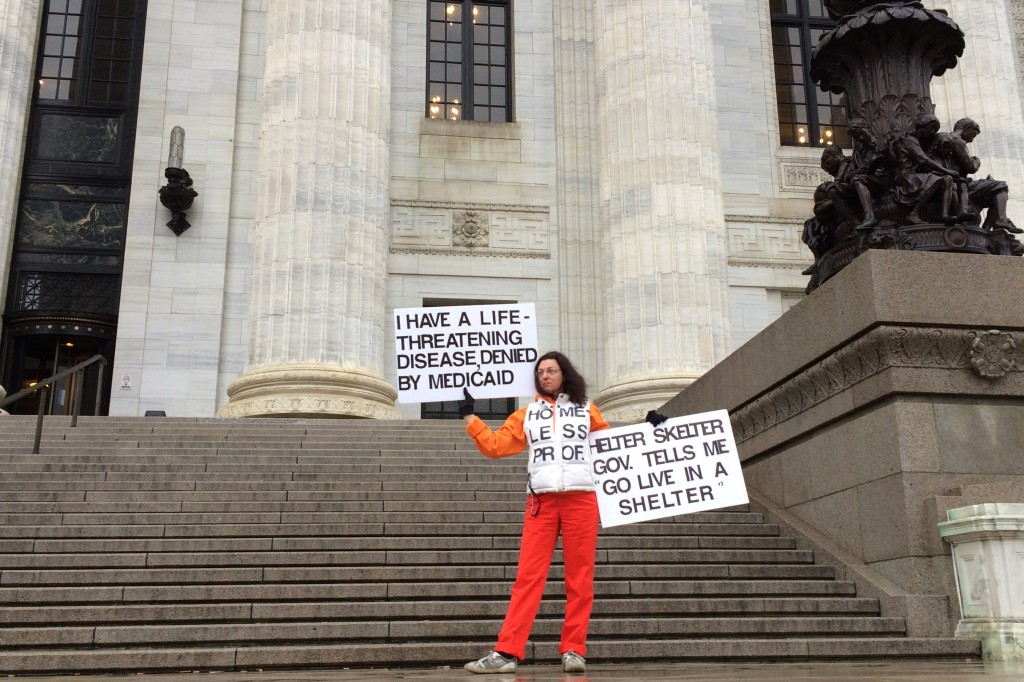
Prompted by a homeless adjunct professor’s one-woman protest outside the New York State Department of Education in Albany, adjunct professors across the nation took to Twitter over the weekend to call attention to the low-wages and exploitation of adjuncts working in higher education.

via Lee Koromvokis at PBS

Mary-Faith Cerasoli went to Albany during Spring Break to protest working conditions for adjunct college professors. Cerasoli is an adjunct  at Mercy College in New York where she teaches a full courseload, but makes only $22,000 per year before taxes. Ineligible for public assistance, Cerasoli relies on friends for shelter but is sometimes forced to live out of her car – a gift from a used-car dealer in Westchester, NY. Cerasoli has no office, no health benefits, and a sizeable debt-load thanks to unpaid student loans and medical bills. “They call us professors, but they’re paying us at poverty levels,” she said. “I just want to make a living from a skill I’ve spent 30 years developing.”

Cerasoli is not alone. Adjunct professors – the majority of whom are women – are contract employees usually paid per course taught, and the pay is low. The average adjunct is paid less than $3,000 for a typical three-credit course, but one study found that adjuncts at several colleges reported earning less than $1,000. The vast majority of adjuncts do not receive health insurance, retirement benefits, or sick leave, and many must cobble together a living, often by traveling miles to teach at multiple campuses. In terms of annual compensation, then, adjuncts earn between $18,000 and $30,000, without any benefits, for the equivalent of full-time work, compared to “tenure-track” professors who earn between $68,000 to $116,000 plus benefits.

Some adjuncts have joined labor unions at their institutions in order to organize for better pay and working conditions, but the average adjunct professor is still a source of cheap labor for many colleges. And the use of adjuncts is more widespread than ever. Adjunct professors now make up approximately half of all college faculty.

“I had this idea that I could get a job so that I could have a good income to support my son, and it didn’t work out that way,” explained Nicole Beth Wallenbrock, an adjunct professor featured on PBS NewsHour. “I’m a precarious worker. I have no job security.”

Media Resources: Minneapolis Star Tribune 3/31/14; PBS NewsHour 3/31/14, 2/6/14; New York Times, 3/27/14; The Nation 7/11/13; The Chronicle of Higher Education 1/4/13


Arizona Restrictions on Medication Abortions Take Effect Today

A federal district judge has refused to temporarily block enforcement of Arizona’s restrictions on medication abortion, meaning that as of today, women in Arizona will no longer be able to access non-surgical, medication abortion beyond seven weeks, and doctors will be forced to administer that medication according to an outdated protocol.

via Shutterstock
via Shutterstock

The decision, by US District Court Judge David Bury, is not the final ruling on the issue. The lawsuit challenging the constitutionality of the medication abortion restrictions remains ongoing. Judge Bury’s decision, however, does mean that the restrictions will go into effect pending the final outcome of the case.

Planned Parenthood and the Tucson Women’s Center, represented by the Center for Reproductive Rights, challenged the Arizona restrictions, which were passed in 2012. The restrictions require doctors to follow a protocol approved by the Food and Drug Administration (FDA) in 2000. The problem is that the FDA protocol on the use, dosage, and administration of mifepristone – the medication at issue – no longer represents the predominate medical standard of care. Instead, doctors have developed a new standard – endorsed by the American College of Obstetricians and Gynecologists – that calls for a significantly lower dosage of mifepristone, one that can be safely administered beyond seven weeks.

“With today’s disappointing ruling, Arizona women’s constitutional rights and access to safe, high-quality reproductive health care have been diminished, simply by virtue of where they live,” said David Brown, staff attorney with the Center for Reproductive Rights. “This law serves no purpose other than to prevent Arizona women from using a safe alternative to surgical abortion and force their doctors to follow an outdated, riskier, and less effective method. This is what happens when politicians, not doctors, practice medicine.”

Several states have enacted restrictions on medication abortion, and court decisions on their legality have been mixed. The Fifth Circuit Court of Appeals last week upheld Texas’s medication restrictions, but restrictions in North Dakota and Oklahoma have been found unconstitutional and overturned. The US Supreme Court has so far stayed out the the debate, refusing to hear an appeal of the Oklahoma Supreme Court decision this term.

Media Resouces: Arizona Capitol Times, 3/31/14; Center for Reproductive Rights, 3/31/14; New York Times, 3/31/14; Feminist Newswire, 11/4/13, 4/19/13, 12/5/12

More than 7 Million People Enrolled in Healthcare Through Affordable Care Act

More than 7 million people have enrolled in private health insurance plans through the Affordable Care Act (ACA), also known as Obamacare.

txking via Shutterstock

The White House met its original goal of enrolling 7 million people by March 31 through new federal and state marketplaces created by the landmark legislation. Despite false advertising about the ACA, numerous Republican attempts to dismantle the law, and problems with the rollout of the Healthcare.gov site, millions of Americans will now access quality, affordable health insurance.

In addition, the White House will offer some relief to those individuals who began the process of enrolling online, but could not finish by the March 31 deadline. In these cases, the deadline will be temporarily extended. In order to qualify for this extension, individuals must indicate on Healthcare.gov that they attempted to enroll before March 31. Special enrollment periods will also continue to be available to accommodate families with new babies or to enroll people who become unemployed and lose their health insurance.

Media Resources: Washington Post 4/1/14, 3/25/14


Federal Court Upholds Texas Law Restricting Abortion Access

The Fifth Circuit Court of Appeals last week upheld a provision of a Texas law that requires abortion providers to have admitting privileges at local hospitals. The requirement is part of HB 2, which passed last summer and has already led to the closure of several Texas abortion clinics since it went into effect. The appeals court decision means that even more clinics are expected to close in the state.

via Shutterstock
via Shutterstock

“The legislators lied when they said this law wouldn’t close clinics,” explained Amy Hagstrom Miller, CEO of Whole Woman’s Health, to RH Reality Check. “This law has closed clinics. This law has denied women access to safe care. This law is now and will in the future do great damage to the health-care infrastructure in the State of Texas.”

Texas’s anti-abortion law passed last summer in a special legislative session called by Texas Governor Rick Perry (R) after Texas State Senator Wendy Davis (D) successfully led a filibuster of the bill for 12 hours.  In addition to the admitting privileges requirement, the law also bans abortion at 20 weeks, restricts medication abortion, and mandates that facilities where abortion is performed meet the same standards as ambulatory surgical centers.

Planned Parenthood Federation of America, the American Civil Liberties Union, and the Center for Reproductive Rights filed a lawsuit on behalf of several clinics and their patients, challenging the admitting privileges requirement as well as the law’s restrictions on medication abortion.  In October, federal district judge Lee Yeakel ruled that the admitting privileges requirement was unconstitutional. The Fifth Circuit almost immediately stayed Judge Yeakel’s order, allowing the law to go into effect. In its decision yesterday, the Fifth Circuit also upheld the medication abortion restrictions.

Media Resources: Center for Reproductive Rights Press Release, 3/18/14; RH Reality Check, 3/28/14; Feminist Newswire 3/6/14, 11/1/13, 10/29/13

Breastfeeding Woman Pushed To Resign Will Not Get Discrimination Trial

A woman who filed charges against her employer for failing to accommodate her and encouraging her to resign when she was breastfeeding cannot continue with her lawsuit, a court ruled on Thursday.

via Shutterstock
via Shutterstock

Angela Ames returned to work in 2010 at Nationwide Mutual Insurance in Des Moines after a two-month maternity leave. She needed to breastfeed every three hours, but the company refused to let her use its lactation rooms because she had not completed necessary security paperwork, which she was unaware was a requirement and would take three days to process. A nurse told her she could lactate in a wellness room, but that it might expose the milk to germs.

While she was in pain after being unable to express her milk for several hours, her supervisor told her she would have to work overtime. When she then spoke to her department head, Karla Neel, she told her it was not her responsibility to help her, and she said, “I think it’s best that you go home to be with your babies.” Neel then handed Ames papers with details of her resignation on them and told her to sign. In addition, several months prior, her supervisors told Ames she may have to cut her maternity leave short and gave the impression that taking extra unpaid leave would be looked at unfavorably.

Ames filed a lawsuit alleging gender and pregnancy discrimination at the state and federal level. A US District Judge dismissed the case in 2012, but the US Equal Employment Opportunity Commission filed a friend-of-the-court brief urging that it be reinstated. Against all evidence, the 8th US Circuit Court of Appeals – a court of all men – ruled that Ames had not provided legal proof that she had been discriminated against, that the company had properly tried to accommodate her needs, and that a reasonable person would not “jump to the conclusion that her only option was to resign,” even though Ames was in significant pain and distress at the time.

Despite the Pregnancy Discrimination Act of 1978’s bar on discrimination toward pregnant employees, many American women are forced out of their jobs or denied accommodations that would allow them to continue working once they become pregnant. The Pregnant Workers Fairness Act (PWFA) would strengthen it, requiring employers to provide reasonable accommodations for workers and barring them from denying employment opportunities based on a reasonable accommodation, but it has stalled in Congress since last May.

Media Resources: ThinkProgress 3/19/14; MSN News 3/19/14; Feminist Newswire 2/4/14, 5/15/13


New Bill Aims To Expand Health Care Access for Immigrant Women and Families

The Health Equity and Access Under the Law (HEAL) for Immigrant Women and Families Act of 2014, introduced last week, would significantly improve the ability of immigrant women and families to access affordable health care.

via Shutterstock
via Shutterstock

The act will eliminate discriminatory barriers to coverage, including the current 5-year ban on enrollment after an immigrant has established lawful status. It will immediately restore full Medicaid and Children’s Health Insurance Program (CHIP) coverage to immigrants who are authorized to live and work in the US and are otherwise eligible for coverage. The HEAL Act will also remove the exclusion of DREAMers who have been granted deferred action through the Deferred Action for Childhood Arrivals (DACA) program from obtaining insurance under the Affordable Care Act.

“This legislation would correct the harmful restrictions that have been placed on legal immigrants’ ability to access affordable health insurance coverage,” said Representative Michelle Lujan Grisham (D-NM), who introduced the bill. “Limiting access to healthcare has a profound negative impact on families, communities and the nation as a whole and it must be corrected. These immigrants are hardworking taxpayers who deserve to be treated fairly under the system they pay into.”

Around 200 organizations and associations have signed onto a letter of support for the legislation.

Media Resources: National Latina Institute for Reproductive Health 3/13/14; RH Reality Check 3/17/14; Rep. Grisham Press Release 3/13/14; Feminist Newswire 8/9/13

Federal Court Strikes Down Arkansas Early Abortion Ban

US District Judge Susan Webber Wright struck down an Arkansas law last week that would have banned abortions at 12 weeks of pregnancy. Webber declared the measure to be unconstitutional, stating that it “impermissibly infringes a woman’s Fourteenth Amendment right to elect to terminate a pregnancy before viability.”

via Shutterstock
via Shutterstock

 “This was one of the most extreme laws passed in 2013 by lawmakers dead-set on taking away a women’s ability to make the best medical decision for herself and her family,” said Talcott Camp, deputy director of the ACLU Reproductive Freedom Project. “We must ensure that this personal medical decision remains where it belongs: not with politicians, but with a woman, her family, and her doctor.”

Democratic Governor Mike Beebe vetoed the bill last year, but Republicans controlling the state legislature overrode the veto with a simple majority vote. The Arkansas law would have banned most abortions at or after 12 weeks of pregnancy if a fetal heartbeat could be detected. Judge Webber had previously ordered a temporary injunction of the law, preventing it from being enforced pending a decision on the law’s constitutionality. Her ruling last week means that the law can never go into effect, although Judge Webber did let stand the law’s mandatory ultrasound requirement.

Several other states are pushing extreme legislation to severely limit access to abortion, including Georgia, North Dakota, and Oklahoma. The consequences of laws targeting access to abortion and women’s reproductive healthcare are being felt acutely in Texas, where dozens of abortion clinics have been forced to close.

Media Resources: ACLU 3/17/14; Reuters 3/15/14; AP 3/14/14; Feminist Newswire 5/21/13, 3/6/14, 3/10/14

Senate Votes to Reauthorize Child Care Bill

The Senate voted 96-2 last week to pass the Child Care and Development Block Grant Act of 2014 (CCDBG), a federal grant program that provides child care assistance to families and funding for child care initiatives.

via Shutterstock
via Shutterstock

The CCDBG was authored by Senators Barbara Mikulski (D-MD) and Richard Burr (D-NC), along with Tom Harkin (D-IA) and Lamar Alexander (R-TN), and reflected feedback from parents, child care providers, and childhood development experts. It aims to improve the health and safety of the 1.5 million children and families who benefit from the federal child care subsidy program, by strengthening regulations for child care providers and facilities such as requiring background checks and inspections [PDF]. It will improve families’ access to child care by, among other changes, requiring states to use at least 70 percent of the grant’s funding for direct services [PDF]. It will also strengthen the quality of child care by requiring developmentally appropriate training for child care providers, and it will improve the coordination of early care and education.

“CCDBG provides a lifeline so that all children have the care that they need and deserve,” said Senator Mikulski. “Updating this vitally important child care program will help support those who care for our children, give parents peace of mind that their children are safe and receiving quality care, and better prepare our children for the future. It will help keep working parents at work while ensuring children have a safe environment that provides them the skills they need to begin to develop their potential and be better prepared for school.”

The CCDBG now moves to a vote in the House. If passed, this would be the first time the law has been reauthorized since 1996.

Media Resources: Senator Barbara Mikluski 3/13/14; Politico 3/13/14; National Women’s Law Center; Child Care Aware of America 3/11/14; US Senate

Obama Aims To Reform Overtime Pay Regulations

President Barack Obama announced in a statement yesterday that he would be directing Tom Perez, the Secretary of Labor, to improve overtime pay labor regulations as part of his “year of action.” It is expected that the salary threshold for overtime pay will be raised, among other changes.

via Shutterstock
via Shutterstock

“If you go above and beyond to help your employer and your economy succeed, then you should share a little bit in that success,” Obama said in his remarks yesterday.

Under the current rules, any worker making more than $455 per week or $23,660 per year is not eligible for overtime pay, a threshold that has not been significantly changed since 1975. The Economic Policy Institute estimates that if the threshold is raised to $970 per week or $50,440 per year – what the threshold would be if it had been adjusted for inflation – around 10 million workers would receive overtime pay for working more than 40 hours a week.

In addition, any workers classified as executive, administrative, or professional under the “white-collar exemption” can currently be denied overtime pay, usually time-and-a-half, if they work more than 40 hours per week. An executive title can be applied to someone even if they oversee people for only a small percentage of their job, such as fast-food shift supervisors or convenience store managers.

The changes could significantly improve the economy and boost income for 10 million Americans, especially lower-income people. ThinkProgress also reports that it has the potential to reduce the standard workweek. Many Americans work 50 hours or more a week without overtime, so businesses may cap their hours or hire more people rather than pay them more.

The Obama administration has focused on labor protections and improvements in the past few months. Last September, the DOL expanded labor protections for home care workers. In February, Obama issued an executive order increasing the minimum wage for federal contractors from $7.25 to $10.10, and he is pushing Congress to raise the federal minimum wage for all Americans. The White House also released charts yesterday detailing women’s participation in the workforce and ways to reduce the gender wage gap.

“We need to fix the system so folks working hard are getting compensated fairly,” said Cecilia Munoz, the director of the White House Domestic Policy Council.

Media Resources: The White House 3/12/14; ThinkProgress 3/12/14; The New York Times 3/11/14; The Washington Post 3/12/14; Bloomberg 3/12/14; The Economic Policy Institute 3/12/14; Feminist Newswire 9/18/13, 1/29/14, 2/14/14

>