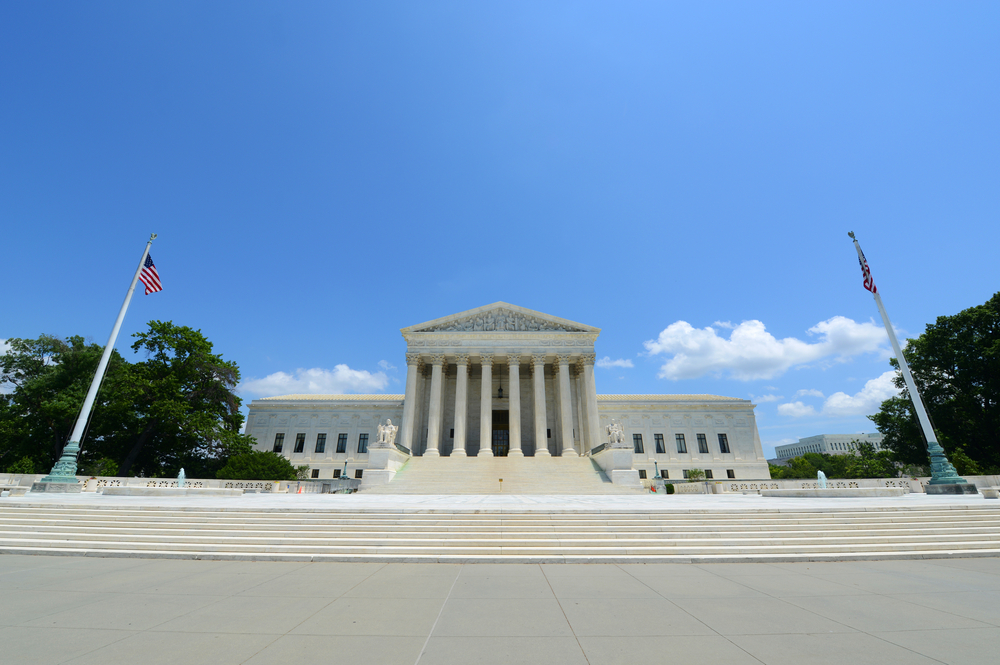
On Monday, the US Supreme Court declined to review the decision by the US 9th Circuit Court of Appeals to block a restrictive Arizona abortion law. Anti-abortion proponents of the law claimed it would have essentially eliminated medical abortions in Arizona. Similar laws enacted in Ohio, North Dakota and Texas will likely now meet a similar fate.
The Arizona law would have prevented women from receiving a medication abortion between their seventh and ninth week of pregnancy. The anti-abortion Arizona law passed in 2012 was blocked by the Ninth Circuit. Arizona then appealed the decision to the Supreme Court. The Court’s decision to deny the appeal means the law cannot be enforced.
“Mifepristone, or the pill method of abortion, is extremely safe and non-invasive,” said Eleanor Smeal, President of the Feminist Majority Foundation. “Politicians should stop trying to practice medicine and allow women and their doctors to decide the best course of action for their well-being.”
Medical abortions, or pill-inducing early option abortions, are used in the first 49 days after a woman’s last missed menstrual period. Medical abortions are non-surgical and involve the use of the mifepristone pill. This method accounts for some 40 percent of all first-trimester abortions. The appeals court in blocking the law said it “substantially burdens women’s access to abortion services,” and it “introduced no evidence that the law advances in any way its interest in women’s health.”
The Center for Reproductive Rights, when arguing against the law before the court, agreed, saying it would only cause harm for women.”Women who have made the decision to end a pregnancy will continue to get safe, legal care based on the expertise of their doctors, not politicians who presume to know better,” said Nancy Northup, of the Center for Reproductive Rights, in response to the Supreme Court’s decision.
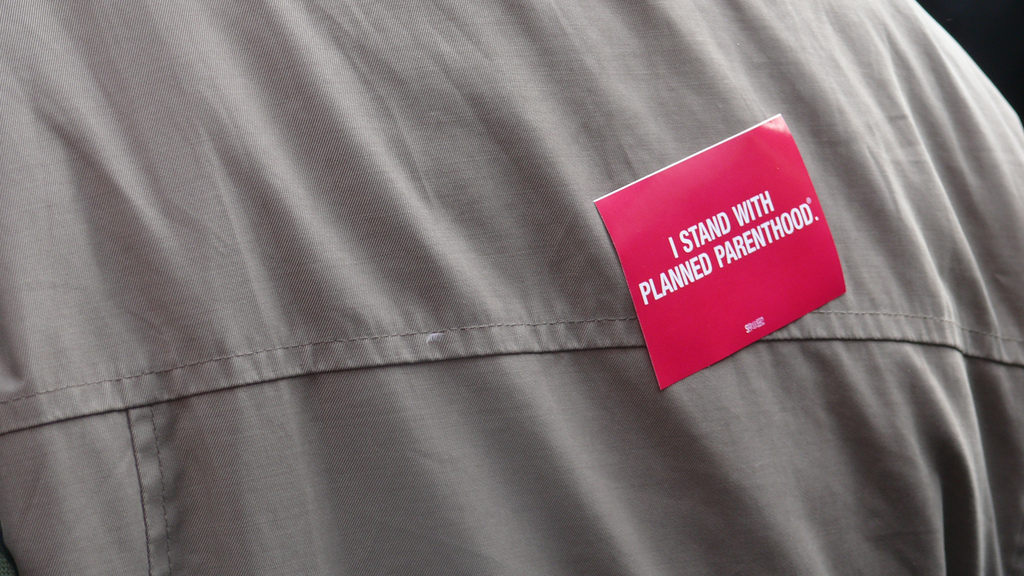
Cecile Richards, president of Planned Parenthood Federation of America, applauded the decision. “Politicians across the country should take note: These harmful and unconstitutional restrictions won’t be tolerated by the courts or the public.”
Media Resources: NBC News 12/15/2014; The Washington Post 12/15/2014; Feminist Newswire 4/10/2014; Center for Reproductive Rights 4/9/2014
House Bill 248, a direct affront to Roe v. Wade, would have banned abortion before viability, even in cases of rape or incest. 11 Republicans voted against the bill, causing it to fail with a vote of 47-40. 11 legislators did not vote.
“It’s not supported by good science, it’s not supported by good medicine,” said Representative John Patrick Carney (D-Columbus), who voted against the bill.
The bill, a so-called “fetal heartbeat ban,” was labeled a “Heartless Abortion Ban” by reproductive rights advocates. Kellie Copeland, the executive director at NARAL Pro-Choice Ohio, said her organization was “elated” that the bill failed, but that debate surrounding the bill had had a “chilling effect” on women and physicians in Ohio.
“Sadly, we know that defeat of this legislation is not the end of the threat to women’s health,” Copeland said. “Anti-choice forces already have more restrictions on access to reproductive health care ready for introduction when the legislature returns in January.”
An earlier version of the failed Ohio bill had previously passed the Ohio House in 2011 but was defeated in the Senate.
Both North Dakota and Arkansas have passed early abortion bans, but these have been blocked by the courts. In April, a federal court permanently blocked enforcement of the North Dakota six-week abortion, calling the measure “invalid and unconstitutional.” Another federal court earlier this year struck down a “fetal heartbeat law” in Arkansas that would have banned abortion at 12 weeks.
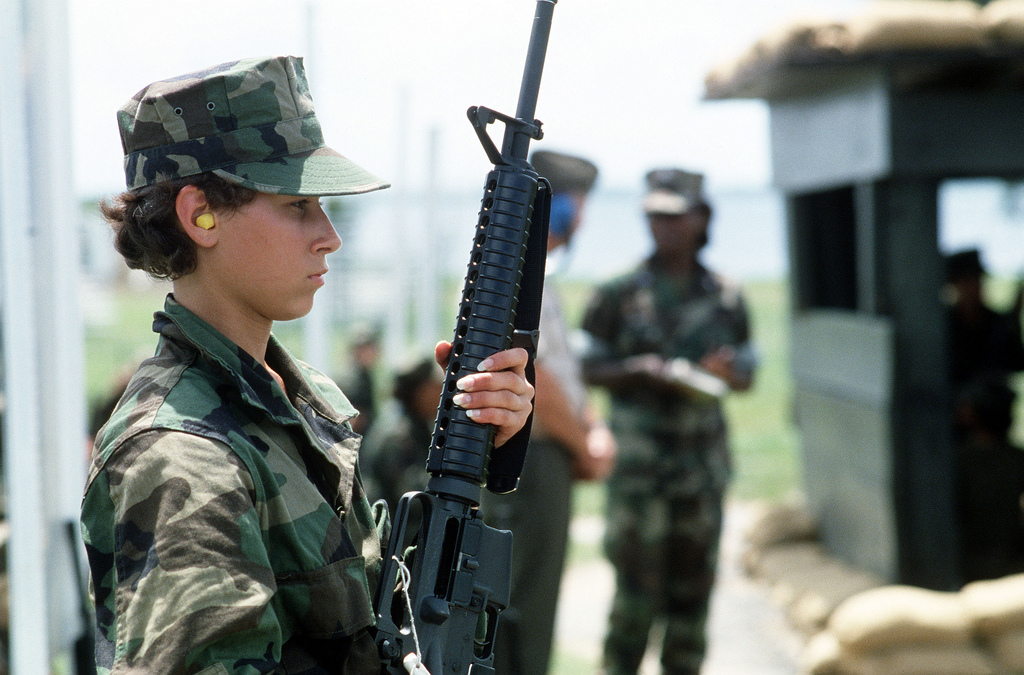
A bipartisan group of senators approached the senate floor yesterday to push for the Military Justice Improvement Act (MJIA), spearheaded by Senator Kirsten Gillibrand (D-NY), but it failed to come to a vote. Gillibrand was hoping the Act would be added as an amendment to the National Defense Authorization Act, but said that she will push for it as a stand-alone bill, and is even prepared to urge President Obama to take executive action. The bill would combat recently released data from a Pentagon report showing little progress over the past year in preventing sexual assault in the military by making it easier for survivors to report assault and eliminating retaliation for those who do report. The bill fell short of being passed by only five votes earlier this year.
The MJIA would move the decision to prosecute military sexual assault outside the chain of command and give it to trained, independent professional military prosecutors. “The Department of Defense has failed on this issue for over 20 years now,” Senator Gillibrand said yesterday, “and the data shows they still don’t get it.” She continued “Why should our service members enjoy a lesser standard of justice and fairness than you and I, whose freedoms they risk everything to protect?”
Senator Lindsey Graham (R-SC), who led the objection to the bill, said he feared that it would undermine the authority of commanders in the military, although Sen. Gillibrand clarified that this bill would only affect the top 3 percent of commanders.
Media Resources: C-SPAN Senate Hearing on Military Sexual Assault 12/11/14; Department of Defense Report to the President on Sexual Assault Prevention and Response 11/25/14; Senator Kirsten Gillibrand Press Office 12/3/14; Reuters 12/2/14
The US House of Representatives passed a $1.1 trillion, 1603-page spending bill late last night, 219-209, which will now head to the Senate for a vote. In both chambers of Congress, women are leading the fight against the legislation, which contains controversial provisions on abortion, abstinence-only education, financial reform, and other issues impacting millions of Americans.
In the Senate, Elizabeth Warren (D-MA) led the fight against passage, asking if Congress was representing Wall Street or representing the people. She said the bill represented “the worst of government for the rich and the powerful.” House Democratic leader Nancy Pelosi (D-CA) also took to the floor to denounce the bill, saying that members were being blackmailed to pass the measure in the closing hours of the session with the threat of a government shutdown. The bill was passed within 3 hours of the deadline.
The bill contains a provision that weakens the Dodd-Frank Financial Reform Act by easing restrictions on banks, which ultimately contributed to the financial debacle of 2008. It also includes a provision on the Hyde Amendment, which bans spending federal dollars on abortion, and delineates spending $5 million and upwards to $12-15 million more for ineffectual and harmful abstinence-only education. Despite these provisions, the bill also contains $101 million in funding for the Teen Pregnancy Initiative, which covers comprehensive family planning education.
Additionally, the spending bill as it stands could result in cuts to pensions for millions of retired workers. A provision allowing cuts to multi-employer underfunded pensions plans, which are typically sponsored by employers and unions, allows those in control of the plans to cut benefits “well before” they reach insolvency. The teamsters claim that one of the provisions dealing with pensions “could save UPS $2 billion,” whereas those receiving pensions could lose as much as a half to two-thirds of their worth. This particular provision, despite support from both sides of the aisle as well as some unions and employers, is opposed by AARP, the Pension Rights Center, and other advocacy groups because it “sets a precedent for cutting social security and senior employer plans.”
The legislation also contains a provision – one that has nothing to do with government spending – allowing wealthy individuals to increase their contributions to national political party committees. This provision increases the current campaign donation cap of $97,200 to as much as $777,600, giving even more political power to the rich. Although exact calculations differ, the increase could make a substantial impact on the political landscape, especially in conjunction with a recent Supreme Court decision that allows individuals to give unlimited secret funds to non-profit independent expenditure campaigns. Ultimately, this new donation cap provides more power to politicians and political parties supported by organizations like the Koch brothers’ Americans for Prosperity.
Media Resources: Fox Politics 12/12/14; FundAbortionNow.org; SEICUS.org 12/12/14; LA Times The Economy Hub 12/12/14; Star Tribune Business 12/11/14; Politico 12/11/14
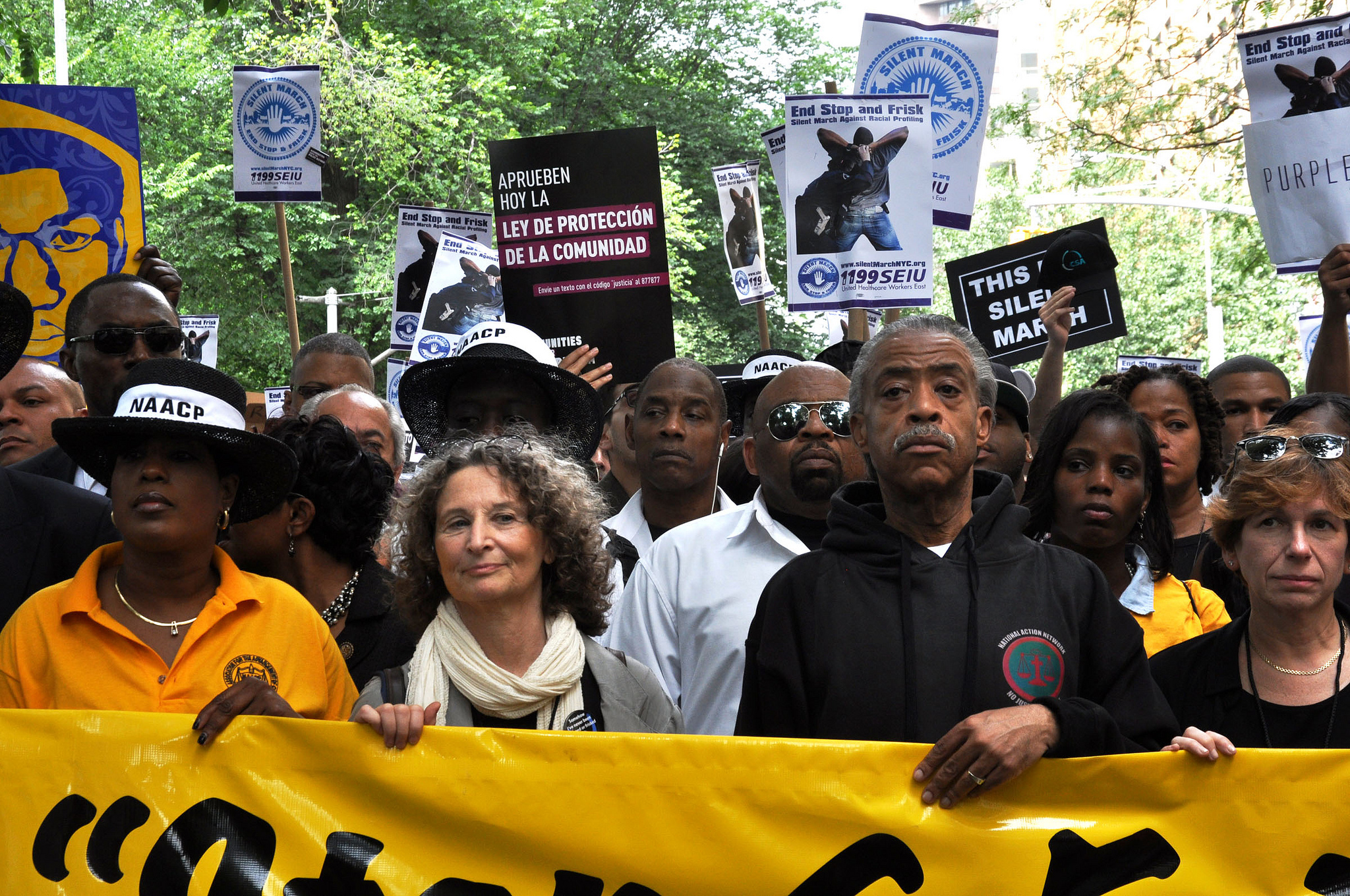
Reverend Al Sharpton and the families of Eric Garner, Michael Brown, Trayvon Martin, Akai Gurley, and Tamir Rice will be leading a march in Washington, DC tomorrow to call for an end to police violence.
A coalition of civil rights groups led by Reverend Al Sharpton at the National Action Network organized the Justice for All march, which will begin at Freedom Plaza at noon on Saturday and proceed down Pennsylvania Avenue to the Capitol. The march is not expected to have record-setting numbers but will make a strong national statement in support of the ongoing demonstrationsagainst excessive forcethat have captured the nation. Those participating in the march are calling on Congress to take legislative action to combat racial profiling, and police discrimination and violence.
Charter buses are coming from many cities and states across the East coast for tomorrow’s march. For more information about the march and to learn how to get involved, visit the National Action Network’s webpage.
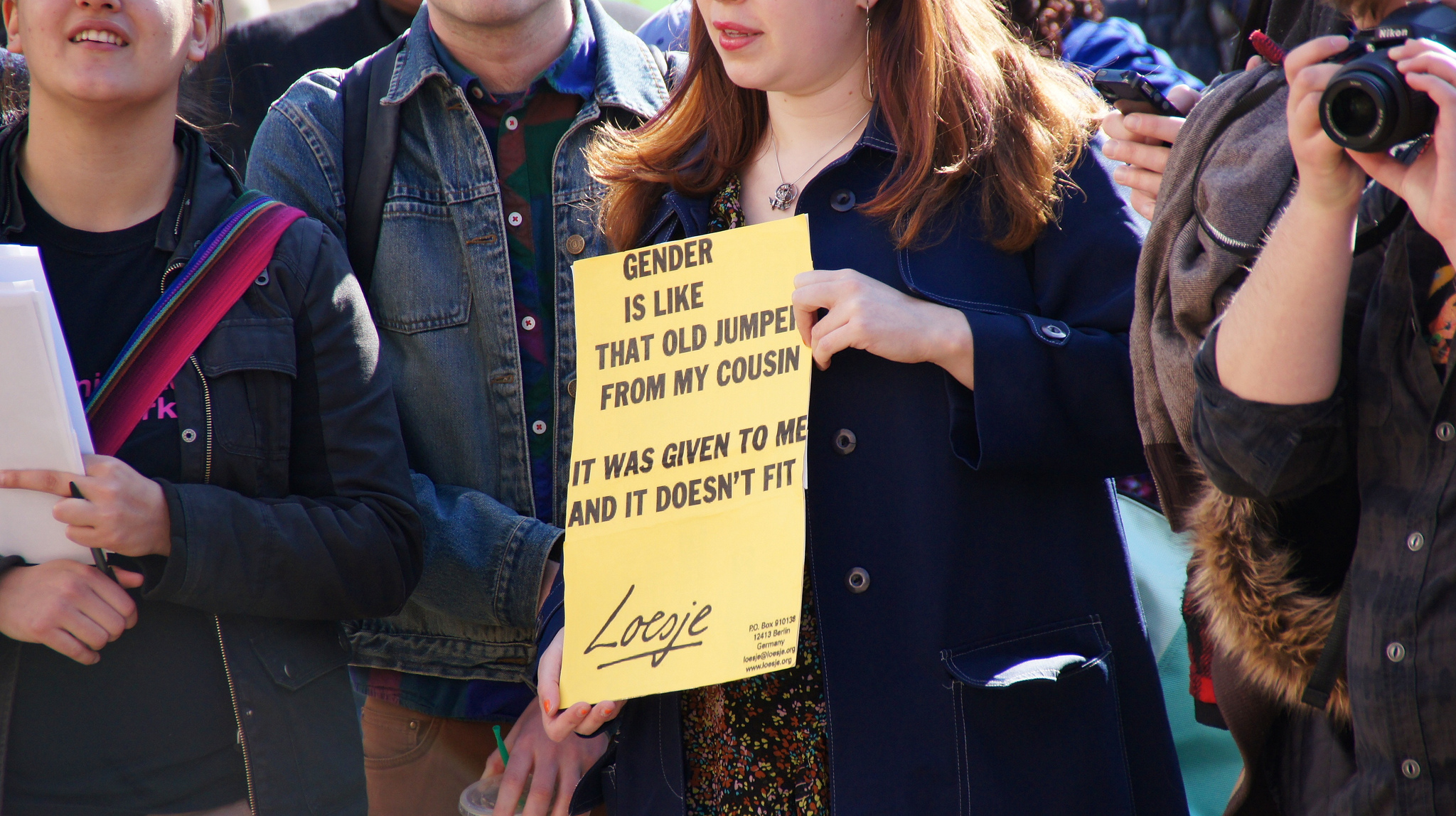
The Board of Trustees at Scripps College in California has announced that the school will now admit transgender women. The new policy will be in effect for all Fall 2016 applicants.
In a notice to the Scripps community, the Board of Trustees stated that the new policy will include applicants who report that the sex listed on their current birth certificate is ‘female’ and applicants who self-identify as women. The school will not require government-issued documentation to verify sex or gender identity.
In the school’s Frequently Asked Questions, Scripps clarifies that transmen whose legal sex is ‘male’ are not eligible for admission under the policy change. Although, the school states the following: “We recognize that transgender men do not have the same history and lived experience as cisgender men, and that formally admitting transgender men supports the educational goal of building strong minds among gender minorities.”
Lynn Pasquerella, Mount Holyoke’s president, announced the change to their policy during her convocation address to new students at the start of the school year. “We recognize that what it means to be a woman is not static,” she said. “Just as early feminists argued that reducing women to their biological functions was a foundation of women’s oppression, we acknowledge that gender identity is not reducible to the body. And we are mindful that exclusion from the category of ‘woman’ based on properties of birth is nothing new.”
Media Resources: Scripps College Admission Policy FAQ; “Support A Trans-Inclusive Admission Policy!” Facebook Page 11/21/14; CMC Forum 11/21/14; Inside Higher Ed 9/3/14, 12/8/14; KQED Radio 8/21/14
Through December 12, policymakers representing at least 195 countries are in Lima, Peru for the United Nations Framework Convention on Climate Change (UNFCCC) COP20 (Conference of the Parties). The talks are a continuation of the UN Climate Summit in New York earlier this year, and a precursor to the 2015 climate meeting in Paris, where these world leaders are expected to finalize a new global climate agreement. Friday, the Climate Action Network (CAN), a civil society member of the UNFCCC’s Women and Gender Constituency (WGC), issued an assessment of the gender gap facing the ongoing global climate discussions.
In the Lima edition of the ECO newsletter, CAN acknowledged the COP20 President’s stated intent to advance “gender-responsive climate policy,” but called on the body to codify those commitments into the actual convention. The Women and Gender Constituency is a coalition of civil society organizations that participates in the COP meetings. The WGC is working to ensure women’s rights and gender justice are central elements of the final UNFCCC agreement.
In a statement released Wednesday, the WGC stated that one of their two primary concerns is the development of a climate plan that includes a measure for gender equality. On the first day of COP20 talks, Carmen Capriles of Reaccion Climatica in Bolivia, addressed the larger delegation on behalf of the WGC. “In regions like ours here in Latin America, where women are distinguished by their triple work days; as heads of household, as mothers and as fundamental players in the economy, it is important to recognize that their livelihoods are being affected [by climate change]…which is compounded by poor access to resources and land, lack of education, and lack of access to decision-making,” Capriles said. “This reality has caused women to be on the frontlines of climate action.”
Mrinalini Rai, representing the Global Forest Coalition, another member of the WGC, demanded that the 2015 talks in Paris be transparent, people-centered negotiations. “This includes women, youth, Indigenous peoples, and local communities, with considerable expertise to be found in each of the constituencies represented here in Lima,” Rai told the larger body last week. “This is the right moment to set the bar high and ensure that future climate policies take into account the rights, needs, perspectives, capacities and expertise of women and men alike, in order to achieve truly sustainable development and avert the climate crisis.”
Media Resources: Women Gender Constituency 12/4/14; Climate Action Network 12/4/14; Food and Agriculture Organization of the UN; UN Development Programme 5/6/09
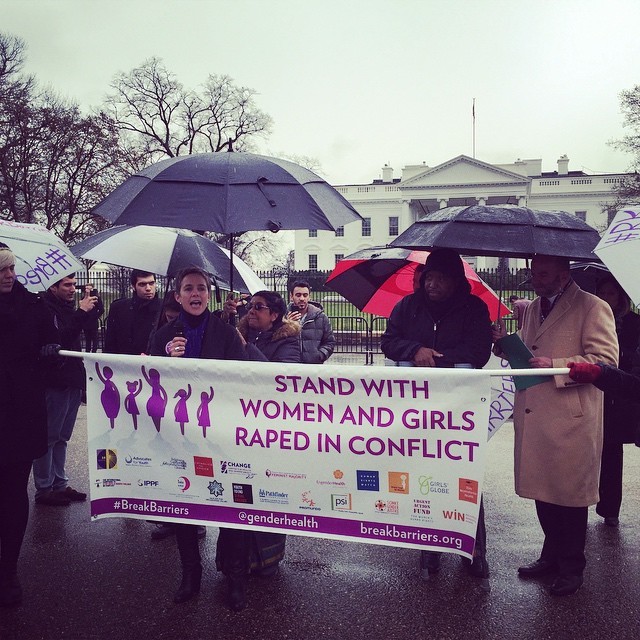
Dozens of activists braved the rain yesterday at a rally outside of the White House, where they called on President Obama to stand with women and girls raped in conflict.
More than 20 organizations, including the Feminist Majority, the Center for Health and Gender Equity (CHANGE), Advocates for Youth, and several human rights and faith-based groups, came together to urge President Obama to ensure that US foreign assistance helps survivors of war rape access comprehensive medical care, including abortion.
“Rape as a tool of war is older than the scriptures,” said Reverend Harry Knox, president and CEO of Religious Coalition for Reproductive Choice, at the rally. “But our faiths tell us we have a powerful tool in our hands. We can show compassion. We can show compassion to those women from the conflict zones who have been raped. Compassion means providing the full range of health care options, including access to safe abortion.”
Around the world women and girls – some as young as 11 – are systematically raped during war and conflict. These women and girls face increased rates of maternal mortality, permanent reproductive damage, and obstetric fistula, in addition to isolation, trauma, and unintended pregnancy.
In their article, “The Cruelest Weapon,” appearing in the Fall 2014 issue of Ms., Akila Radhakrishnan, Legal Director of Global Justice Center, and Attorney Kristina Kallas explain:
In today’s wars, like ones of the past, rebels and government soldiers alike systematically use sexual violence against women and girls (and sometimes men and boys) to demoralize, terrorize, destroy and, in some cases, change the ethnic composition of entire communities.
Survivors, however, are denied comprehensive medical care. Women who become pregnant as a result of rape are often unable to access abortion services because of US political barriers to safe abortion, and a misinterpretation of the Helms Amendment – a provision of the US law that prevents US foreign assistance for abortion “as a method of family planning” – but does allow US funds to help women obtain abortion care in cases of rape, incest, or life endangerment.
President Obama, however, has the power to break the political barriers women face in seeking comprehensive health care, including abortion, in warzones by taking executive action.
Media Resources: Feminist Majority Foundation 12/9/14; Center for Health and Gender Equity; Religious Coalition for Reproductive Choice 12/9/14; Ms. Magazine Fall 2014; Feminist Majority Foundation Blog 8/25/13; Feminist Newswire 6/27/13
Wednesday, an Indiana federal judge found a 2013 state TRAP (Targeted Regulation of Abortion Providers) law unconstitutional. The law arbitrarily requires abortion clinics to meet the same building code requirements as ambulatory surgical centers (ASC). It also expanded the definition of an “abortion clinic” to include providers that only administer medication abortions, even if they offer no surgical abortion services.
The bill, which was signed into law by Gov. Mike Pence in spring 2013, targeted the only abortion clinic in Lafayette, Indiana. Because of the law, the Planned Parenthood clinic in Lafayette would have been subject to costly renovations despite the fact that it offers no surgical procedures. According to court documents, the Lafayette clinic saw more than 4,000 unduplicated patients in the year preceding the law’s enactment. During that time, there were 54 women seeking medication abortion services, but more than 10,000 prescriptions or dispensed orders for other medications, not limited to contraceptives. To avoid disruption of service, the Lafayette clinic sought a waiver from the Indiana Department of Health citing its status as a non-surgical provider, but was rejected in November 2013.
Planned Parenthood of Indiana and Kentucky (PPINK) and the American Civil Liberties Union of Indiana (ACLU) filed suit against the state immediately following the passage of the ASC requirement. Planned Parenthood and the ACLU also took issue with the state’s provision that the Indiana Department of Health could not “exempt an abortion clinic from…physical plant requirements,” which would have adversely impacted operations for Lafayette and other Planned Parenthood facilities.
“We are very pleased with this victory, which protects a woman’s constitutional right to reproductive health care,” said PPINK President and CEO Betty Cockrum. “Medically unnecessary laws such as this are designed to chip away at a woman’s right to access a safe, legal abortion. Countless medical professionals are on record that such laws do nothing to protect a woman’s health and safety, and we are thankful the court recognized the irrational basis of this law.”
Media Resources: United States District Court Southern District of Indiana Order 12/4/14; Feminist Newswire 12/2/13; ACLU of Indiana 12/4/14; Planned Parenthood of Indiana and Kentucky 12/4/14
The Michigan House last week voted to pass a bill that gives service providers the right to deny service to anyone who does not adhere to their religious beliefs.
Speaker Jase Bolger’s proposed bill, cynically promoted as protecting religious freedom, passed through the House with a vote of 59-50 along party lines. The bill will now go to the Republican-controlled Michigan Senate. Opponents of the bill argue that it gives service providers a license to discriminate against those who do not share their religious beliefs. Far from protecting religious freedom, opponents say the bill limits religious exercise.
“The free exercise of religion is one of the most basic principles in our state and federal constitutions,” State Rep. Vicki Barnett said. “This bill moves us in a new and uncharted direction. It requires me and others to practice the faith of our employers, grocers and pharmacists.”
Susan Grettenberger, a professor at Central Michigan University, says she believes the bill could be extremely harmful. “Social workers who are opposed to war on religious ground could refuse to serve military members,” she said. “If their religion excludes the use of alcohol, they could refuse a client with substance abuse problems.”
The Obama Administration just released the Bureau of Labor Statistics for November 2014, and the employment report shows more job growth in the past 11 months than in any previous calendar year since the 1990s, with women surpassing their previous employment peak in September 2013.
This November marked the longest streak – 57 months – of private sector growth on record. In November 2014 alone, 321,000 jobs were added to the economy, with 314,000 of these jobs in the private sector. Today’s unemployment rate of 5.8 percent represents a 1.2 percent decrease since the beginning of 2014. Overall women’s unemployment is now 5.3 percent, slightly lower than men’s at 5.4 percent.
“Public job growth, which is currently being truncated, especially by Republican governors who are cutting public sector jobs and by the failure of Congress to pass a desperately needed infrastructure bill, is not keeping pace with the private sector job growth,” said Eleanor Smeal, President of the Feminist Majority. “This is particularly hard on women and people of color, who hold a larger share of public sector than private sector jobs, and on blue-collar men in construction jobs.”
Unemployment rates for black and Hispanic women, although decreasing considerably, still remain high. The unemployment rate for African American women is 9.8 percent from a high of 13.8 percent in 2010. Hispanic women’s unemployment rate has been cut in half, from 12.3 percent in 2010 to 6.4 percent. White women’s unemployment rate at 4.5 percent is considerably better than the overall unemployment rate. The unemployment rate for women who maintain families, including single mothers, is also high at 8.2 percent, although it has decreased considerably from a peak in 2010 at 13.4 percent.
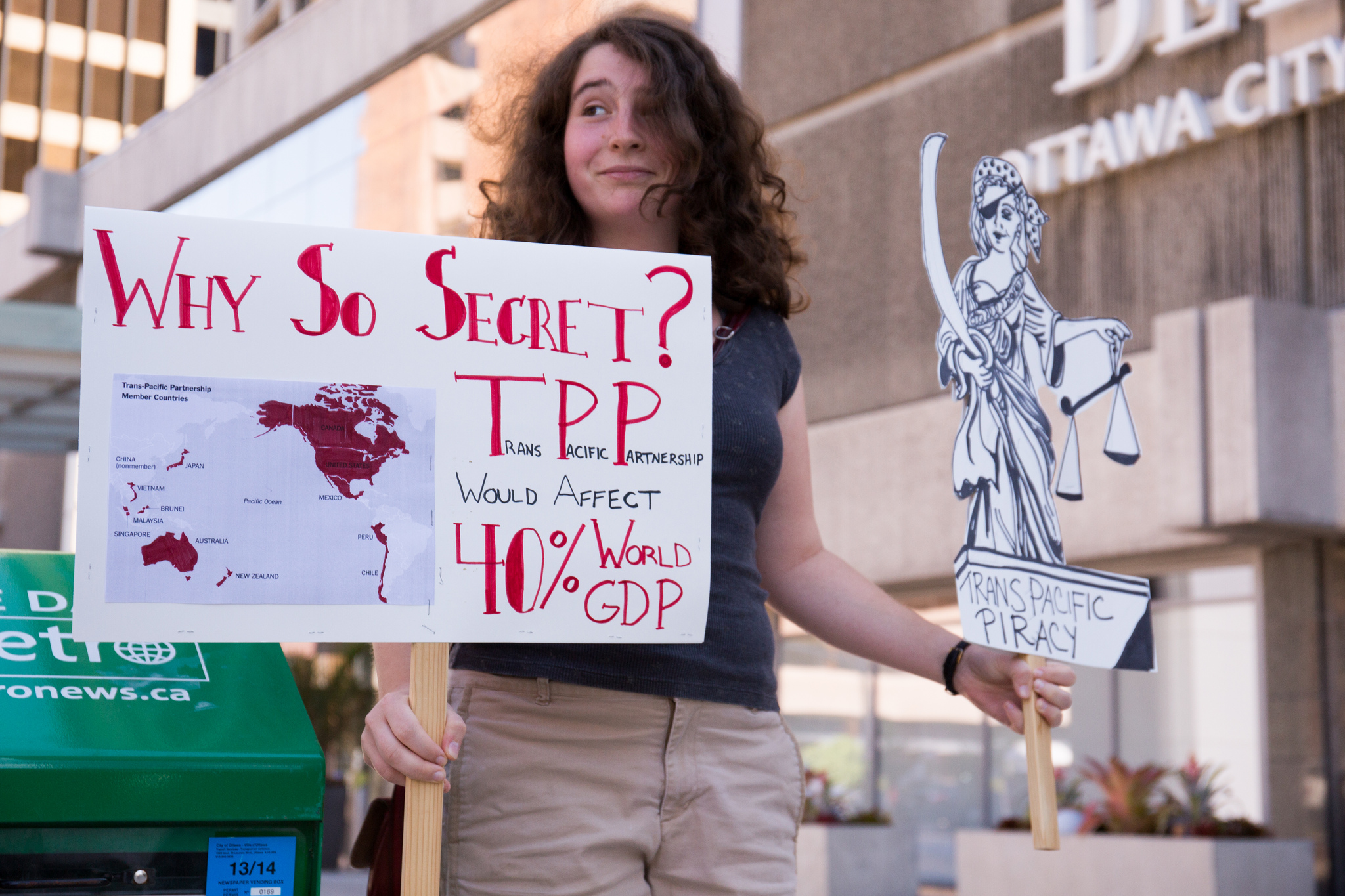
Workers, human rights advocates, environmental organizations, and consumer rights leaders rallied today in front of the Office of the US Trade Representative to oppose the Trans-Pacific Partnership (TPP) free trade agreement, described as “a massive corporate power grab that would set rules governing roughly 40% of the global economy, with potentially dire consequences for the economy, environment and public health both at home and abroad.”
Negotiators on Sunday kicked off a week of closed-door meetings on the proposed free trade agreement in Washington, DC. These negotiations follow the TPP summit last month in Beijing, at which leaders, including President Obama, expressed that concluding the TPP – which would be the largest free trade deal in history – was “a top priority.”
A number of workers’ rights, human rights, women’s rights, environmental, and LGBT groups, however, have opposed the deal, citing a broad range of concerns. As Martha Burk explained in the Fall 2014 issue of Ms., the TPP is “unprecedented in its scope, affecting not only trade in goods and services, but also regulation of intellectual property, foreign investments, and labor and environmental standards.” Unions say that the deal means fewer US jobs – especially majority-female jobs in the communications and human resources sectors. Groups like Doctors without Borders have also pointed out that the TPP’s provisions on intellectual property could reduce access to generic drugs, including drugs that are critical for treatment of HIV/AIDS.
The agreement also threatens human rights. The Feminist Majority Foundation in June led a group of 12 women’s rights organizations, demanding the White House suspend all TPP talks until Brunei was removed from the negotiating table or until the Sultan of Brunei revoked its new penal code, which calls for the stoning of gays, lesbians and people convicted of adultery, as well as the public flogging of women who’ve had abortions. In a letter to President Obama, the groups wrote:
It is simply unacceptable for the United States to bind itself into a close and enduring relationship with a country that is enacting such policies… The administration has claimed that the TPP will be a high-standard 21st century agreement. But clearly no 21st century agreement can include a country that has imposed 5th century laws that deny women, LGBT people and others their basic human rights.
A bipartisan group of House Representatives, led by Rep. Rosa DeLauro (D-CT-3), have also opposed the TPP, highlighting in particular that the TPP is largely a secret deal, negotiated without sufficient transparency. “Right now, lead negotiators from the 12 nations involved in the Trans-Pacific Partnership are meeting behind closed doors and without input or oversight from members of Congress,” DeLauro said in a statement released to coincide with the DC negotiations. “The Administration has repeatedly refused to take into account the deeply harmful impact the TPP would have on workers and families, food safety, intellectual property, financial regulations, the environment and access to medicine. The American people want confidence that international trade creates jobs and grows the economy. Instead, we know that corporate interests are driving these negotiations.”
House members have also stressed that negotiations with known labor rights offenders sends a conflicting message to the world about the United States’ commitment to the rights of working people. In a letter to the US Trade Representative Michael Froman, Reps. DeLauro, George Miller (D-CA-11), Loretta Sanchez (D-CA-46), and Mark Pocan (D-WI-2) warned, “Free trade agreements with nations that violate international child labor and forced labor standards not only undermine our moral authority, but they also capitalize on the lack of oversight and regulation in developing nations.” The group cited the Department of Labor’s International Labor Affairs Bureau’s (ILAB) annual report that has cited one-third of the TPP countries for labor abuses. In particular, Vietnam, Mexico, Peru, and Malaysia have all faced charges of labor violations. In ILAB’s 2014 report, Vietnam was one of only four countries in the world cited in the report for both child and forced labor abuses.
The countries represented in the TPP negotiations are Australia, Brunei Darussalam, Canada, Chile, Japan, Malaysia, Mexico, New Zealand, Peru, Singapore, the United States, and Vietnam. The deal would set rules governing roughly 40 percent of the global economy, while impacting everything from the cost of healthcare, deregulation of food and drug safety, environmental policy, and FCC rules.
Media Resources: Public Citizen; MarketPulse 12/8/14; Ms. Magazine Fall 2014; Feminist Newswire 7/9/14, 6/9/14; Office of Congresswoman Rosa DeLauro 12/8/14, 12/4/14; Center for American Progress 3/25/14
The Pentagon released new data last week on sexual assault in the military, showing a continued need for reform of the military justice system to help combat an epidemic that has gone virtually unabated over the past year.
The MJIA would move the decision to prosecute military sexual assault outside the chain of command and give it to trained, independent professional military prosecutors. The bill would apply to all crimes punishable by one or more years in confinement, and would exclude crimes that are uniquely military, such as disobeying orders or going Absent Without Leave.
“There is no other mission in the world for our military where this much failure would be allowed,” said Senator Gillibrand in response to the Pentagon report. “Enough is enough, last December the President said he would give the military and previous reforms a year to work and it is clear they have failed in their mission.”
Col. Christensen called the current process an “ineffective, broken system of justice” that “undermines the military I love.” He explained, “If you really knew what victims have to go through when they walk into a military courtroom; walk by their co-workers, their bosses, their commanders, their first squad leaders; all sitting behind her rapist; you would understand why we need to change the way we do things in the military.”
The failure to significantly reduce sexual assault in the military, the persistent hurdles to reporting, and the inherent bias of the system point to the need for action, according to Gillibrand and a bipartisan group of Senators who stood with her as she pushed for another vote on MJIA. By taking prosecutorial discretion out of the chain of command, the MJIA removes inherent conflicts of interest and helps create a more equitable justice system while giving some additional confidence to those who fear reporting due to the threat of retaliation.
Overall, 74 percent of women and 60 percent of men in the military perceive a barrier to reporting sexual assault. About 62 percent of women who decided to report their assault say they experienced some form of retaliation for doing so. They also continued to face a broken system, highlighted in a recent New York Times magazine feature, in which commanders fail to prosecute sexual assault cases, and convicted rapists go without punishment.
Media Resources: Office of Senator Kirsten Gillibrand 12/3/14, 12/2/14; Bloomberg 12/4/14; New York Times 11/26/14; Politico 4/29/14; Feminist Newswire 3/7/14
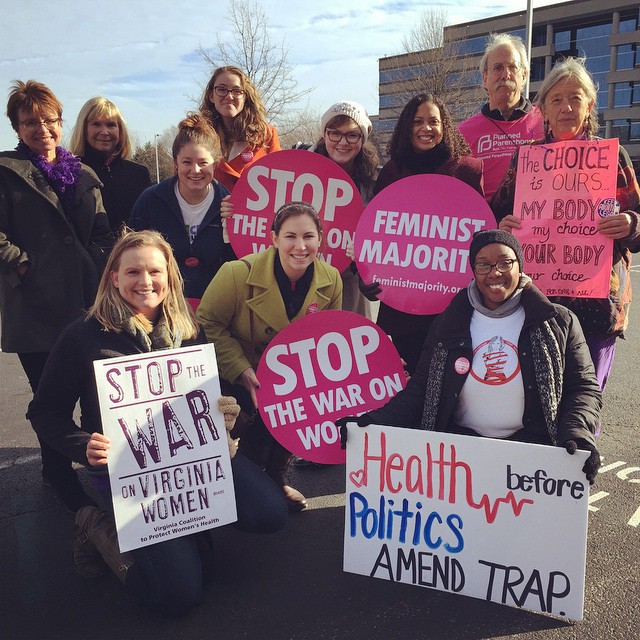
In a victory for Virginia women, the Virginia Board of Health yesterday voted 13-2 to amend politically motivated, medically unnecessary TRAP regulations which have already caused women’s clinics in the state to close and threatened to shutter several more.
Dozens of women’s health supporters, including the Feminist Majority Foundation, lined up at as early as 6 AM to make public comments against Virginia TRAP (Targeted Regulations against Abortion Providers) regulations. Several medical professionals, legal experts, and impacted women testified, calling on the Board to approve an October 2014 recommendation made by Virginia Health Commissioner Dr. Marissa Levine to amend the restrictive regulations, which she called “arbitrary” and “marked by political interference.”
The Virginia Board of Health approved the existing regulations in 2013 under pressure from anti-choice, former Attorney General Ken Cuccinelli. The rules require clinics to have the same physical architectural standards as newly built hospitals. The Board of Health had initially exempted existing clinics from the rules, but reversed itself after Cuccinelli, who unsuccessfully ran for Virginia governor in 2013, threatened Board members with the denial of state legal counsel.
The current, un-amended regulations will require women’s clinics to spend millions of dollars on changes to their facilities, such as the addition of parking, replacing existing ceilings, and adding showers to all facilities for staff members. None of these costly changes improve patient care or safety. The regulations, however, jeopardize women’s health care, especially for low-income women and people of color, by forcing clinics to close.
“While we are all committed to ensuring patient health and safety, these regulations do not do that,” stressed Keene. “That’s why hundreds of medical experts – including Dr. Karen Remley, the former Virginia Health Commissioner, and the Virginia Chapter of the American College of Obstetricians and Gynecologists – oppose these restrictions. We have to ask ourselves, who is most competent to set standards for women’s health care centers — medical experts who are on the frontlines of patient care every day, or politicians that are determined to cut off access to safe, legal abortion?”
This summer, the Virginia Department of Health received more than 10,000 comments, including comments submitted by the Feminist Majority Foundation, in support of amending or repealing the TRAP regulations.
The Board of Health will begin the amendment process next year.
Media Resources: NARAL Pro-Choice Virginia 12/4/14; Feminist Newswire 10/2/14, 4/12/13, 9/14/12
A Staten Island grand jury Wednesday failed to indict the New York Police Department officer responsible for the choking death of 43-year-old Eric Garner, prompting mass protests throughout New York City and across the country.
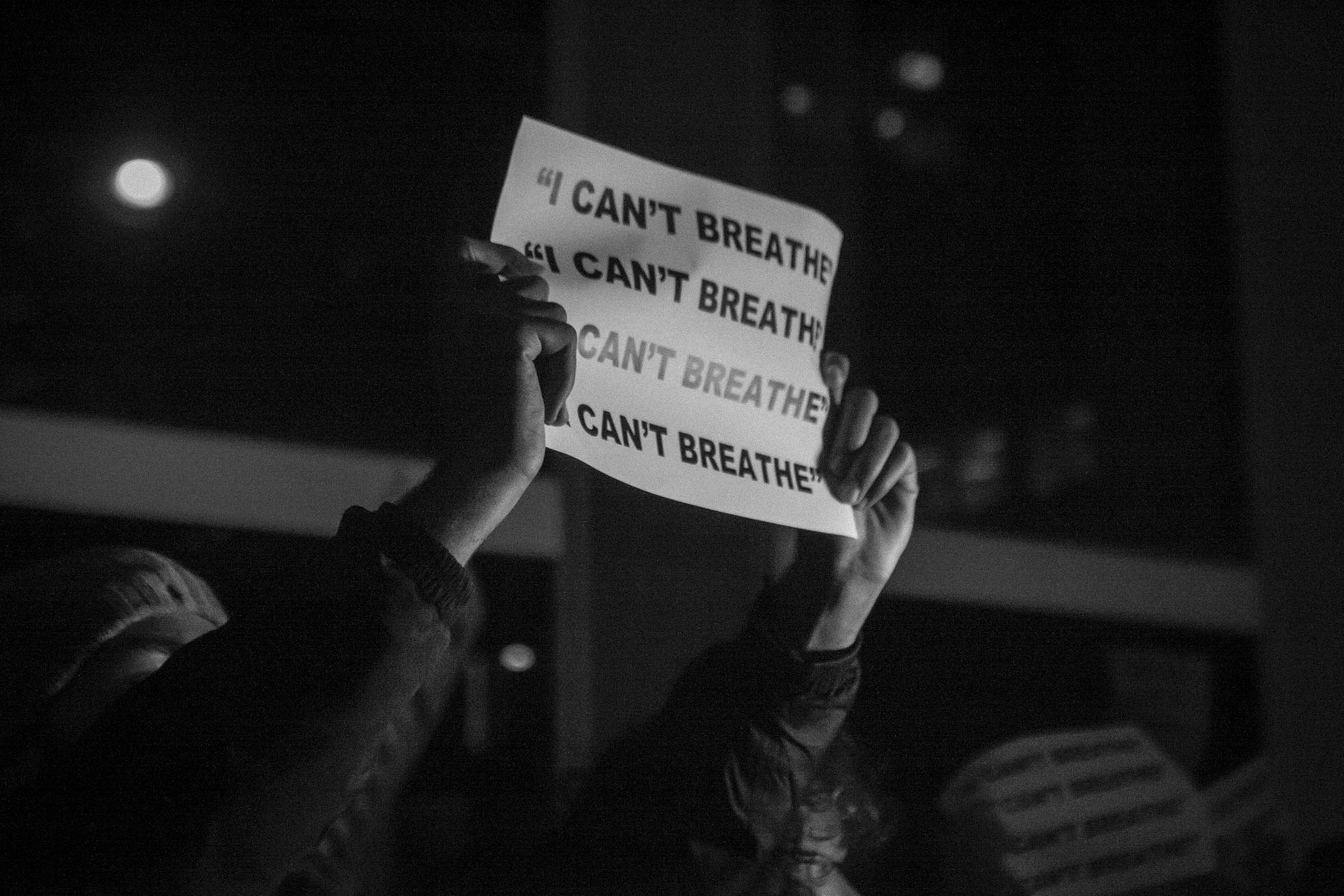
In July, several New York Police Department (NYPD) officers approached Garner, including two sergeants, on suspicion he’d been selling loose, untaxed cigarettes. Garner was pinned to the ground and held in a chokehold by NYPD officer Daniel Pantaleo during that altercation, an act which was documented in a now-viral mobile phone video. In the footage, Garner can be seen and heard repeatedly shouting, “I can’t breathe!” Garner fell unconscious while in the chokehold and was ultimately pronounced dead at a hospital that day. The medical examiner later ruled that his death was a homicide.
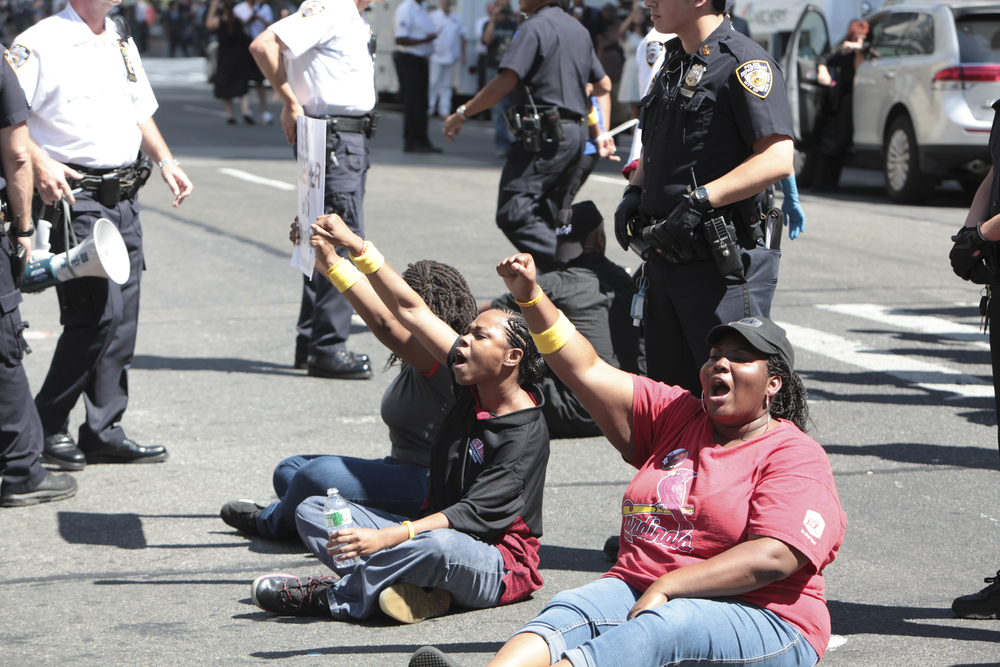
Immediately following the announcement that Pantaleo would not be indicted, hundreds of demonstrators spilled into the streets in New York City, blocking traffic in the Lincoln Tunnel and on the Brooklyn Bridge and staging a die-in at Grand Central Station. “We All Witnessed Murder” one protester’s sign read.
Ramsey Orta, who took the cell phone recording of Garner’s death, told the Daily News on Thursday that the grand jury “already had their minds made up.” Orta testified before the grand jury on September 1, and although he expected to be questioned for hours the proceedings took only 10 minutes. “I feel like it wasn’t fair at all,” Orta said. “It wasn’t fair from the start.” Orta was indicted by a different Staten Island grand jury in August on unrelated weapons charges. At his arraignment, Orta argued that he was being tried on trumped up charges in retaliation for his recording of the police-involved murder. His initial bail was set at $75,000, and he is now the only person charged in connection with the incident.
For nearly two weeks now, anti-police violence demonstrations have been taking placeacross the country in the wake of the decision not to indict Ferguson Police Department officer Darren Wilson in the killing of unarmed teen Michael Brown, and the Staten Island decision only added to the ire of protesters seeking an end to excessive and lethal force by police officers. Solidarity demonstrations underscoring outrage over the Staten Island decision went forward in multiple cities Wednesday night, including Washington, DC, Oakland, Seattle, Atlanta, and Denver. On Twitter, the hashtag #CrimingWhileWhite rose to trending status as people shared personal examples of how they benefited from their white privilege in police encounters. The hashtag #AliveWhileBlack emerged in response, as people shared stories of racial profiling despite having committed no crime.
Media Resources: NBC New York 12/3/14; New York Daily News 8/1/14, 12/4/14; St. Louis Post Dispatch 12/4/14; Al Jazeera America 12/4/14; Twitter.com
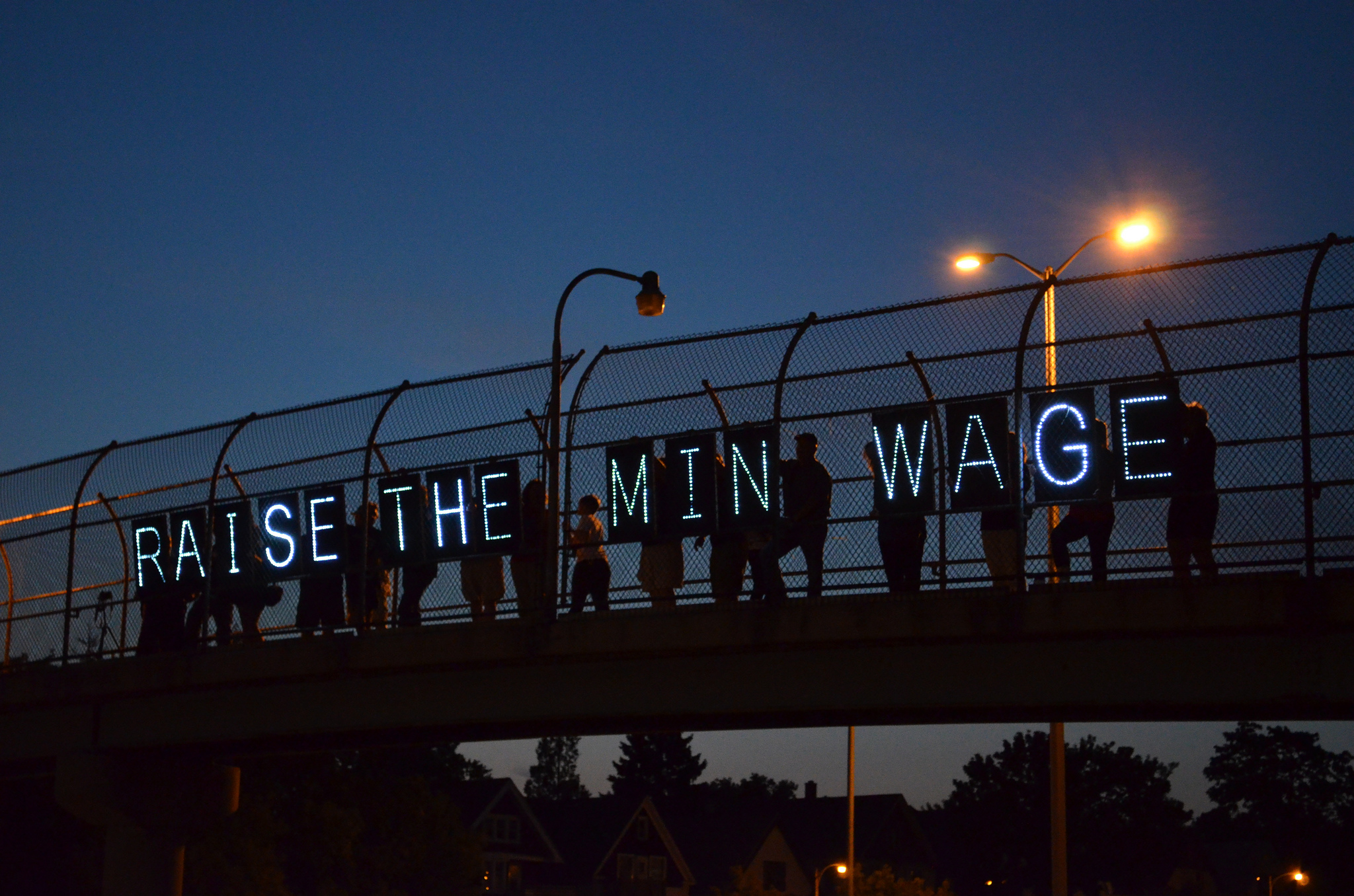
Fast food, home care, retail and other low-wage workers in nearly 190 cities walked off the job today to demand a $15 minimum wage and the right to unionize.
The strikes come less than 24 hours after the Department of Labor issued a new study that shows at least 300,000 wage and salary earners in New York and another 300,000 in California are making less than the current minimum wage due to wage theft. “These findings are alarming in terms of the prevalence of the problem, particularly in a set of industries where we already know workers earn low wages and struggle to earn even a basic family budget,” said David Weil. Weil is the administrator of the Labor Department’s Wage and Hour Division. The violations amount to more than $20 – $29 million in lost income per week. Minimum wage workers in California earn $9 an hour in California, and $8 in New York, creating on average a 49 percent and 38 percent drain in lost income for workers in those states, respectively. According to the study, correcting the violations would theoretically move between 7,000 and 8,000 families out of poverty.
The Department of Labor looked at violations across 13 industries. In general, the greatest concentration of wage violations were found in the leisure and hospitality industry, which includes food services; then educational and health services; followed by wholesale and retail trade. In the two years since the fast food worker strikes began, DOL investigations into lost wages have grown as significantly as the Department itself. Some 1,040 Wage and Hour Division investigators now work to recover lost wages and monitor violations through lawsuits taken out against major employers like McDonald’s.
McDonald’s Corporation executives have attempted to undermine the impact the worker strikes have had on operations. Executives downplayed accusations of retaliation against employees in some locations, arguing that federal law prohibits the company from firing workers who strike. In an emailed statement last week, a company spokesperson said, “At McDonald’s we respect everyone’s right to peacefully protest.”
The non-indictment of NYPD officer Daniel Pantaleo, the officer responsible for the choking death of Eric Garner, has also contributed to the tenor and massive size of today’s strikes. Activists and organizers representing both #StrikeFastFood and the #BlackLivesMatter movements have embraced the wage fight and the ongoing call for police reform as non-mutually exclusive struggles.
Media Resources: Al Jazeera America 12/4/14; New York Times 12/3/14; Department of Labor, “The Social & Economic Effects of Wage Violations: Estimates for California and New York” 12/2014; The New Republic 8/31/14; Feminist Newswire 9/3/14
The Chicago City Council Tuesday overwhelmingly passed a bill increasing the state’s minimum wage to $13 an hour by mid-2019, but that decision could come under fire at the state level.
The Council approved Mayor Rahm Emanuel’s measure in a 44-to-5 vote. It implements the increase with lesser, incremental rises in the tipped minimum wage through 2016. The current minimum wage throughout the state is $8.25. The new bill calls for an initial increase to $10 by the start of 2015.
According to the Chicago Sun-Times, Emanuel called the special session of the City Council in advance of the Illinois General Assembly’s reconvening. The General Assembly is expected to approve a smaller, statewide increase of $10 an hour. The state’s measure would have prohibited Chicago from going any higher, but some opponents of the new law argue Chicago may be forced to fall in line with the lower state limit.
“There’s a question out there about whether the city has the authority to implement its own minimum wage set apart from the state,” Tanya Triche, vice president and general counsel for the Illinois Retail Merchants Association, said. “I don’t know that that question has necessarily been answered by the courts yet. And it’s certainly worth looking into.”
Mayor Emanuel, however, defended the city’s move. “If we had not moved, [Chicago] could have been locked in place and we would not see a minimum wage…reflective of the cost-of-living in Chicago,” he said. He believes the city’s home-rule authority should insulate the city from any attempt to roll back the law.
Organizers and activists who have long been engaged in the fight for a higher wage are still pushing for a $15 minimum. They responded with critical praise for the new law. “In the past seven days, the mayor has shown us what is possible when he has the political will to make things happen,” Amisha Patel, executive director of Grassroots Illinois Action said in a statement. “He could have given Chicago a raise a year ago. Chicago families need progress every year, not just during election year.” The group said it will continue to fight for a $15-an-hour minimum wage.
However, others lauded other advances made by the bill. “This groundbreaking vote means that Chicago’s household workers will finally gain the same protections that most other workers have had for decades,” Myrla Baldonado, an organizer with Latino Union of Chicago and a domestic worker, said. For the first time in history, the law includes wage protections for domestic workers and caregivers.
The Illinois General Assembly’s three-day veto session ends this week.
Media Resources: City of Chicago 12/2/14; Chicago Sun-Times 12/2/14; Progress Illinois 12/2/14; Reuters 12/2/14; Equal Voice 12/2/14; State Journal Register 11/30/14
A recently released handbook by the World Health Organization (WHO) states “virginity tests” – a “two-finger test” used to determine whether or not a woman has had sex or has been sexually assaulted – has no scientific basis and should never be used.
“Prejudice and negative stereotypes against women and girls are passed off as medical science by many doctors who wrongly believe they can determine a woman’s virginity,” said Liesl Gerntholtz, who is the director of women’s rights at HRW. “Governments and doctors should abide by the WHO handbook to ensure that they conduct themselves ethically, respect women’s privacy and dignity, and take steps to educate their peers to end the scourge of ‘virginity testing.’”
Virginity tests are still used in many parts of the world, including North Africa, the Middle East and South Asia. In Indonesia, these virginity tests are used to screen women who apply for the national police force, and proposals to institute the tests for schoolgirls are routinely brought up. There have also been reports of teachers in Brazil being required to “prove” their virginity, and protesters in Egypt who have to do the same after being arrested. In Afghanistan, Human Rights Watch (HRW) documented virginity tests performed. Authorities in the country used these tests to investigate what they consider to be “moral crimes,” such as sex outside of marriage.
HRW found that women who are accused of these “moral crimes” are often already fleeing violence in the home, and sometimes the tests are performed on women who are accused of robbery or assault because of a mistake in policy. Because authorities in Afghanistan claim virginity tests can determine whether or not a woman has had consensual sex outside of marriage, the results of the test are used as evidence and often lead to convictions.
The WHO handbook also provides real ways for healthcare providers to proceed with someone who has been sexually assaulted. WHO suggests approaching the patient with kindness, not forcing the patient to talk about anything they do not want to talk about, offering emergency contraception, obtaining consent before any examinations for injuries or STI tests, and offering options for future mental health services.
Media Resources: Human Rights Watch 12/2/14; LA Times 12/2/14; World Health Organization 2014
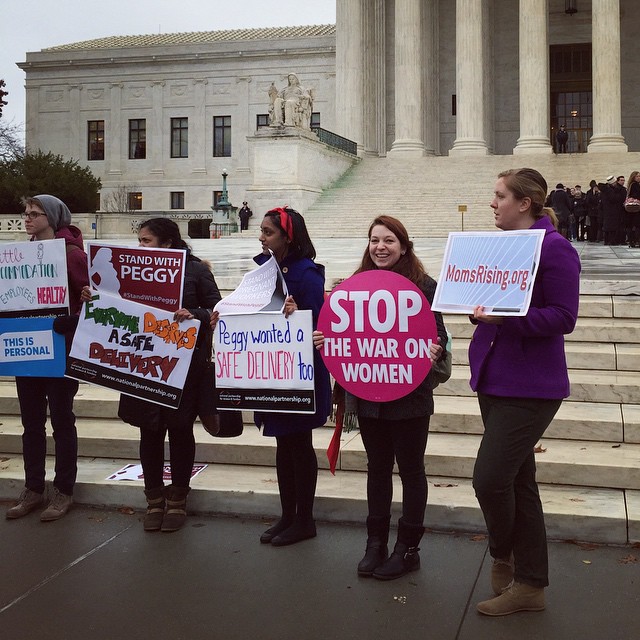
The US Supreme Court heard arguments in the Young v. United Parcel Service case this morning, brought by Peggy Young who faced pregnancy discrimination during her employment as a UPS delivery driver. Young’s case was bolstered by a rally held outside the Supreme Court during the hearing.
When Young discovered that she was pregnant, UPS denied her doctor-recommended request for light duty assignment and forced to take unpaid medical leave without health insurance, despite UPS granting similar requests for other employees with disabilities or injuries. Young sued on the grounds of pregnancy discrimination, but two lower courts ruled against her.
Early this morning, advocates and activists gathered outside the Supreme Court from feminist groups including the Feminist Majority Foundation, National Women’s Law Center, Moms Rising, and the National Organization for Women to show support for Young. A virtual rally is also ongoing today using the hashtag #StandWithPeggy.
It has been almost four decades since the passing of the Pregnancy Discrimination Act, protecting employees from discrimination if they become pregnant. The law is unclear, however, how far that protection goes and what sort of accommodations are required for pregnant women in the workplace. Although UPS has since changed their policy, this Supreme Court ruling could ensure additional protection under the law for all working pregnant women in the United States.
Accommodations such as more frequent bathroom breaks, lighter physical workplace tasks, and access to water and chairs while at work are some of the things Young and advocates for pregnant worker’s rights are hoping for. They argue that if a group of workers on payroll are allotted lighter duty or assignments such as desk work because of temporary disabilities, the same opportunity should be available to pregnant workers whose doctors recommend limits to their workload. The Pregnant Workers Fairness Act, which has been stalled in both chambers of Congress since last year, would require every employer in the nation to provide these accommodations to their employees.
The opposition argues that pregnancy is not a disability and should not be treated as such.
For Young, this case is about more than seeking justice in her particular situation. “I have two daughters,” she says, “I don’t ever want them to experience what I did. We need to fix this. For them, and for all women.”
The Supreme Court decision will be announced next summer.
Media Resources: SCOTUS Blog Young v. United Parcel Service; Feminist Newswire 7/3/2014; Washington Post 11/30/2014
On Monday, President Barack Obama announced a plan that involves $75 million to equip 50,000 police officers with body cameras. The plan for body cameras is part of a larger initiative to better train and equip law enforcement that budgets for $263 million in three years. There are around 460,000 sworn officers in local police departments throughout the US. Earlier that day, Obama had asked federal agencies to come up with recommendations to make sure the US is not creating a “militarized culture.”
The same day, US Attorney General Eric Holder said in a speech that he will announce updated guidance for the Justice Department regarding profiling by law enforcement.
“[The Justice Department’s new guidance] will institute rigorous new standards and robust safeguards to help end racial profiling, once and for all,” Holder said. “This new guidance will codify our commitment to the very highest standards of fair and effective policing.”
Obama also requested a meeting that took place this week with Ferguson activists. Ashley Yates, co-founder of Millennial Activists United, said Obama requested the meeting because the movement “cannot be ignored.”
“We have two sets of laws in America – one for young Black and Brown people, and one for the police,” Yates said. “We are sick and tired of our lives not mattering, and our organized movement will not relent until we see justice.”
Ferguson protesters have suggested body cameras are one way to start the process of police reform by helping identify racial discrimination. Currently, a black man in the US is four times more likely to be arrested for possession for marijuana than a white man – and 21 times more likely to be shot dead by police. Of all people who were shot dead by police where the circumstance is recorded as “undetermined,” 77 percent were black. Colin Loftin, co-director of the Violence Research Group and professor at University at Albany, told ProPublica more data is needed to paint a better picture of racial discrimination in the US, but that the data currently available is “certainly relevant.”
“No question, there are all kinds of racial disparities across our criminal justice system,” Loftin said. “This is one example.”
“It is a crisis when a Black American can get locked up for traffic fines, but police officers are rarely prosecuted for killing unarmed children,” Rasheen Aldridge, director of Young Activists United St. Louis and one of the activists who met with Obama this week, said. “Black communities have suffered under racially biased policing and unconstitutional law enforcement policies for far too long. This has to stop.”
Media Resources: The St. Louis American 12/2/2014; ABC News 12/2/2014; PolicyMic 12/1/2014; CBS News 12/1/2014; ProPublica 10/10/2014; ACLU; Bureau of Justice Statistics