July 23, 1937: National Federation of Business and Professional Women’s Clubs Endorses Equal Rights Amendment

Founding Feminists is FMF’s daily herstory column.

FoundingFeministLogo-color

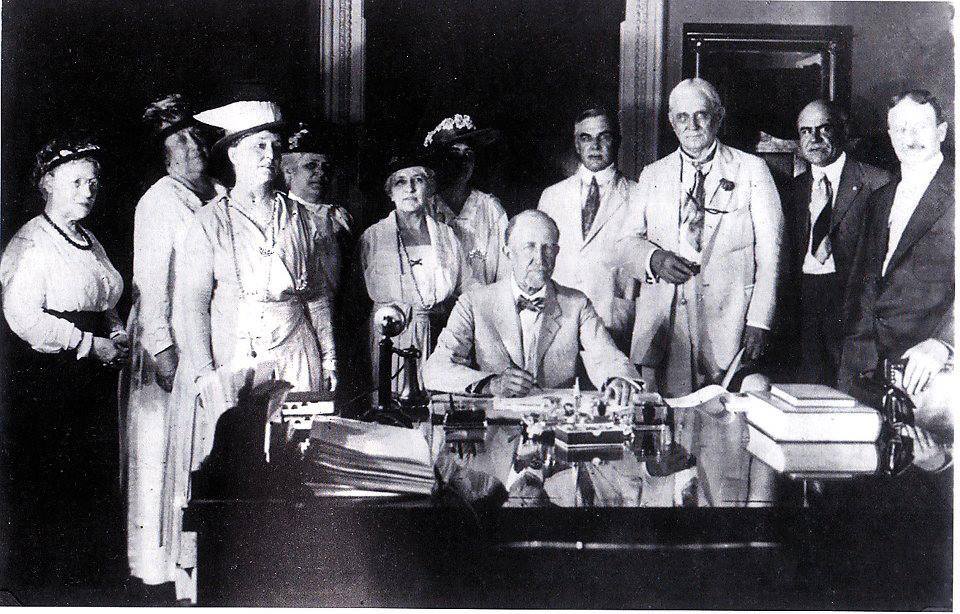
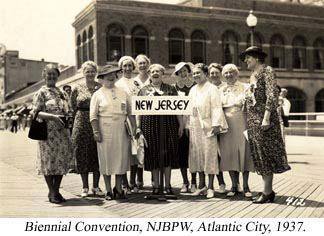
The Equal Rights Amendment received the most prestigious organizational approval in its 14-year history today when it was endorsed at the biennial convention of the National Federation of Business and Professional Women’s Clubs.

B.P.W.’s huge membership and nationwide influence should certainly speed up the drive for E.R.A.’s passage by Congress, and submission to the States for ratification. Just last month both the House and Senate Judiciary Subcommittees reported it favorably, and in March, NBC broadcast an E.R.A. debate nationwide, so the campaign begun and spearheaded by the National Woman’s Party in 1923 is moving along well, and clearly gaining support and attention.

B.P.W. then went on to take strong stands on other issues of vital concern to women. The Equal Rights Treaty, which would improve the status of women internationally, and is expected to be voted on in September by the League of Nations, was proposed for approval by Lena Madesin Phillips, president of the International B.P.W. It was quickly endorsed by an overwhelming vote. But the International Woman’s Charter was unanimously rejected after Anita Pollitzer of the National Woman’s Party pointed out to delegates that it would validate and spread so-called “protective” labor laws that actually just limit women’s opportunities in regard to employment through restrictions that don’t apply to men.

10544364_10202857855230977_554067285843791843_nThere was a huge celebration at the convention today when Charl Ormond Williams, B.P.W. President, announced to the delegates that Congress had given final approval to repealing Section 213 of the National Economy Act of 1932. This section has been fought by women’s groups since its passage, because it requires government agencies to fire those whose spouses are also employed by the government when reductions in force need to be made. Since men have more job categories open to them, and get promoted faster and higher, it’s husbands who almost always earn more than wives, so it’s the wife who winds up quitting if the couple must live on one salary.

Contributing to the five-year delay in repeal was the fact that discrimination against married women in the workforce is widespread, and prejudice still remains strong. Last year, “Fortune” magazine did a survey, asking a representative sample of Americans: “Do you believe that married women should have a full-time job outside the home?” Only 15% of those polled said “yes,” 37% approved under certain circumstances, and 48% were opposed (54% of men and 41% of women.)

Immediately upon learning of the Section 213 victory, delegates printed up signs saying “Goodbye 213” and “Hurrah for McKellar and Celler.” (Senator Kenneth McKellar, Democrat of Tennessee and Rep. Emanuel Celler, Democrat of New York, were the sponsors of the repeal legislation.) Then, accompanied by a trumpeter and accordionist playing “Pack Up Your Troubles In Your Old Kit Bag,” there was an impromptu march out of Haddon Hall down the Boardwalk here in Atlantic City, with delegates singing most of the way. The repeal bill now goes to President Roosevelt, who is expected to sign it.

But amid all the celebrations, actions and good news, there was one appropriately somber note at the convention. A tribute was paid to B.P.W. member Amelia Earhart, although one group made it clear that it had not yet given up hope: “The New York delegation, to which Miss Earhart belonged, is glad to honor her but does not join in the feeling that she is lost. We deeply and sincerely hope that she will yet be rescued from the islands where her ship disappeared,” said Isabelle Henderson.

Though the mystery of what happened to Earhart three weeks ago today when flying from New Guinea to Howland Island continues, there is no doubt that if she were here at the convention she would applaud B.P.W.’s endorsement of the E.R.A., because she has been advocating its passage and ratification for many years.

July 22, 1920: Suffragist Demand More Action from Harding

Founding Feminists is the FMF’s daily herstory column.

FoundingFeministLogo-color

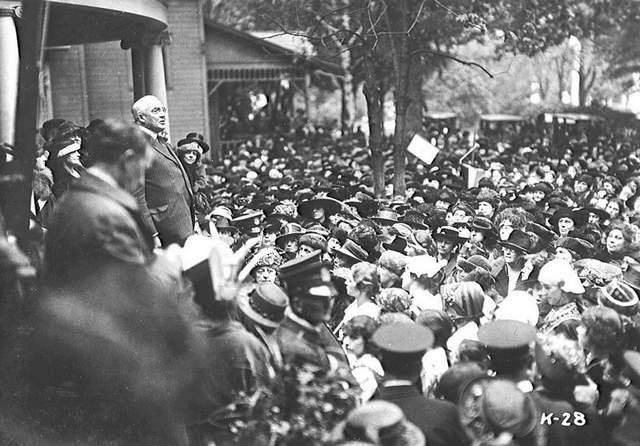
Over a hundred members of the National Woman’s Party met with Republican Presidential nominee Warren G. Harding today, and made it clear that the N.W.P. will not settle for mere words from the Senator, but will insist on deeds.

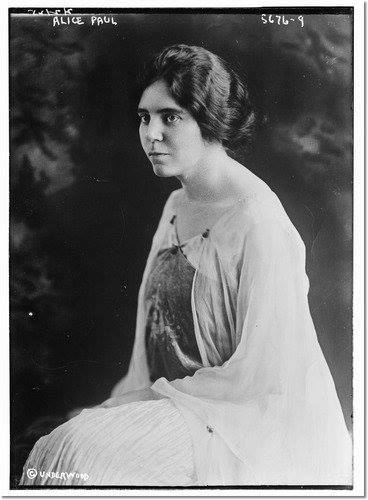
In fact, if he doesn’t do something meaningful to help the suffrage cause, Harding should probably just continue his “Front Porch Campaign,” because if he leaves his home he will be followed to all events by National Woman’s Party members, who will be pointing out his lack of commitment to winning “Votes for Women.” According to Alice Paul:

Suffragists can feel only dissatisfaction with Senator Harding’s refusal today in his reply to the Woman’s Party delegation, and in his acceptance speech, to take a positive stand for the carrying out of the suffrage plank in the Republican platform. The suffrage plank is the only one in the platform which Senator Harding and his party have the power to carry out without waiting until elected to national office, because of the fact that their party is already in control in several legislatures which have not yet acted on suffrage.

Vermont and Connecticut legislators appear to be especially eager to ratify, but their Republican governors have been refusing for months to call these legislatures back into session so they can vote on ratification. Paul continued:

If Senator Harding refuses to live up to the suffrage plank, and contents himself merely with ‘earnestly hoping’ and ‘sincerely desiring,’ how can he expect the country to take seriously the other planks in his platform? The National Woman’s Party will continue to demand that Senator Harding carry out his platform by securing a unanimous vote in support of ratification from the Republican delegation in the Tennessee Legislature when it meets next month. If Senator Haring will use his full power, as a leader of his party, in behalf of the enfranchisement of women, he can secure such a Republican vote in favor of ratification in Tennessee. Only by action and not by the expression of polite interest will women be satisfied.

Paul’s last comment may refer to a telegram Harding sent last night to Carrie Chapman Catt, in which he said he would “cordially recommend” that Republican legislators in Tennessee vote for suffrage if they asked his opinion.

Harding was very polite to today’s large Woman’s Party delegation, which marched down the streets of Marion, Ohio, to his home, dressed in white, bearing the N.W.P.’s purple, white and gold banners, and wearing similarly colorful sashes. A number of the group’s members spoke frankly to the Republican nominee. Louisine Havemeyer brought up a good point about the Republicans’ frequent boast that they have done more for suffrage than the Democrats:

True, the Republican Party has given us more States than the Democratic Party, but they had more States to draw upon, and I recommend your informing yourselves as to the number of Democrats who voted in these Republican States … This has been a seventy-year struggle between the men and women of this great country. Isn’t it time to end the struggle? Is it fair that a woman should make the flag and only the men should wave it?

Republican Presidential nominee Warren G. Harding speaks to a crowd of supporters gathered outside his home.

Havemeyer then brought Republican Party icon Abraham Lincoln into the discussion, comparing his efforts for the 13th Amendment with those of present Republicans for the proposed 19th: “Fifty-six years ago Abraham Lincoln also wished to pass an amendment …. Did he say, ‘I have done enough,’ or ‘I will request some one,’ or ‘I will urge,’ … or ‘ladies, don’t bother me, I have done all I could.’ No. He said: ‘I need another State, and I am going to make one.’ And he did, and his amendment was ratified.”

Having now met with the Presidential nominees of both major parties, the Woman’s Party will expect them to do whatever is necessary to deliver Tennessee or North Carolina when those legislatures meet in less than three weeks to vote on approving the Susan B. Anthony (nationwide woman suffrage) Amendment. The approval of either State would be the 36th and final one needed to put woman suffrage into the U.S. Constitution as the 19th Amendment. The vote is certain to be quite close, and the result is presently unpredictable, complicated by the fact that most legislators are scattered around their home States at their residences, often in quite remote areas, while others are on extended vacations in undisclosed locations.

The General Election is less than 15 weeks away. Registration deadlines have passed in at least two States where women cannot vote, and are rapidly approaching in many others where women will not be allowed to register unless the 19th Amendment passes. Pressure from the highest levels of each party on State legislators in Tennessee and North Carolina could make the difference between millions of women around the country voting for all offices and referenda on the ballot in November, or being barred from the polls until at least next year – and from voting for President until the 1924 election. No effort will be spared by suffrage forces to get that 36th State ratified, and an all-out drive by anti-suffragists to block any further ratifications it is equally inevitable. So, meaningful efforts by Republican Presidential nominee Senator Warren G. Harding and Democratic Presidential nominee Governor James Cox could be crucial to victory, and will be vigorously sought.

July 21, 1923: National Women’s Party Kicks Off ERA Campaign

Founding Feminists is FMF’s daily herstory column.

FoundingFeministLogo-color

The National Woman’s Party’s campaign for an Equal Rights Amendment has been officially kicked off!

This was the second and final day of the N.W.P.’s convention, which has been celebrating the 75th anniversary of the first women’s rights convention here in Seneca Falls, New York, July 19-20, 1848.

The true beginning of this new campaign actually dates back to February 16, 1921. At the National Woman’s Party’s first convention since the winning of the vote six months earlier, Nora Blatch Barney, granddaughter of Elizabeth Cady Stanton, called for “absolute equality” and the delegates enthusiastically endorsed turning that ideal into a legal guarantee as the group’s post-suffrage goal.

A committee of lawyers was quickly formed to come up with something that would assure equality for women. On December 11th of that same year they submitted a first draft of a Constitutional amendment: “No political, civil or legal disabilities or inequalities on account of sex, or on account of marriage unless applying alike to both sexes, shall exist within the United States or any place subject to their jurisdiction.”

10534770_10202845912132407_558291605226167160_nA considerably more streamlined text was submitted to the convention today by its author, Alice Paul, then unanimously approved: “Men and women shall have equal rights throughout the United States and every place subject to its jurisdiction.” Her resolution, as she read it from the pulpit of the local Presbyterian Church to the assembled delegates said:

Whereas, only one point in the equal rights program of 1848, that of equal suffrage, has been completely attained; and, whereas, the National Woman’s Party, as stated in its declaration of principles, is dedicated to the same equal rights program as that adopted on this spot seventy-five years ago, be it resolved, that in order to bring the complete equal rights ideal to the victory that was won for suffrage we undertake the following program: The securing of an amendment to the United States Constitution stating men and women shall have equal rights throughout the United States and every place subject to its jurisdiction.

In speaking for the resolution, Alice Paul said:

We began the campaign for equal rights a year ago. In one State we obtained without difficulty a law establishing equal guardianship and in another State a law making women eligible for jury duty. If we keep on in this way we will be here in another seventy-five years celebrating the one hundred and fiftieth anniversary of the 1848 convention. I think we ought to start immediately on another campaign similar to that which won suffrage. We should demand a Constitutional amendment of Congress and the President. We are not safe until we have equality guaranteed by the Federal Constitution.

Paul then suggested a nickname for the E.R.A.:

We tie up this amendment to the 1848 movement. It is easier to get support for something with tradition behind it and which has grown respectable with age than for something new-born from the brain of the Woman’s Party. We are going to call this amendment the Lucretia Mott Amendment, just as we called the suffrage amendment the Susan B. Anthony Amendment, because to Lucretia Mott more than to anyone else the feminist movement in the United States owed its start.

This was not the only stirring speech to the delegates. For instance, in last night’s opening address to the convention, Alva Belmont said:

In Seneca Falls we stand on consecrated ground, the birthplace of women’s emancipation when 75 years ago women came together to tell the world that slavery could no longer hold half the race. The Woman’s Party today is working for nothing more than the complete fulfillment of the demand for equality made here in 1848. In three-quarters of a century complete equality has been won only in the vote. Discriminations continue to exist in education, in industry, in the professions, in political office, in marriage, in personal freedom, in control of property, in guardianship of children, in making contracts, in the church and in the double moral standard. We have carried out only a part of the command, the fight must go on. Let every woman here consecrate herself to toil to the end that women as well as men shall be free in the United States.

The day ended with a pageant consisting of a fifty-voice choir, 300 banner-bearers, and fifty more participants costumed in the same manner as those who were here in 1848, playing the parts of the original participants in re-enacting the highlights of that previous convention. It was a fitting tribute to the pioneers of 75 years ago and clearly inspirational to those who must now go out and finish the fight begun so well.

July 16, 1920: Suffragist Factions Work Separately For The Women’s Vote

Founding Feminists is FMF’s daily herstory column.

FoundingFeministLogo-color

Both factions of the suffrage movement were quite busy today.

Alice Paul of the National Woman’s Party met with Democratic Presidential nominee Governor James Cox of Ohio, while Carrie Chapman Catt, head of the National American Woman Suffrage Association, left New York for Tennessee to coordinate N.A.W.S.A.’s ratification campaign there. Both women, sensing that victory is finally within reach, are now putting maximum pressure on anyone who can help deliver the 36th and final State needed to get the Susan B. Anthony (nationwide woman suffrage) Amendment into the Constitution in time for the November elections.

10492106_10202817942753190_1056703756361171032_n

Alice Paul and the other National Woman’s Party members with her were quite demanding of Governor Cox at today’s meeting, and got the reassurances they sought from the long-time active supporter of suffrage that he would do everything he could to help. “I give to you without any reservation the assurance that my time, my strength and my influence will be dedicated to your cause as our combined councils might suggest,” he said, “with a view to procuring a favorable result in Tennessee.”

Following the meeting, Alice Paul told reporters, “We are glad that Governor Cox appreciates the responsibility of carrying out his party platform. His statement this afternoon indicates that he realizes the unprecedented opportunity offered the Democratic Party to enfranchise the 17,000,000 women of the nation by giving the thirty-sixth suffrage State.”

Alice Paul is, of course, more interested in deeds than words, so she concluded by saying: “We shall look for immediate action by Governor Cox.”

Republican Presidential nominee Warren G. Harding’s statement day before yesterday, in which he finally got around to urging Republican legislators in Tennessee and North Carolina to ratify the suffrage amendment, isn’t sufficient for the usually-diplomatic Catt. She expressed disappointment that after doing so much for the cause, Republicans are now failing to provide the final State ratification needed. As she left for Nashville, she said:

It is not enough for Senator Harding to make an effort to secure the 36th ratification. It is not enough to point to past performances. The Republican Party must finish the task. We now pin our faith on the Tennessee and North Carolina prospects. It is true that the Republican Party has a record of nearly five times as many ratifications as the Democratic, but without the 36th State that record is like a tail without a kite. Apparently it is the Democrats who must supply the kite.

Both Tennessee and North Carolina are Democratic States, and their legislatures will be called into special session in less than a month to vote on ratification of the proposed 19th Amendment. There has been great frustration among suffragists for many months over the fact that the Republican governors of Vermont and Connecticut have refused to call their legislatures back into session to vote on the measure, since it’s quite likely that it could quickly pass in either one.

The National Woman’s Party has expressed sentiments similar to those of N.A.W.S.A. regarding Senator Harding’s late entry into the battle for the ballot, and the fact that though Republicans have provided 26 of the 35 States that have ratified, and get half-credit for three more, in which one party controls the Senate and the other the House, it isn’t enough:

Thirty-five States are worth nothing at all to us without the thirty-sixth. The bitter opposition we have encountered in the last few States and the delay since Washington, the thirty-fifth State, ratified on March 22nd, indicate clearly that political leaders also know well the difference between a ‘good record’ and ratification.

Senator Harding says that only one Republican State has rejected the amendment. He fails to mention the Republican States of Vermont and Connecticut, where Republican officials have refused to permit any action whatever on the amendment.

He says also that it makes no difference to him whether a Democratic or a Republican State completes ratification. It certainly makes no difference to the women of the nation, but Senator Harding cannot evade his responsibility in such a phrase.

Just over three weeks remain until special sessions of the legislature open in Tennessee (August 9th) and North Carolina (August 10th). Time to register for the November elections is running out for women in many States where they cannot vote until the 19th Amendment is passed. Registration deadlines have already passed in at least two States (Georgia & Mississippi). So now is the time for the parties to prove the sincerity of their convention resolutions in favor of nationwide woman suffrage by working to assure a “yes” vote on ratification by their members in the Tennessee and North Carolina legislatures next month.

It will be by their success – or failure – to place a permanent and explicit guarantee of woman suffrage into our Constitution that the parties will be judged for many years, and not by easily passed and quickly forgotten party planks, or campaign rhetoric by Presidential candidates.

July 15, 1940: Democratic Party Will Not Endorse Equal Rights Amendment

Founding Feminists is FMF’s daily herstory column. We’re bringing you women’s history, straight outta the newsroom.

FoundingFeministLogo-color

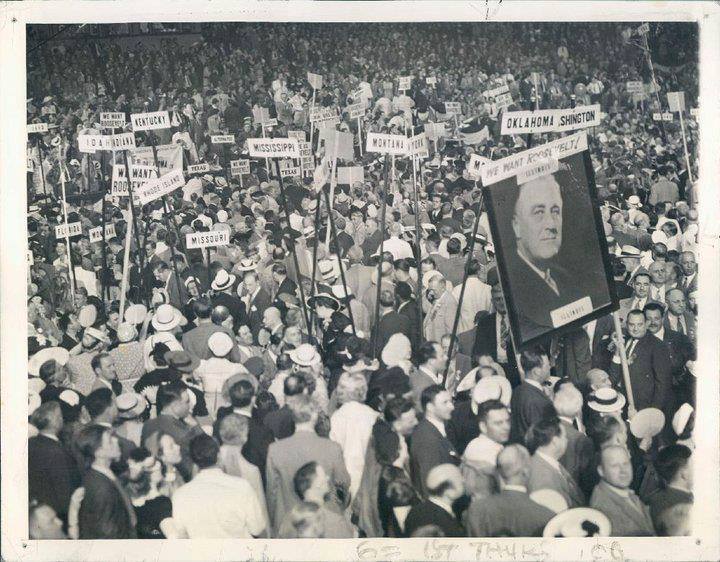
Despite a valiant effort by the National Woman’s Party and the National Federation of Business and Professional Women’s Clubs, the Democratic Party today declined to join Republicans in endorsing the Equal Rights Amendment.

It was fear that it would eliminate so-called “protective” labor laws for women that caused it to become controversial, though it was Eleanor Roosevelt’s opposition that sealed its fate, at least until the next convention.

The battle was intense, and had been anticipated ever since June 26th, when Republicans made the E.R.A. a campaign issue by including the following statement in their platform: “We favor submission by Congress to the States of an amendment to the Constitution providing for equal rights for men and women.”

The clash here in Chicago began when the Women’s Advisory Committee, which advises the Resolutions Committee on women’s issues, ignored the E.R.A. in its 15-point program. The portion of their proposal that dealt with labor read:

The Democratic Party will continue its efforts to achieve equality for men and women, without impairing the social legislation which protects true equality by safeguarding the health, safety and economic welfare of women workers. The right to work for compensation in both public and private employment is an innate privilege belonging to women as well as to men, without distinction as to marital status.

Though the second sentence, which attacks the widespread discrimination and entrenched prejudice against married women who work outside the home, had universal support here at the convention, the first sentence did not.

1937429_10202812549178354_423422142350551373_n

Endorsing equality for women without calling for the legislation that would bring it about was totally unacceptable to the National Woman’s Party, B.P.W. and others. Perhaps the most zealous E.R.A. advocate among the delegates is Emma Guffey Miller of Pennsylvania, who attacked the Women’s Advisory Committee’s validity, since it is small, met in a secret “executive session,” and E.R.A. advocates had no opportunity to make their case. As she noted: “If the official Resolutions Committee feels it wise, necessary and democratic to ask what the people of the nation desire in the platform, how can a woman’s advisory committee for fifteen States meeting in secret session reflect the sentiment of the Democratic women of the nation?”

Though unsuccessful in persuading the Resolutions Committee to allow all the delegates to vote on an E.R.A. plank, advocates did at least get a chance to voice their views to the committee. George Gordon Battle, a New York attorney, was among those allowed to speak at length. But his eloquent address was interrupted when First Lady Eleanor Roosevelt’s statement arrived and was read:

I feel about the Equal Rights Amendment just as I have always felt, namely, that until women are unionized to a far greater extent than they are at present, an equal rights amendment will work great hardship on the industrial group, which after all is the largest group of wage-earning women. Therefore, at the present time, for us, as a party interested in the well-being and protection of workers, to put into our platform an equal rights amendment plank would be a grave mistake, and in this I think all the leaders of the workers would concur.

Battle tried to make a rebuttal to the First Lady’s statement on behalf of the 17 national and 150 local organizations that have endorsed the E.R.A., but Senator Wagner of New York, head of the Resolutions Committee, prevented him from reading statements from those groups and some prominent individuals. But Battle did get to finish his own presentation, and noted a number of laws that clearly discriminated against women. For instance, in Oklahoma, women are prohibited from holding any major public office, and in Wisconsin, Minnesota and some other States, women have inferior rights in regard to making contracts, being guardians of their children, and inheriting property. As he stated:

It seems a curious thing that there should be any objection to such a movement as this when we have progressed so far in other and minor directions toward removing from women the injustices and inequalities under which they have formerly suffered. This committee is not being asked to make a decision on the amendment. It is being requested merely to submit to the convention a plank which provides that the amendment be referred to the various States for action by the voters of those States. Surely this is nothing if not democratic action.

Immediately after Battle finished, Nan Wood Honeyman asked permission to read statements in opposition to the E.R.A. from David Dubinski of the International Ladies Garment Workers Union and Rose Schneiderman of the Women’s Trade Union League. Then without waiting for approval, she did so.

Though the E.R.A. has not yet achieved bipartisan support, the fact that one major party has endorsed it and that there are many strong supporters in the other means that this should be only a temporary setback. Another attempt will be made in 1944 to convince those in opposition that labor laws applying only to women do more to “restrict” them than to “protect” them.

The E.R.A. was written by Alice Paul, formally endorsed by the National Woman’s Party on July 21, 1923, then introduced into the Senate on December 10, 1923, by Republican Senator Charles Curtis of Kansas. It was introduced into the House three days later by Republican Representative Daniel Anthony, also of Kansas, and a nephew of Susan B. Anthony.

It states: “Men and women shall have equal rights throughout the United States and in every place subject to its jurisdiction.”

July 14, 1920: Harding Caves to Suffragist Criticism

Founding Feminists is FMF’s daily, news-style herstory column.

FoundingFeministLogo-color

Any remaining doubts about the National Woman’s Party’s political clout must certainly have been dispelled today.

Just four days after it issued a press release detailing Senator Warren G. Harding’s “varied, evasive and non-committal” record on the issue of woman suffrage over the years, and after discussing plans to demonstrate outside one of his campaign events next week, the Republican Presidential nominee has suddenly become a fervent advocate of the Susan B. Anthony (nationwide woman suffrage) Amendment.

Today Harding appealed directly to legislators in both Tennessee and North Carolina, where ratification of the proposed 19th Amendment will be voted upon next month, asking them to vote in favor of suffrage when their legislatures are called into special session. Either State could provide the 36th and final ratification needed to fulfill the Constitutional requirement that an amendment be approved by 2/3 of both Houses of Congress, then a 3/4 majority of the 48 States. Harding’s action is quite a change from his previous position of sympathy for the cause, but refusal to overtly lobby for it.

Republican Presidential nominee Senator Warren G. Harding

Suffrage is certainly a major campaign issue now, with both parties already eager to win the votes of women who live in States where they can presently vote, and party strategists becoming concerned about how women in the other States will vote if the proposed 19th Amendment is ratified before November. Democrats are hoping that a Democratic State (Tennessee or North Carolina) will be the one that puts the Anthony Amendment over the top. Republicans are hoping women voters will take note of the fact that it was a Republican, Senator Aaron Sargent of California, who originally introduced the Anthony Amendment into Congress in 1878, that it was fierce opposition by Southern Democrats which delayed its passage by Congress, and that Republicans control 26 of the 35 State legislatures that have ratified the Anthony Amendment so far. Just six ratified States are controlled by Democrats, and in three, one party controls the House, the other the Senate.

Harding entered the battle today with the following statement:

For myself and the Republican Party I earnestly desire that ratification may be accomplished in time to give the whole body of American women the ballot next November. I am wearied with efforts to make partisan advantage out of the situation. I hope there will be ratification, and I don’t care a fig whether it is secured through a Republican or Democratic State. I will rejoice if North Carolina will do it or if Tennessee will do it, just as I would rejoice if a Republican State did it. There will be glory enough for the Republican Party, no matter whether the thirty-sixth State is Republican or not. If any word of mine could possibly be influential with any Republicans in the North Carolina Legislature, or in the Tennessee Legislature, that word would be: ‘Vote for ratification and don’t worry about who gets the credit for putting it over.’

This isn’t the first time the National Woman’s Party has prodded a powerful politician into action. President Wilson took a “supportive but passive” stance until the N.W.P. (at that time called the Congressional Union for Woman Suffrage) began picketing him along the White House fence on January 10, 1917, to point out Wilson’s hypocrisy in vigorously campaigning for democracy around the world while doing nothing to help enfranchise the female half of his own country’s citizens.

Eventually – after hundreds of arrests, jail sentences, and even hunger strikes by some of the prisoners – Wilson became an ardent lobbyist for suffrage. He even went so far as to speak in person before the Senate on September 30, 1918, urging the Anthony Amendment’s approval as a “War Measure,” and has recently been lobbying Democratic State Legislators in Tennessee and North Carolina to approve the proposed 19th Amendment.

Ohio Governor James Cox, the Democratic Presidential nominee, has been a strong and outspoken supporter of suffrage “from the beginning” according to the National Woman’s Party. Alice Paul has just left for Columbus, Ohio, to meet with him on the 16th, and will then go to meet with Senator Harding at his home in Marion, Ohio on the 22nd.

Though the 72-year fight for “Votes for Women” seems to be in its final stage, there will certainly be future battles in the fight for full equality, so the fact that Alice Paul and the National Woman’s Party are being formally received and consulted by the next President – whichever candidate that may turn out to be – bodes well for feminism’s post-suffrage era.

July 10, 1908: Police Intervene As Suffragists Invade Financial District

Founding Feminists is FMF’s daily herstory column. Each day, we report on the history-making women’s rights milestones of generations and decades past.

FoundingFeministLogo-color

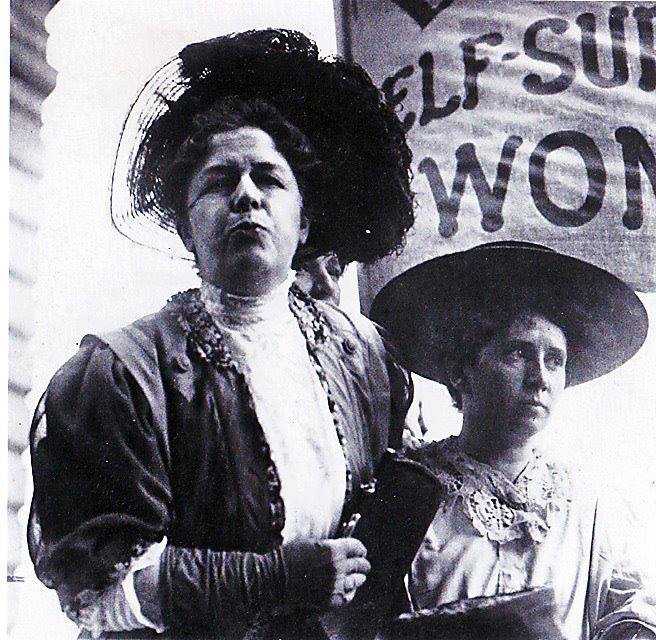
Harriot Stanton Blatch and six young suffragists invaded Manhattan’s financial district earlier today, and had much better success with its inhabitants than they did with the police.

Before even arriving at their first stop, the one-automobile procession down Broadway attracted a good deal of attention as a small crowd of newsboys, messenger boys and brokers’ clerks followed along behind the suffrage-yellow “Equality League of Self-Supporting Women” banner, held up by two of the machine’s passengers, attorneys Madeleine Zabriskie Doty and Helen Hoy.

When they reached Bowling Green Park, Blatch decided this was the perfect place to begin looking for converts. Telling the chauffeur to park along the curb, then standing up in her seat, she said, “You will not come to our meetings, so we have decided to come to you. All we ask is your attention while we tell you what it is we want, and why we should have it.”

But a police officer then rode up on his horse and asked for Blatch’s permit to hold a meeting. She didn’t think she needed one, as she had a right to free speech. The officer disagreed. Since her missionary zeal compelled a thorough exploration of this previously unpreached territory anyway, she agreed to move on, still accompanied by newsboys, messengers and clerks, plus a number of adults from the crowd.

Harriot Stanton Blatch, on the left, with Rose Schneiderman

Going even farther South, she eventually stopped in an alley near State and Pearl Streets, which soon became packed with listeners. This time it was 26-year-old union organizer Rose Schneiderman – in a pink dress, which the crowd definitely liked – who was chosen to do the speaking. Blatch kept an eye out for the law, and Florence Bradley distributed literature while Adelma Burd held up banners saying “COME, LET US REASON TOGETHER” and “VOTES FOR WOMEN.”

After receiving a number of greetings from members of the audience, such as “Hello, Pinkie!” Schneiderman addressed the crowd, as well as the hundreds of brokers in neighboring buildings who poked their heads out of windows to hear. She began by saying:

You say that men are far above women …(shouts of ‘Hurrah! Hurrah!’ from the crowd) … but we say that one is just as bad – I mean good – as the other, and therefore they should have equal rights in everything. Are the laws enforced in this country? No! You men have made a pretty bad job of it.

The crowd seemed to agree on that last point and shouted its approval.

Mary Coleman went next, but just as she said, “In this free, or supposedly free Republic …” a man in one of the upper floors of a nearby building got out the megaphone he uses to call orders down to curb runners, and tried to drown her out with hoots and catcalls. This made the crowd get even noisier. But after a while Coleman was able to be heard above the din and said:

Listen to me! You can hear hoots anywhere. Are things as they should be in this country? If they were, would we have [William Jennings] Bryan out in Denver declaring against all sorts of things? Would we have the Socialists shouting against our social order?” She finished by saying: “All we women want you men to do is to take us out of our swaddling clothes and free our minds.

Blatch then spoke, and asked her listeners if they knew “why we have the poorest city governments in this country of any civilized nation in the world?” Intuitively knowing the correct response at this point, the crowd shouted along with her: “Because we don’t let women vote!”

The success of this rally, and absence of police, encouraged the invaders to press on, this time to the Northeast. But they had apparently used up their day’s supply of luck, as attempted gatherings in front of the New York World (Pulitzer) Building, and at City Hall Park were immediately broken up by police. Still, it was quite an adventure, especially for the younger – but now a bit more experienced – members of the group. Though there are few “sure things” in the financial district, it’s a good bet that equal-suffrage supporters will be back, with or without permits.

July 9, 1978: Feminists Make History With Biggest-Ever March for the Equal Rights Amendment

Founding Feminists is FMF’s daily herstory column. We relish in the memories of feminist history by recapping all of its glorious milestones victories.

FoundingFeministLogo-color

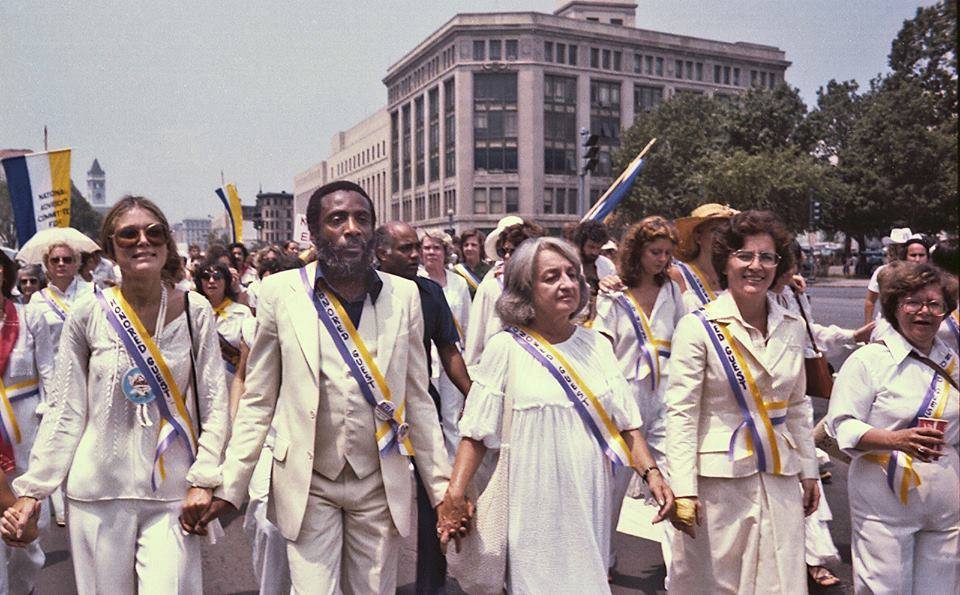
In the largest march for women’s rights in the nation’s history – nearly three times the size of the largest suffrage parade, and at least twice as big as the landmark August 26, 1970 march in New York – a hundred thousand supporters of equality took to the streets of Washington, D.C., today to call for an extension of the deadline for ratification of the Equal Rights Amendment.

The spectacle was as colorful as it was powerful, with over 325 delegations, representing a wide coalition of groups, displaying their names on purple, white and gold banners. Those were the colors of the National Woman’s Party, which in February, 1921, just six months after having played a major role in winning the struggle for the vote, began turning its efforts toward the next logical step of achieving “absolute equality.”

Appropriately, the first banner in today’s march paid tribute to the National Woman’s Party’s founder, and the author of the E.R.A.: “Alice Paul, 1885-1977.” This was followed by an antique trolley car carrying several veterans of the battle for “Votes for Women,” which ended successfully on August 26, 1920, after a 72-year effort. Numerous participants saluted the suffragists by dressing in white, as many had done in parades and pageants, plus other events such as the “Silent Sentinel” picketing of President Wilson from 1917 to 1919.

The unexpectedly large turnout overwhelmed everyone, from organizers who had to delay the start for 90 minutes, to police who suddenly had to close all of Constitution Avenue instead of just half. It was more than three hours after the start of the march that the last delegation finally made its way from the Mall to the rally on the West Steps of the Capitol. There the crowd heard 35 nationally known speakers tell why the E.R.A. is needed and that the battle can be won.

“This is just the beginning,” said Eleanor Smeal, president of the National Organization for Women, sponsor of the rally. She then said:

We are here because our hearts are here, our souls are here and our spirits long for liberty and justice. And we will not – we will not ever – accept a country in which we remain second-class citizens ! The E.R.A. – liberty for women – is not an idea. It is not just a hope. It is a spirit that lives in each one of us, and it can’t go away. We can’t go home to the 19th Century because we are going to march into the 21st ! So we will march, we will demonstrate, we will petition, we will write letters, we will work this summer like we have never worked before, and we will march into history. We will finish and complete the American dream. We will make real the promise of equality for all.

936072_10202777819830142_7961910370597552452_n

Other speakers and marchers expressed similar feelings. Esther Rolle, best known for her roles in the hit shows “Maude” and “Good Times,” said: “Congress better wake up. There will be political consequences if E.R.A. doesn’t get the support it should.” Patsy Mink, of Americans for Democratic Action agreed, saying: “If they dare to turn us down, we will turn them out on the next election day.” Rep. Elizabeth Holtzman (D-NY), sponsor of H.J.R. 638, which would extend E.R.A.’s present deadline of March 22, 1979, said: “Time is on our side and we will win !”

Eleanor Holmes Norton, of the Equal Employment Opportunity Commission asked:

“How will people look at us 50 years from now if Congress doesn’t even give us more time ? We look back on history and we wonder what all the fuss was about over an issue. The point of E.R.A. is to get people to recognize that change is already here. You see a 22-year-old girl with a cop’s hat and you know that 20 years ago, a girl the same age would have been a secretary in the police station.”

N.O.W.’s first president, Betty Friedan, marched along on this hot and humid day, and said: “It’s an incredible turnout. I don’t see how anybody could say there wasn’t support for E.R.A. with this crowd showing up in this weather.”

Eleanor Smeal had also noted the huge numbers for this event and the lack of anything comparable by “Stop E.R.A.” forces, when she said, to the delight of the audience: “Phyllis Schlafly – wherever you are – eat your heart out !”

Former N.O.W. presidents Wilma Scott Heide and Karen DeCrow were there to participate in N.O.W.’s largest event ever, ably coordinated by Jane Wells-Schooley, who had only weeks to turn a N.O.W. Board Resolution into a march and rally of truly historic proportions.

The campaign for the Equal Rights Amendment was formally kicked off by the National Woman’s Party on July 21, 1923, as part of its commemoration of the 75th anniversary of the Seneca Falls Women’s Rights Conference of July 19-20, 1848. The E.R.A. was introduced into the U.S. Senate on December 10, 1923 and into the House three days later. It was passed by Congress on March 22, 1972, following overwhelming approval by both House (354-24) and Senate (84-8). A seven-year deadline was set at the time, but as was first noted by law students and N.O.W. members Catherine Timlin and Alice Bennett, the deadline is not part of the text of the amendment, so it can be altered or deleted by a simple majority of Congress.

Thirty-five of the thirty-eight State ratifications needed occurred between March 22, 1972 and January 24, 1977. Had just EIGHT individual State Senators changed their votes, the E.R.A. would have gotten three more State ratifications and become part of the Constitution on March 1, 1977. (In 1975 an E.R.A. ratification resolution was passed by the Florida House and the Nevada House, but it came up three votes short in the Senate in both states. In 1977 the North Carolina House passed a ratification resolution, but it came up 2 votes short in the Senate.)

The American people are ready for equality, as public support for the E.R.A. stands at 64% according to a recent CBS/New York Times poll, and at 58% according to Gallup. The E.R.A.’s full text is:

“Section 1: Equality of rights under the law shall not be denied or abridged by the United States or by any state on account of sex.

“Section 2: The Congress shall have the power to enforce, by appropriate legislation, the provisions of this article.

“Section 3: This amendment shall take effect two years after the date of ratification.”

The extension resolution is currently being considered by the House Judiciary Committee, and a vote is expected soon. As many as 5,000 of today’s marchers are expected to stay overnight and then participate in Monday’s “Lobby Day” on Capitol Hill to keep up the momentum generated by today’s mass march.

Though time is short, and just 256 days remain until the original deadline expires, today’s turnout has caused a justifiable boost in optimism. There’s a universal consensus among the marchers that E.R.A. ratification is only a question of “when” or “how,” and not “if,” because as in the struggle for suffrage, there is no time limit on seeking equality, or on how long feminists are willing to work for that goal.

July 8, 1916: Alice Paul Pushes Presidential Nominee to Support Suffrage

Founding Feminists is FMF’s daily herstory column where we recap the news from way back when.

FoundingFeministLogo-color

Alice Paul is back in Washington, D.C., following a meeting with Republican Presidential nominee Charles Evans Hughes at the Hotel Astor in New York City.

10464174_10202771951003425_9106444620651000965_nPaul said today that she made it clear to Hughes that despite her dissatisfaction with Democrats, his party must work to earn her support and women’s votes in the eleven full-suffrage States of the West, as well as in Illinois, where women can vote for President.

“If the Republican Party continues to dream it has nothing to do but sit tight and profit by the Democratic mistakes in regard to the Susan B. Anthony Amendment,” she said this morning at the headquarters of the Congressional Union for Woman Suffrage, “it is destined to a sad awakening.”

Her forces are already organized in the Western States, and will try to influence the 4 million women voters there to support whichever party will do the most to help win nationwide woman suffrage via the Anthony Amendment:

Voting women will not accept a mere endorsement of the principle of suffrage. They are solely interested in the best method of protecting their own political rights and of emancipating the rest of their sex. The Republican Party wants the women’s votes. They are essential to the success of the party next Fall. But it will not receive them by default.

Though both the Republicans and Democrats passed pro-suffrage planks at their conventions this year, they endorsed only the State-by-State method, something totally unacceptable to Alice Paul and her Congressional Union for Woman Suffrage and newly-formed National Woman’s Party of Western Women Voters. Organizing of the women voters of the West began in April, when the Congressional Union sent speakers on a tour of Western States in a “Suffrage Special” railroad car. A second campaign tour to unite and energize those millions of women voters seems likely, and may be even more extensive and intense than the first.

Getting the active support of Charles Evans Hughes for the Susan B. Anthony (nationwide woman suffrage) Amendment would give it quite a boost. The former Governor of New York and recent Justice of the Supreme Court, who resigned his position on the High Court on June 10th when he won the Republican nomination for President, is highly respected by most Americans. But regardless of whether he actively works for suffrage, or becomes President, just the fact that he considers Alice Paul to be enough of a political force in this country to agree to a meeting with her despite his rigorous campaign schedule shows the power of the suffrage movement in general, and the growing influence of its militant branch in particular.

July 7, 1920: Democrats Turn the Tide on Suffrage

Founding Feminists is the FMF’s daily herstory column. We present the annals of women’s history with a newsroom twist.

FoundingFeministLogo-color

To the surprise of many long-time suffragists and political observers, it’s starting to look as if it may be Democrats, not Republicans, who will be responsible for the final step needed to put woman suffrage into the Constitution.

10322686_10202766404744772_2739118476496231807_nGovernor James Cox of Ohio, who officially became the Democratic nominee for President last night, today sent a telegram to the head of the Democratic State Committee of Louisiana urging reconsideration of that State’s recent rejection of the Susan B. Anthony (nationwide woman suffrage) Amendment. He said that “the Legislature owes it as a duty to the Democratic Party to ratify at once.” (Of the 35 States which have ratified thus far, 26 are controlled by Republicans, 6 by Democrats, and in three, one party controls the House and the other the Senate. Of the 9 States which have rejected ratification, 8 are Democratic.)

Alice Paul was quite pleased with Governor Cox’s enthusiasm, and noted that:

By taking action on the day following his nomination to secure ratification by a Southern State, Mr. Cox is making an excellent beginning. He is evidently striving to make the suffrage plank of his platform an actuality. If his efforts continue with sufficient vigor there is little doubt of ratification by at least one of three possible Democratic States – Louisiana, Tennessee and North Carolina.

Of course, the entire ticket needs to be working for the cause, and the National Woman’s Party intends to meet with the Democratic Vice-Presidential nominee, Assistant Secretary of the Navy Franklin D. Roosevelt of New York. Though not well-known nationally – or even to Governor Cox – Secretary Roosevelt was described by his running-mate today as a “vigorous, upstanding, courageous and progressive Democrat.”

Suffragists are not giving up on Senator Harding and the Republicans, however. It was announced this evening that Harding will meet with a delegation of National Woman’s Party officers on July 22nd, the day he is given formal notification of his Presidential nomination. He has been somewhat non-committal on the issue of suffrage over the years, but did vote in favor of the Anthony Amendment on October 1, 1918, when it was before the Senate. Harding has not been active in its support, but that’s something the National Woman’s Party intends to change, and as President Wilson can attest, the party can be quite assertive when it comes to the art of persuasion.

In other encouraging news about ratification, Governor Bickett of North Carolina announced that he will call a special session of the legislature for August 10th, and that he has telegraphed President Wilson that he will urge a favorable vote on ratification of the Anthony Amendment.

As might be expected, the “antis” are becoming ever more desperate as they see their chances to stop ratification slipping away. Today, Charles S. Fairchild filed suit in the Supreme Court of the District of Columbia on behalf of the American Constitutional League, seeking an injunction to restrain Secretary of State Colby from signing the proclamation of ratification if a 36th State approves, and to keep Attorney General Palmer from immediately enforcing what would become the 19th Amendment. Fairchild contends that West Virginia and Missouri ratified illegally, and that there are only 33 valid ratifications, with three more needed, not just one. But according to the National Woman’s Party:

We are convinced that, as in the Ohio referendum case, the validity of the action of the various State Legislatures in ratifying the suffrage amendment will finally be upheld by the courts. Anti-suffragists are evidently grasping at straws in their attempt through court proceeding to lengthen the suffrage struggle and to force the expenditure of more money and time by suffragists for the success of their cause.

The grounds cited for the injunction petition are matters already passed upon by the Attorney General and the Legislatures of the States concerned, and in the case of Tennessee also by the Acting Attorney General of the United States. By filing certificates of ratification with the Secretary of State these have completed in the manner prescribed by the Constitution the process of ratification of the Nineteenth Amendment and we believe that the court will uphold the validity of their action.

So, with the Louisiana Legislature in regular session now, and about to reconsider the Anthony Amendment, and the legislatures of Tennessee and North Carolina to meet in special sessions in August, that final, 36th State ratification – and the end of a 72-year struggle – may be anywhere from just a few days to a few weeks away!

July 4, 1876: Suffragists Present “Declaration of Rights of the Women of the United States”

Founding Feminists is FMF’s daily herstory column. Every day, we re-write the news that was fit to print.

FoundingFeministLogo-color

An eloquent and timely reminder that the American Revolution has brought liberty and equality to only some of its citizens over the past century became an unauthorized part of the nation’s Centennial celebration here at Independence Square in Philadelphia today.

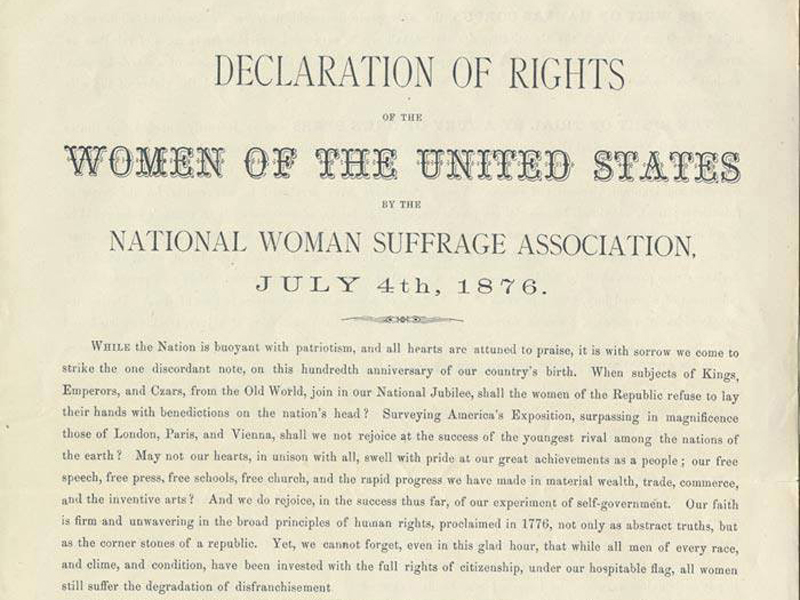
Susan B. Anthony, Matilda Joslyn Gage, Sara Andrews Spencer, Lillie Devereux Blake and Phoebe W. Couzins presented a “Declaration of Rights of the Women of the United States” – written by Anthony, Gage and Elizabeth Cady Stanton on behalf of the National Woman Suffrage Association – to a rather startled Senator Thomas Ferry. As President Pro Tempore of the Senate, he was the official representative of the United States Government at the ceremony due to President Grant’s inability to attend, and the vacancy in the office of Vice-President.

10462597_10202750051735957_5738780758358195327_n

Having accomplished their goal, the five protesters departed, and made their way to an empty platform, where Susan B. Anthony read the entire four-page document to a crowd that quickly gathered to hear her. She began her presentation by saying:

While the nation is buoyant with patriotism, and all hearts are attuned to praise, it is with sorrow we come to strike the one discordant note, on this one-hundredth anniversary of our country’s birth. When subjects of kings, emperors, and czars from the old world join in our national jubilee, shall the women of the republic refuse to lay their hands with benedictions on the nation’s head?

Surveying America’s exposition, surpassing in magnificence those of London, Paris, and Vienna, shall we not rejoice at the success of the youngest rival among the nations of the earth ? May not our hearts, in unison with all, swell with pride at her great achievements as a people; our free speech, free press, free schools, free church, and the rapid progress we have made in material wealth, trade, commerce and the inventive arts?

And we do rejoice in the success, thus far, of our experiment of self-government. Our faith is firm and unwavering in the broad principles of human rights proclaimed in 1776, not only as abstract truths, but as the cornerstones of a republic. Yet we cannot forget, even at this glad hour, that while men of every race, and clime, and condition, have been invested with full rights of citizenship under our hospitable flag, all women still suffer the degradation of disenfranchisement.

She then gave a comprehensive list of grievances women have against a government that practices taxation without representation, denies women the right to be tried a jury of their peers, and has passed numerous unequal codes and laws. She ended her presentation by saying:

And now, at the close of a hundred years, as the hour hand of the great clock that marks the centuries points to 1876, we declare our faith in the principles of self-government; our full equality with man in natural rights; that woman was made first for her own happiness, with the absolute right to herself – to all the opportunities and advantages life affords to her complete development; and we deny that dogma of centuries, incorporated into the codes of nations – that woman was made for man – her best interests, in all cases, to be sacrificed to his will. We ask our rulers, at this hour, no special favors, no special privileges, no special legislation. We ask justice, we ask equality, we ask that all the civil and political rights that belong to citizens of the United States, be guaranteed to us and our daughters forever.

The protesters had originally hoped that their declaration could be presented as an official part of the ceremony. The woman suffrage movement has now gained sufficient support and prestige that five of its advocates had been given official passes to observe the proceedings, and they thought a brief presentation would be at least a symbolic acknowledgment of women’s contributions to the nation over the past century. So, Elizabeth Cady Stanton wrote to General Joseph Hawley, head of the United States Centennial Commission, noting: “We do not ask to read our declaration, only to present it to the President of the United States, that it may become an historical part of the proceedings.”

General Hawley admitted that “Undoubtedly we have not lived up to our own original Declaration of Independence in many respects.” But after making the excuse that the program had already been set and could not be changed, he finally admitted the real reason for his refusal to allow the presentation: “I understand the full significance of your very slight request. If granted, it would be the event of the day – the topic of discussion to the exclusion of all others. I am so sorry to refuse so slight a demand; we cannot grant it.”

Their official passes – allowing them to closely witness, but not take part – in the ceremonies, got the suffragists within striking distance of the official representative of the Government. Then, as Richard Henry Lee finished reading the Declaration of Independence, and those in charge were momentarily distracted while preparing for the next speaker, the women quickly – and with an air of authority – marched to the front of the platform, and gave their declaration to an obviously startled Senator Ferry. They then began to exit the platform with great dignity, giving out numerous copies of their declaration to some of those on stage, and then to many in the crowd who eagerly sought to read it.

So, as befits a work-in-progress, there were two competing ceremonies earlier today to mark America’s Centennial. Men stood on one side of Independence Hall praising the nation’s accomplishments and looking back to 1776, while of the other side, Susan B. Anthony was reminding us of how much still needs to be done if we are to be a true democracy at the next such celebration in 1976.

June 19, 1873: Susan B. Anthony Advocates for Suffrage While On Trial for Voting

Founding Feminists is FMF’s daily herstory column. Today, in feminist history…

FoundingFeministLogo-color

Susan B. Anthony was as eloquent as she was defiant when sentenced earlier this afternoon by Judge Ward Hunt for “illegally” voting in last November’s General Election.

Though she was not allowed to speak during the two-day parody of justice masquerading as a trial, she was at least given the traditional right to address the Court before punishment was imposed. Judge Hunt first rejected a motion by her attorney for a new trial, to which her defense lawyer believed she was entitled, due to numerous examples of prejudice, including Hunt’s having directed the jurors to render a verdict of guilty yesterday.

The judge then asked if the prisoner had anything to say. She replied:

Yes, your honor, I have many things to say; for in your ordered verdict of guilty, you have trampled under foot every vital principle of our government. My natural rights, my civil rights, my political rights, are all alike ignored. Robbed of the fundamental privilege of citizenship, I am degraded from the status of citizen to subject; and not only myself individually, but all of my sex, and, by your honor’s verdict, doomed to political subjection under this, so-called, form of government.

Judge Hunt then told her he would not listen to any arguments her lawyer had already spent three hours presenting. She then said:

May it please your honor, I am not arguing the question, but simply stating the reasons why sentence cannot, in justice, be pronounced against me. Your denial of my citizen’s right to vote, is the denial of my right to consent as one of the governed, the denial of my right of representation as one of the taxed, the denial of my right to a trial by a jury of my peers as an offender against the law, therefore, the denial of my sacred rights to life, liberty, property, and ….

At this point Hunt interrupted her again, but she continued:

But your honor will not deny me this one and only poor privilege of protest against this high-handed outrage upon my citizen’s rights. May it please the Court to remember that since the day of my arrest last November, this is the first time that either myself or any person of my disenfranchised class has been allowed a word of defense before judge or jury …

Hunt told her to sit down and that the Court would not allow her to speak further. To no one’s surprise, she didn’t sit and she did speak:

All of my prosecutors, from the Eighth Ward corner grocery politician, who entered the complaint, to the United States Marshal, Commissioner, District Attorney, District Judge, your honor on the bench, not one is my peer, but each and all are my political sovereigns; and had your honor submitted my case to a jury, as was clearly your duty, even then I should have had cause to protest, for not one of those men was my peer; but, native or foreign born, white or black, rich or poor, educated or ignorant, awake or asleep, sober or drunk, each and every man of them was my political superior; hence, in no sense, my peer.

Even, under such circumstances, a commoner of England, tried before a jury of Lords, would have far less cause to complain than should I, a woman, tried before a jury of men. Even my counsel, the Honorable Henry R. Selden, who has argued my case so ably, so earnestly, so unanswerably before your honor, is my political sovereign. Precisely as no disenfranchised person is entitled to sit upon a jury and no woman is entitled to the franchise, so, none but a regularly admitted lawyer is allowed to practice in the courts, and no woman can gain admission to the bar – hence, jury, judge, counsel, must all be of the superior class.

Another interruption by the judge: “The Court must insist – the prisoner has been tried according to the established forms of law.”

Anthony replied:

Yes, your honor, but by forms of law all made by men, interpreted by men, administered by men, in favor of men, and against women; and hence, your honor’s ordered verdict of guilty; against a United States citizen for the exercise of ‘that citizen’s right to vote,’ simply because that citizen was a woman and not a man.

But, yesterday, the same man-made forms of law, declared it a crime punishable with $1,000 fine and six months imprisonment, for you, or me, or any of us, to give a cup of cold water, a crust of bread, or a night’s shelter to a panting fugitive as he was tracking his way to Canada. And every man or woman in whose veins coursed a drop of human sympathy violated that wicked law, reckless of consequences, and was justified in so doing.

As then, the slaves who got their freedom must take it over, or under, or through the unjust forms of law, precisely so, now, must women, to get their right to a voice in this government, take it; and I have taken mine, and mean to take it at every possible opportunity.

The now-exasperated judge made one more futile attempt to regain control of his courtroom, and said: “The Court orders the prisoner to sit down. It will not allow another word.” But she still had a number of choice words to say, and ignored the judge in the same way he had ignored her rights:

When I was brought before your honor for trial I hoped for a broad and liberal interpretation of the Constitution and its recent amendments, that should declare all United States citizens under its protecting aegis – that should declare equality of rights the national guarantee to all persons born or naturalized in the United States. But failing to get this justice – failing, even, to get a trial by jury not of my peers – I ask not leniency at your hands – but rather the full rigors of the law.

She then sat down, having made her point to the judge, as well as to the nation via the many reporters who were busily writing down her every word. Judge Hunt then ordered her to stand for sentencing: “The sentence of the Court is that you pay a fine of one hundred dollars and the costs of the prosecution.” Anthony then spoke for a final time:

May it please your honor, I shall never pay a dollar of your unjust penalty. All the stock in trade I possess is a $10,000 debt, incurred by publishing my paper – “The Revolution” – four years ago, the sole object of which was to educate all women to do precisely what I have done, rebel against your man made, unjust, unconstitutional forms of law, that tax, fine, imprison and hang women, while they deny them the right of representation in government; and I shall work on with might and main to pay every dollar of that honest debt, but not a penny shall go to this unjust claim. And I shall earnestly and persistently continue to urge all women to the practical recognition of the old revolutionary maxim, that ‘Resistance to tyranny is obedience to God.’

10405359_10202660928627935_3027761212702051662_nThough this particular skirmish in the battle for suffrage has ended without any extension of the franchise, it is by no means a setback, because the struggle for women’s equality, which is being waged on many fronts, has been reinvigorated. Women – and men – who are working nationwide for equal suffrage will certainly find their ranks increased as a result of what was said and done this day.

Regardless of what strategy – or combination of tactics – eventually brings total victory to the cause of woman suffrage, Susan B. Anthony’s courage in undertaking this protest, and her refusal to pay such an unjust fine, deserve praise and admiration by all those who believe in democracy. Though the judge could abuse his authority, and prevent even the illusion of justice from being dispensed in his tiny courtroom this week, he is powerless to stop this brilliant and dedicated advocate of suffrage from gaining a coast-to-coast audience for her flawless and compelling arguments when they are printed in the nation’s most influential newspapers.

In exactly one month, the movement for women’s rights will celebrate the 25th anniversary of that first gathering in Seneca Falls, New York, on July 19th and 20th, 1848. A great deal has been accomplished in just a quarter century, and the pace of progress is accelerating. Though none of the 37 States have yet been won for equal suffrage, women have voted on the same basis as men in the Territory of Wyoming since 1869 and in Utah Territory since 1870. There are now well-established suffrage organizations composed of experienced and talented individuals operating nationwide.

Virginia Minor, a suffrage leader in Missouri, is also trying to use the 14th Amendment to gain the vote for women, though she’s taking a different approach from Anthony. When Registrar Reese Happersett refused to allow Minor to register to vote on October 15th of last year, solely because she was a woman, she sued him. It may take a while to get there, but a victory for Minor in the Supreme Court could enfranchise women in all States and Territories overnight.

This week’s courtroom drama clearly shows that the second quarter century of the struggle for women’s equality will be at least as energetic and eventful as the first, and there can be no doubt that the day of victory is now considerably closer than it appeared to be just a year – or even a few hours – ago.

UPDATE : She never paid a penny of her $100 fine (equal to $ 1,951 today) but she did pay off all of her $10,000 debt (equal to $ 195,129 today.)

June 18, 1873: Susan B. Anthony Found Guilty of Voting in General Election

Founding Feminists if FMF’s daily herstory column. Each day, we cover an issue from the news the way we would have way back when.

FoundingFeministLogo-color

Susan B. Anthony has been found guilty of having “illegally” voted in last November’s General Election.

She was not convicted by a true jury of her peers, because women cannot serve on juries. Nor was she able to eloquently make her own case to the all-male jury, because the judge ruled in favor of the prosecution when the District Attorney said that as a woman “she is not competent as a witness in her own behalf.” Her conviction did not come after secret deliberations by an unbiased jury because Judge Ward Hunt, after hearing the evidence, directed the jurors to find her guilty. Even a defense motion to poll the jurors individually after they delivered their verdict was denied. Only the final act of this farce now remains, with sentencing scheduled for tomorrow.

10412034_10202655400889745_2027619014837721757_n

Her test of whether the 14th Amendment confers the vote upon women began on Friday, November 1st of last year when she, three of her sisters, and a number of other women went into a barber shop in the Eighth Ward of Rochester, New York, to register to vote in the 1872 General Election. Though it took an hour of debate with the Registrars – and the threat of suing them personally if she was refused the right to register – they finally did allow it. Four days later she came back to cast her vote. As she explained in a letter written to Elizabeth Cady Stanton on election night, November 5th:

Dear Mrs. Stanton:

Well, I have been & gone & done it!! — positively voted the Republican ticket — strait this a.m. at 7 O’clock — & swore my vote in at that — was registered on Friday & 15 other women followed suit in this ward — then on Sunday others, some 20 or 30 other women tried to register, but all save two were refused — all my three sisters voted — Rhoda De Garmo too — Amy Post was rejected & she will immediately bring action for that — similar to the Washington action — & Hon. Henry R. Selden will be our Counsel — he has read up the law & all of our arguments & is satisfied that we are right & ditto the Old Judge Selden — his elder brother. So we are in a fine state of agitation in Rochester on the question — I hope the morning’s telegrams will tell of many women all over the country trying to vote — It is splendid that without any concert of action so many should have moved here so impromptu.

Haven’t we wedged ourselves into the work pretty fairly & fully – & now that the Repubs have taken our votes — for it is Republican members of the Board — The Democratic paper is out against us strong & that scared the Dems on the registry board — How I wish you were here to write up the funny things said and done — Rhoda De Garmo told them that she wouldn’t swear or affirm — ‘but would tell the truth’ – & they accepted that.

When the Dems said my vote should not go in the box — one Repub said to the other — ‘What do you say Marsh?’ — ‘I say put it in!’ — ‘So do I,’ said Jones — and ‘we’ll fight it out on this line if it takes all winter’ — Mary Hallowell was just here — She & Mrs. Wllis tried to register but were refused — also Mrs. Mann the Unitarian minister’s wife — & Mary Curtiss — Catherine Stebbins’ sister — Not a jeer not a word — not a look — disrespectful has met a single woman — If only now all the Woman Suffrage Women would work to this end, of enforcing the existing Constitution — supremacy of national law over State law – what strides we might make this very winter — But — I’m awful tired — for five days I have been on the constant run — but to splendid purpose — so all right — I hope you voted too.

Affectionately —

Susan B. Anthony.

A warrant for Anthony’s arrest was issued on November 14th, after a Democratic poll watcher named Sylvester Lewis filed a complaint. She was charged with voting in a Congressional Election “without having a lawful right to vote and in violation of Section 19 of an Act of Congress.” The Enforcement Act carries a penalty of up to a $500 fine and three years’ imprisonment. Arrest by a U.S. Deputy Marshal followed on November 18th.

At a hearing on November 29th, before United States Commissioner William C. Storrs, she was questioned by her lawyer and able to state that she believed she had the right to vote, as authorized by the 14th Amendment, and therefore was not guilty of willfully and knowingly casting an illegal vote. Storrs nevertheless decided that she was probably guilty, so the case proceeded. On January 24th, a 20-man Grand Jury returned an indictment against her.

After her indictment, Anthony went on a speaking tour which proved so successful that in May, when the trial was supposed to begin, it was moved out of Monroe County because both the judge and the prosecutor agreed that there were probably not 12 local residents who would vote to convict. Anthony then went on another speaking tour, this time in Ontario County, where the trial was now to be held in the county seat of Canandaigua.

The trial began yesterday in a packed courtroom, with former President Fillmore among the spectators. Prosecutor Richard Crowley presented testimony from Inspector of Elections B.W. Jones that Anthony had cast a vote. Anthony’s defense attorney, Harry Selden, then called himself as a witness and testified that he had told her that “the laws and Constitution of the United States authorized her to vote, as well as they authorize any man to vote.” Since as a woman she was denied the right to testify, this was the only meaningful evidence given that she had believed what she was doing was legal. Though the prosecution brought out the fact that Selden had told her this after she had registered, it was still before she had voted, and illegal voting was the offense with which she had been charged.

Selden then gave three hours of testimony which noted that the “crime” with which Anthony was being charged would have been considered an honorable and praiseworthy act if she were a man; that the 14th Amendment prohibits abridging “the privileges or immunities of citizens of the United States,” and therefore she cannot be denied the right to vote by New York State; and that even if one disagrees with these arguments, the fact that she believed she was acting lawfully means she did not, as the act requires, deliberately commit an illegal act, and therefore is not guilty.

District Attorney Crowley spoke for two hours, but apparently everything beyond the minimal legal formalities was unnecessary. Immediately following the end of testimony, Judge Hunt took a piece of paper out of his pocket and read from his previously prepared opinion:

“The Fourteenth Amendment gives no right to a woman to vote, and the voting by Miss Anthony was in violation of the law … Miss Anthony knew that she was a woman, and that the Constitution of this State prohibits her from voting. She intended to violate that provision; intended to test it perhaps, but certainly intended to violate it … There was no ignorance of any fact, but all the facts being known she undertook to settle a principle in her own person. She takes the risk, and she ought not to shrink from the consequences.”

Everyone will be back in court again tomorrow, when Anthony hopes to make a statement before sentencing, and we will find out whether she shall face imprisonment or a fine, and if a fine, whether she will pay it.

June 17, 1904: International Council of Women Hears Arguments on Women’s Access to Higher Education

Founding Feminists is FMF’s daily herstory column where we tackle women’s history headline by headline.

FoundingFeministLogo-color

It’s been quite a day here in Berlin’s Philharmonic Hall, as delegates of Women’s National Councils from as far away as New Zealand assembled for an International Council of Women, the first such gathering since they last met in London five years ago.

Today, Martha Carey Thomas had the opportunity to address some of the current myths about women and education, then Susan B. Anthony, Rev. Anna Howard Shaw, and Carrie Chapman Catt told women around the world about the benefits which have resulted in the four U.S. States with equal suffrage.

Martha Carey Thomas, President of Bryn Mawr since 1894.

The myth that higher education is unhealthy or too difficult for women was demolished by Thomas, the current and second President of Bryn Mawr College. Speaking on “The University Education of Women in the United States,” she challenged theories such as that of Paul Broca, who believed that the brains of women were too small to intellectually compete with those of men. Then she attacked the popular notion that women were too weak for the rigors of college life by citing statistics showing that more men than women broke down from overwork in American colleges.

Thomas also noted that contrary to the assumptions of many, college women were just as interested in marriage as those who did not go to college. She then went on to attack the theory of Edward Clarke, who said that studying diverts blood from a woman’s reproductive organs to her brain, and can render her infertile. Thomas cited statistics showing that college educated wives actually had a higher number of children.

Catt said that the improvement in the character of the legislators in the four States where women can now vote (Wyoming, Utah, Colorado and Idaho) has been observed by everyone. As an example of specific legislation, she said that in Colorado, where women were enfranchised by male voters approving a Statewide suffrage referendum in 1893, the past 11 years have seen lawmakers pass the best laws in the world in regard to the protection of children. She then went on to address a popular myth in regard to the emancipation of women. Though opponents of woman suffrage allege that it is destructive to the family, Catt noted that the divorce rate in Wyoming, where women have had the vote longer than anywhere else, is lower than in other Western States where only men are eligible to vote.

The gathering is proving to be a great success, and has enabled many international friendships to be made, as well as campaign strategies to be shared. So, such events should occur on a regular basis until worldwide suffrage – and then total equality for women – is achieved.

June 16, 1937: Eleanor Roosevelt Confident That One Day A Woman Will Be President

Founding Feminists is FMF’s daily herstory column, in which we re-write the headlines of yore.

FoundingFeministLogo-color

One day a woman will be elected President! That’s the assurance of the woman who currently lives in the White House, Eleanor Roosevelt.

She expressed that view this evening in answer to a question from Constance Eberhardt, selected as being representative of those graduating from high school, and given the chance to talk with the First Lady on an NBC radio program.

But while Roosevelt thinks a woman will win the Presidency, it won’t be any time soon. She said she is sure that:

 …there will be a woman President some day, but that day is not yet here. We women still have to prove ourselves, and at the present moment I do not think the country as a whole would have enough confidence in a woman, and without that confidence and cooperation she could not do a good job. Before we have a woman President we will have to have more women Governors of the States, more women in the Senate, and in Congress. The women who have served in those capacities have done good jobs, but they are far too few to create the confidence necessary.

10390424_10202643887641921_1415608541613147284_nTwenty years after Jeannette Rankin, Republican of Montana, became the first woman to take a seat in Congress, and seventeen years after women were Constitutionally assured of their right to vote on the same basis as men, there are already many “firsts” in the record books and gains continue to be made. In the new 75th Congress there are five women in the House and one in the Senate, bringing the number who have ever served to twenty in the House and three in the Senate.
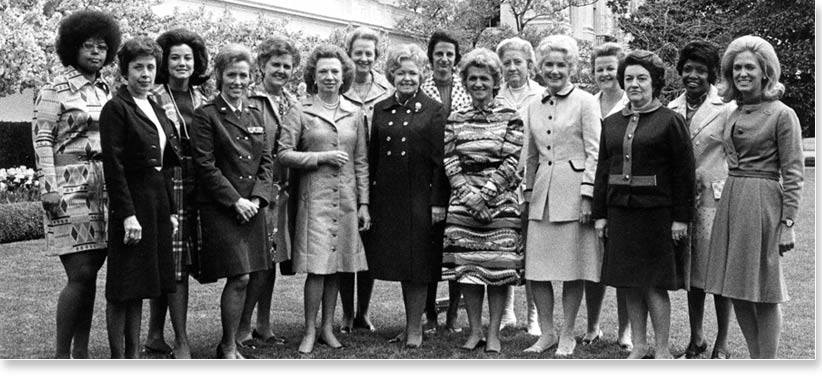
The first woman to serve in the Senate was Rebecca Latiner Felton of Georgia. She was appointed on October 3, 1922, to fill a vacancy caused by the death of Senator Thomas E. Watson. Between the time of her appointment and Congress reconvening on November 21st, Walter F. George won a special election, but postponed his own swearing in for a day so Felton could be a Senator for 24 hours. Hattie Caraway of Arkansas was appointed a Senator in 1931, then won a full term in 1932 and is expected to run again in 1938. Rose McConnell Long of Louisiana, widow of Huey Long, served from January, 1936 until January, 1937.

Two women have served as State Governors: Nellie Tayloe Ross of Wyoming and Miriam “Ma” Ferguson of Texas. Both were elected on November 4, 1924, with Ross being sworn in first. There have been no women governors since Ferguson’s second two-year term (1933-1935) ended.

Though electing a woman President may be a distant goal, the diplomatic corps is already open to women. As the First Lady noted during her radio interview: “We have sent women as diplomats to two foreign countries already.”

Former Member of Congress Ruth Bryan Owen Rohde, daughter of three-time Democratic Presidential nominee Wllliam Jennings Bryan, was Minister to Denmark from 1933 to 1936. Florence Jaffray Hurst Harriman, an active suffragist during the battle for the vote, was recently appointed as our Minister to Norway.

Even the President’s Cabinet is no longer an all-male institution, because Frances Perkins has been serving as Secretary of Labor since 1933. With so many barriers broken in just the past two decades, it can’t be many more until the last and most difficult barrier, that of the Presidency, falls!

June 9, 1970: Clarifications on Workplace Sex Discrimination Follow Report Detailing Widespread Effects

Founding Feminists is FMF’s daily herstory column where we cover the women’s issues of the day – from many days ago.

FoundingFeministLogo-color

Two long overdue developments today in regard to an Executive Order by a former President, and a Task Force appointed last year by the present Chief Executive.

Though it certainly took a while, guidelines have finally been issued specifying what kinds of sex discrimination in the workplace were barred by President Johnson’s Executive Order issued on October 13, 1967. The order required equal opportunity and treatment of women by contractors and subcontractors when they do business with the Federal Government, but it didn’t say exactly what constituted illegal treatment.

The new guidelines were issued by the Labor Department at a White House briefing, and they ban a number of common practices. Newspaper “Help Wanted” ads may no longer specify whether the employer is looking to fill the position with a man or a woman, unless it can be shown that gender is a “bona fide occupational qualification” for the job. It is also now illegal to penalize women for taking time off to give birth, or to bar mothers of young children from being hired unless fathers are similarly banned.
Specific job classifications may no longer be made off limits to women, and separate seniority lists based on sex are unlawful. Enforcement can begin immediately, and will be the responsibility of the Office of Federal Contract Compliance.

Unfortunately, establishing these guidelines are the only part of the 33-page report by the President’s Task Force on Women’s Rights and Responsibilities that President Nixon has accepted. The report itself was completed and submitted on December 15th, but was suppressed by the White House until today, though some parts of it have leaked out.

The Task Force, announced with great fanfare by President Nixon on October 1st of last year, and headed by Virginia R. Allan, gathered information about sex discrimination in the U.S., and made recommendations about how to end it in its report entitled “A Matter of Simple Justice.”

The President's Task Force on Women's Rights and Responsibilities. The Task Force was chaired by Virginia R. Allan, and the report was signed by Elizabeth Athanasakos, Ann R. Blackham, P. Dee Boersma, Evelyn Cunningham, Ann Ida Gannon, Vera Glaser, Dorothy Haener, Patricia Hutar, Katherine B. Massenburg, William C. Mercer, Alan Simpson and Evelyn E. Whitlow.
The President’s Task Force on Women’s Rights and Responsibilities. The Task Force was chaired by Virginia R. Allan, and the report was signed by Elizabeth Athanasakos, Ann R. Blackham, P. Dee Boersma, Evelyn Cunningham, Ann Ida Gannon, Vera Glaser, Dorothy Haener, Patricia Hutar, Katherine B. Massenburg, William C. Mercer, Alan Simpson and Evelyn E. Whitlow.

In a cover letter accompanying the report and sent to the President, Nixon was asked to use his influence on behalf of “the more than half our citizens who are women and who are now denied their full legal and Constitutional rights.” The Task Force noted that “an abiding concern for home and children” should not cut women off from “the freedom to choose the role in society to which their interest, education, and training entitle them.” The letter also said that “The United States, as it approaches its 200th anniversary, lags behind other enlightened and indeed some newly emerging countries, in the role ascribed to women.”

Among other things, the Task Force recommended establishing a permanent Office of Women’s Rights and Responsibilities, whose director would report directly to the President, passage of the Equal Rights Amendment, having the President send a special message to Congress calling for new laws against gender bias, and increased assistance in regard to child care for women who work outside the home.

Coincidentally, the results of a 56-question survey about workplace discrimination were released today by the American Association of University Women. Of the 4,173 women and 3,001 spouses and male workplace colleagues who returned the surveys, 84% of the women and 77% of the men said that they believed women still suffer from discrimination in the workplace. 60% of men, but only 43% of the women, still think that a woman’s prime role is that of wife and mother.

Clearly, even as the 50th anniversary of the passage of the 19th Amendment approaches, a lot of work still needs to be done to achieve full equality for women.

June 6, 1920: Republican National Convention Picket Plans Underway

Founding Feminists is FMF’s daily herstory column. We bring feminist history to life with news-style reporting of milestones from years past.

FoundingFeministLogo-color

Alice Paul has been busy since arriving in Chicago, and today announced specific plans for picketing the Republican National Convention, which starts here day after tomorrow.

In keeping with the tradition of the “Silent Sentinels” who picketed President Wilson, there will be no heckling. As before, the messages of the National Woman’s Party will be made quite clear by being written on large, colorful banners.

More than a hundred women representing twenty-two States will be outside the convention hall each day. They will be bearing banners with the names of their States, and slogans intended to pressure party leaders into using their influence to persuade the Republican governors of Connecticut and Vermont to call special sessions of their legislatures so that one of those States can become the 36th and final one needed to ratify the Susan B. Anthony Amendment and enfranchise women nationwide.

Though the pickets are expecting both parties to put endorsement of the Anthony Amendment into their platforms for the first time this year, mere words will have no effect whatsoever on the protests, because words alone cannot satisfy the Constitutional requirements for ratification. Only the approval of 36 of the 48 State Legislatures can do that, and thus far just 35 have given their endorsement since June 4, 1919, when the amendment gained final Congressional approval.

A banner to be used in the picketing of the Republican Convention. From left to right: Abby Scott Baker, Florence Taylor Marsh, Sue White, Elsie Hill and Betty Gram.

Suffrage headquarters, directly across the street from the Coliseum, where the convention will be held, was crowded, and a beehive of activity today. Even though most of the volunteers have not even arrived yet, some meetings had to be held out on the sidewalk due to lack of room. But though this outpouring of enthusiasm is sure to cause many logistical problems, that’s certainly preferable to a sparsely populated office due to apathy, or overconfidence that ratification before the November 2nd Presidential election is inevitable.

The picket line will be led by suffrage pioneer Rev. Olympia Brown, 85 years old, who along with another elder suffragist, Anna Kendall, will be holding a banner inscribed: “How long must women wait for liberty?” These were the final public words of the late Inez Milholland Boissevain, who collapsed on stage during a grueling speaking tour of the West in 1916, and never recovered.

The main banner to be used will carry the following inscription: “We protest against the continued disenfranchisement of women, for which the Republican Party is now responsible. The Republican Party defeated ratification in Delaware. The Republican Party is blocking ratification in Vermont. The Republican Party is blocking ratification in Connecticut. When will the Republican Party stop blocking suffrage?”

Another featured banner notes that women can already vote in some States: “Republicans: Twenty million unenfranchised women ask you for the vote. Seven million women who can vote for Congress and the President are waiting for your answer to them.”

Pickets from Connecticut and Vermont will carry banners saying: “The Republican governors of Connecticut and Vermont refuse to call our legislatures, ready to ratify suffrage at a special session. Will the Republican Party allow two men to prevent the enfranchisement of 20,000,000 women?”

Though National Woman’s Party pickets have repeatedly proven themselves willing to go to jail in the past, it is not expected that there will be any repetition here of the arrests that took place in Washington, D.C., during the campaign against President Wilson. According to one suffrage leader, Police Chief Garrity “is a suffragist, even though he is a bachelor.”

There is still hope the upcoming confrontation can be avoided, and that Republicans can still preserve their reputation as the party of suffrage. Last year, Republicans gave the Anthony Amendment 81.8% support in the U.S. Senate and 91.3% support in the House, providing the votes needed to put the measure over the 2/3 supermajority required since Democrats gave it only 54% support in the Senate and 59.8% support in the House. Since then, 26 of the 35 States which have ratified had Republican majorities in their legislatures.

If Republican leaders use their influence to get the Republican governor of an unratified State to call an immediate special session of the legislature, and it then provides the 36th and final ratification needed, there will be jubilant, cheering suffragists surrounding the Coliseum instead of silent, solemn pickets. But until that final victory is achieved, every tactic that has been successfully used to get the amendment this far will be employed, and no one will be letting up in their efforts until the Secretary of State certifies that the following words are in the U.S. Constitution:

The right of citizens of the United States to vote shall not be denied or abridged by the United States or by any State on account of sex. Congress shall have power to enforce this article by appropriate legislation.

June 5, 1916: Rival Suffrage Groups Take Different Paths to Achieve Bipartisan Support for Women’s Vote

Founding Feminists is the FMF’s daily herstory column. We take a look back every day into what happened that day in feminist history.

FoundingFeministLogo-color

An exciting week and a half of activity began today as members of two rival suffrage organizations arrived in Chicago.

Both are planning on heavily lobbying the Republicans at their national convention here this week, then doing the same with the Democrats at their convention in St. Louis from June 14th to 16th, with the goal of getting both parties to include woman suffrage planks in their platforms.

The National American Woman Suffrage Association and the Congressional Union for Woman Suffrage are working hard to win the vote for women nationwide, but are taking radically different paths to achieve their mutual goal. Probably the most obvious difference between the two approaches can be seen by the fact that one task of Alice Paul’s Congressional Union over the next few days will be to organize a new political party made up entirely of women.

Now that women vote in almost 1/4 of the States, they can become a meaningful force in politics. As keynote speaker Maud Younger noted when the Congressional Union convention kicked off this morning:

With the formation of the Woman’s Party a new force marches on the political field, a new cry rings out in the national campaign. For the first time in a Presidential election the voting women are a factor to be reckoned with. The Woman’s Party has no candidates, and but one plank, the enfranchisement of the women of America through Federal Amendment. There is no higher service for which we can use our votes. With enough women in each State organized to hold the balance of power, the women voters may determine the Presidency of the United States.

Ann Martin summarized the party’s purpose: “The object of our party is not to create sex antagonism. It has no fantastic vision of sex solidarity. It is simply an organization of the 4,000,000 voting women in the suffrage States who place equal suffrage before the interests of any political party.”

Ann Martin (far left) and Sara Bard Field (far right) pose behind the "Great Demand" banner of the Congressional Union for Woman Suffrage.
Ann Martin (far left) and Sara Bard Field (far right) pose behind the “Great Demand” banner of the Congressional Union for Woman Suffrage.

Alva Belmont, arriving today from New York, is not only a strong supporter of the new party, but quite optimistic about feminism’s future in general:

I am sure that the Susan B. Anthony Amendment will be passed within the next year. Before that great goal is reached the women of New York City will have placed New York among the suffrage States. The women of that city have been making great headway, and immediate access is bound to be the result of their wonderful fight … A new woman’s world is about to be created. From this day forward this history of the woman movement throughout the world will be one of emancipation and entrance into the councils of nations.

Not wanting to be eclipsed by their younger and more militant rivals, the National American Woman Suffrage Association has some big plans as well. Day after tomorrow it will hold a mass march down Michigan Avenue as a way of pressuring the Republican Convention to adopt a woman suffrage plank.

Once the Republican Convention closes on the 10th, suffrage forces plan on trekking South to St. Louis to lobby Democrats for a suffrage plank when their convention opens on the 14th. Getting both parties on record in favor of nationwide woman suffrage could be of great help in regard to upcoming State referenda and in getting Congress to pass the Anthony Amendment, so every possible effort will be made by suffrage groups at both conventions.

June 4, 1919: Women’s Suffrage Amendment Headed to States for Ratification

Founding Feminists is the FMF’s daily herstory column. Once a day, we head back in time to see what was happening way back when.

FoundingFeministLogo-color

The unprecedented elation expressed by suffragists in the Senate gallery earlier today has now spread nationwide, along with the news of the biggest victory so far in the history of the movement for women’s rights.

41 years after the Susan B. Anthony Amendment was first introduced into Congress for the purpose of winning the vote for women nationwide, today’s Senate vote of 56 to 25 finished the process of gaining approval by 2/3 of both Houses of Congress, and sends the proposed 19th Amendment to the States for ratification.

In recognition of their many decades of work for the measure, representatives of the National American Woman Suffrage Association were invited to be present when House Speaker Frederick Gillett signed the suffrage bill, then the gold pen he used to sign it was presented to N.A.W.S.A. Tomorrow, Vice-President Thomas R. Marshall is expected to sign on behalf of the Senate.

The final step to victory was the targeting of anti-suffrage Senators in the November elections, reducing their number enough in the new Congress to turn the measure’s previous narrow defeats into a two-vote victory today. But though opponents knew they were fighting a losing battle, they kept putting up every imaginable roadblock, from a filibuster to numerous attempts to add “riders” to the amendment as a last ditch strategy to dilute its power or delay passage.

Speaker of the House Frederick H. Gillett signing the suffrage resolution, surrounded by members of the National American Woman Suffrage Association and leading pro-suffrage members of the House.

One example from yesterday clearly illustrated why the Southern wing of the Democratic Party has been so vehemently opposed to the Anthony Amendment, and held up its passage for so long. Senator Pat Harrison of Mississippi offered a rider that would make the suffrage amendment apply to white women only. It was rejected 58 to 17. When segregationists were unable to accomplish their goal that way, Senator Edward James Gay of Louisiana tried another approach: Change the section which gives Congress the power to enforce the amendment to one which leaves enforcement to State Legislatures. This, of course, would have reassured those who are still ignoring the 15th Amendment that they would be free to do the same with the 19th. His proposal was defeated 62 to 19, and so the race-neutral wording endorsed by all suffrage groups, composed by Susan B. Anthony herself in 1875, and already passed twice by the House, was preserved intact.

It reads:

Section 1: The right of citizens of the United States to vote shall not be denied or abridged by the United States or by any State on account of sex.

Section 2: Congress shall have the power to enforce this article by appropriate legislation.

When the final four-hour debate was over, and the five-minute standing ovation from the Senate gallery after the vote had died down, the hard job of gaining ratification by 36 of the 48 State Legislatures began immediately. Fortunately, a proposal by Senator Oscar Underwood, Democrat of Alabama, which would have required that the amendment be submitted to State Constitutional Conventions, rather than State Legislatures, was rejected 55 to 28, because this would have made the ratification process considerably longer and more cumbersome.

Suffrage leaders are as confident that 36 approvals can be obtained before the 1920 Presidential election as anti-suffragists are that they can get at least one house in each of 13 State Legislatures to permanently stand against nationwide woman suffrage. The opposition would literally have to be permanent to stop the amendment, since there is no time limit on how long the States have to ratify, a restriction uniquely applied to the 18th Amendment.

Alice Paul, already on the road and campaigning for ratification in Minnesota, and who along with other National Woman’s Party members braved arrests, jail brutality, hunger strikes and force-feedings as part of a successful campaign to get President Wilson to finally endorse and then work for the Anthony Amendment, said today:

Women who have taken part in the long struggle for freedom feel today the full relief of victory. Freedom has come not as a gift but as a triumph, and it is therefore a spiritual as well as a political freedom which women receive ….There is no doubt of ratification by the States. We enter upon the campaign for special sessions of the Legislatures to accomplish ratification before 1920 in the full assurance that we shall win.

Carrie Chapman Catt, President of the National American Woman Suffrage Association since 1915, said from New York City:

The last stage of the fight is to obtain ratification of the amendment so women may vote in the Presidential election of 1920. This we are confident will be achieved … In the result we can turn our backs today upon the end of a very long and arduous struggle needlessly darkened and embittered by the stubbornness of a few at the expense of many. ‘Eyes front’ is the watch word now as we begin another struggle, short, as the other was long, the struggle for ratification.

The ratification campaign is complicated by the fact that opponents succeeded in delaying Congressional approval so long that many State Legislatures which began meeting earlier this year have either already adjourned, or are about to, and therefore special sessions will have to be called by State governors in order to gain some of the necessary approvals before the legislatures reconvene for their next regular sessions in 1921.

But the power and political sophistication now being exercised by the National Woman’s Party and the National American Woman Suffrage Association seem equal to the task. In the same way that credit should be shared for getting the measure this far, both groups – and their radically different tactics – should soon be dividing up the credit for ratification of what now seems certain to become the 19th Amendment.

June 3, 1920: Suffragists to Protest Republican National Convention

Founding Feminists is FMF’s daily herstory column. Each day, we serve up our take on the feminist headlines of yore.

FoundingFeministLogo-color

Alice Paul arrived in Chicago today, and immediately announced that there would be women picketing outside the Republican National Convention each day that it’s in session here next week unless a 36th – and final – State ratification is obtained for the Susan B. Anthony Amendment.

The proposed 19th Amendment reads:

The right of citizens of the United States to vote shall not be denied or abridged by the United States or by any State on account of sex. Congress shall have power to enforce this article by appropriate legislation.

Paul is aware of the fact that a resolution supporting the Anthony Amendment will be passed by the delegates, but said:

We are not content with words on suffrage which are not backed by party pressure. We are protesting against the continued disenfranchisement of women, for which the Republican Party has now become responsible, and are demanding that the Republican Party secure ratification immediately in one more State, so that millions of women may vote in the Presidential election.

Members of the National Woman's Party standing outside their national headquarters in Washington, D.C., displaying one of the banners they were about to pack up and take with them to next week's 1920 Republican National Convention. Alice Paul is standing above the word "woman" in the banner, which reads: " 'No self respecting woman should wish or work for the success of a party that ignores her sex.' Susan B. Anthony 1872 and 1894."
Members of the National Woman’s Party standing outside their national headquarters in Washington, D.C., displaying one of the banners they were about to pack up and take with them to next week’s 1920 Republican National Convention. Alice Paul is standing above the word “woman” in the banner.

It had been hoped that the Republican-controlled Delaware Legislature would have ratified by now, but yesterday the Delaware Assembly refused by 24-10 to even vote on the ratification resolution, then it adjourned for the year. In Vermont and Connecticut, there are believed to be enough votes in their State legislatures to ratify, but because both have already ended their regular sessions, they can only meet again this year if called into “special session” by their Republican governors, and both have refused to issue the call, despite intense lobbying.

It’s as ironic as it is frustrating that the party which has done by far the most for suffrage is now starting to be seen as the party blocking it just short of victory. The Anthony Amendment was first introduced into Congress by Republican Senator Aaron Sargent of California on January 10, 1878. When the amendment was passed for the second time by the House on May 21, 1919, the vote was 102 Democrats in favor and 70 opposed, their support level of 59% falling short of the 2/3 needed. But 200 Republicans voted in favor, and just 19 were opposed, so their 91% support pushed the measure to well over the 2/3 needed. The final vote was 304-89, 42 votes more than the 262-131 required for passage by the 393 members present and voting, with 1 Farmer-Labor Party member and 1 Prohibitionist Party member providing two of the favorable votes.

When the Senate voted on the Anthony Amendment on June 4, 1919, there were 20 Democrats in favor and 17 opposed (54% support) with 36 Republicans in favor and 8 against (81.8% support) giving the measure two votes more (56-25) than was needed for passage by 2/3 (54-27) of the 81 Senators present and voting.

Once passed by Congress, the Anthony Amendment went to the 48 State Legislatures for ratification. The Constitution requires approval by 3/4, which works out to 36. Of the 35 which have ratified so far, 26 have Republican legislatures, 6 are Democratic, and in the remaining 3, one party controls the Lower House, the other the Upper House.

Reaffirming its strong and traditional support for equal suffrage, the Republican National Committee passed the following resolution just two days ago:

Whereas, the Republican National Committee at its regular meeting has repeatedly indorsed woman suffrage and the Nineteenth Amendment to the Constitution of the United States, and has called upon Congress to pass, and the States to ratify such amendment; and

Whereas, such amendment still lacks ratification by a sufficient number of States to become law, therefore be it

Resolved, By the Republican National Committee, that the Nineteenth Constitutional Amendment be, and the same is hereby again indorsed by this committee, and such Republican States as have not already done so are now urged to take such action by their Governors and their legislators as will assure the ratification of such amendment and establish the right of equal suffrage at the earliest possible time.

But an Anthony Amendment with only 35 ratifications wins the vote for no one, so the pressures and tactics which have gotten suffrage this far must be kept up, and even increased as registration deadlines in States where women cannot presently vote approach. According to Alice Paul, ten thousand letters have been sent by the National Woman’s Party to suffrage supporters in and around Chicago asking them to take part in the upcoming protest. So when the Republican Convention opens on June 8th, delegates and party leaders may have to walk through quite a large number of picketers, all asking why the party is giving the appearance of support for Constitutionally banning sex discrimination at the ballot box, but not providing ratification by a 36th State for an amendment that would guarantee that result.

>