Tennessee Governor Signs Bill Allowing Criminalization of Pregnant Women

Tennessee Governor Bill Haslam signed into law yesterday a bill that will allow criminal charges to be brought against women who suffer from drug-related pregnancy complications – legislation which advocates fear will deter women with addiction from seeking out resources and could even be interpreted more broadly to criminalize non-drug related complications.

via Shutterstock
via Shutterstock

“Today, the Tennessee governor has made it a crime to carry a pregnancy to term if you struggle with addiction or substance abuse,” said Alexa Kolbi-Molinas, staff attorney with the ACLU Reproductive Freedom Project, in a statement. “This deeply misguided law will force those women who need health care the most into the shadows. Pregnant women with addictions need better access to health care, not jail time.”

SB 1391 would permit women to be charged with assault – theoretically up to the point of aggravated assault, which incurs a maximum penalty of 15 years in prison – if they have pregnancy complications after using illegal drugs or deliver children with “neonatal abstinence syndrome.” According to RH Reality Check, the bill will also single out users of illegal street drugs, even though prescription painkillers are involved in 41 percent of Tennessee cases when infants are born with addiction.

The original bill allowed women to be charged with homicide if the fetus or baby died, but was later amended. The bill was also amended to give women the option of abandoning all charges if she voluntarily enters an approved treatment program. However, advocates say the bill itself will discourage those women from seeking care in the first place. Medical associations like the American Medical Association and American Academy of Pediatrics have spoken out against these types of bills because they push women out of the health care system for fear of prosecution. Due to its vague language, advocates have expressed that it could cause investigations to occur whenever women suffer from complications, regardless of drug use.

Tennessee is the only state to successfully pass legislation allowing criminal prosecution of pregnant women based on the outcome of her pregnancy, although other states have attempted to codify the practice and have successfully used similar logic to win court casesAccording to the Guttmacher Institute [PDF], 17 states consider substance abuse during pregnancy to be child abuse, and 3 consider it grounds for civil commitment. 15 states require health care professional to report suspected drug abuse by pregnant women, and 4 require subsequent drug testing. However, only 18 states have drug treatment program that target women, only 10 provide pregnant women with priority access to state-funded programs, and only 4 prohibit discrimination against pregnant women in those programs.

Media Resources: ACLU 7/6/10, 4/29/14; RH Reality Check 4/29/14; Tennessee Senate; Feminist Newswire 4/11/14

Google Removes Misleading Crisis Pregnancy Center Ads

feature image via Shutterstock.

In response to a campaign by NARAL Pro-Choice America, Google has removed deceptive crisis pregnancy center (CPC) advertisements from its search engine results when users seek information about abortion services.

10329141_10152369757054321_1395968204872427967_n

An investigation by NARAL found that 79 percent of the CPCs advertising on Google misrepresented their services by claiming they provided abortions when they did not; they only provided counseling services and information about alternatives to abortion. Crisis pregnancy centers have been found to purposefully use inaccurate medical information, false statements, and emotional manipulation to dissuade women from receiving abortion care. These ads have now been taken down for violating Google’s advertising policy that ads must be truthful and accurate.

“Anyone looking for abortion services should be able to depend on their search engine to provide them with accurate resources,” said Ilyse Hogue, President of NARAL. “Anything less is aiding and abetting ideologically driven groups with a calculated campaign to lie to and shame women making one of the most important decisions of our lives.”

TAKE ACTION: Check out Feminist Majority Foundation’s Feminist Campus Campaign to Expose Fake Clinics.

Media Resources: NARAL Pro-Choice America 4/28/14; The Washington Post 4/28/14; Feminist Campus Campaign to Expose Fake Clinics

White House Campus Sexual Assault Task Force Releases First Report

The White House Task Force to Protect Students from Sexual Assault released its first report today, detailing steps the Task Force will take to identify the scope of the problem of sexual assault on college campuses, help prevent it, and support survivors on college campuses.

via Shutterstock
via Shutterstock

“The Administration is committed to putting an end to this violence,” the fact sheet for the report says.

To compile “Not Alone: The First Report of the White House Task Force to Protect Students from Sexual Assault,” The Task Force used recommendations it gathered from a wide variety of people during a 90-day review period.

To help schools identify the extent of the problem on their campuses, the Task Force will provide them with toolkits for conducting a survey about the campus climate around sexual assault. “As we know, campus sexual assault is chronically underreported – so victim reports don’t provide a fair measure of the problem,” the report says. “A campus climate survey, however, can.”

Among other actions, the Centers for Disease Control and Prevention (CDC) and the Justice Department’s Office on Violence Against Women will pilot and evaluate sexual assault prevention strategies on campuses. The Task Force will provide specialized training for school officials and give schools guidance on how to improve their investigative and adjudicative protocols. It will also make federal enforcement efforts more transparent and clear with the launch of a new website: www.NotAlone.gov.

President Obama created the Task Force in January and released an initial report that found 1 in 5 women have been sexually assaulted in college, but only 12 percent of student victims report the assault. The most recent report comes at a time when dozens of schools have been placed under federal investigation for mishandling sexual assault cases on campus.

TAKE ACTION: To get involved in preventing sexual assault on your campus, check out Feminist Majority Foundation’s Feminist Campus Campaign to End Campus Sexual Violence.

Media Resources: The White House; Feminist Newswire 3/6/14, 4/18/14

Florida Governor Expected to Sign Fetal Homicide Bill

The Florida Senate voted 25-14 last week to pass a bill making it a separate crime to kill or harm a fetus while committing a crime against a pregnant woman. Florida Governor Rick Scott is expected to sign it.

via Shutterstock
via Shutterstock

Under current Florida law, a person can already be charged with manslaughter or murder if he or she kills a viable fetus. But this new bill, HB 59, expands the penalties to include causing injury or death to a fetus at any stage of development, starting with conception.

At least 38 states have enacted some type of fetal homicide law, and 23 of those laws apply to the earliest stages of development. Supporters of these laws usually promote them as a way to curb violence against pregnant women. The Florida bill was reportedly a response to a woman who lost her pregnancy after a boyfriend tricked her into taking an abortion pill; the now ex-boyfriend was sentenced to 14 years in prison for drug-tampering. But, fetal homicide laws, by creating independent rights for fetuses separate from pregnant women, have proved to be a dangerous proposition.

States have used fetal homicide laws, like the one is Florida, to criminalize pregnant women or poor pregnancy outcomes. National Advocates for Pregnant Women has asserted that since 2005, there have been more than 200 arrests of women based on arguments that purport to treat fetuses separate from pregnant women. Consider Bei Bei Shuai, who in 2012 was charged with fetal murder after Shuai, who was 33 weeks pregnant, attempted suicide.

More recently, Alicia Beltran was arrested after after she sought early prenatal care and told health care workers about her prior use of painkillers and her attempts to stop using on her own. Instead of receiving support, a court ordered Beltran to be detained at an inpatient drug treatment program two hours from her home. Despite her loss of liberty, Beltran did not have an attorney at her initial court appearance; but her fetus did.

Media Resources: Florida House of Representatives; RH Reality Check 4/24/14; Associated Press 4/23/14; Feminist Newswire 10/4/13, 4/11/14

Afghanistan May Hold Runoff Presidential Election

Preliminary results for Afghanistan’s recent presidential election were released on Saturday, showing that former Foreign Minister Abdullah Abdullah and former Finance Minister and World Bank economist Ashraf Ghani Ahmadzai are the top contenders.

via Shutterstock
via Shutterstock

The Afghan Independent Election Commission (IEC) announced that Abdullah Abdullah, who lost the election in 2009 to outgoing president Hamid Karzai, won 44.9 percent of the vote.  Ashraf Ghani came in second with 31.5 percent. The preliminary results are not expected to be finalized until May 14, after the Afghan Electoral Complaints Commission (ECC) has had an opportunity to complete investigations into fraud complaints. However, under Afghan law, if no candidate wins more than 50 percent of the vote, then a runoff election must be held.

“According to our findings it seems that this election will go to the second round,” said election commission chairman Ahmad Yousuf Nouristan. “We have a tentative schedule of June 7th to start the second round.”

The IEC also announced that 36 percent of voters in the April 5 elections were women, confirming strong participation by women in these elections despite the threat of violence. Overall, some 7 million Afghan men and women voted in the historic elections.

The April 5 elections represent the beginning of the first democratic shift in presidential power in Afghanistan. President Hamid Karzai has served as president of the country since the collapse of the Taliban in 2001. Both Abdullah Abdullah and Ashraf Ghani have supported a continuing relationship with the United States and have indicated that they would sign the bilateral security agreement negotiated between the two countries. President Karzai has delayed signing the agreement, preferring to wait until after the elections.

Media Resources: Independent Election Commission of Afghanistan 4/26/14; TOLO News 4/26/14; Associated Press 4/26/14; The New York Times 4/26/14; Feminist Newswire 11/27/13, 4/7/14

Mississippi Governor Signs 20-Week Abortion Ban Into Law

Mississippi Governor Phil Bryant signed a bill into law yesterday that bans abortion 20 weeks after a woman’s last menstrual period, effectively at only 18 weeks.

via Shutterstock
via Shutterstock

“With the women and families of their state facing extreme poverty, unacceptable rates of maternal mortality, and skyrocketing teen pregnancy, Mississippi’s elected officials have more than enough real work to do to bolster women’s well-being in their state,” said Nancy Northrup, CEO of the Center for Reproductive Rights, in a statement. “It’s time for these politicians to stop passing laws that attack constitutionally protected women’s health care and finally focus on policies that would support the health, lives, and rights of Mississippi women and families.” 

HB 1400 includes only a narrow exception for medical emergencies or fatal fetal abnormalities, and has no exception for pregnancy by rape or incest. Physicians who break the law, which goes into effect on July 1, could lose their medical license.

Several other state legislatures have passed similar 20-week abortion bans or other anti-choice measures. Many have been blocked by the courts for unconstitutionally banning abortion before fetal viability, usually around 24 weeks. West Virginia’s governor vetoed a 20-week ban earlier this month because of legal and privacy concerns.

Media Resources: RH Reality Check 4/23/14; Times Free Press 4/23/14; Center for Reproductive Rights 4/23/14; Mississippi Legislature; Planned Parenthood Southeast 2/13/14; Feminist Newswire 5/23/13, 3/10/14, 4/2/14

Supreme Court Upholds Michigan Affirmative Action Ban

The Supreme Court yesterday upheld a Michigan state constitutional ban on affirmative action for women and minorities in public education, employment, and contracting.

via Shutterstock
via Shutterstock

The decision in Schuette v. Coalition to Defend Affirmative Action, Integration and Immigrant Rights and Fight for Equality By Any Means Necessary (BAMN) did not address the constitutionality of affirmative action itself. Instead, the Court focused on whether an amendment banning the practice violated the Equal Protection Clause of the US Constitution. And a majority of the Court found that it did not.

BAMN argued that the amendment prevented women and minorities from using the political process to push for one specific policy: affirmative action. So, University of Michigan alumni could advocate for an admissions policy that would consider applicants’ legacy status. Those alumni could lobby the Board of Regents for that status or support candidates to the Board – who are elected – that hold their views. For legacy admission, the political process is open. The amendment forecloses the processes for one policy only: affirmative action. Consequently, the amendment creates a unique burden on minorities. For this group, the rules of the game have changed.

In 2006, Michigan voters approved Proposition 2 to amend the state constitution by adding the affirmative action ban. Writing in the Fall 2013 issue of Ms. magazine, attorneys Debra Katz and Abigail Cook-Mack, explained that already, “the ban’s impact on Michigan’s  public universities has been staggering. The percentage of black, Latino and Native American student admissions in the University of Michigan’s undergraduate program has fallen by a third.”

The amendment, however, does not only affect minorities and public education. The affirmative action ban – styled after California’s affirmative action ban, Proposition 209 – also applies to women and and affects government hiring and the award of government contracts.

Media Resources: Ms. magazine Fall 2013, Supreme Court

Florida Supreme Court Recognizes Anti-Discrimination Protections for Pregnant Workers

The Florida State Supreme Court ruled last week that pregnancy discrimination is a form of sex discrimination under Florida employment law.

via Shutterstock
via Shutterstock

The 6-1 decision allows Peguy Delva to proceed with her lawsuit against her employer, real estate developer Continental Group. Delva alleged that her employer, real estate developer Continental Group, denied her extra shifts after she became pregnant and failed to reschedule her to work after maternity leave. A lower court dismissed Delva’s case, finding that the Florida Civil Rights Act did not extend to discrimination in employment on the basis of pregnancy. The Florida Supreme Court rejected that ruling, noting that the Florida law does provide protection against discrimination based on sex and that this protection extends to pregnancy.  The court cited similar rulings in Massachusetts and Minnesota.

The Florida decision puts Florida state law in line with the federal 1978 Pregnancy Discrimination Act – whose passage was championed by the National Organization for Women (NOW) and Eleanor Smeal, then-president of NOW. The Pregnancy Discrimination Act explicitly recognizes discrimination against pregnant women as a form of sex discrimination and prevents employers from legally discriminating against pregnant women in hiring, firing, pay, job assignments, career development, or benefits. “Florida law will now finally recognize the state of the law as established by the federal government,” said Smeal, now president of the Feminist Majority Foundation. 

The Pregnancy Discrimination Act expanded economic opportunities for women, helped women maintain job stability, protected women against lost wages and costs associated with job loss, and contributed to families’ overall financial well-being. Yet, pregnancy discrimination in the workplace persists. A report released last summer by the National Women’s Law Center demonstrated that many pregnant women are not given even basic accommodations during pregnancy, and many pregnant workers—especially those in lower-paying jobs or jobs traditionally held by men—are fired or forced to take unpaid leave when they request these adjustments.

In response to this continued discrimination, Congressman Jerrold Nadler (D-NY) and Senators Jeanne Shaheen (D-NH) and Robert Casey (D-PA) introduced the federal Pregnant Workers Fairness Act last May. The Act would clarify that pregnant women are guaranteed the same workplace protections that are in place for other workers temporarily unable to perform job duties without reasonable accommodations.  The Act would also prohibit an employer from forcing a pregnant worker to use unpaid leave if she is able to work with a reasonable accommodation.

Media Resources: Miami Herald 4/17/14; RH Reality Check 4/21/14; Feminist Majority 10/31/13; National Women’s Law Center 6/18/13

Alaska Governor Signs Law Restricting Definition of Medically Necessary Abortions

Alaskan Governor Sean Parnell signed a bill last week limiting which abortions can be labeled medically necessary by a doctor and therefore covered by Medicaid under the federal Hyde Amendment. The original bill included provisions for family planning services, but the state House removed them.

via Shutterstock
via Shutterstock

SB 49 requires doctors to select a reason that the procedure is medically necessary from an approved list of 21 reasons. The list includes threat to the life or physical health of a patient, but does not include anything about mental health. Anchorage Senator Hollis French expects the bill to be placed on hold in the courts “because it’s contrary to our Constitution.”

“SB 49 is a blatant attempt to put politicians between low-income women and access to abortion, and by removing the Medicaid Women’s Health Program, the legislature has made it clear that their only interest is restricting women’s pregnancy decisions–not promoting women’s health or reducing unintended pregnancies,” said Jessica Cler, Alaska Public Affairs Manager for Planned Parenthood Votes Northwest, in a statement.

“There shouldn’t be a list at all,” Erik House, a spokesperson for Planned Parenthood Votes Northwest told RH Reality Check. “It’s up to women and their doctors to make these personal medical decisions–not an arbitrary list drafted by politicians and bureaucrats in Juneau.”

Media Resources: Planned Parenthood Votes Northwest 4/14/14; Alaska Dispatch 4/14/14; RH Reality Check 4/18/14; LegiScan

Arizona Governor Signs Bill Allowing Suprise Inspections of Abortion Clinics

Arizona Governor Jan Brewer signed a bill into law last week allowing state health authorities to conduct surprise inspections of abortion clinics without a warrant.

via
via

HB 2284 repeals an Arizona law that requires a judge to give approval for inspections of abortion clinics. Department of Health Services officials will now be able to inspect any clinic during business hours, even without reasonable cause.

Activists are concerned the law will put the state’s nine clinics at risk of abuse by anti-abortion legislators. “House Bill 2284 does nothing but open the door to provider and patient harassment,” Bryan Howard, President and CEO of Planned Parenthood Arizona, said in a statement.

The law was written by the Center for Arizona Policy, a conservative think tank behind three other abortion laws that courts have ruled against. One of them, a law putting restrictions on medication abortions, went into effect earlier this month, but a federal court issued a temporary injunction against it shortly after.

The law could go into effect as early as next week. Planned Parenthood Advocates of Arizona expects there will be a legal challenge to the law, but is unsure if the organization will participate.

Media Resources: Planned Parenthood Arizona 3/4/14; Planned Parenthood Advocates of Arizona 4/15/14; AZ Central 4/15/14; RH Reality Check 4/17/14; Reuters 4/15/14; Arizona State Legislature; Feminist Newswire 4/1/14, 4/10/14

Dartmouth President Calls For Changes In Wake of Federal Sexual Assault Investigation

Dartmouth College President Phil Hanlon gave a powerful speech Wednesday night calling for significant changes on campus in light of its high rates of sexual assault, high-risk drinking, and discriminatory social scene.

via Shutterstock
via Shutterstock

Darmouth’s promise is being hijacked by high-risk and harmful behaviors, behaviors that are hurting too many of our students, dividing us as a community and distracting from our important work of teaching and learning,” Hanlon said. “From dangerous levels of drinking, to sexual assaults, disgusting and sometimes threatening insults posted on the Internet, and parties with racist and sexist undertones, our social scene is too often at odds with our mission and the practices of inclusion our students deserve.”

The Department of Education Office for Civil Rights (OCR) is currently investigating Dartmouth for allegedly mishandling sexual assault cases under Title IX, a law that bans discrimination on the basis of gender, and the Clery Act, which requires cases of sexual assault to be reported to the Department. As recently as February, while the OCR investigation was ongoing, a student whose name appeared in a “rape guide” on a student-run website was sexually assaulted.

Applications to Dartmouth fell 14 percent this year, the steepest drop in two decades, perhaps as a result of the spotlight on its campus sexual assault problem.

To address these issues, President Hanlon announced the creation of a Presidential Steering Committee made up of students, faculty, administration and alumni, that will spend the summer developing solutions. Hanlon strongly encouraged student input, saying this “cannot be viewed as a mandate from the top.” Changes have also already begun on campus, including the work of The Dartmouth Bystander Initiative and the newly established Center for Community Action and Prevention to mobilizing the community against sexual assault, and the implementation of a disciplinary policy mandating expulsion for offenders.

Several other universities have come under federal investigation recently for mishandling sexual assault cases. In January, 39 members of Congress signed a letter calling for more transparency in the Department of Education’s findings regarding these cases, and the White House launched a taskforce to prevent campus sexual assault.

TAKE ACTION: Organize to end rape on campus with Feminist Campus!

Media Resources: Dartmouth College Office of the President 4/17/14; The Washington Post 4/16/14; Huffington Post 1/31/14; Feminist Newswire 7/23/13, 1/22/14; 3/14/14

Texas Hospitals Revoke Admitting Privileges to Abortion Providers

Reproductive health access in Texas continues to vanish in the wake of HB 2, the omnibus anti-abortion bill that, among other things, requires abortion providers to have admitting privileges in order to keep their clinics open. Three Texas abortion providers this week had their hospital admitting privileges revoked at nearby hospitals after abortion opponents threatened the hospitals with negative publicity.

via Shutterstock
via Shutterstock

Foundation Surgical Hospital of El Paso revoked Dr. Pamela Richter’s temporary admitting privileges last week without notice or explanation. Dr. Richter, who provides abortion care at Reproductive Services in El Paso, immediately filed for a temporary restraining order, but federal district judge Lee Yeakel denied her request Wednesday afternoon. Although Judge Yeakel said he believed “irreparable harm” would be caused to the over one million people living in the clinic’s vicinity, he ultimately ruled that plaintiffs had not met the legal requirements for the restraining order.

“Forcing patients to travel hundreds of miles to the nearest clinic does absolutely nothing to improve any ‘health or safety’ measures. In fact, it does exactly the opposite,” Heather Busby, the executive director of NARAL Pro-Choice Texas, told ThinkProgress. “But we knew all along HB 2 was not about improving care, but making it inaccessible.”

Dr. Richter has performed over 17,000 abortions over her career – and not once has required admitting privileges or sent a patient to the hospital for post-abortion care. Reproductive Services, however, will no longer be able to provide abortion services.

In North Texas, Doctors Lamar Robinson and Jasbir Ahluwalia received notices on March 31 informing them that their admitting privileges to the University General Hospital of Dallas had been revoked, with the hospital’s CEO claiming the hospital was unaware they were providing abortion care and that the hospital believed such care would damage its reputation. A Dallas County judge granted Robinson and Ahluwalia a temporary restraining order against HB 2 until their legal challenge can receive a full hearing on April 30. Both doctors claim that they were open about their off-site abortion services when they applied for admitting privileges. Federal and state laws also forbid hospitals from discriminating against doctors who perform abortions.

Texas advocates expressed fears during legislative debate over HB 2 that anti-abortion protesters would pressure hospitals to deny abortion providers required admitting privileges, and as predicted, reproductive rights opponents in the state have indeed developed templates for action – including threatening protests and vigils on hospital grounds – with the intent to convince hospitals to revoke admitting privileges for abortion providers.

“Texas has put the constitutional rights of women in the hands of hospital administrators,” said Nancy Northup, president of the Center for Reproductive Rights, which has filed two legal challenges to HB2. “As a consequence, the list of high-quality abortion providers forced to turn away patients continues to grow, while reproductive health care options for Texas women continue to shrink.”

Before HB 2 was enacted in Texas, the state had 44 operating abortion clinics. Now, at least 20 have closed – and a 400-mile region in the state has been left with no clinics at all. Many women are being forced to cross state lines to access abortion care, and those who cannot find the resources to do so are resorting to illegal and unsafe methods to end their pregnancies.

Earlier this month, the Center for Reproductive Rights, Planned Parenthood Federation of America, the American Civil Liberties Union (ACLU), and the ACLU of Texas filed a petition asking the full US Court of Appeals for the Fifth Circuit to reconsider its panel decision upholding the constitutionality of HB 2’s admitting privileges requirement.

Media Resources: RH Reality Check, 4/17/2014, 4/18/2014; Center for Reproductive Rights Press Release 4/17/14; ThinkProgress 4/18/2014; Feminist Newswire 3/6/2014, 4/14/2014

Federal Court Permanently Blocks North Dakota’s Extreme 6-Week Abortion Ban

A federal district court permanently blocked one of the most restrictive abortion bans in the nation yesterday, calling it “invalid and unconstitutional.”

via Shutterstock
via Shutterstock

The North Dakota law, HB 1456, directly challenged Roe v. Wade by banning abortions before viability and as early as 6 weeks. The law – styled as a “fetal heartbeat” ban – would have created harsh penalties for physicians who knowingly violated the ban, making it a felony punishable by up to five years in prison. The law had been temporarily blocked since July.

“The court was correct to call this law exactly what it is: a blatant violation of the constitutional guarantees afforded to all women,” said Nancy Northup, president and CEO of the Center for Reproductive Rights (CRR). CRR challenged the “heartbeat” ban on behalf of North Dakota’s sole abortion clinic. “But women should not be forced to go to court, year after year in state after state, to protect their constitutional rights,” continued Northup. “We hope today’s decision, along with the long line of decisions striking down these attempts to choke off access to safe and legal abortion services in the US, sends a strong message to politicians across the country that our rights cannot be legislated away.”

The ban was part of a series of anti-abortion laws signed into law last year in North Dakota, including, among other things, an admitting privileges requirement and a ban on medication abortion. CRR filed lawsuits challenging those provisions as well as the 6-week ban. The admitting privileges case settled last month, and the medication abortion ban is currently being considered in the North Dakota Supreme Court.

North Dakota will also vote in November on a personhood measure – called Measure 1 – that would amend the North Dakota state constitution to provide an “inalienable right to life” at “every stage of development.” If passed by North Dakota voters, Measure 1 would ban all abortions in the state, without any exceptions, and could make illegal certain forms of birth control, stem cell research, and in vitro fertilization. In addition, Measure 1 threatens the provision of end-of-life care, may prevent individuals from making their own personal decisions concerning the use of life support, and interfere with organ donation.

Media Resources: Center for Reproductive Rights 4/16/14; Associated Press 4/16/14; RH Reality Check 4/16/14; Feminist Newswire 3/16/13, 7/23/13, 

10-Year Old Girl Banned from Boys Basketball Team Will Now Play

Ten-year old Albuquerque, New Mexico fourth-grader Jaelyn Bates plays on the Frey Academy Basketball team, and her coach, Kevin Frey, thinks she’s pretty good. “She always gives 100 percent,” Frey said. “She’s a competitor, and she makes others around her better. She’s definitely earned every minute she has played.”

maxresdefault

But last week, the New Mexico Select Youth Sport Club told Coach Frey that Jaelyn could not play with her team in the upcoming Southwest Salsa Slam basketball tournament – because she’s a girl.

Tournament organizers sent an email to Frey explaining: “Girls can not play on boys teams and boys can not play on girls teams. That has been our rule in our tournament for a number of years.” NM Select follows the American Athletic Union tournament rules.

Coach Frey and the team, however, did not abandon Jaelyn – one of the team’s star players. According to Frey, the boys on the team “didn’t feel good [about Jaelyn not playing] and they don’t want to play without her.” Jaelyn, who was born with a heart defect that prevented her from walking until she was 2, has played basketball for three years and was named MVP at a local tournament last month.

After being told that NM Select would “not bend or change” the rules, Jaelyn’s parents sued Friday, requesting a restraining order against NM Select, which could have impacted whether the tournament went forward.

Immediately after the suit was filed, on Monday, NM Select announced that it would allow Jaelyn to play. It wasn’t a total victory. NM Select Executive Director Joseph Jaramillo explained that the organization was not changing its sex-segregation rules, but would provide an exception.

According to Jaelyn’s father Barry Bates, Jaelyn is excited to play with her team, but Jaelyn – like many of us – “didn’t understand why she couldn’t play just because she was a girl.”

Media Resources: Albuquerque News Journal 4/15/14, 4/12/14; TODAY 4/12/14; Albuquerque KRQE News 4/8/14


Activist Monica Jones Found Guilty of “Walking While Trans”

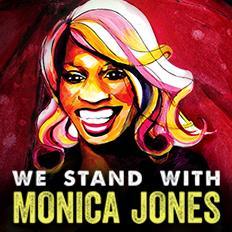
Trans woman, student, and sex work activist Monica Jones was found guilty Friday of “manifesting prostitution” by a Phoenix, Arizona judge after she accepted a ride with two undercover police officers in May 2013. Jones pled not guilty to the charge and challenged the law’s constitutionality. She now faces time in a men’s prison.

via Support Monica Jones on Facebook

Phoenix Municipal Code 23-52 defines behavior that “manifests an intent to commit or solicit an act of prostitution” illegal, although the broad language of the law allows authorities to decide which behaviors qualify as criminal action. If a police officer in Phoenix suspects someone of sex work, that person can be arrested for engaging in conversation with motorists, beckoning to cars, or stopping passersby.

Jones and other advocates, including members of the Arizona ACLU and Sex Workers Outreach Project, have asserted that Jones is guilty of simply “walking while trans,” and that the Phoenix law allows for discriminatory profiling of women of color, trans* women, and women in poverty by the authorities. “I have been harassed by police four times since my initial arrest,” she told Chase Strangio, an ACLU Staff Attorney. “The police have stopped me for no real reason when I have been walking to the grocery store, to the local bar, or visiting with a friend on the sidewalk.”

Jones also believes she was targeted by authorities for speaking out against Project ROSE, an anti-prostitution collaboration between Arizona State University’s School of Social Work, which Jones currently attends, the Phoenix Police Department, and various Catholic charities. The diversion program detains community members suspected of sex work and pressures them to participate in a Catholic “re-education” program, often threatening them with criminal charges if they refuse to participate. 

Jones will appeal her case. “I am saddened by the injustice that took place at my trial,” she said, “but we are not giving up the fight. It’s time that we end the stigma and the criminalization of sex work, the profiling of trans women of color, and the racist police system that harms so many of us.”

Media Resources: PolicyMic, 4/15/2014; ACLU Blog, 4/2/2014; Jezebel, 4/13/2014; The Guardian, 4/15/2014

Virginia Bishops Advocate More Abortion Restrictions for Poor Women

Using the Medicaid expansion debate as a platform, the Virginia Catholic Conference issued a statement Friday calling for the repeal of a Virginia law that allows state funding of abortion care for Medicaid recipients in situations where the fetus exhibits a “gross and totally incapacitating physical deformity” or a “gross and totally incapacitating mental deficiency.”

via Shutterstock
via Shutterstock

Bishop Francis DiLorenzo of the Diocese of Richmond and Bishop Paul Loverde of the Diocese of Arlington authored the statement which urges Virginia lawmakers to act to expand Medicaid to cover more of Virginia’s poor. The statement notes how failure to expand Medicaid would hurt vulnerable populations: “Some are forced to choose between taking their child to the doctor and paying rent, or rush to emergency rooms when untreated chronic conditions become catastrophic. These situations are unacceptable, and the solution is clear.” The bishops continue, “Everyone should have access to health insurance, not just those who can afford it or whose employers provide it. Virginia needs healthcare for all, not healthcare for some.”

Except when it comes to abortion. The bishops carefully state that “healthcare is a right,” but then ask Virginia legislators to repeal healthcare for poor women facing rare, tragic circumstances. NARAL Pro-Choice Virginia Executive Director Tarina Keene told RH Reality Check that state funds covered only 14 abortions in 2013 due to gross and totally incapacitating fetal impairment.

Democrats and Republicans in Virginia have been at an impasse over whether to expand Medicaid, as allowed by the Affordable Care Act (ACA), to an estimated 400,000 low-income individuals in the state. The federal government would pay the full cost of the expansion through 2016, after which it would reduce its contributions incrementally to a minimum of 90 percent of the total cost by 2020. Governor Terry McAuliffe (D) has pushed for Medicaid expansion, but so far, Republicans in the Virginia House of Delegates have been steadfast in their opposition, leading to a stalemate over the state budget.

Media Resources: RH Reality Check 4/14/14; Washington Post 4/13/14; Virginia Catholic Conference 4/11/14; Reuters 3/24/14

Advocates Ask Court To Reconsider Texas Admitting Privileges Case

The Center for Reproductive Rights, Planned Parenthood Federation of America, the American Civil Liberties Union (ACLU), and the ACLU of Texas filed a petition last week asking the full US Court of Appeals for the Fifth Circuit to reexamine the constitutionality of the admitting privileges requirement contained in HB2, Texas’ omnibus anti-abortion bill.

via Ginae McDonald on Shutterstock

“We’re asking the court to acknowledge what is crystal clear–this law hurts women,” said Louise Melling, ACLU deputy legal director. “Because of this law, women are being forced to choose between putting food on the table and traveling hundreds of miles to get the care they need. This law does absolutely nothing to further patient safety.”

At least 19 abortion clinics in Texas have closed since the admitting privileges requirement went into effect, making it increasingly difficult for Texans to access quality, affordable care when they want an abortion. Many cannot afford to take off work and travel to the nearest abortion clinic, which may be hours away. This difficulty may push women to use illegal products and services that are dangerous to their health.

HB2 passed the legislature last summer in a special legislative session called by Texas Governor Rick Perry (R) after Texas State Senator Wendy Davis (D) successfully led a filibuster of the bill for 12 hours. A federal district court originally struck down the admitting privileges requirement of the bill as unconstitutional. A Fifth Circuit panel, however, blocked that decision – after an emergency appeal by Texas Attorney General Greg Abbott – allowing the law to go into effect. Providers and advocates filed an emergency petition with the US Supreme Court, but it refused to intervene. Later, the Fifth Circuit panel issued a final decision to uphold the requirement. Last week’s filing now asks the full Fifth Circuit Court of Appeals to reconsider the case.

In addition to the admitting privileges requirement, HB2 also bans abortion at 20 weeks, restricts medication abortion, and mandates that facilities where abortion is performed meet the same standards as ambulatory surgical centers. Several other state legislatures are working to restrict abortion access using similar laws.

Media Resources: Center for Reproductive Rights 4/10/14; RH Reality Check 4/10/15; Feminist Newswire 10/29/13, 11/1/13, 11/5/13, 11/27/13, 3/10/14, 3/28/14

Kathleen Sebelius Resigns as Secretary of Health & Human Services

President Barack Obama last week announced the resignation of Secretary of Health and Human Services (HHS) Kathleen Sebelius.

via Deval Patrick
via Deval Patrick

Noting that she will “go down in history” for “serving as the Secretary of Health and Human Services when the United States of America finally declared that quality, affordable health care is not a privilege, but it is a right for every single citizen of these United States of America,” President Obama praised Secretary Sebelius for guiding the implementation of the landmark Affordable Care Act (ACA).

At least 7.5 million Americans have now signed up for health coverage through health insurance marketplaces created by the ACA. That number surpasses the Administration’s original target of 7 million enrollments. Over 7 million had already signed up by the March 31 deadline, but the latest tally includes those individuals who began the process of enrolling online before March 31 but who were allowed completed the process after the deadline. Another 3 million individuals also enrolled in Medicaid between October 2013 and the end of February. Twenty-six states and the District of Columbia acted to expand Medicaid coverage through the ACA.

Beyond the ACA, President Obama remarked on Secretary Sebelius’s work to improve child health, expand mental health services, reduce health disparities, and promote women’s health, in addition to her efforts to combat healthcare fraud.

President Obama also announced his nomination of Sylvia Mathews Burwell to be the next HHS Secretary. Burwell is currently the Director of the Office of Management and Budget (OMB). She will face hearings in both the Senate Finance Committee and the Health, Education, Labor and Pensions Committee before receiving a confirmation vote by the full Senate.

Media Resources: The White House 4/11/14; Politico 4/11/14; Los Angeles Times 4/10/14; Feminist Newswire 4/1/14

Tennessee Legislature Approves Measure Criminalizing Pregnant Women

The Tennessee state legislature passed SB 1391 Wednesday, a bill that allows women who suffer from drug-related pregnancy complications to be charged with assault and potentially imprisoned.

via Shutterstock
via Shutterstock

The bill would permit women to be charged with assault – theoretically up to the point of aggravated assault, which incurs a maximum penalty of 15 years in prison – if they have pregnancy complications after using illegal drugs or deliver children with “neonatal abstinence syndrome.” The original bill allowed women to be charged with homicide if her fetus or baby died, but was later amended. The bill was also amended to give women the option of abandoning all charges if she voluntarily enters an approved treatment program, although advocates say the measure would discourage those women from seeking care in the first place.

Advocates worry that the language of the bill is broad enough to subject any woman with pregnancy complications to a criminal investigation. “The law itself, even though it permits women to be charged with misdemeanor assault, in no way limits the prosecution to misdemeanor assault, nor does it limit the prosecution to women who are illegally taking narcotics,” Farah Diaz-Tello, staff attorney with National Advocates for Pregnant Women, told RH Reality CheckShe asserted that any woman who loses a pregnancy or delivers a child with health problems could face an investigation, because it “is the only way to rule out an unlawful act.”

Lawmakers in Tennessee attempted to pass similar legislation two years ago, but their efforts were defeated. Instead, the state eventually put the Safe Harbor Act into place, which gives pregnant women struggling with substance abuse incentives to pursue treatment and guarantees that they will not lose their newborns. Medical experts opposed SB 1391, primarily because punitive measures that criminalize pregnancy outcomes discourage women using drugs from seeking prenatal care. Anti-choice groups opposed the bill because they believe it will increase the number of abortions in the state, instilling fear in women who want pregnancies but also face drug addiction.

“Quite honestly,” Gary Zelizer, director of government affairs for the Tennessee Medical Association, told The Tennessean, “any kind of punitive approach, from a health care perspective, drives women underground. It doesn’t encourage them to get treatment.”

Tennessee is the only state to successfully pass legislation allowing criminal prosecution of pregnant women based on the outcome of her pregnancy, although other states have attempted to codify the practice and have successfully used similar logic to win court cases. According to the Guttmacher Institute [PDF], 17 states consider substance abuse during pregnancy to be child abuse, and 3 consider it grounds for civil commitment. 15 states require health care professional to report suspected drug abuse by pregnant women, and 4 require subsequent drug testing. However, only 18 states have drug treatment program that target women, only 10 provide pregnant women with priority access to state-funded programs, and only 4 prohibit discrimination against pregnant women in those programs.

SB 1391 passed the House Wednesday afternoon 64-30, and passed the state Senate Monday 26-7. It is now headed to the desk of Tennessee Governor Bill Haslam.

Media Resources: RH Reality Check, 4/10/2014; The Wire 4/9/2014; MSNBC 4/10/2014; Guttmacher Institute State Policy Brief 4/1/2014

Women’s Rights Groups Pressure Walmart to Improve Pregnant Worker Policies

Following a class action lawsuit filed by A Better Balance, the National Women’s Law Center, and local counsel, Walmart has updated its worker accommodation policy to explicitly make women eligible for a reasonable accommodation if she experiences a temporary disability caused by pregnancy. The policy change puts Walmart in compliance with the Americans with Disabilities Act, but advocates say that the new policy may still allow discrimination against pregnant workers who do not have a disabling illness or injury related to pregnancy but who still need a reasonable accommodation in order to maintain a healthy pregnancy.


via Shutterstock
via Shutterstock


“While we are enthusiastic about this policy change, it does not go far enough,” said Dina Bakst, co-founder and co-president of A Better Balance. “Over and over again, Walmart has failed to accommodate pregnant workers. Many pregnant women without illness or complications are advised by their doctors to stay off tall ladders, drink water throughout the day, or take other steps to prevent health problems. Walmart must further update its policy to make clear that it will provide reasonable accommodations for all pregnant workers.”

The complaint against Walmart filed earlier this year alleged that the superstore had a nationwide policy and practice of discriminating against pregnant workers by failing to make reasonable accommodations for those who needed them. At the center of the case was a Walmart sales associate who had been refused accommodations when she was seven months pregnant and forced to take unpaid leave. “Three months before my baby was born, Walmart forced me out the door,” she said. “I was doing my job as a sales associate just as I had been for months, but suddenly I lost the paycheck that my family was counting on – simply because I was pregnant.”

Discrimination against pregnant women has been a growing problem in the US. Between 1992 and 2011, pregnancy discrimination complaints in the United States increased by 71 percent. In the period 2010-2012 alone, the U.S. Equal Employment Opportunity Commission (EEOC) received 11,757 such complaints. Despite being illegal to fire someone for being pregnant, women are often forced to take unpaid leave during their pregnancy or fired after requesting small accommodations recommended by a physician but not honored by their employer –  including sitting on a stool or the ability to carry a water bottle.

Persistent discrimination against pregnant workers led to the introduction of the Pregnant Workers Fairness Act in both the U.S. House of Representatives and Senate in May of 2013. Among other things, the Pregnant Workers Fairness Act would prohibit an employer from forcing a pregnant worker to use unpaid leave if she is able to work with a reasonable accommodation.

Media Resources: A Better Balance 4/7/2014; National Women’s Law Center Press Release 4/7/2014; Washington Post 4/5/14; Feminist Majority Blog 10/31/13; Feminist Newswire 3/15/2013

>