
Afghan Women Coders Make Anti-Drug Trafficking Video Game

A group of Afghan women who broke gender barriers by becoming the first female coders in the country have designed a game called “Fight against Opium,” underscoring Afghanistan’s struggle to combat opium trafficking.

In the game, an Afghan soldier has the mission to clear out drugs in Helmand and faces obstacles such as drug traffickers, hidden heroin labs and land mines in the process. Khatera Mohammadi, one of the coders, said the scenarios in “Fight against Opium” were based on her brother’s real-life experiences as a translator for the U.S. troops in Helmand. “He would tell us about the poppy fields, the terrible mine blasts, battling opium traffickers and drugs,” says Mohammadi.

These women created the game in one month at the Code to Inspire computer training center in the city of Herat. They hope the game will raise awareness of Afghanistan’s struggle to eliminate large opium poppy fields, which are controlled and profited from by the Taliban. Currently, Afghanistan is the world’s top cultivator of the poppy from which opium and heroin are produced.

Code to Inspire (CTI) is a girls-only computer programming school in Herat and was founded by Fereshteh Forough, who was born an Afghan refugee in Iran. After the fall of the Taliban, Forough returned to Afghanistan where she obtained her Bachelor’s Degree in computer science at the University of Herat and later obtained her Master’s degree from Technical University of Berlin in Germany. Forough seeks to break gender barriers and empower Afghan girls to learn to code as a way to change their lives.

CTI houses over 80 girls, both high school and university students and provides courses in coding, access to tech and professional resources as well as job placement, allowing CTI students to attain employment that is both financially rewarding and socially accessible. In Afghanistan, women’s travel is heavily restricted, making it crucial for women to have the ability to work remotely. “It’s not easy for a girl to find a job and go to work outside of her home in Afghanistan,” says CTI project manager Hasib Rassa. “Now, with just one laptop at home, she can work online and earn money and help her family.”


Media Resources: Winnipeg Free Press 2/6/18; Christian Science Monitor 2/6/18;
Budget Bill Passes Without Protections for Dreamers

Early Friday morning, a contentious Congress passed a two-year budget bill that did not include protections for Dreamers, ending the litany of short-term spending bills that have threatened government shutdowns every few weeks since September, but that Democrats have also been using as leverage in the immigration debate.

The bill raises the debt ceiling in order to support a significant increase in funds to military spending, as well as increased funds to some domestic initiatives, a concession the GOP was forced to make in order to earn the votes of some Democrats. Republican Senator Rand Paul temporarily held up a vote on the bill with a speech that lambasted Republicans for their hypocrisy on spending increases.

On Wednesday, House Minority Leader Nancy Pelosi (D-CA) made history with an 8-hour demand to secure protections for Dreamers, the longest speech ever delivered on the floor of the House of Representatives. Pelosi urged her colleagues not to vote for the long-term budget deal without first getting a commitment from Speaker Paul Ryan to allow a vote on a bill that would grant legal status to young immigrants who were brought to the United States as children.

After the budget deal passed, Pelosi released a statement reading, “The fight in the House to protect Dreamers is not over. I’m greatly disappointed that the Speaker does not have the courage to lift the shadow of fear from the lives of these inspiring young people. When we protect Dreamers, we honor the highest ideals of America. Their patriotism, their perseverance, their optimism are an inspiration that stirs the conscience of our entire nation.”

After the vote succeeded in the Senate, Senate Majority Leader Mitch McConnell scheduled a vote on Monday to proceed with crafting an immigration bill. In order to craft the bill, the senators will be offering amendments to an unrelated House bill that will serve as a vehicle. The competing proposals will then be voted on to see which ones are able to secure the required 60 votes.

But securing a bill that can pass the House, earn 60-votes in the Senate, and get the signature of the President appears an increasingly difficult task. Meanwhile the arbitrary March 5 deadline set by the President to extend protections for Dreamers looms in the near future.

Democrats have been willing to grant a moderate increase in border security spending in exchange for protecting Dreamers, which could include as many as 1.8 million young people.  But the President and conservative lawmakers are insisting on a number of hardline concessions like building a border wall, limiting family members of immigrants, and ending the diversity lottery system, measures that aim to cut legal immigration in half.

Meanwhile, 122 DACA recipients lose their protections each day, largely because they are afraid to apply to renew their DACA status, fearing that the information they provide could soon be used against them.


Media Resources: Ms. Magazine 2/7/18; CNN 2/9/18; Feminist Newswire 1/25/18; CNBC 2/9/18

Labor Department Audited after Reports it Misled Public on Proposed “Tip Stealing” Rule

The Office of the Inspector General (OIG) for the Department of Labor (DOL) announced Monday that it will audit the Department’s rulemaking process for its proposed tip rule after a report from Bloomberg BNA that the Department intentionally hid its own economic analysis showing that the proposed rule would cost tipped workers billions of dollars in income.

Labeled a “Tip Stealing” rule by workers’ rights advocates, the proposed rule would allow employers to pocket employees’ tips for themselves so long as they pay those employees the federal minimum wage—currently $7.25 per hour. The Department of Labor announced the proposed rule in December and asked for public comment. In its announcement, the DOL claimed that it could not quantify how the proposed rule would affect total tipped income or how the rule would impact reallocation of tips, from employees to employers.

Yet, on Thursday, Bloomberg reported that the DOL did perform—but then actively concealed—its own economic analysis showing how tipped workers would lose billions of dollars. Workers’ and women’s rights groups, such as the National Employment Law Project, Restaurant Opportunities Centers (ROC) United, the Institute for Policy Studies (IPS), the National Women’s Law Center, and the Feminist Majority, along with Senator Patty Murray (D-WA) and Congressman Bobby Scott (D-VA), demanded that the DOL withdraw the proposed rule immediately. Attorneys general from 17 states, led by Xavier Becerra of California, noted that, if the reports are true, that the Department’s conduct would violate federal law.

The public comment period for the proposed rule ended on February 5, four days after the public learned that DOL was intentionally hiding unfavorable data.

Workers’ rights groups, led by ROC United, held a protest outside of DOL headquarters on Monday demanding: “Trump Don’t Steal Our Tips.” The DOL received hundreds of thousands of comments from the public in opposition to its proposed rule, which is expected to hit women the hardest. The Economic Policy Institute estimates that the proposed rule would cost tipped workers $5.8 billion per year in tips, with women—who make up nearly two-thirds of tipped workers nationwide—losing $4.6 billion per year. Women of color would be particularly impacted as they are disproportionately represented among tipped workers. The loss of income could have devastating effects for tipped workers. Already, poverty rates for tipped workers is more than twice as high for workers overall.

The proposed rule has also been blasted for how it could make women workers even more vulnerable to sexual harassment, especially in the restaurant industry. In a 2014 report, The Glass Door: Sexual Harassment in the Restaurant Industry, ROC United and Forward Together found that sexual harassment in the restaurant industry is pervasive among tipped workers. Reliant on tips to survive, these workers often feel forced to tolerate sexual harassment from customers, managers, and co-workers. Giving employers a direct interest in an employee’s tips could make that situation even worse.

Now that the comment period is over, the DOL is free to move forward in the rulemaking process, even as the OIG conducts its audit. Advocates are therefore asking that the public comment period be extended until after the OIG issues a final report of its audit.

Media Resources: Department of Labor Office of the Inspector General 2/5/18; Feminist Newswire 2/1/18; Economic Policy Institute 1/17/18; ROC United

Supreme Court Upholds Ruling Against Pennsylvania Congressional Map

On Monday, the Supreme Court refused to block the Pennsylvania Supreme Court’s ruling invalidating the state’s heavily gerrymandered congressional map and requiring that Pennsylvania’s districts be redrawn before the 2018 election.

In January, the Pennsylvania Supreme Court ruled that the state’s congressional districts violate the state Constitution by unfairly benefiting the GOP and required they be redrawn in the next couple of weeks. Republican leaders then filed an emergency appeal asking the U.S. Supreme Court to hold that redrawing order, which the Justices then rejected.

The Republican-controlled legislature now has until only Friday to submit a replacement map to Democratic Governor Tom Wolf, who then has a week to decide to endorse and submit it to the state Supreme Court for final approval. The state Supreme Court expects new districts to be in place by February 19, which means that the map will be finalized before the May congressional primary. Democrats are hoping the new map could help the party pick up as many as half a dozen seats in the 2018 elections.

Since Republicans redrew the Pennsylvania congressional map in 2011, the GOP has held 13 of the state’s 18 seats in the House of Representatives, despite the fact that Democrats have almost 800,000 more registered voters than Republicans.

While the U.S. Supreme Court did not take any actions with regard to Pennsylvania, they did recently delay a lower-court ruling requiring that North Carolina redraw their congressional map, which gives an overwhelming political advantage to Republicans. In 2016, Republicans won 10 of the 13 congressional seats in North Carolina despite only winning 53 percent of the popular vote, and those district lines could still be in effect when the November election occurs.

North Carolina and Pennsylvania are not the only states involved in gerrymandering lawsuits. In July 2015, twelve Wisconsin residents filed a lawsuit arguing that the legislative district map that was drawn by Republicans after the 2010 census is unconstitutional and discriminatory towards Democratic candidates and voters. The map was thrown out by a federal court in November 2016, marking the first time a court had taken such an action in response to partisan gerrymandering. The case was heard before the Supreme Court in October and the decision will be announced in June 2018.

Media Resources: Washington Post 2/5/17; Feminist Newswire 1/23/18

Congress Passes Bill to Protect Young Athletes from Sexual Abuse

Last week, the House and Senate passed the Protecting Young Victims from Sexual Abuse and Safe Sport Authorization Act that makes it mandatory for sports organizations to report the sexual abuse of athletes to law enforcement or social services within 24 hours. The bill is now waiting to be signed into law by the President.

The bill was co-authored by Senators Susan Collins and Dianne Feinstein and was introduced in March 2017, brought on by sexual abuse allegations against personnel involved with USA Gymnastics, USA swimming and USA taekwondo. In a press conference, Senator Collins said, “I believe that by moving this legislation forward, we have taken concrete action to end the thoroughly corrupt system that was exposed by these brave women.”

Aside from mandatory reporting, the bill also expands the statute of limitation so that the period for reporting begins only when a victim realizes they have been abused, ensures easier and safer ways to report abuse, and requires extensive training for people involved in sports that will teach them to follow strict standards for child abuse prevention and detection.

The bill was passed by the House and the Senate a week after former Michigan State and US Gymnastics team doctor, Larry Nassar, was sentenced in Ingham County, Michigan to 40-175 years in prison for sexually abusing girls who sought medical treatment. At Nassar’s sentencing hearing, 156 survivors made statements about their experiences and exposed the system that allows predators to prey on young girls. Nassar is accused of sexually assaulting over 200 women and girls.

On Monday, an Eaton County court sentenced Nassar to another 40 to 125 years in prison on three counts of criminal sexual conduct. That sentence will be served concurrently with the Ingham County sentence after Nassar serves a separate 60 year sentence in federal prison on child pornography convictions.

The survivors who have spoken out about the abuse they suffered under Nassar have sharply criticized Michigan State University, USA Gymnastics and the US Olympic Committee for failing to take any action with regard to accusations against Nassar. Since 1997, women and girls have reported being sexually assaulted by the former-doctor, yet none of the institutions that employed him ever took any notable action to investigate him or protect other athletes from his assaults.

Even Michigan State’s Title IX coordinator dismissed reports from students alleging Nassar had sexually assaulted them. After Nassar was reported to the FBI in July 2015, he was no longer allowed to treat patients at USA Gymnastics, but was permitted to continue sexually assaulting young women and girls for over a year at Michigan State.


Newswire: Susan Collins Press Releases 1/30/18; CNN 2/5/18

Department of Labor Hid Data Revealing that Proposed Tip Rule Would Cost Workers Billions

The Department of Labor (DOL) intentionally hid internal analysis revealing that its proposal to allow tip pooling in restaurants and other businesses could cost minimum wage workers billions of dollars.

Bloomberg Law reported that the DOL failed to include unfavorable economic analysis in a proposal to reverse an Obama-era rule and allow employers who pay as little as $7.25 an hour to legally keep their employees’ tips. This rule change would permit employers to create tip pool arrangements that would allow employers to pocket a portion of their employees’ earned tips. The vast majority of tipped workers—around two thirds—are women and disproportionately women of color.

Government analysis revealed that workers could lose billions of dollars in tips as a result of the proposed rule reversal. In response to the unfavorable data, senior DOL officials ordered staff to lessen the expected impact by changing the methodology of the analysis. However, according to Bloomberg reporting, Labor Secretary Alexander Acosta was still unhappy with the results and got White House approval to publish a proposal that left the data out completely.

The Trump administration published its proposal to reverse the Obama-era tip pooling rule on December 5 and opened 30 days of public comment without including the economic analysis. Many workers’ rights advocates and women’s rights groups, including the Feminist Majority, the National Employment Law Project, and that National Women’s Law Center, are now demanding that the DOL immediately withdraw the proposed rule.

Following the Trump administration’s announcement in December, the Economic Policy Institute (EPI) released its own economic analysis of the proposal. EPI estimated that under this proposed rule reversal, employers would pocket $5.8 billion in tips each year. Of this $5.8 billion, almost 80 percent is expected to be gratuity earned by women. This is a total of $4.6 billion a year taken away from women in tipped jobs. Critics of the proposal say that the DOL hid their economic analysis because they likely found similar results.

Saru Jayaraman, co-founder and president of ROC United, says this rule reversal will have a disproportionate effect on women, who are more likely to be tipped workers than men. These women also suffer from the highest rates of sexual harassment, because women in tipped jobs are expected to put up with inappropriate behavior in order to earn the tips that support them and their families.

In response to the report that the DOL hid this economic data and knew about the negative impact it would have on workers, particularly women workers, Jayaraman said, “In a moment where the country is moving forward on issues of gender discrimination and sexual harassment, you’ve got an administration that is attempting to really codify gender discrimination and sexual harassment through legalized tip theft.”

The DOL has still not released its internal analysis, leaving workers and businesses to weigh in on the proposal without seeing the government’s data. The comment period on the rule change is set to end on February 5. The public can submit comments online here.

Senator Patty Murray (D-WA), Ranking Member of the Senate Health, Education, Labor, and Pensions Committee, condemned the DOL on Twitter, and called on President Trump to directly tell Secretary Acosta to withdraw the rule change. Senator Murray tweeted, “This botched cover-up of evidence proving President Trump’s policies help businesses steal billions from workers shows exactly what President Trump truly cares about: helping those at the top squeeze every last penny from families trying as hard as they can to get ahead.”

Media Resources: Bloomberg Law 2/1/2018; The Economic Policy Institute 12/14/2017

DeVos Sued for Discriminating Against Student Survivors of Sexual Assault

The National Women’s Law Center (NWLC) together with co-counsel Democracy Forward, National Center for Youth Law, and Equal Rights Advocates, filed suit in the Northern District of California to challenge Education Secretary DeVos’ discriminatory 2017 Title IX policy on sexual misconduct in schools.

“The new policy discriminates against women and girls and makes it harder for them to learn in a safe environment,” said Fatima Goss Graves, the President of the NWLC. Fatima also released a statement declaring that the new guidance will have a “devastating impact on students and schools.”

The lawsuit will show how the Department based its new Title IX policy on sexist stereotypes and put forth an illegal policy without following the proper procedures. “We will not accept Secretary DeVos making it harder for survivors to have equal access to education.” says Laura L. Dunn, Esq., Executive Director of SurvJustice. “We should be making it easier, not harder, for survivors to speak out, and we’re committed to fighting this unconstitutional action by the Trump Administration.”

In September, DeVos’ Education Department ignored the hundreds of thousands of people who submitted comments urging them to keep the Obama-era Title IX guidance intact, and instead issued new interim guidance that seemed to ignore the concerns of survivors.

The Department of Education rescinded the April 2011 Dear Colleague Letter on Sexual Violence, which “informed more than 7,000 colleges that receive federal money to use the lowest possible standard of proof, a preponderance of evidence, in sexual assault cases.” The letter required universities to allow accusers to appeal not-guilty findings. It also told schools to accelerate their adjudications, with a recommended 60-day time limit for resolving investigations.

The Department also rescinded the 2014 guidance document, which gave schools additional guidance concerning their new obligations to protect survivors of campus sexual assault and work to reduce the high levels of sexual violence on college campuses.

DeVos’ new 2017 guidance did away with the 60-day guideline for resolving investigations, allowing schools to draw out the process and unnecessarily delay resolution of sexual misconduct complaints. It also allows schools to impose a clear and convincing evidence standard to the grievance procedures, giving the alleged perpetrator, and the perpetrator only, the presumption of truth.

Shockingly, DeVos’ decision to rescind the Obama-era policies was largely informed by men’s right activists who claimed to be victims of false rape accusations.

One in five women and one in sixteen men will be sexually assaulted while in college, and 90 percent of survivors will never report the attack. “It’s not equitable for the department to meet with the ‘wrongly accused’ for 90 minutes because these men’s rights activists are speaking on behalf of the statistic that 2 to 8 percent are wrongly accuses,” said Fabiana Diaz, a 23-year-old survivor of sexual assault who was also allotted only 90 minutes to speak with DeVos. “It’s simply not equitable.”

“Through this action, we are left wondering whether Secretary DeVos takes equal access to education for survivors seriously. For many, of course, sexual violence is deadly serious,” testified Gaylynn Burroughs, Director of Policy and Research at FMF, at an Education Department hearing. “By withdrawing the 2011 and 2014 guidance, the Administration has unfortunately sent the message that women’s education is disposable. They can either put up with sexual violence or get out.”


Media Resources: New York Times 1/25/18; NWLC 1/25/18; Washington Post 1/31/17; Huffington Post 7/14/17

Congressional Leaders Request Review of Climate Surveys on Campus Sexual Violence

United States Representatives Carolyn Maloney (D-NY), Ro Khanna (D-CA), and Susan Davis (D-CA) requested Monday that the US Government Accountability Office (GAO) conduct a comprehensive review of past and existing campus climate surveys used to collect data on the incidence of sexual violence on college campuses in order to provide recommendations to Congress for developing a standard, nationwide survey.

“A safe campus environment free from sexual assault is essential to ensure that all students can pursue higher education,” the Representatives wrote in their letter to US Comptroller General Gene Dodaro. “Achieving this goal requires accountability from colleges and universities that receive federal funds and a well-developed standardized survey will ensure that we have accurate data on the scope of the problem.”

The Representatives request that the GAO address student perspectives on the incidence of violence, including domestic violence, dating violence, sexual assault, and stalking on campus; student knowledge of institutional policies and procedures related to this violence; and the utility and efficacy of making survey data public. For student survivors, the Representatives request that the GAO review reporting trends, response to reports of violence, contextual factors surrounding the violence, and whether survivors were made aware of appropriate resources. The goal is for the GAO to asses the effectiveness of past and existing surveys in collecting complete and accurate data and make recommendations in each of the areas studied.

In 2014,  the Obama-Biden White House Task Force to Protect Students from Sexual Assault recommended that colleges and universities undertake campus climate survey on sexual assault and produced a toolkit that schools could use to help them create and conduct such surveys. Climate surveys are currently not required by law. Congresswoman Maloney introduced the Campus Accountability and Safety Act in 2017, which would establish a biennial, confidential survey of students about sexual violence on campus. The bill would also create new protections for survivors and strengthen enforcement of existing federal law. Senator Claire McCaskill (D-MO) introduced the companion bill in the Senate.

The request from the Representatives to the GAO comes in the middle of a fight to ensure robust enforcement of Title IX for survivors of sexual violence. In September, Education Secretary Betsy DeVos rescinded Obama-era guidance meant to protect the rights of survivors of sexual assault and reduce the high levels of sexual violence on college and university campuses. The Department then issued new interim guidance that Feminist Majority Foundation president Eleanor Smeal says, “tipped the scales against victims.”

Last week, three groups that represent survivors filed a lawsuit against DeVos and the Department of Education seeking to vacate the new guidance. In their lawsuit, the groups assert that the new policy, developed in consultation with so-called “men’s rights” groups, is based on dangerous sex stereotypes about women, is discriminatory and illegal, and violates the constitution.

Media Resources: Office of Congresswoman Carolyn Maloney, Press Release, 1/30/18; National Women’s Law Center, 1/25/18; Feminist Newswire, 9/22/17

Janet Benshoof, Reproductive Justice Leader, Dies at 70

A memorial service was held on Sunday for Janet Benshoof, a renowned human rights lawyer who spent much of her career defending the right to access abortion and contraceptives in the United States and around the world.

Benshoof died December18 at her home in New York at age 70. According to her son, Benshoof had been battling a rare and aggressive form of endometrial cancer since November.

Benshoof began her career at a pivotal time of the women’s movement, just before the 1973 Supreme Court case Roe v. Wade that established a woman’s right to an abortion. For the next four decades, Benshoof dedicated herself to upholding the constitutional right, as well as advocating for reproductive freedom across the globe.

Benshoof began serving as the director of the ACLU’s Reproductive Freedom Project in 1977. ACLU Executive Director Anthony Romero stated that Benshoof “was known for her brilliant legal mind, her sharp sense of humor, and for her courage in the face of injustice.” Romero recalls the time when Benshoof made national headlines in 1990 when she flew to the U.S. territory of Guam to lobby against a new law making even the discussion of abortion illegal.

Benshoof proceeded to hold a news conference where she advised women needing an abortion to leave the island and head to a Planned Parenthood clinic in Hawaii. Just a day later, she was arrested for “soliciting” women to have abortions and was sentenced to a year in prison. The charges against Benshoof were dropped after a judge ruled that Guam’s ban on discussing abortions did not comply with the decision in Roe.

In 1992, Benshoof left the ACLU and founded the Center for Reproductive Rights (CRR), an international human rights organization focusing on reproductive rights and equality, which was the first of its kind at the time. For 25 years now, the Center has used the law to advance reproductive freedom as a fundamental human right that all governments are legally obligated to protect, respect, and fulfill. According to the CRR, the Center envisions a world where every woman participates with full dignity as an equal member of society.

One of Benshoof’s most significant achievements at the Center came in 1996, after the Center successfully pushed the Food and Drug Administration’s (FDA) to approve the morning after pill as an emergency contraceptive to prevent unwanted pregnancies.

In 2005, Benshoof founded the Global Justice Center (GJC), which works to implement and enforce human rights laws. One of GJC’s  projects, “Rape As a Weapon of War” advocates for rape to be prosecuted as an illegal weapon under international law, thus increasing victim’s avenues for medical treatment, reparations, and justice. Benshoof served as the president at GJC until her passing.

Benshoof was selected by the National Law Journal as one of the “100 Most Influential Lawyers in America” and received numerous awards for her great work, including the MacArthur Fellowship “Genius Award,” the Gloria Steinem Women of Vision Award and the Planned Parenthood Federation of America’s Margaret Sanger Award.

Eleanor Smeal, president of the Feminist Majority Foundation, described Benshoof as a “new spirit” in the feminist movement and that she was the definition of “complete dedication as she was an absolute joy to work with.”

“Her chosen path was not easy, but Ms. Benshoof was fearless,” Romero stated. “To say she made the world a better place would be an understatement and she will be dearly missed.”


Media Resources: Washington Post 12/19/17, 3/27/90; New York Times 12/21/17, 8/24/90; ACLU 12/19/17


2018 Women’s March–Reflecting on Challenges and Victories

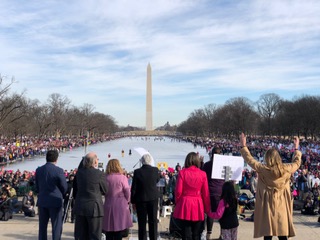
This past weekend, thousands of feminist activists once again took the streets of cities and towns across the country for the Women’s Marches to protest a number of the policies and positions of the Trump administration and Republican controlled Congress including the dismantling of Title IX, the rollback of birth control coverage, the failure to protect Dreamers, and more.

Protesters were calling on political leaders to ratify the Equal Rights Amendment, protect the healthcare of millions of people, defend access to abortion and birth control, save the EPA and combat climate change, and guard civil rights protections for people of color, immigrants, people with disabilities, and the LGBTQ community.

The theme of this year’s march was Power to the Polls, an effort to get people engaged and ready to turn out to vote in the 2018 elections. That message registered with many women after last year’s march as well.

“The Women’s Marches one year ago led to the largest number of new candidates, especially women, running for political office, as well as the unprecedented victories for feminists in the 2017 state and local elections,” said Eleanor Smeal, president of the Feminist Majority and speaker at the Women’s March on Washington. “Today, a record number of women are running for Congress, state legislatures, and state-wide offices, and we intend to win. We are going to send a pink wave through Congress and the states in 2018.”

Emily’s List says that in the ten months before the 2016 elections, about 1,000 women had contacted the organization interested in running for office. Since Trump’s election, that number has jumped to over 26,000. From county school boards to Capitol Hill, women are running in unprecedented numbers. 291 Democratic women are running for seats in the House of Representatives and 25 Democratic women are running for the Senate, twice as many women as were running two years ago. And many of these women are running against Republican incumbents.

And they aren’t just running; they’re winning. In Virginia, Democrats picked up 15 seats in the House of Delegates, unseating the Republican super-majority; 11 of those victories went to feminist women, many running for the first time against incumbents. A wave of similar victories was seen across the country in city council races, mayoral races, and more.

And feminists aren’t just seeing electoral victories. In March, Nevada became the 36th state, and the first state since 1982, to ratify the Equal Rights Amendment.

In 2017, Republicans tried at least four times to repeal the Affordable Care Act and decimate Medicaid, and each time the people stopped them.

Oregon passed a law to guarantee no-cost birth control, abortions, STI testing and more to every resident of the state, including undocumented immigrants, gender non-conforming people, and transgender individuals. And Illinois became the first state in over twenty years to voluntarily pass a law permitting funding for abortions under the state Medicaid program, as well as under the state insurance programs for state employees.

Attorneys General in 22 states have taken up the fight to defend civil rights, suing the Trump administration over everything from withholding health insurance subsidies, to rolling back environmental protections, to rescinding DACA, to the Muslim ban.

Feminist champions in Congress have continued to introduce legislation on everything from codifying Title IX guidance, to stopping Trump’s Global Gag Rule, to enforcing women’s constitutional right to access abortion.

And of course the #MeToo movement took over in 2017, empowering countless survivors to share their stories, many for the first time, because they feel they will now be believed, embraced and supported.

The day after Donald Trump was inaugurated, 5.6 million people took to the streets. People marched in at least 999 marches, in all 50 states, in 92 countries, and on all seven continents, including Antarctica. “Last year, the naysayers tried to dismiss the marches as a one-time event,” said Smeal. “But they know now what we knew then: that we will not go away and are determined to change the direction of this nation.”


Media Resources: New York Times 12/4/17; Time 1/18/18; Vox 11/8/17

Fairfax County Pushes Virginia to Ratify ERA

On Tuesday, the Fairfax County Board of Supervisors voted unanimously for a resolution in support of the Virginia legislature ratifying the Equal Rights Amendment to the U.S. Constitution. If it passed, Virginia would become the 37th state to ratify the ERA, which adds to the Constitution a prohibition on discrimination based on sex.

“While specific laws advancing equal pay, promoting child care and protecting women from domestic violence are critical, fundamental rights etched into our Constitution are long overdue as well,” read a statement by Penny Gross, Mason District Supervisor and sponsor of the resolution. “As the political body representing the largest population of Virginians, and therefore the largest population of Virginia women, the Fairfax Board of Supervisors strongly supports Virginia’s efforts to make them equal under our U.S. Constitution.”

Fairfax County is not the first local governing body to pass a resolution in support of the ERA. In 2016, the Durham City Council passed a resolution calling on the North Carolina state legislature to ratify.

The Virginia legislative session is only 60 days long, and activists are already rallying in the capital of Richmond to garner support for the ERA. The November 2017 elections saw 15 new Democrats elected to the Virginia House of Delegates—11 of whom were women—ending the Republicans’ long-held super-majority in the state house. With Democrats now controlling 49 of the 100 seats, many feminist activists believe Virginia has a real chance at ratifying the ERA.

The ERA passed both houses of the United States Congress in 1972, and like every proposed amendment to the U.S. Constitution, was sent to the states for ratification. The amendment lost momentum after the arbitrary ten year deadline set by Congress for its passage came in 1982. The movement was three states short of the 38 needed for ratification. But the push for the ERA has received renewed attention following the election of Donald Trump.

In March, Nevada became the 36th state–and the first state since 1982–to ratify the ERA. The formalities of the ratification procedure were successfully concluded on March 22, the 45th anniversary of when the U.S. Senate approved the ERA and forwarded it to the states for ratification in 1972.

Many Constitutional scholars believe that because the time-limit is in the pre-amble of the amendment, and therefore not voted on by the states, it is subject to extension by a vote in Congress. Thousands demonstrated in Washington in 1978, and Congress granted an extension until June 30, 1982.

The ERA’s passage would be far from simply symbolic: it will help women in cases of discrimination in education, employment, wages, insurance benefits, scholarships, military service, social security, violence against women, and so much more. Without the passage of the ERA, women have been forced to gain equality law by law. If the ERA was ratified by 38 states and became the law of the land, there would be a Constitutional provision against the Supreme Court, Congress or state legislatures gutting equality on the basis of sex.


Media Resources: Feminist Newswire 10/19/16, 3/20/17;

Government Shutdown Ends, Immigration Unrest Continues

On Monday night, President Trump signed a bill that ended the government shutdown and extended federal funding until February 8. The government shutdown, which started on Saturday, began after Democrats and Republicans were unable to agree on a budget bill that included long-term funding for the Children’s Health Insurance Program and a deal for Dreamers.

While Democrats were able to secure long-term funding for CHIP with the bill signed Monday, an agreement over the Dreamers has been delayed until February 8, leaving 800,000 young people still uncertain about their futures. Democrats were only able to secure promises from number of Senate Republicans, including Majority Leader Mitch McConnell, that a bi-partisan Dreamer bill would be introduced by then.

“Promises aren’t going to protect our community, promises aren’t going to grant us a permanent solution” says Antonio Jaregui, a 20-year-old college student and Dreamer who was disappointed by the results of the government shutdown.

Dreamers, the term used to describe young undocumented immigrants who were brought to the United States as children, were previously protected from deportation by President Obama’s executive action creating the Deferred Action for Childhood Arrivals (DACA) program, which has allowed 800,000 young people to stay in the only country they’ve ever known and pursue educational opportunities, start careers, and live their lives freely. The median age of entry to the U.S. among people who applied for protection under DACA was 6 years old.

In September, Attorney General Jeff Sessions announced that the Trump administration had rescinded DACA, fundamentally uprooting the lives of millions of people and disrupting communities across the country. The Congress has until March to pass a bill reinstating the program. If a bill is not passed, Immigration and Customs Enforcement (ICE) agents will begin deporting Dreamers, using addresses and personal information that the young people trustingly provided to the government to qualify for DACA.

Democratic Senator Richard Durbin and Republican Senator Linsdey Graham almost immediately issued a bipartisan bill, the Dream Act, that would allow undocumented immigrant youth—most of whom grew up in the United States—to apply for permanent residency and eventually citizenship. The bill would also end the deportation proceedings of anyone who qualifies for permanent residency under the Dream Act and children over five years of age who are in elementary or middle school. 80 percent of Americans support extending protections for Dreamers.

But the White House has slowed progress on a bi-partisan agreement by demanding a number of provisions be included in any new immigration bill, including funding for a border wall.

Since DACA was rescinded in September, an estimated 122 DACA recipients per day lose their protections, largely because they are afraid to apply to renew their DACA status, fearing that the information they provide could soon be used against them.

DACA recipients are not the only ones who fear deportation on a daily basis while waiting for clear solutions on immigration. Recently, the Immigration and Customs Enforcement (ICE) has deported or detained at least four immigrant activists. Maru Mora Villalpando, an immigration activist who was targeted for deportation by ICE in December, stated that ICE’s actions were “retaliation for her political activism.”

ICE’s rising deportation and detainment counts started when the Trump Administration expanded the guidelines concerning the deportation of criminals. Under Trump’s guidelines, the term “criminal” includes immigrants who have been charged with, but not convicted of, a crime and immigrants who “in the judgement of an immigration officer, pose a risk to public safety.” Since Trump’s presidency, the number of immigration sanctuaries have doubled in order to accommodate safe spaces for migrants, due to rising and reoccurring threats of deportation and detainment.

News Sources: CNN 1/23/18, 1/20/18, 1/2/18, 10/26/17; San Antonio Current 1/22/18; The Washington Post 1/22/18; Huffington Post 1/22/18, 1/17/17; Center for American Progress 11/9/17; Feministing 1/18/18; Democracy Now 1/17/18; White House 1/25/17; Feminist Majority Foundation 9/5/17, 9/11/17

Judges Rule Two Congressional District Maps Unconstitutional

On Monday, the Pennsylvania Supreme Court ruled that the state’s Republican drawn congressional districts are unconstitutional and ordered they be redrawn in the next several weeks.

Pennsylvania’s February 9 deadline means that the district lines will be redrawn before the May congressional primary. Democrats are hoping the new map could help the party pick up as many as half a dozen seats in the 2018 elections.

The ruling in Pennsylvania comes less than two weeks after three federal appeals judges ruled that North Carolina’s congressional district map is also unconstitutional, as the map was drawn to give an overwhelming political advantage to Republicans.

North Carolina’s map was supposed to be redrawn by January 24, but the Supreme Court has agreed to pause that timeline, meaning the unconstitutional district lines could still be in effect when the November elections occur.

Pennsylvania and North Carolina are two of the most gerrymandered states in the country. In 2016, Republicans won 10 of the 13 congressional seats in North Carolina despite only winning 53 percent of the popular vote.

The North Carolina and Pennsylvania are not the only states involved in gerrymandering  lawsuits. In July 2015, twelve Wisconsin residents filed a lawsuit arguing that the legislative district map that was drawn by Republicans after the 2010 census is unconstitutional and discriminatory towards Democratic candidates and voters. The map was thrown out by a federal court in November 2016, marking the first time a court had taken such an action in response to partisan gerrymandering. The case was heard before the Supreme Court in October and the decision will be announced in June 2018.


News Sources: Washington Post 1/22/18, 1/10/18; CNN 1/101/18; New York Times 1/9/18; Huffington Post 1/9/18; The Time 10/2/17; Feminist Majority Foundation 7/28/17


Trump Administration to Protect Health Workers Denying Treatment on Moral Grounds

On Thursday, the Trump administration announced the creation of a new division at the Department of Health and Human Services (HHS) that seeks to defend healthcare workers who choose to discriminate against patients who have had or who require certain medical procedures, such as abortions, due to moral or religious objections.

According to the new Division of Conscience and Religious Freedom section on the HHS website, doctors, nurses, and other health workers are encouraged to submit a complaint if they believe they were discriminated against because they were reprimanded when they refused to participate in “specific medical procedures, including abortion and sterilization, and related training and research activities,” or if they felt “coerced” into participating in these procedures.

The creation of a Division of Conscience and Religious Freedom was announced one day before March for Life, an annual anti-abortion gathering in Washington.

Feminist advocates are concerned that they will allow for further discrimination and restrict access to health care, particularly for women and members of the LGBTQ community. Under these protections, health workers will be able to refuse to provide care for transgender patients, gay or lesbian patients, or women who have had abortions.

The Center for American Progress released a report on Thursday outlining the ways that LGBTQ people already face “disturbing rates” of discrimination in healthcare. For example, a transgender teenager admitted with suicidal ideation was misgendered by hospital staff, discharged early, and later committed suicide. The report also included the story of an infant in Michigan who was denied treatment by a pediatrician’s office because she has same-sex parents. Moreover, the report said that these high rates of discrimination often discourage LGBTQ people from seeking care at all.

Civil rights advocates worry that with the creation of this new division, individual health workers as well as health organizations who seek to discriminate because of religious and moral beliefs now have the legal protection of the Trump administration. Existing discrimination in healthcare for women and the LGBTQ community will likely worsen as a result of this policy.

Democratic lawmakers have also widely condemned the announcement. U.S. Senator Patty Murray (D-WA), Ranking Member of the Senate Health, Education, Labor, and Pensions Committee, issued statement saying she is “deeply troubled” by the policy that will restrict health care access for women and transgender individuals. Murray stated that “any approach that would deny or delay health care to someone and jeopardize their wellbeing for ideological reasons is unacceptable.”

This move is a continuation of the Trump administration’s policy to let individuals refuse to provide services that they morally and religiously object to. In October, the Civil Rights Office similarly allowed employers to opt out of providing birth control coverage for employees if it contradicted their religious or moral beliefs.

News sources: NPR 1/18/18, New York Times 1/18/18,  HHS.gov 1/18/18, Washington Post 1/18/18, Center for American Progress 1/18/18, NBC News 1/20/18, Senate.gov 1/18/18, Feminist Majority Foundation 10/6/17

Commemorating the 45th Anniversary of Roe v. Wade

Today marks the 45th anniversary of Roe v. Wade, the 1973 ruling in which the Supreme Court stated that access to abortion is protected under the right to privacy, legalizing abortion across the United States. The right to privacy is protected by the Fourteenth Amendment to the Constitution.

The story of Roe v. Wade started in 1971 in Texas when Norma McCorvey, named Jane Roe in court documents, sought an abortion but could not find a doctor to perform one. Dallas County district attorney Henry Wade was enforcing a state law banning abortions despite the fact that the law had already being declared unconstitutional in an earlier court case. McCorvey filed a lawsuit against Wade, setting off a case that would eventually transform reproductive healthcare in the U.S.

Through the mid 1960s, abortion was only legal in six states and estimated counts of illegal abortions between the 1950’s and 1960’s ranged from 200,000 to 1.2 million per year. Due to severe abortion bans in most of the country, many women performed the procedures themselves despite significant health risks. Most women who performed illegal or self-induced abortions were women of color and low-income women. In 1962, roughly 1,600 women were admitted to a hospital in New York City for incomplete abortions. According to Planned Parenthood, illegal abortions made up one-sixth of all pregnancy-related deaths in 1965.

With the legalization of abortion across all 50 states, abortion-related mortality rates dramatically decreased. Currently, abortions are one of the safest medical procedures in the US, with a 99% safety record.

But with the progress of Roe v. Wade came the rise of a vocal anti-abortion movement that over the last 45 years has pursued judicial and political influence in an attempt to pass anti-abortion legislation, and with the goal of eventually overturning Roe v. Wade.

Between 2011 and 2016, 334 new abortion restrictions were implemented in states across the country, from unconstitutional building requirements that led to the closures of dozens of clinics to multi-day waiting periods that aim to make it more difficult for women, especially low-income women, to access abortion care. Meanwhile, anti-abortion politicians at the state and federal levels pursue policies that defund Planned Parenthood, fund abstinence only education, ban abortions after 20 week, and ban abortions after 8 weeks.

Despite these restrictions, a Pew Research survey shows that 69% of Americans do not want to overturn Roe v. Wade. Feminist activists are fighting every day to stop abortion restrictions at the state and federal levels and to protect family planning clinics that provide reproductive healthcare to some of the most vulnerable people in the United States. If you would like to learn more about the Feminist Majority’s efforts to protect clinics, visit our Campaign to Expose Anti-Abortion Violence.   


News Sources: Planned Parenthood; Bustle 12/9/16; CNN 1/22/13; The Washington Post 1/22/13; Feminist Newswire 11/5/17

Afghan Girls Robotics Team Back in the US

On January 5, the Afghan Girls Robotics Team, who became famous after they were denied a visa to enter the U.S. for an international robotics competition in summer 2017, came back to the United States to attend, speak and exhibit their newest robot at the 4th annual Raw Science Film Festival.

The festival, which took place across Santa Barbara, California, honors films on science and technology worldwide and ensures that science experts receive public attention in popular culture. The festival created a gofundme page in order to raise money for the Afghan team’s travels to the US. Roya Mahboob, an Afghan technology entrepreneur, wrote on her Facebook page that unlike their first trip to the United States, the girls did not face any problems obtaining their visas.

In November, the Afghan Girls Robotics Team participated against 3,700 competitors and won the Entrepreneur Challenge at the Robotex Festival, which is Europe’s largest robotics event. The Entrepreneur Challenge is a new challenge at Robotex Festival where competitors must present an innovative robotic product that can solve a real-world issue. The team’s robot used solar energy to support small-scale farmers in their fields and was chosen to win by the thousands of spectators at the festival. “They are undeniably the future of Afghanistan,” said Afghanistan Ambassador in the UK Tayeb Jawad in an emailed statement after the girls’ major win.

The Afghan Girls’ Robotics Team sparked major outcry and feminist protests in July 2017 when the State Department twice refused to grant the girls’ U.S. visas. The feminist protests successfully put public pressure on the Department of Homeland Security to issue humanitarian paroles that allowed the girls to enter the country so they could compete in the First Global Challenge in Washington DC. At the robotics competition, the girls were awarded silver medals for “courageous achievement” for a robot they built in a period of two weeks, after their package of supplies was detained at the airport.

After the Afghan Girls’ Robotics Team’s success in the United States in July, more and more young girls in Afghanistan have expressed interest in becoming more involved with robotics and technology.

News Sources: New York Times 11/29/17; NPR 11/29/17, 11/30/17; Nooshawk 12/30/17; Forbes 11/29/17; Feminist Newswire 07/19/17, 07/13/17, 09/11/17

Talks of Reparations for South Korean “Comfort Women” End

South Korea announced that it will not be pursuing renegotiations with the Japanese government over reparations for South Koreans victimized by the Imperial Japanese Army sex slave trade during World War II.

Known as “comfort women”, tens of thousands of women, many of whom were Korean, were lured into working in military brothels set-up by the Japanese military. These women were raped and tortured; many survivors were left infertile due to sexually transmitted diseases.

Many of the women who survived the war did not go public with their experiences until the 1990s, in which a total of 238 Korean women declared their former imprisonment as comfort women. Lee Ok-seon recalled to NPR that she was running an errand in her hometown of Busan when “two Japanese men in uniform grabbed me by the arms and dragged me away.”

“”That’s how I became enslaved.”

As the tensions between North and South Korea escalated, South Korea turned to Japan over the shared concern for stability in Asia. However, the issue of Japan’s war crimes became an obstacle between the two nations. An agreement reached in 2015, detailed that Japan was to fund over $8 million dollars for a foundation for surviving families of comfort women. Additionally, Japanese Prime Minister Shinzo Abe issued an apology, where he expressed his “most sincere apologies and remorse.” In return, South Korea agreed not to publicly criticize Japan over the issue.

While both countries saw the agreement as “final and irreversible,” many South Koreans were dissatisfied with the settlement. Some of the surviving women felt that the agreement did not implicate Japan legally and failed to pay official reparations directly to the victims and their families. According to the civic group, Korean Council for the Women Drafted for Military Sexual Slavery in Japan, “The agreement is nothing but a diplomatic collusion that thoroughly betrayed the wishes of comfort women and the South Korean people.”

Additionally, South Korean President Moon Jae-In promised during his Presidential campaign to review the agreement if elected. While President Moon consulted a group of policy experts who declared that the “agreement was finalized mostly based on government views without adequately taking into account the opinions of victims,” President Moon chose to comply with the existing agreement. The decision to adhere to the existing conditions suggests that President Moon is not willing to risk upending the deal with Japan, who has been cooperating with South Korea to disarm North Korea’s weapons program.

Sexual violence in conflict zones continues to be a contemporary issue as groups like ISIL in Iraq and Syria, the Lord’s Resistance Army in the Central African Republic, and Boko Haram in Nigeria continues to use sexual slavery as a weapon to harm civilian girls and women.

The United States continues to fail victims of war rape by not complying with the 1949 Geneva Convention protection that guarantees the “wounded and sick” the right to non-discriminatory medical care. Despite ratifying the Conventions 61 years ago, the U.S. government, the largest aid donor in the world, has implemented a policy that denies survivors of war rape access to abortion, a practice that amount to a denial of basic, and often lifesaving, medical care to some of war’s most vulnerable victims.


Sources:

The Korean Council for the Women Drafted for Military Sexual Slavery by Japan 2011; The New York Times 12/28/15;UN Report of the Secretary-General on Conflict-Related Sexual Violence 4/15/17; NPR 5/30/17; Feminist Majority Foundation 8/12/16

Trump Administration Terminates Protected Status for People from El Salvador

On January 8, the Department of Homeland Security Secretary, Kirstjen M. Nielsen announced that the United States would terminate Temporary Protected Status (TPS) for immigrants from El Salvador. The United States granted TPS to citizens of El Salvador in January 2001 when a deadly earthquake struck the country.

Temporary Protected Status, or TPS, is a temporary status given to undocumented people who are unable to safely return to their home countries due to armed conflicts, natural disasters or other dangerous and temporary conditions.  Over 200,000 Salvadorans reside in the United States under this program, and now have eighteen months to either leave the United States or find a way to obtain a green card. Once the Salvadorans officially lose TPS, they will also lose other protections including work permits, health insurance, and more.

Many Honduran women are worried about how this decision will affect their and their family’s lives. This includes Veronica Lagunas, a 39 year-old Salvadoran immigrant who cleans offices in Los Angeles. “We had hope that if we worked hard, paid our taxes and didn’t get in trouble we would be allowed to stay…There is nothing to go back to in El Salvador,” said Lagunas. “The infrastructure may be better now, but the country is in no condition to receive us.” Veronica also has two children who were born and raised in the United States and owns a mobile home.

Democratic Members of Congress are outraged by the Trump administration’s decision to revoke protections for the Salvadorans. Senator Elizabeth Warren insists that Congress passes the SECURE (Safe Environment from Countries Under Repression and in Emergency) Act, which ensures that qualified people with Temporary Protective Status can receive permanent residency.

Some Republican members of Congress have criticized the administration’s decision as well. Representative Mario Diaz-Balart stated: “These innocent people fled their home country after a disastrous earthquake, and while living conditions may have slightly improved, El Salvador now faces a significant problem with drug trafficking, gangs and crime.”

More than 300,000 people in the United States are currently covered by TPS. They are from 10 countries: El Salvador, Honduras, Haiti, Nepal, Syria, Nicaragua, Yemen, Sudan, Somalia, and South Sudan. On November 20, 2017, the Department of Homeland Security removed TPS for more than 50,000 Haitians. Haitians who have TPS status have until July 22, 2019 to either leave or receive a visa. Nicaragua and Sudan have also lost their TPS. South Sudan is up for review in May 2019 and Honduras was recently granted a six month extension.


News Sources Used: DHS.gov 1/8/18, Washington Post 1/8/18, New York Times 1/8/18, Newsweek 1/9/18, Congress.gov 11/16/17, CNN 1/9/18

Iran Sees Protests Against Corruption and Struggling Economy

Anti-government protests that erupted in Iran at the end of December have lead to the arrests of an estimated 3,700 people and the deaths of at least 21. Tens of thousands of people have taken to the streets across Iran to demonstrate against corruption, unemployment and the struggling economy.

These are the largest protests seen in Iran since the Green Movement in 2009. Unlike the 2009 protests, the current protests spread throughout the country, in large cities as well as smaller scale protests in poorer areas of the country. The origin of the protests is unknown, as are its leaders.

Even with restricted social media access, videos of the protests were still widely circulated and shared. The videos and pictures showed that some of the protesters were calling for the country’s religious hardliners to step down. One of the most widely shared and talked about images on social media was a picture of a woman breaking Iranian dress code by taking off her scarf and waving it on a stick in the middle of a crowded street as an act of defiance against strict Islamic rule. The popular image was posted on social media a few days before the protests began but became the symbol and the face of the protests.

Last month, police in Tehran, Iran’s largest city, said they would no longer arrest women for not wearing a headscarf, but rather force them to attend classes where they will “educate them” on the importance of following the Islamic code.

Many Iranian women are taking part in the current protests and are boldly speaking out against the strict religions rules in Iran that continually oppress them.   Although women’s activism in the current protests captured the media’s attention, Iranian women’s activism is not new and can be traced back to the establishment of the Islamic Republic.

The government is claiming that the protests are dwindling, though that is largely due to the fact that the government has blocked popular messaging apps that were being used to spread word of the movement.

News Sources: CNN 1/3/18, 1/9/18; Washington Examiner 1/2/2018; BBC 1/4/18; NBC News 1/2/18; Time 1/9/18; Newsweek 12/29/17

Civil Rights Icon Recy Taylor Dies at 97

Recy Taylor, a civil rights icon who was one of many black women victimized with impunity in the Jim Crow Era, died in her sleep at a nursing home in Abbeville, Alabama on December 28, 2017, just three days before her 98th birthday. Taylor leaves behind a legacy of bravely speaking out against sexual assault and white supremacy.

On September 3, 1944, Taylor was abducted and raped by six white men on her way home from church. After the brutal rape, these men threatened her not to come forward about the assault and left her blindfolded on the side of the road. Taylor did not listen, coming forward decades before the #MeToo movement in an attempt to seek justice in the Jim Crow Era.

Despite the fact that one of the attackers, Hugo Wilson, confessed to the rape and named the other men involved (Dillard York, Billy Howerton, Herbert Lovett, Luther Lee, Joe Culpepper, and Robert Gamble), none of the men were arrested. The National Association for the Advancement of Colored People (NAACP) sent then investigator Rosa Parks to discover why. Parks was pushed out of Abbeville due to pressure from the sheriff, Lewey Corbitt. When she returned to Montgomery, Alabama, Parks started the the Alabama Committee for Equal Justice for Mrs. Recy Taylor. This group flooded the South with articles about the rape titled “Victim of White Alabama Rapists.” By October 1944, Taylor was making national headlines and everyone knew about her case. However, two different all-white and all-male juries failed to indict the men.

Author and historian Pippa Holloway  states that “during the Jim Crow era, women’s bodies served as signposts of the social order, and white men used rape and rumors of rape not only to justify violence against black men but to remind black women that their bodies were not their own.” When we learn about the Jim Crow Era, much of the conversation is dominated by lynchings, but it rarely reflects the sexual violence black women endured.

In 2011, 67 years after her rape, the Alabama legislature released an apology for “for its failure to prosecute her attackers.” Though Taylor’s story has gone untold to many, she remains an important figure in the civil rights and feminist movements. NPR argues that we can say #MeToo now because Taylor said it in 1944. Oprah Winfrey believes that Recy Taylor’s name is “a name I know and I think you should know, too,” which she declared in her Golden Globes speech on Sunday. Filmmakers also released a documentary on December 8, 2017 titled “The Rape of Recy Taylor” which chronicles her rape and its aftermath. Nancy Buirski, the director of the film, believes that Taylor passed away peacefully knowing that her story has now been told.


Sources:

Washington Post 1/8/18; ABC News 1/8/18; NPR 1/8/18; New York Times 12/29/17; CNN 1/8/18; NBC News 12/28/2017

>