House Oversight Committee Holds Hearings on Flint Water Crisis

As the aid package to help Flint residents is stalled in Congress, the House Committee on Oversight and Government Reform held hearings this week to investigate what actions—or inaction—led to the water contamination crisis in Flint, Michigan that produced a spike in lead poisoning and other health issues.

Tuesday’s hearing included Darnell Earley, the emergency manager appointed by Governor Rick Snyder, who switched the city’s water source from the Detroit Water and Sewerage Department to a local river in order to save money; Dayne Walling, Flint’s mayor at the time of the water source switch; Susan Hedman, the former Environmental Protection Agency regional administrator covering Flint; and Marc Edwards, the Virginia Tech professor whose research and water testing revealed the magnitude of the problems in the city.

Earley—who has received much of the blame for the decision to switch Flint’s water source—claimed that he has been “unjustly persecuted, vilified, and smeared – both personally and professionally” in this matter. Earley, who had to be subpoenaed to testify, continued, “It was not my decision to use the Flint River when the switch was made in April 2014.” This stands in contrast to Walling’s testimony that neither he nor the city council had any power to make a decision of that degree under the state’s emergency management system.

Hedman, who resigned over the handling of the crisis in February, stated, “I don’t believe anyone at the EPA did anything wrong, but I do believe we could have done more.” Edwards sharply countered Hedman’s testimony, saying that she and the EPA had acted with “willful blindness … to the pain and suffering of Flint residents, unremorseful for their role in causing this manmade disaster and completely unrepentant and unable to learn from their mistakes.”

Testimony continued yesterday when Michigan Governor Rick Snyder and Environmental Protection Agency (EPA) Administrator Gina McCarthy both appeared in front of the Committee. Snyder’s testimony passed much of the blame onto the Michigan Department of Environmental Quality (MDEQ)—a state office under his purview—and the federal EPA, but he rejected the notion that he was negligent in his handling of the water crisis. Snyder has repeatedly downplayed concerns about the water, despite being informed about abnormally high lead poisoning rates in Flint’s children. While Democrats on the committee repeatedly called for his resignation, Snyder pushed the blame onto the federal government and McCarthy—whom Republicans would later call to resign.

McCarthy pushed back on the idea that her agency was at fault. “The system failed. We were part of that system… I will take responsibility for not pushing hard enough, but I will not take responsibility for causing this problem. It was not EPA at the helm when this happened,” said McCarthy. “We were strong armed, we were misled, we were kept at arm’s length, we couldn’t do our jobs effectively. We did not create this problem.”

At the end of the hearings, many were still left with lingering questions and concerns. For Flint’s residents – 40 percent of whom live in poverty – still struggling with contaminated water and medical issues stemming from the contamination, the hearings did little to resolve anything.

“To me it just sounded like a lot of people protecting themselves and their own interests — a lot of finger pointing, a lot of blame, but not a lot of concern for the residents of Flint. This is more than someone’s career, because there are lives that are stake, and that’s what didn’t get across today,” said Flint resident Desiree Duell. “When it comes down to it, if you are truly, genuinely trying to help the people of Flint, it’s time to come super clean, be super transparent and accountable to your actions, and that just didn’t happen.”
Senate Judiciary Committee Considers Two Anti-Abortion Bills

The Senate Judiciary Committee held a hearing Tuesday on two anti-abortion bills that seek to prohibit abortion and criminalize physicians. The first bill would ban abortion after 20 weeks—a bill that was already rejected in a procedural Senate vote in September. The second would threaten abortion providers with new criminal penalties of up to five years in jail.

Senator Diane Feinstein, the only woman Senator present at the Committee’s hearing, decried the Committee’s attempts to ban abortion, saying, “Women should be afforded control over their own reproductive systems… This effort, if it is successful, will be to drive women underground away from safe clinics and hospitals and into areas of serious danger.

S. 1553—championed by Senator Lindsey Graham (R-SC) — would ban abortion after 20-weeks. The bill is a direct challenge to Roe v. Wade, the US Supreme Court decision protecting an individual’s right to an abortion before fetal viability. The U.S. Circuit Court of Appeals for the Ninth Circuit has already ruled that a 20-week abortion ban in Arizona was unconstitutional; a decision that the U.S. Supreme Court let stand.

The bill would also force rape survivors under 18 years of age seeking abortion care to report the crime to authorities. For survivors over the age of 18, the only option other than reporting the crime to authorities under this restrictive bill is for the woman to seek medical attention or counseling at least 48 hours before their procedure at a location other than where they plan to have their procedure. This requires seeking two separate providers – one for medical attention or counseling and one for an abortion – and is expensive, unrealistic, and overly burdensome.

Abortion rights advocates have been quick to point out the fallacies propping up S. 1553, including the dubious claim of “fetal pain” that has been discredited by scientists and major medical groups like the American Medical Association and British Royal College of Obstetricians and Gynecologists.

S. 2066 would amend a 2002 law to impose criminal penalties on abortion providers who “fail to preserve the life and health” of a fetus “born alive” after an abortion. The bill has been reintroduced repeatedly despite a total lack of evidence that any wrongdoing by providers is occurring across the country. This includes letters from 38 of the state attorneys general and 32 of the health departments in 2013 stating that they have never had cause to prosecute an abortion provider for any acts described in the bill.

The real impact of S. 2066 is to intimidate abortion providers and compromise healthcare for women.

“When doctors are facing complex, urgent medical situations, they need to be able to focus on providing the best treatment for their patients, and not delay as they consider whether their professional judgment will land them in prison,” explained Physicians for Reproductive Health President & CEO Jodi Magee. “In no other area of medicine is this kind of political intrusion into medical care tolerated.”

Over 800,000 Federal Contract Workers Will Receive Paid Sick Days Under Proposed Rule

Acting on an executive order introduced by President Barack Obama last year, the Department of Labor issued a Notice of Proposed Rulemaking recently, outlining a strategy to secure paid leave for an estimated 828,000 federal contract workers, more than half of whom currently receive no paid sick days at all.

Though the proposed plan must undergo a period of public scrutiny before it is finalized, the measure requires federal contractors to allow their employees to earn, at a minimum, up to seven paid sick days per year. The ability to earn paid sick leave would provide a measure of economic security to these workers by offering them a means by which to care for themselves or a loved one without fear of losing their paychecks, or worse, their jobs.

Announcing the proposed rule, Labor Secretary Tom Perez lauded the benefits of paid sick leave to the health and well-being of families and individuals, as well as to the economy. “When parents can’t stay home and are forced to put a sick child on a school bus, they endanger the health of their child and other children. When people go into work sick, they risk infecting their coworkers and customers,” said Perez. “The lost wages from staying home sick means less money in workers’ pockets to spend on basic necessities, hurting local businesses that depend on their spending.”

According to the Bureau of Labor Statistics, nearly 44 million American workers don’t receive paid leave of any kind from their employers. More than one-third of women working for companies with more than 15 employees do not have access to even one paid sick day, and low-wage workers, the majority of whom are women, are even less likely to have paid sick days.

The proposed rule would guarantee that workers on federal contracts could use their paid sick days to care for themselves, a family member, or another loved one. In addition, workers could use paid leave for absences related to domestic violence, sexual assault, or stalking.

Although the proposed rule is an important step in the right direction, it will only apply to federal contractors. Congress must still act to help provide paid sick days for millions more. The Healthy Families Act, introduced by Congresswoman Rosa DeLauro (D-CT) and Senator Patty Murray (D-WA), would require certain employers with more than 15 employees to allow their workers to earn up to 7 paid sick days per year. Employers with 15 employees or less could opt out of paid leave, but would still be required to provide at least 7 days of unpaid sick leave to their employees.

In the absence of Congressional action, some state and local governments have enacted their own paid leave laws. According to the National Partnership for Women and Families, as of February 2016, five states – Connecticut, California, Massachusetts, Oregon, and Vermont – have statewide laws allowing for paid sick days. Twenty-two cities and towns have also passed local paid leave laws, including eleven local jurisdictions in New Jersey.

The proposed new DOL rule will complement these local efforts until Congress passes legislation to expand access to earned paid sick days for the millions of workers who must choose between caring for themselves or their loved ones and their paychecks.

Federal Court Rejects Title IX Claim Made By Columbia Student Accused of Sexual Assault

A federal district court judge dismissed a lawsuit on Friday from a former Columbia University student who claimed that the university had violated Title IX by failing to protect him after one of his accusers, Emma Sulkowicz, publicly protested the university’s failure to find him responsible for sexual misconduct.

At least three students accused Paul Nungesser of sexual misconduct while at Columbia. After conducting internal disciplinary proceedings, the university found Nungesser “not responsible” in each one. Sulkowicz, however, described several problems with how the university conducted its investigation and the hearing, including that the investigator had taken incomplete notes and that the questioning from the disciplinary panel displayed not only ignorance of sexual assault but of trauma-informed practice. Of the entire process, Sulkowicz told the New York Times that she “never felt more shoved under the rug in my life.”

In the fall of her senior year, Sulkowicz, a visual arts major, developed a performance art project, called “Carry That Weight,” where she would carry a dorm-sized, extra-long twin mattress with her every where she went, every day, until Nungesser was expelled or left the school. Sulkowicz carried the mattress until her graduation from Columbia, and her project drew national attention.

A group called Carry That Weight Together formed at Columbia. Other students started carrying mattresses at Columbia, and then at other campuses. In the fall of 2014, over 130 campuses participated in a national Day of Action to demand that universities take action to address the epidemic of campus sexual assault. As part of that protest, Columbia students carried 28 mattresses around campus and then placed them on Columbia University President Lee Bollinger’s lawn, for which the students were fined and charged with clean-up costs.

Meanwhile, Nungesser continued at Columbia. He later filed a complaint against the university, and Sulkowicz’s art professor, alleging that the school had violated Title IX – the federal law prohibiting sex-discrimination in educational programs – by allowing Sulkowicz to protest through her art project on campus. According to Nungesser, the project amounted to gender-based harassment.

U.S. District Judge Gregory H. Woods disagreed. In his opinion granting Columbia’s motion to dismiss, Judge Woods wrote, that Nungesser “assumes that because the allegations against him concerned a sexual act that everything that follows from it is ‘sex-based’ within the meaning of Title IX. He is wrong.” Judge Woods went even further, “Taken to its logical extreme, Nungesser’s position would lead to the conclusion that those who commit, or are accused of committing, sexual assault are a protected class under Title IX. The statute does not permit that result.”

Nungesser’s case is one of several brought by alleged perpetrators who have – so far unsuccessfully – tried to use Title IX to receive monetary compensation from their universities for alleged “sex discrimination.” Unlike Nungesser, most of these cases have involved students who have been found “responsible” for sexual misconduct after disciplinary proceedings. Title IX, of course, requires universities to investigate, remedy, and prevent sexual assault. These lawsuits, therefore, appear to some to be attempts to create financial incentives for schools not to hold perpetrators accountable, especially since Title IX complaints against colleges and universities have never resulted in financial penalties for the schools involved.

Currently, the Office for Civil Rights in the Department of Justice is investigating over 100 colleges and universities that may have violated Title IX in their approach to sexual violence. Between 2009 and 2014, the number of Title IX complaints related to sexual assault at colleges and universities increased by more than 1,000 percent. This increase, together with a lack of appropriate resources, has contributed to severe delays in the resolution of complaints. The average duration of a sexual violence investigation in mid-2015 was 940 days, or more than two years, and no resolution has ever led to a school losing federal funds.

Supreme Court Reverses Alabama Ruling Against Gay Adoption

The U.S. Supreme Court ruled yesterday that every state must recognize the parental rights of same-sex parents who legally adopt a child. The decision reverses an Alabama Supreme Court decision that refused to recognize the parental rights of a lesbian mother who adopted three children in Georgia in 2007.

The mother at the heart of the case – identified in court documents only as V.L. – adopted her partner’s biological children in Georgia in 2007. V.L. and her partner, E.L., were residing in Alabama when they split in 2011. At that time, V.L. sought joint custody, but when the custody case was brought before the Alabama court, the court rejected V.L.’s request, arguing Georgia’s sex-same adoption laws conflicted with Alabama’s and therefore did not recognize her as a legal parent.

According to the unanimous decision by the Supreme Court, however, “A state may not disregard the judgment of a sister state because it disagrees with the reasoning underlying the judgment or deems it to be wrong on the merits.” Rather, Alabama must give “full faith and credit” to the Georgia court’s decision. The “full faith and credit” clause is a constitutional protection that requires states to honor judgments issued by courts in other states.

“The Supreme Court’s reversal of Alabama’s unprecedented decision to void an adoption from another state is a victory not only for our client but for thousands of adopted families,” said National Center for Lesbian Rights Family Law Director Cathy Sakimura, who represented V.L in her case. “No adoptive parent or child should have to face the uncertainty and loss of being separated years after their adoption just because another state’s court disagrees with the law that was applied in their adoption.”

Louisiana Politicians Pre-File Anti-Abortion Bills

Even as the U.S. Supreme Court on Friday blocked enforcement of a Louisiana TRAP law that would have left the state with only one abortion provider, anti-abortion politicians continue to propose an onslaught of legislation that could shutter the state’s four remaining abortion clinics for good.

Louisiana’s official legislative session will not convene until March 14, but a slew of anti-abortion bills have already been pre-filed in the State House and State Senate.

HB606 and SB264 would prohibit health clinics that perform abortions from receiving any public funding – local, state, or federal – for any purpose. These bills would be particularly onerous for Planned Parenthood, which currently receives government funding for sexually transmitted infection testing, cancer screenings, and other services. Former Governor Bobby Jindal, last year, attempted terminate state Medicaid funding for Planned Parenthood, but his plan was blocked by a federal court.

Also on the docket is HB386, which would impose a 72-hour waiting period for any woman seeking an abortion. This legislation would triple the state’s current 24-hour mandate and would tie Missouri, North Carolina, Oklahoma, South Dakota, and Utah for the longest waiting period in the nation.

Louisiana’s current TRAP law – known as Act 620 – contains an admitting privileges requirement similar to Texas’ HB2, which is currently being reviewed by the Supreme Court in Whole Woman’s Health v. Hellerstedt. Both laws mandate that doctors who provide abortion must obtain admitting privileges at a local hospital within 30 miles of the clinic. Like HB2, Act 620 was also struck down by a federal district court judge, but upheld by the Fifth Circuit Court of Appeals. A decision in the Texas case is expected in June.

Activists to Senate Republicans: Do Your Job

Nearly 100 civil rights, women’s rights, environmental, labor and social justice organizations, including the Feminist Majority Foundation, sent a letter last week to 11 Republican members of the Senate Judiciary Committee urging them to fulfill their constitutional duty to help vet and confirm a new Supreme Court justice following the death of Justice Antonin Scalia.

The letter was sent after the senators announced to Majority Leader Mitch McConnell (R-KY) that they would not cooperate in the judicial confirmation process on any Supreme Court nominee until after a new president is chosen in November.

The organizations’ condemned this refusal as “a clear perversion of [the senators’] constitutional duties as understood by almost every scholarly authority on the topic and by most Americans.” National polling that shows nearly 60 percent of Americans would prefer to see President Obama nominate a justice.

Despite this public opinion, McConnell said that he’ll wait until a new president is chosen to move forward on a nominee. “I agree with the Judiciary Committee’s recommendation that we not have hearings,” he said. “In short, there will not be action taken.”

McConnell’s position could leave the Supreme Court—which lost Justice Scalia in February—without a ninth judge for at least two terms.

The coalition of organizations calling on the senators to act, called their position “a dereliction of your constitutional duty” that “would cause a constitutional crisis that would shake the very foundation of our democracy.” Explaining that “Our legal system is based on the rule of law and requires stability and certainty,” the coalition noted that “shackling the court for two terms would undermine the rule of law, leave legal questions unresolved, and hamper the administration of justice across our nation.”

The Senate Judiciary Committee is not only holding up the Supreme Court nomination process, but a majority of its members has repeatedly blocked the appointment of federal judges nominated by President Obama. According to the Alliance for Justice, there are 12 nominees currently pending on the Senate floor, 25 pending in the Judiciary Committee, and 76 federal judiciary vacancies nationwide.

Man Pleads Guilty To Threatening Minnesota Abortion Clinics

Anti-abortion extremist Michael John Harris pled guilty on Wednesday to threatening to kill staff, patients, and doctors at two Minnesota reproductive health clinics.

Harris admitted to making threats via telephone to the clinics in order to intimidate people wishing to obtain or provide reproductive health services. He faces a maximum prison sentence of one year for each count.

Harris made the threats in May of 2014. In his first call, he threatened to kill the person on the receiving end of the call with his bare hands and then cut off that person’s head with a band saw. In a call to the second clinic, Harris terrorized clinic staff by threatening to kill the person who answered the phone and warning he would travel to the clinic and shoot everyone inside.

Asserting Harris’ threat constituted “a serious attack on an important right guaranteed by law,” Principal Deputy Assistant Attorney General Vanita Gupta of the Department of Justice Civil Rights Division promised the Department would “continue to vigorously prosecute those who seek to interfere with access to reproductive health care.”

“Threatening the lives of health care workers is not a legitimate means of voicing dissent,” added U.S. Attorney Andrew M. Luger of the District of Minnesota. “Today’s guilty plea serves as an important reminder that our disagreements cannot devolve into violent threats.”

Unfortunately, harassment and threats of violence against abortion providers is nothing new. In 2015, the Feminist Majority Foundation released the results of a nationwide clinic violence survey that found the percentage of abortion clinics experiencing violence and intimidation nearly doubled between 2010 and 2014, increasing from 26.6 percent to 51.9 percent.

Threats and intimidation of abortion providers has also escalated in the wake of the release of deceptive, highly-edited videos, created by the anti-abortion group Center for Medical Progress, which falsely accused Planned Parenthood of illegally selling fetal tissue.

In November, anti-abortion extremist Robert Lewis Dear shot and killed three people at a Colorado Springs Planned Parenthood clinic and injured nine others. According to news accounts, after his arrest, Dear told law enforcement, ‘no more baby parts,’ widely believed to be a reference to the videos. Then in December, another anti-abortion extremist was indicted for threatening to kill an executive of the biotech firm that was featured in the videos.

Even though the videos have now been thoroughly debunked, a House Select Investigative Panel – formed after the release of the videos to investigate abortion providers – is continuing its investigation. The Panel held its first hearing just this week, and Chairwoman Marsha Blackburn (R-TN) has subpoenaed healthcare providers, research institutions, and others, in an attempt to force them to disclose the names of doctors, medical students, and other personnel, a move that Ranking Member Jan Schakowsky (D-IL) notes could “put people’s lives at risk,” given the escalation of violence.

“Despite numerous U.S. House and state investigations finding no wrongdoing on the part of Planned Parenthood regarding claims of highly misleading videos, the majority of the House Select Investigative Panel is continuing its one-sided hearings and investigation against abortion providers,” said Feminist Majority Foundation President Eleanor Smeal. “Meanwhile, the House Panel has ignored the activities of anti-abortion extremists who use violence, harassment, and intimidation to terrorize patients who use, and doctors, staff, and clinic escorts who are providing, full comprehensive reproductive health care.”

The Feminist Majority Foundation has called on the House Panel to either redirect its investigation to anti-abortion violence, harassment, and intimidation, or to disband.

House Select Investigative Panel Holds First Hearing

The House Select Investigative Panel, formed after the release of deceptive, highly-edited videos falsely accusing Planned Parenthood of illegally selling fetal tissue, held its first hearing yesterday, the same day the Supreme Court heard oral arguments in a case that will determine whether millions of Texas women will be able to access abortion.

Though called a hearing on bioethics and fetal tissue, Republicans spent most of the hearing attacking abortion rights and calling into question the morality of women who choose to terminate their pregnancies. The majority also questioned the value of fetal tissue research itself, despite evidence that such research has benefitted millions of people and has the potential to lead to lifesaving vaccines, cures, and therapies – a fact presented by Dr. Lawrence Goldstein, a professor of Cellular and Molecular Medicine in the Department of Neurosciences at the University of California, San Diego and Director of the UCSD Stem Cell Program and Sanford Stem Cell Clinical Center.

Dr. Goldstein testified specifically about the benefit of fetal tissue to advance medical research related to Alzheimer’s disease and spinal cord injuries, noting that “fetal tissue and cells that would otherwise be discarded [after an induced abortion] cannot be replaced by embryonic stem cells, reprogrammed stem cells, or adult stem cells.” He also clearly stated that fetal tissue donated after miscarriage, or spontaneous abortion, would not be an adequate substitute as the cells contained in the tissue may not have developed properly.

Fetal tissue donation and research – currently being used to search for vaccines against Ebola, HIV, and dengue fever – is already subject to federal and state laws and its ethics were examined in the 1970s by a commission on medical research, created by President Gerald Ford, and again in the 1980s by President Regan’s Human Fetal Tissue Transplantation Research Panel. Both the commission and the panel found fetal tissue research ethical, but moreover, they found no evidence that fetal tissue donation impacted the decision whether to have an abortion.

Given existing regulation of fetal tissue research and its value to public health, Professor R. Alta Charo, a Professor of Law and Bioethics at the University of Wisconsin, told the Panel she was “outraged at the idea that we would sacrifice valuable medical research and gamble with lives” because of abortion politics, especially since “the number of abortions in the U.S. will be unaffected by this discussion, about whether to use the remains for research.”

Ranking Member Jan Schakowsky (D-IL) also reminded the Panel that there is no basis for its continued investigation into Planned Parenthood, or the allegations made in the now debunked videos, which were created and released by anti-abortion group Center for Medical Progress (CMP).

“Today’s hearing is not part of a serious investigation into fetal tissue research or anything,” said Schakowsky. “Twelve states, three congressional committees, and a grand jury in Texas have already investigated and found no evidence that Planned Parenthood is seeking to profit from the sale of fetal tissue. Indeed, the only criminal acts uncovered in the course of these investigations have been those of anti-abortion extremist David Daleiden.” She continued, “Faced with these facts, the Select Panel should have disbanded. Instead, the Chair has embarked on a partisan and dangerous witch hunt. Her actions are putting the privacy and safety of Americans at risk.”

Daleiden, the head of CMP, was indicted by a Harris County, Texas grand jury on felony criminal charges related to his CMP activities. Daleiden and CMP employee Sandra Merritt were also charged with a related misdemeanor.

Feminist Majority Foundation President Eleanor Smeal has urged the House Panel to either call on Daleiden, as well as CMP founding officer, board member and Operation Rescue president Troy Newman to answer questions about how their activities might have contributed to anti-abortion harassment, intimidation, and terrorizing of abortion providers, or to disband. Since the release of the CMP videos, threats and violence against abortion providers has escalated. In November, anti-abortion extremist Robert Lewis Dear shot a killed three people and injured nine others at a Colorado Springs Planned Parenthood. Then in December, another anti-abortion extremist was indicted for threatening to kill an executive of the biotech firm that was featured in the videos.

The CMP videos also appear to have had “a chilling effect on science,” according to the Guttmacher Institute. In a recent report, “Fetal Tissue Research: A Weapon and a Casualty in the War against Abortion,” Heather Boonstra explains that some scientists have been afraid to speak out against the political attacks on fetal tissue research. “They have seen how abortion providers have been targeted, and now they too fear for their personal safety,” she writes.

At the hearing, Congressman Jerrold Nadler (D-NY) continued to object to subpoenas issued by Chairwoman Marsha Blackburn (R-TN) that would force healthcare providers, research institutions, and others to disclose the names of doctors, medical students, and clinic personnel. Ranking Member Schakowsky previously noted her strong opposition to the subpoenas in a letter to Blackburn, explaining that releasing this type of information could “put people’s lives at risk.”

Nadler asked Blackburn pointedly to answer why the names of medical researchers and others were pertinent to the Panel’s investigation. Blackburn replied, “No, sir, I am not going to answer that.” The Panel then voted 8-6 along party lines to table Nadler’s motion to quash the subpoenas.

Thousands Rally for Abortion Access at the U.S. Supreme Court

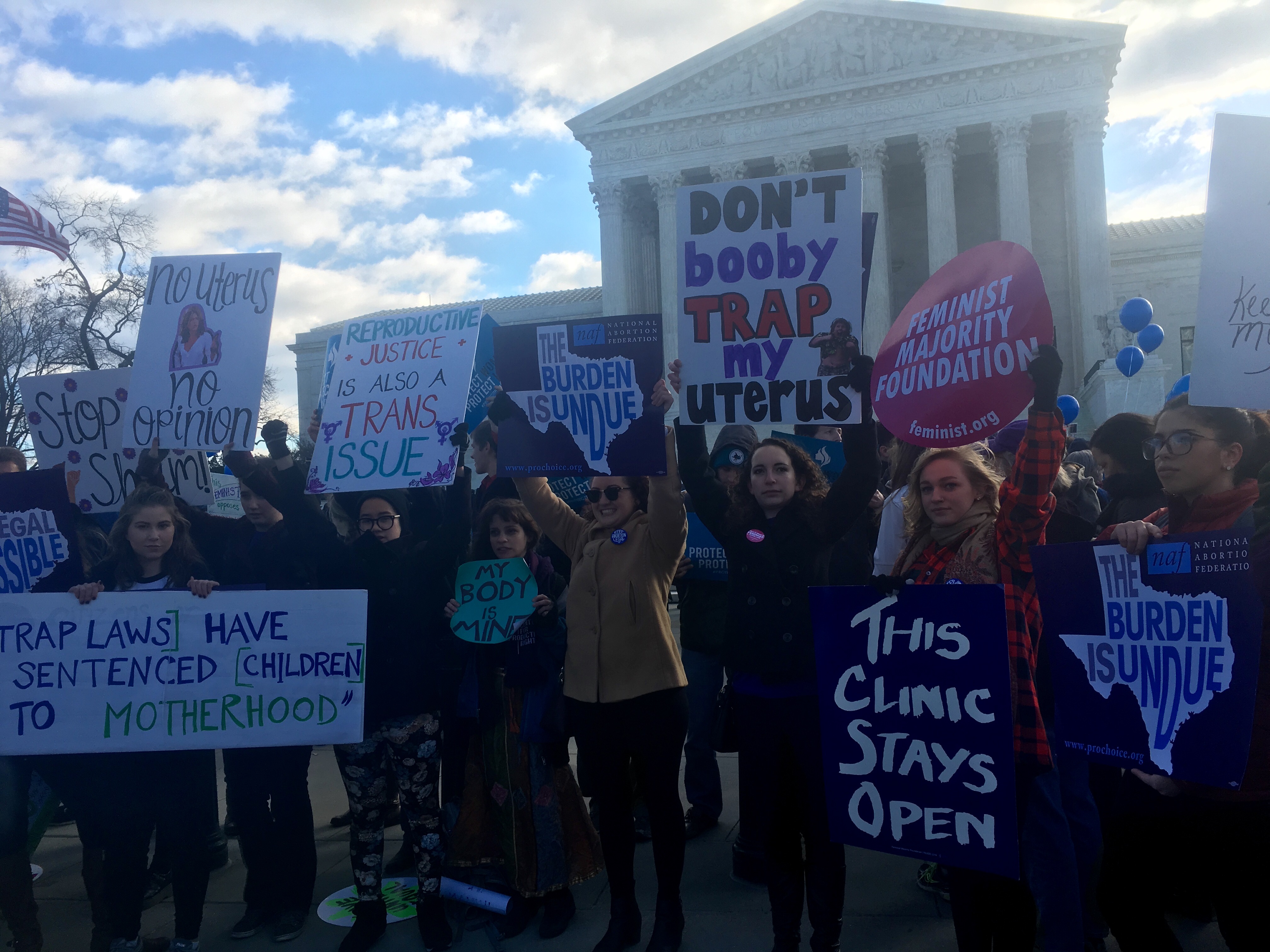
At least two thousand pro-abortion rights activists, including Feminist Majority Foundation staff and interns, rallied outside the U.S. Supreme Court on Wednesday as justices heard arguments in Whole Woman’s Health v. Hellerstedt, a challenge to the Texas TRAP law designed to close off access to abortion.

FullSizeRender

“We are here for the women in Texas and around the country — women who are being denied their most basic rights,” said Amy Hagstrom Miller, President and CEO of Whole Woman’s Health, about the case. “Those who come to our clinics should be able to receive the care they need without worrying about clinic shutdowns or medically unnecessary obstacles. As we stand before the court, we will be side by side with every woman and family in Texas and this entire nation.” The Feminist Majority Foundation honored Hagstrom Miller with the Courage Award this past November.

More than fifty leaders in the reproductive health, rights, and justice movements spoke while oral arguments took place. Each approached the issue through their own personal perspective, reflecting on how religion, racial justice, and gender identity intersect in the movement for abortion access.

The case before the Court challenges the Texas law known as HB2, which requires abortion clinics to become ambulatory surgical centers and for physicians providing abortions to obtain local hospital admitting privileges, has already shuttered half of the abortion clinics in the state. The law threatens to close more than 75% of abortion clinics in the state and deny millions of women access to safe, legal abortion.

While activists came from across the country—including Texas, New York, Ohio, Pennsylvania, and North Carolina—thousands of others who could not attend in person rallied online using the hashtag #StopTheSham.

A decision is expected from the Court in mid-June.

Miss it? Here’s a livestream of the rally.

House Democrats Denounce Rep Blackburn’s Unilateral Use of Subpoenas Targeting Healthcare Providers

The six Democratic Members of the House Select Investigative Panel sent a letter to Chair Marsha Blackburn (R-TN) on Friday objecting to the Chair’s “abusive and unjustifiable” use of her subpoena authority – done over the objection of Ranking Member Jan Schakowsky (D-IL) and without a vote – to force healthcare providers and others to disclose the names of doctors, medical students, and clinic personnel.

In their letter, the Democratic Members of the Panel explain that they have “repeatedly” asked Blackburn “not to seek this type of personally identifiable information and to put in place clear rules that would govern the Panel’s handling of any sensitive information that it receives.” According to Schakowsky, Blackburn’s subpoenas, and the Panel’s lack of safeguards for sensitive information, is “dangerous and could put people’s lives at risk.”

Indeed, the letter references the shooting at an abortion clinic in Colorado Springs last November by an anti-abortion extremist that resulted in the death of three people, as well as the December 2015 indictment of another extremist who offered cash in exchange for the death of a healthcare provider. “It is appalling that, in this atmosphere, you have elected to use your unilateral subpoena authority in a manner that may increase the risk for healthcare providers, clinic personnel, medical students, and researchers,” the Members wrote.

Despite these safety concerns, Blackburn issued three subpoenas on Tuesday to Stem Express, the University of New Mexico, and Southwestern Women’s Options. These subpoenas are just the latest in the Panel’s broad investigation that has already resulted in document requests to more than 30 organizations, including abortion providers and research institutions.

The House Panel was created in the aftermath of highly-edited, deceptive videos created and released by the anti-abortion group Center for Medical Progress (CMP). The videos falsely accused Planned Parenthood of illegally selling fetal tissue. To date, federal and state-level investigations in 12 states have turned up zero evidence of wrongdoing on the part of Planned Parenthood, and eight states have refused to investigate citing a lack of evidence of any wrongdoing. CMP’s  malicious videos have been debunked repeatedly, and CMP leader David Daleiden and a CMP employee were themselves recently indicted on felony criminal charges related to their fraudulent activities.

After months of relative silence, the Panel’s first hearing is scheduled for early March. The Panel has, so far, not been willing to investigate CMP leaders or other anti-abortion extremists. With attacks on abortion providers rising, the Feminist Majority Foundation launched a campaign calling on the Select Investigative Panel to redirect its focus to anti-abortion violence, intimidation, and harassment, or to disband.

Judge Orders Anti-Abortion Group to Cease Release of Secretly Recorded NAF Meetings

In a victory for abortion providers under attack from anti-abortion extremist group Center for Medical Progress (CMP), a United States District Court judge issued a preliminary injunction ordering CMP, Biomax Procurement Services, CMP leader David Daleiden, and Troy Newman, president of Operation Rescue and founding board member of CMP, to halt the release of several surreptitiously-recorded videos filmed illegally at National Abortion Federation (NAF) meetings.

On Friday, after studying over 500 hours of illegally obtained “secret” video footage, Judge William H. Orrick ruled NAF was not in violation of any laws, determining no evidence existed suggesting that any of its members “engag[ed] in, agreed to engage in, or expressed interest in engaging in potentially illegal sale of fetal tissue for profit.” Orrick also rejected claims made by CMP that David Daleiden and his associates should be protected as investigative journalists. Instead, Judge Orrick described CMP’s exploits not as “pieces of journalistic integrity,” but as “misleadingly edited videos and unfounded assertions.”

In his order, Judge Orrick noted that the “documented, dramatic increase in the volume and extent of threats to and harassment of NAF and its members” since the release of the first set of CMP videos was “critical” to his decision to grant the preliminary injunction which will remain in place until the conclusion of the trial.

“There’s no denying that the fraudulent campaign launched by the defendants has put abortion providers at risk,” said NAF President & CEO Vicki Saporta in response the court’s ruling. “We are very grateful that the judge granted this preliminary injunction, which will help protect the safety and security of our members.”

Prevented from releasing any further videos of abortion providers at NAF meetings, CMP yesterday turned its attention to Saporta herself, releasing a new deceptively-edited video recording featuring Saporta accepting an award at an ACLU ceremony. That footage was spliced with other footage of former NAF staff taken at a reproductive health conference.

Just two weeks ago, a grand jury in Houston, Texas indicted David Daleiden and his CMP colleague Sandra Merritt on felony criminal charges related to their CMP activities. Both Daleiden and Merrit turned themselves in to authorities last week and are out on bail. Their attorneys have told reporters that the pair plan to plead not guilty. They will next appear in court in Houston on March 28.

In its malicious videos, CMP makes the false claim that abortion providers illegally sold fetal tissue. This claim has been widely debunked, with numerous Congressional and state investigations finding no evidence of any wrongdoing. Despite these facts, a Select Investigative Panel has been formed in the Energy and Commerce Committee of the House of Representatives to investigate “big abortion providers.” The Panel has, so far, not been willing to investigate CMP leaders or other anti-abortion extremists, something advocates find unacceptable as abortion providers have faced increased levels of threats, intimidation and harassment.

In December, the Feminist Majority Foundation launched an ongoing campaign calling on the House Select Investigative Panel to redirect its focus to anti-abortion violence, or to disband.

US Military Generals Support Women’s Inclusion in the Draft

Just one month since opening combat roles to women, top US military officials have stated support for women’s inclusion in the draft.

At a Senate Armed Services Committee hearing last week, Army Chief of Staff General Mark A. Milley and Marine Corps Commandant General Robert B. Neller supported women’s incorporation into the Selective Service System, a mechanism that currently requires almost all male US citizens, no matter where they live, and most male immigrants living in the United States, to register to serve in the Armed Forces, or in an Alternative Service program, in the event of a national emergency.

Senator Claire McCaskill (D-MO) asked the military leaders whether Congress should look at opening up the Selective Service System to women. General Neller told the Senator it was his “personal view” that “every American who’s physically qualified should register for the draft.” After the hearing, Neller added, “It doesn’t mean you’re going to serve, but you go register.”

Notably, the United States has not operated a draft since 1973. The current US military service is an all-volunteer force, in which over 200,000 active-duty women serve. Even though a military draft has not operated for more than four decades, federal law still requires almost all men between 18-25 years old to register for the Selective Service.

Women have never been required to register for the Selective Service. In 1981, the Supreme Court ruled that excluding women from registration was constitutional, in part because women were excluded from combat roles and the purpose of registration was to prepare for a draft of  combat troops. Now that women can serve in combat roles, women’s participation in the the Selective Service is once again in question.

Defense Secretary Ash Carter announced in December that the services would have until April 1 to integrate women into all roles. At the hearing, however, military leaders said that fully integrating women into combat jobs could take up to three years.

Zika Virus Raises Need for Increased Access to Reproductive Healthcare

As the Zika virus spreads, at least five countries have advised women to delay pregnancy, advice that many women’s rights advocates have criticized as unrealistic and offensive given restrictive abortion laws and the inaccessibility of birth control in many of the affected areas.

The Zika virus, which is typically transmitted through mosquito bites, has been linked to poor pregnancy outcomes, including microcephaly, a condition where the brain does not develop properly causing a newborn’s head to be smaller than expected. Microcephaly is linked to severe physical and intellectual developmental delays.

Officials in Colombia recently advised women to delay pregnancy for six to eight months. In Jamaica, the Health Ministry advised waiting up to a year. El Salvador recommended postponing pregnancy for two years, and officials in Brazil and Ecuador advised women in those countries to delay pregnancy indefinitely.

Monica Roa, programs director of Women’s Link Worldwide, called the recommendations “naïve and ineffective.” In an interview with NPR, Roa explained that more than 50 percent of pregnancies in Latin America are unplanned and that the recommendations “fail to take into account the prevalence of rape and sexual violence in the region.” Roa also noted that many women lack information about and access to birth control and abortion, even in countries where these services are legal.

In countries where abortion is illegal, recommendations to postpone pregnancy to deal with a global health emergency are particularly questionable. “To prevent pregnancies in situations of risk, this isn’t a bad option, but it’s not enough,” said Morena Herrera, president of the Citizen’s Group for the Decriminalization of Abortion in El Salvador. “We don’t think it is taking into account the realities of the women in El Salvador.”

Abortion in El Salvador is illegal, with no exceptions for rape, incest, severe fetal anomalies, or to save a woman’s life, forcing women to seek out potentially dangerous illegal abortions. According to the World Health Organization (WHO), more than 35,000 women in El Salvador obtain unsafe abortions each year. Restrictive laws have even made women in El Salvador subject to prison for up to 50 years for miscarrying or for stillbirth. Between 2000 and 2011 alone, 129 Salvadoran women faced prosecution for “abortion” crimes, including 23 convictions for undergoing an illegal abortion and 26 found guilty of homicide.

The United Nations High Commissioner for Human Rights, Zeid Ra’ad Al Hussein, has urged countries affected by Zika to ensure that women have access to sexual and reproductive health counseling and that responses respect women’s human rights.

“In situations where sexual violence is rampant, and sexual and reproductive health services are criminalized, or simply unavailable, efforts to halt this crisis will not be enhanced by placing the focus on advising women and girls not to become pregnant,” said Al Hussein. “Many of the key issues revolve around men’s failure to uphold the rights of women and girls, and a range of strong measures need to be taken to tackle these underlying problems.”

For now, charitable organizations like Women on Waves, a floating women’s reproductive health clinic providing contraception and medical abortions to women in underserved countries, hope to stem the spread of the virus by offering free medical abortions for women in Zika-infected areas who are less than nine weeks pregnant.

The World Health Organization has not endorsed delaying pregnancy as a means of controlling the Zika virus.  Instead, WHO has called for a preventive response that focuses on preventing transmission through the control of mosquito populations and the prevention of bites.

US Signs Controversial Trans-Pacific Partnership Agreement

United States Trade Representative Michael Froman signed the Trans-Pacific Partnership today in New Zealand, formally ending negotiations on the trade deal. The Obama Administration can now submit the agreement to the U.S. Senate and House of Representatives for approval.

The Trans-Pacific Partnership (TPP) is a sweeping trade agreement among 12 countries that will impact a startling 40 percent of the world’s economy. It addresses a broad range of issues, including trade in goods and services, food safety, regulation of intellectual property and foreign investments, Internet access, as well as labor and environmental regulations.

Activists, including the Feminist Majority, and have heavily criticized the TPP, which was negotiated in near-secrecy, on a number of issues, including the likelihood that the agreement will offshore US jobs and depress US wages. The agreement also threatens US environmental regulations and access to low-cost generic drugs, while creating unaccountable private international tribunals where corporations can challenge US policies and regulations.

In June – despite opposition from over 2,000 organizations representing labor, environmental, farming, civil rights, digital rights, human rights, public health, faith, student, consumer, and other concerns – Congress granted President Obama trade promotion authority, better known as “Fast Track.” This authority allows Obama to present the TPP for an up-or-down vote in Congress, at any time, prohibiting amendments or filibusters. “Fast Track” mandates that once the President submits the deal to Congress, the House and Senate must vote on it within 90 days. Fast Track also limits debate to 20 hours.

Congressional leaders have already called on Congress to reject the agreement. In a press release issued even before the agreement was signed, Congresswoman Rosa DeLauro (D-CT) stated that the “TPP is too dangerous for us simply to stand aside and let it pass.” She continued, “When the jobs and wages of working families are jeopardized by a bad trade agreement, we risk engaging in a global ‘race to the bottom’ that our country cannot afford, and that our middle class does not deserve.”

Fast Track also prevents Congress from having input into U.S. trading partners, a big concern since among the countries included in the TPP is oil-rich Brunei, a country that adopted a vicious new penal code last year that threatens the rights and lives of women, lesbians, and gay men, as well as other countries with questionable human rights records.

According to Congresswoman Louise Slaughter (D-NY), the TPP will not only “ship more American jobs overseas [and] lower wages here at home,” it will “force us to do business with notorious human rights violators such as Malaysia, a country with one of the most egregious records of human trafficking.” Slaughter vowed “to use every tool at our disposal to stand up for the American worker and oppose the TPP.”

House Fails to Override Veto of Measure to Defund Planned Parenthood and Repeal Affordable Care Act

The House of Representatives failed to gather enough votes yesterday to override President Obama’s veto of a measure that would have defunded Planned Parenthood for one year and repealed key provisions in the Affordable Care Act. The 241-186 vote fell short of the two-thirds majority needed to override.

Obama vetoed the measure last month. The House passed the anti-women’s health measure only after it was pushed through the Senate late last year using a legislative strategy called reconciliation, which allowed the bill to pass with a simple majority. To date, Republicans have attempted to repeal or undermine the ACA 63 times. Yesterday’s vote was also the 12th time anti-women’s health politicians have tried to defund Planned Parenthood during this Congress.

This latest attempt by the House to defund Planned Parenthood comes only a week after a grand jury in Houston, Texas indicted anti-abortion extremist David Daleiden on felony criminal charges related to his activities as director of the so-called Center for Medical Progress (CMP). Sandra Merritt, a CMP employee was also indicted on a felony charge. Last year, CMP released a series of misleading videos falsely accusing Planned Parenthood of illegally selling fetal tissue. These videos have been used by anti-abortion politicians to justify political attacks on Planned Parenthood even though the videos have been thoroughly debunked and investigations in 12 states have found no evidence of wrongdoing by Planned Parenthood.

Despite these many investigations, a Select Investigative Panel has been formed in the House Energy and Commerce Committee to investigate “big abortion providers.” The Panel has, so far, not been willing to investigate CMP leaders or other anti-abortion extremists, even after the indictment of Daleiden and Merritt. Targeted threats and intimidation of abortion providers has also increased, nearly doubling over four years, according to the Feminist Majority Foundation’s National Clinic Violence Survey.

The Feminist Majority Foundation has an ongoing campaign calling on the House Select Investigative Panel to redirect its focus to anti-abortion violence, intimidation, and harassment, or to disband.

USAID Promote Program Graduates First Afghan Women Leaders

Afghan First Lady Rula Ghani delivered a commencement address in Kabul earlier this month to the first Afghan women graduates from the United States Agency for International Development (USAID) Women’s Leadership Development program.

The Women’s Leadership Development Program is one component of USAID’s ambitious Promote program, the largest women’s empowerment program in the world. Promote launched the Women’s Leadership Development Program in July 2015 with a ceremony at Kabul University attended by US and Afghan government representatives, university students, and women’s rights leaders. So far, 689 Afghan women leaders have completed the program.

Graduates created an implemented a variety of projects, ranging from public education campaigns on gender-based violence to the development of home-based businesses. The purpose of these projects, according to USAID, is to create a “multiplier effect,” where those touched by the projects will in turn pass on the lessons to other Afghan women.

The skills learned were both practical and, for some, transformational. “We learned so much,” explained one graduate. “I used to be so quiet and so scared but now I know that I can help myself and my family while helping others and the entire country.”

The First Lady congratulated participants on all they had learned and implored them “to get to work.” She continued, “the ultimate goal should always be to rebuild this beautiful country of ours into a harmonious and prosperous country where both men and women can live a happy and fulfilling life.”

USAID announced Promote in the fall of 2014. A five-year program, Promote will invest up to $416 million into the education, training, and promotion of Afghan women in civil society, government, and business. The program is geared to Afghan women between the ages of 18 and 30 who have had secondary education, and focuses on four areas: leadership training; increasing representation of women in decision-making roles within the government; women’s inclusion in the workplace, particularly in technology, finance, and administration; and strengthening the capacity of women’s rights groups and networks.

White House Announces New Measures to Further Equal Pay

President Obama, on Friday, announced new steps his Administration is taking to help close the gender-race pay gap.

Announced during the commemoration of the 7th anniversary of the Lilly Ledbetter Fair Pay Act, President Obama has empowered the Equal Employment Opportunity Commission (EEOC), in coordination with the Department of Labor, to collect pay data sorted by gender, race, and ethnicity from businesses with 100 or more employees. The data collection, which will occur annually, covers over 63 million employees and will provide more concrete information on pay discrimination across industries and occupations. Unlike previous data collection proposals, this new action will include information on benefits and retirement packages, and not simply wage information, providing a more comprehensive picture of the gender-race pay gap.

The Administration proposes to collect the data through a mechanism that already exists. Under the proposal, no specific salary information on any individual employee would be collected. Instead, employers will have to provide summary data. The Administration says data collection will encourage greater voluntary compliance with equal pay laws, but it will also help the EEOC and the Office of Federal Contract Compliance Programs (OFCCP) identify and focus their investigations on employers who flout the laws.

The White House Council of Economic Advisors issued a report on Friday, The Gender Pay Gap on the Anniversary of the Lilly Ledbetter Fair Pay Act, detailing the progress of equal pay initiatives since 2009. According to the report, the gender wage gap in the US is larger, on average, than other industrialized nations – by 2.5 percentage points.

In his remarks, President Obama acknowledged that progress on equal pay has been slow and that more action was necessary to support today’s workers, including paid sick days, paid family and medical leave, and an increase in the minimum wage. He also called on Congress, once again, to pass the Paycheck Fairness Act.

The Administration also revealed plans to host a May 23rd summit in partnership with the Department of State, the Department of Labor, the Aspen Institute, and Civic Nation called “The United State of Women.” Bringing together a diverse group of business leaders, academics, and activists, the summit will examine key areas of impact affecting women and girls including educational opportunity, violence against women, and economic prosperity.

Overall, women earn just 79 cents for every dollar earned by men. But it’s women of color who suffer the most, with African-American women and Latinas earning a mere 60 cents and 55 cents respectively for every dollar earned by men. Moreover, studies show women also take on more than half of unpaid work, spending more than twice as time as men cleaning house and caring for children. Over time, this disparity leads to wider gaps in educational and occupational opportunities between women and men, destabilizing women’s economic futures.

Obama Administration Announces Plan to Expand Lunch Program to Feed Children in Need

In an effort to address child hunger and food insecurity in the United States, the Obama Administration announced the launch of a pilot program that certifies students eligible for free or reduced-price in-school lunches automatically if their families’ collect Medicaid benefits.

According to the United States Department of Agriculture (USDA), millions of children whose families qualify for Medicaid are not enrolled in the National School Lunch Program (NSLP), which provides free and reduced-price in-school meals to children from low-income families. By certifying children whose families collect Medicaid benefits automatically, the burdensome application process imposed upon already-qualifying families in need—and upon schools to participate in the program—is removed, making it easier for hungry children to access food.

The program, which enjoyed a small-scale test drive in seven locations around the country, has already garnered positive results. Test site New York City, for example, experienced a 7 percent boost in enrollment, an increase Agriculture Secretary Tom Vilsack predicts will only continue to rise. “That’s just free lunches,” said Vilsack. “The new expanded program is going to include reduced-price lunches, too, so we know that that 7 percent number is only going to go up.” Citing success stories like New York City, Vilsack hopes to extend the program to five states next school year, building to 20 states the year after, and eventually expanding nationwide.

With 15.3 million children facing hunger in the US and more than 21.5 million low-income children receiving free or reduced-price lunches in 2014 alone, the need for an initiative like the Obama administration announced Wednesday could not be more critical.

“We know that the program works, and we want to expand it,” said Vilsack. “Many children who are eligible for free and reduced lunch meals aren’t enrolled in the program – this is going to help ensure that they receive the benefits, too.”

Taiwan Elects First Woman President

In a landslide victory, the leader of Taiwan’s Democratic Progressive Party (DPP) Tsai Ing-wen won the country’s presidential election, becoming the first woman in Taiwan’s history to hold the position.

Emphasizing her party’s commitment to maintaining Taiwan’s independence from China, Tsai won over young voters eager to usher in a political changing of the guard following some 70 years of dominance by the pro-Chinese unification party, the Kuomintang (KMT), chaired by presidential opponent Eric Chu. In her victory speech, Tsai hailed a “new era” in Taiwan, vowing to cooperate with other political parties to resolve major issues and follow the will of the people regarding the sovereign nation’s relationship with China. “I also want to emphasize that both sides of the Taiwanese Strait have a responsibility,” said Tsai, “to find mutually acceptable means of interaction that are based on dignity and reciprocity.”

A scholar with advanced degrees in law from Cornell University and the London School of Economics, Tsai served previously as chairwoman of the Mainland Affairs Office, a government office that mediates interactions between Taiwan and Beijing. In 2004, Tsai joined the DPP, stepping in as the party’s chairwoman just four years later. Despite a failed presidential bid in 2012, Tsai persevered, guiding her party to victories in regional elections. Tsai also emerged as a vocal advocate of women’s and LGBT rights, advocating publicly for equal employment opportunities for women and marriage equality, respectively.

For now, Tsai has pledged to not only work to establish Taiwan’s unique identity independent of mainland China, but also to address Taiwan’s flagging economy, low wages and deepening income inequality once she is inaugurated in May.

“The results today tell me the people want to see a government that is willing to listen to people, that is more transparent and accountable,” Tsai told reporters following her declaration of victory, “and a government that is more capable of leading us past our current challenges and taking care of those in need.”

Media Resources: CNN 1/18/16; BBC  1/17/16; New York Times 1/16/16

>